Search results
Search for "triazoles" in Full Text gives 155 result(s) in Beilstein Journal of Organic Chemistry.
Recent advances in copper-catalyzed direct hydroamination of alkenes with (hetero)aromatic amines
Beilstein J. Org. Chem. 2026, 22, 925–947, doi:10.3762/bjoc.22.73
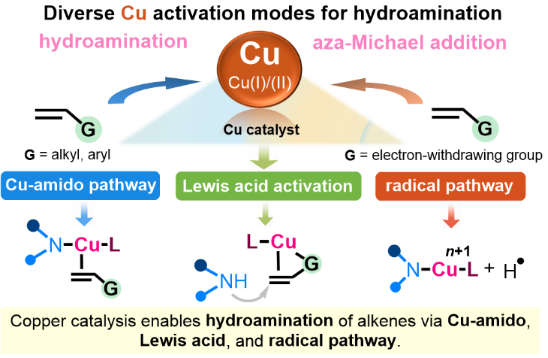
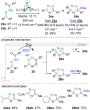
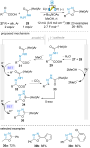
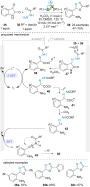
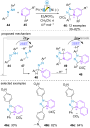
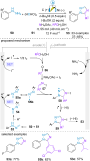
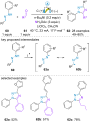
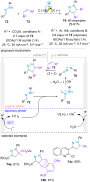
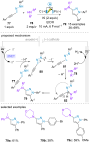
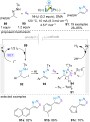
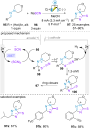
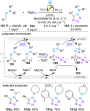
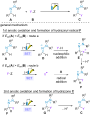
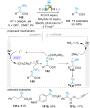
- toluene at 80 °C, enabling the direct addition of various nitrogen nucleophiles to nitrostyrene derivatives 37 with excellent anti-Markovnikov selectivity. Under the optimized conditions, various arylamines and N-heterocycles, including imidazoles, benzimidazoles, pyrazoles, and triazoles, underwent


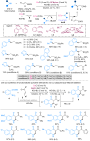





Design, synthesis, and biological evaluation of FXR/ASK1 dual-target modulators
Beilstein J. Org. Chem. 2026, 22, 771–781, doi:10.3762/bjoc.22.59
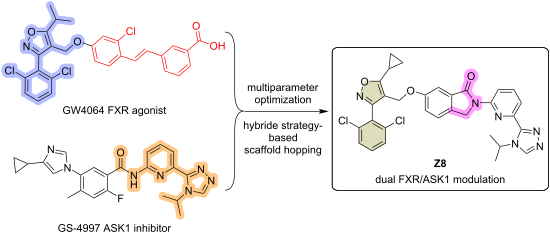
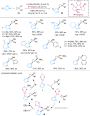
- afford triazoles IXa,c,d or, in case of product IXb with (R)-alanine methyl ester. The absolute stereochemistry of IXb is R. All compounds with defined absolute configuration described below were synthesized from IXb, thereby preserving the absolute stereochemistry and affording the corresponding R


Molecular tweezer–peptide conjugates disrupt the protein–protein interaction between survivin and histone H3 essential in mitosis
Beilstein J. Org. Chem. 2026, 22, 557–567, doi:10.3762/bjoc.22.41
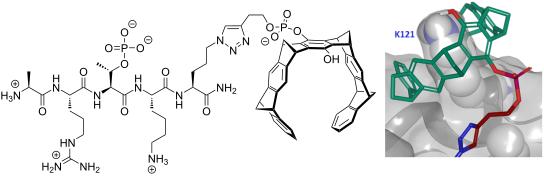
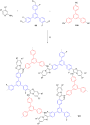
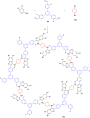
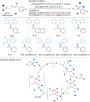
- ) Peptide tweezer conjugates 1 and 2a with triazoles linking the tweezer and H3 peptide at its C-terminus. Note that both azidopropylamine as well as azidoornithine establish almost the same distance between peptide and tweezer. In addition, they place the tweezer into the vicinity of the phosphorylated




Experimental and DFT studies on the regioselective methanolysis of 5-azido-9-oxabicyclo[6.1.0]nonan-4-yl 4-nitrobenzoate isomers
Beilstein J. Org. Chem. 2026, 22, 547–556, doi:10.3762/bjoc.22.40
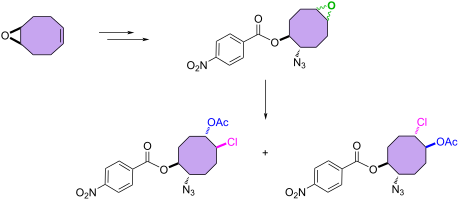
- triazoles and aminocyclitols, which have numerous applications in industry, medicine, and pharmacy [1][2][3][4][5]. They are found in many biologically active compounds. For example, 3’-azido-3’-deoxythymidine (zidovudine, 1) is used in treatment of AIDS, while azapride (2), azidamphenicol (3), and


Recent advances in the stereoselective synthesis of distal biaxially chiral molecules
Beilstein J. Org. Chem. 2026, 22, 461–479, doi:10.3762/bjoc.22.34
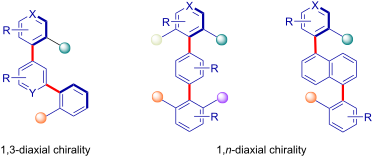
- atropisomeric (hetero)biaryls (Scheme 17) [56]. This highly enantioselective C–H arylation of heteroarenes employs a Pd(0) complex with H8-BINAPO L8 as the chiral ligand, enabling the arylation of 1,2,3-triazoles and pyrazoles in excellent yields with great selectivity. This method also facilitates


Cone p-aminocalix[4]arenes enriched with ‘clickable’ alkyne or azide functionalities
Beilstein J. Org. Chem. 2026, 22, 399–415, doi:10.3762/bjoc.22.28
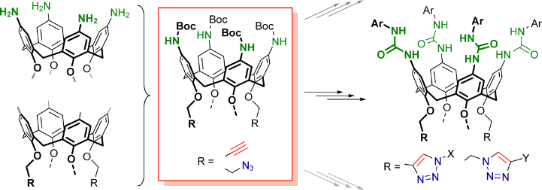
- virtually any functional units attached to them via triazole groups. Keywords: calixarene amines; dimeric capsules; functionalization; tetraureacalixarenes; triazoles; Introduction Considered generally as multifunctional molecular cores, calixarenes in their native forms as cyclic oligophenols actually
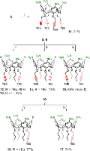
- the macrocycles. Some transformations of propargylated/2-azidoethylated p-aminocalix[4]arenes To evaluate the synthetic potential of the obtained heterobifunctionalized calix[4]arenes, they were subjected to three-step chemical transformations, including the synthesis of triazoles under CuAAC






Synthesis of tricyclic fused pyrrolidine nitroxides from 2-alkynylpyrrolidine-1-oxyls
Beilstein J. Org. Chem. 2026, 22, 344–351, doi:10.3762/bjoc.22.22

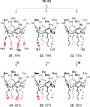
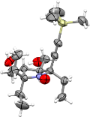
- triazoles to occur [25]. However, there are also examples where the corresponding triazoles were isolated instead of 5-azidopentyne derivatives under the same conditions (DMF, 80 °C) [26]. The nitroxides 3a–f were treated with excess of NaN3 in milder conditions, in DMSO at 60 °C, and a single product was




Pentacyclic aromatic heterocycles from Pd-catalyzed annulation of 1,5-diaryl-1,2,3-triazoles
Beilstein J. Org. Chem. 2025, 21, 2524–2534, doi:10.3762/bjoc.21.194
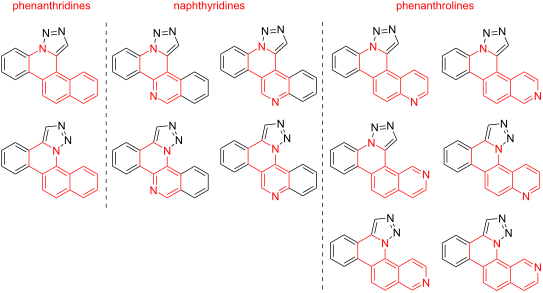
- phenanthridines, naphthyridines, and phenanthrolines were prepared via Pd-catalyzed annulation of 1,5-diaryl-1,2,3-triazoles. Analogs with triazole N1-connected ortho-bromobenzene subunits successfully underwent annulation under microwave irradiation in yields of 31–90%. In contrast, annulations of triazole C1
- ][21], and materials [22][23][24]. Numerous examples of 1,4-diaryl-1,2,3-triazoles with quinoline and isoquinoline subunits have been reported, including those with anticancer [25][26][27][28][29], antiviral [30][31], antibacterial [32], antifungal [33], antimalarial [34][35], antitubercular [36], and
- other bioactive properties [37][38][39][40][41][42][43][44]. In contrast, examples of 1,5-diaryl-1,2,3-triazoles with quinoline or isoquinoline subunits are lacking [45]. The neighboring proximity of the arene subunits in such 1,5-regioisomers allows for potential intramolecular annulation to form


Effect of a photoswitchable rotaxane on membrane permeabilization across lipid compositions
Beilstein J. Org. Chem. 2025, 21, 2498–2512, doi:10.3762/bjoc.21.192
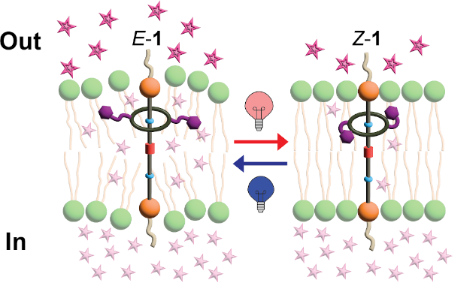
- nm resulted in slightly higher dye release compared to 370 nm, accompanied by similar changes in absorption spectra (Figure 7c and 7d). The most likely photoactive unit in axle 3 is the triazolium group. However, triazoles typically absorb in the 200–220 nm region (π→π* transitions) [21], and only




Research towards selective inhibition of the CLK3 kinase
Beilstein J. Org. Chem. 2025, 21, 2250–2259, doi:10.3762/bjoc.21.172
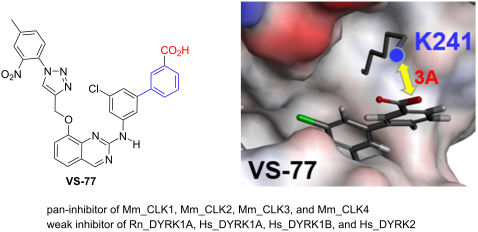
- VS-77 which has now a significant affinity toward CLK3 (IC50 = 0.3 μM). Thus, VS-77 appears as a new pan-inhibitor of the CLK family. Keywords: cancer; CLK3; kinases; molecular modelling; quinazolines; triazoles; Introduction Human protein kinases are a family comprising nearly 535


Electrochemical cyclization of alkynes to construct five-membered nitrogen-heterocyclic rings
Beilstein J. Org. Chem. 2025, 21, 2173–2201, doi:10.3762/bjoc.21.166
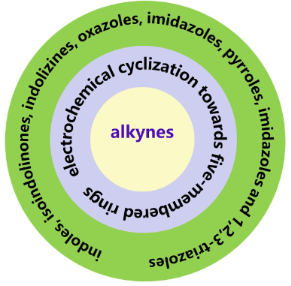
- alkynes, amines and azides, respectively. Imidazopyridines could be obtained by electrochemical [3 + 2] cyclization of heteroarylamines. The electrochemical oxidative [3 + 2] cycloaddition of secondary propargyl alcohols was a simple and efficient access towards 1,2,3-triazoles. In this review
- reactions of alkynes towards five-membered rings are classified and presented in detail. Based on different types of five-membered rings, electrochemical construction of indoles, isoindolinones, indolizines, oxazoles, imidazoles, pyrroles, imidazoles and 1,2,3-triazoles are summarized and the possible
- imidazoles, (d) construction of pyrroles, imidazoles and 1,2,3-triazoles. Literature on the electrochemical formation of five-membered rings from alkynes in this review was collected up to June 2025. We apologize to the authors if their contributions were not involved here due to the limitations of the



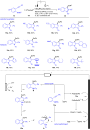


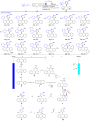


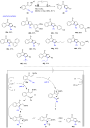


Switchable pathways of multicomponent heterocyclizations of 5-amino-1,2,4-triazoles with salicylaldehydes and pyruvic acid
Beilstein J. Org. Chem. 2025, 21, 2030–2035, doi:10.3762/bjoc.21.158
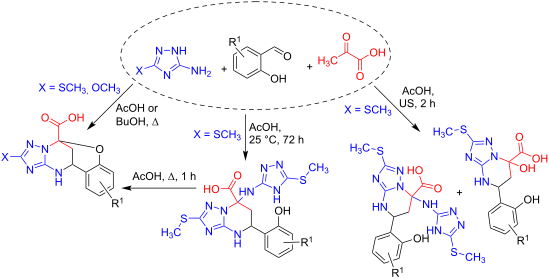
- -triazoles, pyruvic acid, and salicylaldehydes were studied under different conditions. Upon conventional heating, benzotriazolooxadiazocine-5-carboxylic acids were formed in the three-component reactions as single reaction products. Upon ultrasonic activation or mechanical stirring at room temperature, the
- -1,2,4-triazoles, is important because the formation of different chemotypes of final heterocyclic compounds are possible depending on the structure of the reagents, the solvents and the catalysts, and type of activation methods [7][8][9]. MCRs of aminotriazoles, methylene-active compounds, and
- substituted salicylaldehydes are particularly interesting because of the possibility of additional reactions and post-cyclizations involving the o-hydroxy group. It was demonstrated [10][11][12] that the multicomponent reaction of substituted 3-amino-1,2,4-triazoles, various salicylaldehydes, and acetone


Photoswitches beyond azobenzene: a beginner’s guide
Beilstein J. Org. Chem. 2025, 21, 1808–1853, doi:10.3762/bjoc.21.143
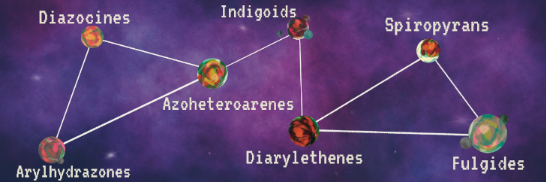
- -triazoles 28 can be obtained by click chemistry (Scheme 6B) via one-pot deprotection of 26 and Cu(I)-catalysed reaction with an azide [43][44]. Heteroarylimines 31a,b can be easily obtained by condensation of a (hetero)aromatic aldehyde 30a,b with a (hetero)aromatic amine 29a,b [36][37][38] (Scheme 7). The




Azide–alkyne cycloaddition (click) reaction in biomass-derived solvent CyreneTM under one-pot conditions
Beilstein J. Org. Chem. 2025, 21, 1544–1551, doi:10.3762/bjoc.21.117
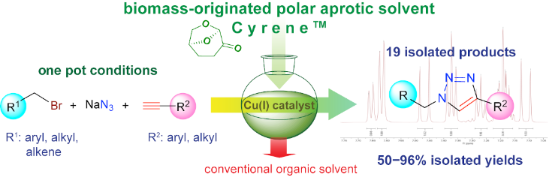
- CyreneTM, as a biomass-originated polar aprotic solvent, could be utilized as an alternative reaction medium for one-pot copper(I)-catalyzed azide–alkyne cycloaddition (click or CuAAC) reactions, for the synthesis of various 1,2,3-triazoles under mild conditions. Nineteen products involving N-substituted-4
- -phenyl-1H-1,2,3- and 1-allyl-4-substituted-1H-1,2,3-triazoles were synthesized under one-pot conditions and isolated with good to excellent yields (50–96%) and purity (>98%). The observed results represent an example that proves that biomass-derived safer solvents can be introduced into a synthetically
- important transformation exhibiting higher chemical and environmental safety. Keywords: alternative solvent; click chemistry; cycloaddition; CyreneTM; 1,2,3-triazoles; Introduction In the past few decades, transition-metal-catalyzed coupling and addition reactions have represented one of the most powerful


Copper catalysis: a constantly evolving field
Beilstein J. Org. Chem. 2025, 21, 1477–1479, doi:10.3762/bjoc.21.109
- , Burley, Watson, and co-workers present a new synthesis of germyl triazoles from germyl alkynes through a copper-catalyzed azide–alkyne cycloaddition (CuAAC) reaction [6]. The resulting Ge-substituted triazoles could be further diversified. For example, through chemoselective transition-metal-catalyzed
Reactions of acryl thioamides with iminoiodinanes as a one-step synthesis of N-sulfonyl-2,3-dihydro-1,2-thiazoles
Beilstein J. Org. Chem. 2025, 21, 1397–1403, doi:10.3762/bjoc.21.104
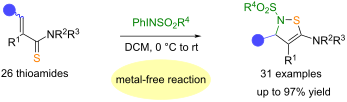
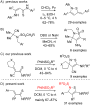
- strong bases in acetonitrile (Scheme 1B) [17]. Very recently, our group reported the synthesis of spirocyclic 2,3-dihydro-1,2-triazoles by the reaction of thioamides containing a cycloalkylidene fragment with N-tosyl and N-mesyliminoiodinanes (Scheme 1C) [18]. In the present work, an effective method for



Cu(OTf)2-catalyzed multicomponent reactions
Beilstein J. Org. Chem. 2025, 21, 122–145, doi:10.3762/bjoc.21.7

- other hand, 4-(α-tetrasubstituted)alkyl-1,2,3-triazoles 45 can be obtained by a two-step reaction of cyclohexanone, amines, silylacetylene, and aryl or alkyl azides in the presence of copper(II) catalysts (Scheme 34) [53]. In a first step, there is the formation of a propargylamine derivative XLIII
- isoxazole-linked imidazo[1,2-a]azines 35. Synthesis of 2,3-dihydro-1,2,4-triazoles 36. Synthesis of naphthopyrans 37. Synthesis of benzo[g]chromene derivatives 38. Synthesis of naphthalene annulated 2-aminothiazoles 39, piperazinyl-thiazoloquinolines 40 and thiazolocoumarins 41. Synthesis of furo[3,4-b
- ]pyrazolo[4,3-f]quinolinones 42. Synthesis of spiroindoline-3,4’-pyrano[3,2-b]pyran-4-ones 43. Synthesis of N-(α-alkoxy)alkyl-1,2,3-triazoles 44. Synthesis of 4-(α-tetrasubstituted)alkyl-1,2,3-triazoles 45. Funding This work has been supported by Università degli Studi dell’Insubria and Università degli






Germanyl triazoles as a platform for CuAAC diversification and chemoselective orthogonal cross-coupling
Beilstein J. Org. Chem. 2024, 20, 3198–3204, doi:10.3762/bjoc.20.265
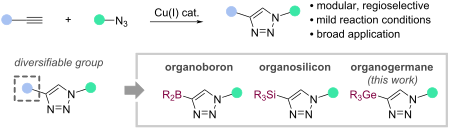
- 10.3762/bjoc.20.265 Abstract We report the synthesis of germanyl triazoles formed via a copper-catalysed azide–alkyne cycloaddition (CuAAC) of germanyl alkynes. The reaction is often high yielding, functional group tolerant, and compatible with complex molecules. The installation of the Ge moiety enables
- towards the synthesis of germanyl triazoles. These reagents are generally compatible but seem to be less reactive than other classes of alkyne. The germanyl alkyne CuAAC is applicable to functional group-rich molecules, opening opportunities for downstream diversification by chemoselective
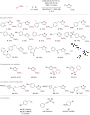
- ) Functionalisation of germylated triazoles. Isolated yields unless stated. (i) Pd(PPh3)4 (10 mol %), 2-bromothiazole (1.2 equiv), KCl (3.0 equiv), PhMe/EtOH 4:1, N2, 100 °C, 16 h. NMR yield in parentheses. (ii) Pd2(dba)3 (2.5 mol %), iodobenzene (1.5 equiv), AgBF4 (1.5 equiv), DMF, N2, 80 °C, 16 h. (iii) NBS (2.0



Synthesis of the 1,5-disubstituted tetrazole-methanesulfonylindole hybrid system via high-order multicomponent reaction
Beilstein J. Org. Chem. 2024, 20, 3077–3084, doi:10.3762/bjoc.20.256
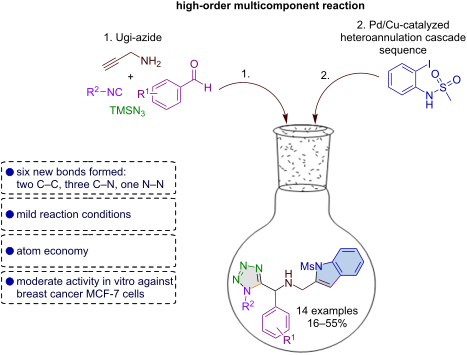
- the application of this reagent as a central building block in the synthesis of hybrid systems via Ugi-azide reactions, including structures based on triazoles-tetrazoles [24][26][27], benzofuran-tetrazoles [23] and indolizines-tetrazoles [25], all of which have significant relevance in medicinal



Recent advances in transition-metal-free arylation reactions involving hypervalent iodine salts
Beilstein J. Org. Chem. 2024, 20, 2891–2920, doi:10.3762/bjoc.20.243

- auxiliary enhanced the arylation yields. Hypervalent iodonium salts are also useful to achieve the N-arylation of azoles. Prakash and co-workers applied iodonium salts 48 in the presence of a base to obtain regioselectively the N2-arylated products of 1,2,3-triazoles via ligand exchange followed by
- reductive elimination in exceptional yields (Scheme 20) [71]. Although screening studies indicated the possibility of achieving the N-arylation at both, the N1- and N2-positions of the triazoles, N2-arylation was predominantly observed. It was incredible to achieve splendid regioselectivity without the
- usage of directing groups and any metal catalyst. Also, the electronic nature of a substituent at the C4 position of the starting triazole did not negatively impact the regioselectivity. Further, C4 and C5 disubstituted triazoles also produced the N2-arylated product. Remarkably, this is the only




Synthesis and antimycotic activity of new derivatives of imidazo[1,2-a]pyrimidines
Beilstein J. Org. Chem. 2024, 20, 2806–2817, doi:10.3762/bjoc.20.236
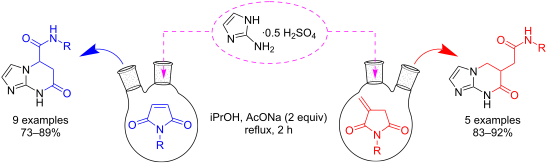
- -spectrum antifungal agents. Among the many drugs and hits, the azole-based systems (including triazoles and imidazoles) are of particular importance in this context. Their mechanism of action is the inhibition of the activity of the enzyme lanosterol 14α-demethylase (CYP51), which is encoded by the CYP51


Multicomponent syntheses of pyrazoles via (3 + 2)-cyclocondensation and (3 + 2)-cycloaddition key steps
Beilstein J. Org. Chem. 2024, 20, 2024–2077, doi:10.3762/bjoc.20.178

- Sonogashira cyclization sequence from (triisopropylsilyl)butadiyne (118). Subsequent immediate desilylation and Click reaction with organoazides lead to 4-pyrazolyl-1,2,3-triazoles 119 (Scheme 42) [139]. Notably, in some examples, it was even possible to synthesize the organoazides in situ from alkyl halides
- and cesium azide for the synthesis of compounds 120. The choice of the hydrazine substituent represents a limitation, as no aromatic substituents are tolerated in the strategy due to the reduced reactivity. However, due to the building blocks’ simplicity, various 4-pyrazolyl-1,2,3-triazoles are


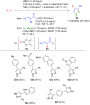


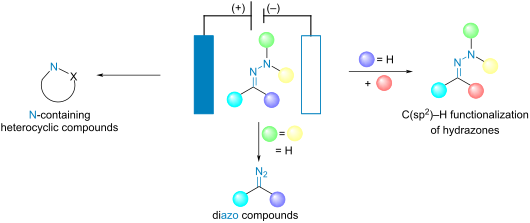
Harnessing the versatility of hydrazones through electrosynthetic oxidative transformations
Beilstein J. Org. Chem. 2024, 20, 1988–2004, doi:10.3762/bjoc.20.175
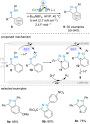
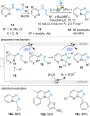
- 2018, Yuan and Yang developed a multicomponent synthesis of 1-aryl and 1,5-disubstitued 1,2,4-triazoles using tetrabutylammonium iodide as electromeditor [49]. 1-Methylene-2-arylhydrazine 52 was in situ generated through the condensation of paraformaldehyde 51 with arylhydrazines 50, while the
- atom abstraction by iodide radical and deprotonation. Inspired by these works, Li and Gu et al. proposed the electrosynthesis of 1,3,5-trisubstituted 1,2,4-triazoles from preformed aldehyde-derived N-arylhydrazones 60, aldehydes 61 and ammonium acetate. Herein, the authors suggested the electromediated
- oxidation of N-arylhydrazone by electrogenerated iodide radical (Scheme 11) [50]. In parallel, the group of Yuan achieved the electrosynthesis of 1,3,5-trisubstituted 1,2,4-triazoles 67 from arylhydrazines 64, aldehydes 65 and primary amines 66. Iodine-mediated electrooxidation of in situ-generated aldehyde









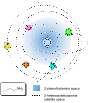
2-Heteroarylethylamines in medicinal chemistry: a review of 2-phenethylamine satellite chemical space
Beilstein J. Org. Chem. 2024, 20, 1880–1893, doi:10.3762/bjoc.20.163
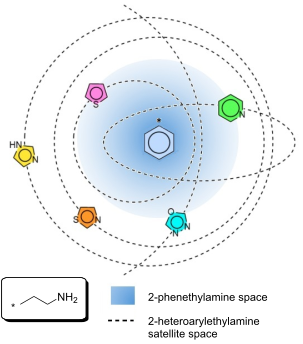
- originally synthesized by Palazzo et al. [76] and several other derivatives were developed based on ethylamine-chain homologation [77]. Triazoles: Hall and co-workers [78] developed 1,2,3-triazolyl analogues 111 of ʟ-histidine for ʟ-type amino acid transporter 1 (LAT1) activity, a sodium-independent membrane




The Groebke–Blackburn–Bienaymé reaction in its maturity: innovation and improvements since its 21st birthday (2019–2023)
Beilstein J. Org. Chem. 2024, 20, 1839–1879, doi:10.3762/bjoc.20.162