


Search results
Search for "adsorbates" in Full Text gives 122 result(s) in Beilstein Journal of Nanotechnology.
Molecular assemblies on surfaces: towards physical and electronic decoupling of organic molecules
Beilstein J. Nanotechnol. 2021, 12, 950–956, doi:10.3762/bjnano.12.71

- dielectric layers on top of the surface [34][35] or a chemical modification of the surface to saturate the dangling bonds. In surface-science-based studies, for the latter approach hydrogenation of semiconductor surfaces is frequently applied as effective passivation against chemisorption of adsorbates [36
- design often relies on non-planar adsorbates with bulky spacer groups, which can adopt various conformations. From a theoretical point of view, finding the energetically most stable conformational structure can be challenging and costly because conventional atomistic simulations are often limited to the
- substrate. Hurdax et al. reported that both charged and neutral species of sexiphenyl can co-exist on thin dielectric MgO films on Ag(100) [89]. Due to the changed work function of the substrate, charging of the adsorbates is enabled by electron tunneling. The charge transfer strongly influences the
Electromigration-induced formation of percolating adsorbate islands during condensation from the gaseous phase: a computational study
Beilstein J. Nanotechnol. 2021, 12, 694–703, doi:10.3762/bjnano.12.55
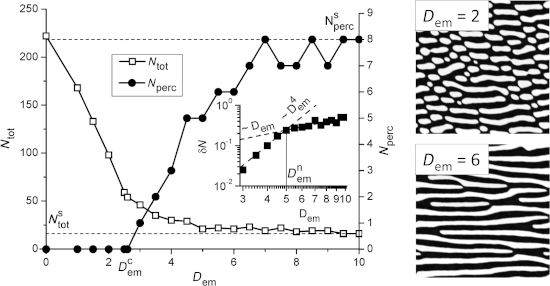
- α leads to ordering processes at α ≥ αc. At a fixed value of the adsorption coefficient α = α0 adsorbates will self-organize into surface structures if the rate of transference reactions k∥ exceeds the critical value . It is seen from Figure 2 that an increase in the values of the interaction


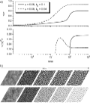


![[Graphic 29]](/bjnano/content/inline/2190-4286-12-55-i36.svg?max-width=637&scale=1.18182) on the adsorption coefficient α ...
on the adsorption coefficient α ...

Local stiffness and work function variations of hexagonal boron nitride on Cu(111)
Beilstein J. Nanotechnol. 2021, 12, 559–565, doi:10.3762/bjnano.12.46
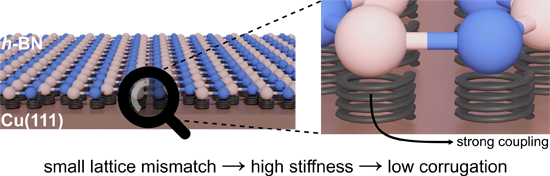
- for atomic and molecular adsorbates owing to its local electronic trapping potential due to the in-plane electric field. We obtain work function (Φ) variations on the h-BN/Cu(111) superstructure of the order of 100 meV using two independent methods, namely the shift of field emission resonances and
- expected at low bias voltages making it transparent to STM, as seen in Figure 2b,d. At this bias, only Friedel oscillations due to the scattering of the Cu(111) surface-state electrons on defects and adsorbates are observed. Contrarily, as Figure 2a reveals, at higher bias, the STM topography corresponds
- images and the STM topography. Also, the Δf variation between rim and valley areas in both images changes only marginally. The additionally imaged adsorbates (dots or ring-like features) allow, thereby, the precise alignment between the subsequently acquired data sets. Work function variation While the


TiOx/Pt3Ti(111) surface-directed formation of electronically responsive supramolecular assemblies of tungsten oxide clusters
Beilstein J. Nanotechnol. 2021, 12, 203–212, doi:10.3762/bjnano.12.16
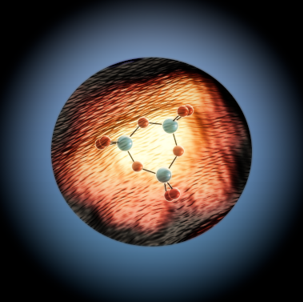
- substrate and, thus, they should be special attraction points for adsorbates. As shown in Figure 1c and Figure 1d, it is very probable that W3O9 clusters prefer to adsorb these defects inside the trenches of the z’-TiOx phase. The result is a 1D alignment of the clusters along the direction of the stripes
- thin. Thus, a direct contact of the adsorbates with the metallic alloy surface can be excluded. As shown in Figure 2c and Figure 2d, the adsorption of W3O9 on the hexagonal w’-TiOx phase shows a behavior that is completely different from the behavior observed on the rectangular z’-phase. On the fully
- controlled adsorption and manipulation of metal oxide nanoclusters. Depending on the preparation conditions, different atomically thin and highly ordered titanium oxide films can be formed on the bimetallic alloy surface, offering various templates and bonding options for adsorbates. This approach opens up



Direct observation of the Si(110)-(16×2) surface reconstruction by atomic force microscopy
Beilstein J. Nanotechnol. 2020, 11, 1750–1756, doi:10.3762/bjnano.11.157
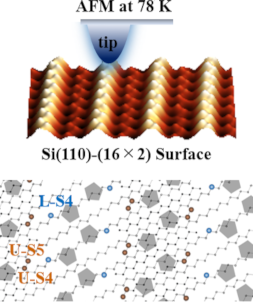
- shows an AFM image of a 16×2 reconstruction with sudden protrusions on L-P3 sites (defined in Figure 2a). The direction of fast scan was left to right, and that of slow scan was top to bottom. It can be ruled out that there were adsorbates on L-P3 sites because the pressure was kept below 3 × 10⁻¹¹ Torr
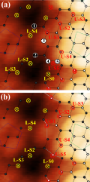
- sites could no longer be observed. Two consecutive scans of Figure 3a and 3b indicated that these sudden protrusions were not adsorbates on L-P3 sites because they are observed in Figure 3a and not observed in Figure 3b. They can be explained by the fact that the L-P3 atom is pulled by the Si tip



Detecting stable adsorbates of (1S)-camphor on Cu(111) with Bayesian optimization
Beilstein J. Nanotechnol. 2020, 11, 1577–1589, doi:10.3762/bjnano.11.140
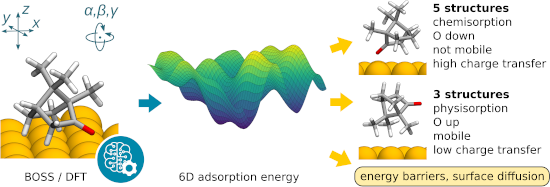
- structure of complex molecular adsorbates from microscopy images can be difficult, and using atomistic simulations to find the most stable structures is limited to partial exploration of the potential energy surface due to the high-dimensional phase space. In this study, we present the recently developed
- Bayesian Optimization Structure Search (BOSS) method as an efficient solution for identifying the structure of non-planar adsorbates. We apply BOSS with density-functional theory simulations to detect the stable adsorbate structures of (1S)-camphor on the Cu(111) surface. We identify the optimal structure
- among eight unique types of stable adsorbates, in which camphor chemisorbs via oxygen (global minimum) or physisorbs via hydrocarbons to the Cu(111) surface. This study demonstrates that new cross-disciplinary tools, such as BOSS, facilitate the description of complex surface structures and their


Controlling the electronic and physical coupling on dielectric thin films
Beilstein J. Nanotechnol. 2020, 11, 1492–1503, doi:10.3762/bjnano.11.132
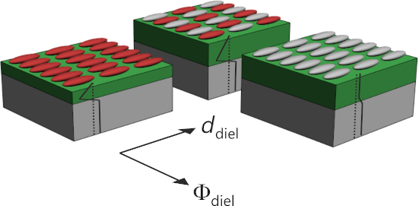
- underlying metal [2][3]. As dielectric films can significantly reduce the work function, principally due to Pauli repulsion (pushback) at the metal interface, adsorbates of sufficiently high electron affinity (EA) will become negatively charged via tunneling from the underlying metal. This was predicted by
- Pacchioni et al. [4][5][6] and either inferred or observed for adsorbates ranging from metal atoms [7][8] and small molecules [9][10] to larger π-conjugated molecules [11][12][13]. This phenomenon has been comprehensively analyzed for 5A on epitaxial MgO(100)/Ag(100), in which orbital-resolved STM and
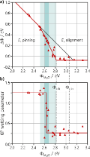
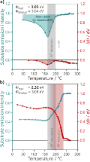
- is only a small reduction of Φ, then the system is in the vacuum level alignment regime and there is no charge transfer. If there is any significant change in Φ, then the system is in the Fermi level pinning regime with equilibrium achieved by a balance between charged and neutral adsorbates in the




Self-assembly and spectroscopic fingerprints of photoactive pyrenyl tectons on hBN/Cu(111)
Beilstein J. Nanotechnol. 2020, 11, 1470–1483, doi:10.3762/bjnano.11.130
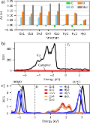
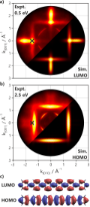
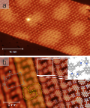
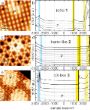
- , molecule–metal interactions can adversely affect the intrinsic electronic characteristics of molecular adsorbates and quench the optical properties [9][10][11][12][13]. Consequently, recent studies aiming to characterize the relation of adsorption, supramolecular organization, and electronic and optical
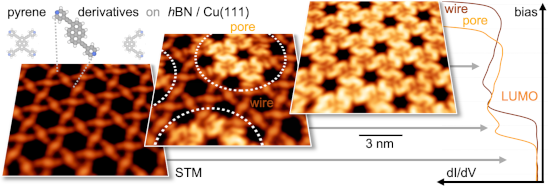
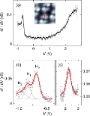
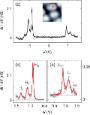
- allows the determination of the electronic properties of the pyrene adsorbates by STM and STS", and the comparison with the gaps estimated by theoretical simulations in vacuum and by UV-vis spectroscopies in solution. Remarkably, the electronic states of the pyrene adsorbates near the Fermi level, probed
- of well-defined, narrow molecular resonances and large HOMO–LUMO gaps evidenced a reduction of the electronic molecule–support interactions by the hBN spacer layer, as previously reported for adsorbates on hBN/Cu(111) [28][35][36][37][38] and other hBN/metal supports [18][19][20][79][80]. The dI/dV




Effect of localized helium ion irradiation on the performance of synthetic monolayer MoS2 field-effect transistors
Beilstein J. Nanotechnol. 2020, 11, 1329–1335, doi:10.3762/bjnano.11.117
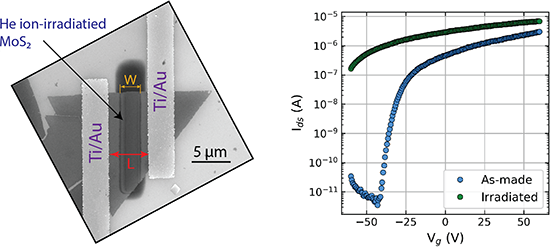
- ). Prior to testing, the devices were outgassed at a pressure of approx. 10−5 mbar for 12 h to minimize surface adsorbates. Helium ion irradiations were carried out at a beam energy of 30 keV and He gas pressure of 2 × 10⁻⁶ Torr, using a Zeiss Nanofab microscope. The fabricated MoS2 FETs were placed in the
- than half of the channel has been treated with the ion beam. Thus, we expect a dominant contribution of oxygen-containing atmospheric adsorbates (known p-type dopants in MoS2) in saturating the vacancy sites created by the ion beam, allowing for residual hole conduction in the newly formed effective


Scanning tunneling microscopy and spectroscopy of rubrene on clean and graphene-covered metal surfaces
Beilstein J. Nanotechnol. 2020, 11, 1157–1167, doi:10.3762/bjnano.11.100
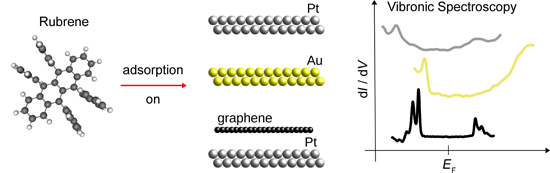
- ) [18][19], while Au(111) is characterized by a surface-projected gap of sp-derived electron states [20]. Graphene on Pt(111) exhibits a considerable distance of 330 pm from the metal surface [21], which implies a weak graphene–metal hybridization. Adsorbates on graphene-covered Pt(111) are therefore



Quantitative determination of the interaction potential between two surfaces using frequency-modulated atomic force microscopy
Beilstein J. Nanotechnol. 2020, 11, 729–739, doi:10.3762/bjnano.11.60
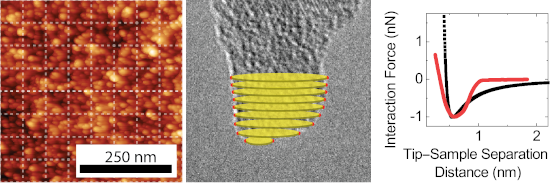
- holder, transferred into the vacuum chamber, and baked at 120 °C for 1 h to remove any residual adsorbed moisture and other adsorbates on the probe. No tip preparation beyond this was conducted, to ensure that the tip structure remained as similar to the initial images and as small as possible. Before


Adsorptive removal of bulky dye molecules from water with mesoporous polyaniline-derived carbon
Beilstein J. Nanotechnol. 2020, 11, 597–605, doi:10.3762/bjnano.11.47
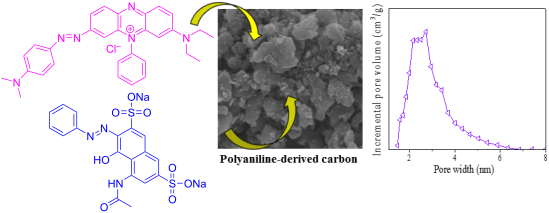
- effective adsorption of small MO or MB since van der Waals interactions rely on adequate matching between pore and adsorbates. On the contrary, bulky dye molecules such as AR1 and JGB can interact effectively with KOH-900 via van der Waals interactions, which relies on the suitable pore size of KOH-900 for


Atomic-resolution imaging of rutile TiO2(110)-(1 × 2) reconstructed surface by non-contact atomic force microscopy
Beilstein J. Nanotechnol. 2020, 11, 443–449, doi:10.3762/bjnano.11.35
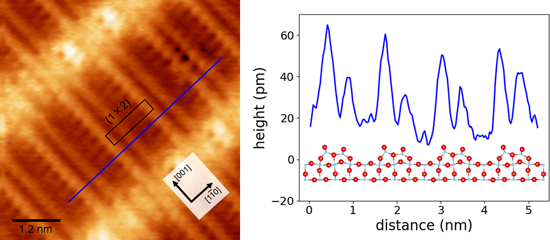
- -AFM and tunneling current for STM), the surface structure sometimes results in different contrasts in both images. In Figure 3, white squares and circles indicate line defects and protrusions, which are considered to be adsorbates or contamination. A line defect was imaged as a likely vacancy by STM


An advanced structural characterization of templated meso-macroporous carbon monoliths by small- and wide-angle scattering techniques
Beilstein J. Nanotechnol. 2020, 11, 310–322, doi:10.3762/bjnano.11.23
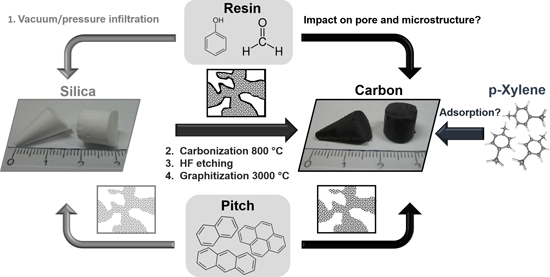
- mesoporosity of these monolithic carbon materials was studied by the sorption behavior of a relatively large organic molecule (p-xylene) in comparison to typical gas adsorbates (Ar). In addition, to obtain a detailed view on the nanopore space small-angle neutron scattering (SANS) combined with in situ
- adsorbates such as nitrogen, argon, krypton or carbon monoxide. We chose p-xylene as an adsorbate for vapour sorption to address the sorption at room temperature. To obtain a detailed view of the nanopore space, which exhibits micro-, meso- and macropores, but with an upper limit of ca. 100 nm, small-angle




Kelvin probe force microscopy work function characterization of transition metal oxide crystals under ongoing reduction and oxidation
Beilstein J. Nanotechnol. 2019, 10, 1596–1607, doi:10.3762/bjnano.10.155
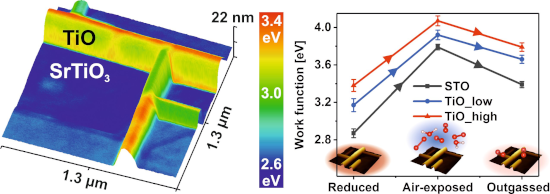
- known that water molecules present in the ambient air form a dipole layer, which can give rise to an effective surface potential [49]. To reduce the impact of weakly interacting adsorbates, in the next step, the sample underwent in situ UHV annealing, which implicated a WF decrease of both TiO and
- abundant adsorbates, also mimicking the typical operating temperatures of metal oxide gas sensors [51]. Numerical calculations suggest that H2O and CO2 species present in air saturate almost all free adsorption sites on TiO2-terminated SrTiO3(100) [52]. The low Redhead desorption temperature of H2O (CO2
- ) of 233–283 K (428–523 K) calculated by Baniecki et al. [52] suggests that our surface, which is predominantly TiO2-terminated, is cleaned of those adsorbates after annealing, hence the 0.35 eV difference in the WF. The lower response of TiO to annealing is a hint of the higher adsorption energy of


Imaging the surface potential at the steps on the rutile TiO2(110) surface by Kelvin probe force microscopy
Beilstein J. Nanotechnol. 2019, 10, 1228–1236, doi:10.3762/bjnano.10.122
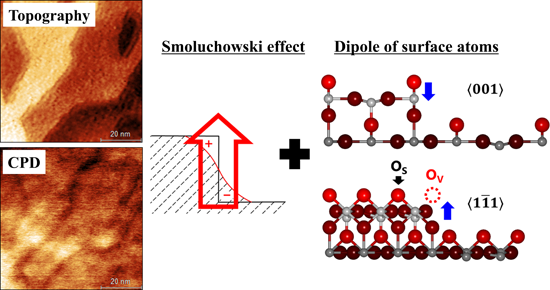
- and steps are formed. In this image, the bright spots on the surface are adsorbed oxygen species or other adsorbates. The profiles of the average height show that the height of both and steps was about 260 pm, which is smaller than the known height of 325 pm because of the large tip–sample distance
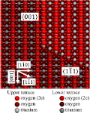
![[Graphic 16]](/bjnano/content/inline/2190-4286-10-122-i16.svg?max-width=637&scale=1.18182) and
and ![[Graphic 17]](/bjnano/content/inline/2190-4286-10-122-i17.svg?max-width=637&scale=1.18182) .
.
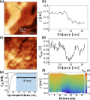

![[Graphic 38]](/bjnano/content/inline/2190-4286-10-122-i38.svg?max-width=637&scale=1.18182) and
and ![[Graphic 39]](/bjnano/content/inline/2190-4286-10-122-i39.svg?max-width=637&scale=1.18182) steps. (a) Topographic image...
steps. (a) Topographic image...


![[Graphic 72]](/bjnano/content/inline/2190-4286-10-122-i72.svg?max-width=637&scale=1.18182) , b)
, b) ![[Graphic 73]](/bjnano/content/inline/2190-4286-10-122-i73.svg?max-width=637&scale=1.18182) , c) reduced
, c) reduced ![[Graphic 74]](/bjnano/content/inline/2190-4286-10-122-i74.svg?max-width=637&scale=1.18182) , and d)
, and d) ![[Graphic 75]](/bjnano/content/inline/2190-4286-10-122-i75.svg?max-width=637&scale=1.18182) steps. B...
steps. B...
In situ AFM visualization of Li–O2 battery discharge products during redox cycling in an atmospherically controlled sample cell
Beilstein J. Nanotechnol. 2019, 10, 930–940, doi:10.3762/bjnano.10.94
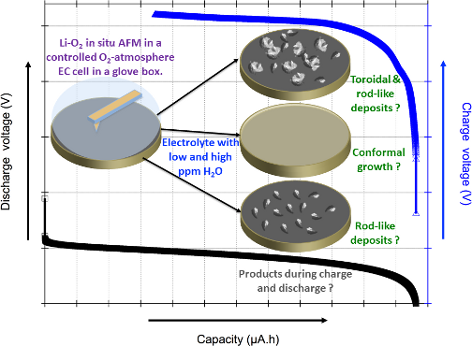
- deposition [3], corrosion and molecular adsorbates on a variety of surfaces [4] have also been investigated with scanning probe microscopy. In situ local probe techniques at electrical interfaces [5] use scanning probe microscopy to probe surface changes and reactions. A recent review by Yang et al. [6


The effect of translation on the binding energy for transition-metal porphyrines adsorbed on Ag(111) surface
Beilstein J. Nanotechnol. 2019, 10, 706–717, doi:10.3762/bjnano.10.70
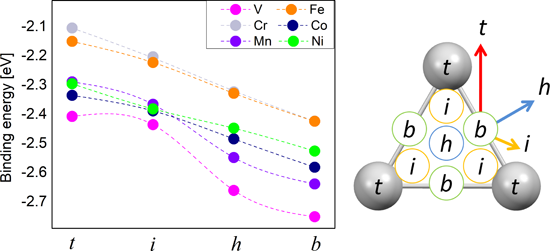
- DFT results can fail to accurately reproduce all these situations mainly because of the underestimation of correlation effects in DFT. Consequently, spin effects are described with limited accuracy for both TM and ligand spin. The latter is just barely present in the calculations of adsorbates [77


![[Graphic 1]](/bjnano/content/inline/2190-4286-10-70-i1.svg?max-width=637&scale=1.18182) , for all systems and relative molecule–surface positions. Right: symm...
, for all systems and relative molecule–surface positions. Right: symm...


![[Graphic 7]](/bjnano/content/inline/2190-4286-10-70-i7.svg?max-width=637&scale=1.18182) for selected TMPP systems (M = V, Mn, Co; red: positive values, blue: negative value...
for selected TMPP systems (M = V, Mn, Co; red: positive values, blue: negative value...
Intuitive human interface to a scanning tunnelling microscope: observation of parity oscillations for a single atomic chain
Beilstein J. Nanotechnol. 2019, 10, 337–348, doi:10.3762/bjnano.10.33
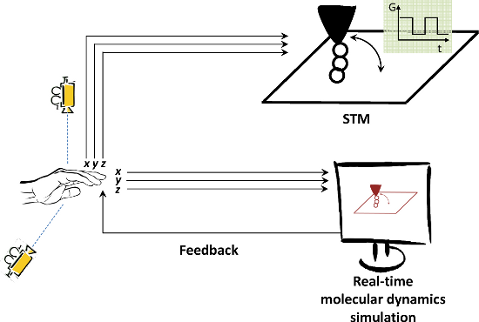
- valence electrons in metals [34]. It is possible to image the atomic configuration by functionalizing the STM tip by adsorbates (for example CO molecules [35] or other foreign adsorbates [36]) at the tip apex, and by quantum point contact microscopy [37]. To keep the surface clean we did not introduce
- adsorbates in the system and dragging the STM tip in contact with the surface is also not a useful option as the STM tip may pick up the adatoms we want to study later. So, we devised a simple geometric technique to get the information of the surface atom positions without the need to resolve the individual
- unwanted adsorbates that may be present in the UHV chamber, most likely hydrogen. In fact we have observed this jump to contact when approaching a Au adatom from the top in more than 80% of the times and we attribute it to the relaxation [42] of tip and surface atoms. Recent work [43][44], albeit not




Wet chemistry route for the decoration of carbon nanotubes with iron oxide nanoparticles for gas sensing
Beilstein J. Nanotechnol. 2019, 10, 105–118, doi:10.3762/bjnano.10.10
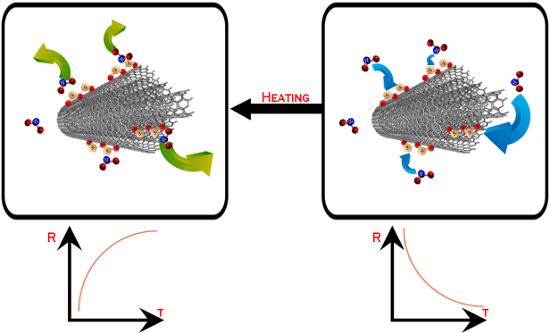
- into more reactive species that, in turn, interact with CNTs. In addition, such nanoparticles shift the Fermi level of CNTs, adsorb target molecules, and help in mediating the charge transfer between adsorbates and CNTs [6][10]. Several metal oxides have been reported as useful for decorating CNTs and




Apparent tunneling barrier height and local work function of atomic arrays
Beilstein J. Nanotechnol. 2018, 9, 3048–3052, doi:10.3762/bjnano.9.283
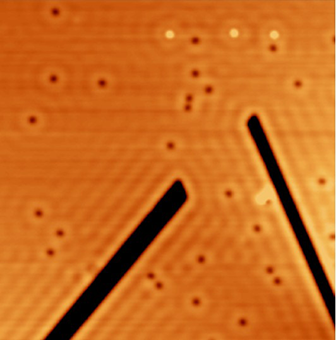
- . This is reflected by the notion of a local work function Φ [7][8][9]. Adsorbates modify Φ in an intriguing manner [10][11][12][13]. In turn, variations of Φ produce, e.g., atomic-scale contrast in field-emission microscopy, photo-emission electron microscopy, and low-energy electron microscopy [14][15


Investigation of CVD graphene as-grown on Cu foil using simultaneous scanning tunneling/atomic force microscopy
Beilstein J. Nanotechnol. 2018, 9, 2953–2959, doi:10.3762/bjnano.9.274
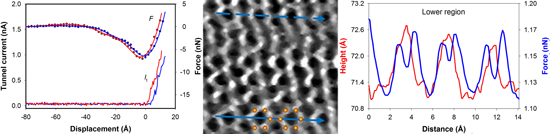
- conducting or semiconducting samples, because the acquired spectroscopies associated with forces and tunneling current between the foremost atoms of probe and sample provide complementary results. This would be helpful to detect distinct unique structures or chemical adsorbates on surfaces or in


Heterostuctures of 4-(chloromethyl)phenyltrichlorosilane and 5,10,15,20-tetra(4-pyridyl)-21H,23H-porphine prepared on Si(111) using particle lithography: Nanoscale characterization of the main steps of nanopatterning
Beilstein J. Nanotechnol. 2018, 9, 1211–1219, doi:10.3762/bjnano.9.112
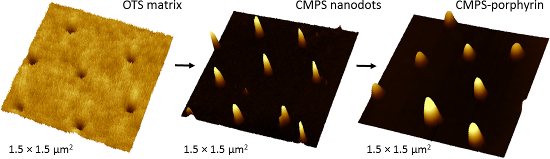
- nanostructures measuring 500 nm, as revealed in the close-up topography and phase views (Figure 4b and 4c). There is little nonspecific binding of adsorbates on the OTS matrix areas between the nanostructures, as shown in the phase map of Figure 4c. An example cursor profile that was traced across two of the


Electro-optical interfacial effects on a graphene/π-conjugated organic semiconductor hybrid system
Beilstein J. Nanotechnol. 2018, 9, 963–974, doi:10.3762/bjnano.9.90
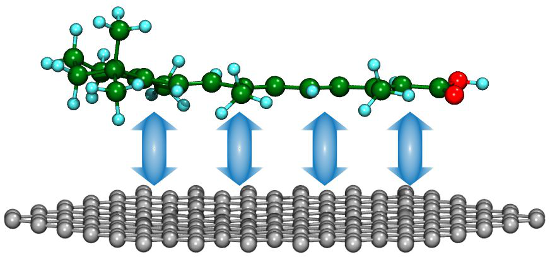
- pair is photogenerated and liberates graphene adsorbates via hole recombination (e.g., h+ + O2− → O2 (gas)), releasing electrons that, then, contribute toward an effective n-doping [39][40]. The shorter the wavelength, the more effective such process is [39][40]. Thus, in the present case, which uses
- white light illumination, the shorter wavelengths should be responsible for most of this effect. The increase on the RA SAM potential might result from concomitant contributions of several mechanisms, including photo-electron generation via hole recombination with RA surface states and adsorbates




Facile chemical routes to mesoporous silver substrates for SERS analysis
Beilstein J. Nanotechnol. 2018, 9, 880–889, doi:10.3762/bjnano.9.82
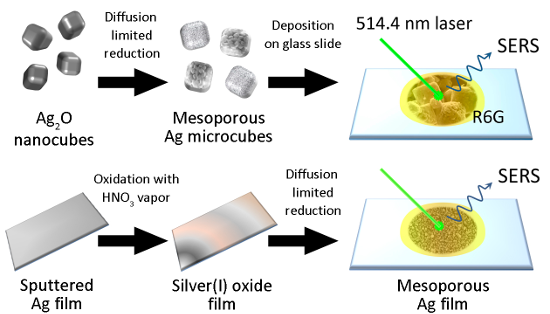
- role as surfactant, partly blocking the nucleation at (100) facets if the prevalent growth mechanism is normal or lateral layer-by-layer growth [28]. Presumably, the PVP adsorbates remained at the Ag2O crystallite surface after the washing procedure. Remarkably, the porous polyhedron-like silver
- correspond to the metal state of silver [31]. Both characteristic energies are decreased slightly, probably, as a result of PVP adsorbates at the surface. The absence of a silver oxide phase at the surface is also beneficial for efficient surface plasmon resonance, which is strongly required for SERS. This





