Search results
Search for "photodegradation" in Full Text gives 87 result(s) in Beilstein Journal of Nanotechnology.
Spindle-like MIL101(Fe) decorated with Bi2O3 nanoparticles for enhanced degradation of chlortetracycline under visible-light irradiation
Beilstein J. Nanotechnol. 2022, 13, 1038–1050, doi:10.3762/bjnano.13.91
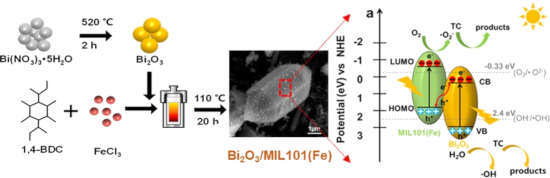
- To evaluate the photocatalytic activity of BOM-20, the photodegradation of chlortetracycline (CTC) under visible-light irradiation was conducted. It can be seen from Figure 6a that Bi2O3 shows poor adsorption and photocatalytic activity, and the CTC removal rate is only 40% within 120 min. MIL101(Fe
- ) shows strong adsorption capacity in the dark and a poorer photocatalytic activity. With the photocatalysis of MIL101(Fe), the photodegradation efficiency of CTC only could reach 64.5% after irradiation for 120 min. Compared with MIL101(Fe), Bi2O3/MIL101(Fe) composites exhibit a slightly weakened
- various composites, BOM-20 shows the highest activity with a CTC removal rate up to 88.2%. Additionally, Figure 6b demonstrates that the photocatalytic degradation of CTC accords with the quasi-first-order kinetic model. Figure 6c shows the apparent kinetic constant (k) of CTC photodegradation by the as


Solar-light-driven LaFexNi1−xO3 perovskite oxides for photocatalytic Fenton-like reaction to degrade organic pollutants
Beilstein J. Nanotechnol. 2022, 13, 882–895, doi:10.3762/bjnano.13.79
- transmittance and suitable surface area for degrading methylparaben. Although Ti-doped catalyst was expected as a semiconductor to enhance the photocatalytic efficiency, pure LaFeO3 still revealed the better performance of methylparaben photodegradation than LaTi0.15Fe0.85O3 [28]. On the contrary, Garcia-Muñoz
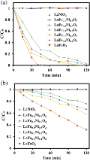
- showed no MB degradation). The degradation of 70% LaFeO3 in 30 min was approximately 60.0%. Considering the light shading effect by LaNiO3, the MB photodegradation of physically mixed 70% LaFeO3 and 30% LaNiO3 might be lower. On the contrary, the LaFe0.7Ni0.3O3 showed 78.5% of MB degradation in 30 min
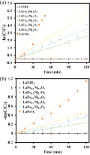
- . Therefore, we believed there would be a benefit of doping Ni to improve the photodegradation. In Figure 9, by taking the negative natural logarithmic value of C/C0, it was observed that all the degradation trends were in line with first-order kinetics: where k was the rate constants of MB degradation



Hierarchical Bi2WO6/TiO2-nanotube composites derived from natural cellulose for visible-light photocatalytic treatment of pollutants
Beilstein J. Nanotechnol. 2022, 13, 745–762, doi:10.3762/bjnano.13.66


Sodium doping in brookite TiO2 enhances its photocatalytic activity
Beilstein J. Nanotechnol. 2022, 13, 599–609, doi:10.3762/bjnano.13.52
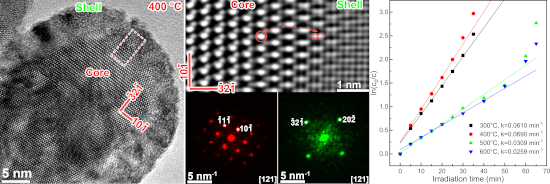
- photodegradation of the orange II dye of brookite varies with the annealing temperature [20]. These differences in the photocatalytic activity of brookite were generally considered as factors such as the specific surface area, crystallite size, and crystallinity [9][21]. But whether the local atomic structure of
- activity. Results and Discussion Enhanced photocatalytic activity The photocatalytic activity of the samples calcinated at 300–600 °C for 2 h was measured by the photodegradation of MB under UV light at room temperature. Figure 1a and Figure 1b display the dynamic changes in the absorption spectra of MB
- activity, and more than 90% of MB was decolorized after UV light irradiation for 30 min. However, for the samples calcinated at 500 and 600 °C, it takes about 60 min to degrade 90% of MB. Moreover, the photodegradation rate of MB by the samples was quantitatively characterized based on pseudo first-order


A comprehensive review on electrospun nanohybrid membranes for wastewater treatment
Beilstein J. Nanotechnol. 2022, 13, 137–159, doi:10.3762/bjnano.13.10




Tin dioxide nanomaterial-based photocatalysts for nitrogen oxide oxidation: a review
Beilstein J. Nanotechnol. 2022, 13, 96–113, doi:10.3762/bjnano.13.7
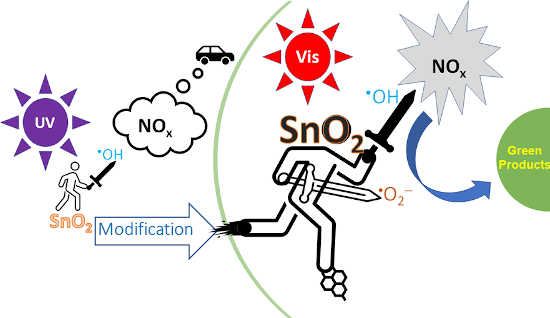
- photocatalytic mechanisms, and the polymer photodegradation of the resulting nanocomposite using DFT techniques. The results confirmed that the interaction between NO and PANI is indeed a hydrogen bond and photogenerated holes serve as the primary factor of the photocatalytic NO removal [35]. Moreover, this
- . Figure 6 was reprinted with permission from [66], Copyright 2010 American Chemical Society. This content is not subject to CC BY 4.0. NO photodegradation of materials under solar light (a), the dependence of concentration on irradiation time (b), photochemical stability of SnO2 NPs (NPs) (c), and NO


Unravelling the interfacial interaction in mesoporous SiO2@nickel phyllosilicate/TiO2 core–shell nanostructures for photocatalytic activity
Beilstein J. Nanotechnol. 2020, 11, 1834–1846, doi:10.3762/bjnano.11.165
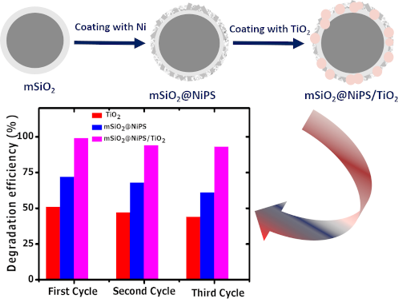
- obtained via a hydrothermal treatment method using solid SiO2 spheres, urea, and nickel nitrate hexahydrate. Although NiPS compounds are extensively used as catalysts, to our knowledge, reports on the use of core–shell based nickel–phyllosilicate composites in dye photodegradation are yet to be reported
- photodegradation of methyl violet dye. For comparison, the photocatalytic properties of pristine TiO2 were also investigated. It is postulated that the controlled surface area of the mesoporous SiO2 as well as the formation of a core–shell network with a flake-like NiPS structure on the surface aided in creating a
- recombination, leading to faster charge transport and photodegradation. Typically, the photocatalytic degradation efficacy of TiO2 depends on the surface area and metal-ion doping on the surface. Metal-ion doping of TiO2 influences its interfacial charge-transfer properties [51]. Differences in


Nanocasting synthesis of BiFeO3 nanoparticles with enhanced visible-light photocatalytic activity
Beilstein J. Nanotechnol. 2020, 11, 1822–1833, doi:10.3762/bjnano.11.164
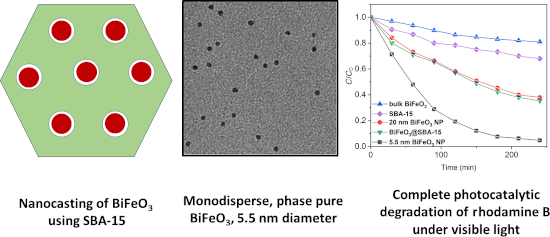
- wet impregnation process and a calcination procedure with intermediate plateaus, monodisperse 5.5 nm BiFeO3 nanoparticles were successfully obtained. Furthermore, the nanoparticles were applied in photodegradation reactions of rhodamine B in aqueous solution under visible-light irradiation. Notably
- , the cast BiFeO3 nanoparticles demonstrated very high efficiencies and stability under visible-light irradiation, much higher than those of BiFeO3 nanoparticles synthesized by other synthetic methods. The possible mechanism in the photodegradation process has been deeply discussed on the basis of
- the particle size. The smaller the particle, the greater the specific surface area is and, thus, the more active sites are available for photodegradation [15][18]. In addition, it was shown that size and shape of BiFeO3 particles have a direct influence on the bandgap of the material. Smaller BiFeO3




Synthesis and enhanced photocatalytic performance of 0D/2D CuO/tourmaline composite photocatalysts
Beilstein J. Nanotechnol. 2020, 11, 407–416, doi:10.3762/bjnano.11.31
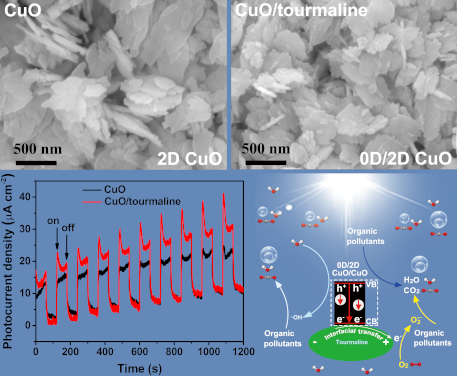
- 0D/2D CuO structure and interfacial interaction between CuO and tourmaline. The initial solution pH affected the photocatalytic performance mainly via changing the adsorption of dye molecules onto photocatalysts (Figure 7a), as adsorption occurred firstly during the photodegradation reactions [42


Improved adsorption and degradation performance by S-doping of (001)-TiO2
Beilstein J. Nanotechnol. 2019, 10, 2116–2127, doi:10.3762/bjnano.10.206
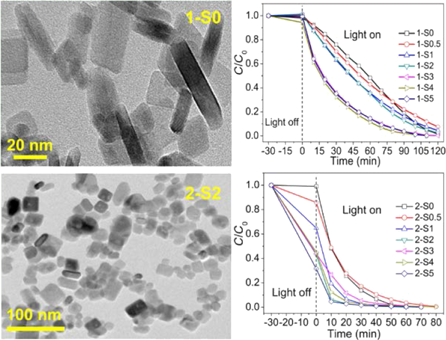
- photocatalytic degradation performance of all samples was tested with MB as the target pollutant. Figure 7 representatively shows the temporal evolution of the UV–vis spectra during the photodegradation of aqueous MB over the 2-S2 sample (a) and the variation of the MB concentration C/C0 with time in the
- denotes the photodegradation process of MB during irradiation. The concentration of MB at t = −30 min is referred to as the initial concentration C0. After 30 min of adsorption, the concentration decreases to Ce at t = 0. The adsorption efficiency (Ae) is calculated by (C0 − Ce)/C0. The degradation
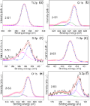
- the fitted curves. Valence-band XPS of 2-S0, 2-S0.5, 2-S1, 2-S3 and 2-S5. The UV–vis DRS of 2-S0, 2-S0.5, 2-S1, 2-S3 and 2-S5. The inset is the magnified plot of the UV–vis DRS in the visible light region. The temporal evolution of the UV–Vis spectra during the photodegradation of aqueous MB over the




Lipid nanostructures for antioxidant delivery: a comparative preformulation study
Beilstein J. Nanotechnol. 2019, 10, 1789–1801, doi:10.3762/bjnano.10.174
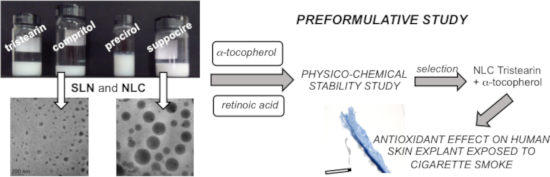
- proposed in the treatment of breast, lung and liver cancers [21][22]. Notably, it has been demonstrated that CS induces RA deficiency [23]. Despite the enormous potential of TOC and RA, some drawbacks are associated to their topical use, such as photodegradation, poor water solubility and irritative skin

Direct observation of oxygen-vacancy formation and structural changes in Bi2WO6 nanoflakes induced by electron irradiation
Beilstein J. Nanotechnol. 2019, 10, 1434–1442, doi:10.3762/bjnano.10.141
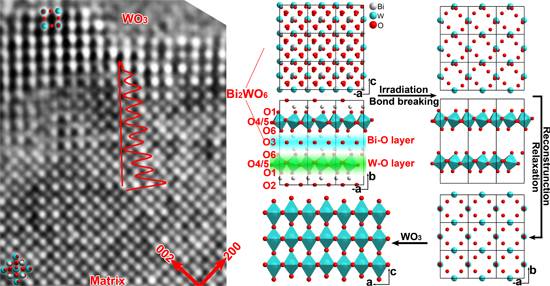
- during the electron-beam irradiation process. The formation mechanisms of Bi/O defects are discussed in detail by combining the HRTEM imaging of defects and the calculation of the electrostatic site potentials of Bi2WO6. Results and Discussion Structural features and photodegradation The Bi2WO6 sample is


BiOCl/TiO2/diatomite composites with enhanced visible-light photocatalytic activity for the degradation of rhodamine B
Beilstein J. Nanotechnol. 2019, 10, 1412–1422, doi:10.3762/bjnano.10.139
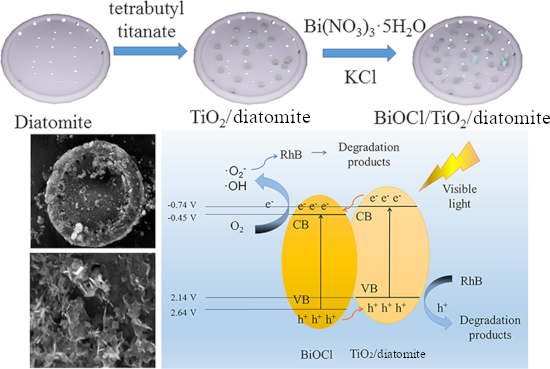
- the main active substance in the photocatalytic process. Secondly, the presence of KI and IPA also inhibits the degradation of RhB, but the inhibition effect is slightly less. It has been proved that the h+ and ·OH are also active species but are not as active as O2− in the photodegradation process
- ), Ti element (e) and Bi element (f). TEM image (a) and high-resolution image showing the lattice fringes (b) of BTD. The photodegradation curves and corresponding kinetic plots of different samples, including various photocatalysts (a and d), BTD with different molar ratios of BiOCl to TiO2 (b and e


Construction of a 0D/1D composite based on Au nanoparticles/CuBi2O4 microrods for efficient visible-light-driven photocatalytic activity
Beilstein J. Nanotechnol. 2019, 10, 1360–1367, doi:10.3762/bjnano.10.134
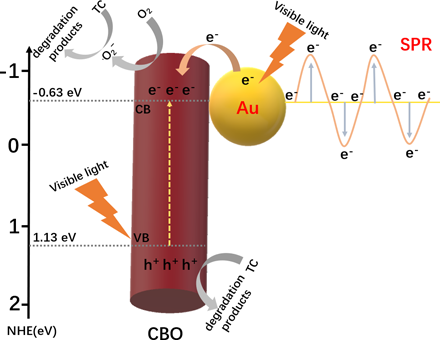
- visible-light irradiation. Trapping of reactive species during the photodegradation of TC over 2.5 wt % Au/CBO composite under visible-light irradiation. Possible photocatalytic reaction mechanism of the 0D/1D Au/CBO heterojunction photocatalyst during TC degradation under visible-light irradiation


Imaging the surface potential at the steps on the rutile TiO2(110) surface by Kelvin probe force microscopy
Beilstein J. Nanotechnol. 2019, 10, 1228–1236, doi:10.3762/bjnano.10.122
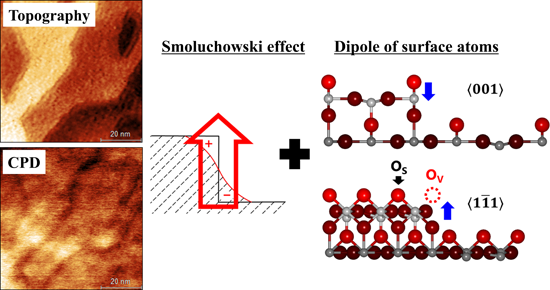
- preparation. The steps showed a higher photodegradation activity than the steps for aqueous solutions of methylene blue [23], indicating that the different step structures have different catalytic activities. KPFM measures the contact potential difference (CPD), corresponding to the difference in work
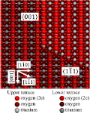
![[Graphic 16]](/bjnano/content/inline/2190-4286-10-122-i16.svg?max-width=637&scale=1.18182) and
and ![[Graphic 17]](/bjnano/content/inline/2190-4286-10-122-i17.svg?max-width=637&scale=1.18182) .
.
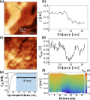

![[Graphic 38]](/bjnano/content/inline/2190-4286-10-122-i38.svg?max-width=637&scale=1.18182) and
and ![[Graphic 39]](/bjnano/content/inline/2190-4286-10-122-i39.svg?max-width=637&scale=1.18182) steps. (a) Topographic image...
steps. (a) Topographic image...


![[Graphic 72]](/bjnano/content/inline/2190-4286-10-122-i72.svg?max-width=637&scale=1.18182) , b)
, b) ![[Graphic 73]](/bjnano/content/inline/2190-4286-10-122-i73.svg?max-width=637&scale=1.18182) , c) reduced
, c) reduced ![[Graphic 74]](/bjnano/content/inline/2190-4286-10-122-i74.svg?max-width=637&scale=1.18182) , and d)
, and d) ![[Graphic 75]](/bjnano/content/inline/2190-4286-10-122-i75.svg?max-width=637&scale=1.18182) steps. B...
steps. B...
A highly efficient porous rod-like Ce-doped ZnO photocatalyst for the degradation of dye contaminants in water
Beilstein J. Nanotechnol. 2019, 10, 1157–1165, doi:10.3762/bjnano.10.115
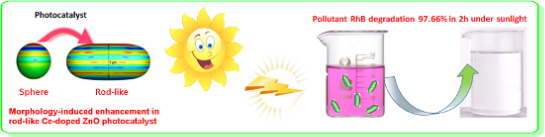
- to improve its photocatalytic activity by modifying its surface morphology [10][11]. Wang et al. [12] prepared Ce-doped ZnO with different doping levels by using a one-step solution method, using methylene blue as the target pollutant for photodegradation. After exposure to light for 200 minutes, the


Photoactive nanoarchitectures based on clays incorporating TiO2 and ZnO nanoparticles
Beilstein J. Nanotechnol. 2019, 10, 1140–1156, doi:10.3762/bjnano.10.114
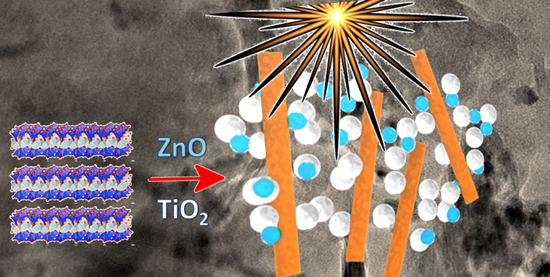
- photodegradation of diverse organic compounds, including the photodecolorization of dyes such as methylene blue (MB), methyl green (MG), acid red G, acid yellow 11, acid orange 11, and Congo red, in water, as well as other photo-applications, for instance, water splitting under UV or visible/solar light
- @montmorillonite materials can be synthesized from a Zn solution and cetyltrimethylammonium (CTA)-montmorillonite organoclays. In these materials, the bandgap energy of ZnO is decreased compared to bare ZnO NPs, which results in a faster photodegradation of MB. In experiments to prepare ZnO@clay nanoarchitectures
- CTA-saponite was stronger than in montmorillonite and CTA-montmorillonite, suggesting that the iron atoms in montmorillonite play a significant role through the quenching of excited states. In the photodegradation experiments, the ZnO–smectite nanoarchitectures show a longer life time at low pH values



Outstanding chain-extension effect and high UV resistance of polybutylene succinate containing amino-acid-modified layered double hydroxides
Beilstein J. Nanotechnol. 2019, 10, 684–695, doi:10.3762/bjnano.10.68
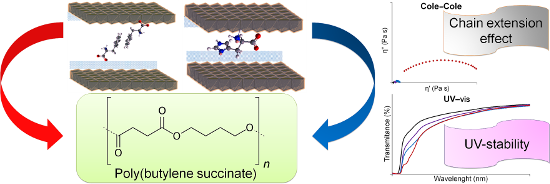
- to a photodegradation process, showing their resistance to UV irradiation. Experimental Materials and reagents Aluminium nitrate Al(NO3)3·9H2O, magnesium nitrate Mg(NO3)2·6H2O, sodium nitrate NaNO3, sodium hydroxide, the amino acids L-histidine (HIS) and L-phenylalanine (PHE) were purchased from
- for one minute. Photodegradation PBS and PBS–LDH nanocomposite films were placed on a rotating carousel in a SEPAP 12/24 chamber from ATLAS equipped with four 400 W mercury lamps with spectral rays above 300 nm. The accelerated photodegradation was studied at 60 °C and under air atmosphere
- can be caused by the cycle phenyl or imidazole acting as a chromophore. Also, PBS with Mg2Al/nitrate LDH shows lower transmittance, as described above. The evolution of the UV–vis transmittance of PBS and PBS nanocomposites was measured during photodegradation at 60 °C (Supporting Information File 1


Ceria/polymer nanocontainers for high-performance encapsulation of fluorophores
Beilstein J. Nanotechnol. 2019, 10, 522–530, doi:10.3762/bjnano.10.53
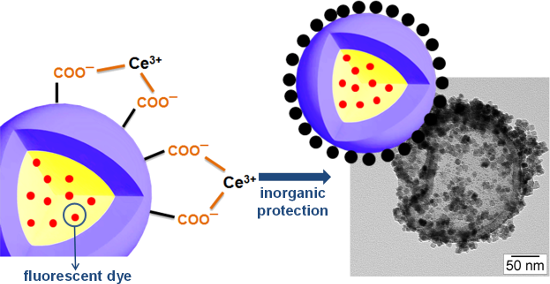
- the oxygen concentration inside the capsules during polymerization. This decrease of oxygen content resulted also in a decreased rate of photodegradation of the TDI molecule. To further minimize the effect of fluorescence quenching, cerium(IV) oxide was crystallized on the surface of polymer sample NC
- fluorescence emission spectra for all synthesized samples after having sealed the samples with argon in the glove box (see Supporting Information File 1, Figure S6). The spectra did not show any significant difference to samples prepared in an oxygen-free atmosphere. Finally, photodegradation experiments were
- , ambient conditions with CeO2) and NC(Ar)-CeO2 (dash-dotted green line, argon conditions with CeO2). Photodegradation measurements of nanocapsules synthesized under different conditions without cerium oxide (sample NC at ambient conditions and sample NC(Ar) under argon) and with cerium oxide on the surface


Impact of the anodization time on the photocatalytic activity of TiO2 nanotubes
Beilstein J. Nanotechnol. 2018, 9, 2628–2643, doi:10.3762/bjnano.9.244
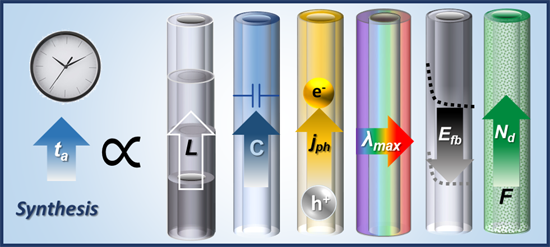
- situ measurement was performed. The integrated signal from the UV–vis spectra is presented in Figure 9d to assess the extent of the photodegradation. From these results, it can be seen that TNTs generated with ta ≥ 1 h exhibit superior performance, with a higher oxidation rate for higher ta. This trend


Nanocellulose: Recent advances and its prospects in environmental remediation
Beilstein J. Nanotechnol. 2018, 9, 2479–2498, doi:10.3762/bjnano.9.232
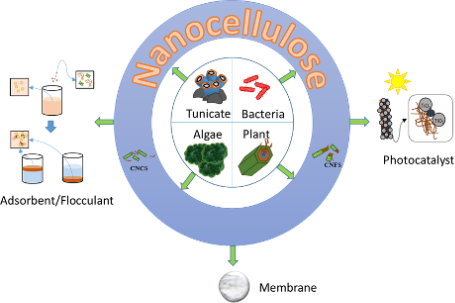
- dioxide sample. The incorporation of magnetite was able to inhibit the photodegradation of the cellulose structure during UV irradiation and this hybrid structure demonstrated high catalyst recyclability using an external magnetic field. Nanoparticles generally tend to aggregate, leading to difficulties
- , exhibited multifunctionality of water filtration and photodegradation of diphenhydramine and methyl orange. This study demonstrated the advantage of using a cellulose-derived film to support the TiO2 nanoparticle–cellulose film as a good support to avoid TiO2 loss during photocatalytic treatment of


Sheet-on-belt branched TiO2(B)/rGO powders with enhanced photocatalytic activity
Beilstein J. Nanotechnol. 2018, 9, 1550–1557, doi:10.3762/bjnano.9.146
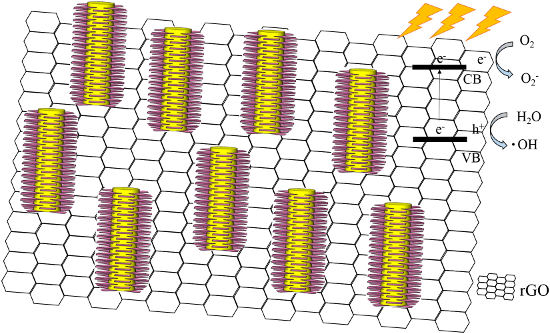
- assist the photodegradation of phenol in water under UV light illumination. The enhanced photocatalytic activity can be attributed to the significantly increased surface area and enhanced charge separation. Keywords: branched nanostructure; photocatalysis; reduced graphene oxide; TiO2(B); Introduction
- Figure 2b). Photocatalytic activities of the pristine TiO2 nanobelt, TGN and TGN-branches were evaluated via photodegradation of phenol in water under UV light illumination. After stirring in the dark for 1 h, an adsorption–desorption equilibrium was established. About 5% phenol in water was adsorbed by
- all three photocatalysts. The TGN-branch 4 h sample demonstrated enhanced photocatalytic performance as compared to TiO2 nanobelts and the TGN sample. Figure S3 in Supporting Information File 1 shows the photodegradation curves in the presence of TGN and TGN-branches with different deposition times


Cr(VI) remediation from aqueous environment through modified-TiO2-mediated photocatalytic reduction
Beilstein J. Nanotechnol. 2018, 9, 1448–1470, doi:10.3762/bjnano.9.137
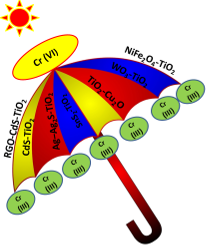
- transformation for the fine chemical synthesis [39][40][41][42] and (v) photodegradation of pollutants [43][44][45][46][47][48][49]. Semiconductor-based photocatalysis proceeds through following three steps: (1) absorption of light; (2) separation and transport of charge carriers; and (3) redox reactions on the
- visible-light irradiation. The authors have also reported that •CO2− radicals (produced by the reaction of hVB+ with HCO2NH4) and eCB− are responsible for the reduction of 4-nitroaniline to p-phenylenediamine over CdS/TiO2 photocatalysts [56]. Photodegradation of pollutants The principle of photocatalysis
- irradiation of suitable light energy. The mechanism of photodegradation of organic pollutants involves the formation of reactive species like O2•− and •OH as per Equation 6 and Equation 7. Some of the O2•− species combine with H+ ions to form •OOH as represented in Equation 8. These active species (•OH, O2


Facile synthesis of a ZnO–BiOI p–n nano-heterojunction with excellent visible-light photocatalytic activity
Beilstein J. Nanotechnol. 2018, 9, 789–800, doi:10.3762/bjnano.9.72
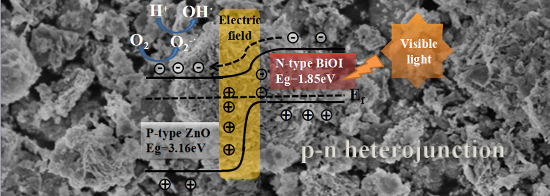
- exhibit a significant improvement in the photodegradation of rhodamine B under visible light (λ ≥ 420 nm) irradiation as compared to single-phase ZnO and BiOI. A sample with a Zn/Bi ratio of 3:1 showed the highest photocatalytic activity (≈99.3% after 100 min irradiation). The photodegradation tests
- detail. With the addition of different kinds of sacrificial agents, the possible ZnO/BiOI heterojunction mechanism of photodegradation is preliminarily discussed. Results and Discussion Structure and morphology characterization The composition of as-prepared ZnO/BiOI heterojunction nanocomposites was
- , which is significantly improved from the pure BiOI (5.23 cm2/g) and ZnO (16 cm2/g) materials. This may lead ZnO/BiOI to have more active bonding sites than pure BiOI and ZnO, which is beneficial for the photodegradation activity. Chemical state analysis X-ray photoelectron spectroscopy (XPS) was carried


Surface-plasmon-enhanced ultraviolet emission of Au-decorated ZnO structures for gas sensing and photocatalytic devices
Beilstein J. Nanotechnol. 2018, 9, 771–779, doi:10.3762/bjnano.9.70
- investigated for photocatalytic activity as reported previously [8][20]. The photocatalytic activity of the Pt/ZnO hybrid nanocomposite under photodegradation of rhodamine B (RhB) was higher compared to commercial TiO2 [21]. Here, it is quite reasonable to note that the plasmonic metal NP/metal-oxide
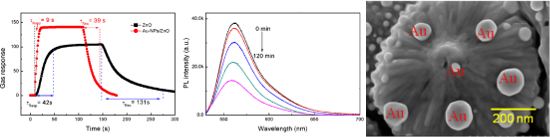
- solution in the presence of these photocatalysts under visible-light irradiation were investigated. The results are shown in Figure 5a and Figures S2 and S3 (Supporting Information File 1). The changes in the PL spectra during photodegradation indicated that the PL peak position of RhB (561.5 nm) decreases
- activity wase evaluated by the photodegradation of an aqueous rhodamine B (RhB) solution at room temperature. Experiments were performed as follows: the prepared ZnO and Au NP/ZnO films (7.5 × 7.5 mm) were added into 2 mL of an aqueous RhB solution (1 × 10⁻⁶ M) in a quartz cuvette, and then the cell was