Search results
Search for "Si substrate" in Full Text gives 213 result(s) in Beilstein Journal of Nanotechnology. Showing first 200.
Assessment of the optical and electrical properties of light-emitting diodes containing carbon-based nanostructures and plasmonic nanoparticles: a review
Beilstein J. Nanotechnol. 2021, 12, 1078–1092, doi:10.3762/bjnano.12.80
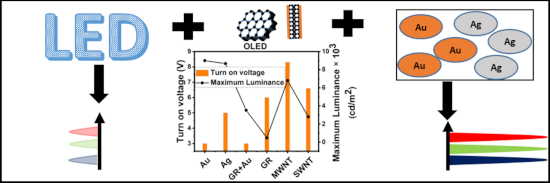
- their sizes [92]. Generally, a QD-based EML is sandwiched between a polymer-based ETL and HTL. Carbon-based nanomaterials such as SWNT have also been investigated as EML in OLED. Firstly, a SWNT p–n junction on a Si substrate has been investigated by Lee et al. [93]. Further, Mueller et al., with some


A Au/CuNiCoS4/p-Si photodiode: electrical and morphological characterization
Beilstein J. Nanotechnol. 2021, 12, 984–994, doi:10.3762/bjnano.12.74
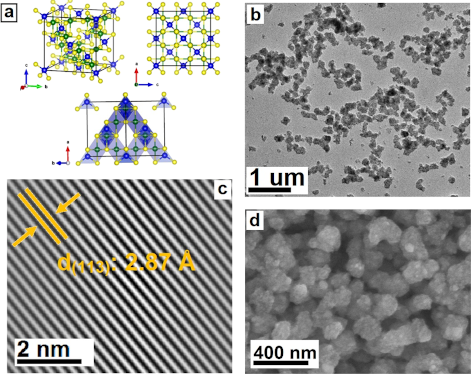
- /H2O (1:10) solution for eliminating the oxide layer and impurities from the surfaces. An ohmic contact with low resistance was made by evaporation of aluminium (Al, 99.999% from Kurt J. Lesker) with a thickness of 150 nm at 5 × 10⁻⁶ Torr on the back side of the p-type Si substrate and subsequent



9.1% efficient zinc oxide/silicon solar cells on a 50 μm thick Si absorber
Beilstein J. Nanotechnol. 2021, 12, 766–774, doi:10.3762/bjnano.12.60
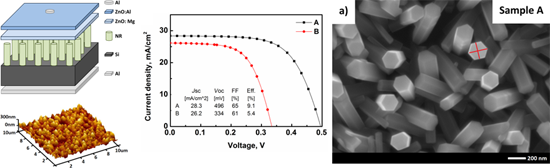
- a 180 μm thick p-type Si substrate. Further cost reduction requires the use of a thinner Si substrate/absorber. Thus, in this paper we report photovoltaic results for a 50 μm thick Si absorber. Experimental Silicon preparation The p-type silicon wafer with thickness of 50 μm and a diameter of 5 cm
- large angles between cell and light source. The magnesium-doped zinc oxide films exhibited grain growth mode on sample B. Close to the silicon surface, only small grains were grown initially. The size of the MZO grains varies but does not exceed a value of 50 nm. Then (for larger distances from the Si
- substrate), the growth mode is similar to that observed for sample A. However, the size of the columns is smaller and does not exceed 100 nm in width. In the tested samples, a microcrystalline structure of the MZO film was detected. Our previous research proved the monocrystalline quality of ZnONR [15


A review of defect engineering, ion implantation, and nanofabrication using the helium ion microscope
Beilstein J. Nanotechnol. 2021, 12, 633–664, doi:10.3762/bjnano.12.52

- SiO2/Si substrate were irradiated on one half with 25 keV helium ions. It was found that at a dose of 2 × 10¹⁵ ions/cm2 a domain wall could be injected into the structure due to the introduction of lattice defects that locally reduced the perpendicular magnetic anisotropy. By raising the dose slightly


Electron beam-induced deposition of platinum from Pt(CO)2Cl2 and Pt(CO)2Br2
Beilstein J. Nanotechnol. 2020, 11, 1789–1800, doi:10.3762/bjnano.11.161
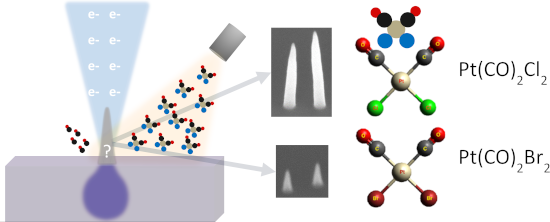
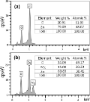
- dispersive X-ray analysis Energy dispersive X-ray (EDX) spectroscopy was performed using an Oxford XMax150 detector on a Zeiss Supra 55 SEM. For EDX measurements, 250 × 250 nm2 squares were deposited, thick enough to minimize the signal from the Si substrate during the analysis with a 5 keV beam. The beam
- Information The file contains EDX spectra of deposits grown from all three precursors before and after plasma cleaning the SEM chamber, an EDX spectrum of the bare Si substrate and graphs of the diameters of pillars grown in experiments 1 and 2. Supporting Information File 150: Additional experimental data


Mapping of integrated PIN diodes with a 3D architecture by scanning microwave impedance microscopy and dynamic spectroscopy
Beilstein J. Nanotechnol. 2020, 11, 1764–1775, doi:10.3762/bjnano.11.159
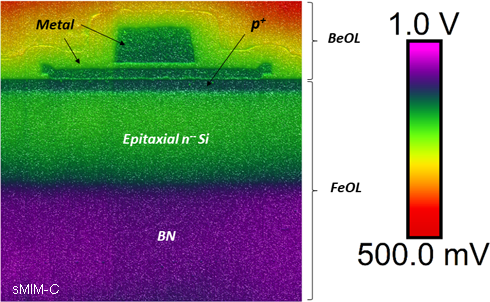
- . The starting material is a p-type Si substrate with relatively high ohmic resistance (1 kΩ·cm), oriented along the ⟨100⟩ direction. The first step in the process consists of forming an n-type doped buried layer (BN) on the top of the wafer (through implantation and diffusion of the doping species). A


Imaging and milling resolution of light ion beams from helium ion microscopy and FIBs driven by liquid metal alloy ion sources
Beilstein J. Nanotechnol. 2020, 11, 1742–1749, doi:10.3762/bjnano.11.156
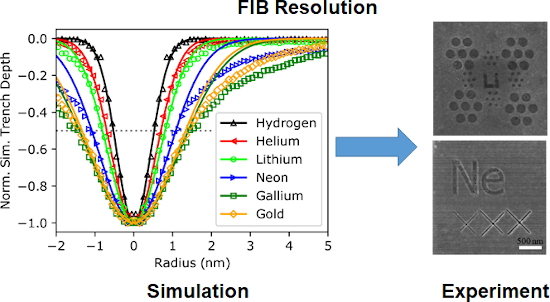
- mass-separated FIBs from a Co36Nd64 LMAIS to implant Co into Si at elevated temperatures, leading to metallic CoSi2 nanostructures down to 20 nm [13]. Ge nanowires could be grown by molecular beam epitaxy, via a vapor–liquid–solid process, on a Si substrate after formation of a regular seed array using


A self-powered, flexible ultra-thin Si/ZnO nanowire photodetector as full-spectrum optical sensor and pyroelectric nanogenerator
Beilstein J. Nanotechnol. 2020, 11, 1623–1630, doi:10.3762/bjnano.11.145
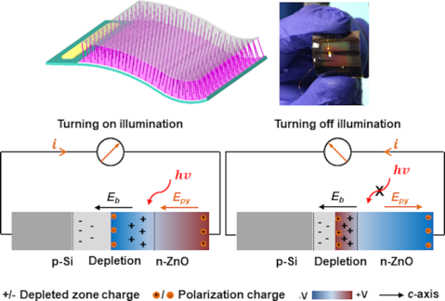
- -performance PDs for full-spectrum communication and PENGs utilizing a simple and low-cost method, which offer potential applications in self-powered flexible electronic devices. Experimental Fabrication process of the device: Firstly, the ultra-thin (45 μm) p-Si substrate was prepared by isotropic chemical
- etching. More specifically, a 500 μm p-type high conductivity Si substrate was dipped into potassium hydrate (KOH) solution with a concentration of 50% at 130 °C for 6–8 h. Then, the obtained 45 μm p-Si was washed with acetone, isopropanol, and deionized water. Secondly, a thin ZnO seed layer was


High-responsivity hybrid α-Ag2S/Si photodetector prepared by pulsed laser ablation in liquid
Beilstein J. Nanotechnol. 2020, 11, 1596–1607, doi:10.3762/bjnano.11.142
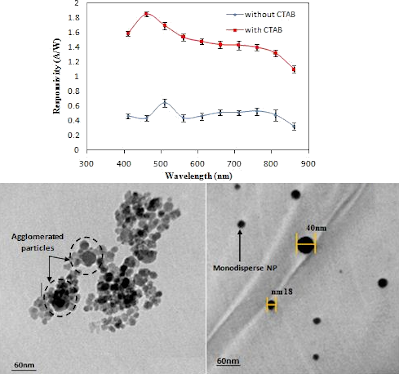
- from the generated e–h pairs in the depletion region; this process occurred when hν ≥ Eg (Ag2S NPs). As shown in Figure 14, the electrons drifted to Ag2S, and the holes diffused toward the p-Si substrate. Conclusion In this work, we successfully prepared monodisperse Ag2S NPs by laser ablation of a




Fabrication of nano/microstructures for SERS substrates using an electrochemical method
Beilstein J. Nanotechnol. 2020, 11, 1568–1576, doi:10.3762/bjnano.11.139
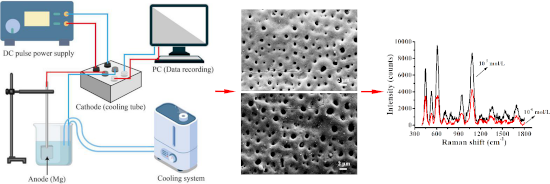
- over a 20 × 20 μm2 area. Before the tests, the Raman spectra were rectified using a standard Si substrate. A Raman intensity peak of 1362 cm−1 for R6G was chosen in the experiment. An atomic force microscopy (AFM) system (Dimension Icon, Bruker, Germany) was employed to detect the two-dimensional and


Analysis of catalyst surface wetting: the early stage of epitaxial germanium nanowire growth
Beilstein J. Nanotechnol. 2020, 11, 1371–1380, doi:10.3762/bjnano.11.121
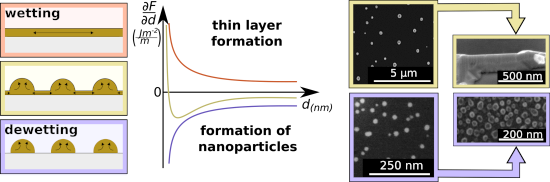
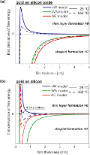
- were formed throughout the sample surface. The results for gold and germanium deposition onto a silicon substrate are shown in Figure 4c and Figure 4d, respectively. In Figure 4c, the gold droplets formed on the Si substrate were larger than the ones formed on the SiOx substrate (Figure 4b). When


Band tail state related photoluminescence and photoresponse of ZnMgO solid solution nanostructured films
Beilstein J. Nanotechnol. 2020, 11, 899–910, doi:10.3762/bjnano.11.75
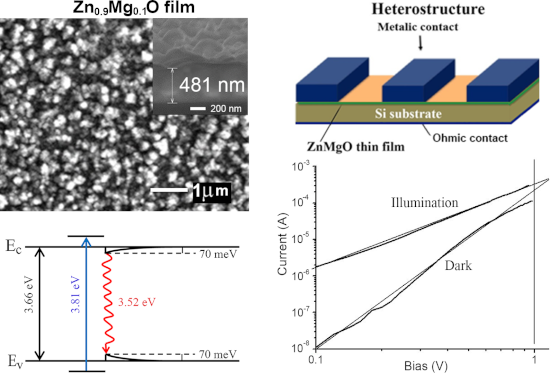
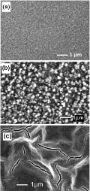
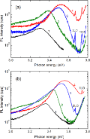
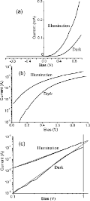
- contact on the p-type Si substrate. Figure 9 and Figure 10 compare the current–voltage characteristics of p-Si/n-Zn1−xMgxO heterojunctions for two films deposited by spin coating with x values of 0.10 (Figure 9) and 0.40 (Figure 10). One can see from Figure 9b and Figure 10b that in both cases the current
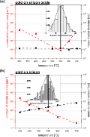
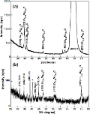
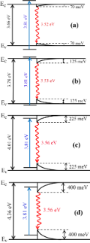
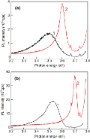
- ), annealed at 400 °C and measured at a) 300 K and b) 20 K. For comparison, the spectrum of a bulk ZnO single crystal is shown by curve (4). a) XRD pattern of a Zn0.8Mg0.2O film deposited by spin coating on a Si substrate and annealed at 500 °C. b) XRD pattern of a Zn0.8Mg0.2O film deposited by spin coating

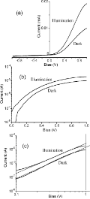
Templating effect of single-layer graphene supported by an insulating substrate on the molecular orientation of lead phthalocyanine
Beilstein J. Nanotechnol. 2020, 11, 814–820, doi:10.3762/bjnano.11.66
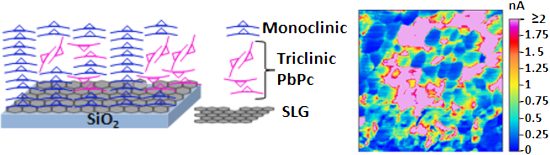
- of PbPc on graphene revealing interconnected highly conducting domains. Results and Discussion The Raman spectrum of CVD-grown single-layer graphene transferred onto a SiO2/Si substrate (referred to as SLG/SiO2/Si hereafter) is presented in Figure 2. A sharp and strong peak at 2680 cm−1 corresponds
- found to be 2.82 nm. Wang et al. carried out a similar study by depositing a 10 nm thin ZnPc film on a graphene/SiO2/Si substrate to study the effects of the molecular orientation on the interfacial electronic properties. The roughness of the film was reported to be 2.47 ± 0.28 nm [19]. The crystallite
- thus give rise to higher current values. Conclusion Structural studies of a thin layer of PbPc (10 nm) deposited on CVD-grown single-layer graphene supported on a SiO2/Si substrate show the presence of a mixture of monoclinic and triclinic polymorphs with, respectively, face-on and edge-on


Hexagonal boron nitride: a review of the emerging material platform for single-photon sources and the spin–photon interface
Beilstein J. Nanotechnol. 2020, 11, 740–769, doi:10.3762/bjnano.11.61


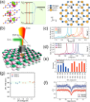


Structural optical and electrical properties of a transparent conductive ITO/Al–Ag/ITO multilayer contact
Beilstein J. Nanotechnol. 2020, 11, 695–702, doi:10.3762/bjnano.11.57
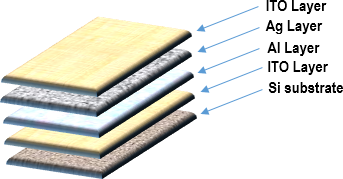
- annealing on the Si substrate obtained using energy-dispersive X-ray spectroscopy (EDXS) are displayed in Table 1. A reduction of the oxygen content was observed after annealing. The content of metal and semiconductor materials accordingly increases. Si as substrate material shows the highest content. The


Electromigration-induced directional steps towards the formation of single atomic Ag contacts
Beilstein J. Nanotechnol. 2020, 11, 680–687, doi:10.3762/bjnano.11.55
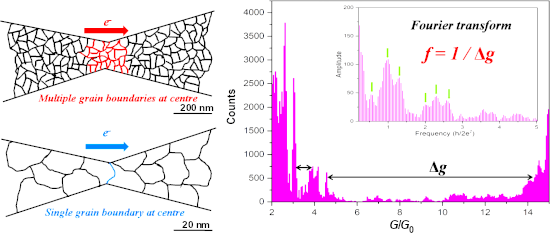
- ; nanostructures; silver; Si substrate; Introduction The transition from a three-dimensional (3D) conductor to single atomic chains or atomic point contacts is an intriguing process, which has been addressed many times over the years. Its many aspects ranging from bulk solid-state physics to the stability of


Evolution of Ag nanostructures created from thin films: UV–vis absorption and its theoretical predictions
Beilstein J. Nanotechnol. 2020, 11, 494–507, doi:10.3762/bjnano.11.40
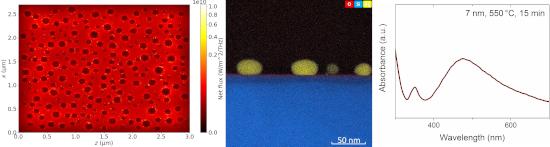
- , modelled as spheres truncated by 25% and flattened on the y axis to 60% of the initial size (Figure 1) on a Si substrate were reproduced on a sample of size 2.7 × 3.0 µm (Figure 2). Modelling the whole sample with regards to a realistic shape of the nanoparticles based on TEM images (see Figure 8 below
- , illustrating the shape of the Ag nanoparticles, modelled as truncated and flattened spheres (brown) on a Si substrate (yellow), in air (light blue). Top view of the simulation setup. SEM images of the films after annealing at 250 °C for 15 min. Initial film thickness was: (a) 1 nm, (b) 2 nm, (c) 3 nm, (d) 4 nm


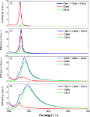


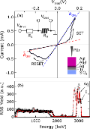
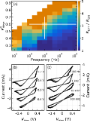
Nanosecond resistive switching in Ag/AgI/PtIr nanojunctions
Beilstein J. Nanotechnol. 2020, 11, 92–100, doi:10.3762/bjnano.11.9
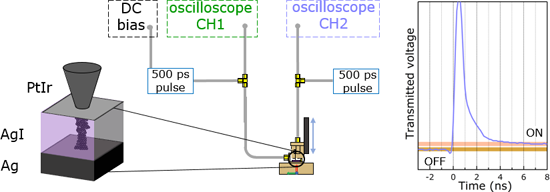
- structure (top to bottom) of 200 nm AgI, 22.5 nm Ag3I and 43 nm Ag after iodine exposure on the Ti/SiO2/Si substrate. Nanometer-scale Ag/AgI/PtIr nanojunctions were created by bringing the PtIr tip into direct contact with the thin-film surface while a constant bias voltage of 100 mV was applied on the


The effect of heat treatment on the morphology and mobility of Au nanoparticles
Beilstein J. Nanotechnol. 2020, 11, 61–67, doi:10.3762/bjnano.11.6
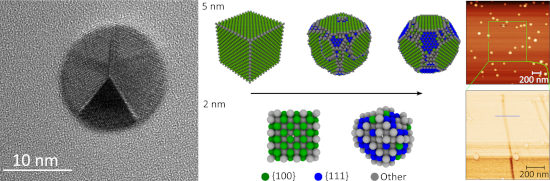
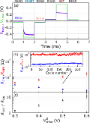
- , Latvia 10.3762/bjnano.11.6 Abstract In the present paper, we investigate the effect of heat treatment on the geometry and mobility of Au nanoparticles (NPs) on a Si substrate. Chemically synthesized Au NPs of diameter ranging from 5 to 27 nm were annealed at 200, 400, 600 and 800 °C for 1 h. A change in
- particles became immovable again. This effect was attributed to the diffusion of Au into the Si substrate and to the growth of the SiO2 layer. Keywords: annealing; atomic force microscopy (AFM); Au nanoparticles; manipulation; melting; nanotribology; Introduction Gold is one of the most prominent
- diffusion of Au into the Si substrate. It is known that gold diffuses into silicon at higher temperatures by the so-called kick-out mechanism, in which self-interstitials present at thermal equilibrium displace substitutionally dissolved Au atoms into interstices, such that these may undergo rapid


Label-free highly sensitive probe detection with novel hierarchical SERS substrates fabricated by nanoindentation and chemical reaction methods
Beilstein J. Nanotechnol. 2019, 10, 2483–2496, doi:10.3762/bjnano.10.239
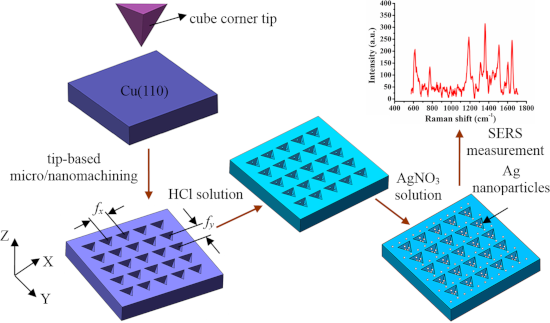
- diameter was about 1 μm. The signal detector was a Renishaw CCD camera (1040 × 256). The Raman spectrum was validated with a standard Si substrate, without finding specific peaks. The Raman intensity peaks of the R6G probe and malachite green molecules were chosen as 1362 cm−1 or 1614 cm−1, which are the


The importance of design in nanoarchitectonics: multifractality in MACE silicon nanowires
Beilstein J. Nanotechnol. 2019, 10, 2094–2102, doi:10.3762/bjnano.10.204
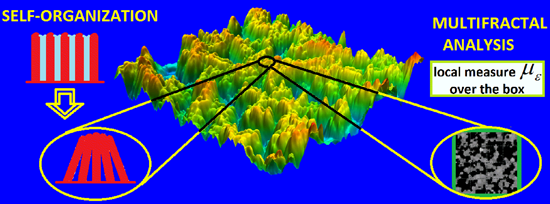
- Si substrate by electron beam evaporation. The conditions during the growth of the gold thin film were similar to the ones during the growth of the samples SiNW1 and SiNW2. The black regions correspond to the uncovered silicon areas, while the white region represents the deposited Au. It is evident




Fabrication and characterization of Si1−xGex nanocrystals in as-grown and annealed structures: a comparative study
Beilstein J. Nanotechnol. 2019, 10, 1873–1882, doi:10.3762/bjnano.10.182
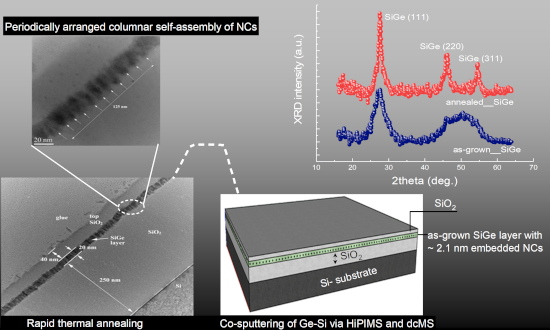
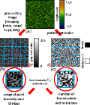
- such that the Si substrate spots together with the ring spots of the SiGe polycrystalline layer were measured. A description of this analysis is given in our previous work [23]. The bright spots are due to Si substrate and the smaller and less bright spots are due to SiGe NCs. The white circular cloud
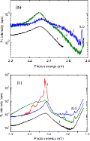
- photocurrent spectra of as-grown structure (SiGe via dcMS and HiPIMS) are shown in Figure 7a. Deconvolution was carried out to obtain the individual peaks. The observed peaks were assigned to interface related localized states (peak I), the photo effect from NCs (peak N) and capacitive coupling from Si
- substrate, i.e., surface photo-voltage (SPV) and gating effect (peak S). Figure 7b shows the photocurrent for structures of the same batch that underwent annealing procedure for a short period of 1 min at different temperatures. A large increase in intensity was observed by increased annealing temperature


Remarkable electronic and optical anisotropy of layered 1T’-WTe2 2D materials
Beilstein J. Nanotechnol. 2019, 10, 1745–1753, doi:10.3762/bjnano.10.170
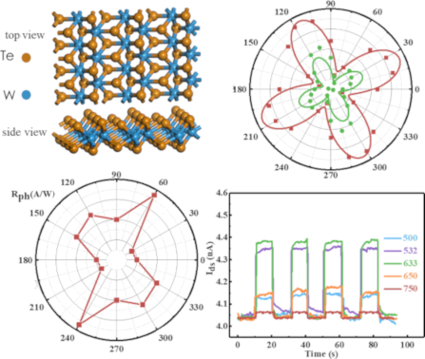
- novel device concepts by utilizing its angle-resolved and wavelength-dependent properties. Methods Exfoliation and characterization of 1T’-WTe2 flakes The 1T’-WTe2 single crystals were purchased from XianFeng Nano Corporation. A blue film was used to exfoliate 1T’-WTe2 onto the N++-doped Si substrate


Subsurface imaging of flexible circuits via contact resonance atomic force microscopy
Beilstein J. Nanotechnol. 2019, 10, 1636–1647, doi:10.3762/bjnano.10.159
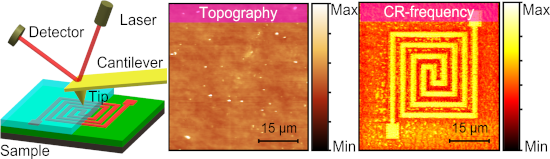
- on the tip and the bottom of the Si substrate was fixed. Because the contact stiffness is the derivative of loading force to elastic deformation, we used the following approximation [43], Here, ΔFi is the difference of the applied forces between load steps i + 1 and i, and Δdi is the difference of
- thickness. Such a behaviour is due to the influence of the Si substrate. When the bottom layer becomes thicker, the substrate effect is less significant. For the middle layer thickness, there is an inflection point at approximately 300 nm. The contact stiffness contrast first drastically increases with



Development of a new hybrid approach combining AFM and SEM for the nanoparticle dimensional metrology
Beilstein J. Nanotechnol. 2019, 10, 1523–1536, doi:10.3762/bjnano.10.150
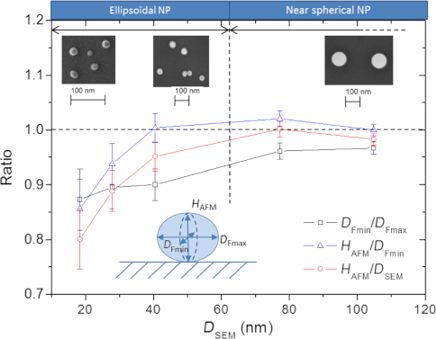
- defined by: where K the equivalent elastic modulus of the NP and the substrate defined by: where Ei and νi are the Young’s modulus and the Poisson’s ratio of the sphere and the half space. The depth of indentation δ, i.e., the elastic displacement is defined by: In the case of silica NPs deposited on a Si
- substrate under ambient conditions, since the area/volume ratio becomes important, capillary adhesion forces must be taken into account. Deformations of the silica NP and substrate can be assessed using the model developed by Derjaguin, Muller and Toporov (DMT) [33]. This model describes the elastic