


Search results
Search for "calibration" in Full Text gives 358 result(s) in Beilstein Journal of Nanotechnology. Showing first 200.
New application of bimetallic Ag/Pt nanoplates in a colorimetric biosensor for specific detection of E. coli in water
Beilstein J. Nanotechnol. 2024, 15, 95–103, doi:10.3762/bjnano.15.9
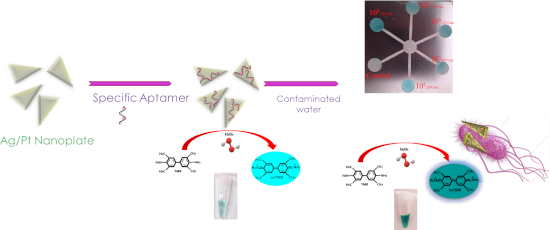
- limit (LOD) was calculated to be 10 CFU·mL−1 (S/N) after a 30 min detection time with the naked eye, indicating that the concentration of E. coli in the sample was growing (Figure 3c). If the sample color is too subtle, we can enter the amount of gray intensity of the sample in the calibration curve and
- /Pt NPL. a) Absorbance spectra of Ag/Pt NPL after the addition of TMB, TMB and H2O2, NPL, and aptamer-NPL in the presence of TMB-H2O2. b) Image related to the color change of the proposed NPL, c) the zeta potential of NPL, aptamer-NPL, E. coli bacteria, and NPL-E. coli. a) The calibration curve of


Berberine-loaded polylactic acid nanofiber scaffold as a drug delivery system: The relationship between chemical characteristics, drug-release behavior, and antibacterial efficiency
Beilstein J. Nanotechnol. 2024, 15, 71–82, doi:10.3762/bjnano.15.7
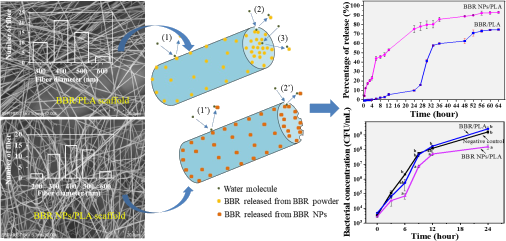
- between their antibacterial activity with the BBR release profile from these scaffolds. To determine the concentration of BBR in the nutrient solution, a standard calibration curve of UV–vis absorbance versus BBR concentrations was built as follows: 1 mg of BBR powder was dissolved in 1 mL of bidistilled
- Multi-function shaker at room temperature with constant agitation at 40 rpm. At each time interval, 2 mL of each solution was withdrawn, the UV–vis absorbance at 421 nm was measured, and then the amount of BBR release based on the standard calibration curve was calculated. The percentage of released BBR


Measurements of dichroic bow-tie antenna arrays with integrated cold-electron bolometers using YBCO oscillators
Beilstein J. Nanotechnol. 2024, 15, 26–36, doi:10.3762/bjnano.15.3
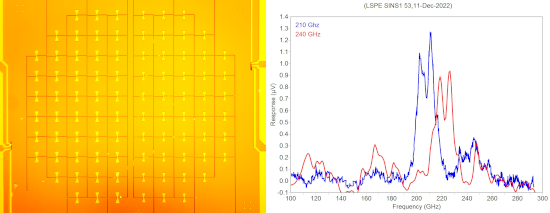
- instrument for measuring the B mode polarization pattern of the CMB. It is a ground-based experiment planned to be placed in Argentina at Alto Chorrillos in the Santa province. This polarimeter is equipped with bolometric interferometers featuring self-calibration ability for systematic controlling of
- TESs as detectors coupled to the optics and microwave-multiplexing SQUID readout. The 220/280 GHz band will have 1728 active detectors and 36 so-called “dark” detectors, used for calibration, per array. The AliCPT [7] is a ground-based experimental setup aimed at CMB measurements in Tibet, China, at an


unDrift: A versatile software for fast offline SPM image drift correction
Beilstein J. Nanotechnol. 2023, 14, 1225–1237, doi:10.3762/bjnano.14.101
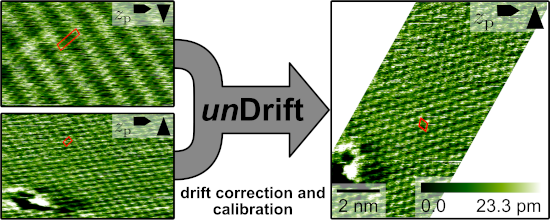
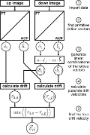
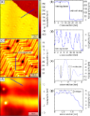
- force microscopy; calibration; drift correction; image correlation functions; periodic structures; scanning probe microscopy; Introduction In science and technology, scanning probe microscopy (SPM) techniques are widely used to study the structure and properties of surfaces and interfaces from the
- resulting in an image of the structure or a specific surface property. This scanning process is also the origin of two prominent artifacts in SPM image data, that is, an imperfect scanner calibration and thermal drift. Both of which cause a misalignment between probe and surface; thus, the measured SPM
- images are distorted and potentially shifted [1][2][3][4][5][6]. The calibration of an SPM scanner is used by the SPM instrument to convert the voltages applied to the scanner piezo into a probe position [2][7]. If this calibration is not correct, the position assumed by the SPM instrument deviates from


Determination of the radii of coated and uncoated silicon AFM sharp tips using a height calibration standard grating and a nonlinear regression function
Beilstein J. Nanotechnol. 2023, 14, 1200–1207, doi:10.3762/bjnano.14.99
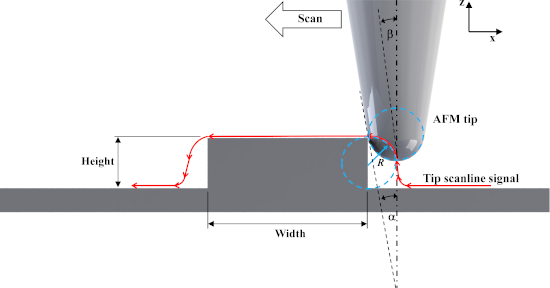
- -coated, Cr/Au-coated, and uncoated Si tips were used to scan a calibration standard grating in AFM contact mode with sub-nanonewton load to obtain the curved scan profile of the edge corner of the grating structure. The data points of the curved profile of each tip were fitted with a nonlinear regression
- . However, this method yields an accurate estimate of the tip radius with a low root mean squared error of the curve fitting results. Keywords: AFM tip calibration; nonlinear regression curve fitting; Introduction Atomic force microscopy (AFM) with a sharp tip is typically used to characterize
- measured using a tip characterizer and tip qualification or standard calibration grating. In one of those studies, the tip geometry was determined by using a well-known sharp-edged silicon structure, which included height patterns with a certified pitch on a nanostructure plate [10]. Three types of AFM


A multi-resistance wide-range calibration sample for conductive probe atomic force microscopy measurements
Beilstein J. Nanotechnol. 2023, 14, 1141–1148, doi:10.3762/bjnano.14.94
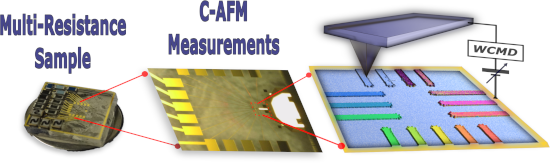
- restricted to qualitative comparisons. Reference resistance calibration samples are key to advancing the research-to-manufacturing process of nanoscale devices and materials through calibrated, reliable, and comparable measurements. No such calibration reference samples have been proposed so far. In this
- work, we demonstrate the development of a multi-resistance reference sample for calibrating resistance measurements in conductive probe atomic force microscopy (C-AFM) covering the range from 100 Ω to 100 GΩ. We present a comprehensive protocol for in situ calibration of the whole measurement circuit
- encompassing the tip, the current sensing device, and the system controller. Furthermore, we show that our developed resistance reference enables the calibration of C-AFM with a combined relative uncertainty (given at one standard deviation) lower than 2.5% over an extended range from 10 kΩ to 100 GΩ and lower


Dual-heterodyne Kelvin probe force microscopy
Beilstein J. Nanotechnol. 2023, 14, 1068–1084, doi:10.3762/bjnano.14.88
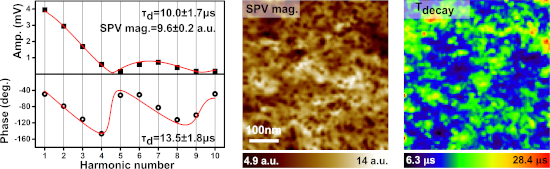
- transfer function calibration. More importantly, there is virtually no limit to the number of harmonics that can be probed and the time resolution, other than that imposed by the maximum modulation/demodulation frequencies allowed by the lock-in units and the AWG. Last but not least, DHe-KPFM can be




Exploring internal structures and properties of terpolymer fibers via real-space characterizations
Beilstein J. Nanotechnol. 2023, 14, 1004–1017, doi:10.3762/bjnano.14.83
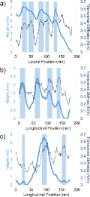
- for pre- and post-scans to confirm calibration. Additional scans were obtained from other regions within the same fibers, as well as other fibers, and we observed similar features to those reported here. For clarity, our analysis has focused on regions that were most clearly defined in AFM scans. Line






Fragmentation of metal(II) bis(acetylacetonate) complexes induced by slow electrons
Beilstein J. Nanotechnol. 2023, 14, 980–987, doi:10.3762/bjnano.14.81
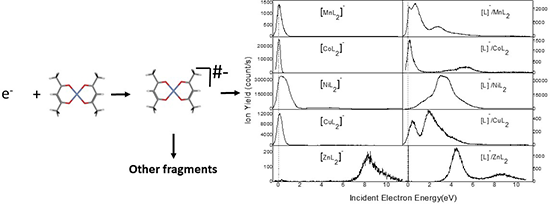
- scale was calibrated using a flow of SF6 gas through the oven that produced the well-known SF6− resonance near 0 eV. The measurements were performed without the presence of the calibration gas, avoiding potentially unwanted reactions such as dissociative electron transfer with the investigated molecules


Silver-based SERS substrates fabricated using a 3D printed microfluidic device
Beilstein J. Nanotechnol. 2023, 14, 793–803, doi:10.3762/bjnano.14.65
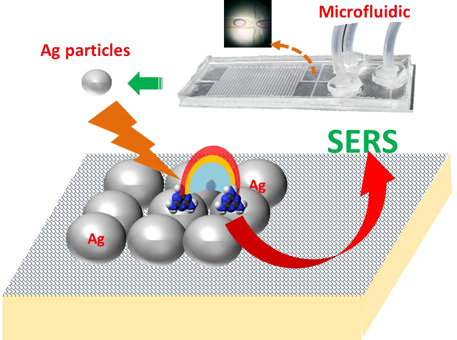
- PS40min@Ag substrate (Figure 5a). The SERS intensity of RhB increased as the concentration increased. Figure 5b illustrates the correlation between RhB concentration and the peak intensity at 621 cm−1, which was used to create a linear calibration with a high regression coefficient of R2 = 0.99968. By



Cross-sectional Kelvin probe force microscopy on III–V epitaxial multilayer stacks: challenges and perspectives
Beilstein J. Nanotechnol. 2023, 14, 725–737, doi:10.3762/bjnano.14.59
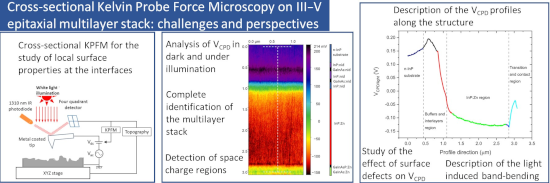
- the growth rates at the two surface temperatures, which were around 2.13 μm·h−1. The second part of the structure corresponds to the Zn calibration stack used for the p-type cladding of the multiple quantum well-based structure. The doping concentration of the InP:Zn layers was varied from 2 × 10¹⁸ to


A graphene quantum dots–glassy carbon electrode-based electrochemical sensor for monitoring malathion
Beilstein J. Nanotechnol. 2023, 14, 701–710, doi:10.3762/bjnano.14.56
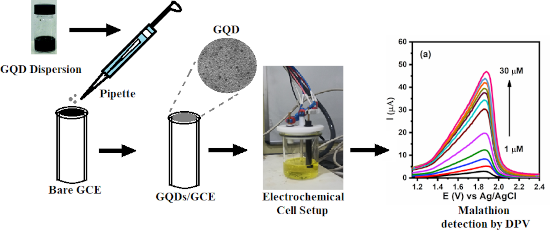
- concentration for malathion detection is: Using the equation kSb/m [35], where Sb represents standard deviation of the peak current of the blank, m represents the slope of the calibration plot, k has a value of 3, the limit of detection (LOD) was calculated to be 0.62 nM. In a similar manner, the limit of


Metal-organic framework-based nanomaterials as opto-electrochemical sensors for the detection of antibiotics and hormones: A review
Beilstein J. Nanotechnol. 2023, 14, 631–673, doi:10.3762/bjnano.14.52
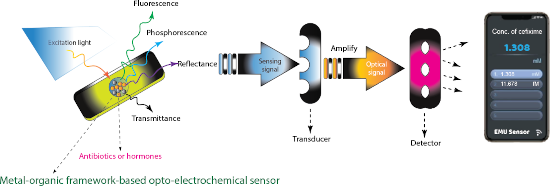
- increases. Generally, it is acknowledged that the CLOD can be stated as a function of S and Sb (the standard deviation of a group of blank signals produced via consecutive tests devoid of an analyte): LOD = 3.3·Sb/S where S = slope of the calibration curve. Also, the slope of the calibration curve can be


Quercetin- and caffeic acid-functionalized chitosan-capped colloidal silver nanoparticles: one-pot synthesis, characterization, and anticancer and antibacterial activities
Beilstein J. Nanotechnol. 2023, 14, 362–376, doi:10.3762/bjnano.14.31
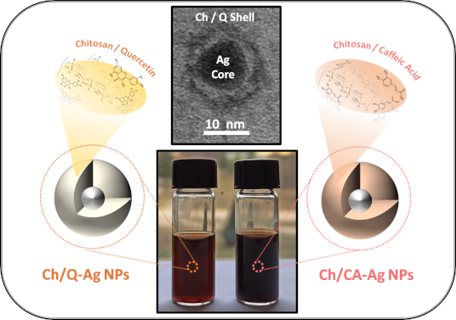
- solution [67]. Because of the formation of the quercetin–AlCl3 complex, a red shift is observed in the absorption peaks of the quercetin. Since the absorption band observed between 400 and 450 nm does not have any overlap with pure quercetin, it is generally used to draw the calibration curve. Considering
- the calibration curve (Figure 5b). From this calibration curve and the absorbance of the Ch/Q-Ag sample measured at 433 nm, the amount of quercetin in the Ch/Q-Ag sample was determined to be approximately 31.0 ± 0.8 μg/mL. Similarly, the amount of caffeic acid, which is a phenolic compound, in the Ch
- the concentration of phenolics. Figure 5c shows the absorption spectra of pure caffeic acid (inset graph) and caffeic acid–FC–Na2CO3 mixtures. The calibration curve was obtained using absorbance values at 762 nm (Figure 5d). Since the phenolic content will be proportional to the amount of caffeic acid


Observation of collective excitation of surface plasmon resonances in large Josephson junction arrays
Beilstein J. Nanotechnol. 2022, 13, 1578–1588, doi:10.3762/bjnano.13.132
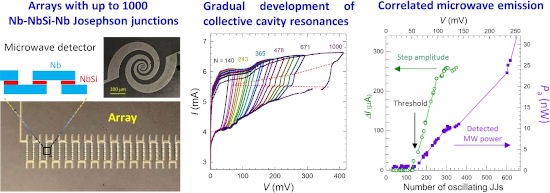
- calibrate the detector, we use a MW source with f = 74.5 GHz. Figure 6c represents a sketch of the calibration setup. The detector is placed in an optical cryostat and the gigahertz signal is guided through an optical window using two high-density polyethylene lenses. The gigahertz source is linearly
- suppression of Is corresponds to the absorbed MW power, Pa ≃ ≃ 30 nW. Thus, we can perform an absolute calibration of the absorbed power as a function of the detector resistance, as shown in Figure 6f. The absorbed power depends on the absorption efficiency, γ, the antenna area, Aa, and the power density
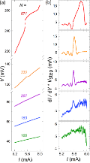
- from Figure 5b. The latter data set was multiplied with a calibration factor of 2.63 in order to merge it with direct measurements of ΔI in the range 300 < N < 500 where both methods are working well. A quasi-linear growth in ΔI(N) starting from the threshold number Nth ≃ 150 is observed. However, as




Rapid and sensitive detection of box turtles using an electrochemical DNA biosensor based on a gold/graphene nanocomposite
Beilstein J. Nanotechnol. 2022, 13, 1458–1472, doi:10.3762/bjnano.13.120
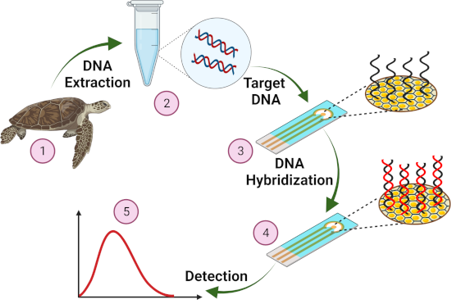
- 1 × 10⁻⁵ M. The DPV peak current increased as the reverse complementary DNA concentration increased, as seen in Figure 6a. A calibration curve was constructed using log10 concentration of DNA to test the linearity of the DNA concentration with peak current (Figure 6b). The curve exhibited good



Orally administered docetaxel-loaded chitosan-decorated cationic PLGA nanoparticles for intestinal tumors: formulation, comprehensive in vitro characterization, and release kinetics
Beilstein J. Nanotechnol. 2022, 13, 1393–1407, doi:10.3762/bjnano.13.115
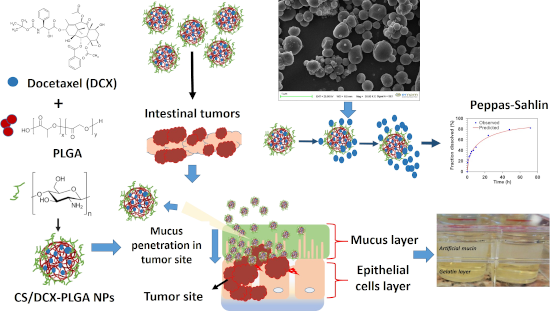
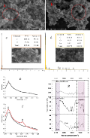
- (LOQ) were determined for validation of the spectrophotometric method used for DCX quantification. Absorbance values for the amount of DCX were converted to concentration according to the standard calibration curve (r2 = 0.994). LOD and LOQ values were calculated as 0.0173 mg/mL and 0.0634 mg/mL


Studies of probe tip materials by atomic force microscopy: a review
Beilstein J. Nanotechnol. 2022, 13, 1256–1267, doi:10.3762/bjnano.13.104
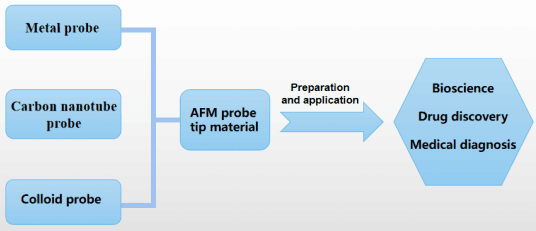
- adjustments are made to its cantilever dynamics, the calibration accuracy of CPs does not fluctuate when the additional mass of the ball is the same as the cantilever. In the type of large CPs, applying the homogeneity theorem for topless cantilever beams to Equation 1 can achieve accurate calibration. These
A cantilever-based, ultrahigh-vacuum, low-temperature scanning probe instrument for multidimensional scanning force microscopy
Beilstein J. Nanotechnol. 2022, 13, 1120–1140, doi:10.3762/bjnano.13.95
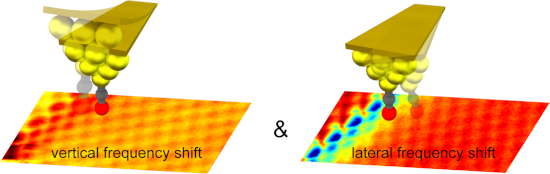
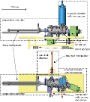
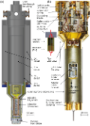
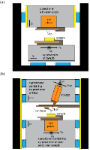
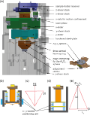
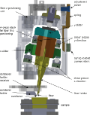
- oscillation amplitude, without the need of a complicated calibration [43][44][45]. Fiber-optical sensors can obtain sensitivities up to about 1 fm/ using Fabry–Pérot interferometry [46][47]. To date, however, we only implemented a simpler form of the interferometer composed of a cleaved and uncoated fiber end





DNA aptamer selection and construction of an aptasensor based on graphene FETs for Zika virus NS1 protein detection
Beilstein J. Nanotechnol. 2022, 13, 873–881, doi:10.3762/bjnano.13.78
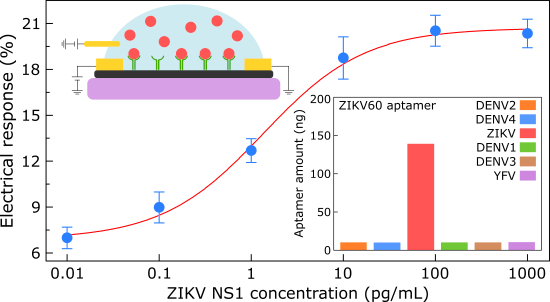
- graphene devices, whose detection range extends from 0.1 to 100 pg/mL, see Figure S5 (Supporting Information File 1) for more details. We therefore analyzed in depth the general dose-dependent responses of all seven aptasensors. Figure 5a exhibits a calibration curve for ZIKV NS1 detection, reflecting the
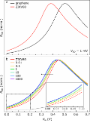
- /mL. The inset highlights the portion of each graphene transfer curve extending from 0.00 to 0.20 V. In each measurement, ZIKV NS1 protein was diluted in human serum, which was used as electrolyte for gating. Calibration curve for ZIKV NS1 protein detection. Percentage change in graphene resistance



Optimizing PMMA solutions to suppress contamination in the transfer of CVD graphene for batch production
Beilstein J. Nanotechnol. 2022, 13, 796–806, doi:10.3762/bjnano.13.70
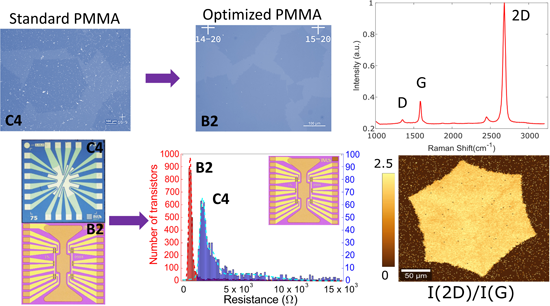
- . The characteristic Raman signature collected from a p-doped Si wafer at 520.7 cm−1 was employed as standard calibration. Raman mapping was conducted by raster scan, where the step size of the laser spot moving over a selected area is 1 µm, and the exposure time of 0.4 s was taken at each point of the




Gelatin nanoparticles with tunable mechanical properties: effect of crosslinking time and loading
Beilstein J. Nanotechnol. 2022, 13, 778–787, doi:10.3762/bjnano.13.68
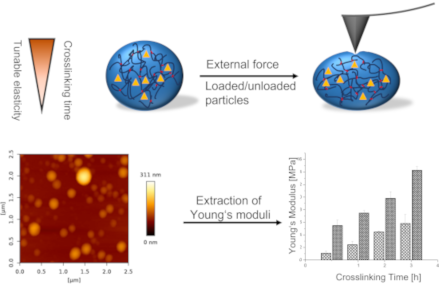
- incubation, samples were centrifuged. The fluorescence intensity of supernatants was measured with the spectrofluorometer Duetta™ (Horiba Europe GmbH, Oberursel, Germany) using an excitation wavelength of 493 nm and an emission wavelength of 519 nm. Concentrations were calculated using a calibration row made
- B: 90% acetonitrile, 10% Milli-Q® water and 0.1% trifluoro acetic acid. The flow rate was 0.8 mL/min, and a gradient was set from 100% A to 100% B in 15 min. The concentration was determined using a calibration row by different lysozyme concentrations and the resulting AUC/min extracted from the


A nonenzymatic reduced graphene oxide-based nanosensor for parathion
Beilstein J. Nanotechnol. 2022, 13, 730–744, doi:10.3762/bjnano.13.65
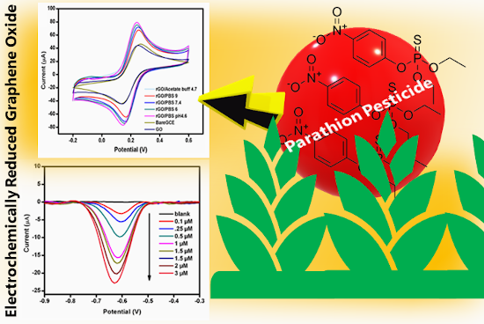
- due to π–π* transition was noted at 273 nm using ethanol as blank, and a calibration curve was plotted to compare the results obtained from the proposed nanosensor. Material characterization Voltammetric studies were carried out using an IVIUMStat electrochemical analyzer (Model: A09050, Iviumstat
- as the concentration of PT enhanced, indicating a diffusion-controlled process [40]. The concentration-dependent linear plot depicts good linearity (Figure 9B, Figure 9C) with a calibration equation of Ip (μA) = 3.5735 [PT] + 12.018 (R² = 0.9871) for the range of 0.1–11 μM, Ip (μA) = 0.2916 [PT
- linear curve (i.e., 0.03–0.15 nM)] and limit of quantification (LOQ = [(10 * SD of blank)/slope]) were calculated as 10.9 pM and 36.5 pM, respectively, from the lower calibration equation [39][41]. The selectivity of the proposed ERGO/GCE modified nanosensor (Figure 9D) was investigated in the presence


A new method for obtaining the magnetic shape anisotropy directly from electron tomography images
Beilstein J. Nanotechnol. 2022, 13, 590–598, doi:10.3762/bjnano.13.51
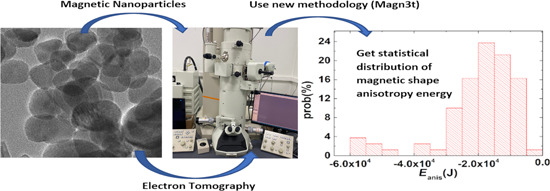
- circular transversal cross section. Using a calibration of 1.47 nm/px, it can be estimated that the MNPs have a cross section with an average diameter of roughly 30 nm whereas their length is, on average, slightly above 40 nm, which is compatible with the XRD measurements. Orientation data is given in


Ciprofloxacin-loaded dissolving polymeric microneedles as a potential therapeutic for the treatment of S. aureus skin infections
Beilstein J. Nanotechnol. 2022, 13, 517–527, doi:10.3762/bjnano.13.43
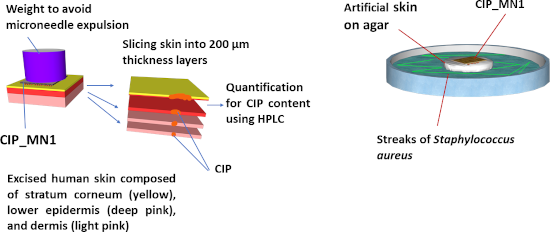
- isocratic composition of 0.025 M phosphoric acid (pH 3.0 ± 0.1) previously adjusted with triethylamine/acetonitrile (80:20 v/v), eluted at a flow rate of 1.5 mL/min. The injection volume was 20 µL. The drug concentration was then determined according to a calibration curve. The calibration curve was plotted





