


Search results
Search for "composite materials" in Full Text gives 130 result(s) in Beilstein Journal of Nanotechnology.
Synthesis of novel C-doped g-C3N4 nanosheets coupled with CdIn2S4 for enhanced photocatalytic hydrogen evolution
Beilstein J. Nanotechnol. 2019, 10, 912–921, doi:10.3762/bjnano.10.92
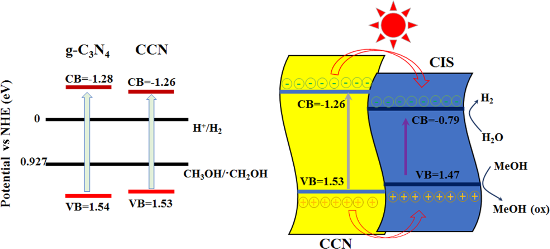
- . Keywords: C-doped g-C3N4; CdIn2S4; composite materials; hydrogen generation; photocatalysis; Introduction The serious environmental concerns and increasing global energy demand have instigated growing awareness in the field of alternative energy generation over the past few decades. Photocatalysis


An efficient electrode material for high performance solid-state hybrid supercapacitors based on a Cu/CuO/porous carbon nanofiber/TiO2 hybrid composite
Beilstein J. Nanotechnol. 2019, 10, 781–793, doi:10.3762/bjnano.10.78
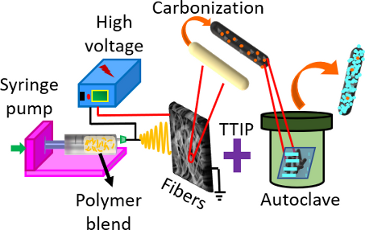
- . Overall, these composite materials offer a several advantages. First, the porous carbon of fiber morphology has a high aspect length-to-volume ratio and provides a reduced ion/electron diffusion path that allows fast, long-distance electron transport, which endows the necessary electrochemical performance
- , 297.5, 262.5, 245, 233.7 and 200 F g−1 at a current density of 1, 3.5, 5, 7, 8.5 and 10 A g−1, respectively. To the best of our knowledge, this is the best capacitance value ever achieved by solid state supercapacitors using metal oxide/carbon composite materials based on polymer gel electrolyte, and we
- clearly shows that a realistic SSHSC made by composite materials attains the highest energy density of 45.83 Wh kg−1 (calculated using Equation 3) at a power density of 1.27 kW kg−1 (calculated using Equation 4) at 0.8 V and 1 A g−1, respectively, which is superior to many of the earlier reported works


Widening of the electroactivity potential range by composite formation – capacitive properties of TiO2/BiVO4/PEDOT:PSS electrodes in contact with an aqueous electrolyte
Beilstein J. Nanotechnol. 2019, 10, 483–493, doi:10.3762/bjnano.10.49
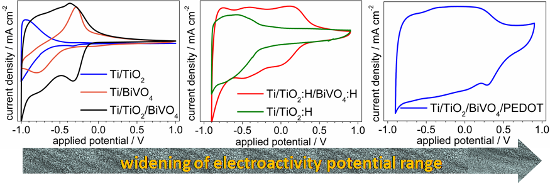
- materials characterized by a developed surface area [9], graphene-based [10] and diamond-based materials [11], conductive polymers (CPs) and hybrid materials [12][13], and numerous types of composite materials [14][15]. For many years, conjugated polymers, also known as conductive polymers, e.g., poly(3,4




Reduced graphene oxide supported C3N4 nanoflakes and quantum dots as metal-free catalysts for visible light assisted CO2 reduction
Beilstein J. Nanotechnol. 2019, 10, 448–458, doi:10.3762/bjnano.10.44
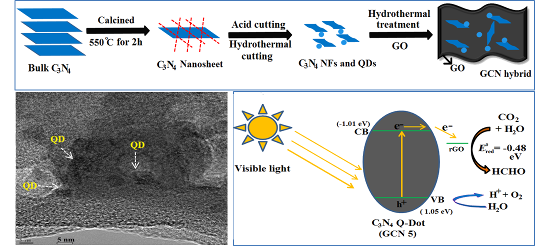
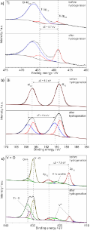
- material, the peaks related to rGO are not observed in the hybrid materials, which may be due to the low amount of rGO incorporation. Moreover, the peaks related to other impurities are not found in the pattern, indicating the formation of pure hybrid composite materials. The presence of rGO is confirmed





New micro/mesoporous nanocomposite material from low-cost sources for the efficient removal of aromatic and pathogenic pollutants from water
Beilstein J. Nanotechnol. 2019, 10, 119–131, doi:10.3762/bjnano.10.11
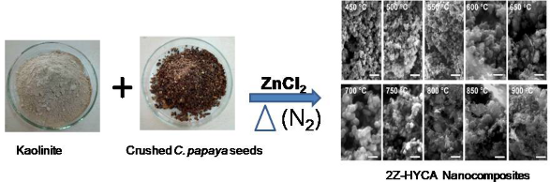
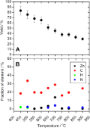
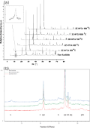
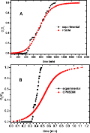
- nanocomposites obtained at various temperatures. “RK” indicates the spectrum of the raw kaolinite mentioned in the text. (a) XRD patterns of raw kaolinite clay and 2Z-HYCA composite materials obtained at various temperatures. (b) Powder X-ray diffraction (PXRD) diagrams of raw kaolinite (RK), raw kaolinite




Graphene–graphite hybrid epoxy composites with controllable workability for thermal management
Beilstein J. Nanotechnol. 2019, 10, 95–104, doi:10.3762/bjnano.10.9
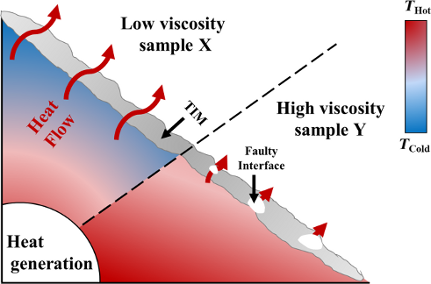
- for TIM applications, while maintaining desirable rheological properties [5][9][10][11][12][46]. In this study, a broader picture was obtained on the integration of graphite–GNP fillers and on the impact of viscosity on optimal design of composite materials for thermal management applications. The



The nanoscaled metal-organic framework ICR-2 as a carrier of porphyrins for photodynamic therapy
Beilstein J. Nanotechnol. 2018, 9, 2960–2967, doi:10.3762/bjnano.9.275
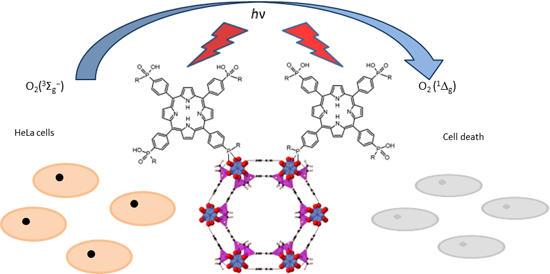
- identical conditions (e.g., irradiation wavelength, time, dose). We can compare the activity of nanoICR-2/TPPPi(Ph) with the activity of previously studied PCN-222 nanoparticles where both systems display comparable activity [22]. Conclusion In the context of photodynamic therapy, we present composite
- materials based on nanoparticles of the ICR-2 metal-organic framework decorated with phosphinic acid-substituted porphyrins. These substituted porphyrins showed superior affinity towards the Fe-MOF ICR-2 in comparison with the well-known tetracarboxyphenyl porphyrin, and this feature allows for superior


Graphene-enhanced metal oxide gas sensors at room temperature: a review
Beilstein J. Nanotechnol. 2018, 9, 2832–2844, doi:10.3762/bjnano.9.264
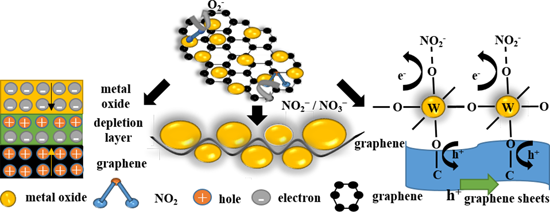
- turn leads to a high specific surface area. Graphene enhances the conductivity of the composite materials, enabling the composite sensors to achieve a high response at low operating temperatures. Moreover, the introduction of graphene provides more adsorption sites at the surface of the composite so



Nanostructured liquid crystal systems and applications
Beilstein J. Nanotechnol. 2018, 9, 2644–2645, doi:10.3762/bjnano.9.245

- . There have also been reports of some very interesting experiments with nanocomposites where the solid nanoparticles are dissolved in liquid crystals. Composite materials and mixtures of liquid crystals usually possess better properties than their pure liquid crystal counterparts. Many challenges could
Hydrothermal-derived carbon as a stabilizing matrix for improved cycling performance of silicon-based anodes for lithium-ion full cells
Beilstein J. Nanotechnol. 2018, 9, 2381–2395, doi:10.3762/bjnano.9.223
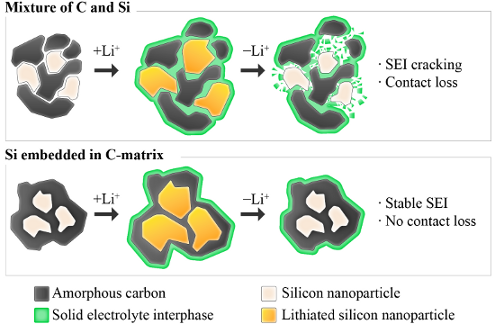
- morphology and structure of the composite materials, as well as the resilience of the hydrothermal carbon against the volumetric changes of Si, in order to examine the opportunities and limitations of the applied matrix approach. Compared to a physical mixture of Si-NPs and the pure carbon matrix, the
- -type) was used to investigate the morphology of the synthesized composite materials. Cycled electrodes were analyzed after washing with DMC and drying in an argon filled glovebox. Multiple areas per sample were analyzed using an Auriga CrossBeam workstation from Zeiss at an acceleration voltage of 3 kV
- . Energy-dispersive X-ray spectroscopy (EDX) measurements were used to investigate the elemental composition of the composite materials using an acceleration voltage of 20 kV. The EDX signal was detected by an X-Max 80 mm2 detector and evaluated with the INCA software, both from Oxford Instruments. Cross


Electrospun one-dimensional nanostructures: a new horizon for gas sensing materials
Beilstein J. Nanotechnol. 2018, 9, 2128–2170, doi:10.3762/bjnano.9.202
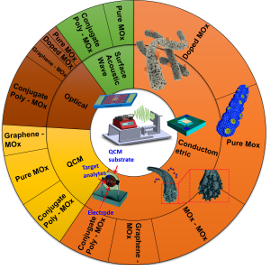
- electrospun nanofibers as the sensing layer. These materials include: metal oxide (MOx) semiconductors (e.g., SnO2, TiO2, SiO2) [83][84], doped MOx semiconductors [4][5][6][7][8][9][10][11], composite materials made of MOx semiconducting materials (e.g., ZnO-In2O3) [86], conducting polymer-based gas sensors






A scanning probe microscopy study of nanostructured TiO2/poly(3-hexylthiophene) hybrid heterojunctions for photovoltaic applications
Beilstein J. Nanotechnol. 2018, 9, 2087–2096, doi:10.3762/bjnano.9.197
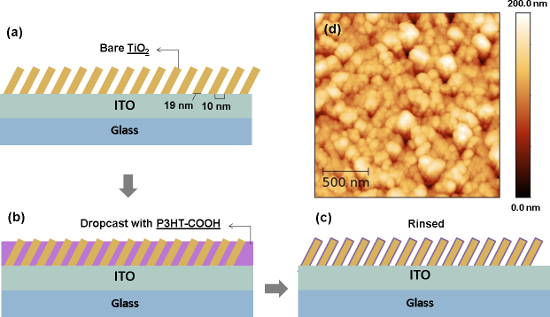
- illumination. The result aimed at demonstrating the absence of light-induced artefact during the recording of topography, as well as the negligibility of the photovoltaic effect at the TiO2/ITO interface. Acknowledgements The authors are grateful to R. Di Ciuccio (Laboratory of Polymeric and Composite
- Materials, University of Mons) for the synthesis of P3HT-COOH. The nanoporous TiO2 layers were synthesized by J. Delvaux (Laboratory of Plasma-Surface Interactions Chemistry, University of Mons). This work was supported by the Action de Recherche Concertée program (MADSSCELLS project), the Science Policy


Defect formation in multiwalled carbon nanotubes under low-energy He and Ne ion irradiation
Beilstein J. Nanotechnol. 2018, 9, 1951–1963, doi:10.3762/bjnano.9.186
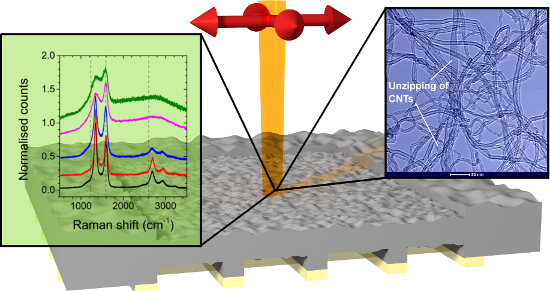
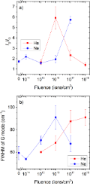
- defect production in SWCNTs [26], the characterisation of composite materials containing MWCNTs [27], the implantation of Si and C ions into DWCNTs [28], and to differentiate between carbon materials with different sp2 environment [29]. The latter study focused on graphene, highly oriented pyrolytic



Uniform cobalt nanoparticles embedded in hexagonal mesoporous nanoplates as a magnetically separable, recyclable adsorbent
Beilstein J. Nanotechnol. 2018, 9, 1770–1781, doi:10.3762/bjnano.9.168
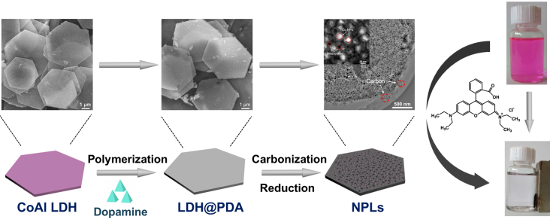
- composite materials are expected to show excellent performance in the preparation of TM-MCNs. Here we report a facile approach for the preparation of novel hexagonal nanoplates (NPLs) containing magnetic Co nanoparticles (in CoAl2O4 phase) and porous carbon by carbonizing PDA-coated CoAl LDH, which can be


Photoluminescence of CdSe/ZnS quantum dots in nematic liquid crystals in electric fields
Beilstein J. Nanotechnol. 2018, 9, 1544–1549, doi:10.3762/bjnano.9.145
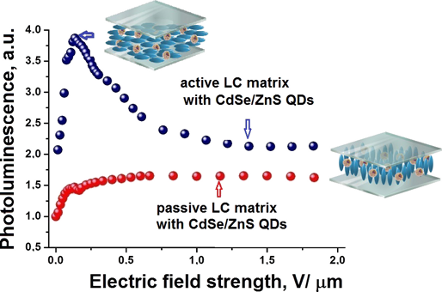
- nanocrystals. These nanoparticles (NPs) of spherical shape are unique luminophores due to the dimensional dependence of the optical properties. The small dimensions of QDs (of the order of 1–10 nm) make it possible to integrate QDs relatively easily into hybrid structures and composite materials. Quantum dots



Preparation and morphology-dependent wettability of porous alumina membranes
Beilstein J. Nanotechnol. 2018, 9, 1423–1436, doi:10.3762/bjnano.9.135
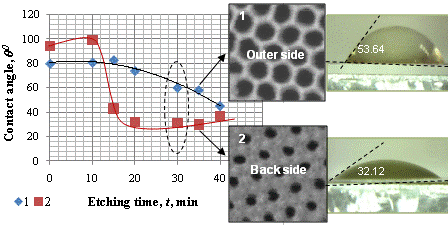
- [10][11], and the development of new nanoporous composite materials based on PAA [12][13]. Both of these are commercially available. Porous silicon formed by electrochemical anodizing [14], zeolites [15], porous mica [16], nanoporous polymer glasses [17] and other materials [18] have also been studied


The electrical conductivity of CNT/graphene composites: a new method for accelerating transmission function calculations
Beilstein J. Nanotechnol. 2018, 9, 1254–1262, doi:10.3762/bjnano.9.117
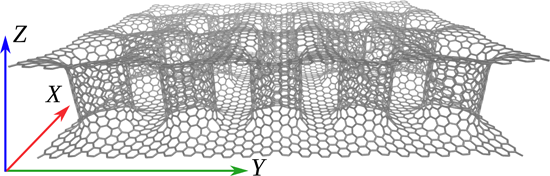
- of methods for accelerating the calculation of the transmission function without a significant loss in the accuracy of calculations has particular relevance and significance for research of the electrical conductive properties of new composite materials. At present, such accelerating techniques are
- especially critical at considering new carbon composite materials such as pillared graphene and other varieties of graphene–nanotube structures. The purpose of this work is to propose an alternative approach to the calculation of transmission function and electrical conductance of composite nanomaterials
- a diameter of 1.23 nm (tubes of diameter 1–1.5 nm are typical for such composite materials). The distance between the tubes was equal to 2.1 nm, the length of the tubes (i.e., the distance between the layers of graphene) ranged from 1.1 to 2.4 nm. The graphene sheet had a length of 2.45 nm along the


Facile phase transfer of gold nanorods and nanospheres stabilized with block copolymers
Beilstein J. Nanotechnol. 2018, 9, 616–627, doi:10.3762/bjnano.9.58
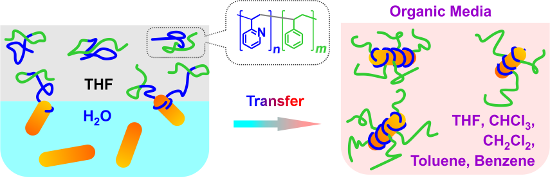
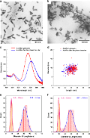
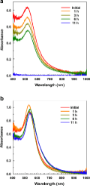
- positioning in host matrices. Control over the size, shape and surface of nanoparticles is an effective tool that can be used in bottom up approaches for the fabrication of composite materials [1][2]. An optimal strategy of nanoparticle synthesis should account for their target application. For example, block


Electron interactions with the heteronuclear carbonyl precursor H2FeRu3(CO)13 and comparison with HFeCo3(CO)12: from fundamental gas phase and surface science studies to focused electron beam induced deposition
Beilstein J. Nanotechnol. 2018, 9, 555–579, doi:10.3762/bjnano.9.53
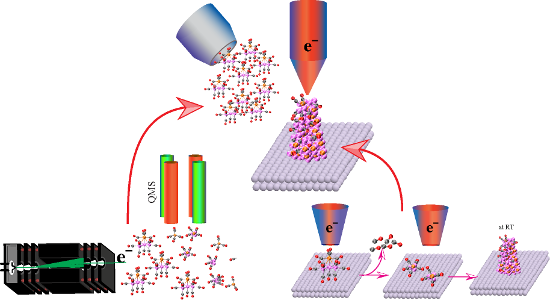
- ligands can be cleaved more efficiently by low energy electrons than other ligands such as allyl and halides [37][49]. Therefore the investigation of Ru carbonyls as potential FEBID precursors is a promising route. Presently, deposition of heterometallic or composite materials containing more than one


Ultralight super-hydrophobic carbon aerogels based on cellulose nanofibers/poly(vinyl alcohol)/graphene oxide (CNFs/PVA/GO) for highly effective oil–water separation
Beilstein J. Nanotechnol. 2018, 9, 508–519, doi:10.3762/bjnano.9.49
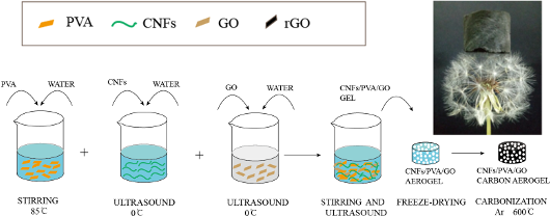
- history of using plant cellulose fibers as reinforcements in polymer composite materials [13][14]. However, the use of nanoscale cellulose fibers to reinforce polymers is a relatively recent effort [15][16]. Despite the challenges described below, CNFs have been combined with various polymer matrices


Engineering of oriented carbon nanotubes in composite materials
Beilstein J. Nanotechnol. 2018, 9, 415–435, doi:10.3762/bjnano.9.41
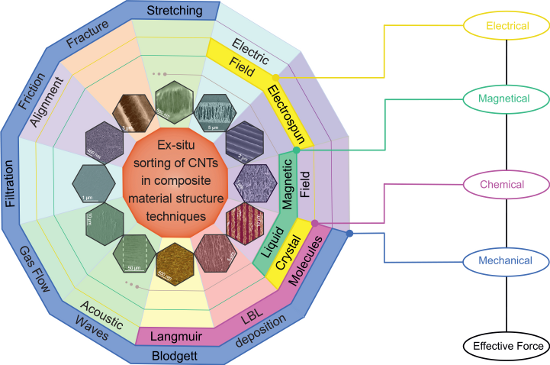
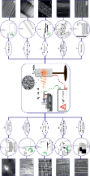
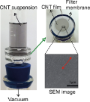
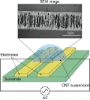
- , they are considered by some as the preferred technique for engineering of oriented CNTs. This review focuses on recent progress in the improvement of the orientation and alignment of CNTs in composite materials. Moreover, the advantages and disadvantages of the processes are discussed as well as their
- future outlook. Keywords: arrangement and alignment; carbon nanotubes; composite materials; orientation; Review Introduction Carbon is one of the most abundant elements comprising the world around us. Before 1985 graphite and diamond were the only known structural forms of carbon [1]. In 1991, Iijima
- a MWCNT consists of many coaxial single-walled tubes nested inside each other. Considering the excellent mechanical and electrical characteristics of CNTs, interest in using them in industry is increasing every day. Various industrial applications of produced CNT composite materials, especially








Design of polar self-assembling lactic acid derivatives possessing submicrometre helical pitch
Beilstein J. Nanotechnol. 2018, 9, 333–341, doi:10.3762/bjnano.9.33
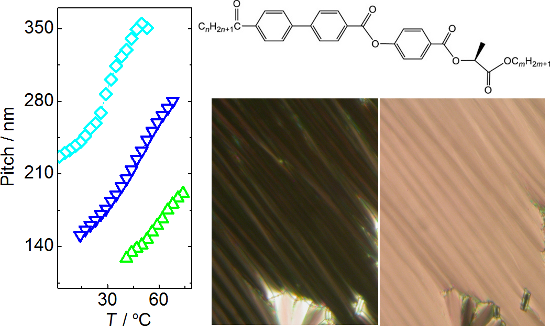
- derivatives demonstrate their high ability to be used as smart and functional dopants for the design and tailoring of the advanced multicomponent LC mixtures [21][22][23][24][25] and LC composite materials [25][26][27][28][29][30][31][32] and tuning their properties. It is quite obvious that the weakening of


Advances in nanocarbon composite materials
Beilstein J. Nanotechnol. 2018, 9, 20–21, doi:10.3762/bjnano.9.3
- Dresden-Rossendorf, Bautzner Landstraße 400, 01328 Dresden, Germany, University of Trieste, Department of Chemical and Pharmaceutical Sciences, Via L. Giorgieri 1, Trieste 34127, Italy 10.3762/bjnano.9.3 Keywords: nano-augmented composite materials; Materials have always been crucial to human
- entering the Composite Age. In particular, nanocarbons display unique properties to innovate in practically all technological sectors and branches of industry. This cutting-edge use of nano-augmented composite materials has the potential to reduce environmental pollution, to conserve resources, to save
- , Moldova, Korea, China, Japan, Australia and New Zealand. This Thematic Series highlights virtually all subfields of advanced nanocarbon materials research, from the longer established fields of carbon nanofibers, graphene oxide (GO) and multiwalled carbon nanotubes (MWCNTs) in composite materials, to the
Magnetic field induced orientational transitions in liquid crystals doped with carbon nanotubes
Beilstein J. Nanotechnol. 2017, 8, 2807–2817, doi:10.3762/bjnano.8.280
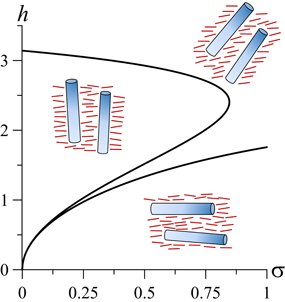
- ferronematics have been published [4][5], which indicates the interest in this kind of composite materials. Along with ferri- or ferromagnetic particles it is also possible to use carbon nanotubes (CNTs) in order to increase the magneto-orientational response of the LC matrix [6][7]. Due to the highly elongated


![[Graphic 43]](/bjnano/content/inline/2190-4286-8-280-i72.svg?max-width=637&scale=1.18182) for the Fréedericksz transition as a function of the couplin...
for the Fréedericksz transition as a function of the couplin...

![[Graphic 58]](/bjnano/content/inline/2190-4286-8-280-i87.svg?max-width=637&scale=1.18182) and (b)
and (b) ![[Graphic 59]](/bjnano/content/inline/2190-4286-8-280-i88.svg?max-width=637&scale=1.18182) on the coupling energy of CNTs w...
on the coupling energy of CNTs w...
Exploring wear at the nanoscale with circular mode atomic force microscopy
Beilstein J. Nanotechnol. 2017, 8, 2662–2668, doi:10.3762/bjnano.8.266
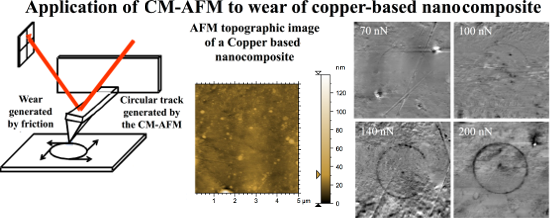
- . Finally, we describe the advantages of this method and we report a relevant application example addressing a Cu/Al2O3 nanocomposite material used in industrial applications. Keywords: circular mode atomic force microscopy; composite materials; image processing; nanowear; wear mechanisms; Introduction





