Search results
Search for "defect" in Full Text gives 407 result(s) in Beilstein Journal of Nanotechnology. Showing first 200.
Quantum-to-classical modeling of monolayer Ge2Se2 and its application in photovoltaic devices
Beilstein J. Nanotechnol. 2024, 15, 1153–1169, doi:10.3762/bjnano.15.94
- resistance and higher losses [59]. We set the optimal absorber thickness at 2 µm, above which the parameter variation was only very little. Effect of defects in the absorber layer Halide pervoskites are generally considered as defect-resilient; yet, deep level defects shows significant impact on the device
- performance [60][61]. Therefore, it is important to analyze their impact on the cell performance for better device design. Figure 7d shows the variation of the cell parameters at varying absorber defect densities from 1014 cm−3 to 1018 cm−3. Figure 7d shows that higher defect densities lead to worse device
- performance. This is due to the decrement in the lifetime of the charge carriers because of the shorter diffusion length, which results from the higher defect densities [62]. We can observed that the performance parameters decrease significantly above defect densities of 1015 cm−3. Effect of interface defects




Effect of wavelength and liquid on formation of Ag, Au, Ag/Au nanoparticles via picosecond laser ablation and SERS-based detection of DMMP
Beilstein J. Nanotechnol. 2024, 15, 1054–1069, doi:10.3762/bjnano.15.86

- ) laser melting in liquid (LML), and (iii) laser defect engineering in liquid (LDL) [16]. In our previous work, we fabricated Ag–Cu alloy NPs using the femtosecond (fs) laser irradiation approach [17]. Similarly, Ag/Au alloy NPs were fabricated by laser ablation of single metal targets in water followed


Bolometric IR photoresponse based on a 3D micro-nano integrated CNT architecture
Beilstein J. Nanotechnol. 2024, 15, 1030–1040, doi:10.3762/bjnano.15.84
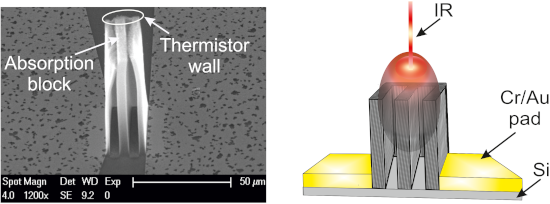
- the carbon nanotubes, while the D- and 2D-band peaks are the defect band peak and its first overtone, respectively. At lower wavenumbers, RBM peaks are seen. Their appearance symbolizes the presence of few-layer CNTs (single or double layer). Compared to SWCNTs [8], for which the characteristic


Beyond biomimicry – next generation applications of bioinspired adhesives from microfluidics to composites
Beilstein J. Nanotechnol. 2024, 15, 965–976, doi:10.3762/bjnano.15.79
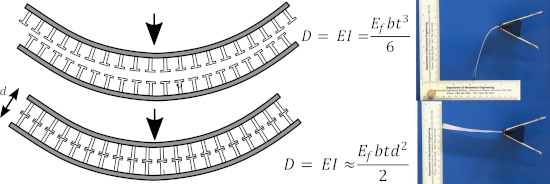
- single sheet. A deliberate defect to yield anisotropic adhesion was described in 2013 by my student Walid bin Khaled [25]. It has been thoroughly characterized in various papers, including his work and that of visiting student Yue Wang, who collaborated with me between 2015 and 2016 [27]. Yue Wang also
- developed the adhesion circle test system, which has been instrumental in characterizing how these fibers with the deliberate defect function, demonstrating that the same geometry with different structural materials can exhibit vastly different adhesion properties [28]. Generally, structural materials for


Electrospun nanofibers: building blocks for the repair of bone tissue
Beilstein J. Nanotechnol. 2024, 15, 941–953, doi:10.3762/bjnano.15.77
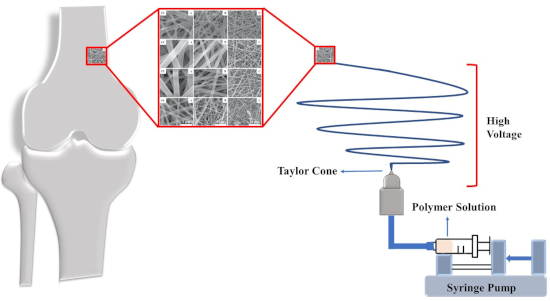
- solution from the needle tip to be higher than the rate required for Taylor cone formation [49][50]. Thus, it may cause multiple jets or destabilization of the Taylor cone, resulting in an increase in bead defect density [49][51][52]. The fiber diameter decreases with increasing voltage [53]. The bead
- defect density increases above a critical voltage [49]. The aspect ratio of the obtained beads increases up to a certain voltage value and then decreases [50][54]. Flow rate Insufficient flow rate does not allow for jet formation. In contrast, excessive flow rates will cause an increase in the polymer


Effects of cutting tool geometry on material removal of a gradient nanograined CoCrNi medium entropy alloy
Beilstein J. Nanotechnol. 2024, 15, 925–940, doi:10.3762/bjnano.15.76
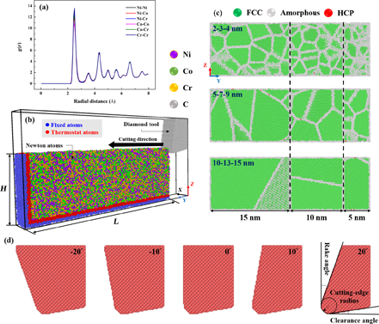
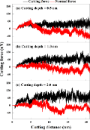
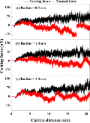
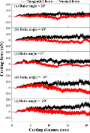
- mechanism of the material is very sensitive to the presence of defects [23]. For specimens in the range of 0.1–100 µm, the formation of voids at grain boundaries is the dominant defect and significantly affects the deformation behavior of the material. In contrast, voids seem negligible when the scale is








Effect of repeating hydrothermal growth processes and rapid thermal annealing on CuO thin film properties
Beilstein J. Nanotechnol. 2024, 15, 743–754, doi:10.3762/bjnano.15.62
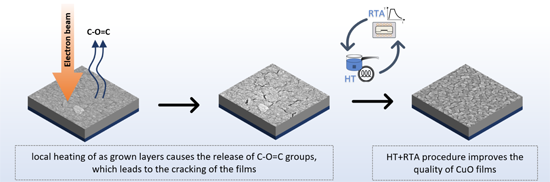
- properties of these layers and to attain the desired parameters in the final product. Controlled thermal treatment serves various purposes, such as enabling crystal structure relaxation, defect reduction, and enhancement of the films’ crystalline arrangement. Furthermore, it can lead to improved electrical


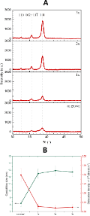


Laser synthesis of nanoparticles in organic solvents – products, reactions, and perspectives
Beilstein J. Nanotechnol. 2024, 15, 638–663, doi:10.3762/bjnano.15.54
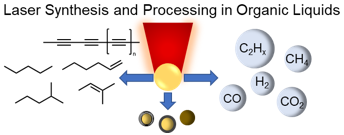





Aero-ZnS prepared by physical vapor transport on three-dimensional networks of sacrificial ZnO microtetrapods
Beilstein J. Nanotechnol. 2024, 15, 490–499, doi:10.3762/bjnano.15.44
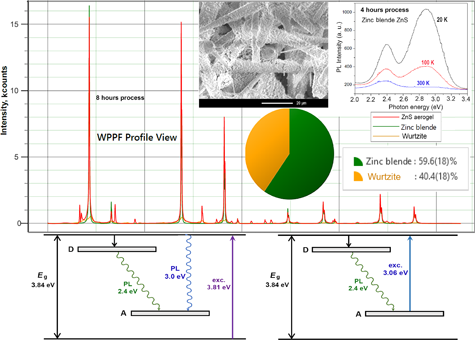
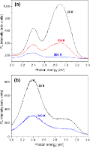
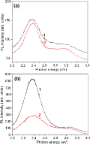
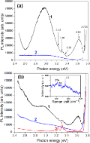
- region at 3.62 eV is related to a free-to-bound electron transition from a shallow donor to the valence band of ZnS [35]. The other two bands around 2.4 and 2.9–3.0 eV in the deep level defect region are the most common PL bands observed in various ZnS samples and have been associated with DA pair
- indicated by the XRD analysis discussed above. A possible scheme of deep energy levels and electronic transitions accounting for the observed PL band in the deep level defect region for the ZnS component of the prepared aeromaterial is proposed in Figure 8. It includes a donor impurity band situated around
- (c, d) are with logarithmic axes. Results of the WPPF weight fraction analysis performed for the sample produced in the 8 h technological procedure. PL spectra of samples prepared in (a) the 4 h procedure and (b) the 8 h procedure measured in the deep level defect region at different temperatures



Unveiling the nature of atomic defects in graphene on a metal surface
Beilstein J. Nanotechnol. 2024, 15, 416–425, doi:10.3762/bjnano.15.37
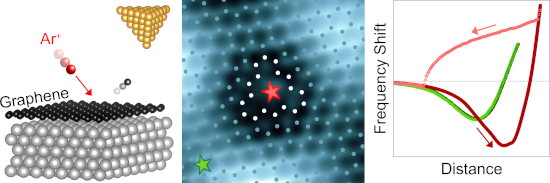
- smallest defects appear as a depression without discernible interior structure suggesting the presence of vacancy sites in the graphene lattice. With an atomic force microscope, however, only one kind can be identified as a vacancy defect with four missing carbon atoms, while the other kind reveals an
- intact graphene sheet. Spatially resolved spectroscopy of the differential conductance and the measurement of total-force variations as a function of the lateral and vertical probe–defect distance corroborate the different character of the defects. The tendency of the vacancy defect to form a chemical
- by noble-gas ion irradiation [6][13][14][17][19][21][24], represents an opportunity for systematic defect studies. The work presented here was stimulated by the lack of experimental data on the actual geometry of atomic-scale defects in graphene. So far, scanning tunneling microscope (STM


Investigating ripple pattern formation and damage profiles in Si and Ge induced by 100 keV Ar+ ion beam: a comparative study
Beilstein J. Nanotechnol. 2024, 15, 367–375, doi:10.3762/bjnano.15.33
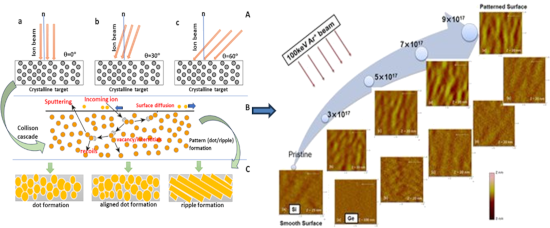
- photoluminescence spectroscopy. Stupp et al. [14] have explored possible applications of self-assembly of biomolecules with controlled stereochemistry in materials technology. However, the fundamental reasoning behind how this self-organization process evolves in terms of defect creation or damage still needs to be
- to analyse the crystal structure and to locate interstitial atoms within the array of target atoms. The relation between yield and defect concentration was derived by Bøgh [33]. It provides information about the depth distribution of defects in the first few microns beneath the crystalline surface
- observed for Si. This further confirms that the near surface region of Si, amorphized to form better ripple patterns in Si as compared to Ge, may be due to the overlap of the collision cascade which led to more defect formation [41]. Rutherford backscattering results The RBS technique was used to determine


Controllable physicochemical properties of WOx thin films grown under glancing angle
Beilstein J. Nanotechnol. 2024, 15, 350–359, doi:10.3762/bjnano.15.31
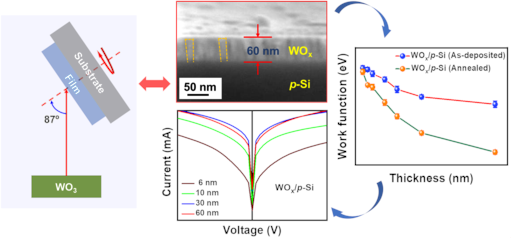
- optical bandgap and work function is thoroughly investigated by employing various spectroscopic and microscopic techniques. The systematic investigation of the work function of the films reveals a distinct trend with thickness, originating from the thickness-dependent defect concentration within the films
- . It is observed that the as-deposited NS-WOx/p-Si heterostructures are quasi-ohmic in nature. The annealed counterparts exhibit a relatively higher rectification, which points towards a possible defect-dependent Fermi level pinning at the hetero-interface. Overall, our systematic experimental
- variability in bandgap energies, we recall that the optical bandgap of this class of materials is a function of defect density and stoichiometric composition, which is mainly governed by the OV concentration within the films [39][40]. To probe any possible variation in OV concentration and stoichiometry


Determining by Raman spectroscopy the average thickness and N-layer-specific surface coverages of MoS2 thin films with domains much smaller than the laser spot size
Beilstein J. Nanotechnol. 2024, 15, 279–296, doi:10.3762/bjnano.15.26
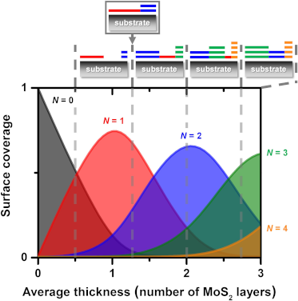
- symmetry for a monolayer (A1g for bulk). These modes are located around 385 and 405 cm−1, respectively, in neutral and defect-free MoS2 monolayers [33][34]. More precisely, in MoS2 multilayers, the symmetries of these phonon modes are E′ and A′1 for an odd number of layers, and Eg and A1g for an even
- lateral size of typically 50 nm, i.e., well below the laser spot size) with possibly a distribution of thicknesses and twist angles between adjacent layers of multilayer domains and a higher number of defects (the average inter-defect distance ranges from 3 to 6 nm as estimated from the LA and A1g


Ion beam processing of DNA origami nanostructures
Beilstein J. Nanotechnol. 2024, 15, 207–214, doi:10.3762/bjnano.15.20
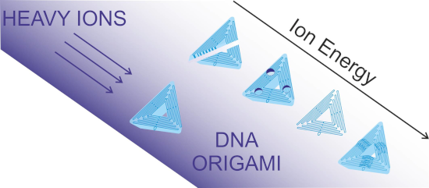
- interfaces. While we demonstrate here that the trimming of individual DNA nanostructures within the lattice is possible, the collective response of the lattice and defect formation as a response to ion impact represents an interesting direction for future studies. The processes leading to height modification


unDrift: A versatile software for fast offline SPM image drift correction
Beilstein J. Nanotechnol. 2023, 14, 1225–1237, doi:10.3762/bjnano.14.101
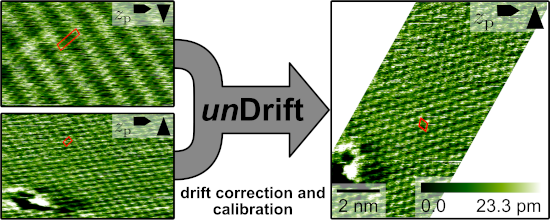
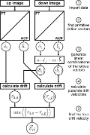
- images. It is apparent that the defect positions are shifted in the second image compared to the first one. (c) Image of the cross-correlation function RXY between the images shown in (a) and (b). The center of the image and the position of the maximum are marked with red dots and connected with a red


Density functional theory study of Au-fcc/Ge and Au-hcp/Ge interfaces
Beilstein J. Nanotechnol. 2023, 14, 1093–1105, doi:10.3762/bjnano.14.90
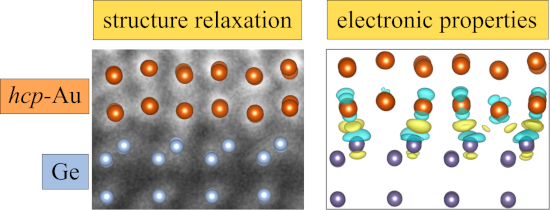
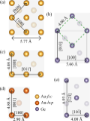
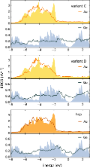
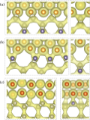
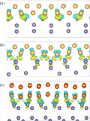
- variant by introducing defects into the interface layer. We investigated three supercells of variant D, in which some pairs of Au atoms in the interface layer were replaced by Ge atoms. Their optimized atomic arrangements are presented in Figure 7b–d. We can observe that while one such defect, shown in
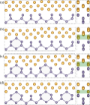
- optimized supercell shown in Figure 9d, the interface energy is slightly higher (0.395 J/m2) than that of the defect-free junction. We also tested another type of defects (Au vacancies). To construct the supercell, we first found the position of slabs with the smallest possible Au–Ge distances (two such
- pairs per interface can be found) and removed the Au atoms from these bonds. The optimized lattice preserves the hexagonal arrangement; however, the interface energy is significantly higher than in the other considered hcp variants (0.514 J/m2). Figure 9e shows the experimental picture and the defect





Dual-heterodyne Kelvin probe force microscopy
Beilstein J. Nanotechnol. 2023, 14, 1068–1084, doi:10.3762/bjnano.14.88
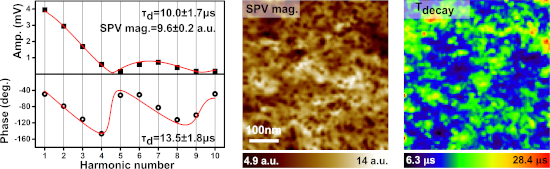
- depositing caesium lead halide perovskite nanosheets (NSs) on a highly oriented pyrolytic graphite (HOPG) substrate. Lead halide perovskites have emerged recently as materials with unique optical and electronic properties, such as high absorption coefficients, high defect tolerance, and charge mobility. Due




Experimental investigation of usage of POE lubricants with Al2O3, graphene or CNT nanoparticles in a refrigeration compressor
Beilstein J. Nanotechnol. 2023, 14, 1041–1058, doi:10.3762/bjnano.14.86
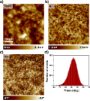
- ) can also be seen. However, D/G < 1 indicates a multilayered graphene structure, which is also seen in the micrographs shown in Figure 4a and Figure 4b. The low intensity of the D band indicates low defect density [40]. The characteristic properties of graphene are directly related to the sp2
- corresponding to the sp2-hybridised C–C system. The XPS data obtained are also consistent with previous studies [41][42]. As a result, the high purity and low defect structures of graphene nanoplatelets used in this study are understood. This supports the fact that the best improvement occurs in the graphene





Cross-sectional Kelvin probe force microscopy on III–V epitaxial multilayer stacks: challenges and perspectives
Beilstein J. Nanotechnol. 2023, 14, 725–737, doi:10.3762/bjnano.14.59
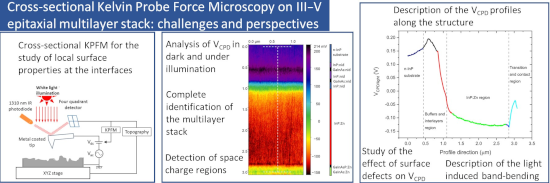
- and continuity equations numerically in two dimensions and includes flexible descriptions of bulk and surface defect distributions. KELSCAN simulates the experimental setup by sequentially moving the AFM tip across the surface of the sample, statically solving the semiconductor equations at each
- of defects extending into the volume is physically more appropriate than a simpler two-dimensional surface distribution [23]. The introduced defect volume density of states (DOS), N(E) (eV−1·cm−3), is assumed to be homogeneous throughout the thickness of the defective layer, tDL, which we took equal
- reported in Figure 6. In this specific case, the charge neutrality level of surface defects is set at mid-gap. Thus, increasing the surface defect densities will produce a pinning of the Fermi level at the neutrality level of the surface states and the energy of valence and conduction bands will appear


Transferability of interatomic potentials for silicene
Beilstein J. Nanotechnol. 2023, 14, 574–585, doi:10.3762/bjnano.14.48
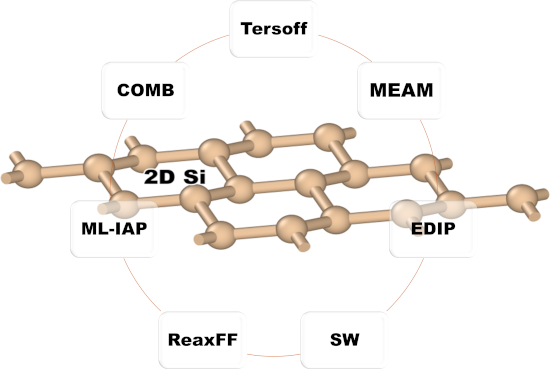
- -dependent interatomic potential (EDIP) fitted to various bulk phases and defect structures of Si ReaxFF [41]: the reactive force-field (ReaxFF) fitted to a training set of DFT data that pertain to Si/Ge/H bonding environments COMB [42]: the charge optimized many-body (COMB) potential fitted to a pure
![[Graphic 3]](/bjnano/content/inline/2190-4286-14-48-i7.svg?max-width=637&scale=1.18182)

Observation of multiple bulk bound states in the continuum modes in a photonic crystal cavity
Beilstein J. Nanotechnol. 2023, 14, 544–551, doi:10.3762/bjnano.14.45
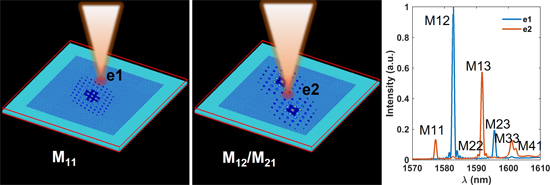
- defects are mainly located at the mode node of a specific mode, the loss caused by the defect will decrease. In contrast, disorders at an antinode will lead to obvious loss (small Qnr) and a dominant Q factor degradation. For our sample, a higher loss caused by defects occurs for the mode with shorter


Plasmonic nanotechnology for photothermal applications – an evaluation
Beilstein J. Nanotechnol. 2023, 14, 380–419, doi:10.3762/bjnano.14.33
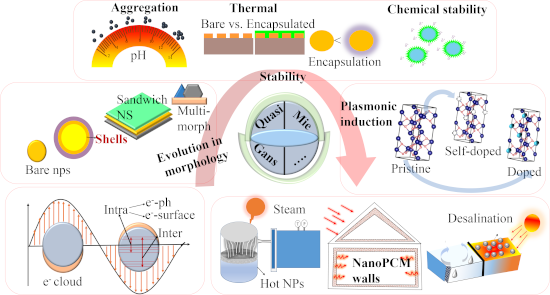
- properties by phonons can thus be effectively realized by lattice tuning of the pristine materials, that is, by defect tailoring, doping, or by providing external stimuli such as pressure. While considering the actual increases in temperature of the nanoparticle possible due to plasmonic heating, the




High–low Kelvin probe force spectroscopy for measuring the interface state density
Beilstein J. Nanotechnol. 2023, 14, 175–189, doi:10.3762/bjnano.14.18
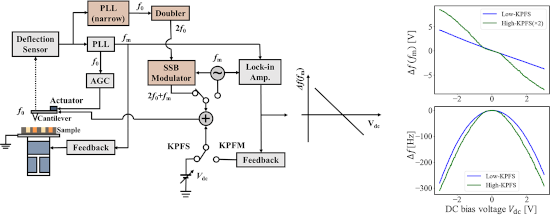
- force spectroscopy; Introduction With the recent miniaturization of semiconductor devices, understanding the physical and electrical properties of semiconductor devices, such as the dopant concentration, dopant distribution, and defect level distribution, at the nanoscale has become important. Among
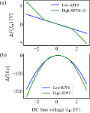
- high-resolution nanoscale measurements of impurity concentration and defect level distributions at the surfaces and interfaces of various semiconductor materials and devices. (a) Schematic of the metal tip–gap–semiconductor sample. (b) Energy band diagram of the metal–gap–semiconductor sample. Emission



Gap-directed chemical lift-off lithographic nanoarchitectonics for arbitrary sub-micrometer patterning
Beilstein J. Nanotechnol. 2023, 14, 34–44, doi:10.3762/bjnano.14.4
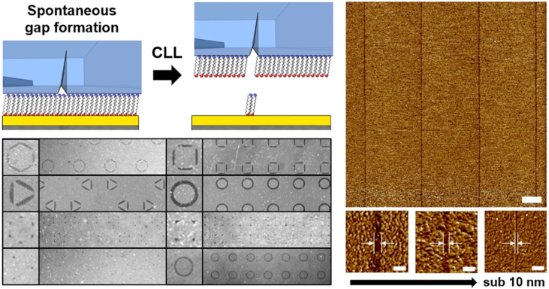
- process provides a unique artificial defect-rich surface, which supports the creation of homogeneously distributed molecular environments for functional substrates, e.g., surface wettability control [23] and enhanced biorecognition phenomenon [24][25][26]. The versatility of CLL can also be expanded by


Induced electric conductivity in organic polymers
Beilstein J. Nanotechnol. 2022, 13, 1551–1557, doi:10.3762/bjnano.13.128
- films can be obtained by centrifugation from a solution in cyclohexanone on a metal surface with a thickness from several nanometers up to micrometers. High homogeneity and defect-free surfaces on nanoscopic scales have been repeatedly confirmed by various methods, including scanning tunneling and
- strip and the whole sandwich itself. (b) Atomic force microscope scan of a PDP film 0.1 wt % on Si substrate. The plot at the bottom illustrates the roughness of the surface along the indicated line. (c) Side view of a Pb–PDP–Pb structure on glass with solitary defect (lead shortcut) obtained by