


Search results
Search for "dielectric" in Full Text gives 463 result(s) in Beilstein Journal of Nanotechnology. Showing first 200.
Recent progress on field-effect transistor-based biosensors: device perspective
Beilstein J. Nanotechnol. 2024, 15, 977–994, doi:10.3762/bjnano.15.80
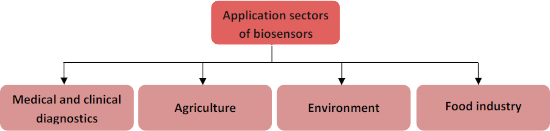
- FET-based biosensors. Finally, this article proposes intriguing avenues for further research on the topology of FET-based biosensors. Keywords: biomolecule detection; biosensors; charge modulation; dielectric modulation; field-effect transistor; Review 1 Introduction In recent years, biosensor
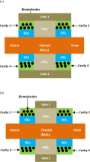
- is known as dielectric modulation, where a nanoscale gap cavity is introduced in either the gate metal or gate insulator region. The biomolecules are immobilized in this cavity region functionalized with bioreceptor elements, where the presence of the specific target biomolecule alters the effective
- dielectric constant inside the cavity resulting in a gating effect modulation and subsequent alteration in channel conductivity. This leads to a change in both threshold voltage and drain current, manifesting the presence of target biomolecules in the cavity, and the corresponding sensitivity is defined




Electrospun nanofibers: building blocks for the repair of bone tissue
Beilstein J. Nanotechnol. 2024, 15, 941–953, doi:10.3762/bjnano.15.77
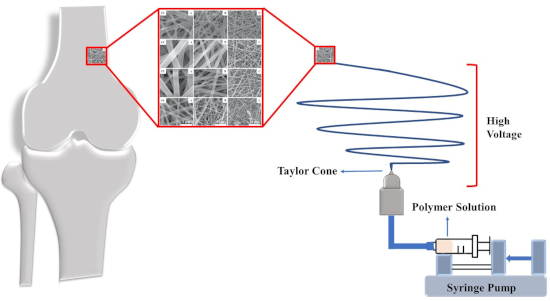
- , concentration and molecular weight of the polymer, solvent or solvent mixture, surface tension, conductivity, dielectric constant, and environmental parameters are parameters that must be optimized in the electrospinning process. Voltage Voltage is the parameter that most affects the shape of the droplet from
- fewer beads are formed [79]. Dielectric constant The dielectric constant refers to the ability of a substance to hold an electric charge in the region where an electric field is applied. The dielectric constant of a polymer liquid mainly depends on the solvent used. For the electrospinning process, the
- dielectric constant must be high enough [74][75]. With an increase in dielectric constant fewer beads and smaller fiber diameters are formed [80]. Environmental parameters Temperature Temperature affects the viscosity and spinnability of polymer liquids and the thickness of the collected fiber mats


Exploring surface charge dynamics: implications for AFM height measurements in 2D materials
Beilstein J. Nanotechnol. 2024, 15, 767–780, doi:10.3762/bjnano.15.64
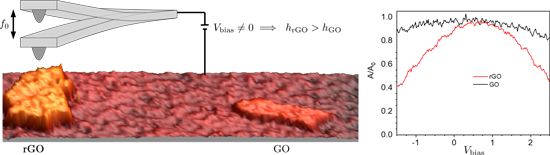
- Equation 8 is entirely a consequence of a non-negligible σs; if we set σs = 0, the time evolution cancels, and we recover the expected solution for a dielectric interface. When the tip oscillates or an AC voltage is applied, the oscillating electric field produces Joule dissipation at the surface as well


Level set simulation of focused ion beam sputtering of a multilayer substrate
Beilstein J. Nanotechnol. 2024, 15, 733–742, doi:10.3762/bjnano.15.61
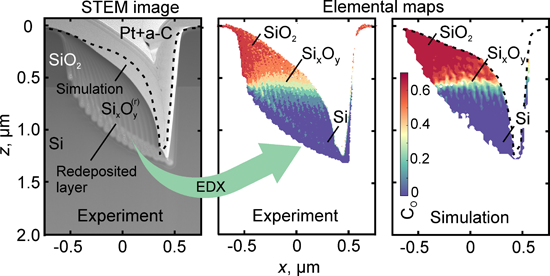
- semiconductor heterostructures [13]. Metal and dielectric layers can be used as hard masks for achieving high resolution and throughput of the FIB nanofabrication process [14]. Modification of integrated circuits [15] is an industrially relevant application of multilayer structure processing. Effective

![[Graphic 55]](/bjnano/content/inline/2190-4286-15-61-i68.svg?max-width=637&scale=1.18182)


Reduced subthreshold swing in a vertical tunnel FET using a low-work-function live metal strip and a low-k material at the drain
Beilstein J. Nanotechnol. 2024, 15, 713–718, doi:10.3762/bjnano.15.59
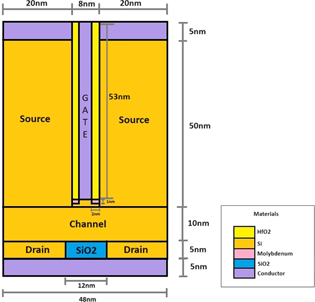
- research paper, a vertical tunnel field-effect transistor (TFET) structure containing a live metal strip and a material with low dielectric constant is designed, and its performance metrics are analyzed in detail. Low-k SiO2 is incorporated in the channel–drain region. A live molybdenum metal strip with
- low work function is placed in a high-k HfO2 layer in the source–channel region. The device is examined by the parameters Ioff, subthreshold swing, threshold voltage, and Ion/Ioff ratio. The introduction of a live metal strip in the dielectric layer closer to the source–channel interface results in a
- excellent improvement in TFETs, an on-current of 1.00 × 10⁻⁵ A/μm, an Ion/Ioff ratio of 7.14 × 10¹¹, and a threshold voltage of 0.28 V. Keywords: dual low-work-function live strip (DLWLS); low-k dielectric spacer; low-work-function live strip (LWLS); Miller capacitance; molybdenum; subthreshold swing (SS


Laser synthesis of nanoparticles in organic solvents – products, reactions, and perspectives
Beilstein J. Nanotechnol. 2024, 15, 638–663, doi:10.3762/bjnano.15.54
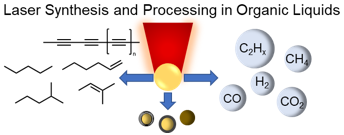
- spectra at long pulse durations and high irradiance [84]. This approach provides the essential understanding of the dependence of electron energy spectra on laser pulse duration, wavelength, and irradiance, which opens pathways for inducing energy-specific molecular modifications in dielectric media, such





CdSe/ZnS quantum dots as a booster in the active layer of distributed ternary organic photovoltaics
Beilstein J. Nanotechnol. 2024, 15, 144–156, doi:10.3762/bjnano.15.14
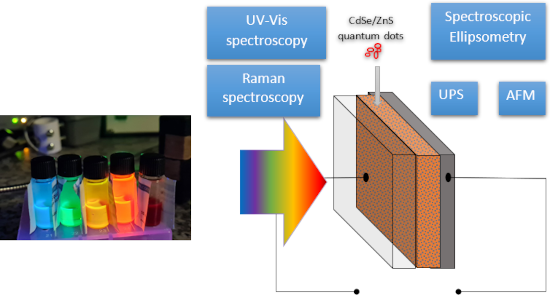
- were applied to gold foils. A system equipped with a Solartron 1260A frequency response analyzer, a Solartron 1296A dielectric interface, and a supervisory computer was prepared to determine the impedance parameters of the obtained structures. The impedance characteristics of the obtained samples were
- (point by point). The layer under consideration was first pure quantum dots and then a ternary system with PC71BM and P3HT. The refractive index (n) of the quantum dots thin film and the extinction coefficient (k) were estimated using the Lorentz model modified by Tauc. The complex dielectric function is
- related to the complex refractive index n by the equation in the Tauc–Lorentz model: where ε1, ε2 are, respectively, the real and imaginary parts of the dielectric function, n is the refractive index, and k is the extinction coefficient. The real part of the Tauc–Lorentz dielectric function is given as




Measurements of dichroic bow-tie antenna arrays with integrated cold-electron bolometers using YBCO oscillators
Beilstein J. Nanotechnol. 2024, 15, 26–36, doi:10.3762/bjnano.15.3
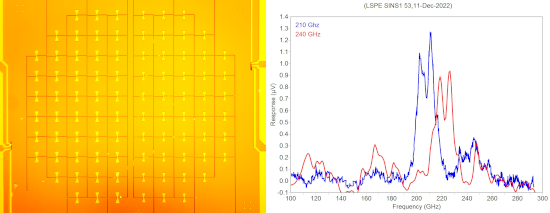
- /20 nm was deposited with an electron-beam evaporation machine. After lift-off, a double layer of MMA and ARP electron resist was deposited, which is necessary to form an aluminum oxide dielectric layer without breaking the vacuum. Then the electron lithography was made, but the resist was not


A combined gas-phase dissociative ionization, dissociative electron attachment and deposition study on the potential FEBID precursor [Au(CH3)2Cl]2
Beilstein J. Nanotechnol. 2023, 14, 1178–1199, doi:10.3762/bjnano.14.98
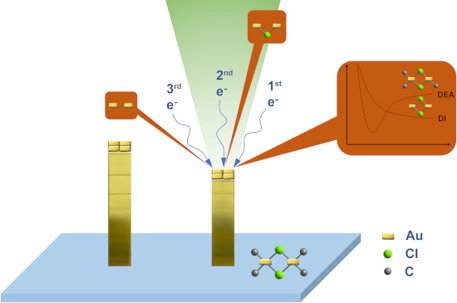
- ; quantum chemical calculation; ultrahigh vacuum; Introduction In recent years, gold nanostructures have received much attention owing to their dielectric properties [1], their biocompatibility [2], and their electrical properties [3][4], which enable a multitude of exciting applications in the field of



A multi-resistance wide-range calibration sample for conductive probe atomic force microscopy measurements
Beilstein J. Nanotechnol. 2023, 14, 1141–1148, doi:10.3762/bjnano.14.94
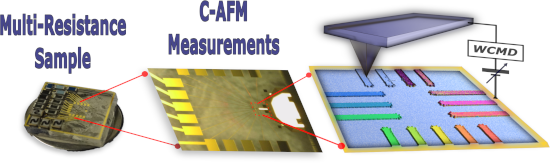
- versatility and high resolution in probing the local conductivity of materials, C-AFM has been extensively used in studying semiconductors [6][7], two-dimensional materials [8][9][10], memristive devices [11][12][13][14][15], photoelectric systems [16][17][18], dielectric films [19][20][21][22][23], molecular


Nanoarchitectonics of photothermal materials to enhance the sensitivity of lateral flow assays
Beilstein J. Nanotechnol. 2023, 14, 988–1003, doi:10.3762/bjnano.14.82
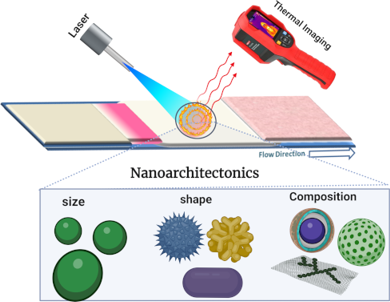
- LSPR effect highly depends on size, shape, composition, interparticle distance, dielectric constant, and surrounding medium of the particles [36][37]. While Pt, Ag, and Au particles all exhibit photothermal properties, Au nanoparticles are commonly used for photothermal applications. By changing the


Silver-based SERS substrates fabricated using a 3D printed microfluidic device
Beilstein J. Nanotechnol. 2023, 14, 793–803, doi:10.3762/bjnano.14.65
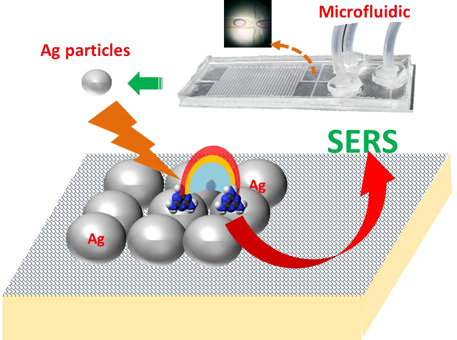
- ], porous aluminum oxide [38], and semiconductors [39] have been reported. Dielectric and semiconductor substrates, such as ZnO nanowires, silicon nanowires, and porous silicon (PS), are particularly popular because of their larger contribution to the amplification of the Raman signal and longer shelf life



Humidity-dependent electrical performance of CuO nanowire networks studied by electrochemical impedance spectroscopy
Beilstein J. Nanotechnol. 2023, 14, 683–691, doi:10.3762/bjnano.14.54
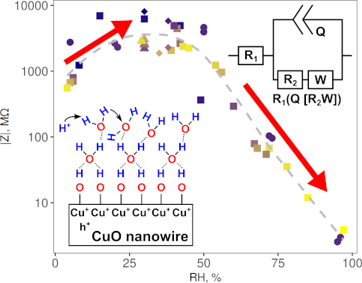
- dependence of log Z on log f in the whole frequency range (Figure 2c) and the phase angle value of ca. 80° in the frequency range of 1–1000 Hz (Figure 2d) indicate that the electrochemical processes on the surface of the sample at RH < 50% result in a capacitive behaviour with good dielectric properties. The


Investigations on the optical forces from three mainstream optical resonances in all-dielectric nanostructure arrays
Beilstein J. Nanotechnol. 2023, 14, 674–682, doi:10.3762/bjnano.14.53
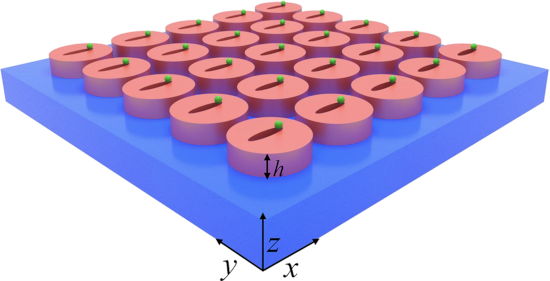
- within the confined fields of three optical resonances supported by all-dielectric nanostructure arrays, including toroidal dipole (TD), anapoles, and quasi-bound states in continuum (quasi-BIC) resonances. By elaborately designing the geometry of a slotted-disk array, three different resonances can be
- large contrast in the optical forces generated with these resonances is attributed to a higher electromagnetic field enhancement provided by the quasi-BIC. These results suggest that the quasi-BIC resonance is preferred when one employs all-dielectric nanostructure arrays for the trapping and
- manipulation of nanoparticles by optical forces. It is important to use low-power lasers to achieve efficient trapping and avoid any harmful heating effects. Keywords: all-dielectric nanostructures; anapole; optical force; quasi-bound states in the continuum; toroidal dipole; Introduction Optical forces have


ZnO-decorated SiC@C hybrids with strong electromagnetic absorption
Beilstein J. Nanotechnol. 2023, 14, 565–573, doi:10.3762/bjnano.14.47
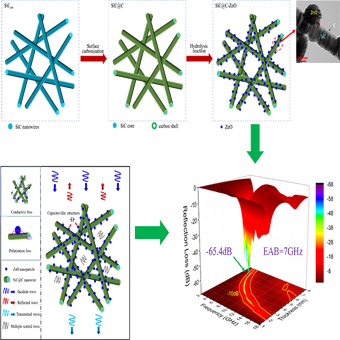
- that crystalline ZnO particles adhere to the surface of amorphous carbon, and the ZnO content increases as a function of a dosage of ZnNO3·6H2O. The as-prepared SiC@C-ZnO hybrids exhibit effective electromagnetic absorption, which is related to a synergy effect of different dielectric loss processes
- mm). The excellent properties of the materials suggest great prospect as electromagnetic absorbers. Keywords: carbon; dielectric; electromagnetic absorption; SiC nanowires; ZnO; Introduction With increasing functionality of electronic devices, the widening of the working frequency bands, and the
- stability, chemical corrosion resistance, and high strength. Hence, it has received a lot of attention [5][6][7]. Because of the high resistivity and the low dielectric parameters of traditionally prepared SiC, its EM absorption is poor [8]. According to existing literature reports, the electromagnetic


Carbon nanotube-cellulose ink for rapid solvent identification
Beilstein J. Nanotechnol. 2023, 14, 535–543, doi:10.3762/bjnano.14.44
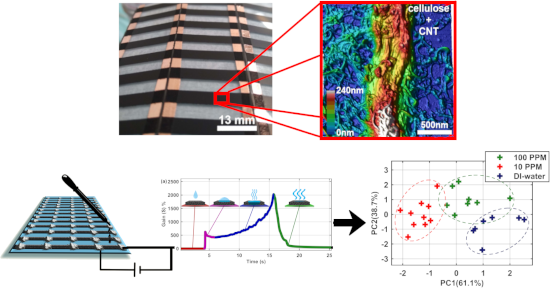
- two important properties of the liquids, namely dielectric constant and vapor pressure, on the transduction of the MFC-MWCNT sensors. These results were corroborated by independent heat flow measurements (thermogravimetric analysis). The proposed MFC-MWCNT sensor platform may help paving the way to
- mechanism of polymer composites with physicochemical characteristics such as dielectric constant, specific heat, and vapor pressure [25][56][57]. Our ink-based devices could extract those characteristics even from unknown samples and mixtures. Finally, test analysis using principal component analysis (PCA
- ) with physicochemical properties of the organic solvents (vapor pressure and dielectric constant) [63][64]. Guided by previous studies that show the electrical response is due to the swelling of CPCs [25][56][57], we found that the maximum value in the Gain curve (max) is proportional to the dielectric


Plasmonic nanotechnology for photothermal applications – an evaluation
Beilstein J. Nanotechnol. 2023, 14, 380–419, doi:10.3762/bjnano.14.33
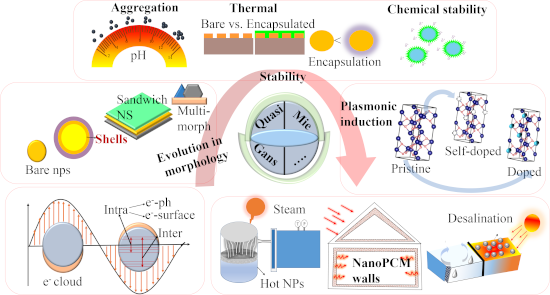
- arrival at the expression for the LSPR frequency of a free electron cloud (as is typically assumed to be present in metals) starts with the relations between the dielectric displacement (D) of the electron gas in relation to the incident electric field (E) which it is [38] subjected to, given by wherein P
- is the polarization density. P can be arrived at by solving the equation of motion for a single electron as Hence the expression relating the dielectric displacement (D) and the external electric field can be obtained as where is the natural frequency of oscillation of the electron cloud. Comparing
- product of ωτ, where τ is the relaxation time of the free electron gas) is much higher than unity, thus leading to an approximation that there is no damping. Hence ignoring the damping term in Equation 5, we get It follows also that under plasmon resonance conditions ε1 < −εm, εm is the dielectric




Quasi-guided modes resulting from the band folding effect in a photonic crystal slab for enhanced interactions of matters with free-space radiations
Beilstein J. Nanotechnol. 2023, 14, 322–328, doi:10.3762/bjnano.14.27
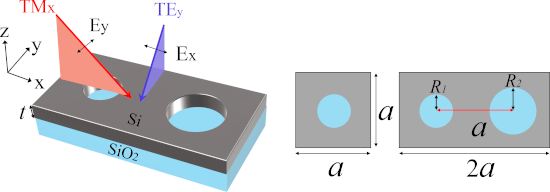
- are introduced into large-scale periodic structures [1]. Extremely high Q-factors can be achieved thanks to the bandgap associated with the periodic structure, which prevents the leakage of radiation into the surrounding environment. Whispering gallery modes supported by dielectric spheres or
- . Plasmonic nanoantennas [3], although with relatively low Q-factors resulting from material dissipation, still provide a large level of field enhancement due to the deep-subwavelength level of mode confinement. As new alternatives to plasmonic nanostructures, all-dielectric nanostructures supporting Mie
- have been demonstrated in all aspects of light–matter interactions, ranging from optical generation [6], propagation [7], nonlinear processes [8] to signal detection [9] and collection, to name a few. Although QBIC resonances in all-dielectric nanostructures have become a popular and mainstream


Bismuth-based nanostructured photocatalysts for the remediation of antibiotics and organic dyes
Beilstein J. Nanotechnol. 2023, 14, 291–321, doi:10.3762/bjnano.14.26
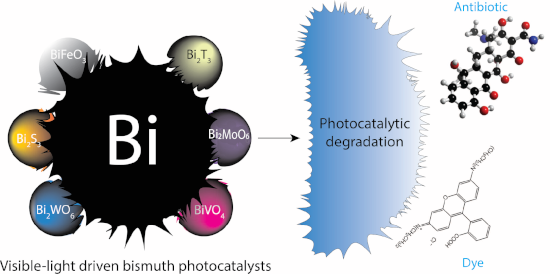
- photocatalytic activity [101][102][103][104]. Bi2WO6 has an orthorhombic structure, a high Curie temperature of about 900 °C, and a narrow bandgap of 2.6–2.8 eV [103]. Other desirable physical and chemical characteristics of Bi2WO6 include comparatively low toxicity, piezoelectricity, non-linear dielectric


Concentration-dependent photothermal conversion efficiency of gold nanoparticles under near-infrared laser and broadband irradiation
Beilstein J. Nanotechnol. 2023, 14, 205–217, doi:10.3762/bjnano.14.20
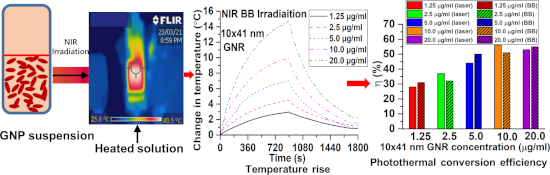
- ]. Localized heat generation through GNPs under irradiation can be used for hyperthermia treatment of tumors, termed plasmonic photothermal therapy (PPTT) [7][8][9][10][11]. The net temperature rise of a GNP-containing medium highly depends on shape and size of the GNPs, the dielectric constant of the medium




High–low Kelvin probe force spectroscopy for measuring the interface state density
Beilstein J. Nanotechnol. 2023, 14, 175–189, doi:10.3762/bjnano.14.18
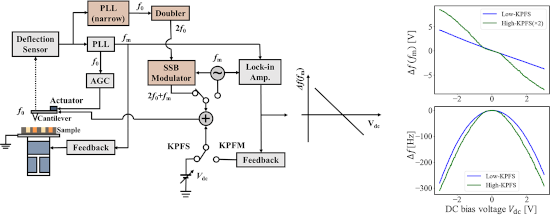
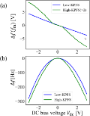
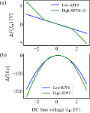
- on the semiconductor surface and ε0 is the dielectric constant of vacuum. A bias voltage Vdc + Vac·cos 2πft is applied between the tip and the semiconductor sample, where Vdc, Vac, and f are the DC bias voltage, amplitude of the AC bias voltage, and modulation frequency of the AC bias voltage
- dielectric constant. LD is the Debye length for majority carriers (electrons), which characterizes the change in the potential inside the semiconductor. kB, T and e are the Boltzmann constant, absolute temperature, and elementary charge (e > 0), respectively. Since the applied voltage V is divided between



A distributed active patch antenna model of a Josephson oscillator
Beilstein J. Nanotechnol. 2023, 14, 151–164, doi:10.3762/bjnano.14.16
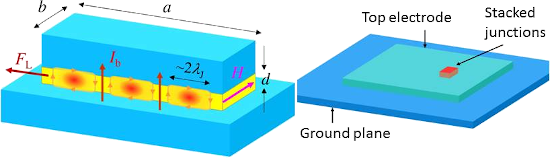
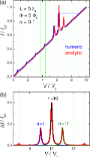
- analysis by introducing the total quality factor, Qtot, of the cavity mode with parallel dissipative and radiative channels, Here, Qdis is associated with all possible dissipative losses, such as QP resistance in the JJ as well as surface resistance in electrodes and dielectric losses while Qrad represents
- and dielectric losses in the junction barrier and surface resistance in electrodes. According to Equation 37, Rdis is defined via the effective quality factor, Qdis, which can be written as: where QQP, Qsurf and Qdiel are determined by QP, surface, and dielectric losses, respectively. QP and surface
- , Rsurf ≪ ωL*, and , we obtain Dielectric losses in the AlOx barrier of a JJ were estimated in [43]. At f ≃ 10 GHz, Qdiel ≈ 104. Although it should decrease at f = 400 GHz, we anticipate that it is still in the range of ca. 103. Therefore, dielectric losses are negligible, compared to QP and surface loses


Batch preparation of nanofibers containing nanoparticles by an electrospinning device with multiple air inlets
Beilstein J. Nanotechnol. 2023, 14, 141–150, doi:10.3762/bjnano.14.15
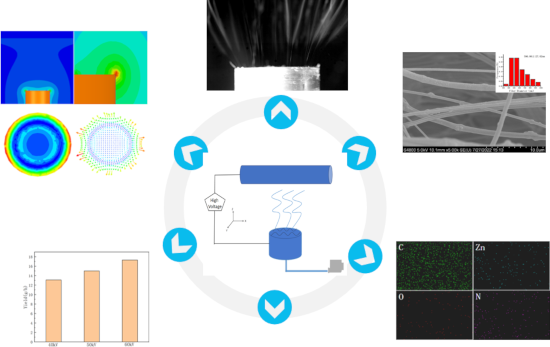
- density of spinning solution (kg/m3), g is the gravitational acceleration (m/s2), h is the fluctuation height of the polymer spinning solution (m), γ is the surface tension coefficient of the spinning solution (N/m), ε0 is vacuum dielectric constant, E0 is the edge electric field intensity (V/m), Ep is
- the electric field intensity of the thin liquid surface (V/m), εα is the dielectric constant of the polymer, and k is the amount of radial fluctuations on the spinning solution surface. In addition, the centripetal force F1 at point B is generated by the horizontal component of the viscous force (τ


Characterisation of a micrometer-scale active plasmonic element by means of complementary computational and experimental methods
Beilstein J. Nanotechnol. 2023, 14, 110–122, doi:10.3762/bjnano.14.12
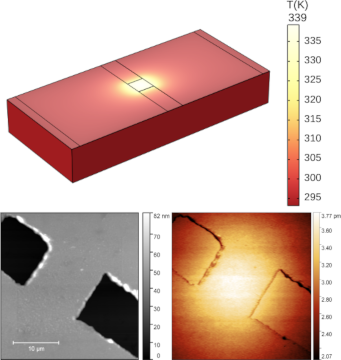
- polaritons (SPPs) are mixed states of photons and electron density waves propagating along the interface between a conductor and a dielectric. As a result of this phenomenon, an electric field strongly confined in the z-direction is produced at the interface. As direct excitation of a smooth metallic surface
- presence of an optically denser dielectric material with which the light interacts before reaching the metal. Light–matter interactions which give rise to the formation of SPPs can be classified into a sub-field of photonics known as plasmonics [8]. Investigations into SPPs provide vital insights into
- ) investigating the changes in the reflectivity induced by a modulated electric current. The acquisition of a surface plasmon resonance (SPR) curve is a common method to characterise a plasmonic far-field response [31] which is highly sensitive to small changes in the refractive index of the metal and dielectric




Solvent-induced assembly of mono- and divalent silica nanoparticles
Beilstein J. Nanotechnol. 2023, 14, 52–60, doi:10.3762/bjnano.14.6
- Instruments). The dielectric constant of water was set to 80.4 and the Smoluchowsky constant f(ka) was 1.5. Synthetic route for the preparation of 1-PSN with a controlled patch-to-particle size ratio. TEM images of the silica/PS monopods after (a) 0, (b) 1, (c) 2, (d) 4, (e) 9, and (f) 14 iterative silica





