


Search results
Search for "electrode" in Full Text gives 612 result(s) in Beilstein Journal of Nanotechnology. Showing first 200.
Emerging strategies in the sustainable removal of antibiotics using semiconductor-based photocatalysts
Beilstein J. Nanotechnol. 2025, 16, 264–285, doi:10.3762/bjnano.16.21
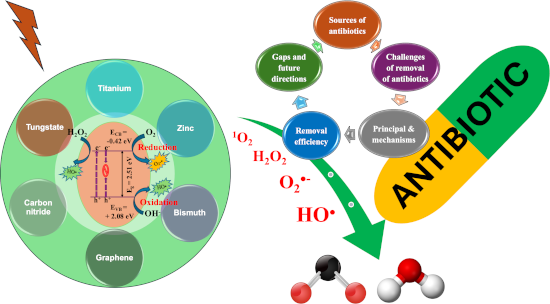
- hydrogen electrode (NHE)). In this reductive pathway, the photoexcited electrons have the ability to interact with electron acceptors, like O2, which can be found on the catalyst surface or dissolved in water. This reaction reduces O2, forming a superoxide radical anion (O2•−) (O2 + e− → O2•−) [35][55



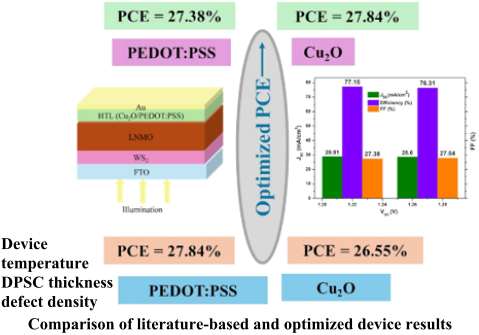
Comparison of organic and inorganic hole transport layers in double perovskite material-based solar cell
Beilstein J. Nanotechnol. 2025, 16, 119–127, doi:10.3762/bjnano.16.11
- Karapinar [2] fabricated a dye-sensitized solar cell (DSSC) with selenium@activated carbon (Se@AC) composites as an alternative to the Pt counter electrode (CE) via chemical activation. The fabricated DSSC showed a power conversion efficiency (PCE) of 5.67%, an open-circuit voltage (VOC) of 0.648 V, a short
- -circuit current density (JSC) of 13.26 mA/cm2, and a fill factor (FF) of 66%. The PCE is close to that of the Pt-based counter electrode (PCE = 6.86%). Akman [3] used hydrothermal methods to synthesize the photoanodes with different doping sources to further improve the stability of DSSCs. For 1.0 mol


Characterization of ZnO nanoparticles synthesized using probiotic Lactiplantibacillus plantarum GP258
Beilstein J. Nanotechnol. 2025, 16, 78–89, doi:10.3762/bjnano.16.8
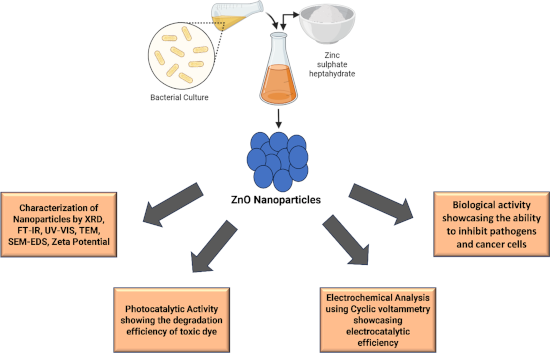
- (CV) and electrochemical impedance spectroscopy (EIS) were carried out at room temperature using a three-electrode cell with 0.1 M KCl electrolyte. The ZnO NP electrode was measured at scan rates from 10 to 50 mV/s. The measurements revealed reversibility and electrode load efficiency along with
- reduction currents and increased peak oxidation, indicating rapid electron transport at the contacts between the electrolyte and electrode. Pseudo-capacitive behavior was observed in both electrolytes, where ionic conductivity influenced capacitance [17][18]. The addition of dextrose increased the redox
- -electrode setup (carbon paste with ZnO NPs as the working electrode, platinum as the counter electrode, and Ag/AgCl as the reference electrode) in 0.1 M KCl. EIS measurements were carried out in a frequency range of 1 Hz to 1 MHz with a 5 mV AC amplitude, while CV studies were carried out on the same



Electrochemical nanostructured CuBTC/FeBTC MOF composite sensor for enrofloxacin detection
Beilstein J. Nanotechnol. 2024, 15, 1522–1535, doi:10.3762/bjnano.15.120
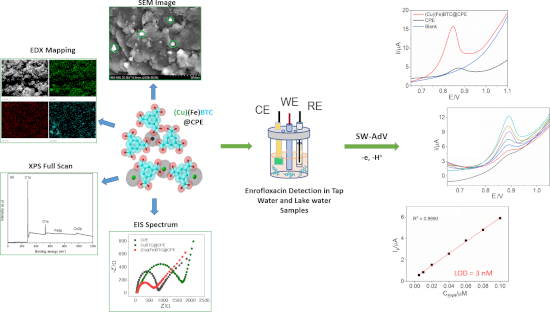
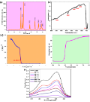
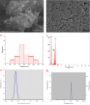
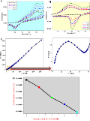
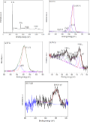
- /bjnano.15.120 Abstract A novel electrochemical sensor for the detection of enrofloxacin (ENR) in aqueous solutions has been developed using a carbon paste electrode modified with a mixture of metal-organic frameworks (MOFs) of CuBTC and FeBTC. These MOFs were successfully synthesized via a solvothermal
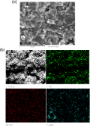
- volume of 0.544 cm3/g, and a capillary diameter of 1.50 nm. Additionally, energy-dispersive X-ray mapping demonstrated the uniform distribution of the two MOFs within the electrode composition. The synergistic effect of the electrocatalytic properties of CuBTC and the high conductivity of FeBTC
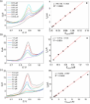
- significantly enhanced the electrochemical response of ENR, increasing the signal by more than ten times compared to the unmodified electrode. Under optimal analytical conditions, the sensor exhibited three dynamic ranges for ENR detection, that is, 0.005 to 0.100 µM, 0.1 to 1.0 µM, and 1 to 13 µM, with





New design of operational MEMS bridges for measurements of properties of FEBID-based nanostructures
Beilstein J. Nanotechnol. 2024, 15, 1273–1282, doi:10.3762/bjnano.15.103
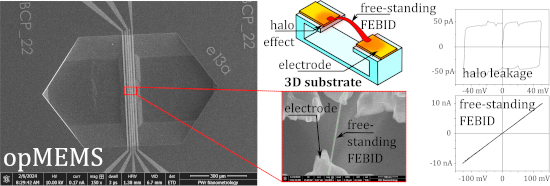
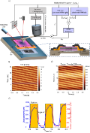
- , 17 pA, 13 ms dwell time, a single line pattern in a single pass with 4 nm pitch, and MeCpPtMe3 precursor at 321 K with a flow rate of 8.5 × 10⁻⁴ μm3/s. The pattern line was set to begin on one electrode and end on the other (Figure 7). In between, the nanowire growth proceeded horizontally with an


Quantum-to-classical modeling of monolayer Ge2Se2 and its application in photovoltaic devices
Beilstein J. Nanotechnol. 2024, 15, 1153–1169, doi:10.3762/bjnano.15.94
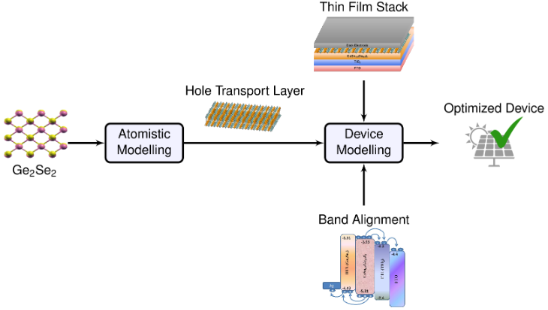
- because of the ultrathin layer and the strong electric field gradient from the active layer to the electrode. Finally, higher in-plane mobility of the monolayers can compensate the potential limitations of out-of-pane mobility for its prospective uses in solar cells, V-FETs, TFETs, and memristors [48]. In
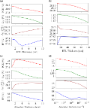
- and transfer them to the respective electrode. The thickness of the HTL also influences the device performance significantly. To optimize the HTL thickness for optimal device performance, we assumed a layer thickness of monolayer Ge2Se2, ranging from 1 to 10 nm. Figure 7a depicts the change of the




Unveiling the potential of alginate-based nanomaterials in sensing technology and smart delivery applications
Beilstein J. Nanotechnol. 2024, 15, 1077–1104, doi:10.3762/bjnano.15.88

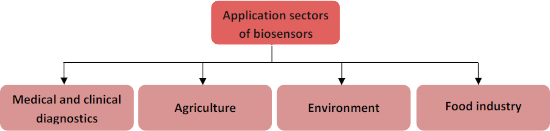
- charge on the polymer. It is critical in enabling quick electron transfer between an enzyme and an electrode surface, triggering the enzyme’s catalytic function for rapid biosensing [100]. Environmental sensing applications One key advantage of using nanosensors in environmental sensing is their ability
- several benefits, including excellent stability and extended storage life, which makes them a desirable choice for biosensor applications. Additionally, they may be quickly immobilized on a surface, such as a glass electrode, which increases their sensitivity and precision for identifying target analytes
- -linking agent to form a gel-like solution. Then, glucose oxidase is incorporated into the alginate mixture. Next, the mixture is sonicated to evenly distribute the alginate-based nanoparticles in an aqueous solution. Once the nanoparticles are formed, they can be immobilized onto a substrate or electrode


Recent progress on field-effect transistor-based biosensors: device perspective
Beilstein J. Nanotechnol. 2024, 15, 977–994, doi:10.3762/bjnano.15.80
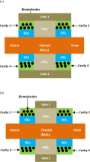
- gates [81][82]. 2.1.5 Nanowire FET-based biosensors. As planar FET devices face several challenges, such as the weak controllability of the gate electrode through the channel, alternative solutions have been explored. The concept of nanowire tunnel FETs (NW TFET) was proposed by Soni et al. [83] for
- , an additional electrode (ASE) was placed around the cavity and the source region in the oxide zone below the gate, and extended towards the source–oxide region, as shown in Figure 9. So, by using the source electrode, additional holes were created and accumulated on the surface of the source region
- include biomolecule species. This structure utilizes MoS2 in the body channel region and HfO2 as a high-k dielectric placed between the electrode gates and the body channel. It has been indicated that the sensitivity parameter of the designed biosensor is almost 100% higher in the case of the TMD FET




Simultaneous electrochemical determination of uric acid and hypoxanthine at a TiO2/graphene quantum dot-modified electrode
Beilstein J. Nanotechnol. 2024, 15, 719–732, doi:10.3762/bjnano.15.60
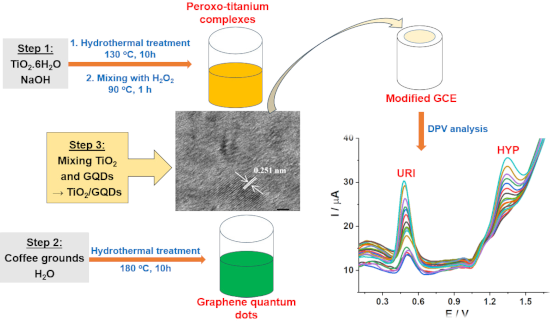
- composite (TiO2/GQDs) obtained by in situ synthesis of GQDs, derived from coffee grounds, and peroxo titanium complexes was used as electrode modifier in the simultaneous electrochemical determination of uric acid and hypoxanthine. The TiO2/GQDs material was characterized by photoluminescence, X-ray
- HYP using a TiO2/GQDs-modified electrode were addressed. Experimental Materials Coffee grounds were collected from the local area. Anatase (98%), hydrogen chloride (39%), hydrogen peroxide (30%), boric acid (99%), phosphoric acid (85%), acetic acid (99%), uric acid (99%), and hypoxanthine (99%) were
- numbers in parentheses stand for the volume ratio of peroxo titanium complex to GQDs solutions. Electrochemical studies Voltammetric measurements were performed at room temperature using a CPA-HH5 electrochemical workstation, Vietnam. A conventional three-electrode cell with a glassy carbon working


Elastic modulus of β-Ga2O3 nanowires measured by resonance and three-point bending techniques
Beilstein J. Nanotechnol. 2024, 15, 704–712, doi:10.3762/bjnano.15.58
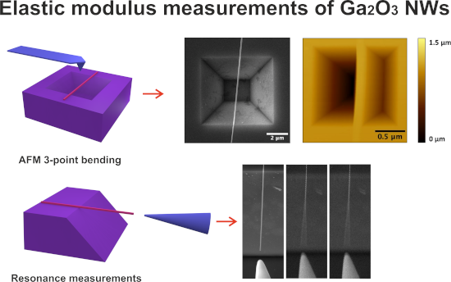
- endpoints of NWs. Mechanical resonance Resonance measurements were executed using a micromanipulator (Kleindiek MM3A-EM) with a sharp tungsten probe. Resonance in the NWs was induced by applying a sinusoidal oscillating AC signal between the NW and the tungsten probe (electrode). The 4 V AC and 2 V DC


Exfoliation of titanium nitride using a non-thermal plasma process
Beilstein J. Nanotechnol. 2024, 15, 631–637, doi:10.3762/bjnano.15.53
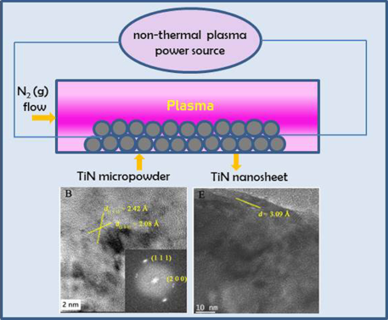
- flow. The arc was generated between a 316 L steel electrode and another electrode composed of graphite. The process lasted 60 min. Subsequently, the resultant material was collected, rinsed in a 1:1 mixture of water and isopropanol, and decanted for 24 h. Then, the liquid phase was filtered using a



AFM-IR investigation of thin PECVD SiOx films on a polypropylene substrate in the surface-sensitive mode
Beilstein J. Nanotechnol. 2024, 15, 603–611, doi:10.3762/bjnano.15.51
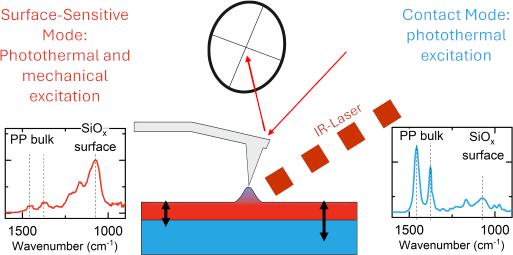
- ]. Experimental Materials and chemicals The substrates used were polypropylene foils (LyondellBasell, Moplen Hp640J) onto which a thin layer of SiOx was deposited by PECVD. Therefore, the samples were placed onto the grounded electrode. The basis pressure was below 5 × 10⁻⁵ mbar and the working pressure ranged


Stiffness calibration of qPlus sensors at low temperature through thermal noise measurements
Beilstein J. Nanotechnol. 2024, 15, 580–602, doi:10.3762/bjnano.15.50
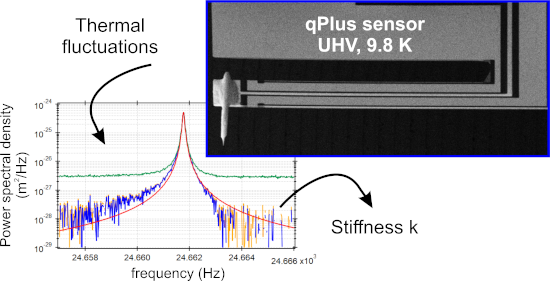
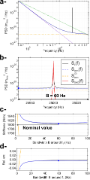
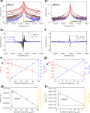
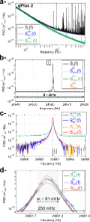
- , which forms the tip. The tip is electrically connected to an electrode that collects the tunneling current if scanning tunneling experiments are to be performed along with nc-AFM experiments. The qPlus sensors feature a resonance frequency of f1 ≃ 25 kHz and a most commonly reported stiffness of 1800 N
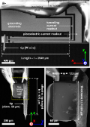
- ring electrode for mechanical excitation. The QTF surface features a set of three metallic electrodes evaporated on it. Their chemical composition has been characterized by EDS as consisting of a ≃200 nm thick layer of Au on a thinner chromium layer to favor the adhesion and wetting of Au. The massive
- electrode is for grounding. The two thinner ones, running along the free prong, are for the piezoelectric current and tunneling current readouts. The free prong is l = (2045 ± 100) μm long. The tip, indicated at the end of the free prong, consists of a W wire that is 50 μm in diameter, better visible in

On the mechanism of piezoresistance in nanocrystalline graphite
Beilstein J. Nanotechnol. 2024, 15, 376–384, doi:10.3762/bjnano.15.34
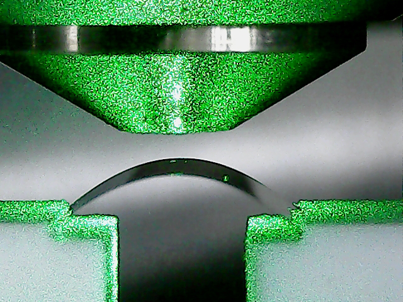
- -induced changes in the contacts, the NCG was patterned such that the NCG itself is used as a contacting electrode (shown in Figure 1b). The area marked with a red square in Figure 1b (2 mm × 2 mm) is the active device area for sheet resistance measurements on a substrate of 10 mm × 10 mm area. Thin NCG


Modulated critical currents of spin-transfer torque-induced resistance changes in NiCu/Cu multilayered nanowires
Beilstein J. Nanotechnol. 2024, 15, 360–366, doi:10.3762/bjnano.15.32
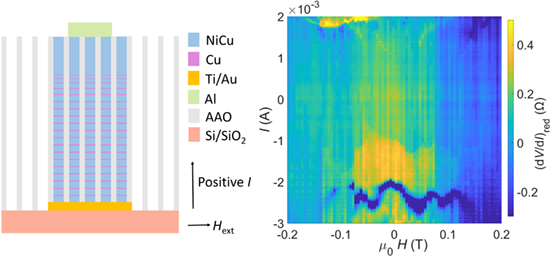
- around 1 µm. The electrodeposition of multilayered nanowires was carried out in situ using a three-electrode potentiostat in the pulsed mode [20] at 25 °C. Note that the nanowires were selectively deposited in the pores on the top of the Ti/Au bottom electrodes as shown in Figure 1a. Therefore, most of
- was patterned to build the top electrode by thermal evaporation at a large deposition rate (>3 Å/s) to ensure quick and continuous film formation and, thus, to efficiently avoid Al to be deposited into the pores. Therefore, only the nanowires the top of which have reached the upper surface of the AAO
- mV) added to a DC bias voltage at a frequency of 4531 Hz. A four-point measurement was used to exclude the effects of the cabling. A positive current is defined such that the electrons flow from the top electrode to the bottom electrode. A magnetic field was applied perpendicular to the nanowires


Controllable physicochemical properties of WOx thin films grown under glancing angle
Beilstein J. Nanotechnol. 2024, 15, 350–359, doi:10.3762/bjnano.15.31
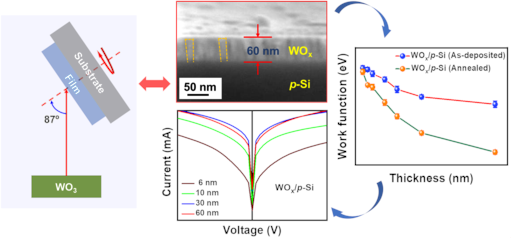
- regarded as an interlayer between the p-Si substrate and the Ag electrode. The glancing angle (87°) growth of a 6 nm film is likely to sustain a large number of metal (Ag)-induced gap states at the NS-WOx/p-Si interface, leading to Fermi level pinning, the degree of pinning being directly related to film
- -deposited films, compared to the annealed ones, indicating a quasi-ohmic nature of the junction. Increased rectification ratios are observed for thinner WOx films, which are insufficient to overcome the metal electrode-induced gap states at the interface leading to Fermi level pinning. Improved current


CdSe/ZnS quantum dots as a booster in the active layer of distributed ternary organic photovoltaics
Beilstein J. Nanotechnol. 2024, 15, 144–156, doi:10.3762/bjnano.15.14
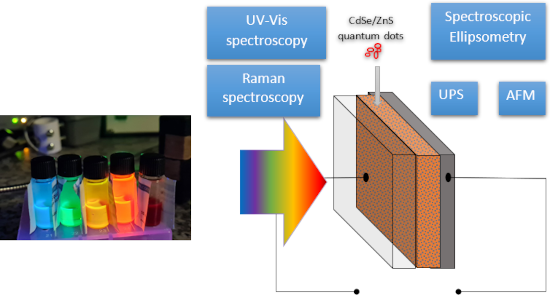
- , which favored the charging process of the metallic electrode. These were used to facilitate the transport of charge carriers between the electrode and the layer, which can become problematic because of limitations in the conductivity of organic materials. The changes in roughness presented from the AFM




Influence of conductive carbon and MnCo2O4 on morphological and electrical properties of hydrogels for electrochemical energy conversion
Beilstein J. Nanotechnol. 2024, 15, 57–70, doi:10.3762/bjnano.15.6
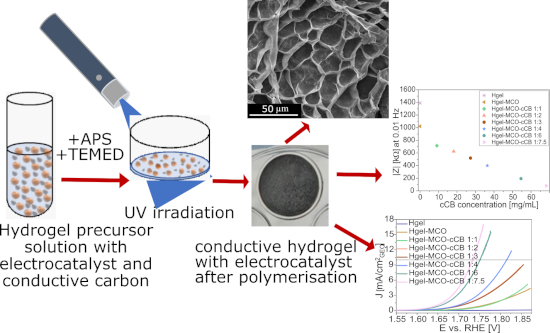
- were tested in terms of their electrical properties, showing that an increase in the concentration of conductive particles in the hydrogel structure translates into a lowering of the impedance modulus and an increase in the double-layer capacitance of the electrode. This, in turn, resulted in a higher
- catalytic activity of the electrode in the oxygen evolution reaction. The use of a hydrogel as a matrix to suspend the catalyst particles, and thus increase their availability through the electrolyte, seems to be an interesting and promising application approach. Keywords: electrical properties; energy
- of the polymer hydrogel in an aqueous environment makes this unlikely choice of material very important, and the optimal combination of polymer and catalyst can provide a robust and efficient electrode system in which the aqueous electrolyte is absorbed in the polymer matrix. This structure is


Spatial variations of conductivity of self-assembled monolayers of dodecanethiol on Au/mica and Au/Si substrates
Beilstein J. Nanotechnol. 2023, 14, 1169–1177, doi:10.3762/bjnano.14.97
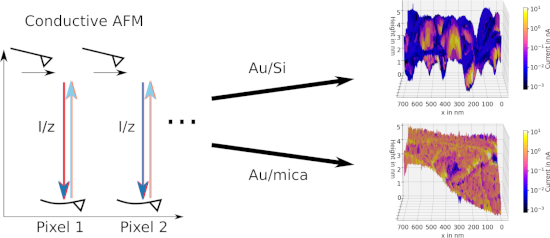
- contacting of molecular layers between a metal surface and a locally probing electrode. In early studies using this approach, the layers were contacted by a mercury droplet at the end of an electrode, which was then placed on top of the SAM [5][6][7]. Applying a voltage and, therefore, a current to the
- substrate and the mercury electrode yields the conductivity of the SAM, averaged over the contact area of the mercury droplet. In such studies, one of the crucial problems was mercury filling out defects in the SAMs, which leads to short circuits and unreliable currents running through the microcontact


A multi-resistance wide-range calibration sample for conductive probe atomic force microscopy measurements
Beilstein J. Nanotechnol. 2023, 14, 1141–1148, doi:10.3762/bjnano.14.94
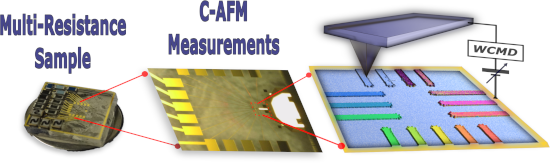
- electrical quantities (i.e., current and resistance) at the nanoscale. In C-AFM, a micro-machined conductive probe with a sharp nanometer-sized tip acts as a top electrode brought into contact with the surface of a sample while applying a potential difference relative to a back electrode. The small currents
- were fixed on the sample surface, creating a set of 15 resistance values, as shown in Figure 1a. The substrate was fixed onto a circular metallic plate (15 mm diameter), which acts as a back electrode connected to all resistances using a peripheral gold line and dashes of silver paste deposited on the
- wide) electrode arms designed for local C-AFM imaging and spectroscopic measurements. The gold lines’ dimensions were characterized for calculating their intrinsic resistances using the gold resistivity value. Calibration of SMD resistors and gold lines Before conducting C-AFM measurements, the


Spatial mapping of photovoltage and light-induced displacement of on-chip coupled piezo/photodiodes by Kelvin probe force microscopy under modulated illumination
Beilstein J. Nanotechnol. 2023, 14, 1059–1067, doi:10.3762/bjnano.14.87
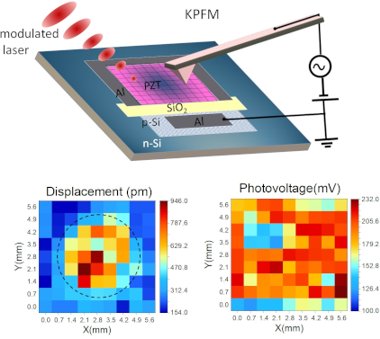
- × 2.8) and (1.4 × 1.2) mm2 labeled as A, B, C, and D, respectively. In the process of fabrication, a 100 nm thick layer of LNO as the bottom electrode was first deposited, using pulsed laser deposition (PLD) technique, on a single crystal silicon wafer. Then, an 850 nm lead barium zirconia titanate
- (PBZT) and a 150 nm LNO as the top electrode were deposited. The wafer was patterned by a standard photolithographic process, starting with the application and patterning of the photoresist mask for defining the device areas. Subsequently, the excess PBZT and LNO were removed by a wet etching process
- piezoelectric stack. Kelvin probe force microscopy was employed to measure the photoinduced voltage simultaneously with the displacement at the surface of the top LNO electrode as the bottom electrode was grounded. These measurements were performed with a Park Systems NX10 AFM microscope equipped with Pt/Ir


Ni, Co, Zn, and Cu metal-organic framework-based nanomaterials for electrochemical reduction of CO2: A review
Beilstein J. Nanotechnol. 2023, 14, 904–911, doi:10.3762/bjnano.14.74
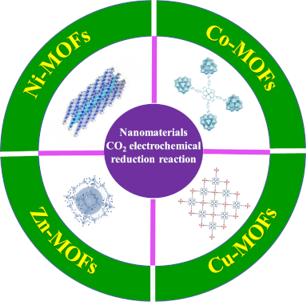
- valuable compounds through electrochemical reduction. The electrocatalytic process for CO2 reduction reactions (CO2RR) encounters a persistent obstacle in the activation of CO2 [4]. The formation of CO2•− necessitates a high thermodynamic potential of −1.90 V vs the standard hydrogen electrode
- carbon pastes, which serve as cathodes for CO2RR. To illustrate, Kornienko et al. deposited a Co-based MOF material onto an FTO substrate as a working electrode for CO2 conversion [40]. This material exhibited good performance in CO generation, achieving a faradaic efficiency (FE) of 76% (at −0.7 V vs
- converting individual MOFs into MOF-derived carbon-support nanomaterials. Another issue is the durability of the working electrodes. Many studies have employed drop casting and the use of binders to affix MOFs onto the substrate for electrode fabrication. This approach presents drawbacks such as reduced


A wearable nanoscale heart sound sensor based on P(VDF-TrFE)/ZnO/GR and its application in cardiac disease detection
Beilstein J. Nanotechnol. 2023, 14, 819–833, doi:10.3762/bjnano.14.67
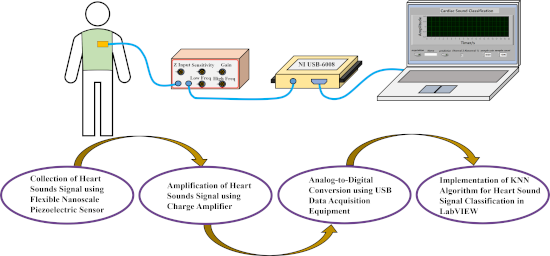
- length and 3 cm in width is cut, and a layer of conductive silver paste is evenly applied to both sides of the film. The paste is then dried completely by heating on a plate at 55 °C for 2 h. Copper foil tape is used as an electrode to attach to the conductive silver paste layer on both sides, and wires
- are welded onto the edges of the copper foil. In the mold shown in Figure 2, a thin layer of silica gel is injected and left to stand until it is dry. The nanofilm attached to the electrode is then placed in the mold, and an appropriate amount of silica gel is slowly injected until the film is


In situ magnesiothermic reduction synthesis of a Ge@C composite for high-performance lithium-ion batterie anodes
Beilstein J. Nanotechnol. 2023, 14, 751–761, doi:10.3762/bjnano.14.62
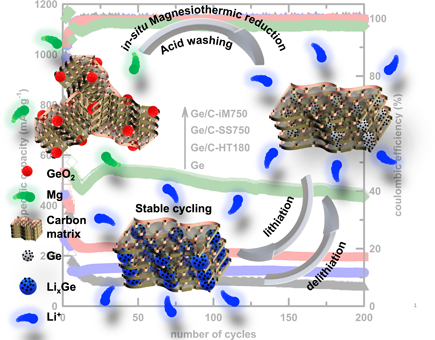
- report an in situ magnesiothermic reduction to synthesize a composite of Ge@C as an anode material for lithium-ion batteries. The obtained electrode delivered a specific capacity of 454.2 mAh·g−1 after 200 cycles at a specific current of 1000 mA·g−1. The stable electrochemical performance and good rate
- performance of the electrode (432.3 mAh·g−1 at a specific current of 5000 mA·g−1) are attributed to the enhancement in distribution and chemical contact between Ge nanoparticles and the biomass-based carbon matrix. A comparison with other synthesis routes has been conducted to demonstrate the effectiveness of
- GeO2 and biomass-derived carbon as precursor. A series of experiments using other methods to combine Ge and biomass carbon was also conducted for comparison. The in situ synthesized electrode exhibits superior electrochemical performance in lithium storage. This is attributed to a better contact


A graphene quantum dots–glassy carbon electrode-based electrochemical sensor for monitoring malathion
Beilstein J. Nanotechnol. 2023, 14, 701–710, doi:10.3762/bjnano.14.56
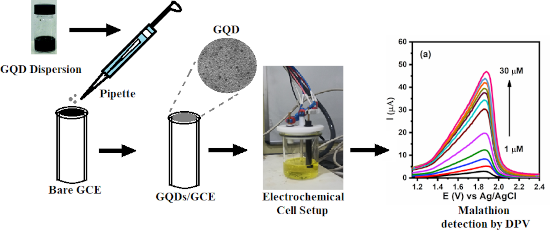
- diffraction were used to characterize the morphological and structural properties of GQDs. An electrochemical sensor was developed by drop casting GQDs on a glassy carbon electrode (GCE). The sensor detects the organophosphate pesticide malathion in a selective and sensitive manner. Using cyclic voltammetry
- , the sensor’s oxidation–reduction behavior was investigated. Electrochemical impedance spectroscopy was conducted to study the electrochemical properties of the modified the GQDs/GCE working electrode, which showed excellent charge transfer properties. We measured malathion in varying concentrations
- -functionalized nickel/silver/graphene quantum dot/graphene hybrid for the colorimetric detection of malathion [28]. This paper describes the development of an electrochemical sensor based on a graphene quantum dot-modified glassy carbon electrode (GQDs/GCE) for the determination and quantification of the





