Search results
Search for "segregation" in Full Text gives 94 result(s) in Beilstein Journal of Nanotechnology.
Modeling of the growth of GaAs–AlGaAs core–shell nanowires
Beilstein J. Nanotechnol. 2017, 8, 506–513, doi:10.3762/bjnano.8.54
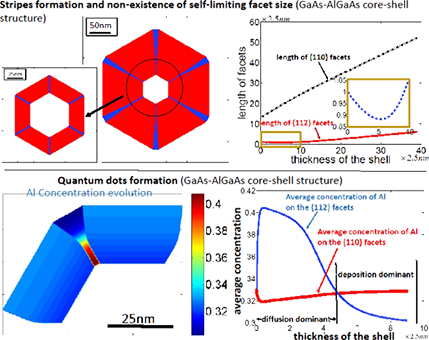
- mechanism responsible for the segregation of Al atoms in the shells. It is found that the mobility difference of the atoms on the {112} and {110} facets together determine the non-uniform concentration of the atoms in the shell. In particular, even though the mobility of Al on {110} facets is smaller than
- nanowires? The other issue is the mechanism responsible for the segregation of Al atoms in the shells. More specifically, under certain deposition conditions, Al atoms move slower than Ga atoms along the {110} facets [6]. If the atoms move from {110} to {112} facets, then the Al atoms should be left behind
- transient growth (Figure 7b). The configuration obtained in the numerical simulation is very close to that seen experimentally (Figure 7a). Besides the dot configuration shown in Figure 7b, Heiss et al. [2] also observed the segregation of Al in the shell of the nanowire (see the Al concentration shown in


Obtaining and doping of InAs-QD/GaAs(001) nanostructures by ion beam sputtering
Beilstein J. Nanotechnol. 2017, 8, 12–20, doi:10.3762/bjnano.8.2
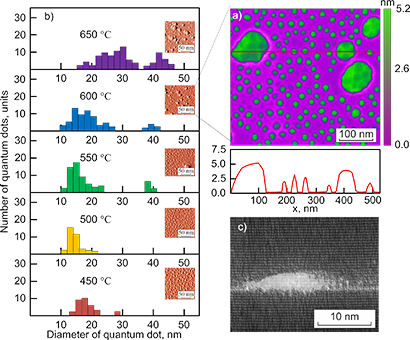
- . The increase in the impurity concentration along the direction of growth for values of RGaAs/SnTe between 100 and 101 can be explained by a weakly pronounced impurity segregation [36][37][38]. Evaporation of the solid SnTe source of can occur in the form of elementary Sn, elementary Te or molecules
- /SnTe ≈ 100–101 is explained by segregation that is mainly caused by existence of Te in the ligature source. The presence of impurities in the GaAs barrier layer increases the intensity of photoluminescence peaks of the ground and excited states of the quantum dots. The appearance of donor levels in the


Ferromagnetic behaviour of ZnO: the role of grain boundaries
Beilstein J. Nanotechnol. 2016, 7, 1936–1947, doi:10.3762/bjnano.7.185
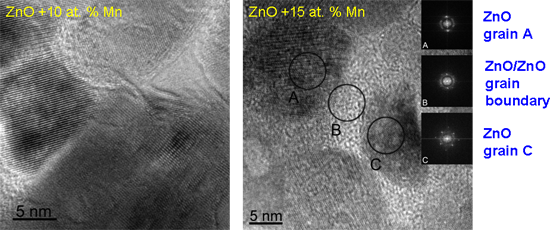
- multilayer grain boundary segregation. Keywords: ferromagnetism; grain boundaries; zinc(II) oxide (ZnO); Review Introduction In 2000 the seminal work of Tomasz Dietl et al. appeared [1]. In this work it was predicted theoretically that many semiconductor oxides can become ferromagnetic (FM) if one dopes
- . Those cs values do not exceed few percent, even at high temperatures. In several micro- and nanograined materials the overall solubility exceeds the cs value [39][40][41][42][43][44]. Already in 1957, McLean [45] proposed the idea that grain boundary segregation of a second component can change the
- sintered (nano)powders contain less GBs, the main defects are free surfaces. In such samples the overall solubility also increases, but now so drastically as in poreless polycrystals [46][47]. Can the monolayer grain boundary or surface segregation ensure such a high increase of solubility? We estimated


A new approach to grain boundary engineering for nanocrystalline materials
Beilstein J. Nanotechnol. 2016, 7, 1829–1849, doi:10.3762/bjnano.7.176
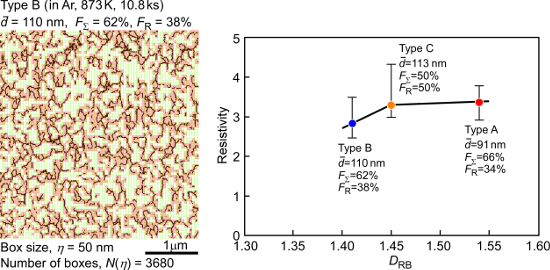
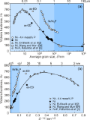
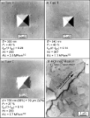
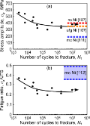
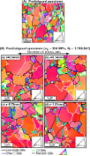
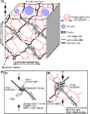
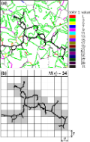
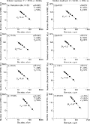
- , hardness, and the control of segregation-induced intergranular brittleness and intergranular fatigue fracture in electrodeposited nickel and nickel alloys with initial submicrometer-grained structure. A new approach to GBE based on fractal analysis of grain boundary connectivity is proposed to produce high
- grain boundaries and triple junctions. This is often associated with the nonequilibrium deformation of microstructures introduced by severe plastic deformation (SPD) with less thermal stability, excess structural defects and chemical composition by segregation to grain boundaries and interfaces [12][15
- . Engineering applications were successfully achieved first by Aust, Palumbo, Erb and their coworkers [31][32] and then by the authors of this work [33][34][35]. The nonequilibrium structure, structural defect and chemical composition by segregation as well as grain boundary character as the importance of grain







Effective intercalation of zein into Na-montmorillonite: role of the protein components and use of the developed biointerfaces
Beilstein J. Nanotechnol. 2016, 7, 1772–1782, doi:10.3762/bjnano.7.170
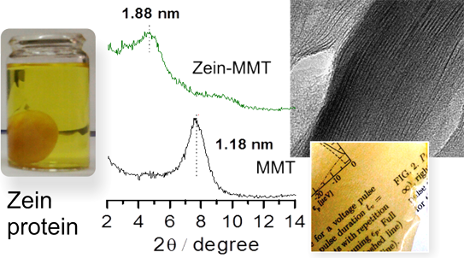
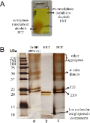
- medium was firstly tried for the preparation of zein–montmorillonite biohybrids (synthesis 1). In an alternative synthetic approach (synthesis 2) the clay was dispersed in water, favoring the formation of a swollen phase, and zein was treated with pure ethanol to provoke its segregation in two phases




Synthesis and applications of carbon nanomaterials for energy generation and storage
Beilstein J. Nanotechnol. 2016, 7, 149–196, doi:10.3762/bjnano.7.17
- few defects [134]. Chemical vapor deposition (CVD). The CVD method is commonly used to produce large-area uniform graphene films [77][135]. Similar to the CVD method used to grow CNTs, graphene can be grown from gases containing C on catalytic metal surfaces or by surface segregation of C dissolved in
- metals such as Fe [136], Ni [137], Co, Pt and Pd [138]. The pioneer who discovered single layer graphite on Pt was S. Hagstrom in 1965 [139], but the first to interpret it as a single layer was J. W. May in 1969 [140]. The CVD and surface segregation methods can also coexist causing the carbon atoms















Counterion effects on nano-confined metal–drug–DNA complexes
Beilstein J. Nanotechnol. 2016, 7, 62–67, doi:10.3762/bjnano.7.7
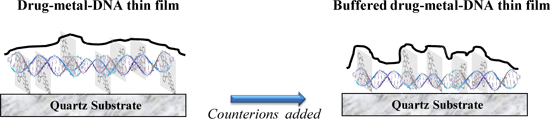
- counterions present in a buffer. X-ray reflectivity at and away from the Cu K absorption edge and atomic force microscopy studies reveal that confinement segregates the drug molecules preferentially in a top layer of the DNA film, and counterions enhance this segregation. Keywords: confinement; metal–drug
- states [6]. Again, a mixture of DNA and other macromolecules undergoes spontaneous segregation and organization under micrometre-scale confinement [7]. Regarding confinement effects at the nanometer scale, we have observed that in absence of counterions DNA molecules form layered structures aligned
- more enhanced in the case of the buffer film, indicating counterions enhance the Cu proportion in this layer. This suggests that a drug–DNA segregation occurs with buffering leaving more drug–metal composites at the surface increasing its roughness and clustering as observed from AFM topography (Figure


Two-phase equilibrium states in individual Cu–Ni nanoparticles: size, depletion and hysteresis effects
Beilstein J. Nanotechnol. 2015, 6, 1811–1820, doi:10.3762/bjnano.6.185
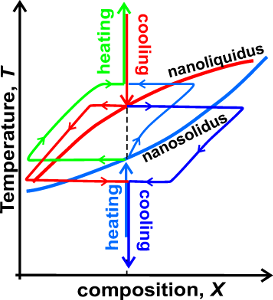
- nucleation in finite systems [14] and for grain boundary segregation problem as a successful approach to stabilize nanocrystalline materials against grain growth [15][16][17]. Chemical depletion is similar to oxygen starvation in medicine (also called as hypoxia) [18]. The origin of hypoxia is the same


Atomic scale interface design and characterisation
Beilstein J. Nanotechnol. 2015, 6, 1708–1711, doi:10.3762/bjnano.6.174

- absorption and emission devices require doping [4][5]. In this context, conventional bulk doping techniques must be adapted, given the large surface to volume ratio of nanostructures, surface segregation of dopant atoms is a severe drawback. Therefore detailed knowledge and control of the physical and
Possibilities and limitations of advanced transmission electron microscopy for carbon-based nanomaterials
Beilstein J. Nanotechnol. 2015, 6, 1541–1557, doi:10.3762/bjnano.6.158
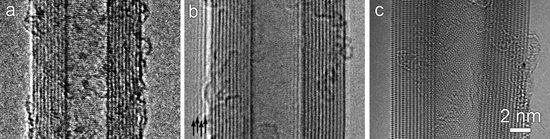
- be used for the study of interfaces in carbon-based nanohybrids. For example, in [97] an attempt is given to resolve the interface of CNT–TiO2 hybrids. Segregation or mixed metal–carbon phases at the interface of nanohybrids can be evaluated. Additionally, the introduction of the monochromator and


Formation of pure Cu nanocrystals upon post-growth annealing of Cu–C material obtained from focused electron beam induced deposition: comparison of different methods
Beilstein J. Nanotechnol. 2015, 6, 1508–1517, doi:10.3762/bjnano.6.156
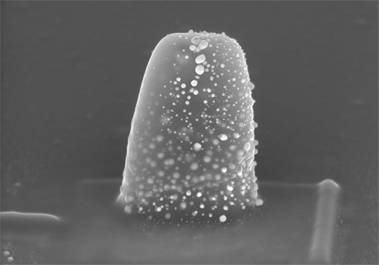
- irradiation dose of these regions and hence a slightly less reticulated carbon network which facilitates segregation at many places. For laser-induced heating we found the same phenomenon of surface precipitation of Cu nanocrystals although the annealing time was only one minute. Also the same trend in the
- the resistance-vs-temperature behavior of the samples would be stable. Here we focused on a proof of concept study. Conclusion We have shown that nanostructural changes were induced in Cu–C FEBID material from Cu(I) and Cu(II) precursors upon post-growth annealing causing the segregation and
- obtained from (hfac)CuVTMS and (hfac)CuDMB. The as-deposited materials were non-conductive. The transition into conductive material as well as the segregation and precipitation of the copper atoms occur upon conventional or laser heating. The surface precipitation of copper nanocrystals upon annealing




Thermal energy storage – overview and specific insight into nitrate salts for sensible and latent heat storage
Beilstein J. Nanotechnol. 2015, 6, 1487–1497, doi:10.3762/bjnano.6.154
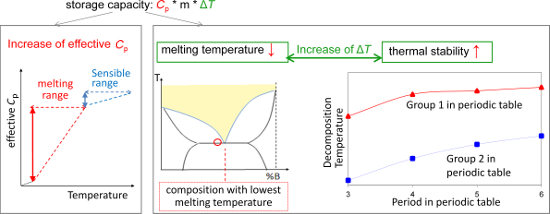
- state and insolubility in the solid state (simple eutectic system) Complete miscibility in the liquid state and partial miscibility in the solid state a) Segregation by eutectic reaction (eutectic system with limited solid solubility) b) Segregation by peritectic reaction System with intermetallic


Heterometal nanoparticles from Ru-based molecular clusters covalently anchored onto functionalized carbon nanotubes and nanofibers
Beilstein J. Nanotechnol. 2015, 6, 1287–1297, doi:10.3762/bjnano.6.133
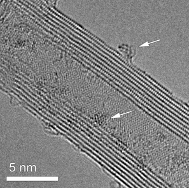
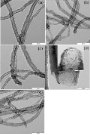
- -containing clusters, a bimodal size distribution of metal nanoparticles was obtained due to gold segregation from the cluster cores and strong aggregation. In the case of Ru–Pt precursors, heterometal nanoparticles of ultrasmall size were formed on the carbon fibers and MWNTs. We used a combination of HRTEM




Electronic interaction in composites of a conjugated polymer and carbon nanotubes: first-principles calculation and photophysical approaches
Beilstein J. Nanotechnol. 2015, 6, 1138–1144, doi:10.3762/bjnano.6.115
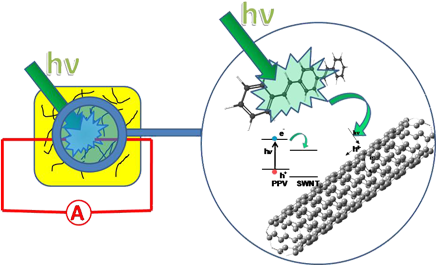
- substantial effect than the salient conjugation changes in the variation of peak-1 intensity with x. We note that the persistence of PL for high x-values suggests phase segregation between PPV and the SWNT network, likely due to an increase of the SWNT bundle sizes. To better understand how the morphology


Observing the morphology of single-layered embedded silicon nanocrystals by using temperature-stable TEM membranes
Beilstein J. Nanotechnol. 2015, 6, 964–970, doi:10.3762/bjnano.6.99

- investigation, it can be concluded that it is important to take images below the threshold dose, when dielectric films containing Si NCs are investigated. Silicon loss and out-diffusion during segregation annealing Another issue that arises directly from inspection of Figure 1a is the low areal density of


Nanostructuring of GeTiO amorphous films by pulsed laser irradiation
Beilstein J. Nanotechnol. 2015, 6, 893–900, doi:10.3762/bjnano.6.92
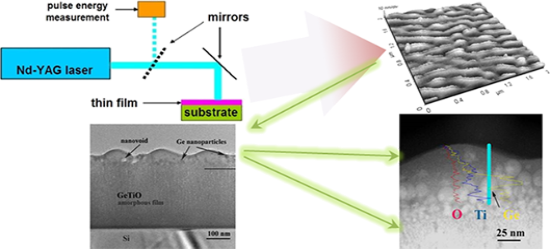
- the formation of amorphous Ge nanoparticles through the segregation of Ge atoms in the GeTiO matrix. The nanostructuring effects induced by the laser irradiation can be used in functionalizing the surface of the films. Keywords: fast diffusion; GeTiO film; nanostructuring; pulsed laser annealing
- ]. In this paper, we report about the nanostructuring at the surface and under the surface of amorphous GeTiO films by laser pulse action. The cross sectional study gives evidence of a fast diffusion effect, i.e., the formation of amorphous Ge nanoparticles through the segregation of Ge atoms in the
- pulse irradiation, the morphology of the film surface layer affected by the laser pulse actions gradually changes. Spherical amorphous Ge nanoparticles are formed by Ge atoms segregation. These spherical Ge nanoparticles have 5 nm diameters at the interface with the region of the unchanged amorphous


Structure and mechanism of the formation of core–shell nanoparticles obtained through a one-step gas-phase synthesis by electron beam evaporation
Beilstein J. Nanotechnol. 2015, 6, 874–880, doi:10.3762/bjnano.6.89
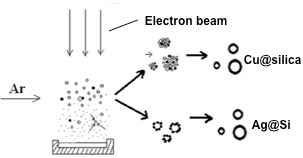
- due to the difference in surface tension. During this segregation process, the silicon will react with any oxygen dissolved inside the droplet or in the atmosphere to form SiO2 as Si has a higher affinity for oxygen than Cu. The silicon on the surface will then solidify long before the inner copper to


In situ scanning tunneling microscopy study of Ca-modified rutile TiO2(110) in bulk water
Beilstein J. Nanotechnol. 2015, 6, 438–443, doi:10.3762/bjnano.6.44
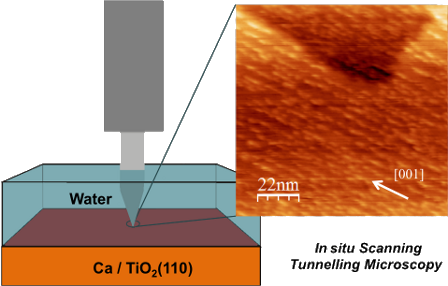
- -modified rutile TiO2(110) surfaces immersed in high purity water. The TiO2 surface was prepared under ultrahigh vacuum (UHV) with repeated sputtering/annealing cycles. Low energy electron diffraction (LEED) analysis shows a pattern typical for the surface segregation of calcium, which is present as an
- ) rutile surface prepared under ultrahigh vacuum (UHV) conditions, which is considered to be a model system [10][11]. Ordered Ca layers have been obtained by thermally activated segregation from the bulk [1][2][3][4][5], where calcium was a common bulk impurity in the TiO2 samples [10]. A c(6 × 2
- ) structure has been proposed for the resulting Ca overlayer based on low energy electron diffraction (LEED) and scanning tunneling microscopy (STM) measurements [1]. Segregation has been reported to produce an additional, differently ordered Ca layer, namely a p(3 × 1) structure [2][3][4]. More controlled


Nanoporous Ge thin film production combining Ge sputtering and dopant implantation
Beilstein J. Nanotechnol. 2015, 6, 336–342, doi:10.3762/bjnano.6.32
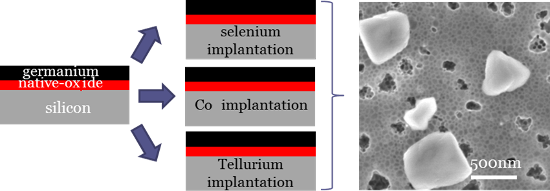
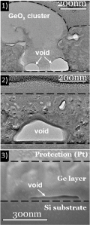
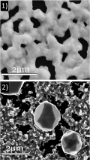
- -dopant cluster formation, surface and interface segregation, etc.) as well as their atomic diffusion mechanism in the bulk and on the surface of the Ge film, have a significant effect on the Ge dewetting phenomenon. For example, the cavity formation at the Ge/SiO2 interface could be also related to the


Si/Ge intermixing during Ge Stranski–Krastanov growth
Beilstein J. Nanotechnol. 2014, 5, 2374–2382, doi:10.3762/bjnano.5.246
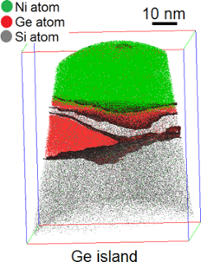
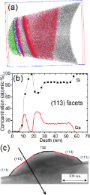
- concentration of about 15 atom %. The Ge distribution in the islands follows a cylindrical symmetry and Ge segregation is observed only in the {113} facets of the islands. The Ge composition of the wetting layer is not homogeneous, varying from 5 to 30 atom %. Keywords: atom probe tomography; germanium islands
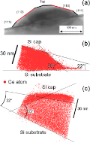
- intermixing during Ge island formation, the Si cap or Si substrate/island interface is abrupt, exhibiting weak Si/Ge intermixing during Si deposition. The islands keep their usual {111} and {113} surface facets under the Si cap, and Ge segregation is observed only in {113} facets. The thickness and the Ge
- (Figure 5 and Figure 6) it is necessary to analyze 1D composition profiles perpendicular to the facets in order to observe that Ge segregation actually only occurs on the {113} facets. For example, Figure 7 presents two different 1D composition profiles measured perpendicular to a {111} facet (squares




The impact of the confinement of reactants on the metal distribution in bimetallic nanoparticles synthesized in reverse micelles
Beilstein J. Nanotechnol. 2014, 5, 1966–1979, doi:10.3762/bjnano.5.206
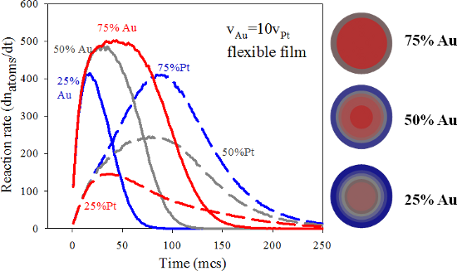
- composition-dependent [15][20][21][22][23]. Specifically, in the field of catalysis, bimetallic nanoparticles exhibit significantly increased catalytic behavior in comparison to monometallic nanoparticles [24]. Of interest is the controlled segregation and the extent of alloying of the two metals, since these
- segregation depends on the microemulsion dynamics. With the exception of the existing studies relating nanoparticle properties to microemulsion composition [2][3][30][31][32][33], there is a gap regarding the impact of microemulsion dynamics on metal segregation in bimetallic nanoparticles. The synthesis of
- beginning of the synthesis, despite its slower reduction rate. It means that Au–Pt nanoparticles with a Pt-core can be obtained. Similar qualitative behavior is obtained when different average concentrations are simulated. This unpredicted evolution of metal segregation when the proportions are varied can


Cathode lens spectromicroscopy: methodology and applications
Beilstein J. Nanotechnol. 2014, 5, 1873–1886, doi:10.3762/bjnano.5.198

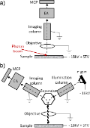
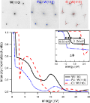
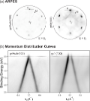
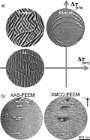
- below 0.1% of a ML. These experiments provided a formidable means to access to the thermodynamics governing carbon segregation, graphene nucleation and film growth [36][37][38]. In other cases, LEEM imaging was used to monitor the intercalation of adspecies below graphene [39][40][41]. As a further



On the structure of grain/interphase boundaries and interfaces
Beilstein J. Nanotechnol. 2014, 5, 1603–1615, doi:10.3762/bjnano.5.172
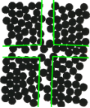
- coworkers [48][49][50] have examined the relevance of the CSL concept in understanding the two properties of segregation and corrosion by using TEM, atom probe tomography (APT) and a “pseudo” 3D-EBSD approach. The major conclusions are as follows. (a) Segregation for low-angle grain boundaries scales with
- Σ3 twins only fully coherent GBs with (nearly exact) (111) GB planes exhibit low segregation. (c) The occurrence of a certain coincidence lattice is not a sufficient criterion for a GB to be “special”. This is because the coincidence site lattice defines only three (out of the five) degrees of
- freedom of a GB and it does not provide any information about the orientation of the GB plane and the degree of coherency in it. For instance, the Σ9 GB, in spite of being a low ΣCSL boundary, does not exhibit “special” behavior regarding its resistance to segregation. This is attributed to the fact that


Current state of laser synthesis of metal and alloy nanoparticles as ligand-free reference materials for nano-toxicological assays
Beilstein J. Nanotechnol. 2014, 5, 1523–1541, doi:10.3762/bjnano.5.165
- with evenly distributed elemental compositions (Ti: 50 ± 4%; Ni: 50 ± 4%) were found. Interestingly, particles with even distributions as well as Ti-rich particles revealed a highly distinctive elemental segregation (Figure 9B); the predominant structure in this case was a Ni core surrounded by a TiOx
- due to surface oxidation which is believed to be far more pronounced in an aqueous medium. Consequently, elemental segregation in NiTi nanoparticles requires a certain degree of surface oxidation, which is likely to occur anyway during unintended nanoparticle release scenarios in biological systems
- findings seem to indicate that elemental segregation in laser fabricated alloy nanoparticles may not be solely dominated by surface oxidation but also by the elemental composition of the alloy particle. In order to further examine this phenomenon, alloy nanoparticles with well-defined elemental


Formation of CuxAu1−x phases by cold homogenization of Au/Cu nanocrystalline thin films
Beilstein J. Nanotechnol. 2014, 5, 1491–1500, doi:10.3762/bjnano.5.162
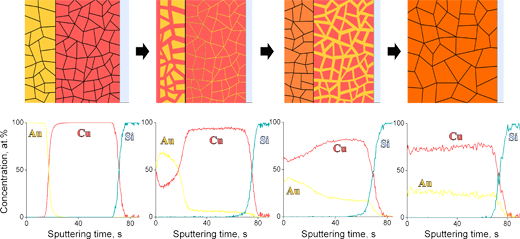
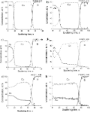
- observed grain sizes. It is noteworthy that the appearance of some Cu atoms at the topmost surface and the development of a minimum can be observed in the center of the Au layer (Figure 1c). It can be explained by the segregation of Cu [29] and/or by the coexistence of fast and slow diffusion boundaries