Search results
Search for "charge transfer" in Full Text gives 375 result(s) in Beilstein Journal of Nanotechnology. Showing first 200.
Hierarchical Bi2WO6/TiO2-nanotube composites derived from natural cellulose for visible-light photocatalytic treatment of pollutants
Beilstein J. Nanotechnol. 2022, 13, 745–762, doi:10.3762/bjnano.13.66
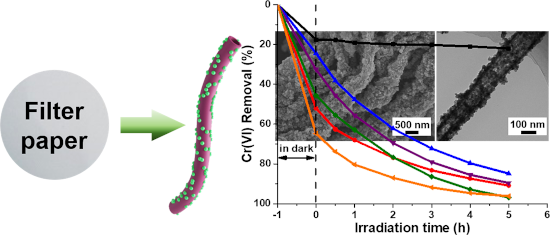
- and Bi2WO6 phases in the nanocomposites, leading to the production of more carriers when induced by visible light. It is reported that the change of binding energy due to the atomic bonding or charge transfer transition of the conduction bands in between TiO2 and Bi2WO6 phases in the Bi2WO6/TiO2-NT


A nonenzymatic reduced graphene oxide-based nanosensor for parathion
Beilstein J. Nanotechnol. 2022, 13, 730–744, doi:10.3762/bjnano.13.65
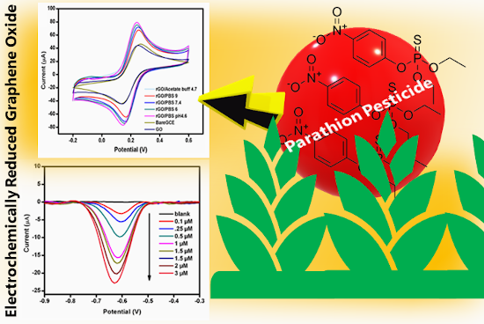
- values of charge-transfer resistance (Rct), capacitance (Cdl), and Warburg impedance (W) of bare GCE, GO/GCE, and ERGO/GCE. The Nyquist plot of the bare GCE electrode depicts a semicircle with Rct of 4.692 Ω. A nearly straight line for ERGO with a negligible Rct (1.618 Ω) value suggests opened porous


Nanoarchitectonics of the cathode to improve the reversibility of Li–O2 batteries
Beilstein J. Nanotechnol. 2022, 13, 689–698, doi:10.3762/bjnano.13.61
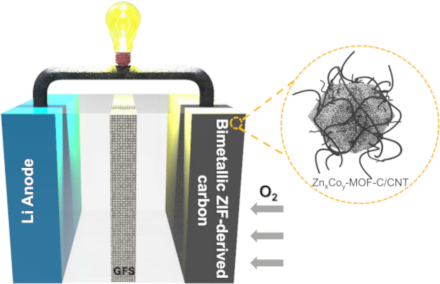
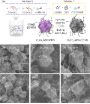
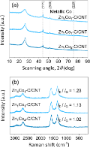
- the charge transfer resistance. In addition, the electrocatalytic activities of metallic Co and N could facilitate the decomposition of Li2O2 during the next charge process, so that the overpotential of Zn4Co1–C/CNT cathode could be reduced. The cycling performance of ZnxCoy–C/CNT cathodes was


Revealing local structural properties of an atomically thin MoSe2 surface using optical microscopy
Beilstein J. Nanotechnol. 2022, 13, 572–581, doi:10.3762/bjnano.13.49
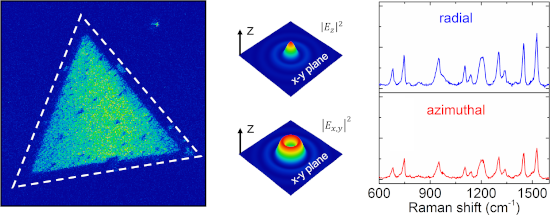
- -of-plane electric field component dominates. This phenomenon indicates that the face-on oriented CuPc molecules strongly interact with the MoSe2 flake via charge transfer and dipole–dipole interaction. Furthermore, the Raman scattering maps on the irregular MoSe2 surface show a distinct correlation
- the interaction with local dipoles in plasma-treated MoS2 [22]. Additionally, the electronic band structure of MoS2 can be significantly modified after oxygen incorporation into MoS2. The charge transfer from the valence band of partially oxidized MoS2 to the LUMO of R6G can be tuned in resonance with
- orientation and molecular energy levels in the vicinity of the Fermi level of graphene, the charge-transfer effect can become more pronounced [24][25]. In summary, the structural irregularities in 2D materials and molecular probe both can impact the strength of molecule–substrate interactions and then modify


Influence of thickness and morphology of MoS2 on the performance of counter electrodes in dye-sensitized solar cells
Beilstein J. Nanotechnol. 2022, 13, 528–537, doi:10.3762/bjnano.13.44
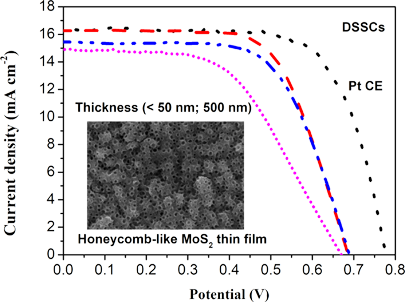
- -circuit model including the series resistances of electrolyte and FTO substrate (Rs) and the charge-transfer resistances on the CE/electrolyte and TiO2/dye/electrolyte interfaces (Rct1 and Rct2) associated with the corresponding constant phase elements (CPE1 and CPE2) as described in Figure 6 (Figure 6
- 1T phase of MoS2 and is in good agreement with Raman analysis. Under dark conditions, the Rct1 value for MoS2 CE-based DSSCs (from 52.6 to 78.5 Ω·cm2) was found to be significantly higher than that of Pt CE-based DSSCs (3.6 Ω·cm2), indicating slower charge transfer kinetics at the MoS2/electrolyte


Zinc oxide nanostructures for fluorescence and Raman signal enhancement: a review
Beilstein J. Nanotechnol. 2022, 13, 472–490, doi:10.3762/bjnano.13.40
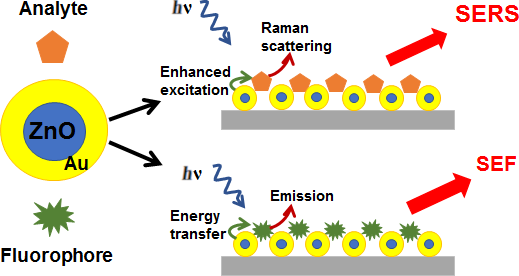
- surface features, and the specific location of analyte molecules. Lately, ZnO-based nanostructures have been exploited especially as SERS substrates showing high enhancement factors and increased charge transfer effect. Additionally, applications focused on enhancing the fluorescence of analyte molecules
- chemical enhancement owing to the interaction between semiconductor and/or noble metals with the analytes [7][35]. The chemical enhancement is related to the photoinduced charge transfer effect that takes place under the light excitation when the highest occupied molecular orbital (HOMO) and lowest
- NPs (or nanofilms), enabling a large area coverage with tiny and well-distributed Ag NPs, thereby efficiently exploiting their EM enhancement. Subsequently, both EM and charge-transfer (CT) enhancement contribute to the final SERS amplification [48], which is the reason for the use of ZnO




A non-enzymatic electrochemical hydrogen peroxide sensor based on copper oxide nanostructures
Beilstein J. Nanotechnol. 2022, 13, 424–436, doi:10.3762/bjnano.13.35
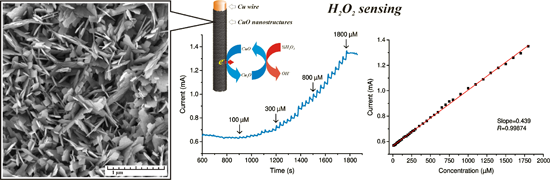
- obtain nanostructures with a large active surface area, which ensures efficient electron charge transfer between CuO nanostructures and the copper substrate due to the formation of high-density, single-crystal nanopetals. Nanostructures are produced in one step, and can be directly used as sensor
- EIS curve and the corresponding equivalent circuit are presented. The absence of characteristic semicircles formed by RCs by the circuit elements indicates a low charge transfer resistance and the predominance of Warburg diffusion over other processes in the electrochemical system. Figure 3f shows an




A chemiresistive sensor array based on polyaniline nanocomposites and machine learning classification
Beilstein J. Nanotechnol. 2022, 13, 411–423, doi:10.3762/bjnano.13.34
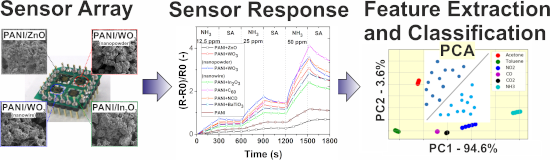
- concentration due to PANI doping and the formation of charge transfer complexes [20]. The decrease of electrical resistance is caused by the greater mobility of the dopant ions, related to the development of PANI chains. Furthermore, the swelling effect contributes to the change in resistivity [21]. Statistical




The effect of metal surface nanomorphology on the output performance of a TENG
Beilstein J. Nanotechnol. 2022, 13, 298–312, doi:10.3762/bjnano.13.25
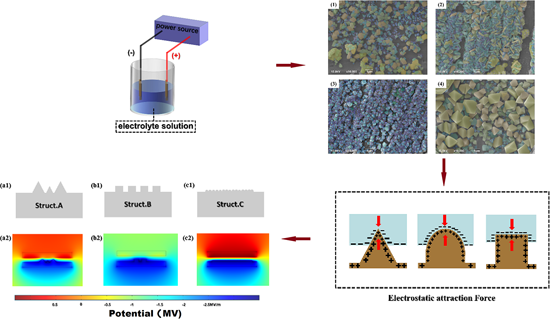
- Normal University, Neijiang 641100, China 10.3762/bjnano.13.25 Abstract In this work, the effect of charge density and nanomorphology of a metal tip on the output performance of a triboelectric nanogenerator (TENG) is studied. The basic working principle of the TENG is charge transfer after separation
- surface. When the materials are separated, the positive and negative electrostatic charges on the materials will also be separated, resulting in a potential difference. The charge transfer strongly depends on the work functions of the two materials in contact, for example, metal–metal, semiconductor




Coordination-assembled myricetin nanoarchitectonics for sustainably scavenging free radicals
Beilstein J. Nanotechnol. 2022, 13, 284–291, doi:10.3762/bjnano.13.23
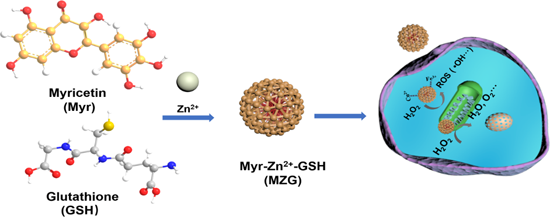
- 5.5), and MZG nanoparticles (pH 5.5) were measured. The UV–vis absorption spectrum of MZG nanoparticles exhibited a blue shift at 550 nm, compared with Myr/Zn2+, which was assigned to the charge transfer between GSH and Zn2+ (Figure 2c). These results demonstrated that Zn2+ as the coordination


Impact of device design on the electronic and optoelectronic properties of integrated Ru-terpyridine complexes
Beilstein J. Nanotechnol. 2022, 13, 219–229, doi:10.3762/bjnano.13.16
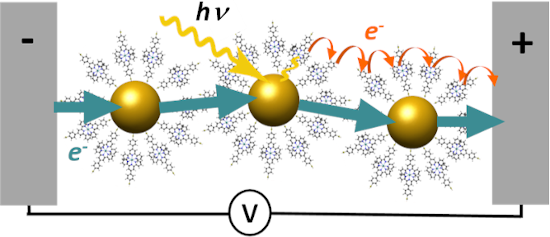
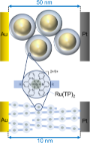
- -ligand charge transfer absorption bands and a relatively long lifetime of the triplet state as well as voltage-driven molecular switching in solid-state molecular junctions [11][12][13][14][15]. In addition, Ru(TP)2-complexes and the corresponding supramolecular wires exhibit a rod-like structure, which
- nm, while the metal-to-ligand charge transfer band of Ru(MPTP)2-complexes is located at 499 nm. However, a considerable overlap of both bands is given (Supporting Information File 1, Figure S13) and, thus, a subsequent transfer of the incident electromagnetic energy to the Ru(MPTP)2-complexes bound
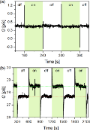
- -complex, that is, a metal-to-ligand charge transfer is induced. The Ru2+ cation creates an exciton consisting of a threefold positive Ru3+ and a negative charge located on the MPTP ligand. Subsequently, these charge carriers are separated in the applied electrical field. Therefore, the electrical field


Tin dioxide nanomaterial-based photocatalysts for nitrogen oxide oxidation: a review
Beilstein J. Nanotechnol. 2022, 13, 96–113, doi:10.3762/bjnano.13.7
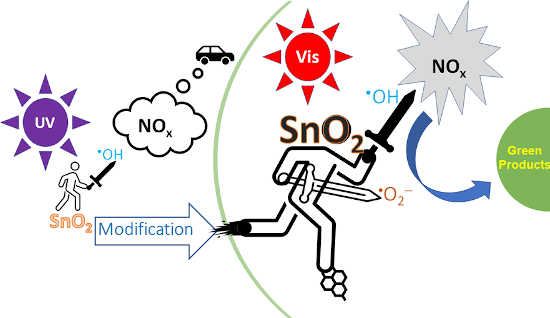
- process. Table 1 shows a comparison of the NO photocatalytic oxidation ability of neat SnO2 and modified SnO2 materials. Recent studies on this material system mainly focus on modifying SnO2 toward the application in the visible light region. Charge transfer improvement The combination of SnO2 with other
- co-photocatalysts, including inorganic and organic semiconductors, is a practical approach to enhance the charge transfer efficacy for the photocatalytic process. The photocatalytic degradation of NOx over SnO2 as a host photocatalyst is reported to be considerably enhanced after the combination with
- transition of photogenerated carriers used for the NO removal [37]. Pham et al. showcased a step-scheme (S-scheme) photocatalyst composed of 2D/0D g-C3N4 nanosheet-assisted SnO2 NPs (g-C3N4/SnO2) for removing NO with low NO2 generation. This work established an S-scheme charge transfer path by combining


The effect of cobalt on morphology, structure, and ORR activity of electrospun carbon fibre mats in aqueous alkaline environments
Beilstein J. Nanotechnol. 2021, 12, 1173–1186, doi:10.3762/bjnano.12.87
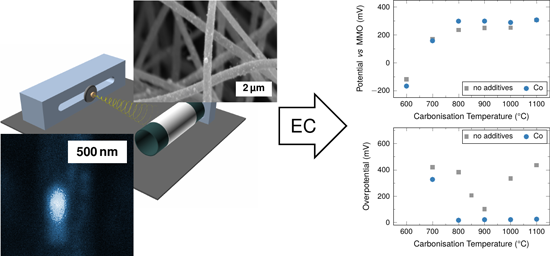
- . The overpotential at a given current density is a measure of the power losses in the system resulting from internal resistances, such as charge transfer resistance and Ohmic resistance relevant to the practical capacity of the system. The resulting values determined in this fashion are summarised in


Irradiation-driven molecular dynamics simulation of the FEBID process for Pt(PF3)4
Beilstein J. Nanotechnol. 2021, 12, 1151–1172, doi:10.3762/bjnano.12.86
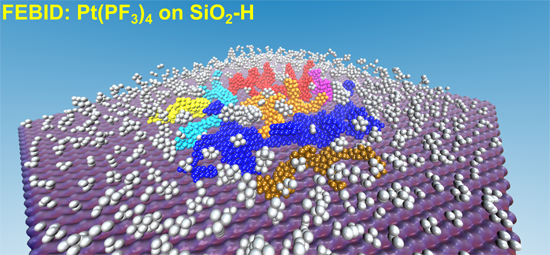
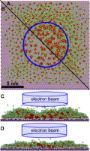
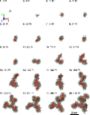
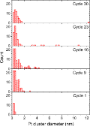
- for quantum and chemical transformation of surface-adsorbed molecular systems under focused electron beam irradiation [13][14][15][16]. Within the IDMD framework various quantum processes occurring in an irradiated system (e.g., ionization, bond dissociation via electron attachment, or charge transfer








Molecular assemblies on surfaces: towards physical and electronic decoupling of organic molecules
Beilstein J. Nanotechnol. 2021, 12, 950–956, doi:10.3762/bjnano.12.71

- substrate. Hurdax et al. reported that both charged and neutral species of sexiphenyl can co-exist on thin dielectric MgO films on Ag(100) [89]. Due to the changed work function of the substrate, charging of the adsorbates is enabled by electron tunneling. The charge transfer strongly influences the
Modification of a SERS-active Ag surface to promote adsorption of charged analytes: effect of Cu2+ ions
Beilstein J. Nanotechnol. 2021, 12, 902–912, doi:10.3762/bjnano.12.67
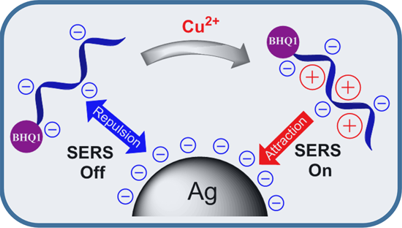
- basic mechanism is EM through localized surface plasmon resonances (LSPRs) on the metal surface [16]. CE is at least two orders of magnitude weaker than EM. The CE mechanism is supposed to be caused by a charge transfer between the plasmonic surface and the chemically adsorbed analyte molecules, which


Nanoporous and nonporous conjugated donor–acceptor polymer semiconductors for photocatalytic hydrogen production
Beilstein J. Nanotechnol. 2021, 12, 607–623, doi:10.3762/bjnano.12.50
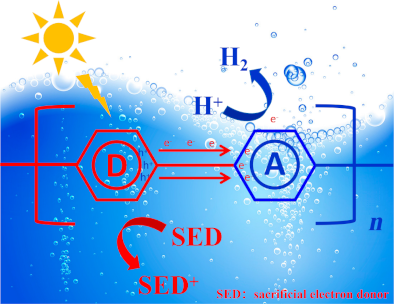
- tunable bandgaps, high charge carrier mobility, and efficient intramolecular charge transfer. In this minireview, recent advances of D–A polymers in photocatalytic hydrogen evolution are summarized with a particular focus on modulating the optical and electronic properties of CPs by varying the acceptor
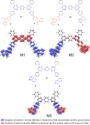
- of CTFs. The carbazole–triazine-containing CTF P1 (Figure 2) triggered a strong intramolecular charge transfer (ICT) and achieved a high HER of 538 μmol·h−1 (50 mg). Bojdys and co-workers reported a series of CTFs with diverse functional moieties (e.g., heterocycles containing S and/or N) at the
- . However, HER is affected by the interplay of several factors, including surface area, light absorption range, crystallinity, charge transfer, and separation. Two azine-linked COFs with three pyridine segments neighboring the central benzene or triazine fragment were prepared to make comparisons, that is




Local stiffness and work function variations of hexagonal boron nitride on Cu(111)
Beilstein J. Nanotechnol. 2021, 12, 559–565, doi:10.3762/bjnano.12.46
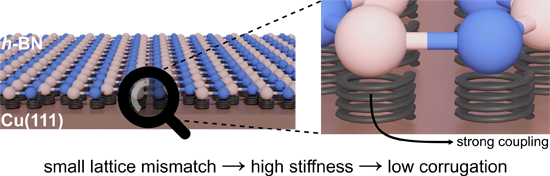
- originate from a locally varying charge transfer between the substrate and the dielectric layer [38][39][40]. In our studied substrate, it is the lattice mismatch between h-BN and the Cu(111) substrate that leads to a varying atomic registry and subsequently induces a lateral modulation of the charge
- transfer [41]. Additionally, this leads to in-plane electric fields, which have been shown to trap atoms, molecules, and nanoclusters [11][13][42]. To map the local Φ fluctuations and to correlate them with the structural properties of the surface, we use two complementary methods: The first method is


Simulation of gas sensing with a triboelectric nanogenerator
Beilstein J. Nanotechnol. 2021, 12, 507–516, doi:10.3762/bjnano.12.41
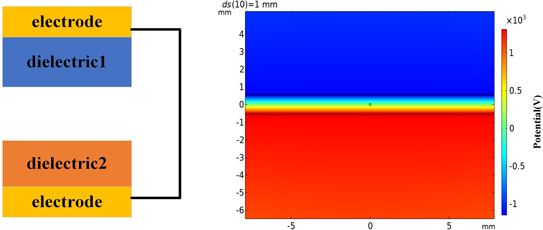
- ], single electrode mode [32][33][34], and independent layer mode [35]. In order to explain the charge transfer process between two friction materials in contact, various models have been proposed and explored, such as electron cloud model [36][37][38], ion transfer model [39], and material transfer model



Interface interaction of transition metal phthalocyanines with strontium titanate (100)
Beilstein J. Nanotechnol. 2021, 12, 485–496, doi:10.3762/bjnano.12.39
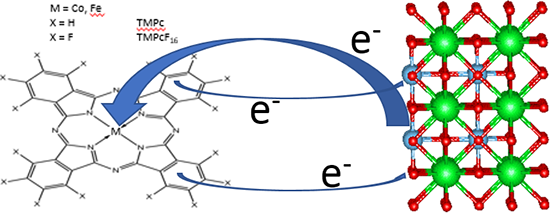
- first monolayer on the oxide surface depends on the central metal atom of the phthalocyanine, whereas the substrate preparation has minor influence on the interaction between CoPc and SrTiO3(100). Differences of the interaction mechanism to related TiO2 surfaces are discussed. Keywords: charge transfer
- properties. Hence, TMPcs are well suited for systematic studies of interface properties. The fluorination of TMPcs varies exceptionally the ionization potential (IP), affecting distinctly the interface properties [29][30][31][32]. As recently shown for FePcFx/MoS2 [33], a charge transfer at interfaces might
- structural ordering of the near-surface region below the topmost layer, and we may rule out a completely SrO-terminated surface. CoPcFx on STO(100) Possible interactions between organic molecules and different substrates may include charge transfer processes or even chemical reactions. In the case of


Boosting of photocatalytic hydrogen evolution via chlorine doping of polymeric carbon nitride
Beilstein J. Nanotechnol. 2021, 12, 473–484, doi:10.3762/bjnano.12.38
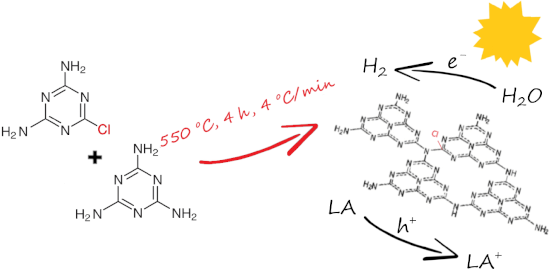
- the EIS spectrum is related to the charge-transfer resistance at the electrode–electrolyte interface [71]. The EIS arc radius of Cl-PCN is smaller than that of PCN. Its impedance is reduced compared to PCN, indicating that Cl doping decreased the charge-transfer resistance of polymeric carbon nitride
- surface reaction sites before recombination leading to hydrogen evolution. These results are consistent with PL spectroscopy and EIS results, revealing a better separation and charge transfer, respectively, after chlorine doping. Moreover, it was revealed that chlorine doping affected the CB shift to a


Solution combustion synthesis of a nanometer-scale Co3O4 anode material for Li-ion batteries
Beilstein J. Nanotechnol. 2021, 12, 424–431, doi:10.3762/bjnano.12.34
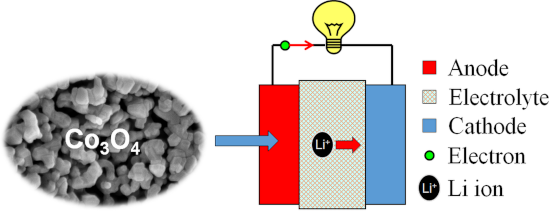
- Information File 1. These EIS features represent the charge transfer at the electrode–electrolyte interface (Rct) and the Warburg impedance (W), which is attributed to the diffusion of Li+ ions in the bulk electrode material [25][38]. The plots for the cycled cell are slightly different. They are composed of
- represent the charge transfer at the electrode–electrolyte interface (Rct) and the Warburg impedance (W), respectively. The semicircle at high frequencies is mainly attributed to SEI resistance (RSEI) and contact resistance (Rf) [13][15][20][21][25][38]. At this point, it should be also mentioned that the
- decreased for the cycled cell. This indicates that the charge transfer reaction has been improved due to cycling. Also, a slight cycle-to-cycle increase of Rct as well as of RSEI is observed for the cycled sample. This phenomenon might be explained by the growth of the SEI layer, which provides some


Nickel nanoparticle-decorated reduced graphene oxide/WO3 nanocomposite – a promising candidate for gas sensing
Beilstein J. Nanotechnol. 2021, 12, 343–353, doi:10.3762/bjnano.12.28
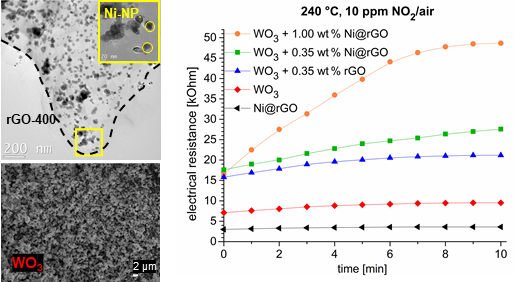
- graphene and metal oxide. In the case of reduced graphene oxide (semiconductor), various reasons are considered, such as the appearance of p–n junctions that shift the Fermi level of the oxide. There is evidence of effective charge transfer between graphene and nanospheres through chemical bonds. Emergence
- plays an important role in charge transfer processes and leads to the enhancement in the gas sensing performance due to the synergistic effect between rGO (p-type) WO3 (n-type) [29]. In [37][53], the formation of C–O–W bonds at the interphase boundaries was observed, when studying a rGO/WO3 composite
- using XPS and Raman spectroscopy. Such bonds can play an important role also in our case with regard to charge transfer. It has been established that adsorption of NO2 molecules will cause upward band bending by capturing free electrons from the conduction band and shift the Fermi level of WO3 away from


Extended iron phthalocyanine islands self-assembled on a Ge(001):H surface
Beilstein J. Nanotechnol. 2021, 12, 232–241, doi:10.3762/bjnano.12.19
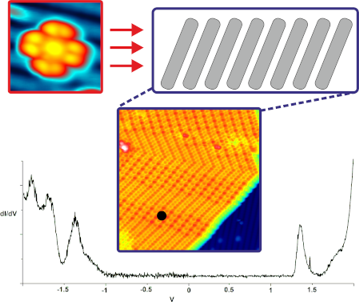
- scanning probe microscopes [1][2][3]. At the same time, however, metallic substrates usually influence the properties of adsorbed molecular species, leading to hybridization, charge transfer, or screening at the interface [4][5][6]. Also, metallic surfaces may provide relatively weak binding, dominated by
Paper-based triboelectric nanogenerators and their applications: a review
Beilstein J. Nanotechnol. 2021, 12, 151–171, doi:10.3762/bjnano.12.12
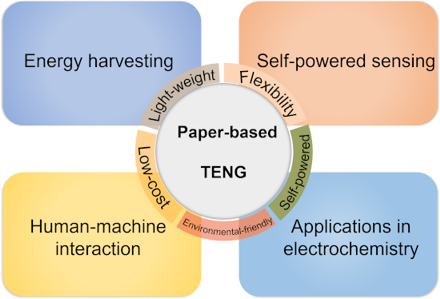
- several typical examples in which P-TENGs are used. This paper starts with an overview of TENGs and the corresponding working mechanism of four basic working modes based on charge transfer and on the electron-cloud potential-well model. Regarding surface modification and fabrication methods involving
- and highly efficient energy-harvesting systems. To conclude the review, perspectives and proposals regarding future potential applications and research directions are discussed. Review Four working modes of TENGs and charge-transfer mechanisms TENGs, which are emerging and efficient apparatus for
- (most common design in previous works) as a typical representative example, we further systematically analyze the working mechanism of the detailed charge-transfer process. Figure 2b elucidates the charge generation and the electron-transfer process at the friction interfaces (paper/the other dielectric