Search results
Search for "selected area electron diffraction" in Full Text gives 95 result(s) in Beilstein Journal of Nanotechnology.
Morphology control of zinc oxide films via polysaccharide-mediated, low temperature, chemical bath deposition
Beilstein J. Nanotechnol. 2015, 6, 799–808, doi:10.3762/bjnano.6.83
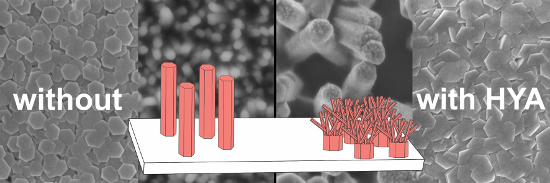
- experiments in which HYA adsorbs onto ZnO crystallites during their growth and thereby influences their size and aspect ratio. Furthermore, those ZnO subunits aggregate under the influence of HYA into highly ordered mesocrystals, which was evidenced by SEM investigations and selected area electron diffraction




Silica micro/nanospheres for theranostics: from bimodal MRI and fluorescent imaging probes to cancer therapy
Beilstein J. Nanotechnol. 2015, 6, 546–558, doi:10.3762/bjnano.6.57
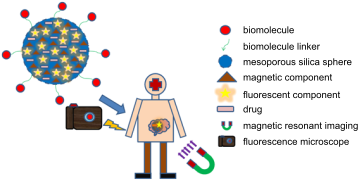
- . The size of MSN and YVO4:Eu3+ MSN NPs was studied by TEM and was found to be about 50 nm in both the cases. The amorphous nature of the silica surface and the crystalline nature of YVO4 NPs inside the silica spheres were further confirmed by selected area electron diffraction (SAED) (Figure 1


Tunable white light emission by variation of composition and defects of electrospun Al2O3–SiO2 nanofibers
Beilstein J. Nanotechnol. 2015, 6, 313–320, doi:10.3762/bjnano.6.29
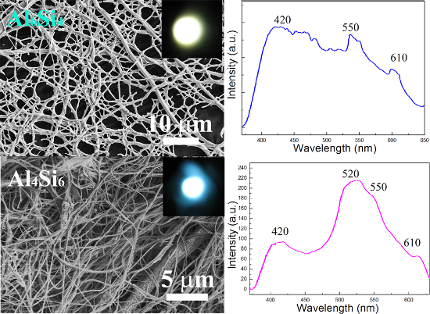
- surface of the fibers, as shown in Figure 3d. Selected area electron diffraction (SAED) patterns are collected from the thin edge of one fiber, as shown in the inset of Figure 3c. The patterns not only verify the high degree of crystallinity of the composite nanofibers, but also indicate the disordered


Two-dimensional and tubular structures of misfit compounds: Structural and electronic properties
Beilstein J. Nanotechnol. 2014, 5, 2171–2178, doi:10.3762/bjnano.5.226

- as nanotubes and nanoscrolls (see Figure 6). These structures have been extensively experimentally and theoretically investigated to date [6][25][26][44]. Selected area electron diffraction (SAED) measurements showed that the interlayer distance between the SnS and SnS2 substructures is nearly


Room temperature, ppb-level NO2 gas sensing of multiple-networked ZnSe nanowire sensors under UV illumination
Beilstein J. Nanotechnol. 2014, 5, 1836–1841, doi:10.3762/bjnano.5.194
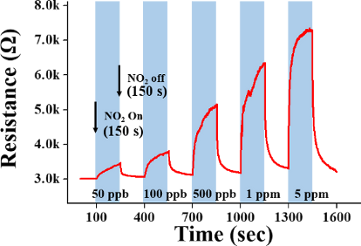
- edge region. The corresponding selected area electron diffraction pattern (Figure 2c) exhibited two types of reflection spots assigned to wurtzite-structured ZnSe: round one from the core region and elongated one from the edge region. Performance of nanowire gas sensors Figure 3a and Figure 3b show the



Formation of CuxAu1−x phases by cold homogenization of Au/Cu nanocrystalline thin films
Beilstein J. Nanotechnol. 2014, 5, 1491–1500, doi:10.3762/bjnano.5.162
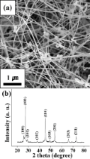
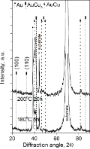
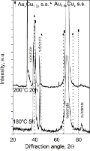
- AuxCu1.5x solid solutions. Figure 9 shows bright field (top view) TEM images and selected area electron diffraction patterns of as deposited and heat treated (for 1 h at 160 °C) Au(10nm)/Cu(15nm) bilayers, respectively. For TEM investigations the specimens were prepared by subsequent magnetron sputtering on
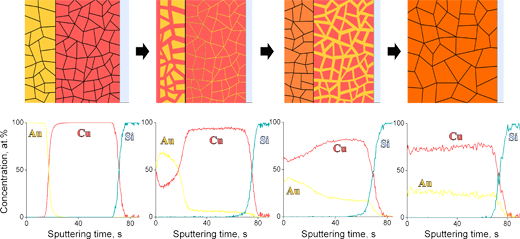
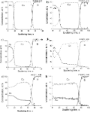
- area electron diffraction patterns of Au(10nm)/Cu(15nm) bilayer b) as deposited and d) after 1 h of heat treatment at 160 °C. Dependence of the average concentration of elements on the annealing time at 150 °C in a) Au(25nm)/Cu(50nm), b) Au(25nm)/Cu(25nm) and c) Au(25nm)/Cu(12nm) systems. Calculated
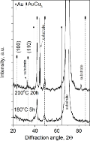
- ) system a) as deposited sample and b) annealed samples. XRD θ–2θ patterns of Au(25nm)/Cu(12nm) annealed samples. Bright field (top view) TEM images of Au(10nm)/Cu(15nm) bilayer a) as deposited and c) after 1 h of heat treatment at 160 °C. The arrow indicates the area of formation of a new phase. Selected






Microstructural and plasmonic modifications in Ag–TiO2 and Au–TiO2 nanocomposites through ion beam irradiation
Beilstein J. Nanotechnol. 2014, 5, 1419–1431, doi:10.3762/bjnano.5.154
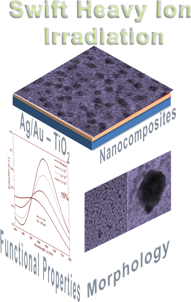
- 1. With the increase of the Au MVF from 7 to 13%, the average diameter of the Au nanoparticles increased and for an extreme case, in which the Au MVF was about 50%, the growth of extremely large nanoparticles has been observed (Figure 1d). The selected area electron diffraction patterns
- selected area electron diffraction (SAED) patterns corresponding to each MVF composite is shown exactly below each TEM image. Bright field TEM morphologies of Ag–TiO2 nanocomposite films with different metal volume filling fractions, (a) 15%, (b) 26%, (c) 34% and (d) 47%. Morphological evolutions in Au
- the images. Microstructural changes in the TiO2 matrix of the nanocomposite film with MVF (Ag) ≈ 15% induced by 100 MeV Ag8+ ions. Bright field TEM images corresponding to: (a) pristine film, (b) 1 × 10¹² ions/cm2, (c) 3 × 10¹² ions/cm2, (d) 1 × 10¹³ ions/cm2. The selected area electron diffraction


Self-organization of mesoscopic silver wires by electrochemical deposition
Beilstein J. Nanotechnol. 2014, 5, 1285–1290, doi:10.3762/bjnano.5.142
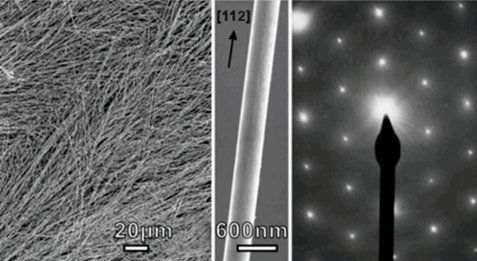
- wires and the corresponding selected area electron diffraction (SAED) pattern (Figure 3b). The SAED patterns demonstrate a distinct single-crystalline feature. The data show that the growth direction of the wire is perpendicular to the [111] direction, along the [112] direction. Figure 3c is a scanning




Pyrite nanoparticles as a Fenton-like reagent for in situ remediation of organic pollutants
Beilstein J. Nanotechnol. 2014, 5, 855–864, doi:10.3762/bjnano.5.97
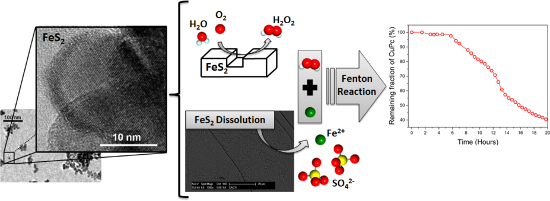
- transmission electron microscopy (HR-TEM), selected area electron diffraction (SAED) and X-ray diffraction (XRD). The TEM studies were done on a JEOL JEM-3011 microscope with accelerating voltage of 200 kV. The XRD analysis of the nanoparticles and the microparticles was done on a Philips diffractometer with a


One-step synthesis of high quality kesterite Cu2ZnSnS4 nanocrystals – a hydrothermal approach
Beilstein J. Nanotechnol. 2014, 5, 438–446, doi:10.3762/bjnano.5.51
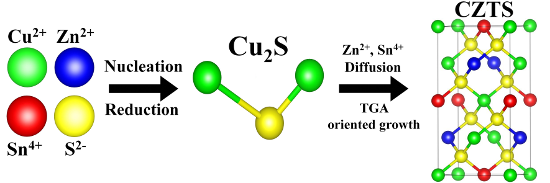
- a JEOL JEM-1400 microscope. High-resolution TEM (HRTEM) and selected area electron diffraction (SAED) images were obtained using JEOL JEM-2100 microscope at an accelerating voltage of 200 kV. Ultraviolet–visible (UV–vis) absorption spectrum of the sample was measured at room temperature using a
- illustrates the crystal interplanar spacing of 3.12 Å, which can be ascribed to the (112) plane of kesterite phase CZTS. The diffraction spots in the selected area electron diffraction (SAED) pattern illustrated in Figure 1e can all be indexed to the (112), (220), (224) and (420) planes of kesterite CZTS




One pot synthesis of silver nanoparticles using a cyclodextrin containing polymer as reductant and stabilizer
Beilstein J. Nanotechnol. 2014, 5, 380–385, doi:10.3762/bjnano.5.44
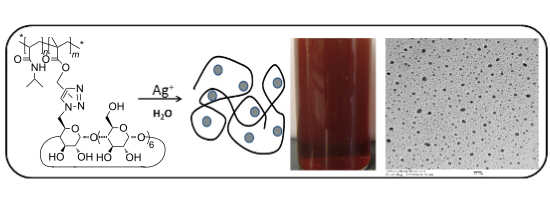
- ) experiments were carried out. Figure 3 shows two TEM images and corresponding size distributions with different ratios of silver nitrate to cyclodextrin containing polymer 1. The selected area electron diffraction (SAED) pattern of the Au nanoparticles 2 shows rings ascribed to Ag crystals of the face


Extracellular biosynthesis of gadolinium oxide (Gd2O3) nanoparticles, their biodistribution and bioconjugation with the chemically modified anticancer drug taxol
Beilstein J. Nanotechnol. 2014, 5, 249–257, doi:10.3762/bjnano.5.27

- drop-casting the particles (suspended in water) on carbon coated copper grid. The selected area electron diffraction (SAED) pattern analysis was carried out on the same grid. X-ray diffraction (XRD) X-ray diffraction (XRD) measurements of biosynthesized Gd2O3 nanoparticles were carried out by coating
- corresponds to plane {400} of Gd2O3 nanoparticles (Figure 2C). Selected area electron diffraction (SAED) analysis (Figure 2D) of the biosynthesized Gd2O3 nanoparticles shows that the nanoparticles are crystalline in nature. Diffraction spots could be well indexed with the cubic structure of Gd2O3
- micrograph recorded from drop-cast films of Gd2O3 nanoparticle solution formed by the reaction of GdCl3 with the fungal biomass of Humicola sp. for 96 h. (B) Particle size distribution determined from TEM microgaph. (C) HR-TEM image of Gd2O3 nanoparticles showing inter planar distance. (D) Selected area


Modulation of defect-mediated energy transfer from ZnO nanoparticles for the photocatalytic degradation of bilirubin
Beilstein J. Nanotechnol. 2013, 4, 714–725, doi:10.3762/bjnano.4.81
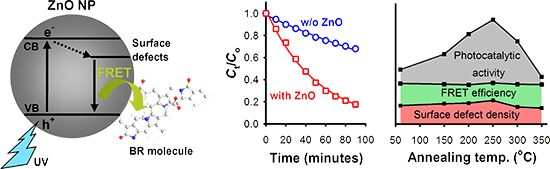
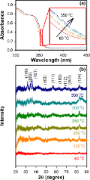
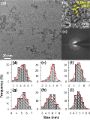
- polycrystalline nature of the nanoparticles is confirmed by the corresponding selected area electron diffraction (SAED) pattern (Figure 2c). The particle size distributions of all samples obtained from the respective TEM micrographs are also shown in Figure 2d–i. For the as-synthesized ZnO nanoparticles the mean


Nanoglasses: a new kind of noncrystalline materials
Beilstein J. Nanotechnol. 2013, 4, 517–533, doi:10.3762/bjnano.4.61
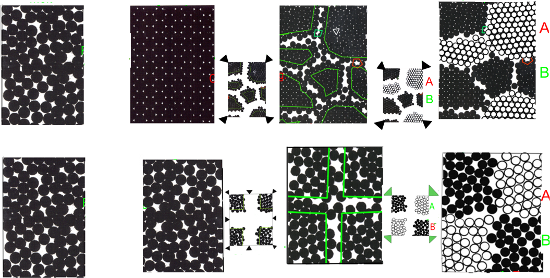
- structure a of Fe90Sc10 nanoglass produced by consolidating Sc75Fe25 glassy clusters at a pressure of about 4.5 GPa is displayed (Figure 6) in the scanning tunneling microscopy image [17] of the polished surface of a nanoglass specimen. The selected-area electron diffraction (SAED) pattern of the Fe25Sc75






Characterization of electroforming-free titanium dioxide memristors
Beilstein J. Nanotechnol. 2013, 4, 467–473, doi:10.3762/bjnano.4.55
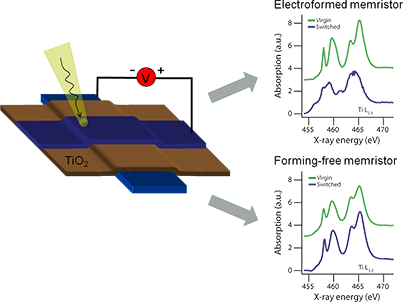
- stoichiometric layer was again deposited from a stoichiometric titania target. Device junction areas studied included 1.5 × 1.5 μm2 and 3 × 3 μm2. The device area is defined by the overlap of the bottom and top electrode. X-ray diffraction (XRD) and selected area electron diffraction (SAED) showed that the
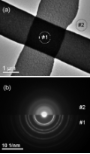
- characterization by TEM TEM characterization was performed using a JEM 2100F microscope. A customized single-tilt sample-holder tip was designed to accommodate the silicon/silicon-nitride substrates with the memristor device. The electron microscope was used to obtain selected area electron diffraction (SAED



Characterization and properties of micro- and nanowires of controlled size, composition, and geometry fabricated by electrodeposition and ion-track technology
Beilstein J. Nanotechnol. 2012, 3, 860–883, doi:10.3762/bjnano.3.97
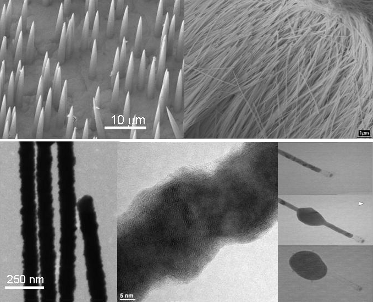
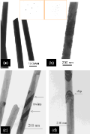
- overvoltages, side reactions, such as hydrogen evolution, are avoided. Figure 7 displays transmission electron microscopy (TEM) images of representative (a) single- and (b) polycrystalline Cu nanowires together with their respective selected-area electron diffraction (SAED) pattern. The single-crystalline Cu








Highly ordered ultralong magnetic nanowires wrapped in stacked graphene layers
Beilstein J. Nanotechnol. 2012, 3, 846–851, doi:10.3762/bjnano.3.95
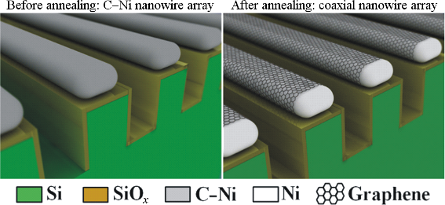
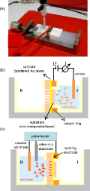
- atmospheric pressure and under argon flow. After annealing, the samples were cooled down at a rate of 12 °C/min. Scanning electron microscopy (SEM) imaging was performed at 5 kV on a JEOL JSM 7600 F microscope. Transmission electron microscopy (TEM) imaging and selected-area electron diffraction (SAED) were
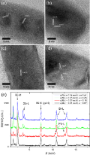
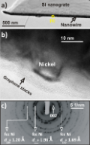
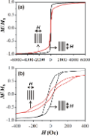
- ) Selected-area electron diffraction pattern recorded on a single wire. The 002 reflection indicated in (c) is attributed to graphitic carbon. (a) Normalized hysteresis loops of the coaxial nanowire array measured at 300 K with an applied magnetic field parallel (black curve) and perpendicular (red curve) to


Nano-structuring, surface and bulk modification with a focused helium ion beam
Beilstein J. Nanotechnol. 2012, 3, 579–585, doi:10.3762/bjnano.3.67
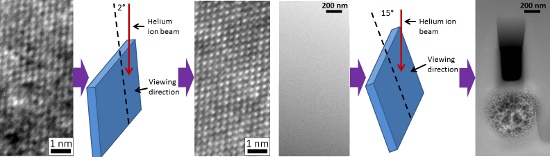
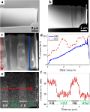
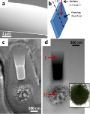
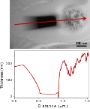
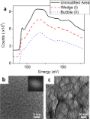
- . EELS spectra were recorded from sample 3. High resolution TEM (HRTEM) images and selected area electron diffraction (SAED) patterns were also recorded. (a) SEM image of the silicon lamella (sample 1) after FIB preparation. (b) HAADF TEM image of the sample after three separate areas (observed as three


Directed deposition of silicon nanowires using neopentasilane as precursor and gold as catalyst
Beilstein J. Nanotechnol. 2012, 3, 535–545, doi:10.3762/bjnano.3.62
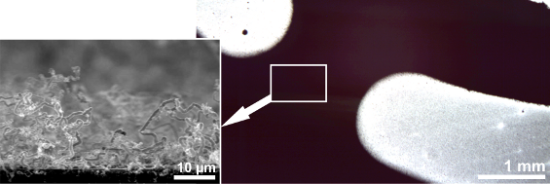
- confirm the buckled structure as well as the branched surface of the NWs (Figure 3, center). The HRTEM measurements show that the NWs are crystalline. The lattice constant of 3.2 Å, which can be seen in the fast Fourier transformed (FFT) image and the selected-area electron diffraction (SAED) pattern, as


A facile approach to nanoarchitectured three-dimensional graphene-based Li–Mn–O composite as high-power cathodes for Li-ion batteries
Beilstein J. Nanotechnol. 2012, 3, 513–523, doi:10.3762/bjnano.3.59
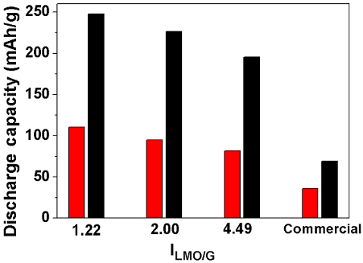
- surface of the nanosheets. The corresponding TEM image (see Figure 2b) reveals that these nanowalls are 3–5 nm in thickness and 25–30 nm in diameter. The high-resolution TEM (HRTEM) image (Figure 2c) and the selected-area electron diffraction pattern (Figure 2d) confirms the formation of the cubic Mn2O3