Search results
Search for "topography" in Full Text gives 451 result(s) in Beilstein Journal of Nanotechnology. Showing first 200.
Mapping the local dielectric constant of a biological nanostructured system
Beilstein J. Nanotechnol. 2021, 12, 139–150, doi:10.3762/bjnano.12.11
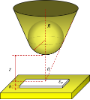
- double-pass mode, which means that the probe executes two scans. The first scan measures the sample topography in tapping mode and the second scan mimics the profile at a defined lift height Zlift applying a voltage VDC between the tip and the conductive substrate [21]. The tip is mechanically forced to
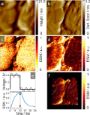
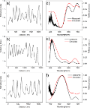
- ). The α coefficient map and its average profile differ slightly from the topographic information, but some correspondences are identified. Thicker regions have a smaller α coefficient, as can be seen at the wing–resin interface (Figure 5b). There seems to be a correlation between topography (Figure 5a
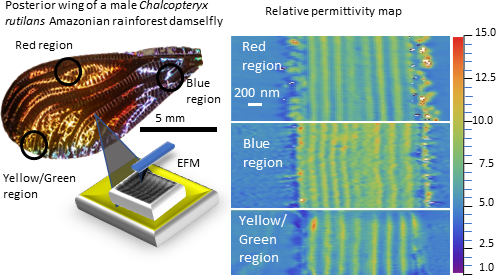
- ) and the relative permittivity εr (Figure 5c): the lower the topography, the larger the εr. However, we observe a small εr value in the lower topography regions adjacent to the wing slab. Hence, topography crosstalk is small. Chalcopterix rutilans damselfly wings Using the protocol described above, we




Fusion of purple membranes triggered by immobilization on carbon nanomembranes
Beilstein J. Nanotechnol. 2021, 12, 93–101, doi:10.3762/bjnano.12.8
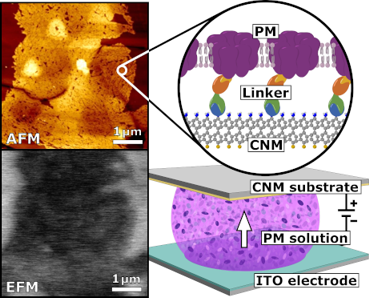
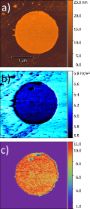
- topography data from the first scan. The voltage applied to the tip to compensate for attracting/repelling electrostatic forces indicates the electrostatic potential of the sample. The samples were further analyzed by SEM in a Zeiss Auriga (Carl Zeiss, Jena, Germany) at an acceleration voltage of 5 kV using
- samples were subsequently washed with 200 µL distilled water and dried in a nitrogen flow. For each sample the topography of a 50 × 50 µm2 area was investigated by AFM to evaluate substrate coverage. It has been shown that the WT PM patches do not form a continuous monolayer, but rather separately


Bulk chemical composition contrast from attractive forces in AFM force spectroscopy
Beilstein J. Nanotechnol. 2021, 12, 58–71, doi:10.3762/bjnano.12.5
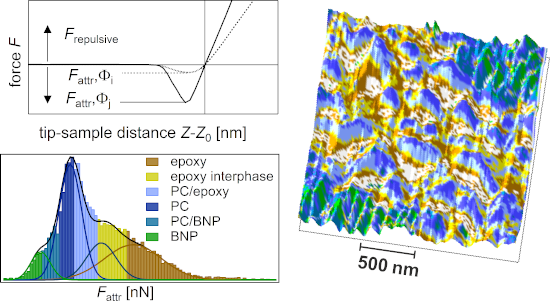
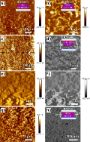
- material phases based on AFM topography. Additional chemical characterization on the nanoscale is performed by an AFM/infrared-spectroscopy hybrid method. Mechanical properties (kr) and attractive forces (Fattr) are calculated and a structure–property correlation is obtained by a manual principle component
- and material interphases are usually deduced from AFM topography. This is problematic because subsurface structures are not taken into consideration even though they might be relevant for the physical properties [2][15]. Also, with increasing resolution and decreasing size of heterogeneous structures
- , AFM topography is often not conclusive. To overcome these disadvantages, complementary measurements are performed. Methods such as SEM and EDX are able to image structural contrasts with a lateral resolution on the order of magnitude of the AFM tip size or higher [16][17][18][19]. However, since those


Atomic layer deposited films of Al2O3 on fluorine-doped tin oxide electrodes: stability and barrier properties
Beilstein J. Nanotechnol. 2021, 12, 24–34, doi:10.3762/bjnano.12.2
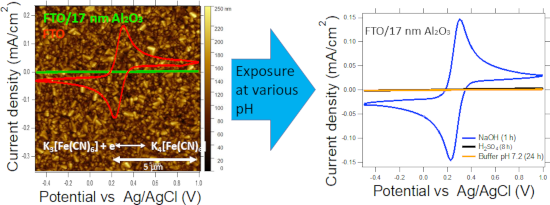
- deposited Al2O3. The height-density distribution (Figure S2, Supporting Information File 1), calculated from the AFM topography images (Figure 1), shows that the deposition of Al2O3 onto FTO substrates does not change its surface morphology. Calculated RMS (root mean square) values for AFM images of FTO and
- protection against the reduction of FTO. While bare FTO was reduced to Sn at −1.2 V vs Ag/AgCl in a neutral electrolyte, the Al2O3-coated FTO became reduction-resistant. AFM topography image (10 µm × 10 µm) of an FTO substrate (left) and of an FTO substrate coated with a 17 nm thick Al2O3 layer (right


Bio-imaging with the helium-ion microscope: A review
Beilstein J. Nanotechnol. 2021, 12, 1–23, doi:10.3762/bjnano.12.1
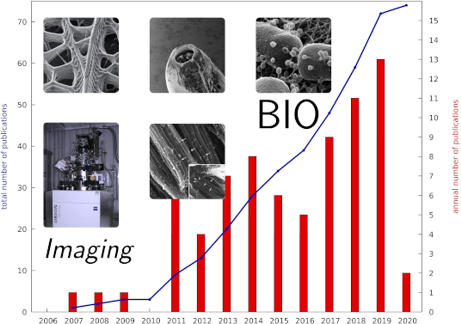
- SEMs (FE-SEM) and transmission electron microscopes (TEM). On the other hand, HIM is less demanding in terms of sample preparation compared to both SEM and TEM. In particular, the advantage of HIM is that opaque and non-conductive specimens, which possess a relatively strong topography, can be imaged
- reach the detector. In HIM, the emitted secondary electrons already have low energy, which results in a strong edge and topography contrast. Furthermore, the low energies of the secondary electrons in a HIM produce excellent contrast due to changes in the work functions of the materials. An interesting
- EPS. The micrograph was recorded using secondary electron imaging. The high surface sensitivity and the strongly pronounced edges in this imaging mode render the thin EPS between the algal cells bright white. Furthermore, it is remarkable that despite the strong topography of more than 20 μm in the


Mapping of integrated PIN diodes with a 3D architecture by scanning microwave impedance microscopy and dynamic spectroscopy
Beilstein J. Nanotechnol. 2020, 11, 1764–1775, doi:10.3762/bjnano.11.159
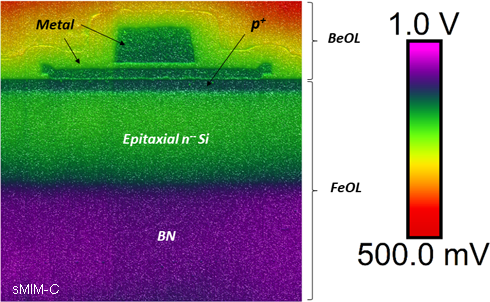
- 90 kHz and VDC = 0 V. The signals of ∂C/∂V phase, ∂C/∂V amplitude, sMIM-R, sMIM-C, and the topography were simultaneously acquired. In a second investigation, dynamic sMIM spectroscopy was performed by sweeping the VDC voltage from −2.0 V to 2.5 V at each location of the scan. The Integrated PIN
- , an electrical back contact is created between the microscope chuck and the sample. Results and Discussion The vertical PIN structure Figure 2 shows the surface topography of the cross section of the PIN diode. The different materials used (silicon substrate, epitaxial layers, oxides, and alloy metals
- ) have a slightly different polishing rate, which results in the observed topography. In the AFM topography image, one can localize the two deep trench isolation structures in the silicon wafer, as well as the anode and cathode contacts. It is important to note that a low roughness is required for a


Direct observation of the Si(110)-(16×2) surface reconstruction by atomic force microscopy
Beilstein J. Nanotechnol. 2020, 11, 1750–1756, doi:10.3762/bjnano.11.157
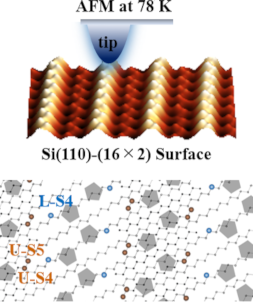
- cantilever was used, which was cleaned by Ar+ sputtering to remove the oxide and contamination on the tip. The deflection of the cantilever was measured by the optical beam deflection method. The topography of the surface was imaged while feedback electronics were used to adjust the tip–sample distance to
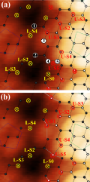
- images [37], these five bright spots can be explained by the dangling bonds of five atoms. Therefore, it was concluded that the five bright spots in pentagonal formation observed for a negative tip bias in STM images correspond to five atoms, that is, they were not due to crosstalk between the topography



Application of contact-resonance AFM methods to polymer samples
Beilstein J. Nanotechnol. 2020, 11, 1714–1727, doi:10.3762/bjnano.11.154
- topography image of a 100 nm thick PnBMA film scanned with a PPP-FMAuD cantilever (kc = 2.74 N/m). The wave pattern was “engraved” into a smaller scan area of (15 µm)2 in DART mode previous to the scan in tapping mode. For the DART scan a static force of 308 nN, a frequency of ca. 320 kHz, and amplitudes of
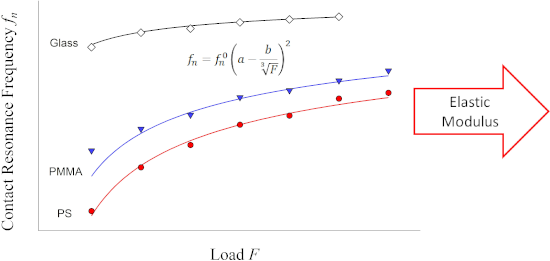
- tip radius R was measured through recording tapping mode topography images on a grid with sharp tips (see Experimental section). The curves can be fitted quite exactly, most of all those on glass and PS. The three values of the reduced elastic moduli obtained for glass, PMMA, and PS are 62.3 GPa, 9.4
- topography image of a 100 nm thick PnBMA film after a smaller area (15 µm)2 was scanned in DART mode with a static force of 308 nN, a frequency of ca. 320 kHz, and amplitudes of 440 and 80 pm. CR frequency f(t) in the first mode as a function of the measuring time on three PnBMA films with thickness of 25


PTCDA adsorption on CaF2 thin films
Beilstein J. Nanotechnol. 2020, 11, 1615–1622, doi:10.3762/bjnano.11.144
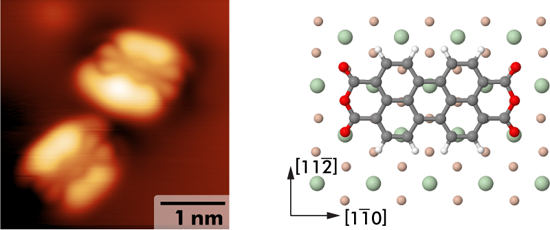
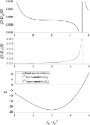
- different surface areas. Imaging of PTCDA on a Si(111)-(7 × 7) cornerhole position at (a) negative and (d) positive sample bias (sample bias indicated in the upper right corner). (b) Topography-mode image at negative bias and (e) constant-height mode imaging at positive bias of PTCDA on a CaF1/Si(111
- in (c). The topography image in (d) presenting PTCDA on a mixed CaF2 and CaF1/Si(111) surface is used for the statistical analysis in (b). STM data acquired on a CaF1/Si(111) surface area (e) before and (f) after accidental removal of single PTCDA molecules by the STM tip. Stationary molecules are


Design of V-shaped cantilevers for enhanced multifrequency AFM measurements
Beilstein J. Nanotechnol. 2020, 11, 1525–1541, doi:10.3762/bjnano.11.135
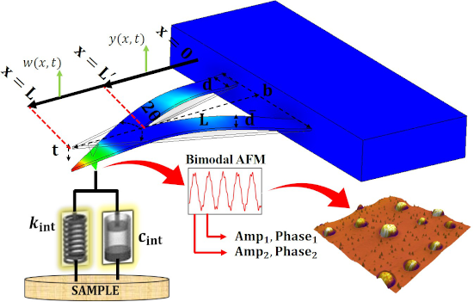
- -pass measurement [1]. In bimodal AFM, the first eigenmode is excited at or near the resonance frequency (reserved for topography measurements) while the second eigenmode is in open-loop capturing material composition via phase shift of the second eigenmode. Due to its unique capabilities
- surface. The second sample is a polymer blend of PS and low-density polyethylene (LDPE) (HarmoniX sample purchased from Bruker) in order to challenge the cantilevers with more similar material properties. Figure 13a–c shows height or topography images of the Au–PS sample imaged in bimodal AFM using a
- 13a–c shows relatively similar topographies, Figure 13f show the highest phase contrast between Au and PS for the short V-shaped cantilever. Figure 14a–c shows height or topography images of the PS–LDPE samples imaged using a rectangular, a long V-shaped, and a short V-shaped cantilever, respectively


![[Graphic 4]](/bjnano/content/inline/2190-4286-11-135-i26.svg?max-width=637&scale=1.18182) = 15 µm, bref = 8...
= 15 µm, bref = 8...


![[Graphic 17]](/bjnano/content/inline/2190-4286-11-135-i39.svg?max-width=637&scale=1.18182) ) of V-shaped cantilevers for...
) of V-shaped cantilevers for...


Helium ion microscope – secondary ion mass spectrometry for geological materials
Beilstein J. Nanotechnol. 2020, 11, 1504–1515, doi:10.3762/bjnano.11.133
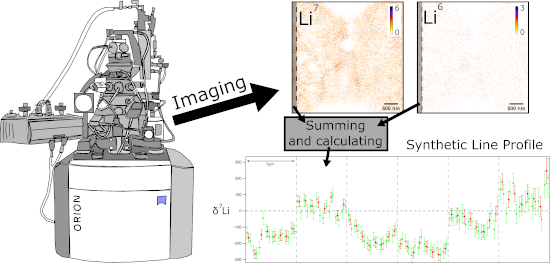
- substitute in the crystal lattice within a solid solution. The Li signal appears to be stronger along mica sheets perpendicular to the c-axis of the crystal structure. However, this may be the result of surface topography similar to that observed in the zircon samples, as a result of polishing picking out



Protruding hydrogen atoms as markers for the molecular orientation of a metallocene
Beilstein J. Nanotechnol. 2020, 11, 1432–1438, doi:10.3762/bjnano.11.127
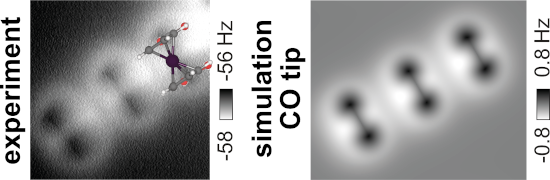
- with respect to the CaF2(111) surface lattice differs for the two geometries. In this work we investigate the NC-AFM contrast formation of FDCA molecules on CaF2(111) surfaces. A distinct dumbbell shape has been observed in both topography and constant-height imaging modes in low-temperature
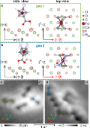
- passes a molecular protrusion. Dumbbell shape of single FDCA molecules. Quadruped binding motif of FDCA on CaF2(111) (adapted from [22]) of (a) geo 1 and (b) geo 2. Dumbbell shape of FDCA molecules (c) on bulk CaF2(111) measured by NC-AFM in topography mode and (d) on thin film CaF2(111) surface measured
- frequency shift image. An inverted colour scale is used for the constant-height Δf NC-AFM data to match the topography appearance.) High-resolution NC-AFM imaging and simulation. Experimental and simulated frequency-shift images of a single molecular row along the direction (red arrows). Exemplary


![[Graphic 10]](/bjnano/content/inline/2190-4286-11-127-i10.svg?max-width=637&scale=1.18182) row of FDCA molecules in geo 2. (a–c) Constant-height frequency-shi...
row of FDCA molecules in geo 2. (a–c) Constant-height frequency-shi...
Atomic defect classification of the H–Si(100) surface through multi-mode scanning probe microscopy
Beilstein J. Nanotechnol. 2020, 11, 1346–1360, doi:10.3762/bjnano.11.119
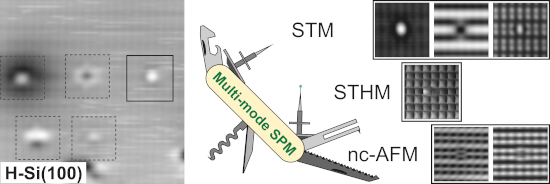
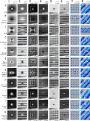
- concentration of dihydrides can be controlled by lowering the annealing temperature during sample preparation [19][70]. While the two varieties of dihydride look unique overall in STM empty states topography (Figure 2d-1 and Figure 2e-1), the side of the pair that the dihydride unit(s) appear on consistently
- , with both groups showing similar image contrast in STM topography (compare Figure 2i-1,2,3 with Figure 2j-1,2,3 and Supporting Information File 1, Figure S9). Their distinct location with respect to the dimer, however, is easily discerned throughout all analysis types in Figure 2i,j. In Si-tip AFM
- surface. The size of the area shown in (a) is outlined in (e). (c,d) Constant current (I = 50 pA) STM topography probing empty and filled states of the surface (bias voltages indicated in the lower left of each panel). (e) Constant height STM image with a fixed bias and height. (f) Scanning tunnelling



An atomic force microscope integrated with a helium ion microscope for correlative nanoscale characterization
Beilstein J. Nanotechnol. 2020, 11, 1272–1279, doi:10.3762/bjnano.11.111
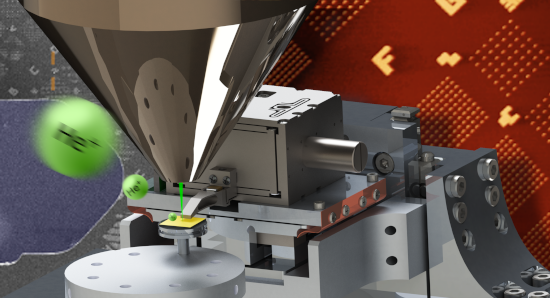
- performed without contamination of the sample and environmental changes between processing steps. The practicality of the resulting tool lies in the complementarity of the two techniques. The AFM offers not only true 3D topography maps, something the HIM can only provide in an indirect way, but also allows
- to be navigated onto the region of interest (Figure 2b,c) to perform AFM topography imaging (Figure 2d). PMMA has traditionally been used as a positive resist in electron beam lithography. Helium ion beam lithography has emerged as a powerful technique to achieve even smaller feature size thanks to
- . Figure 3a and Figure 3b show two AFM topography images of PMMA exposed to a dose of 1 × 1013 cm−2 and 3 × 1013 cm−2 30 keV He ions, respectively, as well as the corresponding height profiles of the irradiated PMMA surface. Focused ion beam damage and implantation can hinder the imaging and nanoscale


High permittivity, breakdown strength, and energy storage density of polythiophene-encapsulated BaTiO3 nanoparticles
Beilstein J. Nanotechnol. 2020, 11, 1190–1197, doi:10.3762/bjnano.11.103
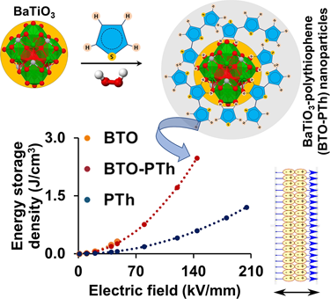
- the SEM image shown in Figure 4a. PTh, on the other hand, exhibits an inhomogeneous surface morphology with large flakes of polymer randomly distributed on the surface. In case of core–shell BTO-PTh nanoparticles (Figure 5b), the surface topography is very consistent with uniformly distributed sub
- images of the as-prepared BTO nanoparticles (a), BTO-PTh nanoparticles (b), and pristine PTh (c). 3D images showing the surface topography, and 2D images along with surface profiles showing the surface morphology of all samples. Dielectric properties of the as-prepared BTO nanoparticles, pristine PTh




Revealing the local crystallinity of single silicon core–shell nanowires using tip-enhanced Raman spectroscopy
Beilstein J. Nanotechnol. 2020, 11, 1147–1156, doi:10.3762/bjnano.11.99
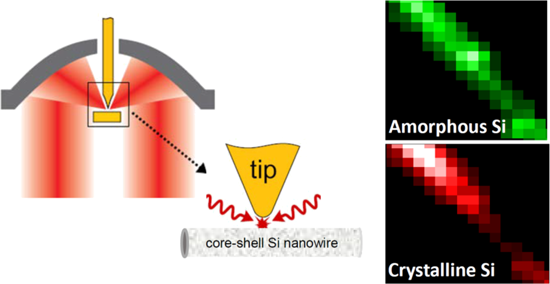
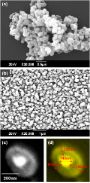
- dominant field component lays out-of-plane (parallel to the tip shaft). Figure 4b,c demonstrates that the tip apex can be easily excited, which is a precondition for producing a localized near field at the tip apex. Next, we approached the sample to the tip and recorded the topography (size: 250 × 250 nm2
- , we combined angle-resolved polarization measurements with TERS to investigate the effects of tip–sample interactions on the optical signals. In Figure 6a the topography of a SiNW surface is shown. Along the dashed arrow, 32 spectra were recorded, and eight of them are plotted in Figure 6b. Although
- greatly increased leading to a strong local near field confined at the tip apex. This gives rise to the enhanced sensitivity of tip-enhanced Raman spectroscopy (TERS). TERS combined with scanning probe microscopy (SPM) also allows for the collection of correlated topography and optical images [42][43


Thermophoretic tweezers for single nanoparticle manipulation
Beilstein J. Nanotechnol. 2020, 11, 1126–1133, doi:10.3762/bjnano.11.97
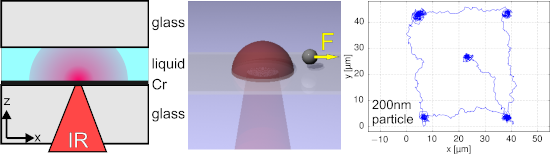
- nanodots, so-called plasmonic tweezers [6][7][8] or a fluidic slit with appropriately tailored topography with resulting spatially modulated electrostatic potential [9] can be used to trap nanoparticles, but again a prefabricated nanostructured substrate is needed. A decade ago, the anti-Brownian


Monolayers of MoS2 on Ag(111) as decoupling layers for organic molecules: resolution of electronic and vibronic states of TCNQ
Beilstein J. Nanotechnol. 2020, 11, 1062–1071, doi:10.3762/bjnano.11.91
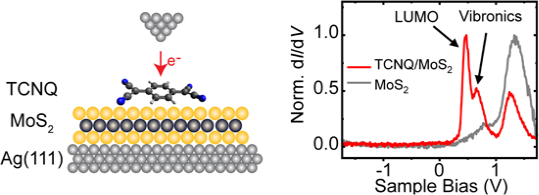
- , although the experimental width prevented us from resolving the individual modes. a) STM topography of MoS2 on Ag(111) recorded at V = 1.2 V, I = 20 pA. Inset: Line profile of a monolayer MoS2 island along the green line. b) Close-up view on the moiré structure. c) Atomically resolved terminating S layer
- (V = 5 mV, I = 1 nA). d) Constant-height dI/dV spectra of MoS2/Ag(111) recorded on a top and on a hollow region of the moiré structure as shown on the inserted STM topography (feedback opened at V = 2.5 V, I = 0.5 nA, Vmod = 10 mV). The inset shows the gap region of MoS2/Ag(111) on a logarithmic
- = 2.5 V, I = 0.5 nA, Vmod = 10 mV (all spectra, except for hollow site on Au(111): Vmod = 5 mV). a) Stick-and-ball model of TCNQ. Gray, blue, and white spheres represent C, N, and H atoms, respectively. b) STM topography of a TCNQ molecular island on MoS2/Ag(111) recorded at V = 1 V, I = 10 pA. c) STM


Measurement of electrostatic tip–sample interactions by time-domain Kelvin probe force microscopy
Beilstein J. Nanotechnol. 2020, 11, 911–921, doi:10.3762/bjnano.11.76
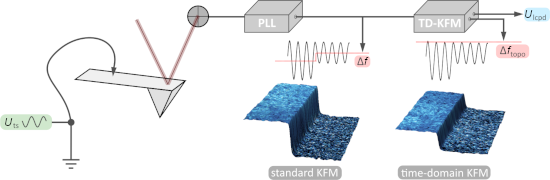
- –sample bias. This allows for an electrostatic characterization and simultaneously minimizes the electrostatic influence onto the topography measurement. However, a static contribution due to the bias modulation itself remains uncompensated, which can induce topographic height errors. Here, we demonstrate
- results in a continuous measurement of the local surface potential, the capacitance gradient, and the frequency shift induced by surface topography. In contrast to conventional techniques, the detection of the topography-induced frequency shift enables the compensation of all electrostatic influences
- , including the component arising from the bias modulation. This constitutes an important improvement over conventional techniques and paves the way for more reliable and accurate measurements of electrostatics and topography. Keywords: atomic force microscopy (AFM); electrostatic height error; extended


Integrated photonics multi-waveguide devices for optical trapping and Raman spectroscopy: design, fabrication and performance demonstration
Beilstein J. Nanotechnol. 2020, 11, 829–842, doi:10.3762/bjnano.11.68
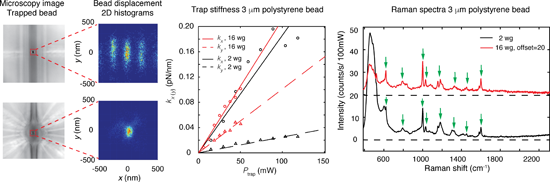
- away from the edge. In the next step, a 3 µm thick layer of SiO2 is deposited using LPCVD (Figure 5e). This layer acts as an upper cladding of the excitation waveguides and separates these from the waveguiding layer that follows. For simplicity, we do not show the surface topography resulting after
- are also clearly discernible. The four detection waveguides occupy a maximum space along the sides of the microbath for optimum collection efficiency. The scanning electron microscope (SEM) image in Figure 6c shows the topography of the microbath and the side channels. The DRIE process of these
- layers does not reflect the real situation. The surface topography resulting from the conformal deposition on the etched structures has been omitted in the cross sections. (a) Optical microscope image of a device with 16 excitation and 4 detection waveguides. (b) Magnification of the marked area in (a


Templating effect of single-layer graphene supported by an insulating substrate on the molecular orientation of lead phthalocyanine
Beilstein J. Nanotechnol. 2020, 11, 814–820, doi:10.3762/bjnano.11.66
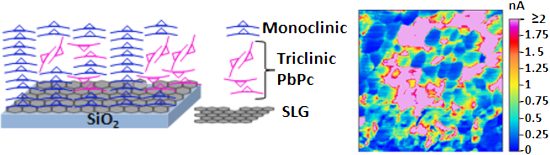
- molecules with monoclinic and triclinic fractions on the surface of SLG/SiO2/Si is inferred in Figure 4. The topography of the PbPc layer was studied using atomic force microscopy (AFM, Figure 5). Figure 5a and the inset show that the film consists of granular PbPc crystallites deposited uniformly on the
- electrical studies using conducting-AFM (C-AFM). Figure 6a,b shows the topography and the corresponding current map of the film. The current response map shows an average current value of about 1 nA across the surface with highly conducting grains, which exhibit current values as high as 8–9 nA (Figure 6c
- height variation. (a) AFM topography,1 µm × 1 µm scan area. (b) Corresponding current map of 10 nm PbPc thin film on SLG/SiO2/Si substrate obtained at 2 V sample bias. (c) Profile section of (b) along the marked line showing the current variation across the film. (d) I–V curve acquired from a conducting


Quantitative determination of the interaction potential between two surfaces using frequency-modulated atomic force microscopy
Beilstein J. Nanotechnol. 2020, 11, 729–739, doi:10.3762/bjnano.11.60
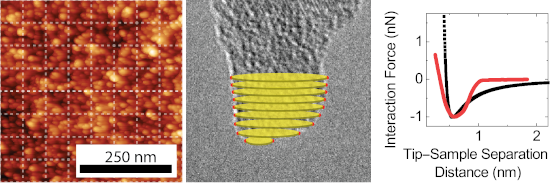
- topography, among other parameters. In order to determine the interaction force behavior as a function of the separation distance, we measured the frequency shift of the oscillating cantilever as a function of the separation distance (Δf–d curves) between a silicon AFM probe and a diamond sample. An


Stochastic excitation for high-resolution atomic force acoustic microscopy imaging: a system theory approach
Beilstein J. Nanotechnol. 2020, 11, 703–716, doi:10.3762/bjnano.11.58
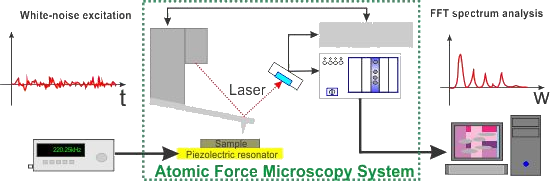
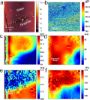
- of the graphite film is 7 nm. A conventional AFM topography image is shown in Figure 6a. Film and substrate are labeled. Then, a comparison is shown between the results obtained by RT-AFAM and S-AFAM. Figure 6b shows an RT-AFAM image where the difference between materials is hardly noticeable. S-AFAM
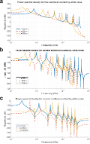
- ) Conventional AFM topography; b) RT-AFAM for 188–191 kHz window; and S-AFAM frequency maps for c) 49–53 kHz window, d) 82–97 kHz window, e) 168–176 kHz window and f) 186–194 kHz window. Results for a graphite film on a glass substrate: a) indentation modulus mapping and b) histogram for the mapping. Modeled and



Exfoliation in a low boiling point solvent and electrochemical applications of MoO3
Beilstein J. Nanotechnol. 2020, 11, 662–670, doi:10.3762/bjnano.11.52
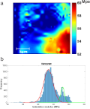
- in Figure 2c shows the topography of MoO3 nanosheets the thickness values of which suggest the presence of 5–7 layers [6]. The FESEM micrographs shown in Supporting Information File 1 corroborate the exfoliation of MoO3. Figure S3a,b (Supporting Information File 1) shows bulk MoO3 and exfoliated

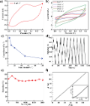
Comparison of fresh and aged lithium iron phosphate cathodes using a tailored electrochemical strain microscopy technique
Beilstein J. Nanotechnol. 2020, 11, 583–596, doi:10.3762/bjnano.11.46
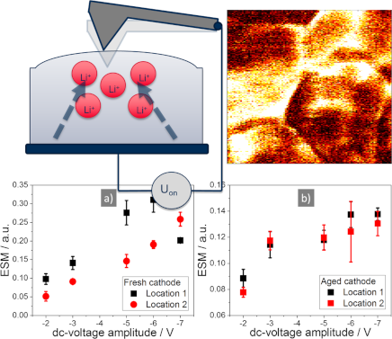
- (FIB) SEM and X-ray absorption near edge structure (XANES) [6][7][8][9][10][11][12][13]. Another technique for post-mortem analysis is atomic force microscopy (AFM). In its basic form, it provides information on the topography of the sample. More advanced AFM modes extract in addition to the topography
- additional mechanical (stiffness, elasticity), electrical (conductivity, surface potential), electrochemical (reactivity, mobility and activity), mechanoelectrical (piezoelectricity) and chemical (chemical bonding) material properties. In situ AFM imaging of the sample topography is often used to study the
- analysis was conducted with a Bruker Icon instrument inside a glovebox (MBraun, O2 and H2O < 2 ppm), equipped with a Zurich Instruments lock-in amplifier (HF2LI), a signal access module (SAM V) and PeakForce quantitative nanomechanical properties (QNM) module. In addition to the ESM signal, the topography