Search results
Search for "anisotropic" in Full Text gives 246 result(s) in Beilstein Journal of Nanotechnology. Showing first 200.
Magnetism and magnetoresistance of single Ni–Cu alloy nanowires
Beilstein J. Nanotechnol. 2018, 9, 2345–2355, doi:10.3762/bjnano.9.219
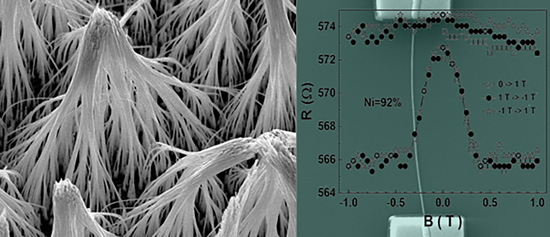
- magnetic elements, usually of dipolar type. In this paper we report on a strategy of studying the magnetic properties of single Ni–Cu alloy nanowires of high aspect ratio via specific anisotropic magnetoresistance measurements. In this respect, arrays of nanowires have been fabricated by means of templated
- , one observes the lack of any magnetoresistive effect in the parallel geometry and a magnetoresistive effect of the order of percent in the perpendicular geometry. Such behavior clearly reminds on anisotropic magnetoresistance effects the physical mechanisms of which were excellently described already
- segments still exhibit the high aspect ratio required for shape anisotropy and hence, their lengths of hundreds of nanometers are consistent with anisotropic magnetoresistive effects and not with a GMR spin-valve configuration of a segmented structure with magnetic/nonmagnetic layers of nanometer thickness


Performance analysis of rigorous coupled-wave analysis and its integration in a coupled modeling approach for optical simulation of complete heterojunction silicon solar cells
Beilstein J. Nanotechnol. 2018, 9, 2315–2329, doi:10.3762/bjnano.9.216
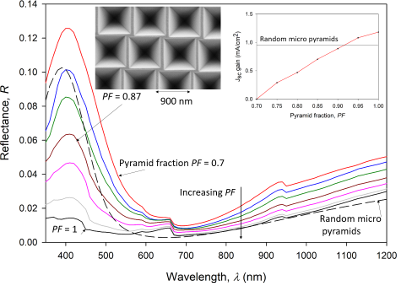
- anisotropic etching), while the thickness of ITO and a-Si:H was kept constant. In Figure 7 the effects of PF variation on reflectance and on the corresponding JSC gain are shown. The front part of the solar cell was simulated by RCWA as in previous sections. In these simulations, ten modes and 300 sublayers


Surface energy of nanoparticles – influence of particle size and structure
Beilstein J. Nanotechnol. 2018, 9, 2265–2276, doi:10.3762/bjnano.9.211
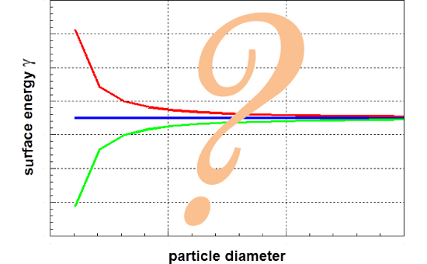
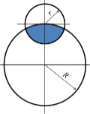
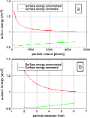
- considered. In this case, the number of next neighbors is proportional the volume of the intersection between the particle and a sphere with the diameter 2r having its center at the surface of the particle. (Certainly, this simplified treatment is not expedient for anisotropic materials.) These





Influence of the thickness of an antiferromagnetic IrMn layer on the static and dynamic magnetization of weakly coupled CoFeB/IrMn/CoFeB trilayers
Beilstein J. Nanotechnol. 2018, 9, 2198–2208, doi:10.3762/bjnano.9.206
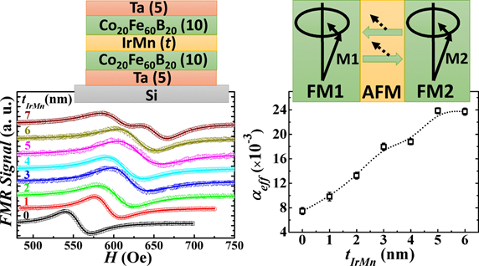
- , AF-based spintronics is gaining momentum because of the unique properties such as zero net magnetization, no stray fields, low magnetic susceptibility, large spin–orbit coupling, ultrafast dynamics and large magneto-transport effects [2][3][4][5][6]. Several of the effects such as tunnel anisotropic
- function of the angle θ. The two-fold symmetry for all samples clearly indicates the existence of the uniaxial magnetic anisotropy (UMA). This UMA results from the breakdown of the azimuthal symmetry in the deposited films, which is likely to be caused by the anisotropic stress in the films generated due
- to the oblique deposition geometry [39]. Since CoFeB is highly sensitive to this induced anisotropic stress (owing to their large positive saturation magnetostriction coefficient λs [40]), the deposition geometry effectively results in the observed UMA [41]. The UMA in films is found to be directly


Electrospun one-dimensional nanostructures: a new horizon for gas sensing materials
Beilstein J. Nanotechnol. 2018, 9, 2128–2170, doi:10.3762/bjnano.9.202
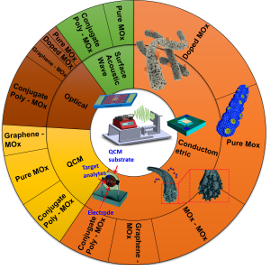
- improves the performance of electrospun fibers/mats. In addition, the electrospun fibers/mats may reduce corrosion and/or oxidation in NPs, especially those with anisotropic structure [40]. Depending on the type of polymer and NPs, electrospun fibers incorporated with NPs are optimized for specific
- applications. This approach shows good potential for applications involving the self-assembly of anisotropic NPs to generate new functional devices [63]. There are two major methods for producing electrospun NP fibers [40]: (i) “indirect synthesis”, that requires some post-processing methods after






Spin-coated planar Sb2S3 hybrid solar cells approaching 5% efficiency
Beilstein J. Nanotechnol. 2018, 9, 2114–2124, doi:10.3762/bjnano.9.200
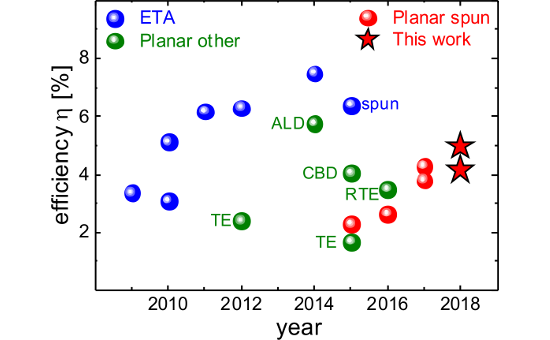
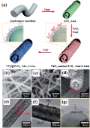
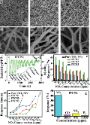
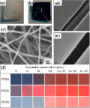
- [32] or liquid [6] sulfur sources might reduce the density of electronic defects in Sb2S3 for certain deposition methods that leave sulfur deficient films [29][72]. Another aim in terms of fabrication is to exploit the anisotropic nature of Sb2S3 by aligning the 1D ribbons with the direction of charge


High-throughput synthesis of modified Fresnel zone plate arrays via ion beam lithography
Beilstein J. Nanotechnol. 2018, 9, 2049–2056, doi:10.3762/bjnano.9.194
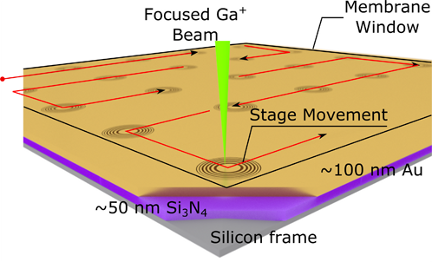
- . Figure 2b and Figure 2c show some hard Au grains remained relatively unharmed by the ion beam due to the strong dependence of the ion beam damage on the crystal orientation concerning anisotropic sputter yield and channeling effects [42]. These grains have a random spatial distribution, which renders


Recent highlights in nanoscale and mesoscale friction
Beilstein J. Nanotechnol. 2018, 9, 1995–2014, doi:10.3762/bjnano.9.190


Correlative electrochemical strain and scanning electron microscopy for local characterization of the solid state electrolyte Li1.3Al0.3Ti1.7(PO4)3
Beilstein J. Nanotechnol. 2018, 9, 1564–1572, doi:10.3762/bjnano.9.148
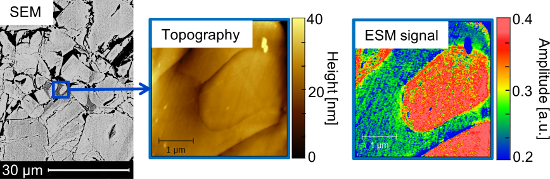
- observed ESM amplitude signal. Electrostatic interactions are discussed to be an important additional parameter that can influence ESM experiments [28][30][31] and will be the subject of future research. Additionally, LATP is known to have a strong anisotropic thermal expansion [3]. LTP, which has the same
- structure, exhibits an anisotropic reaction upon lithium intercalation; the a-axis contracts while the c-axis expands with the transformation from LiTi2(PO4)3 to Li3Ti2(PO4)3 [32]. Hence, LATP might show similar behavior upon (de)-lithiation and its electrostatic interaction can be expected to be strongly
- anisotropic. A simple interpretation of the ESM amplitude signal solely based on Vegard’s Law is therefore demanding and would require a correlative EBSD analysis of the area to retrieve the actual crystallographic orientation [21]. However, a thorough analysis is out of the scope of the current study but is


Robust midgap states in band-inverted junctions under electric and magnetic fields
Beilstein J. Nanotechnol. 2018, 9, 1405–1413, doi:10.3762/bjnano.9.133
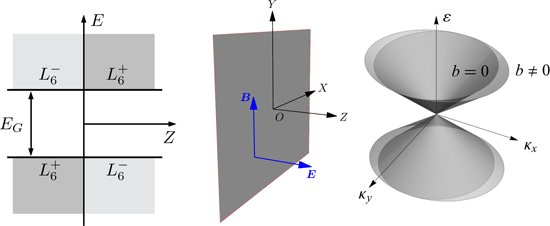
- , v is an interband matrix element having dimensions of velocity and it is assumed scalar, corresponding to isotropic bands around the L point. It is worth mentioning that the bands of IV–VI compounds around the L points are actually anisotropic. Nevertheless, this anisotropy can be absorbed in the
- Figure 2. Hence, the Fermi velocity becomes anisotropic and can actually be modulated with the magnetic field. It is expected that the application of an electric field will lead to further reduction of the Fermi velocity [25]. We will prove later that this is actually the case. In Figure 3a we show a
- magnetic field parallel to the band-inverted junction is applied. The original Dirac cone widens only in the direction perpendicular to the magnetic field but remarkably the dispersion relation remains gapless. Hence, the Fermi velocity becomes anisotropic and the combination of both electric and magnetic

![[Graphic 1]](/bjnano/content/inline/2190-4286-9-133-i26.svg?max-width=637&scale=1.18182) and
and ![[Graphic 2]](/bjnano/content/inline/2190-4286-9-133-i27.svg?max-width=637&scale=1.18182) band-edge profile of an abrupt band-inverted junction with aligned and same-sized gaps, l...
band-edge profile of an abrupt band-inverted junction with aligned and same-sized gaps, l...


![[Graphic 35]](/bjnano/content/inline/2190-4286-9-133-i60.svg?max-width=637&scale=1.18182) and b = 0.5 as a function of the electric field. It is important...
and b = 0.5 as a function of the electric field. It is important...

Predicting the strain-mediated topological phase transition in 3D cubic ThTaN3
Beilstein J. Nanotechnol. 2018, 9, 1399–1404, doi:10.3762/bjnano.9.132
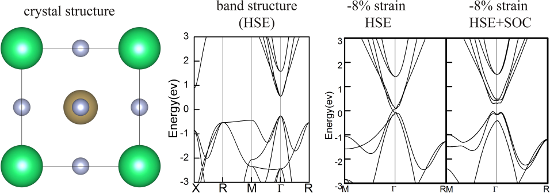
- effective mass (m*) of ThTaN3 at the conduction band minimum (CBM) is estimated from the curvature of the electronic band dispersion, that is, the formula where E and k are the band energy and reciprocal lattice vector. For anisotropic materials, where i, j and k label the transport direction along the x


Induced smectic phase in binary mixtures of twist-bend nematogens
Beilstein J. Nanotechnol. 2018, 9, 1297–1307, doi:10.3762/bjnano.9.122
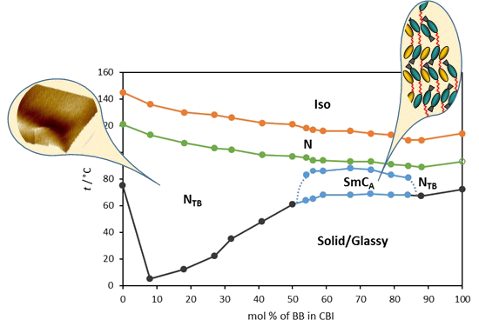
- the anisotropic intermolecular energy parameter between the unlike species is the geometric mean of the anisotropic interaction parameters between the like species. The linearity of both transition temperatures was also observed in the mixtures of methylene and ether-linked dimers and used for




Formation and development of nanometer-sized cybotactic clusters in bent-core nematic liquid crystalline compounds
Beilstein J. Nanotechnol. 2018, 9, 1288–1296, doi:10.3762/bjnano.9.121
- -Carlo simulation for biaxial particles via an anisotropic pair potential [3]. Such a system exhibits three phases: biaxial crystalline at absolute zero temperature, uniaxial nematic and a rotationally disordered isotropic phase. In spite of the several theoretical studies having been successfully
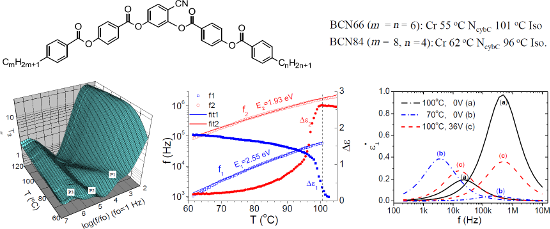
- correlations among the neighboring molecules were revealed and the cybotactic clusters were established [35][36][48]. This was the first successful attempt for determining the cluster size by using the Maier–Meier equations using dielectric parameters such as anisotropic permittivity and the anisotropic


Optical orientation of nematic liquid crystal droplets via photoisomerization of an azodendrimer dopant
Beilstein J. Nanotechnol. 2018, 9, 870–879, doi:10.3762/bjnano.9.81
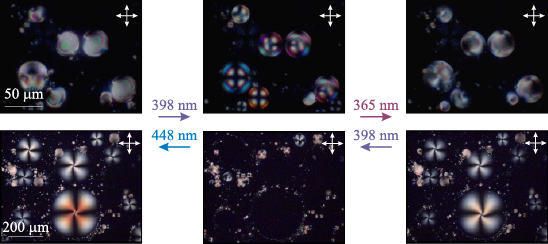
- returns into trans form. The anisotropic interaction of azobenzene molecules with each other, as well as with their environment, essentially depends on their shape (rod-like for trans isomers and having no distinct anisometry for cis isomers). This leads to the modification of physical properties of
- trans and cis isomers are determined by the quantum yields (Φtrans and Φcis) and absorption coefficients and do not depend on exposure time and light intensity. In the case of an anisotropic solution, the light absorption depends on the direction of light propagation. In contrast to disordered cis


Facile phase transfer of gold nanorods and nanospheres stabilized with block copolymers
Beilstein J. Nanotechnol. 2018, 9, 616–627, doi:10.3762/bjnano.9.58
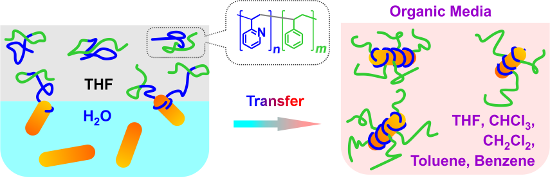
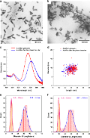
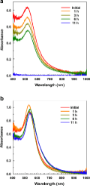
- anisotropic. Their possible coupling with nanorods, as the simplest anisometric nanoparticles, is of emerging interest in recent experimental [6][7][8] and theoretical [9][10][11][12] research. In the case of Au nanoparticles, which are the focus of the current study, a number of synthetic routes are


Dynamic behavior of nematic liquid crystal mixtures with quantum dots in electric fields
Beilstein J. Nanotechnol. 2018, 9, 399–406, doi:10.3762/bjnano.9.39

- ], the polarization field around a spherical cavity inside a dielectric medium is proportional to the applied field, so: Inside an anisotropic dielectric (the liquid crystal) the spherical cavity changes into an ellipsoid with the semi-axes and , where b is the cavity radius, is the parallel


Review: Electrostatically actuated nanobeam-based nanoelectromechanical switches – materials solutions and operational conditions
Beilstein J. Nanotechnol. 2018, 9, 271–300, doi:10.3762/bjnano.9.29
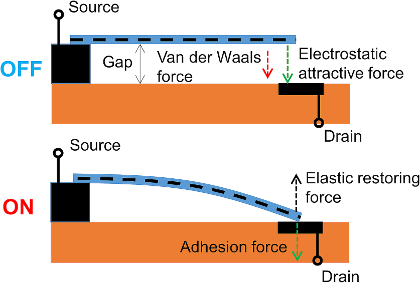
- . Semiconductors Silicon and germanium: Both Si and Ge have a long history as semiconductor device materials. Comparable relatively high Young’s moduli (Si, 130–188 GPa [129] and Ge, 103–150 GPa) [130][131] make these materials useful for applications in NEM devices. Due to the possibility of anisotropic etching


Liquid-crystalline nanoarchitectures for tissue engineering
Beilstein J. Nanotechnol. 2018, 9, 205–215, doi:10.3762/bjnano.9.22
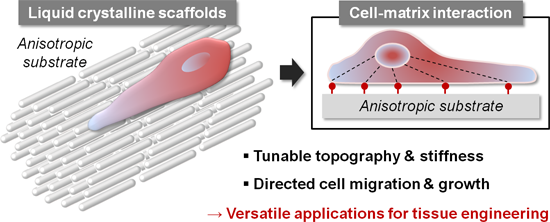
- schematic of LC nanoarchitectures interacting with cells. The LC order of the biopolymers has three major implications for the biological systems: (1) cell–matrix interaction, (2) formation of ECM-based connective tissues, and (3) cellular and subcellular level physiology. First, the spatially anisotropic
- nanoscale topographies [93][94]. LC elastomer scaffolds in nematic and smectic-A phases Liquid crystal elastomers (LCEs) are crosslinked 3D networks of rubber-like synthetic polymers exhibiting orientational and/or positional order [95]. Due to the tunable malleability and highly anisotropic shape change in
- induced 2D and 3D aligned cell growth in response to the lamellar molecular structure of LCE matrices, with tunable porosity and crosslinking density [99][100][101]. In addition, the 3D anisotropic cell scaffolds can be fabricated by using nematic LCE microspheres as building blocks by tuning elastic


Design of photonic microcavities in hexagonal boron nitride
Beilstein J. Nanotechnol. 2018, 9, 102–108, doi:10.3762/bjnano.9.12
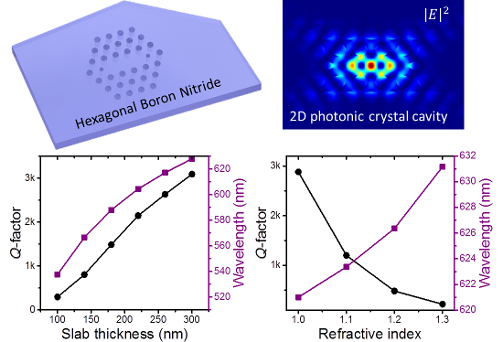
- the emitters. Here, we design 2D and 1D PCCs using anisotropic indices of hBN. The influence of underlying substrates and material absorption are investigated, and spontaneous emission rate enhancements are calculated. Our results are promising for future quantum photonic experiments with hBN
- . Keywords: anisotropic optical materials; boron nitride; photonic crystals; Introduction Hexagonal boron nitride (hBN) has recently emerged as an interesting platform for nanophotonics. This is mainly due to its promising hyperbolic properties [1][2] as well as the ability to host a range of single photon


The rational design of a Au(I) precursor for focused electron beam induced deposition
Beilstein J. Nanotechnol. 2017, 8, 2753–2765, doi:10.3762/bjnano.8.274
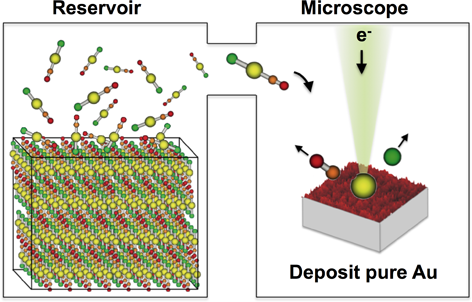
- same behavior was observed for ClAuPEt3 crystals (not shown). MeAuPMe3 was found to sublime within about 20 min in vacuum. The composition of the crystals was analyzed using energy-dispersive X-ray spectroscopy (EDS). It has to be noted that, with an anisotropic material distribution of relatively
- (Figure 7b), less C and more P and Cl were found than expected. We attribute this deviation from the stoichiometric composition to the anisotropic material distribution and the electron sensitivity of the crystals. Most relevant to our analysis is that there was no change in composition after 24 h in the


The role of ligands in coinage-metal nanoparticles for electronics
Beilstein J. Nanotechnol. 2017, 8, 2625–2639, doi:10.3762/bjnano.8.263
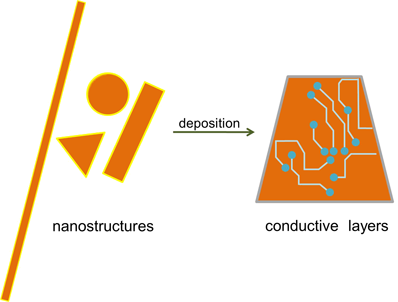
- combination with ascorbic acid and spherical silver seeds yielded rod-like structures in water by reduction of AgNO3. Jana, Gearheart, and Murphy suggested that CTAB forms micellar templates for the anisotropic growth of nanostructures [65]. Recent studies modified this picture and indicated that CTAB
- silver nitrate in the presence of poly(vinylpyrrolidone) (PVP, Figure 2) and sodium bromide. The nanobars formed when bromide ions etched the multiply twinned seeds, promoted the formation of single crystal seeds, and initiated anisotropic growth [68]. Longer silver nanowires grew from multiply twinned
- junction resistance. The same is true for other anisotropic particles that have a potential for electronics: Oleylamine-coated gold nanowires, for example, are too instable to directly use them as inks today, but use of appropriate solvents could alleviate this limitation. This dynamic field at the border


Interactions of low-energy electrons with the FEBID precursor chromium hexacarbonyl (Cr(CO)6)
Beilstein J. Nanotechnol. 2017, 8, 2583–2590, doi:10.3762/bjnano.8.258
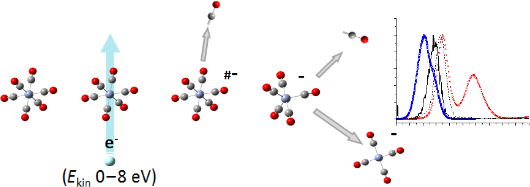
- metal cation W2+ resulting from electron ionization of the neutral W(CO)6 dimer was reported by Neustetter et al. [23] showing the fast conversion of the weak cluster bond into a strong covalent metallic bond. In comparison to electron collisions, anisotropic coulombic explosion of CO ligands upon



The interplay between spin densities and magnetic superexchange interactions: case studies of mono- and trinuclear bis(oxamato)-type complexes
Beilstein J. Nanotechnol. 2017, 8, 2245–2256, doi:10.3762/bjnano.8.224
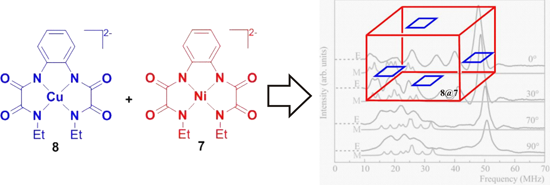
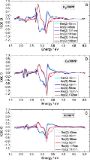
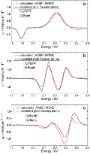
- magnetic field B0 in the plane perpendicular to the molecular plane to obtain anisotropic ESR parameters. A standard manually controlled goniometer from Bruker was used for this purpose with the sample attached to a quartz-rod sample holder. As an example, experimental and simulated X-band ESR spectra of 4
- and Preston [49], the isotropic and anisotropic HF coupling constants for unit spin density on the corresponding s- and p-, d- and f-orbitals have been obtained, respectively. Spin densities on the copper and nitrogen s-orbitals for our complexes are derived as the ratio of the isotropic HF coupling
- ratio of the respective Adip derived from the experimental values and the theoretical anisotropic HF parameters 138.8 MHz and 1197 MHz, which are calculated for unit spin density on the nitrogen p- and copper d-orbitals [49], respectively. Results of electron spin density measurements Obtained results


![[Graphic 15]](/bjnano/content/inline/2190-4286-8-224-i20.svg?max-width=637&scale=1.18182) molecular plan...
molecular plan...


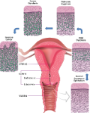
Optical techniques for cervical neoplasia detection
Beilstein J. Nanotechnol. 2017, 8, 1844–1862, doi:10.3762/bjnano.8.186




(Metallo)porphyrins for potential materials science applications
Beilstein J. Nanotechnol. 2017, 8, 1786–1800, doi:10.3762/bjnano.8.180
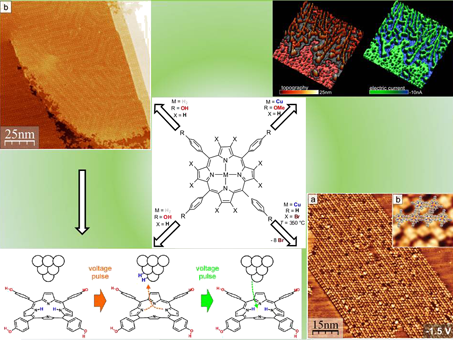
- -assembly. In contrast, on the highly anisotropic Ag(110) surface the observed self-assembled structures of H2TPP(OH)4) can be related to the number of hydrogen bonds and the occupation of favorable adsorption positions. Moreover, molecule–substrate interactions are more pronounced on Ag(110) compared to Au
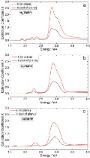
- referred to the web version of this article.) Reproduced with permission from [46], copyright 2014 Elsevier. Extinction coefficient k for a) H2TMPP, b) CuTMPP and c) NiTMPP. The uniaxial anisotropic model results in different intensities in- and out-of-plane. Reproduced with permission from [16], copyright