


Search results
Search for "chemical reactions" in Full Text gives 153 result(s) in Beilstein Journal of Nanotechnology.
Liquid fuel cells
Beilstein J. Nanotechnol. 2014, 5, 1399–1418, doi:10.3762/bjnano.5.153
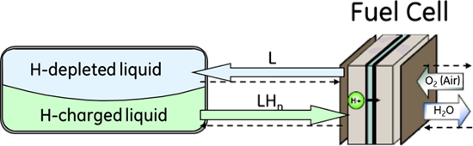
- parallel chemical reactions, and its mechanism is not fully understood [169]. The number of electrons removed from the BH4− ion depends on the anode electrocatalyst, the concentration of sodium borohydride and the ratio [OH−]:[BH4−]. For a ratio of about 4.4, the reaction is described by Equation 21, while

Photocatalysis
Beilstein J. Nanotechnol. 2014, 5, 1071–1072, doi:10.3762/bjnano.5.119

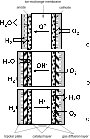
- complex process of solar energy driven water splitting and carbon dioxide reduction. Nanotechnology certainly plays a pivotal role in enabling a rational design of the structures, interfaces and surfaces with controllable features at a length scale comparable to chemical reactions. In this Thematic Series
DFT study of binding and electron transfer from colorless aromatic pollutants to a TiO2 nanocluster: Application to photocatalytic degradation under visible light irradiation
Beilstein J. Nanotechnol. 2014, 5, 1016–1030, doi:10.3762/bjnano.5.115
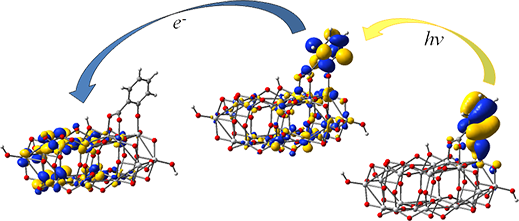
- system in the visible range of the spectrum, iii) proper energy level alignment of the excited state of the pollutant and the conduction band edge of the catalyst, and iv) fast charge transfer from the pollutant to the catalyst. Other requirements would regard the chemical reactions that take place after




Double layer effects in a model of proton discharge on charged electrodes
Beilstein J. Nanotechnol. 2014, 5, 973–982, doi:10.3762/bjnano.5.111
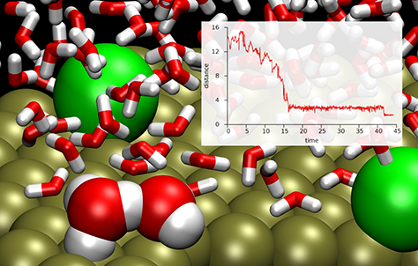
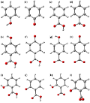
- chemical reactions as isolated rare events, for which it should suffice to study the behavior of the system from shortly before to shortly after the event. Here, we define the reaction time as the time, when the sum of the weights of all metal EVB states is for the first time larger than 0.9 in trajectory


Controlling mechanical properties of bio-inspired hydrogels by modulating nano-scale, inter-polymeric junctions
Beilstein J. Nanotechnol. 2014, 5, 887–894, doi:10.3762/bjnano.5.101
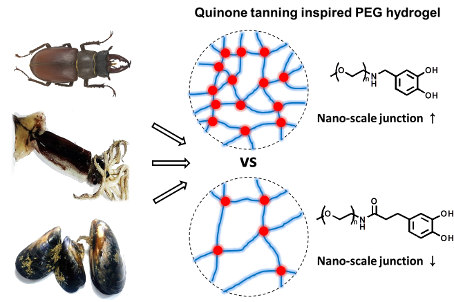
- of gelation kinetics and mechanical properties of PEG hydrogels compared to results obtained by using PEGs in the absence of amine groups. Therefore, the study provides new insight into designing new crosslinking chemistry for controlling nano-scale chemical reactions that can broaden unique
- . Biomaterials formed by quinone tanning processes found in (a) squid beaks, (b) insect cuticles, and (c) mussel adhesives. Representative chemical reactions were shown for each biomaterials (a,b,c top). Synthetic PEG derivatives that can mimic the natural catecholamine-involved quinone tanning due to the



Encapsulation of nanoparticles into single-crystal ZnO nanorods and microrods
Beilstein J. Nanotechnol. 2014, 5, 485–493, doi:10.3762/bjnano.5.56
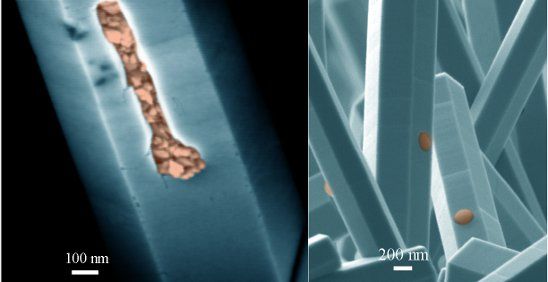
- . The fractured nanorod in Figure 4d reveals a nanobead entirely encapsulated into the nanorod. Growth mechanism The growth of ZnO in aqueous solution can be described as an epitaxial growth process. The precursors Zn(NO3)2 and HMTA in water lead to chemical reactions are as follows [20]: Hence, Zn2


The role of oxygen and water on molybdenum nanoclusters for electro catalytic ammonia production
Beilstein J. Nanotechnol. 2014, 5, 111–120, doi:10.3762/bjnano.5.11
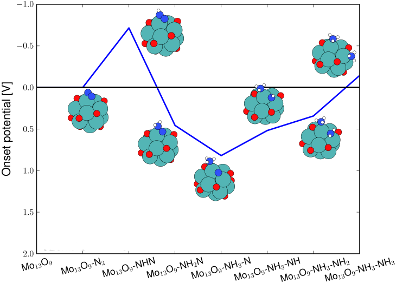
- presence of water often gives rise to oxygen adsorption on catalyst surfaces through decomposition of water and the adsorbed oxygen or hydroxide species often occupy important surfaces sites, resulting in a decrease or a total hindrance of other chemical reactions taking place at that site. In this study
- rise to oxygen or hydroxide adsorption on the surface, which can occupy or block important surfaces sites. The adsorbed oxygen species can either decrease or totally hinder other chemical reactions taking place at that site. Oxygen poisoning of the surface is indeed a main inhibitor for ammonia


Surface assembly and nanofabrication of 1,1,1-tris(mercaptomethyl)heptadecane on Au(111) studied with time-lapse atomic force microscopy
Beilstein J. Nanotechnol. 2014, 5, 26–35, doi:10.3762/bjnano.5.3
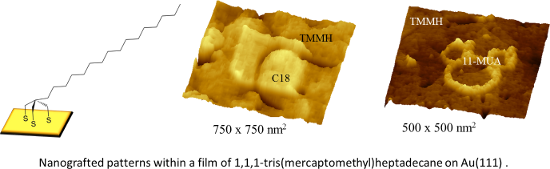
- surface coatings that resist damage. Multidentate molecules provide a model surface that will resist self-exchange and surface migration, and enable further steps of chemical reactions with high fidelity. Degradation of alkanethiol SAMs on metal surfaces is caused by UV exposure, thermal desorption, and


Synthesis of indium oxi-sulfide films by atomic layer deposition: The essential role of plasma enhancement
Beilstein J. Nanotechnol. 2013, 4, 750–757, doi:10.3762/bjnano.4.85
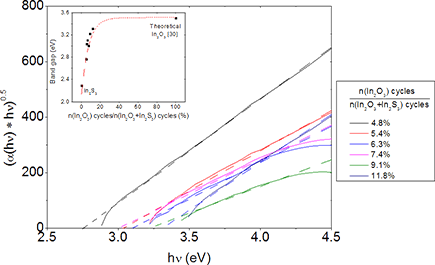
- to the high reactivity of radicals, PEALD generally allows the achievement of many chemical reactions that cannot occur with thermal ALD [13][19]. Here In2(S,O)3 films could be grown while using O2 plasma as oxygen source. But the growth of pure In2O3 films remained unsuccessful. This suggests that



Surface passivation and optical characterization of Al2O3/a-SiCx stacks on c-Si substrates
Beilstein J. Nanotechnol. 2013, 4, 726–731, doi:10.3762/bjnano.4.82
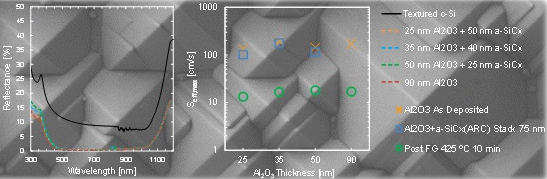
- were subsequently deposited by thermal ALD (Savannah S200, Cambridge Nanotech; Cambridge, MA, USA) at Tdep = 200 °C. This technique is based on sequential, self-limiting chemical reactions at the surface. The surface of the substrate is exposed to the precursor gases in alternating manner. The


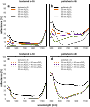
Electrochemical and electron microscopic characterization of Super-P based cathodes for Li–O2 batteries
Beilstein J. Nanotechnol. 2013, 4, 665–670, doi:10.3762/bjnano.4.74
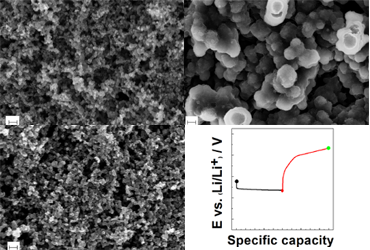
- a stepwise fashion leading to the formation of LiO2 and Li2O2 as shown in the chemical reactions below. Conversely, upon charging, the oxygen evolution reaction (OER) gives O2 and Li+ back via a 2-electrons reaction. The unsuitability of commonly used electrolytes for Li-ion batteries (e.g


Large-scale atomistic and quantum-mechanical simulations of a Nafion membrane: Morphology, proton solvation and charge transport
Beilstein J. Nanotechnol. 2013, 4, 567–587, doi:10.3762/bjnano.4.65
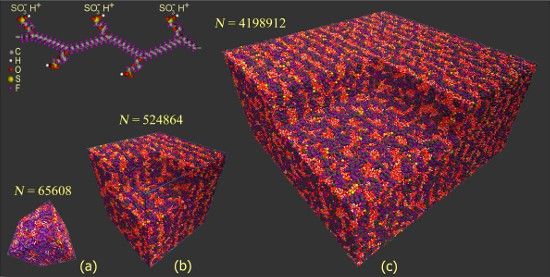
- total number of atoms in these systems was limited to about two million because of computer memory and CPU limitations [28]. Significant efforts have been made to take into account quantum effects and chemical reactions within the molecular dynamics models. For this purpose, the so-called Reax force


Continuous parallel ESI-MS analysis of reactions carried out in a bespoke 3D printed device
Beilstein J. Nanotechnol. 2013, 4, 285–291, doi:10.3762/bjnano.4.31
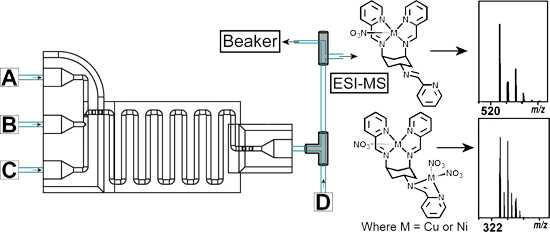
- into the device, was used to initiate chemical reactions [6]. We have also presented how 3D printing can be used to make intricate micro- and milliscale reactionware for organic, inorganic and materials syntheses, offering significant freedom to design bespoke reactors in terms of residence time
- ketone (PEEK), which is a harder plastic than PP, allowing for boring into the PP plastic inlet and outlets to give a tight seal to the device. These fittings can be removed and replaced as many times as necessary, and the whole device can be used repeatedly, for a variety of chemical reactions. LabView
- [Cu(C24H24N6)(NO3)]+ (1), m/z 521.1 species see Supporting Information File 1. Conclusion By carrying out a number of complementary supramolecular chemical reactions in bespoke 3D-printed reactionware we have shown their high potential and configurability. The tailored milliscale reactionware, with


Electrospinning preparation and electrical and biological properties of ferrocene/poly(vinylpyrrolidone) composite nanofibers
Beilstein J. Nanotechnol. 2013, 4, 189–197, doi:10.3762/bjnano.4.19

- , there are a series of chemical reactions between Fc and the enzymes, DNA and RNA in the cell due to the penetration of Fc, leading to cell death [32]. The Fc conveys many unique properties such as low toxicity, stability, lipophilicity, aromaticity and easy access to one-electron oxidation potential


Functionalization of vertically aligned carbon nanotubes
Beilstein J. Nanotechnol. 2013, 4, 129–152, doi:10.3762/bjnano.4.14
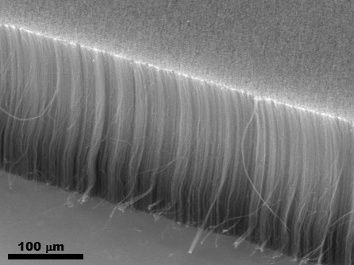
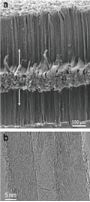
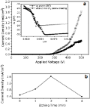
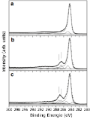
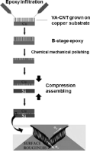
- the evaporation of the solvent. The product has high optical transparency, robust flexibility and good conductivity. Chen et al. [130] used a radio-frequency glow-discharge treatment and chemical reactions post-treatment to graft polysaccharide chains onto a VA-CNT surface. After functionalization








Plasmonics-based detection of H2 and CO: discrimination between reducing gases facilitated by material control
Beilstein J. Nanotechnol. 2012, 3, 712–721, doi:10.3762/bjnano.3.81
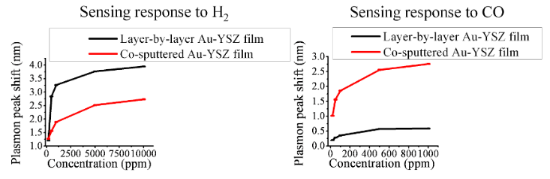
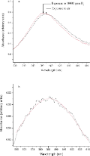
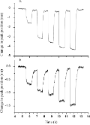
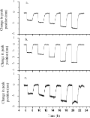
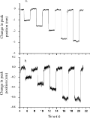
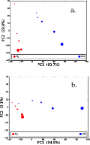
- also likely induce a change in the polarizability of the YSZ matrix, changing the dielectric constant. The shift in the plasmon peak position will therefore be a result of the combined effect of the charge exchange and the change in dielectric properties of the YSZ. Other chemical reactions between H2





Focused electron beam induced deposition: A perspective
Beilstein J. Nanotechnol. 2012, 3, 597–619, doi:10.3762/bjnano.3.70
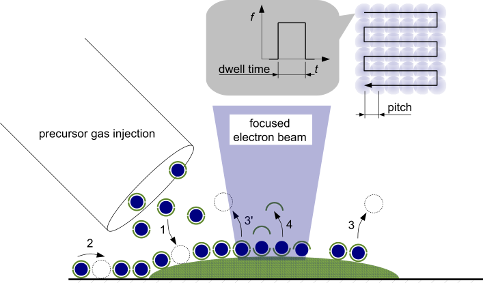
- precursor fragments, i.e., under the assumption that no secondary chemical reactions are taking place between volatile dissociation fragments, the concentration ratios [X]/[Z] of two elements in the binary deposit can be calculated from the yields as follows where [X]i and [Z]i (i = 1, 2) represent the


Junction formation of Cu3BiS3 investigated by Kelvin probe force microscopy and surface photovoltage measurements
Beilstein J. Nanotechnol. 2012, 3, 277–284, doi:10.3762/bjnano.3.31
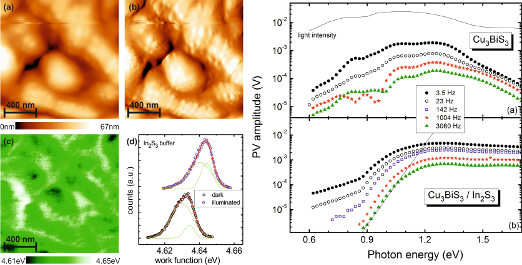
- surface defect states from which separation of photoexcited charge carriers is possible, i.e., chemical reactions at the Cu3BiS3/In2S3 interface lead to the passivation of surface-defect states in the band gap of Cu3BiS3. Often it is useful to analyze the amplitude and phase angle instead of the x- and y


Self-assembly of octadecyltrichlorosilane: Surface structures formed using different protocols of particle lithography
Beilstein J. Nanotechnol. 2012, 3, 114–122, doi:10.3762/bjnano.3.12
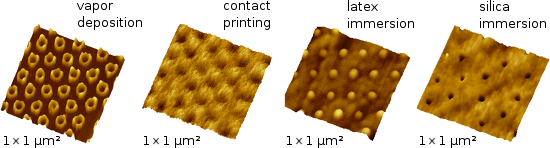
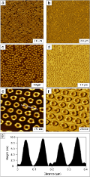
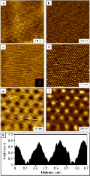
- capabilities for the high-throughput fabrication of nanopatterns from organosilane self-assembled monolayers, which offers the opportunity to study surface-based chemical reactions at the molecular level. Nanopatterns of octadecyltrichlorosilane (OTS) were prepared on surfaces of Si(111) using designed




Substrate-mediated effects in photothermal patterning of alkanethiol self-assembled monolayers with microfocused continuous-wave lasers
Beilstein J. Nanotechnol. 2012, 3, 65–74, doi:10.3762/bjnano.3.8
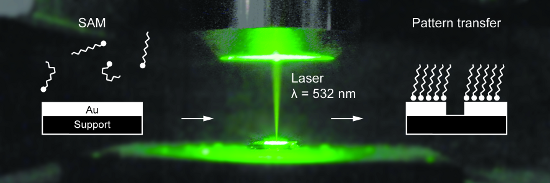
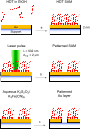
- advantage of nonlinear effects, such as photothermal and multiphoton absorption processes [11][12][13][14][15][16][17]. In photothermal processing, laser light is used in order to locally heat the substrate surface and initiate chemical reactions [12]. Commonly, photothermal patterning of SAMs is carried




Octadecyltrichlorosilane (OTS)-coated ionic liquid drops: Micro-reactors for homogenous catalytic reactions at designated interfaces
Beilstein J. Nanotechnol. 2012, 3, 33–39, doi:10.3762/bjnano.3.4
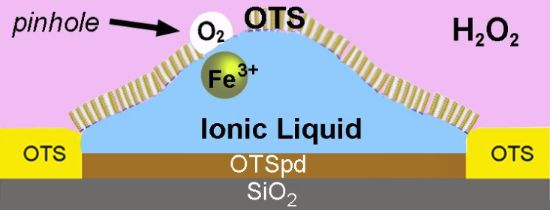
- defects on the OTS coating layer provided spaces for the catalyst inside the capsule and reactants outside the capsule to react. Hence, the coated IL drops enable the interfacial chemical reactions. Results and Discussion Chemical pattern-directed assembly of IL on surface The carboxylic acid-terminated


Micro- and mesoporous solids: From science to application
Beilstein J. Nanotechnol. 2011, 2, 774–775, doi:10.3762/bjnano.2.85
- achieve a basic understanding of what happens inside the porous framework of such a solid on the molecular, and nano- and mesocopic level, in a hierarchical order, during adsorption, desorption and chemical reactions. Alongside the development of experimental methods to unravel the details of the

How to remove the influence of trace water from the absorption spectra of SWNTs dispersed in ionic liquids
Beilstein J. Nanotechnol. 2011, 2, 653–658, doi:10.3762/bjnano.2.69
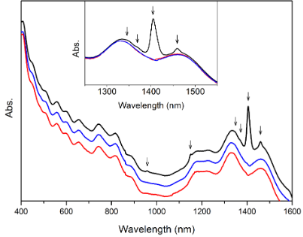
- electrochemistry [4][5], and chemical reactions and separations [6][7][8][9]. In 2003, Fukushima et al. [10] found that by mixing together and mechanically grinding the single-walled carbon nanotubes with imidazolium-based ILs, a thermally stable bucky gel can be formed with SWNTs untangled from the heavily




Inorganic–organic hybrid materials through post-synthesis modification: Impact of the treatment with azides on the mesopore structure
Beilstein J. Nanotechnol. 2011, 2, 486–498, doi:10.3762/bjnano.2.52
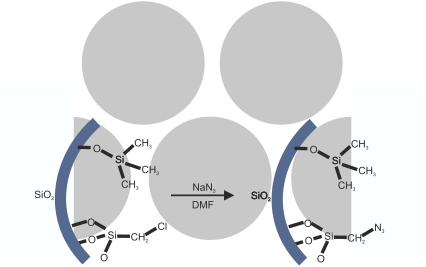
- structural features such as pore size, connectivity, etc., are strongly influenced by the presence of the organosilane [25]. These organo-functionalized silica gels can be further modified by chemical reactions with more complex functional groups; recent examples include Cu(I)-catalyzed 1,3-dipolar
- cycloadditions, also termed Click reactions, on silica surfaces involving alkynes and azide functionalities [26][27][28]. Reviewing the literature on this topic reveals that most of the examples of postsynthesis surface chemical reactions are concerned with the successful chemical conversion, but the structure


Organic–inorganic nanosystems
Beilstein J. Nanotechnol. 2011, 2, 363–364, doi:10.3762/bjnano.2.41
- specificity for subsequent chemical reactions or, in the simplest case, served as a spacer to avoid aggregation in a system of corresponding nanoobjects. However, there is yet another highly active field where the organic component delivers the sought after functionality of a device: Organic electronics. Here



