Search results
Search for "electric field" in Full Text gives 398 result(s) in Beilstein Journal of Nanotechnology. Showing first 200.
Microwave-induced electric discharges on metal particles for the synthesis of inorganic nanomaterials under solvent-free conditions
Beilstein J. Nanotechnol. 2020, 11, 1019–1025, doi:10.3762/bjnano.11.86
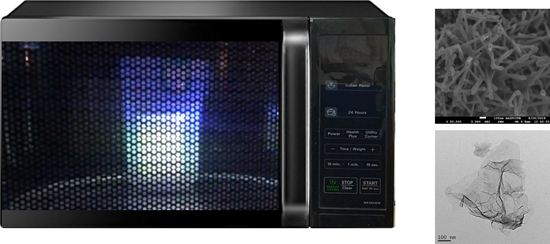
- exposed to microwaves due to the formation of high electric field gradients at sharp edges on the metal surfaces [12]. The generation of arcs might be the reason why microwave irradiation has not been used to generate different nanomaterials from metal particles. However, some studies show that the
- contain rough surfaces or sharp edges. When electrically conducting rough surfaces are exposed to microwaves, electric fields distribute inhomogeneously along the surface of the conductor. At tips and sharp edges, very high electric field gradients occur, leading to the ionization of the material and the


Integrated photonics multi-waveguide devices for optical trapping and Raman spectroscopy: design, fabrication and performance demonstration
Beilstein J. Nanotechnol. 2020, 11, 829–842, doi:10.3762/bjnano.11.68
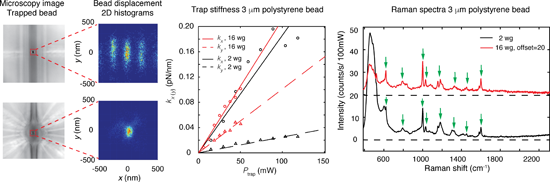
- operation of the waveguides at 785 nm for the transverse magnetic (TM) polarization. For TM polarization, the electric field vector of the waveguide mode is directed perpendicular to the plane of the waveguide (the x–y plane, as indicated in Figure 1). This polarization is conserved in the emitted beam
- maximum obtainable value for the TM polarization, as a result of optimum constructive interference. For transverse electric (TE) polarization, for which the electric field vector of the beams is oriented in the x–y plane, the resulting light concentration is lower. In the simulations, the refractive
- the electric field (per watt of power delivered to the waveguide mode) of the beams emitted into water and for waveguide thicknesses t = 50, 100 and 150 nm. The x-axis is the axis of the waveguide. While for t = 50 nm the profile is flattest (and thus the least divergent), the profile for t = 100 nm


Hexagonal boron nitride: a review of the emerging material platform for single-photon sources and the spin–photon interface
Beilstein J. Nanotechnol. 2020, 11, 740–769, doi:10.3762/bjnano.11.61




Effect of Ag loading position on the photocatalytic performance of TiO2 nanocolumn arrays
Beilstein J. Nanotechnol. 2020, 11, 717–728, doi:10.3762/bjnano.11.59
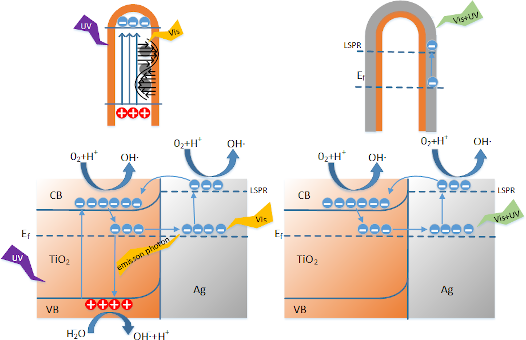
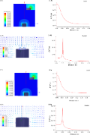
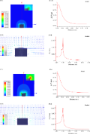
- field distribution of arrays with different structures at 457 and 320 nm. In order to further illustrate the effect of structural changes on the electric field distribution of arrays, the XY plane and the XZ plane are chosen to analyze the arrays. The XY plane chooses the cross section at 75 nm and the
- XZ plane chooses the cross section at 0 nm. The structure of the model was established according to the morphology observed by SEM. As can be seen from Figure 8 (a1–4), the electric field of the TiO2 arrays is stronger under 320 nm illumination, and there is a strong electric field distribution
- absorption of ultraviolet light by TiO2, and the electric field intensity between nanocolumns decreases obviously. Only under 457 nm light can a strong electric field distribution at the top of the array be observed, which is attributed to the absorption of visible light by the LSPR resonance of Ag. Figure 8


Comparison of fresh and aged lithium iron phosphate cathodes using a tailored electrochemical strain microscopy technique
Beilstein J. Nanotechnol. 2020, 11, 583–596, doi:10.3762/bjnano.11.46
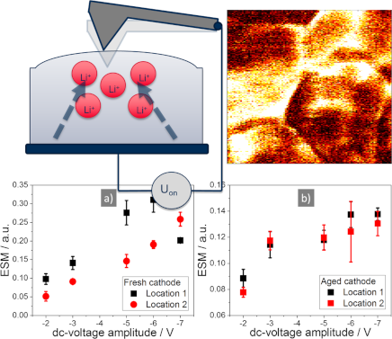
- the capacity degradation of the samples [23]. Electrochemical strain microscopy (ESM) is a relatively new AFM contact mode, which probes ionic charges accumulated in a small volume under the AFM tip after application of an electric field by measuring the resulting surface strain [24][25][26]. It was
- first experimentally introduced by Balke et al. [24][25]. Morozovksa et al. [26][27][28] provided the theoretical background. If an alternating electric field is applied, the ions located in the sample volume under the AFM tip are forced to oscillate, which generates strain due to concentration
- increase or decrease of the ionic concentration in the probed volume due to the electric field. During accumulation of Li-ions with the dc-voltage pulse, due to the electric field driven migration, the ESM signal increases. Afterwards, when the dc-voltage is turned off, the ESM signal decreases due to the



Evolution of Ag nanostructures created from thin films: UV–vis absorption and its theoretical predictions
Beilstein J. Nanotechnol. 2020, 11, 494–507, doi:10.3762/bjnano.11.40
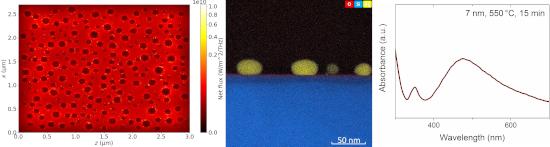
- perpendicularly polarized beams yield, by averaging, the result for the unpolarized beam, according to the formula: where ETE and ETM are electric and magnetic fields obtained from simulations with TE and TM beam polarizations, respectively. For calculations of the electric field distribution, the shape of the




Current measurements in the intermittent-contact mode of atomic force microscopy using the Fourier method: a feasibility analysis
Beilstein J. Nanotechnol. 2020, 11, 453–465, doi:10.3762/bjnano.11.37
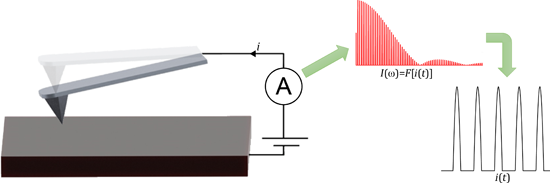
- of the sample as those of an Ohmic material, where the carrier response to the electric field is “immediate”. However, many materials exhibit responses that depend on the timescales of the application of the electrical interactions (e.g., on the timescale of the contact time in our case). The




Synthesis and enhanced photocatalytic performance of 0D/2D CuO/tourmaline composite photocatalysts
Beilstein J. Nanotechnol. 2020, 11, 407–416, doi:10.3762/bjnano.11.31
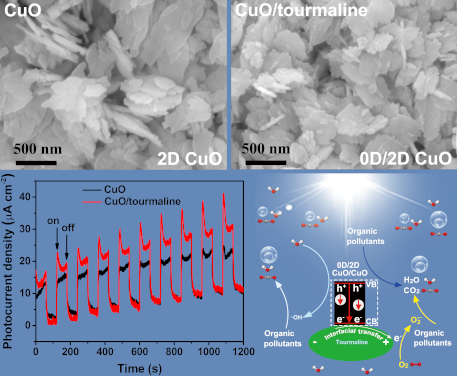
- )(BO3)3V3W, where X: K+, Na+, Ca2+; Y: Li+, Fe2+, Mn2+, Mg2+, Fe3+, Al3+, Cr3+, V3+, Ti4+; Z: Fe3+, Al3+, Cr3+, V3+; T: Al3+, B3+, Si4+; B: B3+; V: OH−, O2−; W: OH−, F−, O2− [21]. The spontaneous permanent polarization provides tourmaline with an electric field of 106–107 V m−1 on its surface [22]. The
- electric field can increase the separation of the photoinduced charge carriers [2][23][24]. Furthermore, tourmaline can augment the oxygen dissolved into water due to its infrared radiation effect [24][25], which contributes to accelerate the photocatalytic oxidation reactions. Tourmaline is a promising
- functional mineral material for accepting the photogenerated e− due to its special electric field. Herein, we report the successful synthesis of the CuO/tourmaline composite photocatalyst with 0D/2D CuO geometric structure by a facile precipitation–hydrothermal process. This work firstly highlights a simple


Nanosecond resistive switching in Ag/AgI/PtIr nanojunctions
Beilstein J. Nanotechnol. 2020, 11, 92–100, doi:10.3762/bjnano.11.9
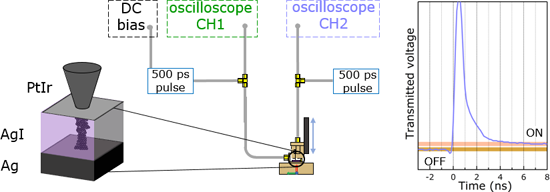
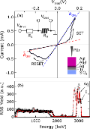
- electric-field-driven redistribution of only a small amount of highly mobile ionic species upon resistive switching. We investigate the memristive behavior of a so-far less explored representative of this class, the Ag/AgI material system in a point contact arrangement established by the conducting PtIr
- solutions [1]. Two-terminal, non-volatile resistance-change memory devices (RRAMs) [2][3][4], the operation of which relies on controllable, electric-field-induced structural changes in an electronically insulating ionic conductor medium, offer a viable alternative to intrinsically overcome the above


Plasmonic nanosensor based on multiple independently tunable Fano resonances
Beilstein J. Nanotechnol. 2019, 10, 2527–2537, doi:10.3762/bjnano.10.243
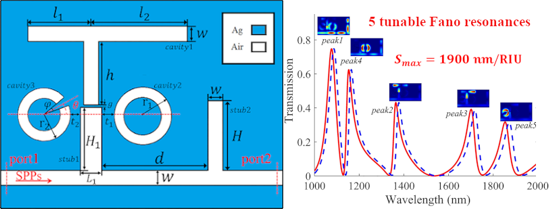
- height of stub1 and its asymmetrical coupling area with the split-ring, as shown in Figure 7. Afterwards, for the convenience of the following analysis of cavity3, the electric field coupled into cavity3 is divided into up and down parts named Eup and Edown, as marked with red arrows along the split-ring
- in Figure 7. When θ = 0°, as shown in Figure 7a, Eup and Edown are the mirror counterparts, which produced a typical destructive interference, resulting in low transmission. A similar phenomenon happens when θ = 180°. When θ is closer to 20°, the electric field is coupled to one end of cavity3, Eup


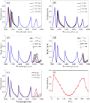


Formation of metal/semiconductor Cu–Si composite nanostructures
Beilstein J. Nanotechnol. 2019, 10, 2497–2504, doi:10.3762/bjnano.10.240
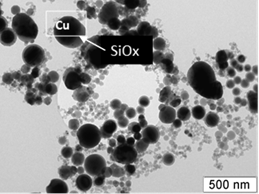
- Mie scattering theory, investigated the optical response of the obtained Si/Au nanoparticles. The results of the study showed an increase of the local electric field and unidirectional light scattering with a high Purcell coefficient compared with a nanoparticle consisting only of gold. Another


Label-free highly sensitive probe detection with novel hierarchical SERS substrates fabricated by nanoindentation and chemical reaction methods
Beilstein J. Nanotechnol. 2019, 10, 2483–2496, doi:10.3762/bjnano.10.239
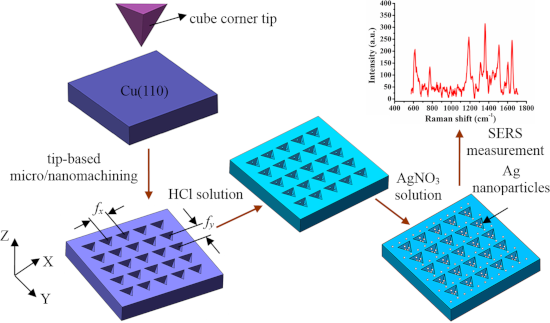
- solution on the Raman intensities of the SERS substrate with hierarchical structures are experimentally studied. The intensity and distribution of the electric field of single and multiple Ag nanoparticles on the surface of a plane and with multiple micro/nanostructures are studied with COMSOL software
- plane. Compared with the other structures, more Ag nanoparticles are generated on the “fish scale” structures using the two parameters as shown in Figure 1c and Figure 1e. More Ag indicates that more nanoparticles are formed in the pyramidal cavities, and a stronger electric field is generated between
- local electric field enhancement is caused when a single nanoparticle comes in contact with the sample and the “hot spots” are formed by multiple nanoparticles to improve the electric field intensity and local electromagnetic field. Zhang et al. [32] deposited a Ag film of 30 nm and a Au film of 10 nm


Multiple Fano resonances with flexible tunablity based on symmetry-breaking resonators
Beilstein J. Nanotechnol. 2019, 10, 2459–2467, doi:10.3762/bjnano.10.236
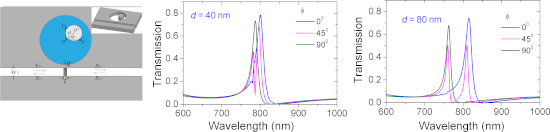
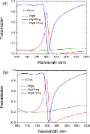
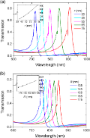
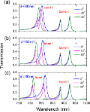
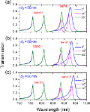
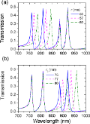
- clockwise from 0° to −90°, a similar phenomenon is observed (Figure 5c). A new resonance peak 2 appears and gradually increases its amplitude. Meanwhile, peak 1 is gradually decreasing. We note that the line widths of peak 2 in Figure 5a and Figure 5b differ. The electric field distributions for peak 1 and
- , (b) outer radius R. The inset shows the resonance wavelength λ0 as a function of radius r. Effective refraction index neff as a function of the wavelength at different ring widths W. The evolution of transmission spectra with angle ϕ varying (a) from 0° to 90°, and (c) from 0° to −90°. The electric
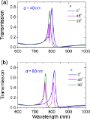
- field distribution for peak I and II at (b) ϕ = 45° (810 nm and 760 nm), and (d) ϕ = −45° (819 nm and 761 nm). The other parameters are R = 155 nm, r = 55 nm, and the deviation distance d = 80 nm. The evolution of transmission spectra with angle ϕ. The deviation distance is (a) d = 40 nm and (b) d = 80




Semitransparent Sb2S3 thin film solar cells by ultrasonic spray pyrolysis for use in solar windows
Beilstein J. Nanotechnol. 2019, 10, 2396–2409, doi:10.3762/bjnano.10.230
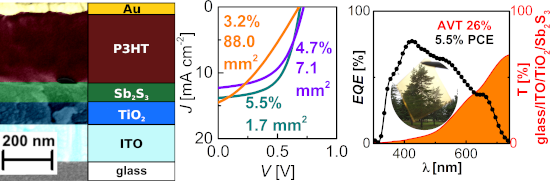
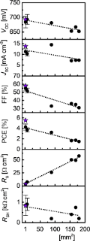
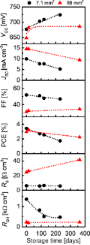
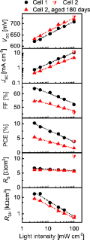
- intensity (2.12% at 25 mW cm−2 and 9.03% at 5 mW cm−2), and it was concluded that the behavior was similar to amorphous Si solar cells [68]. In the case of amorphous Si solar cells, the decrease in FF at increasing light intensity was connected to the increasing electric field inside the solar cell [69



Four self-made free surface electrospinning devices for high-throughput preparation of high-quality nanofibers
Beilstein J. Nanotechnol. 2019, 10, 2261–2274, doi:10.3762/bjnano.10.218
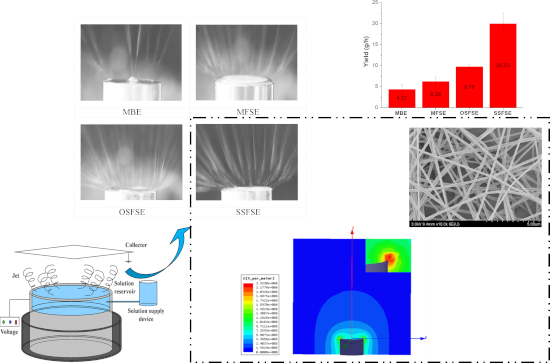
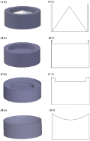
- preparation of the corresponding four FSE devices were studied by simulating the electric field distribution using the Maxwell 3D software. The properties of the electric field in the device are very important for the FSE process. The effects of the particular technique on the morphology and the yield of
- device performs best, providing the highest quality and yield of nanofibers. The SSFE device could yield 20.03 g/h of nanofibers at an applied voltage of 40 kV. Keywords: electric field; free surface electrospinning; high-throughput preparation; Maxwell 3D; mechanism; nanofibers; Introduction Due to
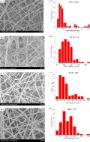
- its surface tension. The effects of the MBE, MFSE, OSFSE and SSFSE device design on the morphology and the yield of the produced nanofibers were experimentally investigated. The differences between them were explained based on simulations of the electric field distribution using the Maxwell 3D






Liquid crystal tunable claddings for polymer integrated optical waveguides
Beilstein J. Nanotechnol. 2019, 10, 2163–2170, doi:10.3762/bjnano.10.209
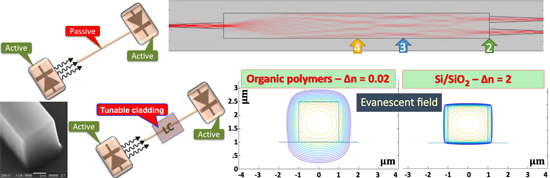
- Discussion Propagation in waveguide structures Figure 1 depicts the electric field distribution in a directional coupler and two multimode interferometers (MMIs) with symmetric and asymmetric input, respectively. The optical power is split between the guides of the directional coupler, showing an alternating
- literature [12]. Repeating the above calculation with waveguides having the same dimensions, and ncore = 2.10, the results vary considerably. The electric field is substantially confined to the core, with no leaks even for neff = 2.08 of the LC. The drawback is that the interaction between core and cladding
- conditioned with spin-coated polyimide (PIA-2304, Lixon Aligner) for homogeneous LC alignment, parallel to the plate, along the waveguide. Both the glass surface and the waveguide were gently rubbed with a velvet cloth to induce the desired orientation. If an external electric field is applied to the LC


Nitrogen-vacancy centers in diamond for nanoscale magnetic resonance imaging applications
Beilstein J. Nanotechnol. 2019, 10, 2128–2151, doi:10.3762/bjnano.10.207
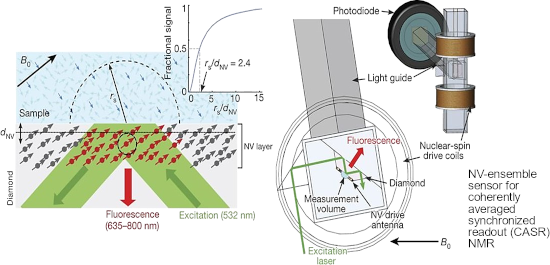
- (NV−). Room temperature manipulation of electron spins at the NV centers by means of magnetic or electric field, microwave or light irradiation, or a combination thereof, allows the generation of sharp resonances in the intensity and wavelength of the NV photoluminescence. The origin of these
- properties with theoretical models. An array of NV sensors under the diamond surface were used in [58] for the spatial mapping of band bending, where the NV sensors probe the electric field associated with the surface distribution of space charge density under different diamond surface termination. The


Gold-coated plant virus as computed tomography imaging contrast agent
Beilstein J. Nanotechnol. 2019, 10, 1983–1993, doi:10.3762/bjnano.10.195
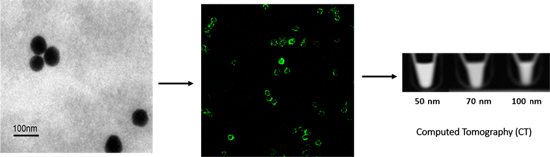
- directly, rather it is deduced from the electrophoretic mobility of the charged NPs under an applied electric field. The electrophoretic mobility toward the positive or the negative electrode determines the zeta potential values as negative or positive. The zeta potential values for Au-CPMV particles of




Prestress-loading effect on the current–voltage characteristics of a piezoelectric p–n junction together with the corresponding mechanical tuning laws
Beilstein J. Nanotechnol. 2019, 10, 1833–1843, doi:10.3762/bjnano.10.178
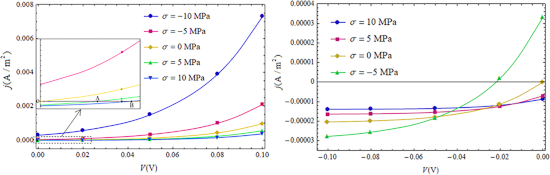
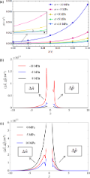
- on how much influence of the deformation-induced electric field can reach the SCZ. Furthermore, it is also found that the deformation-induced electric field becomes weak with increasing doping because the higher doping is corresponding to the stronger electric leakage. Thus, the higher mechanical
- present are third-generation semiconductors, for instance, ZnO, GaN, CdS, and AlN, with wide bandgap, high breakdown electric field, high thermal conductivity, and even mechanical tunability [3]. They show numerous application prospects in electric devices and sensors, such as energy harvesters [4][5][6
- I–V characteristics of p–n junctions are especially important. There is a steady current through a p–n junction when an electric bias voltage is applied. Because mechanical loadings can tune electric potential and electric field of a piezoelectric p–n junction, the corresponding I–V characteristics




Novel hollow titanium dioxide nanospheres with antimicrobial activity against resistant bacteria
Beilstein J. Nanotechnol. 2019, 10, 1716–1725, doi:10.3762/bjnano.10.167
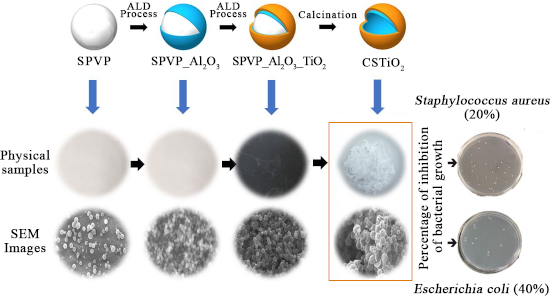
- spherical particles due to the low-viscosity-based solution. In this process, the electric field generated monodisperse drops that contracted due to the fast evaporation of the solvent induced by Columbic explosion [21][22]. Figure 2a–c shows photographs of the three steps of the process: electrosprayed


Effects of surface charge and boundary slip on time-periodic pressure-driven flow and electrokinetic energy conversion in a nanotube
Beilstein J. Nanotechnol. 2019, 10, 1628–1635, doi:10.3762/bjnano.10.158
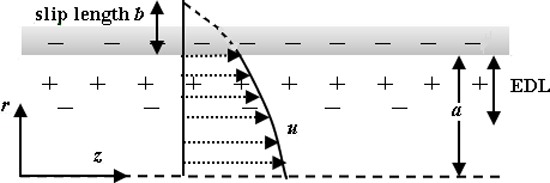
- Economics, Hohhot, China 10.3762/bjnano.10.158 Abstract Time-periodic pressure-driven slip flow and electrokinetic energy conversion efficiency in a nanotube are studied analytically. The slip length depends on the surface charge density. Electric potential, velocity and streaming electric field are
- streaming potential induces an electric field called streaming electric field. Acting on the net mobile charge in EDL, the steaming electric field generates an electric force in the opposite direction of the flow. The flow rate is decreased under the action of the electric office. This effect is called
- , and t is the time. From the continuity equation, we find ∂u/∂z = 0 and so u depends on the variables r and t. Therefore, the momentum balance equations for the incompressible viscous Newtonian liquid becomes where ρ is the mass density, μ is the dynamic viscosity, Es is the streaming electric field


Direct observation of oxygen-vacancy formation and structural changes in Bi2WO6 nanoflakes induced by electron irradiation
Beilstein J. Nanotechnol. 2019, 10, 1434–1442, doi:10.3762/bjnano.10.141
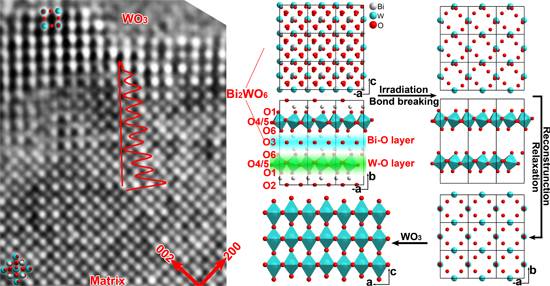
- amorphous layer. These observed features on the Bi2WO6 flake indicate that bonds were broken in the nanoflake, and atoms were expelled towards the surface of the irradiated flake by the released gas and/or the electron-beam-induced electric field [28][29]. The bubbles appeared to be mobile, and the bubbles
- irradiation, in this case, is far too low to decompose Bi2WO6 nanoflakes. Besides, loops or defect clusters were not observed during the whole irradiation process suggesting that the knock-off or sputtering effects can be neglected. When a high-energy electron beam passes through the sample, an electric field
- will be induced by the accumulation of secondary electrons and Auger electrons in the irradiation region [28][29]. The charged ions in the crystal will be displaced, and ionic bonds can be broken when the induced electric field, which can be enhanced with the increase of the irradiation time, is


Kelvin probe force microscopy of the nanoscale electrical surface potential barrier of metal/semiconductor interfaces in ambient atmosphere
Beilstein J. Nanotechnol. 2019, 10, 1401–1411, doi:10.3762/bjnano.10.138
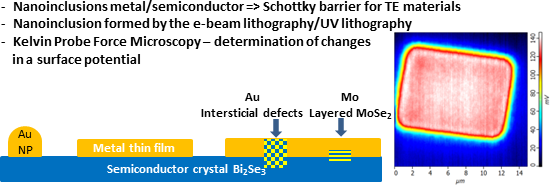
- been observed for Si [51][52], Ti, Ni or Al [53][54][55], carbon [56] and organic–inorganic compounds [57]. We suggest, in our case, that OH− or O−/O2− ions diffuse through our polycrystalline Au layer with many defects (grain boundaries, dislocations) forced by the strong electric field (8 V/53 nm of
- nanometers for SiO2 on Si [51][52]). In our case it is increased by the electric field and good oxygen mobility in BiOx due to the formation of charged Bi vacancies [59][60]. This assumption is in good agreement with the observed increase of the cut-in potential barrier upon thinning of the Au layer (see
- Figure 3) as a reminiscence of the diffusion limitation of oxygen/hydroxy anions due to the electric field through the polycrystalline Au layer. Bare Bi2Se3 had no diffusion limits and the I–V curves are not measurable as electrons immediately form isolating BiOx on the surface. The abovementioned facts


A silver-nanoparticle/cellulose-nanofiber composite as a highly effective substrate for surface-enhanced Raman spectroscopy
Beilstein J. Nanotechnol. 2019, 10, 1270–1279, doi:10.3762/bjnano.10.126
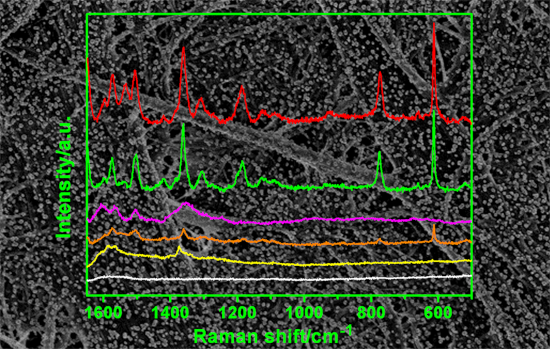
- SERS application. This SERS substrate is usable for the trace detection of the analyte. In order to better understand the high SERS activity of the substrate Ag-NP/cellulose-NF–C, finite element method (FEM) modeling was performed to investigate the localized electric field intensity (Emax) of the
- silver nanoparticles (diameter 70 nm) with different inter-particle spacings. The obtained electric field intensity distributions are shown in Figure 5. The maximum values of the electric field intensities for inter-particle spacings of 15, 5, and 1 nm are 5.7, 9.2, and 40.7 V/m, respectively, and the
- to the fourth-power dependence of the enhancement factor on the electric field intensity, the enhancement factor of this substrate was estimated to be ca. 3 × 10⁶. Compared with previously reported cellulose-based SERS substrates, our current substrate shows a better SERS activity. For example, the


Electroluminescence and current–voltage measurements of single-(In,Ga)N/GaN-nanowire light-emitting diodes in a nanowire ensemble
Beilstein J. Nanotechnol. 2019, 10, 1177–1187, doi:10.3762/bjnano.10.117
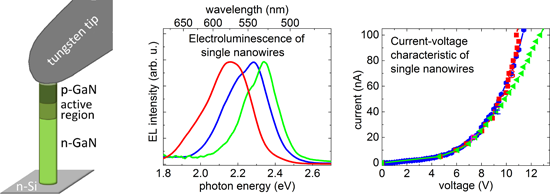
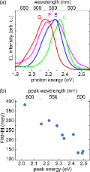
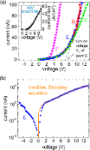
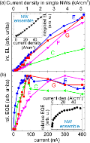
- with increasing current densities as shown for spectrum C is similar to what we recently observed analyzing single-NW spots in top-view EL maps of a comparably processed NW-ensemble LED [7]. By modeling strain, electric field, and charge carrier density inside the active region of a single-NW LED, it