


Search results
Search for "laser" in Full Text gives 905 result(s) in Beilstein Journal of Nanotechnology. Showing first 200.
CdSe/ZnS quantum dots as a booster in the active layer of distributed ternary organic photovoltaics
Beilstein J. Nanotechnol. 2024, 15, 144–156, doi:10.3762/bjnano.15.14
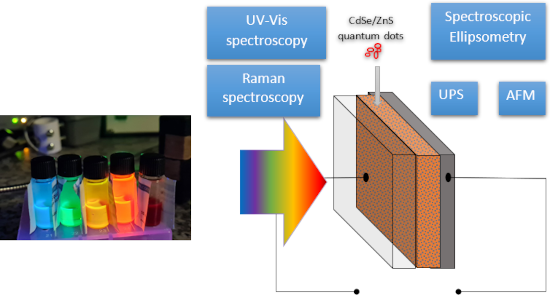
- monocrystalline silicon. A WITec Alpha 300 M+ spectrometer with a 488 nm laser, 600 groove grating, and a 100× ZEISS objective was used for Raman measurements. The samples were deposited on a glass substrate. Ultraviolet photoelectron spectroscopy (UPS) was conducted in an ultrahigh-vacuum chamber with a base
- ultraviolet with a small exponentially decreasing band up to 500–600 nm (Figure 2). The absorption band maximum is about 260 nm in the solid state (quartz was used as reference) and 330 nm in chloroform solution. The photoluminescence spectra, excited by a 405 nm laser, are shown in Figure 3. This type of




Enhanced feedback performance in off-resonance AFM modes through pulse train sampling
Beilstein J. Nanotechnol. 2024, 15, 134–143, doi:10.3762/bjnano.15.13
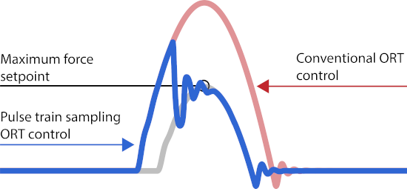
- to add a second piezo on the Z axis with a higher resonance frequency [23]. Another approach is direct actuation of the cantilever, as it typically possesses a higher resonance frequency [24][25][26]. In particular, photothermal actuation, which utilizes laser-induced heating of the cantilever, has


Development and characterization of potential larvicidal nanoemulsions against Aedes aegypti
Beilstein J. Nanotechnol. 2024, 15, 104–114, doi:10.3762/bjnano.15.10
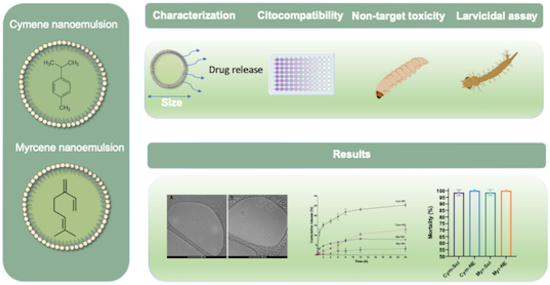
- were evaluated over a period of 60 days using dynamic light scattering, and the zeta potential was determined via electrophoretic mobility in a Zetasizer 3000 HSA (Malvern Instruments) device, using a 10 mW HeNe laser operated at 633 nm with a detection angle of incidence of 173° at 25 °C. Data
- analysis was performed in automatic mode. The NEs were diluted in deionized water (1:25) before the analysis. Nanoparticle tracking analysis Nanoparticle tracking analysis was performed in a NanoSight NS300 (Malvern Instruments, United Kingdom) apparatus equipped with a sample chamber and a 638 nm laser


Fluorescent bioinspired albumin/polydopamine nanoparticles and their interactions with Escherichia coli cells
Beilstein J. Nanotechnol. 2023, 14, 1208–1224, doi:10.3762/bjnano.14.100
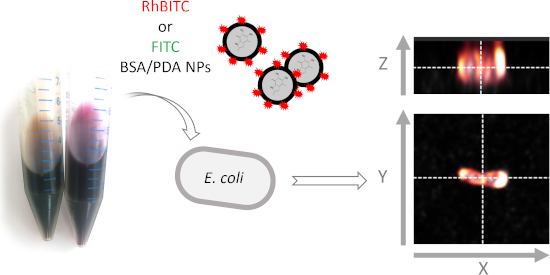
- at excitation and emission wavelengths corresponding to FITC and RhBITC dyes. It was also impossible to identify the specific fluorescent signal emitted by Ox-BSA/PDA NPs in absence of an adequate laser for the excitation of Ox-BSA/PDA NPs at 285 nm. Under excitation with a higher wavelength (405 nm
- obtained with the high-resolution confocal laser scanning microscope (CLSM, Stellaris 5, Leica Biosystems, Wetzlar, Germany). In all experiments with dyes (FITC-BSA/PDA NPs, RhBITC-BSA/PDA NPs, free FITC, and free RhBITC in equivalent concentrations), the fluorescence signal related to RhBITC or FITC was
- , close to the wavelength of the laser used in the device (633 nm). Samples were diluted to get an absorption below 0.1. Size distribution results are given in intensity and can be expressed also in volume or number. Standard deviations of the sample’s mean hydrodynamic diameters as well as the



Hierarchically patterned polyurethane microgrooves featuring nanopillars or nanoholes for neurite elongation and alignment
Beilstein J. Nanotechnol. 2023, 14, 1157–1168, doi:10.3762/bjnano.14.96
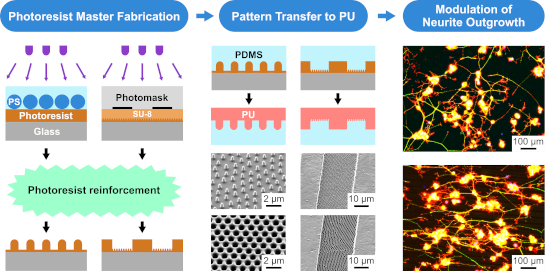
- microenvironment. While several of these focused on stem cell differentiation [9][10], a couple of studies explored their effects on axonal guidance. Lee et al. [11] found that nanorough microridges composed of laser-patterned Al/Al2O3 nanowires increase cell attachment and effectively guide dorsal root ganglia
- fabrication. For instance, traditional techniques, such as electron-beam lithography, laser writing, and cleanroom photolithography, have flexibility in design but require costly equipment [13][14]. Relatively cheaper techniques, such as anodization, electroplating, and electrospinning, are limited by the


A multi-resistance wide-range calibration sample for conductive probe atomic force microscopy measurements
Beilstein J. Nanotechnol. 2023, 14, 1141–1148, doi:10.3762/bjnano.14.94
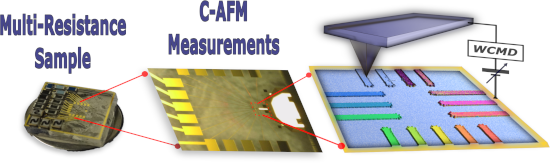
- voltage of +1 V). The origin of I–V curves not going through zero is commonly associated with photovoltaic effects, which was indeed validated by the disappearance of this observation when the laser of the AFM setup was switched off. Although, a photovoltaic effect might be intriguing in current
- core. Thus, the photovoltage effect observed in our paper is solely related to the tip apex and does not depend on the measured sample. We were able to confirm this aspect by running I–V curves using new probes with intact apexes, which showed no shift around zero even with the AFM laser on. This
- the resistance reference (reported in Table 1) and the measurement repeatability. In the insert, the products Ioffset·Ri are given in millivolts, where Ioffset denotes the current offset observed at zero bias voltage on the I–V curves, when the AFM laser is turned on (full circles) and off (full


Dual-heterodyne Kelvin probe force microscopy
Beilstein J. Nanotechnol. 2023, 14, 1068–1084, doi:10.3762/bjnano.14.88
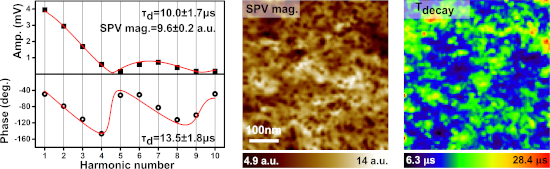
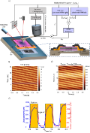
- modulation (period 2π/ωmod, duty ratio fixed at the user convenience), which is used to pump the sample (via a digital modulated laser source, or a direct electrical connection to the sample for tests under electrical pumping). The second channel generates a sinusoidal reference signal at nωmod. The
- + 180° (n_1 sidebands). An external fibre-coupled laser source (Omicron Laserage, PhoxX+ at 515 nm) was used for sample illumination through an optical viewport of the UHV AFM chamber. Samples can be illuminated either from the front or from the back using sample holders with on-board mirrors [3]. The
- latter configuration is used in the case of organic BHJ thin films (processed on transparent substrates, i.e., glass coated with indium thin oxide). The light intensity is adjusted using the laser power control and optical density filters. In the following, for each measurement, the optical power Popt




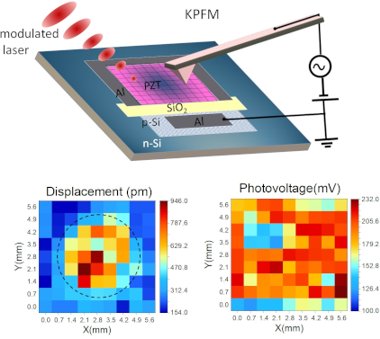
Spatial mapping of photovoltage and light-induced displacement of on-chip coupled piezo/photodiodes by Kelvin probe force microscopy under modulated illumination
Beilstein J. Nanotechnol. 2023, 14, 1059–1067, doi:10.3762/bjnano.14.87
- each function of the components on the overall motion behavior. A variety of characterization techniques, such as white light interferometry, laser Doppler vibrometry (LDV), and double-beam laser interferometry (DBLI) have been used to determine the displacement of piezoelectric membranes [9][10
- × 2.8) and (1.4 × 1.2) mm2 labeled as A, B, C, and D, respectively. In the process of fabrication, a 100 nm thick layer of LNO as the bottom electrode was first deposited, using pulsed laser deposition (PLD) technique, on a single crystal silicon wafer. Then, an 850 nm lead barium zirconia titanate
- the piezo/photodiode device. The device was illuminated from the top surface using a laser diode at a wavelength of 628 nm. The light source was installed inside the AFM chamber, and the light beam was aligned towards the active area of the device. The illumination source was modulated by a square


Recognition mechanisms of hemoglobin particles by monocytes – CD163 may just be one
Beilstein J. Nanotechnol. 2023, 14, 1028–1040, doi:10.3762/bjnano.14.85
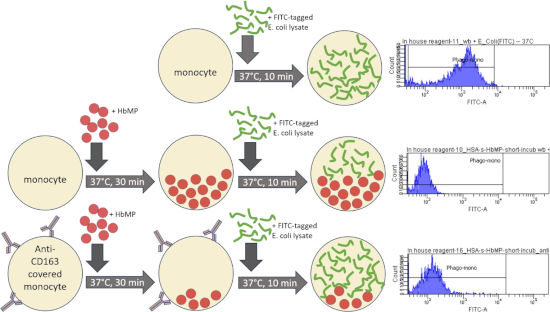
- ; N = 3. Different uptake of untagged E. coli (39.8 ± 11.4%) vs HbMP (30′: 51.9 ± 6.0%; 120′: 47.1 ± 5.1%) by monocytes; N = 3. Phagocytosis of PMMA-FluoroGreen-COOH-MP diameter between 0.4 and 2.1 µm by monocytes and granulocytes. N = 3. The confocal laser scanning microscopy image showing the uptake




A visible-light photodetector based on heterojunctions between CuO nanoparticles and ZnO nanorods
Beilstein J. Nanotechnol. 2023, 14, 1018–1027, doi:10.3762/bjnano.14.84
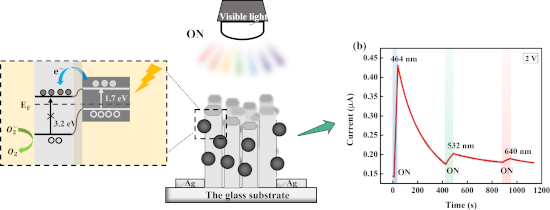
- development of many technologies in the future, such as solar cells [1][2], light-emitting diodes (LEDs) [3][4], laser diodes [5], and optical fibers [6]. Optoelectronics devices contribute to meeting requirements in telecommunications, medical equipment, sensors, and military services. Among those


Exploring internal structures and properties of terpolymer fibers via real-space characterizations
Beilstein J. Nanotechnol. 2023, 14, 1004–1017, doi:10.3762/bjnano.14.83
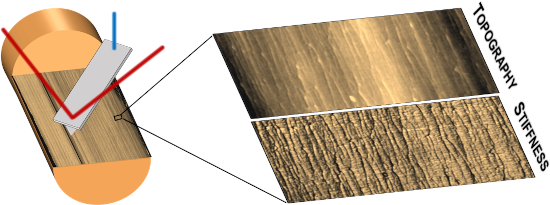
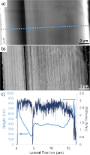
- . Dashed line highlights a shear plane between the two notches. The fiber readily opens along this plane, exposing internal fiber surfaces for characterization. (c) Multifrequency AFM schematic. A cantilever is driven by a blue laser that simultaneously excites the cantilever at its first and second






Nanoarchitectonics of photothermal materials to enhance the sensitivity of lateral flow assays
Beilstein J. Nanotechnol. 2023, 14, 988–1003, doi:10.3762/bjnano.14.82
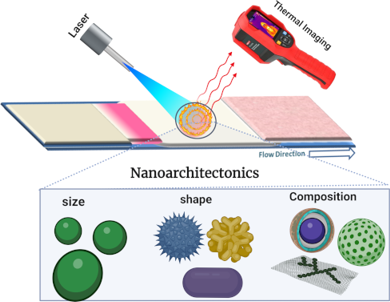
- technique to enhance the sensitivity of LFAs. In LFAs, the nanomaterials are deposited in the test zone along with the analyte to be determined. Upon laser irradiation, thermal energy is generated. The thermal output can be quantified using infrared thermal cameras or thermometers [25]. The quantity of heat
- maintained. Further, the development of a laser readout system to measure the signal intensity of the test line could potentially bring out the characteristic feature of POCT [10]. To establish a correlation between the nanoscale architecture and the optical properties of materials in order to enhance the
- (PCE). However, studies report that gold nanorods suffer from poor photostability, and loss of shape and NIR LSPR upon laser irradiation [39]. By using palladium nanostructures, photothermal stability could be achieved to some extent as they did not change their shape upon laser irradiation. Palladium


Isolation of cubic Si3P4 in the form of nanocrystals
Beilstein J. Nanotechnol. 2023, 14, 971–979, doi:10.3762/bjnano.14.80
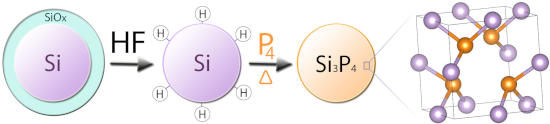
- inclusions in Si wafers implanted with P+ ions and laser-annealed at temperatures of 450–850 °C [2]. Recently, NPs of elemental compositions close to SiP and SiP2 have been observed in thermal annealing products of non-stoichiometric silicon oxide containing high amounts of phosphorus introduced during the
- Si3P4 phase. Also worth noting was that the synthesis of cubic Si3P4 NPs could be performed immediately after laser-induced or plasma-enhanced chemical vapor deposition of nanosilicon from the silane precursor (since the NPs obtained this way are readily hydrogenated). Additionally, there is preliminary
- (reagent grade) were used for sol preparation; 40% hydrofluoric acid (pure) was used for etching. Si NPs were synthesized by laser-induced chemical vapor deposition using a silane precursor (the average particle diameter was 20 nm [41]). The NPs oxidized when stored in air, and the resultant mass fraction


N-Heterocyclic carbene-based gold etchants
Beilstein J. Nanotechnol. 2023, 14, 865–871, doi:10.3762/bjnano.14.71
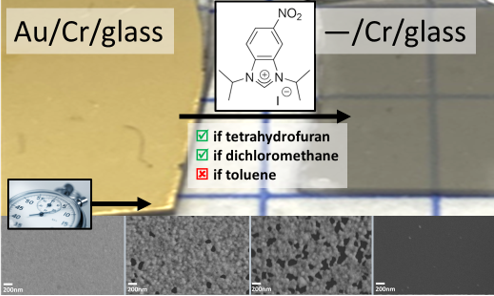
- using the EDS software AZtec from Oxford Instruments (Concord, MA, USA). Gold nanoparticles were synthesized following a modified Fren’s method [33]. Raman spectra were collected using a Snowy Range Instruments Sierra 2.0 spectrometer with laser excitation at 785 nm at a laser power of 74.1 mW and an



Industrial perspectives for personalized microneedles
Beilstein J. Nanotechnol. 2023, 14, 857–864, doi:10.3762/bjnano.14.70
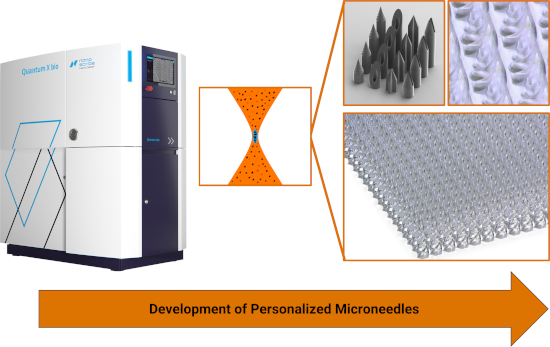
- ) can add up to 50,000+ USD, and this price does not include the femtosecond laser or anti-vibration systems. Custom-built 2PP systems also require extensive optical expertise for the initial installation and are typically a major milestone for several doctoral students. In general, custom-built 2PP
- Quantum X platform that commercialized maskless grayscale lithography for microoptics made via 2PP, a process called “Two-Photon Grayscale Lithography” (2GL®) [59][60]. 2GL® differs from traditional 2PP and 1PP lithography because the laser or exposure dosage in individual voxels is controlled in three


Biomimetics on the micro- and nanoscale – The 25th anniversary of the lotus effect
Beilstein J. Nanotechnol. 2023, 14, 850–856, doi:10.3762/bjnano.14.69

- structure was quantitatively described with confocal laser scanning microscopy and a surface analysis software. The data show a polar development of cuticular ridges and a basipetal ridge progression during leaf ontogeny. Traction experiments with Colorado potato beetles as model species showed low walking
- solid understanding of industrial processes, complex structured biomimetic inventions can indeed be effectively brought to the market. Lifka et al. [14] stick to the nanofibre and production topics in their paper “Laser-processed antiadhesive bionic combs for handling nanofibers inspired by


Silver-based SERS substrates fabricated using a 3D printed microfluidic device
Beilstein J. Nanotechnol. 2023, 14, 793–803, doi:10.3762/bjnano.14.65
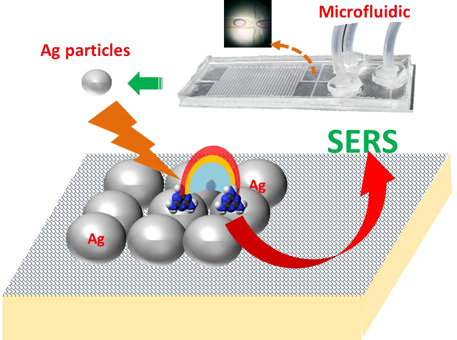
- [30]; also, it does not require a clean room. The stereolithography (SLA) technique is an additive manufacturing technique in which a photopolymer resin is cured and converted from a liquid to a solid by an ultraviolet laser. The resolution of SLA printers is determined by the radial beam scattering
- monolayer of Ag NPs appeared at the methanol/air interface. The PS@Ag substrates were created by depositing a monolayer of Ag NPs on the substrate surface after allowing the methanol to slowly evaporate under ambient conditions. SERS substrate characterization Raman spectra were obtained using a 24 mW laser
- with the analyte solution (30 µL) and air-dried at room temperature. SERS signals were then collected from random locations. Results and Discussion Fabrication of droplet-based microfluidic device using 3D printing SLA 3D printing is an additive manufacturing technology that employs a laser to



Cross-sectional Kelvin probe force microscopy on III–V epitaxial multilayer stacks: challenges and perspectives
Beilstein J. Nanotechnol. 2023, 14, 725–737, doi:10.3762/bjnano.14.59
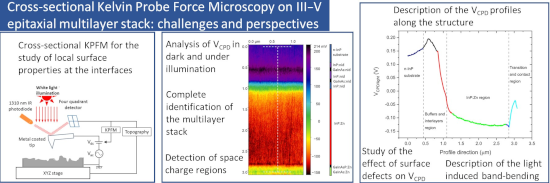
- crosstalk [17]. The laser beam deflection system in our AFM employs a laser wavelength of 1310 nm, which is well below the bandgap of our sample; therefore, the parasitic laser absorption, which may interfere with the KPFM measurement, is reduced to negligible levels [13]. Highly doped n+-Si ARROW EFM tips


A graphene quantum dots–glassy carbon electrode-based electrochemical sensor for monitoring malathion
Beilstein J. Nanotechnol. 2023, 14, 701–710, doi:10.3762/bjnano.14.56
- room temperature, an AIRIX STR 500 laser Raman spectrometer was used with Ar laser excitation at 532 nm. A Panalytical X-Pert Pro diffractometer with Cu Kα radiation (λ = 1.5418 Å) was used for investigating the structural properties of GQDs. Morphology and size of GQDs were confirmed with data


Investigations on the optical forces from three mainstream optical resonances in all-dielectric nanostructure arrays
Beilstein J. Nanotechnol. 2023, 14, 674–682, doi:10.3762/bjnano.14.53
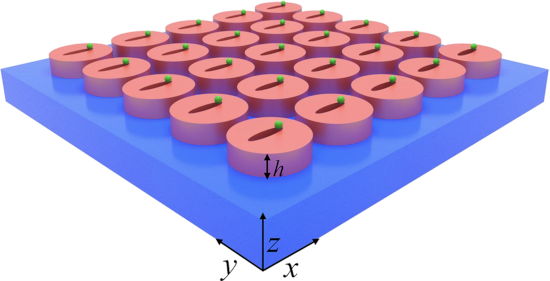
- strong laser beam generates a piconewton level of force, which can be used to manipulate small dielectric particles, including biological entities such as DNA, enzymes, and cells. The underlying physics of nanoparticle manipulation by optical tweezers can be interpreted as the trend of the particle to
- force is dependent on the laser power, we should note that the light transmission spectra through the array is not if the nonlinear effect is ignored. So in the calculations of the transmission spectra and the on-resonance field distributions, the electric field magnitude of the incident plane wave is
- due to a higher Q-factor (2.5 × 10⁵) and the associated much stronger electric field enhancement (837 times) with the quasi-BIC mode. The results show that even at a relatively low laser power intensity, the PS sphere located in the metasurface supporting the quasi-BIC resonance will be subjected to a


Titania nanoparticles for photocatalytic degradation of ethanol under simulated solar light
Beilstein J. Nanotechnol. 2023, 14, 616–630, doi:10.3762/bjnano.14.51
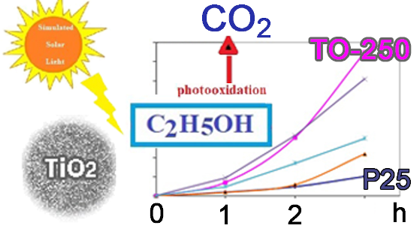
- -Magurele, Romania National Institute of Materials Physics, Atomistilor Str., No. 405A, 077125, Bucharest-Magurele, Romania Romanian Academy, Inst. Phys. Chem. Ilie Murgulescu, 202 Spl. Independentei, 060021, Bucharest, Romania 10.3762/bjnano.14.51 Abstract TiO2 nanoparticles were synthesized by laser
- gas production has been detected for the samples from series “b”, whereas the CO2 evolution was observed for all samples from series “a”. Keywords: ethanol; H2 production; laser pyrolysis; photocatalyst; TiO2 nanoparticles; Introduction Semiconductor materials are widely used, from electronic
- productivity, which are in some cases extremely low compared to a continuous flow method such as laser pyrolysis which, in the case of the studied powders, allows for a productivity of 1 g/h with the possibility of upscaling to an industrial level by increasing the reaction area. Another point is to find the




Suspension feeding in Copepoda (Crustacea) – a numerical model of setae acting in concert
Beilstein J. Nanotechnol. 2023, 14, 603–615, doi:10.3762/bjnano.14.50
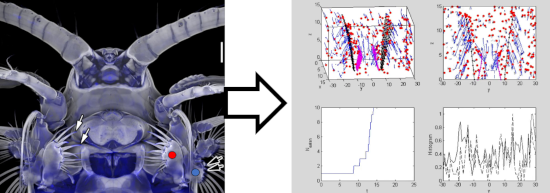
- field of filtration technologies. Keywords: adhesion; confocal laser scanning microscopy (CLSM); feeding efficiency; feeding structures; mechanical properties; Introduction Particle capture mechanisms are common in a huge variety of aquatic animals, such as polychaetes, bryozoans, bivalves, sponges
- chose the copepod Centropages hamatus (Lilljeborg, 1853). This species belongs to the Calanoida, where filter feeding is the derived condition [19][20][29][42][43][44][45][46][47][48][49][50][51][52][53][54]. For this species (Figure 1), previous confocal laser scanning microscopy (CLSM) studies on the
- -periodic (“strange attractor”) motion self-organized in the system, which could be easily analyzed statistically. Besides, one can vary the parameters of the model equation and obtain similar kinds of behavior. Confocal laser scanning micrograph (maximum intensity projection) showing the exoskeleton of a


SERS performance of GaN/Ag substrates fabricated by Ag coating of GaN platforms
Beilstein J. Nanotechnol. 2023, 14, 552–564, doi:10.3762/bjnano.14.46
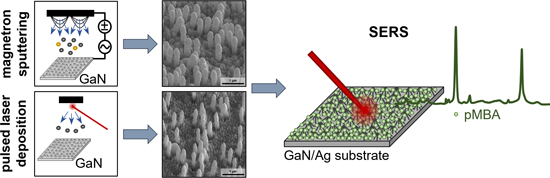
- substrates using pulsed laser deposition (PLD) and magnetron sputtering (MS) and their evaluation as potential substrates for surface-enhanced Raman spectroscopy (SERS) are reported. Ag layers of comparable thicknesses were deposited using PLD and MS on nanostructured GaN platforms. All fabricated SERS
- : GaN/Ag; magnetron sputtering; nanofabrication; pulsed laser deposition; SERS substrates; surface-enhanced Raman spectroscopy (SERS); Introduction Surface-enhanced Raman spectroscopy (SERS) is a highly sensitive and specific technique with multiplexing capabilities [1][2][3][4]. It is considered for
- physical vapor deposition (PVD) methods have been tested to replace MS in coating GaN platforms with plasmonic metals. Pulsed laser deposition (PLD) is an interesting and still not fully explored alternative for the fabrication of SERS substrates [37][38]. Hence, our studies reported herein aimed to


Observation of multiple bulk bound states in the continuum modes in a photonic crystal cavity
Beilstein J. Nanotechnol. 2023, 14, 544–551, doi:10.3762/bjnano.14.45
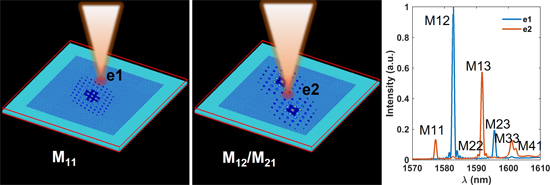
- high-power pulsed laser is applied to obtain stronger signals, thus making the resonance feature more obvious in the spectrum. However, high intensity of direct reflection caused by the pulsed laser could not be totally filtered out with the PBS and, therefore, a pronounced background intensity profile
- of the setup to test the scattering field of a small cavity could be steps for further studies. Mode excitation efficiency and illumination position dependence enable laser mode modulation in photonic-crystal surface-emitting lasers (PCSELs) [17][41][42][43], as well as the control of the radiation


On the use of Raman spectroscopy to characterize mass-produced graphene nanoplatelets
Beilstein J. Nanotechnol. 2023, 14, 509–521, doi:10.3762/bjnano.14.42
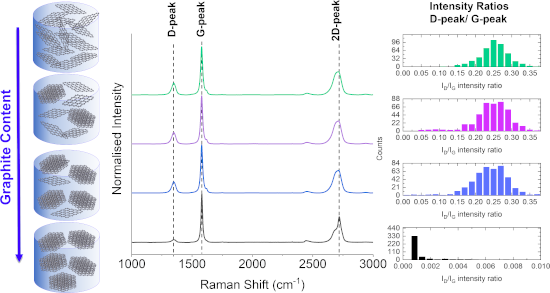
- . Raman spectra of the filtered films on the membrane were recorded using a Renishaw Qontor confocal spectrometer (Renishaw plc., UK) using a 532 nm excitation laser and a 2400 L/mm grating. An area of 20 μm × 20 μm of the film was mapped, with 1 μm distance between measurement locations. Spectra were
- that the sediment component is present in discrete particles, which are significantly larger than the GNP particles and generally larger than the laser spot size (above 1 μm with 100× objective lens). Due to the larger size and thickness of the sediment particles compared to the GNP particles, a given





