


Search results
Search for "transition metal" in Full Text gives 244 result(s) in Beilstein Journal of Nanotechnology. Showing first 200.
Improved catalytic combustion of methane using CuO nanobelts with predominantly (001) surfaces
Beilstein J. Nanotechnol. 2018, 9, 2526–2532, doi:10.3762/bjnano.9.235
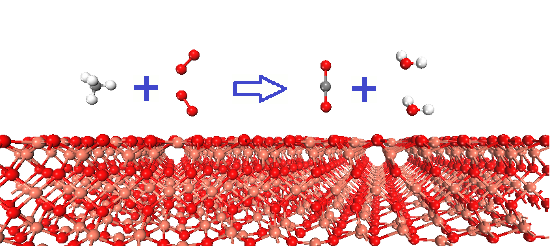
- , such as transition metal (TM) oxides and various complex structures (e.g., perovskite, spinel and hexaaluminate) have been tested as catalysts for CH4 oxidation. But so far their performance is still much lower than noble metals. An ideal catalyst for CH4 oxidation should have a high capacity to adsorb


Thickness-dependent photoelectrochemical properties of a semitransparent Co3O4 photocathode
Beilstein J. Nanotechnol. 2018, 9, 2432–2442, doi:10.3762/bjnano.9.228
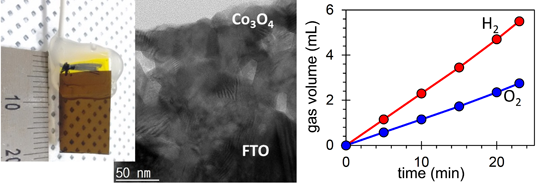
- ][43], and the third is the combination with a catalyst such as NiMo and transition-metal dichalcogenide 2D materials [43][44]. Conclusion We fabricated porous, semitransparent Co3O4 working electrodes of varying thickness using Kirkendall diffusion thermal oxidation in air. The thickness-dependent




Light–Matter interactions on the nanoscale
Beilstein J. Nanotechnol. 2018, 9, 2125–2127, doi:10.3762/bjnano.9.201

- , such as transition-metal dichalcogenides (TMDCs) or hexagonal boron nitride (hBN) [10] have also emerged as interesting platforms for nanophotonics. TMDCs, with their intrinsically broken inversion symmetry in crystal structure, have shown many advanced optical properties with potential applications
Synthesis of rare-earth metal and rare-earth metal-fluoride nanoparticles in ionic liquids and propylene carbonate
Beilstein J. Nanotechnol. 2018, 9, 1881–1894, doi:10.3762/bjnano.9.180
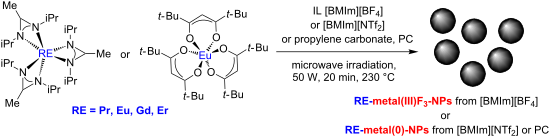
- also abstract fluoride from [BF4]− anions. ILs are not only solvents but can also be reactants, e.g., [BMIm][PF6] in the synthesis of A2SiF6 nanoparticles (A = Li, Na, K, Rb, Cs) [46], in the synthesis of MFx nanoparticles (M = Mn, Fe, Co, Pr, Eu) from the decomposition of transition-metal amidinates


Improving the catalytic activity for hydrogen evolution of monolayered SnSe2(1−x)S2x by mechanical strain
Beilstein J. Nanotechnol. 2018, 9, 1820–1827, doi:10.3762/bjnano.9.173
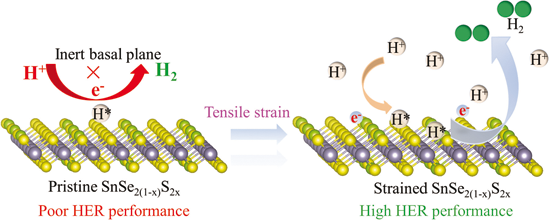
- hydrogen. Two-dimensional (2D) atomic layer thin materials, such as monolayer transition-metal dichalcogenides (TMDs) [11][12][13][14][15][16][17][18][19], have demonstrated many fascinating properties, including the substitution of Pt as an electrocatalyst for HER. 2D MoS2 has been widely studied
- tuned by strain engineering. Results and Discussion 2D monolayer TMD is a three-atomic thickness structure with one transition-metal atom layer sandwiched by two chalcogen atom layers. A triangular prism or octahedron can be formed as the transition-metal atom is bonded with six chalcogen atoms, and the


Uniform cobalt nanoparticles embedded in hexagonal mesoporous nanoplates as a magnetically separable, recyclable adsorbent
Beilstein J. Nanotechnol. 2018, 9, 1770–1781, doi:10.3762/bjnano.9.168
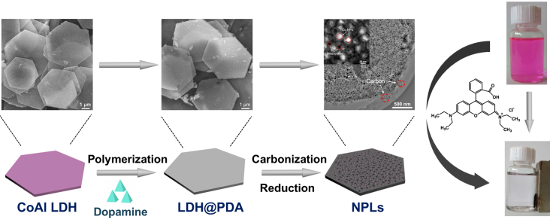
- number of researches have demonstrated that carbon-based nanocomposites can serve as effective adsorbents for wastewater purification [6][7][8][9]. The introduction of transition metal nanoparticles into a mesoporous carbon matrix to form transition-metal-loaded mesoporous carbon nanocomposites (TM-MCNs


Free-radical gases on two-dimensional transition-metal disulfides (XS2, X = Mo/W): robust half-metallicity for efficient nitrogen oxide sensors
Beilstein J. Nanotechnol. 2018, 9, 1641–1646, doi:10.3762/bjnano.9.156
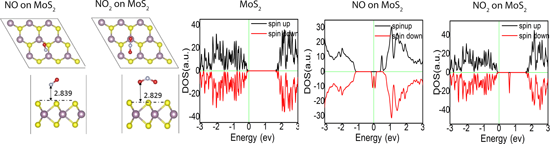
- observed after the adsorption of other free radical gases such as NO2. The unique change in electronic properties after the adsorption of NO on transition-metal sulfides highlights an effective strategy to distinguish NO from other gas species by experimentally measuring spin-resolved transmission. Our


Cr(VI) remediation from aqueous environment through modified-TiO2-mediated photocatalytic reduction
Beilstein J. Nanotechnol. 2018, 9, 1448–1470, doi:10.3762/bjnano.9.137
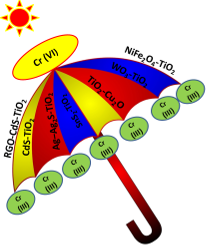
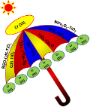
- . This also enhances the light absorption range towards longer wavelengths. The band edge potentials and band gaps of different semiconductor oxides and sulfides are given in Figure 2. Photocatalytic reduction of Cr(VI) over TiO2 modified with simple transition metal oxides under UV irradiation
- Transition metal oxides such as ZnO have been combined with TiO2 to form composite photocatalysts, which are used efficiently for photocatalytic reduction of Cr(VI). ZnO has been recognized as a potential photocatalyst for extensive environmental applications because of its availability and low cost. It also
- the nonsupported bulk TiO2 as well as calcined Fe3O4. In fact, 30% TiO2/Fe3O4 has shown the highest Cr(VI) photoreduction rate due to formation of effective heterojunction by the loading of 30% TiO2 over Fe3O4 [158]. Visible-light responsive, transition metal oxide modified TiO2 for photocatalytic


Electrodeposition of reduced graphene oxide with chitosan based on the coordination deposition method
Beilstein J. Nanotechnol. 2018, 9, 1200–1210, doi:10.3762/bjnano.9.111
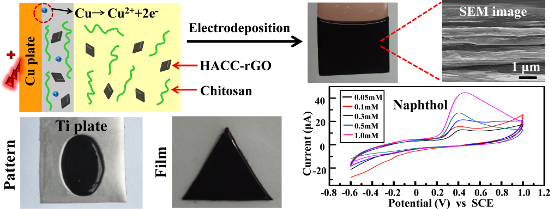
- plate. Chitosan possesses the capability to coordinate to transition metal ions (e.g., Cu2+ and Ag+ ions). This coordination capability is related to the existence of amino groups in chitosan. Consequently, chitosan molecules close to the copper plate are able to coordinate to these Cu2+ ions to form a


Review on nanoparticles and nanostructured materials: history, sources, toxicity and regulations
Beilstein J. Nanotechnol. 2018, 9, 1050–1074, doi:10.3762/bjnano.9.98



Valley-selective directional emission from a transition-metal dichalcogenide monolayer mediated by a plasmonic nanoantenna
Beilstein J. Nanotechnol. 2018, 9, 780–788, doi:10.3762/bjnano.9.71
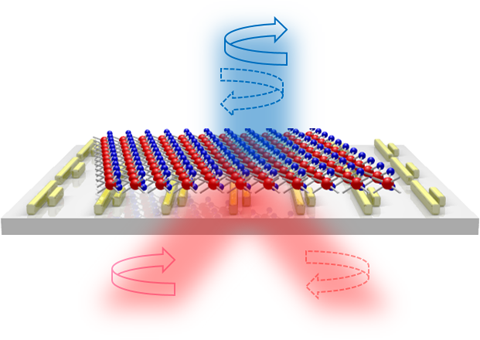
- 10.3762/bjnano.9.71 Abstract Background: Two-dimensional (2D) transition-metal dichalcogenides (TMDCs) with intrinsically crystal inversion-symmetry breaking have shown many advanced optical properties. In particular, the valley polarization in 2D TMDCs that can be addressed optically has inspired new
- structure. Conclusion: The scheme we propose here can potentially serve as an important component for valley-based applications, such as non-volatile information storage and processing. Keywords: 2D materials, multipolar emission; nanoantenna; plasmonic; transition-metal dichalcogenides; valley


Surface-plasmon-enhanced ultraviolet emission of Au-decorated ZnO structures for gas sensing and photocatalytic devices
Beilstein J. Nanotechnol. 2018, 9, 771–779, doi:10.3762/bjnano.9.70
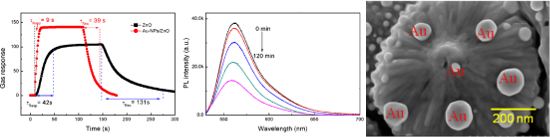
- . Keywords: Au-decorated ZnO; carrier dynamics; gas sensors; photocatalyst; SPR effect; Introduction Inorganic transition metal oxide sensor devices have attracted attention in particular for improving gas sensing, energy conversion, electronics, photocatalysis and optoelectronic devices [1][2][3][4]. Among




Dynamics and fragmentation mechanism of (C5H4CH3)Pt(CH3)3 on SiO2 surfaces
Beilstein J. Nanotechnol. 2018, 9, 711–720, doi:10.3762/bjnano.9.66
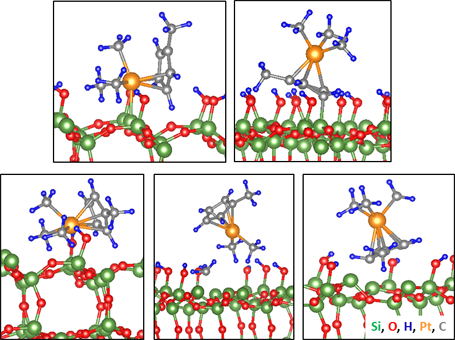
- ); focused electron beam induced deposition (FEBID); precursor; trimethyl(methylcyclopentadienyl)platinum(IV) ((CH3-C5H4)Pt(CH3)3); Introduction Nanoscale device applications require a growth of regular or specially patterned transition metal nanodeposits. Electron beam induced deposition (EBID), is a size




Sensing behavior of flower-shaped MoS2 nanoflakes: case study with methanol and xylene
Beilstein J. Nanotechnol. 2018, 9, 608–615, doi:10.3762/bjnano.9.57
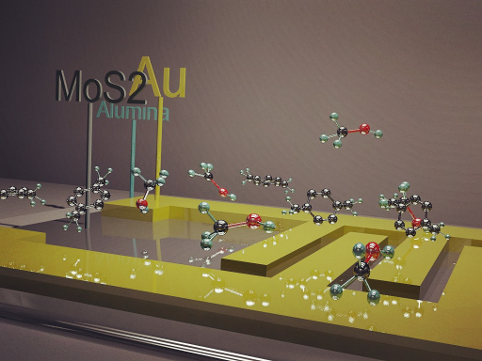
- emerging new group of materials known as transition metal dichalcogenides (TMDs), which have significant electrical, optical, and transport properties. MoS2 is one of the well-known 2D materials in this group, which is a semiconductor with controllable band gap based on its structure. The hydrothermal
- functional theory; gas sensor; hydrothermal method; methanol; MoS2 nanoflakes; xylene vapor; Introduction Recent efforts in exploring two-dimensional (2D) materials have led to the introduction of a new family of materials known as transition metal dichalcogenides (TMDs), which show remarkable electrical
- , optical and transport properties [1][2][3][4][5][6][7][8][9][10][11][12][13]. TMDs are a group of materials with the general formula MX2, where M is a transition metal element of group IV, V or VI, and X is a chalcogen (S, Se, or Te) [1][2][3][4][5][6][7][8][9][10][11][12][13]. Their properties, including


Facile synthesis of ZnFe2O4 photocatalysts for decolourization of organic dyes under solar irradiation
Beilstein J. Nanotechnol. 2018, 9, 436–446, doi:10.3762/bjnano.9.42
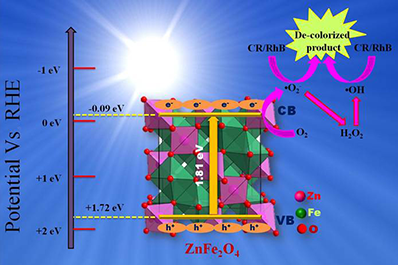
- ]. It is important to develop a suitable environmentally friendly material that can absorb the full range of the solar spectrum for solving energy and environmental challenges. Since last decade, ternary transition metal oxides (TTMOs) have gained tremendous popularity in the field of photocatalysis by
- the scientific community. To exploit solar light more efficiently, photocatalysts with narrow band gap (e.g., ZnSnO3 [2], Bi2WO6 [3], Ce(MoO4)2 [4] and ZnFe2O4 [5]) have been used, for absorbance of solar light in the visible region. Among ternary metal oxides, transition metal ferrites have drawn a


Review: Electrostatically actuated nanobeam-based nanoelectromechanical switches – materials solutions and operational conditions
Beilstein J. Nanotechnol. 2018, 9, 271–300, doi:10.3762/bjnano.9.29
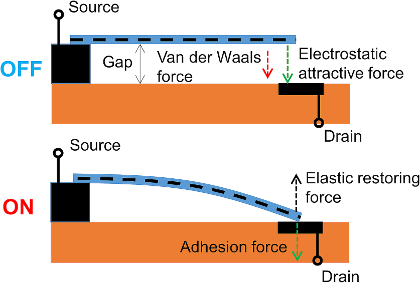
- nanowires’ surface [10][13]. Molybdenum–sulfur–iodine: Excellent functional properties of nanowires based on transition metal chalcogenide-halides, combined with easy synthesis and intrinsic absence of impurities make them attractive NEM switch elements. The properties of these materials include high


Synthesis and characterization of electrospun molybdenum dioxide–carbon nanofibers as sulfur matrix additives for rechargeable lithium–sulfur battery applications
Beilstein J. Nanotechnol. 2018, 9, 262–270, doi:10.3762/bjnano.9.28
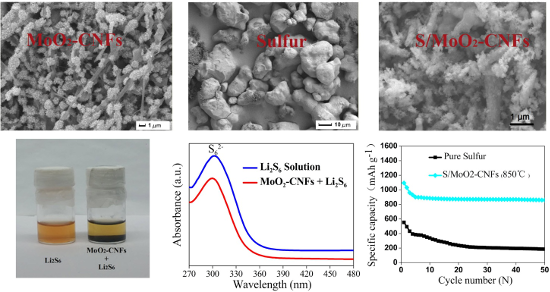
- . Molybdenum dioxide (MoO2) materials are particularly attractive among the transition-metal oxides due to their high melting point, high chemical stability and low electrical resistivity (190 S cm−1). This material has great potential for applications in several fields such as sensing, catalysis


The rational design of a Au(I) precursor for focused electron beam induced deposition
Beilstein J. Nanotechnol. 2017, 8, 2753–2765, doi:10.3762/bjnano.8.274
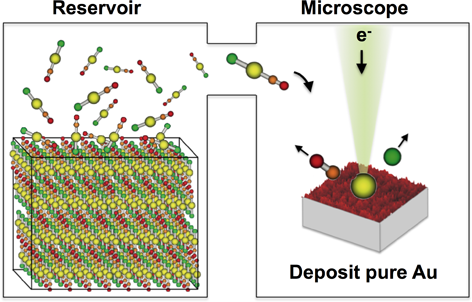
- . The bond between Au (or any other transition metal) and CO is historically explained by the synergistic backbonding model (Figure 3a) [53]. The free electron pair of the C atom can be donated into an empty orbital of the metal. Vice versa, electrons from partially filled d-orbitals can be donated back


Ab initio study of adsorption and diffusion of lithium on transition metal dichalcogenide monolayers
Beilstein J. Nanotechnol. 2017, 8, 2711–2718, doi:10.3762/bjnano.8.270
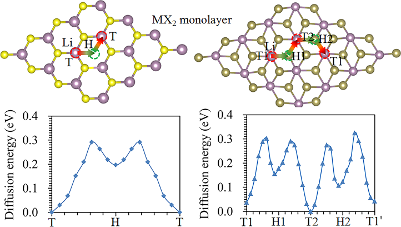
- Xiaoli Sun Zhiguo Wang School of Physical Electronics, University of Electronic Science and Technology of China, Chengdu, 610054, P.R. China 10.3762/bjnano.8.270 Abstract Using first principles calculations, we studied the stability and electronic properties of transition metal dichalcogenide
- monolayers explored in this work can be used as promising anode materials for lithium ion batteries. Keywords: anode materials; lithium adsorption; lithium diffusion; lithium ion batteries; transition metal dichalcogenide; Introduction Lithium ion batteries (LIBs) have been widely used in portable
- for LIBs [2][3][4][5][6][7][8]. Two-dimensional transition metal dichalcogenides, MX2 (where M and X correspond to transition metal and chalcogen atoms, respectively), have been synthesized using different strategies, such as exfoliation [9][10], physical vapour deposition [11] and chemical vapour


One-step chemical vapor deposition synthesis and supercapacitor performance of nitrogen-doped porous carbon–carbon nanotube hybrids
Beilstein J. Nanotechnol. 2017, 8, 2669–2679, doi:10.3762/bjnano.8.267
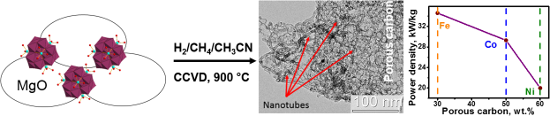
- and porous carbon on the surface of MgO impregnated with bimetallic (transition metal/molybdenum) catalyst precursors. Acetonitrile was added to the methane feedstock to incorporate nitrogen into the graphitic network, which is beneficial for the electrochemical performance of the carbon materials [21
- ]. With the purpose to study the effect of the nature of the transition metal on the nitrogen content and the structure of the porous carbon–MWCNT hybrid, we used cluster-type polyoxomolybdates of Co, Ni, and Fe as catalyst precursors. In earlier work, we have shown that the thermal decomposition of such
- carbon [2]. Conclusion Nitrogen-doped porous carbon/MWCNT hybrid materials were synthesized using cluster molecules containing molybdenum and transition metal as a source of catalytic nanoparticles for the CCVD synthesis. The cluster molecules were distributed over a MgO support before oxidation in air


Adsorption of iron tetraphenylporphyrin on (111) surfaces of coinage metals: a density functional theory study
Beilstein J. Nanotechnol. 2017, 8, 2484–2491, doi:10.3762/bjnano.8.248
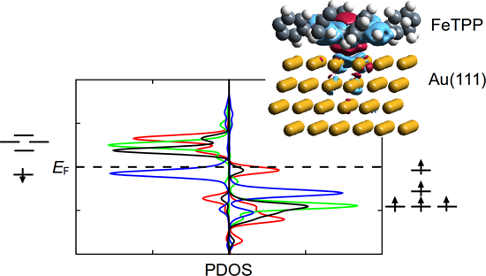
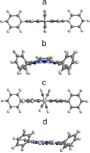
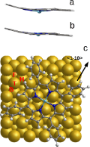
- spin switches. Keywords: activation barrier; density functional theory; iron tetraphenylporphyrin; spin switch; spin states; Introduction Porphyrins, phthalocyanines and their transition-metal (TM) complexes are largely investigated in surface science as reported in detail by Gottfried [1]. The




Synthesis of metal-fluoride nanoparticles supported on thermally reduced graphite oxide
Beilstein J. Nanotechnol. 2017, 8, 2474–2483, doi:10.3762/bjnano.8.247
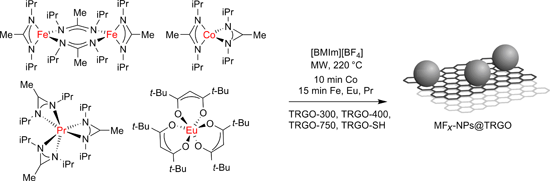
- , 35392 Gießen, Germany 10.3762/bjnano.8.247 Abstract Metal-fluoride nanoparticles, (MFx-NPs) with M = Fe, Co, Pr, Eu, supported on different types of thermally reduced graphite oxide (TRGO) were obtained by microwave-assisted thermal decomposition of transition-metal amidinates, (M{MeC[N(iPr)]2}n) or [M
- heterogeneous nanocatalysts [55][56]. Transition-metal-fluoride nanoparticles are applied, for example, as cathode materials in lithium-ion batteries for vehicles and other mobile devices [57]. In this field, the modification of lithium–transition-metal electrodes is a very important issue to improve the
- functionalities. Results and Discussion Transition-metal amidinates [M(AMD)n; M = Fe(II), Co(II), Pr(III)] as well as Eu(dpm)3 were dissolved or suspended under nitrogen atmosphere in the dried and deoxygenated ionic liquid together with the selected type of thermally reduced graphene oxide (TRGO). Complete


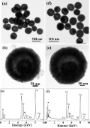
Fabrication of CeO2–MOx (M = Cu, Co, Ni) composite yolk–shell nanospheres with enhanced catalytic properties for CO oxidation
Beilstein J. Nanotechnol. 2017, 8, 2425–2437, doi:10.3762/bjnano.8.241
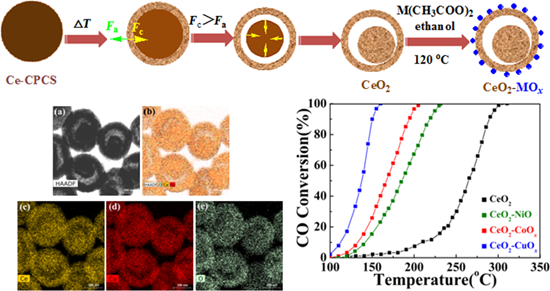
- transition-metal mixed-oxide nanostructures. Based on this synthesis method, other CeO2-based composite oxides with various nanostructures can be expected to be fabricated through the pre-formation of CeO2 or CeO2-based solid solution with different morphologies and the subsequent decoration of highly
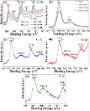
- dispersed transition-metal oxide cluster species. Information about crystallinity and phases of the samples were obtained from X-ray diffraction (XRD) analysis. Figure 6a displays the XRD patterns of the as-synthesized CeO2–MOx nanospheres. All diffraction peaks can be assigned to the fluorite-like cubic





Optical contrast and refractive index of natural van der Waals heterostructure nanosheets of franckeite
Beilstein J. Nanotechnol. 2017, 8, 2357–2362, doi:10.3762/bjnano.8.235
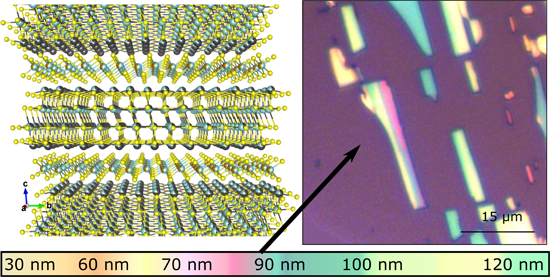
- that franckeite is a semiconductor with narrow band gap. Other 2D semiconductors, such as MoS2, present refractive indexes whose imaginary part vanishes within the visible region of the spectrum. Moreover, the refractive index of transition-metal dichalcogenides shows sharp features associated to the


Dissociative electron attachment to coordination complexes of chromium: chromium(0) hexacarbonyl and benzene-chromium(0) tricarbonyl
Beilstein J. Nanotechnol. 2017, 8, 2257–2263, doi:10.3762/bjnano.8.225
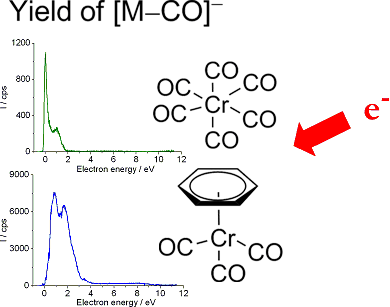
- ligands are removed has been previously reported for a series of transition-metal carbonyls [14][32]. It has also been suggested that such a behavior may be reminiscent of a successive removal of CO fragments in the cracking patterns of the negative ions. Hence, it is very likely that the [M(CO)x]− anions



