


Search results
Search for "damping" in Full Text gives 196 result(s) in Beilstein Journal of Nanotechnology.
Designing magnetic superlattices that are composed of single domain nanomagnets
Beilstein J. Nanotechnol. 2014, 5, 956–963, doi:10.3762/bjnano.5.109
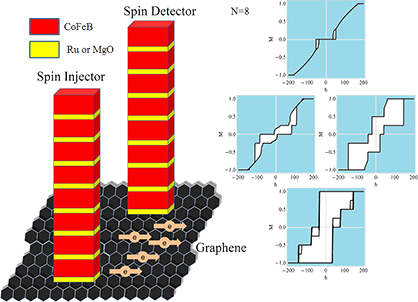
- Landau–Lifshitz–Gilbert (LLG) equation ([15][20][21]), where Heff,i is an effective field and γ is the gyromagnetic ratio. In the last term, the Gilbert damping, with damping parameter α, is incorporated into the model. Equation 6 is expanded as in [22] to find the evolution of the magnetization angles
- applied magnetic field Throughout we use the damping parameter equal to α = 0.01 and a large value of b (about 390) to confine the magnetic moments to move in the x–y-plane. We investigated nanomagnets with semi-major to semi-minor elliptical cross-sections of lx/ly ≈ 10. The external magnetic field in
- not have this transition. Both the AF1 and AF2 phases, however, have transitions that go from parallel states into scissored states [15]. The AF phases are quite robust at the levels of damping that occur in most CoFeB systems (α ≈ 0.01). The balance between the coupling strength J and anisotropy


Resonance of graphene nanoribbons doped with nitrogen and boron: a molecular dynamics study
Beilstein J. Nanotechnol. 2014, 5, 717–725, doi:10.3762/bjnano.5.84
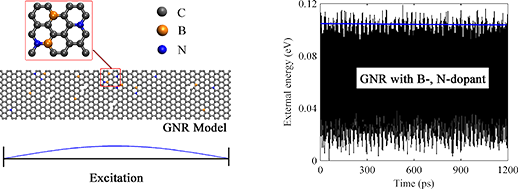
- average energy loss in one radian at the resonant frequency [30], i.e., Q = 2πE/ΔE, where E is the total energy of the vibrating system and ΔE is the energy dissipated by damping during one cycle of vibration. The value of Q is assumed as to be constant during vibration, which gives a relation between the
- maximum energy (En) and the initial maximum energy (E0) as En = E0(1 − 2π/Q)n after n vibration cycles [31]. Since an energy-preserving NVE ensemble is assumed during vibration and the simulation is under vacuum conditions, the damping will result from intrinsic loss only. Therefore, the loss of potential
- initial damping from 0.11 to ca. 0.09 eV at the early stage of vibration (within 300 ps). Afterwards, it saturates around 0.09 eV. The corresponding resonance frequency is estimated to be 107 GHz. Defective GNR with four vacancies Influence of B-dopant To further examine the influence of a combination of


Energy dissipation in multifrequency atomic force microscopy
Beilstein J. Nanotechnol. 2014, 5, 494–500, doi:10.3762/bjnano.5.57
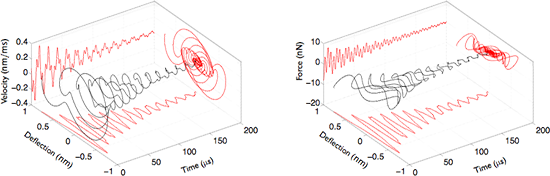
- individuate the excited modes that contribute to the dynamics, Figure 1C. 3) Each flexural mode is schematized as a damped harmonic oscillator (DHO), whose equation of motion is where i is the mode index, zi is the oscillation amplitude, γi is the damping coefficient and the resonance frequency [15
- energy calculated by a balance of potential and kinetic energy () and by integrating the dissipative forces (). Quality factors are derived as Qi = 2 πfi/γi, where the damping coefficient γi = 2/τi, see Table 2). Finally, the elastic constant derived from the theoretical scaling (ki, see Table 1) and


Impact of thermal frequency drift on highest precision force microscopy using quartz-based force sensors at low temperatures
Beilstein J. Nanotechnol. 2014, 5, 407–412, doi:10.3762/bjnano.5.48
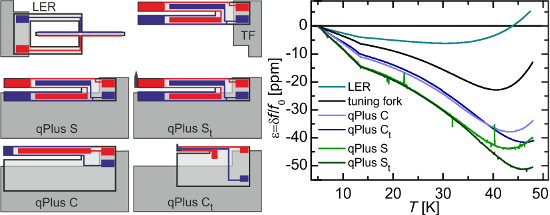
- and the qPlus sensors (Figure 3a) and the LER (Figure 3b). Again, the wiggles in the curves for the qPlus sensors are caused by external excitations due to a lacking damping system. The kink around 13 K from Figure 2 shows up as a clear step. In temperature dependent measurements it might therefore be


Challenges and complexities of multifrequency atomic force microscopy in liquid environments
Beilstein J. Nanotechnol. 2014, 5, 298–307, doi:10.3762/bjnano.5.33
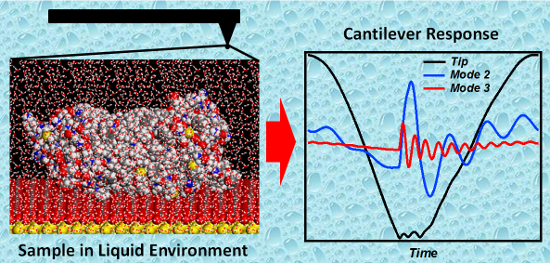
- Santiago D. Solares Department of Mechanical Engineering, University of Maryland, College Park, MD 20742, USA 10.3762/bjnano.5.33 Abstract This paper illustrates through numerical simulation the complexities encountered in high-damping AFM imaging, as in liquid enviroments, within the specific
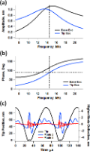
- instrument that is available. Results and Discussion Amplitude and phase relaxation of driven eigenmodes Previous work by Raman and coworkers [22] demonstrated that in high-damping environments the phase contrast derives primarily from an “energy flow channel” that opens up when higher modes of the
- to lower frequencies (see Figure 10), while the frequency at which the phase is 90 degrees remains at the natural frequency. The natural frequency is the only frequency at which all the phase curves intersect for a given (ideal) cantilever driven in environments with different levels of damping (see




Frequency, amplitude, and phase measurements in contact resonance atomic force microscopies
Beilstein J. Nanotechnol. 2014, 5, 278–288, doi:10.3762/bjnano.5.30
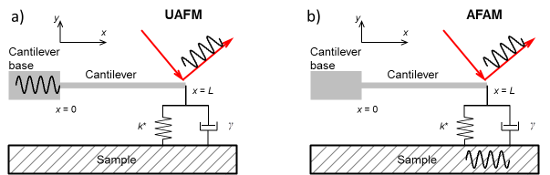
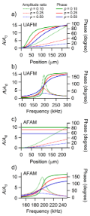
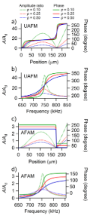
- cantilever is described by its Young’s modulus E, second moment of area of its cross section I, mass density ρ, and cross-sectional area A, and ηair characterizes the damping of the oscillations in air. The general solution of Equation 1 is in the form of y(x,t) = y(x)eiωt, with with A1, A2, A3, and A4
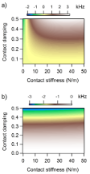
- the cantilever spring constant, k* the contact stiffness, γ* the contact damping constant, and the dimensionless contact damping constant. With the above specified boundary conditions the solution further simplifies to with the following constants for the two configurations: and with M± = sin αL cosh
- configuration. In the following analysis we will characterize the contact damping by the dimensionless contact damping constant p rather than the actual contact damping constant γ*. The discussion is focused on the dynamics of the cantilever in the two CR-AFM configurations only and further consideration of


The role of surface corrugation and tip oscillation in single-molecule manipulation with a non-contact atomic force microscope
Beilstein J. Nanotechnol. 2014, 5, 202–209, doi:10.3762/bjnano.5.22
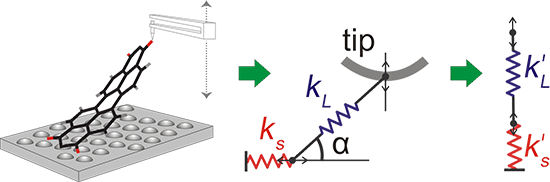
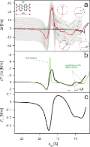
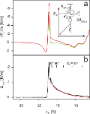
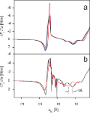
- interaction is damped. We achieve this damping by letting z0 → 0. More details can be found in [24]. For simplicity it is assumed that PTCDA consists of only two types of atoms: the 26 backbone (all carbon plus the two anhydride oxygen atoms; hydrogen atom interaction is scaled by 0.25) and the four

Optical near-fields & nearfield optics
Beilstein J. Nanotechnol. 2014, 5, 186–187, doi:10.3762/bjnano.5.19

- interaction of plasmonic structures with dielectric material that is doped with fluorescent molecules: when the emission line of the dye and the absorption resonance of the nanostructures coincide, the damping of the plasmons can be compensated by the gain in the dielectric material, so that laser-like
Friction behavior of a microstructured polymer surface inspired by snake skin
Beilstein J. Nanotechnol. 2014, 5, 83–97, doi:10.3762/bjnano.5.8
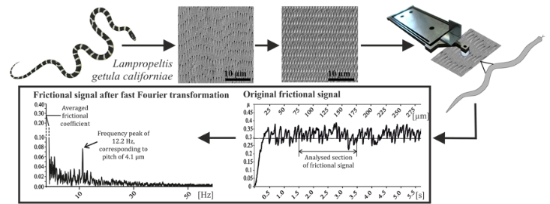
- NanoWizard® atomic force microscope (JPK Instruments), mounted on an inverted light microscope (Zeiss Axiovert 135, Carl Zeiss MicroImaging GmbH). The SIMPS were imaged by using the intermittent contact mode of the AFM. The error channel (also known as the amplitude channel) visualizes the change in damping




Exploring the retention properties of CaF2 nanoparticles as possible additives for dental care application with tapping-mode atomic force microscope in liquid
Beilstein J. Nanotechnol. 2014, 5, 36–43, doi:10.3762/bjnano.5.4
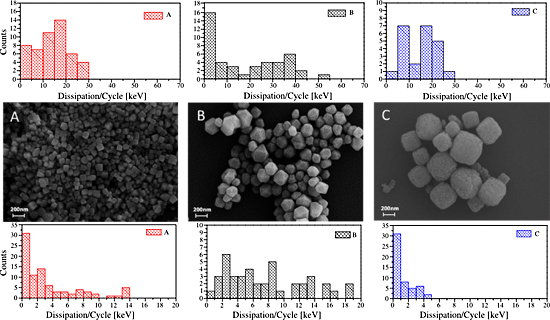
- , . The first term of the dissipated power, , can be thought as the average power dissipated by the body of the cantilever (i.e., air damping or in our case damping of the cantilever motion in the liquid) and can be modeled by simple viscous damping. The second part, , corresponds to the power dissipated


Many-body effects in semiconducting single-wall silicon nanotubes
Beilstein J. Nanotechnol. 2014, 5, 19–25, doi:10.3762/bjnano.5.2
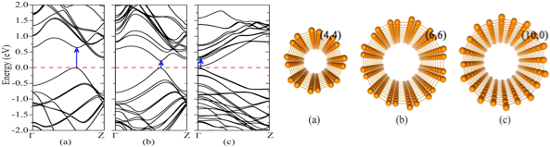
- damping nature, which is an indication of a strong binding between excited electrons and holes with large binding energy. In the case of (6,6) and (10,0) SiNTs, the wave functions of the first bound excitons extend far away along the tubes, similar to a nature of resonant excitons. The reduced electronic
- studied SiNTs are demonstrated in Figure 6. In agreement with the exciton wave functions shown in Figure 5, the first bound exciton of (4,4) SiNTs is mainly localized within a radius of 20 Å. In the case of (6,6) and (10,0) SiNTs, the exciton radii extend over 60 Å. However, we also can see the damping


Dye-doped spheres with plasmonic semi-shells: Lasing modes and scattering at realistic gain levels
Beilstein J. Nanotechnol. 2013, 4, 974–987, doi:10.3762/bjnano.4.110
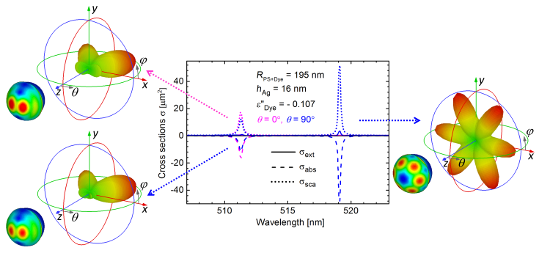
- spectral broadening due to radiative damping. An alternative way to tune the LPR spectrally is to change the shape of the nanoparticle. First, one can relax the radial homogeneity of the nanoparticle and turn from solid nanoparticles to noble metal nanoshells [2][3]. Second, one can also relax the angular
- used for important applications such as biosensing [18], plasmon-enhanced solar cells [19][20], or as substrates for surface-enhanced Raman scattering [21][22] and coherent anti-Stokes Raman scattering [23]. A severe problem for all plasmonic applications is the damping of plasmons due to Ohmic losses
- when modeling is carried out without gain, because they are strongly damped because of the dispersion of the metal. If, however, damping is compensated by gain, the modes might become ultra-sharp and can still be overlooked if they are narrower than the frequency step used in simulations. The situation




Peak forces and lateral resolution in amplitude modulation force microscopy in liquid
Beilstein J. Nanotechnol. 2013, 4, 852–859, doi:10.3762/bjnano.4.96
- beam under the action of external forces, where E is the Young modulus of the cantilever, I the area moment of inertia, a1 the internal damping coefficient, ρ the mass density; b, h and L are, respectively, the width, height and length of the cantilever; a0 is the hydrodynamic damping; w(x,t) is the


Dynamic nanoindentation by instrumented nanoindentation and force microscopy: a comparative review
Beilstein J. Nanotechnol. 2013, 4, 815–833, doi:10.3762/bjnano.4.93
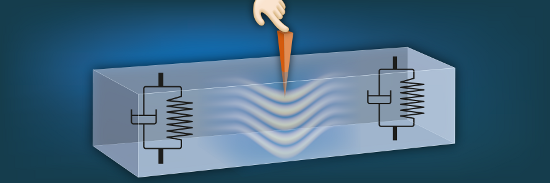
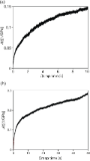
- temperature and frequency is embodied in the temperature–time superposition [70]. In general, increasing the temperature induces a molecular relaxation that leads to an increased phase lag between stress and strain. The loss modulus, which reflects the viscous damping of the sample, then increases with
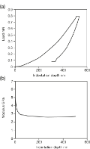
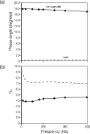
- amplitude h0 induced by the modulated force amplitude P0 is: and the measured phase shift between the applied force and measured displacement is related to sample and instrumental parameters by: where ci, cs are the damping coefficients of the air gap in the displacement transducer and sample, respectively
- used in the equations together with effective k and c in order to avoid an overestimation of c and hence of E”. After calibration to determine m, ci, and ki, the sample-specific values for E′ and E″ can be obtained as shown in Equation 12. These equations also illustrate how the damping coefficient can




Size-dependent characteristics of electrostatically actuated fluid-conveying carbon nanotubes based on modified couple stress theory
Beilstein J. Nanotechnol. 2013, 4, 771–780, doi:10.3762/bjnano.4.88
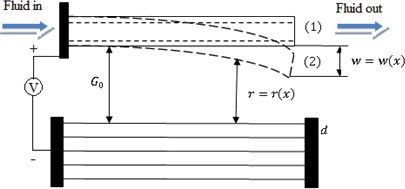
- knowledge, Yoon et al. were the first to study the flutter instability that results from fluid flow in CNTs [23]. They presented the natural frequencies and the damping of the CNT for various flow velocities. Their work had some shortages, which were overcome by Lin and Qiao [24]. They applied the
- changes in the stiffness and damping ratios, as will be studied in the paper. Mathematical formulae All mathematical formulae and expressions that are used in this study can be found in Supporting Information File 1. Results and Discussion The length and chirality of the CNT considered in this paper are
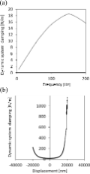
- the system but also influences the damping properties. In addition, the green and red curves show that if the applied voltage exceeds a maximum limit, the CNT does not move harmonically anymore. This phenomenom that is corresponded to the saddle-node bifurcation is known as dynamic pull-in and the


Ellipsometry and XPS comparative studies of thermal and plasma enhanced atomic layer deposited Al2O3-films
Beilstein J. Nanotechnol. 2013, 4, 732–742, doi:10.3762/bjnano.4.83
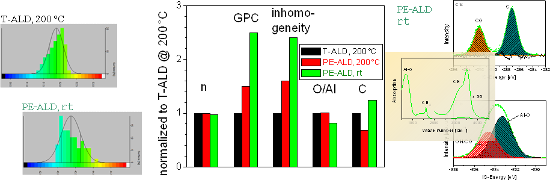
- , oscillator damping, and a distribution factor taking into account the influence of surrounding materials of the single oscillator. This model can be applied for all absorbing molecule groups in the Al2O3 film. In the infrared the thin native oxide film cannot be measured and was neglected. Figure 11 shows


k-space imaging of the eigenmodes of sharp gold tapers for scanning near-field optical microscopy
Beilstein J. Nanotechnol. 2013, 4, 603–610, doi:10.3762/bjnano.4.67
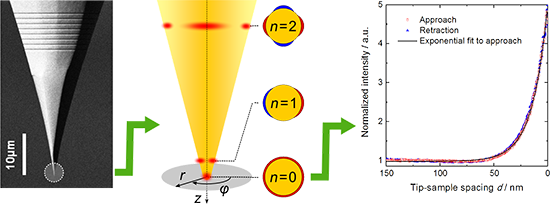
- cover slip is mounted onto a three-axis piezoelectric stage (PI P-363.3CD). This allows us to slowly approach the sample to the taper over a distance of several hundreds of nanometers in steps of 30 pm until the tuning fork starts to be damped by tip–sample interactions. The damping occurs on a length


Multiple regimes of operation in bimodal AFM: understanding the energy of cantilever eigenmodes
Beilstein J. Nanotechnol. 2013, 4, 385–393, doi:10.3762/bjnano.4.45
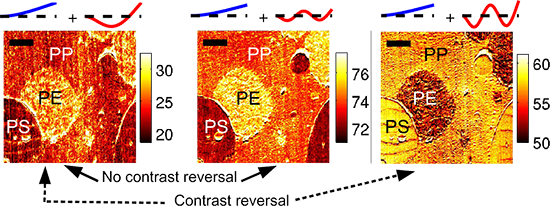
- frequency before every experiment. The effects of squeeze film damping [13] are such that the phase can change by an appreciable amount (10 degrees) when the cantilever is moved a few micrometers away from the surface. Further, piezo resonances can distort the tuning curve. For plain AM-AFM at the first
- given in [21][22]. Here we review the features relevant to the present work. The modeling starts with the Euler–Bernoulli partial differential equation for deflections of a slender, rectangular cantilever beam in a ground-fixed inertial frame, subject to a hydrodynamic damping force, a driving force


![[Graphic 3]](/bjnano/content/inline/2190-4286-4-45-i5.png?max-width=637&scale=1.18182) . In the top row (a, b) the first eigen...
. In the top row (a, b) the first eigen...



Determining cantilever stiffness from thermal noise
Beilstein J. Nanotechnol. 2013, 4, 227–233, doi:10.3762/bjnano.4.23
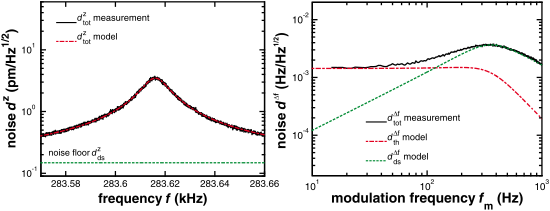
- thermal excitation, namely the resulting noise power spectral density of the cantilever displacement , is the superposition of contributions from all modes and can be derived within the framework of the Nyquist theory [3]. Provided the simple harmonic oscillator model is valid, i.e., the internal damping
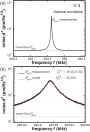
![[Graphic 34]](/bjnano/content/inline/2190-4286-4-23-i40.png?max-width=637&scale=1.18182) measured for the fundamental mode of cantilever V 4. Measureme...
measured for the fundamental mode of cantilever V 4. Measureme...
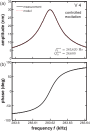
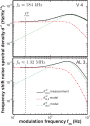
![[Graphic 23]](/bjnano/content/inline/2190-4286-4-23-i29.png?max-width=637&scale=1.18182) measured for cantilever V 4 (A0 = 16.8 nm, demodulator band...
measured for cantilever V 4 (A0 = 16.8 nm, demodulator band...
Bimodal atomic force microscopy driving the higher eigenmode in frequency-modulation mode: Implementation, advantages, disadvantages and comparison to the open-loop case
Beilstein J. Nanotechnol. 2013, 4, 198–207, doi:10.3762/bjnano.4.20
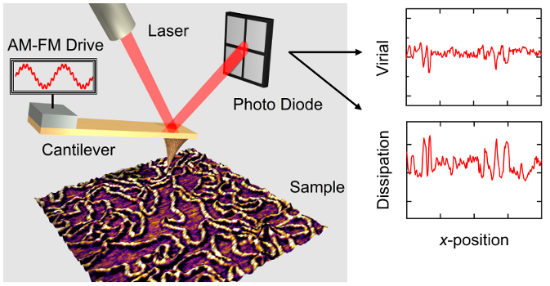
- of damping, which can be more significant when characterizing highly dissipative samples, the natural frequency is a well-defined condition, which allows the relatively easy implementation of amplitude control. That is, one can control the response amplitude by adjusting the drive amplitude, using a
- the dimensionless time, k is the cantilever force constant (stiffness) and Fts is the tip–sample interaction force. We have also used the approximation A ≈ A0 = F0Q/k [22], where F0 is the amplitude of the inertial excitation force, and have grouped the damping and excitation terms together in


Hydrogen-plasma-induced magnetocrystalline anisotropy ordering in self-assembled magnetic nanoparticle monolayers
Beilstein J. Nanotechnol. 2013, 4, 164–172, doi:10.3762/bjnano.4.16
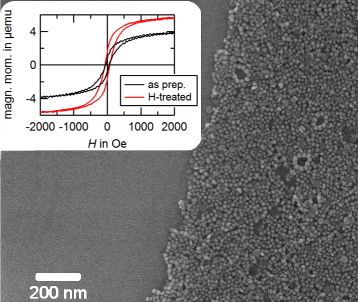
- . A solution is obtained by consideration of its time-dependent extension [25] with γ the gyromagnetic ratio and α a dimensionless damping constant. The microscopic relaxation occurs on time scales significantly shorter than the time scales on which external fields change. Therefore, the microscopic
- dynamics are not in the scope of this work and the value of the damping parameter may be adjusted to provide a high numerical convergence rate. We chose α = 1 [26]. For the integration with respect to time, a backward differential formula of fifth order is applied. As a model system, we consider a two




Towards 4-dimensional atomic force spectroscopy using the spectral inversion method
Beilstein J. Nanotechnol. 2013, 4, 87–93, doi:10.3762/bjnano.4.10
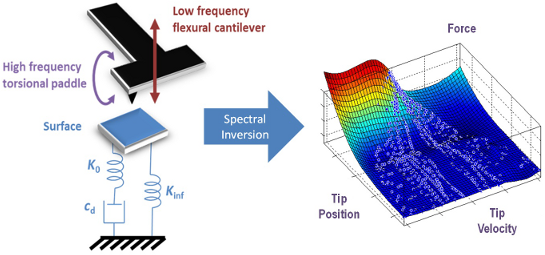
- phenomena take place when imaging samples in high-damping (liquid) environments [18] or in multifrequency AFM characterization [19]. Illustration of the surface depression by the tip–sample impact, and successive recovery within the standard linear solid model. Z1 is the undisturbed surface position, before


Plasmonic oligomers in cylindrical vector light beams
Beilstein J. Nanotechnol. 2013, 4, 57–65, doi:10.3762/bjnano.4.6
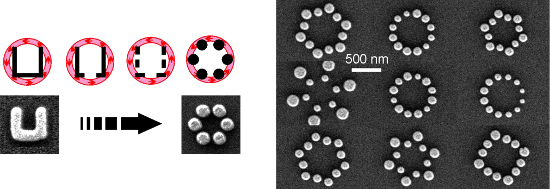
- are in-phase (see field distributions at spectral positions 1 and 3), exhibiting significant mode broadening due to radiative damping. It is worth mentioning that the peak position of the super-radiant mode cannot be exactly determined from the spectrum due to the presence of the resonance dip




Interpreting motion and force for narrow-band intermodulation atomic force microscopy
Beilstein J. Nanotechnol. 2013, 4, 45–56, doi:10.3762/bjnano.4.5
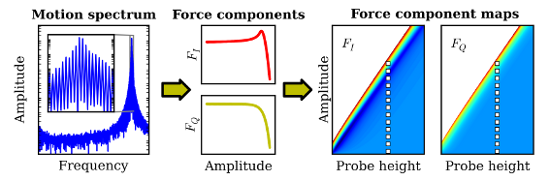
- additional exponential damping, which is defined as where H = 2.96 · 10−7 J is the Hamaker constant, R = 10 nm is the tip radius, γ = 2.2 · 10−7 Ns/m is the damping constant, zγ = 1.5 nm is the damping decay length and E* = 2.0 GPa is the effective stiffness. For the numerical integration of Equation 39 we
- and A as seen in the two-dimensional color maps shown in Figure 6 for the vdW-DMT force with exponential damping used in the previous section. In order to emphasize the interaction region near the point of contact, data in the h–A plane with FI < −8 nN are masked with white. In both frequency
- cantilever dynamics due to a relatively long interaction time, or a change in the hydrodynamic damping forces due to the surrounding air close to the sample surface. One should also note that at this piezo extension the minimum oscillation amplitude begins to increase again. A possible artifact of the




Thermal noise limit for ultra-high vacuum noncontact atomic force microscopy
Beilstein J. Nanotechnol. 2013, 4, 32–44, doi:10.3762/bjnano.4.4
- suspension and eddy-current damping systems. As an additional precaution, connections between the electronics and piezos are removed during noise measurements to ensure that measurements are not affected by any spurious electrical signals exciting the cantilever. All systems investigated here are based on


![[Graphic 53]](/bjnano/content/inline/2190-4286-4-4-i64.png?max-width=637&scale=1.18182) =
= ![[Graphic 32]](/bjnano/content/inline/2190-4286-4-4-i43.png?max-width=637&scale=1.18182) f...
f...


![[Graphic 56]](/bjnano/content/inline/2190-4286-4-4-i67.png?max-width=637&scale=1.18182) using three diff...
using three diff...




