Search results
Search for "patterning" in Full Text gives 191 result(s) in Beilstein Journal of Nanotechnology.
In situ growth optimization in focused electron-beam induced deposition
Beilstein J. Nanotechnol. 2013, 4, 919–926, doi:10.3762/bjnano.4.103
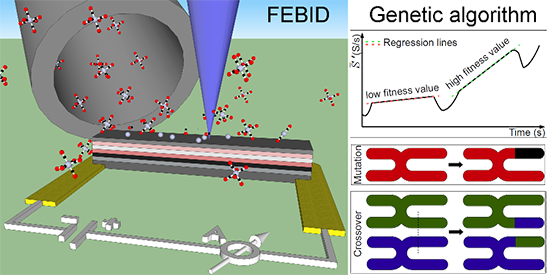
- microscope (TEM). During the last decade FEBID has developed from a highly specialized nanofabrication method with a limited selection of application fields to one of the most flexible approaches for functional nanostructure fabrication with true 3D patterning capabilities. By now FEBID-based nanostructures


Site-selective growth of surface-anchored metal-organic frameworks on self-assembled monolayer patterns prepared by AFM nanografting
Beilstein J. Nanotechnol. 2013, 4, 638–648, doi:10.3762/bjnano.4.71
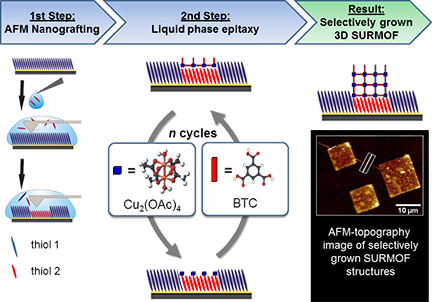
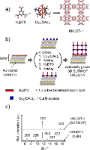
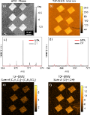
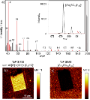
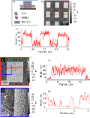
- SAMs by using the AFM as nanografting tool. ToF-SIMS analyses were carried out to demonstrate the successful SAM patterning by nanografting, while FT-IR microscopy and AFM were used to verify the SURMOF growth on the patterned substrate. Results and Discussion The in-situ nanografting process includes
- interesting for biological application, would require a technique, which allows the patterning of the substrate with different SAMs. Although usual structuring methods, such as micro contact printing or e-beam lithography, can be used for SAM patterning as well, those techniques reach a limit when patterns





Mapping of plasmonic resonances in nanotriangles
Beilstein J. Nanotechnol. 2013, 4, 588–602, doi:10.3762/bjnano.4.66
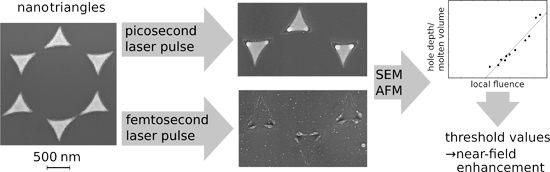
- than the FDTD results. Minimum structure size As mentioned in the introduction, plasmon-mediated ablation is an interesting method for optical patterning of surfaces far below the diffraction limit as well as for imaging optical near fields. The ablation hole shown as an example in the profile of
- around 10 nm. Yet nanopatterning by near-field ablation with femtosecond pulses and the related formation of a nanoscale plasma appears as a novel route for certain applications in biology and medicine, where a chemical patterning of a substrate on scales well below optical wavelengths is of interest


Nanoglasses: a new kind of noncrystalline materials
Beilstein J. Nanotechnol. 2013, 4, 517–533, doi:10.3762/bjnano.4.61
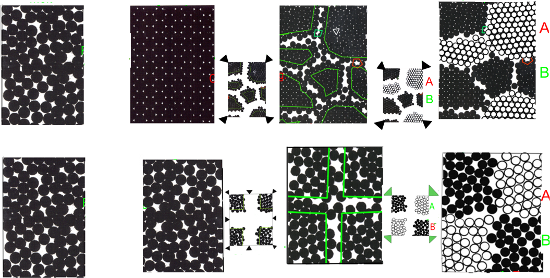
- significance of nanometer-sized patterning of the surface of nanoglasses agrees with the results of recent studies [62][63][64] indicating that the spatial patterning of biochemical cues controls several cellular processes such as spreading, adhesion, migration and proliferation. In fact, these studies
- be so because integrin clustering and adhesion-induced arginine-glycine-aspatic acid (RGD) ligands depend on the local order of the ligand arrangement on the substrate if the average ligand spacing is above 70 nm. Adhesion is “turned off“ by RGD patterning above 70 nm and “turned on” below this






Structural and thermoelectric properties of TMGa3 (TM = Fe, Co) thin films
Beilstein J. Nanotechnol. 2013, 4, 461–466, doi:10.3762/bjnano.4.54
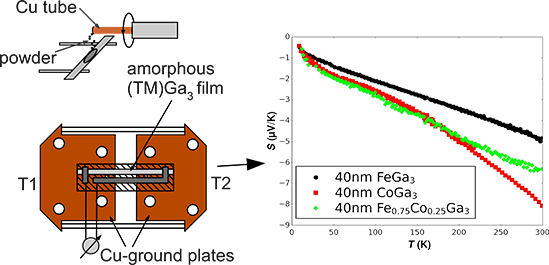
- of typically 1 nm/min as indicated by a quartz crystal monitor at a background pressure of 10−8 mbar with a cooling shield filled with liquid N2. For the lateral patterning of the films evaporation was performed through masks in contact with the substrates (c-cut sapphire or glass) held at ambient


Digging gold: keV He+ ion interaction with Au
Beilstein J. Nanotechnol. 2013, 4, 453–460, doi:10.3762/bjnano.4.53
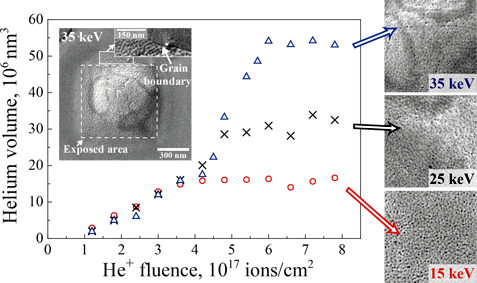
- crystals; helium ion microscopy; ion beam/solid interactions; vacancies in crystals; Introduction The helium ion microscope allows the projection of a He+ beam of several tens of kiloelectronvolts with a diameter of 0.4 nm [1] onto a sample. This makes HIM an attractive tool for surface patterning and


Porous polymer coatings as substrates for the formation of high-fidelity micropatterns by quill-like pens
Beilstein J. Nanotechnol. 2013, 4, 377–384, doi:10.3762/bjnano.4.44
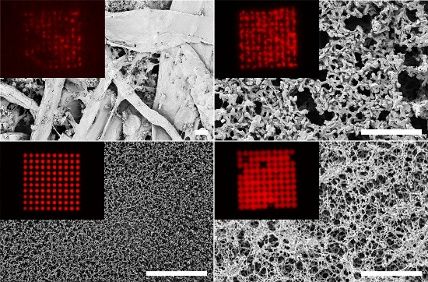
- polymer in the wetted state [4]. Such porous HEMA substrates were used for creating superhydrophilic–superhydrophobic micropatterned surfaces for cell-patterning [6] and cell-screening applications [7][8]. Here, we present an approach for the formation of high-fidelity microarrays of three-dimensional 20
- Discussion Pattern generation The microarrays were fabricated by spotting the dye solution with quill-like microchannel cantilevers, called surface patterning tools (SPTs) [9], attached to a dip-pen nanolithography (DPN) platform (NLP 2000, NanoInk, USA) for precise control in x- y- and z-direction (Figure 1
- reservoir. Bright field and fluorescent microscopy images demonstrate huge differences in the patterning outcome for the different substrates. Plain paper (Figure 4a and Figure 4e) does not consistently take up phloxine B from the SPT, presumably in part because of a large surface roughness (that might have


Guided immobilisation of single gold nanoparticles by chemical electron beam lithography
Beilstein J. Nanotechnol. 2013, 4, 336–344, doi:10.3762/bjnano.4.39
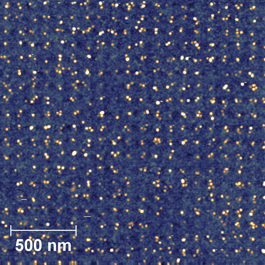
- processing steps, including formation, patterning and development of resist films, metal evaporation/sputtering and lift-off, whereby feature sizes rarely go beyond the 10 nm threshold [1]. Depending on the chosen substrate, e.g., SiO2, additional metal layers such as Ti are needed as adhesive layers. In


Grain boundaries and coincidence site lattices in the corneal nanonipple structure of the Mourning Cloak butterfly
Beilstein J. Nanotechnol. 2013, 4, 292–299, doi:10.3762/bjnano.4.32
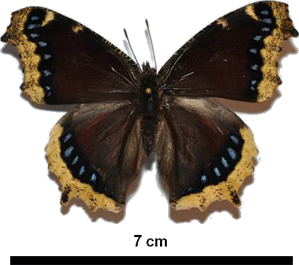
- effect, which provides some protection from predators. In recent years many artificial moth-eye-type surfaces have been developed as antireflection, antiglare surfaces by various methods such as photoresist patterning, porous aluminium oxide templating or direct reproduction, e.g., [7][8][9]. With


Functionalization of vertically aligned carbon nanotubes
Beilstein J. Nanotechnol. 2013, 4, 129–152, doi:10.3762/bjnano.4.14
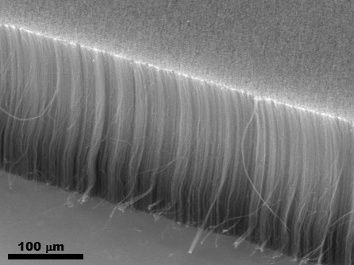
- functionalization, and also dry gas-phase functionalization. Before presenting these methods, we briefly discuss different ways to synthesize vertically aligned carbon nanotubes and the existing approaches to obtain patterning of vertically aligned carbon nanotubes. A part of this review is also dedicated to a
- key achievement was the engineering of vertically oriented CNT-arrays by using CVD of ethylene, size-controlled Fe catalytic particles, and nanotube positioning by substrate patterning. The mechanism of the alignment of the CNTs was proposed to be due to the van der Waals forces where the outer wall
- techniques and the main achievements in this field. For further reading, detailed literature can be found in [54]. 2 Patterning of VA-CNT arrays For optimal engineering in applications such as field emitters or sensors, the location of the VA-CNTs and the design of their growth area are of primary importance








Low-dose patterning of platinum nanoclusters on carbon nanotubes by focused-electron-beam-induced deposition as studied by TEM
Beilstein J. Nanotechnol. 2013, 4, 77–86, doi:10.3762/bjnano.4.9
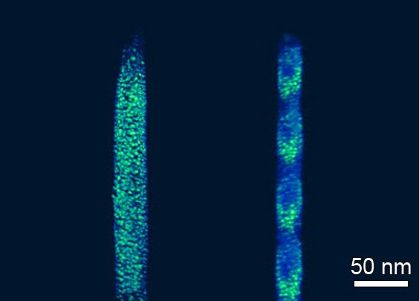
- nanotubes; FEBID; nanocluster; platinum; patterning; radiation-induced nanostructures; TEM; Introduction Hybrid nanostructures consisting of carbon nanotubes (CNTs) decorated with metal nanoclusters enable access to various electrical and catalytic properties. Therefore, they are considered as building
- the formation of a novel stripe-patterning of nanoclusters on the surface of the CNTs, which may open up new prospects of nanostructuring for applications in nanodevices dependent on the distribution of metal clusters. High-resolution transmission electron microscopy (HRTEM) and high-angle annular
- ). Demonstrating the ability of FEBID to deposit nanoclusters on both sides of the CNTs, we believe that the application of FEBID as a direct patterning approach can be extended to various electron-transparent structures, such as nanowires, thin films and graphene. Furthermore, taking into account that


Controlled deposition and combing of DNA across lithographically defined patterns on silicon
Beilstein J. Nanotechnol. 2013, 4, 72–76, doi:10.3762/bjnano.4.8
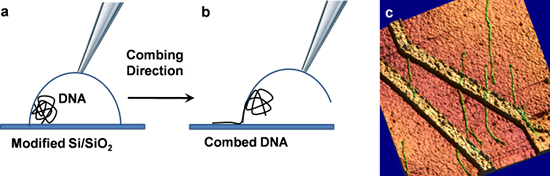
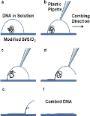
- introduced that involved a combination of molecular combing with other techniques such as lithographic patterning [7]. For instance, Guan et al. used a combination of molecular combing with contact printing and soft lithography. With this method, it was possible to generate complex patterns of DNA on the


Sub-10 nm colloidal lithography for circuit-integrated spin-photo-electronic devices
Beilstein J. Nanotechnol. 2012, 3, 884–892, doi:10.3762/bjnano.3.98
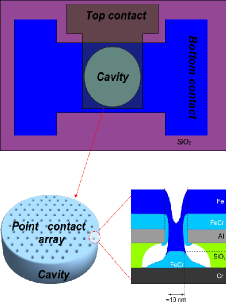
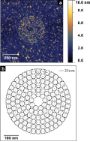
- Adrian Iovan Marco Fischer Roberto Lo Conte Vladislav Korenivski Nanostructure Physics, Royal Institute of Technology, 10691 Stockholm, Sweden 10.3762/bjnano.3.98 Abstract Patterning of materials at sub-10 nm dimensions is at the forefront of nanotechnology and employs techniques of various
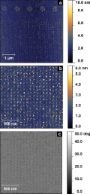
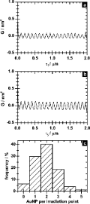
- complexity, efficiency, areal scale, and cost. Colloid-based patterning is known to be capable of producing individual sub-10 nm objects. However, ordered, large-area nano-arrays, fully integrated into photonic or electronic devices have remained a challenging task. In this work, we extend the practice of
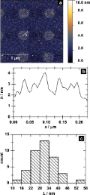
- [4] and DNA [5][6], and for producing artificial crystals in photonics [7][8] and gigahertz oscillators in spin-electronics [9][10][11][12][13][14]. Scaling of colloidal patterning down to 10 nm and below, dimensions comparable or smaller than the main relaxation lengths in the relevant materials


Pinch-off mechanism in double-lateral-gate junctionless transistors fabricated by scanning probe microscope based lithography
Beilstein J. Nanotechnol. 2012, 3, 817–823, doi:10.3762/bjnano.3.91
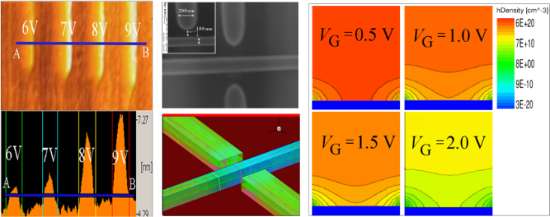
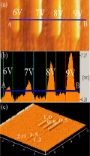
- at constant voltage of 9 V is shown in Figure 1c. The optimized oxidation parameters correspond to a voltage of 9 V on the tip, with a speed of 1 µm/s, with the RH in the range of 65–67%. After patterning of the oxide mask, the first step of wet chemical etching was carried out with a solution of 30


Controlled positioning of nanoparticles on a micrometer scale
Beilstein J. Nanotechnol. 2012, 3, 773–777, doi:10.3762/bjnano.3.86
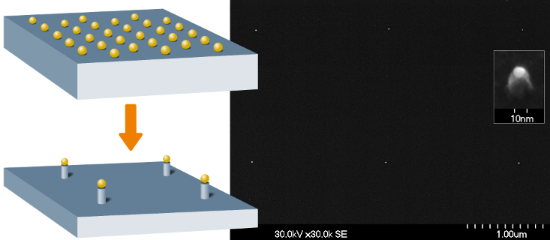
- them as masks for subsequent etching procedures to transfer the NP pattern into their supporting substrate. In this respect, the notion of a nanoparticle should include as well colloids and micelles since their use for patterning is more widely spread [7][8][9][10][11][12]. Of course, in addition to
- system fixed within the sample surface. When restricting the patterning to a 100 μm × 100 μm area, no mechanical movement of the sample holder is necessary, rather all programmed positions are approached by steering the electron beam. During the writing process, however, one observes a time-dependent


Ordered arrays of nanoporous gold nanoparticles
Beilstein J. Nanotechnol. 2012, 3, 651–657, doi:10.3762/bjnano.3.74
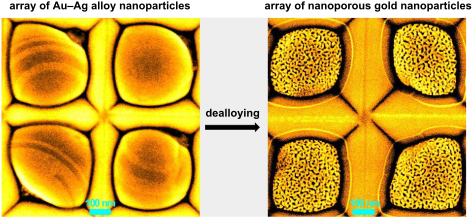
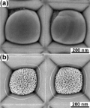
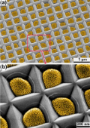
- on the Si wafer, and then an array of holes was defined by SCIL. SCIL was developed as a new nanoimprint lithography technique that combines the advantages of both UV nanoimprint lithography techniques, with a rigid stamp for best resolution and with a soft stamp for large-area patterning [23]. The



Polymer blend lithography: A versatile method to fabricate nanopatterned self-assembled monolayers
Beilstein J. Nanotechnol. 2012, 3, 620–628, doi:10.3762/bjnano.3.71
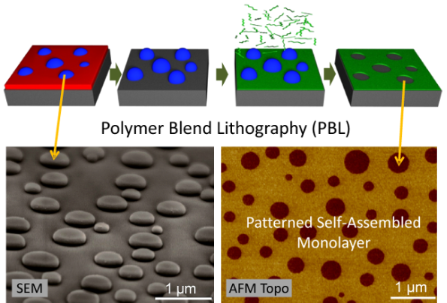
- time featuring regions of bare SiOx. The patterning process could be applied even on meter-sized substrates with various functional SAM molecules, making this process suitable for the rapid preparation of quasi two-dimensional nanopatterned functional substrates, e.g., for the template-controlled
- [8]. Patterning of self-assembled monolayers on the nanometer scale is easily performed by sequential lithographic techniques that are well-established in the literature. Electron beam lithography allows the desorption or destruction of molecules of a SAM layer, line by line [9][10]. Advanced
- -force-microscopy-based lithographic techniques allow the structuring and patterning of surfaces with a lateral resolution down to the nanometer scale [24][25][26][27][28][29][30]. The advantage of techniques such as electron beam lithography or SFM-based lithography is their high lateral resolution and


Nano-structuring, surface and bulk modification with a focused helium ion beam
Beilstein J. Nanotechnol. 2012, 3, 579–585, doi:10.3762/bjnano.3.67
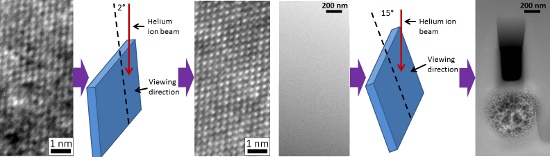
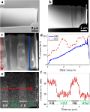
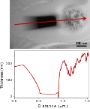
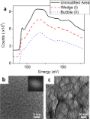
- silicon lamella leaving the subsurface structure intact for further analysis. Surface roughness and contaminants were both reduced by the irradiation process. Fabrication is also realized with a high level of patterning acuity. Implantation of helium beneath the surface of the sample is visualized in
- crystal structure. The resolution of the FIB is limited by the energy spread of the gallium ions generated from the liquid metal ion source (LMIS). The sputter yield is also too large for acute patterning control over very short lateral distances. The recently developed Carl Zeiss Orion Plus helium ion
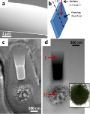
- with a 5 keV gallium ion beam final polish in order to reduce FIB induced artifacts which would obscure our analysis of the patterning and subsurface modification effects of the HIM modification. Sample 3 is shown after FIB lift-out in the SEM image in Figure 4a. Figure 4b is an illustration of the


The oriented and patterned growth of fluorescent metal–organic frameworks onto functionalized surfaces
Beilstein J. Nanotechnol. 2012, 3, 570–578, doi:10.3762/bjnano.3.66
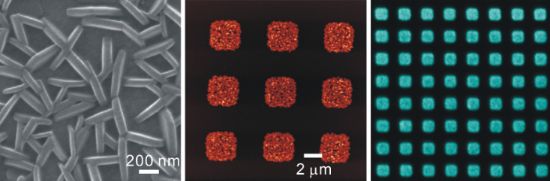
- groups, such as carboxylate and pyridyl groups, capable of coordinating to the constituents of the MOF. It could be demonstrated that this directed coordination also orients the nanocrystals deposited at the surface. Using two different patterning methods, i.e., microcontact printing and electron-beam
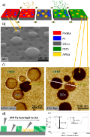
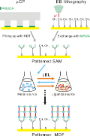
- -substituted alkanethiol solution can be significantly enhanced by electron irradiation, a new patterning technique was developed by Zharnikov et al. [50][51][52][53][54]. Thus, our second strategy to fabricate a patterned SAM was the combination of this irradiation-promoted exchange reaction (IPER) with
- the SAM constituents are not distributed evenly over the surface, but are instead patterned, they also direct the location of SURMOF deposition. Two different methods have been employed for the patterning, namely microcontact printing and electron-beam lithography. We demonstrated that both methods





Directed deposition of silicon nanowires using neopentasilane as precursor and gold as catalyst
Beilstein J. Nanotechnol. 2012, 3, 535–545, doi:10.3762/bjnano.3.62
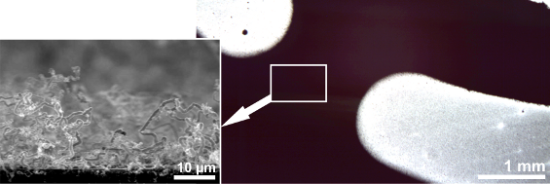
- deposited as a thin film and thermally annealed, but can also be patterned by using UV irradiation, providing access to laterally structured layers of silicon nanowires. Keywords: chemical vapor deposition; gold; nanoparticle; patterning; radiation-induced nanostructures; vapor-liquid-solid mechanism
- around 150 nm. Additionally, smaller-scaled NWs growing in a buckled way could be observed on the substrate (Figure 11, right). The polymeric nature of “liquid bright gold” offers opportunities for patterning and hence controlling the growth areas of the NWs. One well-established method for the patterned
- spin-coated films of “liquid bright gold” at 650 °C, dense layers of nanoparticles can be easily formed, which serve as efficient catalysts for Si NW production. An interesting extension of this approach is that these films can be cross-linked by UV irradiation, permitting their lateral patterning


Colloidal lithography for fabricating patterned polymer-brush microstructures
Beilstein J. Nanotechnol. 2012, 3, 397–403, doi:10.3762/bjnano.3.46
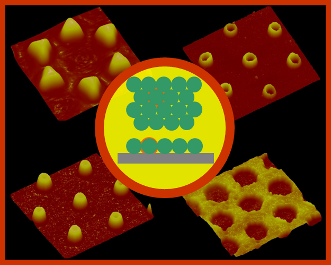
- : atom-transfer radical polymerization; colloidal lithography; patterning; self-assembled microsphere monolayer; Introduction It is well known that monodisperse colloidal microspheres easily self-assemble into hexagonally close-packed arrays on surfaces as a result of capillary forces arising from the
- separation of biological molecules [14][15][16]. They can be grown by surface-initiated polymerization from surface-confined initiator templates, as fabricated by various lithographic approaches. Although a range of strategies for polymer brush patterning, including photolithography [17], electron-beam
- lithography [18], electron-beam chemical lithography [19], microcontact printing (µCP) [20], scanning-probe lithography [21] and capillary-force lithography [22], have been exploited over the years, there is still considerable interest in the exploitation of new, simple patterning strategies that do not


Combining nanoscale manipulation with macroscale relocation of single quantum dots
Beilstein J. Nanotechnol. 2012, 3, 324–328, doi:10.3762/bjnano.3.36
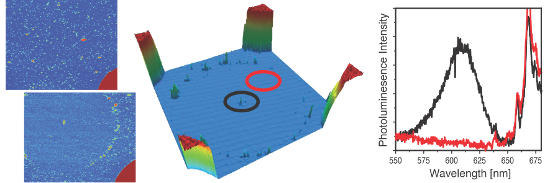
- patterning procedure allows us to (re-)locate a given, previously positioned, QD in any optical system. To manipulate and characterise a single quantum dot we required the ability to repeatedly address an area of only a few square nanometres on a 10 × 10 mm2 substrate. In order to realise this relocation


Variations in the structure and reactivity of thioester functionalized self-assembled monolayers and their use for controlled surface modification
Beilstein J. Nanotechnol. 2012, 3, 213–220, doi:10.3762/bjnano.3.24
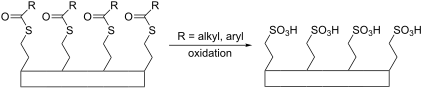
- reported. A striking example of in situ SAM transformations is based on the initial deposition of thioacetate-bearing monolayers and their in situ conversion to sulfonic acid surfaces [15]. This transformation provides the basis for surface patterning of the monolayer and for its use as a patterned


Parallel- and serial-contact electrochemical metallization of monolayer nanopatterns: A versatile synthetic tool en route to bottom-up assembly of electric nanocircuits
Beilstein J. Nanotechnol. 2012, 3, 134–143, doi:10.3762/bjnano.3.14
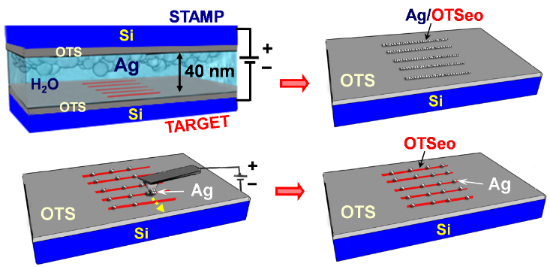
- –solution interface by ion migration to the electrode rather than by electron transfer to hydrated ions in solution. Keywords: AFM (SFM); bipolar electrochemistry; electrochemical metal deposition; monolayer patterning; nanolithography; self-assembled organosilane monolayers; Introduction The quest for a
- ][20][21][22][23][24][25][26][27][28]. To this end, a monolayer-patterning methodology, referred to as constructive lithography (CL), has been advanced, which allows nondestructive local electrooxidation of the top –CH3 groups of a self-assembled OTS/Si monolayer (highly ordered monolayer assembled on
- one-step parallel printing of OTSeo features extending over much larger surface areas, typically beyond the micrometer (constructive microlithography, CML) [16][22]. Recently, we demonstrated a two-step CL patterning and pattern metallization process, referred to as contact electrochemical patterning


Self-assembly of octadecyltrichlorosilane: Surface structures formed using different protocols of particle lithography
Beilstein J. Nanotechnol. 2012, 3, 114–122, doi:10.3762/bjnano.3.12
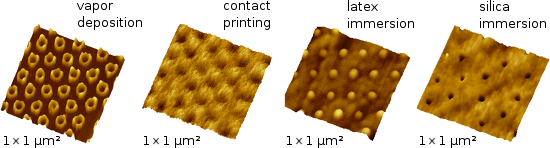
- nanomaterials. The surface density of nanostructures can be designed by selecting the diameter of mesospheres, for high-throughput patterning on the order of 109 nanostructures per square centimeter. Different approaches with particle lithography have been successful for producing periodic, 2D arrays of
- helpful for new applications and developments in the patterning of biomolecules or nanoparticles for optical measurements and biosensor surfaces. The morphology of SAMs or nanostructures of OTS reflects a balance of the interactions that occur between the silane precursor and the silanol groups
- outcome of patterning with particle lithography. Polystyrene latex has been described as a “hairy” particle, with strands of polystyrene extending across the exterior surface areas of the beads. The strands provide surface sites for interaction with OTS to produce a cross-linked arrangement within the