


Search results
Search for "scanning electron microscopy (SEM)" in Full Text gives 544 result(s) in Beilstein Journal of Nanotechnology. Showing first 200.
Properties of graphene deposited on GaN nanowires: influence of nanowire roughness, self-induced nanogating and defects
Beilstein J. Nanotechnol. 2021, 12, 566–577, doi:10.3762/bjnano.12.47
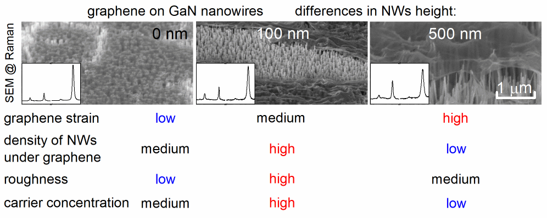
- distinct groups of NWs were observed – approx. 80% of them were 1 μm in height while approx. 20% reached 1.5 μm. The samples were studied by scanning electron microscopy (SEM) using a SU8230 Hitachi microscope equipped with an in-lens secondary electron detector at 5 kV electron beam voltage. The Raman




On the stability of microwave-fabricated SERS substrates – chemical and morphological considerations
Beilstein J. Nanotechnol. 2021, 12, 541–551, doi:10.3762/bjnano.12.44
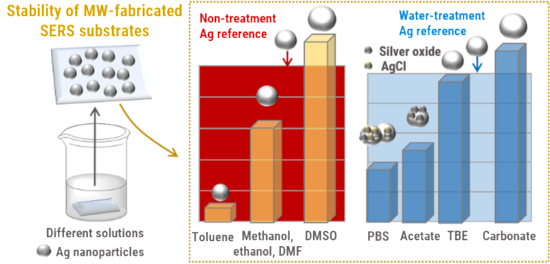
- substrates is studied via scanning electron microscopy (SEM) and their impact on the SERS enhancement capabilities of the substrates is evaluated by Raman spectroscopy (Figure 1b). For this purpose, all treated substrates are carefully rinsed after immersion into the solvents and buffers and are subsequently


A stretchable triboelectric nanogenerator made of silver-coated glass microspheres for human motion energy harvesting and self-powered sensing applications
Beilstein J. Nanotechnol. 2021, 12, 402–412, doi:10.3762/bjnano.12.32
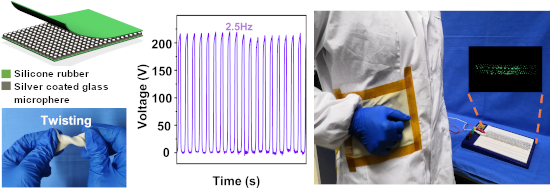
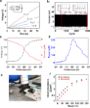
- layer of silicone rubber and the middle layer of SCGMs. The scanning electron microscopy (SEM) image (Figure 1b) and the energy dispersive X-ray spectroscopy (EDS) measurement (Figure 1c) show that the SCGMs are evenly dispersed across the silicone rubber. Figure 1d presents the flow chart for the





Spontaneous shape transition of MnxGe1−x islands to long nanowires
Beilstein J. Nanotechnol. 2021, 12, 366–374, doi:10.3762/bjnano.12.30
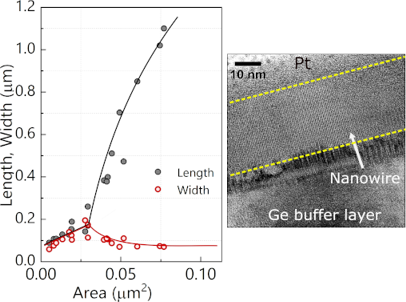
- report a spontaneous morphology modification, from islands to nanowires, in Mn-rich GeMn nanoparticles. The growth is initiated via reaction of a thin Mn wetting layer, evaporated by MBE, with a Ge(111) substrate. Morphology and microstructure of the NWs have been studied by scanning electron microscopy
- (SEM), X-ray diffraction (XRD), and high-resolution transmission electron microscopy (HRTEM). We demonstrate that the thickness of the Mn layer and the annealing conditions finely control the shape transition, resulting in NWs up to ≃1.5 μm length with uniform width and homogeneous composition


Structural and optical characteristics determined by the sputtering deposition conditions of oxide thin films
Beilstein J. Nanotechnol. 2021, 12, 354–365, doi:10.3762/bjnano.12.29
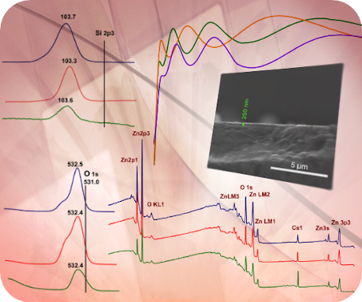
- diffraction (XRD) and X-ray photoelectron spectroscopy (XPS), while the surface topography of the samples was analyzed using scanning electron microscopy (SEM). The optical characteristics were measured for samples with the same composition but obtained with different deposition parameters, such as increasing


Exploring the fabrication and transfer mechanism of metallic nanostructures on carbon nanomembranes via focused electron beam induced processing
Beilstein J. Nanotechnol. 2021, 12, 319–329, doi:10.3762/bjnano.12.26
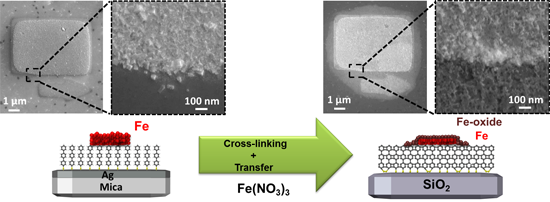
- performed in a commercial UHV system (Multiscanlab, Omicron Nanotechnology, Germany) with a base pressure of p < 2 × 10⁻¹⁰ mbar. The main component of the system is a UHV-compatible electron column (Leo Gemini) for scanning electron microscopy (SEM, nominal resolution better than 3 nm) and a local AES using


The nanomorphology of cell surfaces of adhered osteoblasts
Beilstein J. Nanotechnol. 2021, 12, 242–256, doi:10.3762/bjnano.12.20
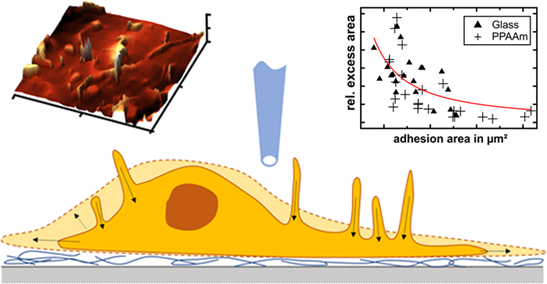
- cellular rims, while this type of extensions was frequently observed on rough or microstructured surfaces. Ruffles observed by SEM Osteoblastic cells have been studied extensively by scanning electron microscopy (SEM) [32][33][46]. Electron microscopy can yield nanoscopic resolution but requires invasive
- room temperature. Measurement principle and data preparation Scanning electron microscopy (SEM) was performed using a field-emission SEM (Gemini Supra 25, Zeiss) at 1 keV electron energy without Au coating. For SICM a commercial AFM/SICM setup (NX-bio, Park Systems, Korea) with a live-cell chamber (5


Imaging of SARS-CoV-2 infected Vero E6 cells by helium ion microscopy
Beilstein J. Nanotechnol. 2021, 12, 172–179, doi:10.3762/bjnano.12.13
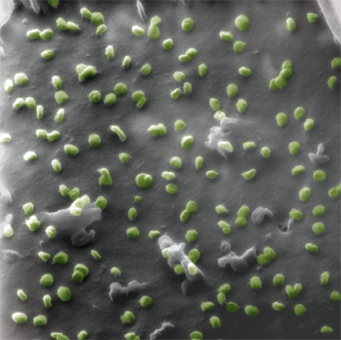
- , while many more cell lines have been reported to be refractory to SARS-CoV-2 infection [15]. Both scanning electron microscopy (SEM) and transmission electron microscopy (TEM) have been used to image SARS-CoV-2 [16][17][18][19][20]. While TEM achieves unsurpassed resolution and can visualize


Mapping the local dielectric constant of a biological nanostructured system
Beilstein J. Nanotechnol. 2021, 12, 139–150, doi:10.3762/bjnano.12.11
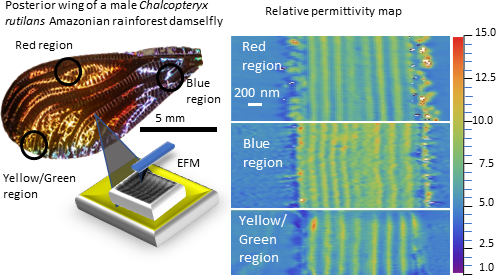
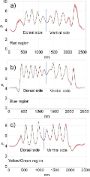
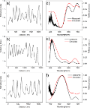
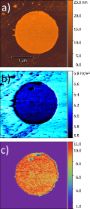
- . The scanning electron microscopy (SEM) image presented in Figure 2 shows the nanostructured section of a fragment of the red region indicated in Figure 1a. The section was partially polished using a focused ion beam (FIB) and the multilayered structure is clearly visible. The corrugated surface is the




A review on the green and sustainable synthesis of silver nanoparticles and one-dimensional silver nanostructures
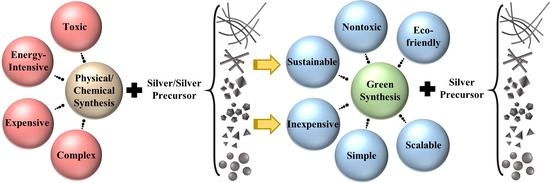
Beilstein J. Nanotechnol. 2021, 12, 102–136, doi:10.3762/bjnano.12.9


Fusion of purple membranes triggered by immobilization on carbon nanomembranes
Beilstein J. Nanotechnol. 2021, 12, 93–101, doi:10.3762/bjnano.12.8
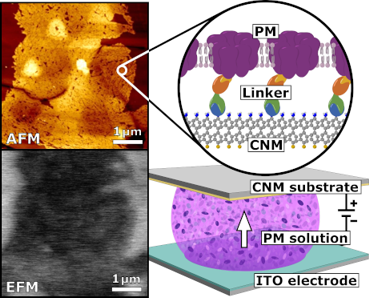
- histidine-tag at the extracellular side of a PM mutant (c-His PM). The functionalization and the resulting hybrid membrane were examined by atomic force microscopy (AFM), scanning electron microscopy (SEM), X-ray photoelectron spectroscopy (XPS), confocal laser scanning microscopy (CLSM), and infrared


Towards 3D self-assembled rolled multiwall carbon nanotube structures by spontaneous peel off
Beilstein J. Nanotechnol. 2020, 11, 1865–1872, doi:10.3762/bjnano.11.168
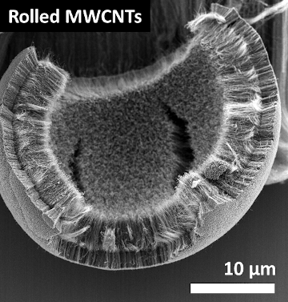
- substrates remain dark, which indicates that MWCNTs are still present. In order to characterize the nature of the peeled-off layer, scanning electron microscopy (SEM) characterization was performed. Figure 1 displays an SEM micrograph of a sample with a C1/N2/C3/N4 structure in which the peeling off was



Self-standing heterostructured NiCx-NiFe-NC/biochar as a highly efficient cathode for lithium–oxygen batteries
Beilstein J. Nanotechnol. 2020, 11, 1809–1821, doi:10.3762/bjnano.11.163
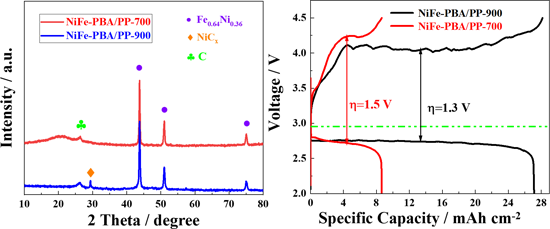
- PANalytical B.V. Empyean X-ray diffractometer with Cu Kα radiation (λ = 1.5406 Å). The surface morphology of the film catalyst was studied via scanning electron microscopy (SEM) on a Carl Zeiss Ultra Plus scanning electron microscope. Transmission electron microscopy (TEM), high-resolution TEM (HR-TEM), and






Electron beam-induced deposition of platinum from Pt(CO)2Cl2 and Pt(CO)2Br2
Beilstein J. Nanotechnol. 2020, 11, 1789–1800, doi:10.3762/bjnano.11.161
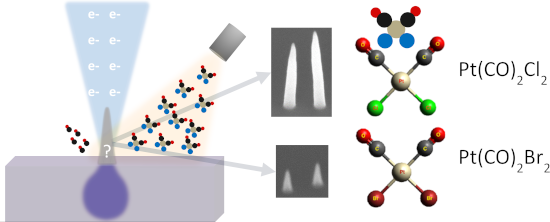
- -dispersive X-ray spectroscopy (EDX); focused electron beam-induced deposition (FEBID); nanofabrication; platinum precursors; scanning electron microscopy (SEM); thermogravimetric analysis (TGA); Introduction Focused electron beam-induced deposition (FEBID) is a direct-write nanopatterning technique. FEBID


A self-powered, flexible ultra-thin Si/ZnO nanowire photodetector as full-spectrum optical sensor and pyroelectric nanogenerator
Beilstein J. Nanotechnol. 2020, 11, 1623–1630, doi:10.3762/bjnano.11.145
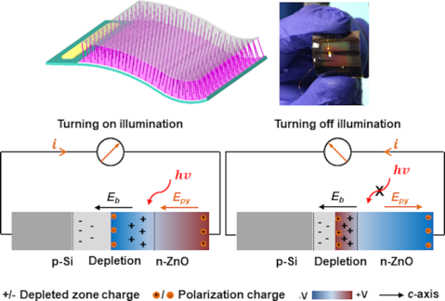
- PD based on a p-Si/n-ZnO NWs heterojunction is illustrated in Figure 1a. A typical cross-sectional scanning electron microscopy (SEM) image of the as-grown Si/ZnO NWs heterojunction is shown in Figure 1b. The uniformly grown ZnO NWs are conducive to a stable short-circuit current output. The detailed


Oxidation of Au/Ag films by oxygen plasma: phase separation and generation of nanoporosity
Beilstein J. Nanotechnol. 2020, 11, 1608–1614, doi:10.3762/bjnano.11.143
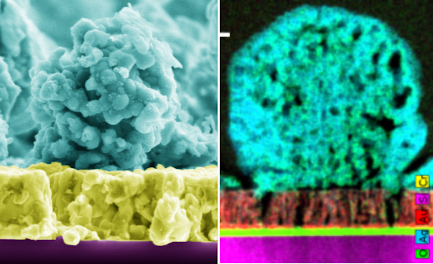
- formation of unique features, consisting of silver oxide nanoporous microspheres (Figure 1). Our observation was supported by various characterization techniques, including scanning electron microscopy (SEM), transmission electron microscopy (TEM) and X-ray diffraction spectroscopy (XRD). We conducted our


High-responsivity hybrid α-Ag2S/Si photodetector prepared by pulsed laser ablation in liquid
Beilstein J. Nanotechnol. 2020, 11, 1596–1607, doi:10.3762/bjnano.11.142
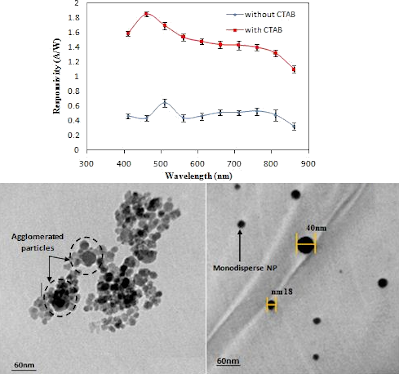
- ) mixed with cationic cetyltrimethylammonium bromide (CTAB) as surfactant. The effect of the CTAB surfactant on the structural, morphological, optical, and elemental composition of Ag2S NPs was evaluated using X-ray diffraction (XRD), transmission electron microscopy (TEM), scanning electron microscopy
- (SEM), energy-dispersive X-ray spectroscopy (EDX), and UV–vis spectroscopy. The optical absorption decreased and the optical energy gap of α-Ag2S increased from 1.5 to 2 eV after the CTAB surfactant was added to the Tu solution. XRD studies revealed that the synthesized Ag2S NPs were polycrystalline




Fabrication of nano/microstructures for SERS substrates using an electrochemical method
Beilstein J. Nanotechnol. 2020, 11, 1568–1576, doi:10.3762/bjnano.11.139
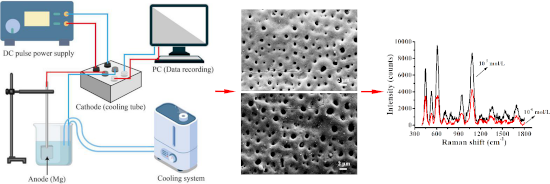
- three-dimensional topographies of the nanopores. Imaging was performed in contact mode and an elastic constant of 0.2 N/m was selected for the silicon cantilever. The scanning area was 50 × 50 μm2. In addition, a scanning electron microscopy (SEM) system (Zeiss, Germany) was employed to characterize the


Electrokinetic characterization of synthetic protein nanoparticles
Beilstein J. Nanotechnol. 2020, 11, 1556–1567, doi:10.3762/bjnano.11.138
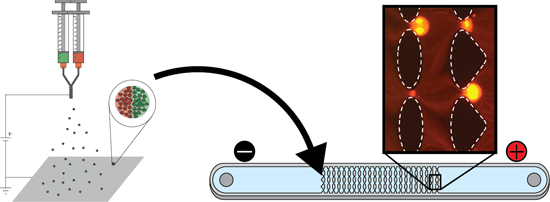
- electrohydrodynamic jetting process, which was used to prepare SPNPs with a single compartment (identical jetting solutions are flown through the needle) as well as two compartments (parallel flow of two different jetting solutions). (b) A scanning electron microscopy (SEM) image demonstrating the morphology of the



Analysis of catalyst surface wetting: the early stage of epitaxial germanium nanowire growth
Beilstein J. Nanotechnol. 2020, 11, 1371–1380, doi:10.3762/bjnano.11.121
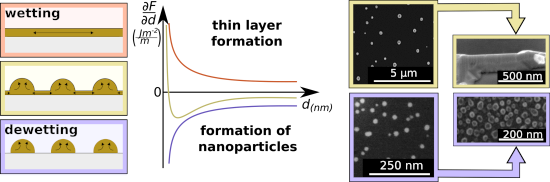
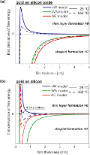
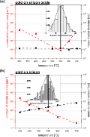
- the results for gold droplet formation on Si(111). A decrease in droplet number and an increase in droplet diameter with increasing temperature can be visualized. The droplet diameter distribution is described by a LSW distribution. Figure 3 shows scanning electron microscopy (SEM) and transmission


Structure and electrochemical performance of electrospun-ordered porous carbon/graphene composite nanofibers
Beilstein J. Nanotechnol. 2020, 11, 1280–1290, doi:10.3762/bjnano.11.112
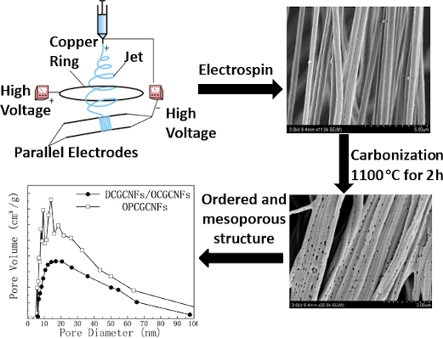
- electron microscopy (SEM) under a field-emission scanning electron microscope (FE-SEM) (Hitachi, S4800, Japan). The structural characteristics of the CNFs were observed via transmission electron microscopy (TEM) (FEI, Tecnai G20, Japan). The diameter values of the CNFs were measured using ImageJ software
- . Afterwards, the tube furnace was cooled to room temperature to obtain CCGNFs, which could be directly used as electrodes. For comparison, disordered CGCNFs were also prepared using electrospinning and carbonization techniques. Material characterization The morphology of the CNFs was investigated via scanning


Gas sorption porosimetry for the evaluation of hard carbons as anodes for Li- and Na-ion batteries
Beilstein J. Nanotechnol. 2020, 11, 1217–1229, doi:10.3762/bjnano.11.106
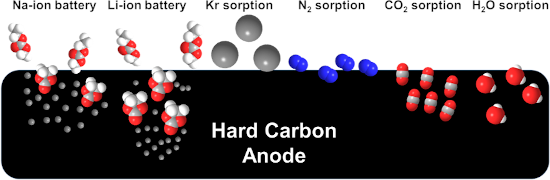
- . The morphologies of the HT samples are very similar (Figure 1), but show a different morphology compared to the RF carbons (Supporting Information File 1, Figure S6). Scanning electron microscopy (SEM) imaging reveals spherical particles, morphologically similar to previously reported HCs derived from
- Ventus 532 nm laser using a power of 25 mW at an exposure time of 10 s), respectively. To investigate the morphology of the samples, scanning electron microscopy (SEM) measurements were performed on a scanning electron microscope (NEOSCOPE JCM-6000, JEOL, Japan, equipped with a tungsten filament at 15 kV


Gram-scale synthesis of splat-shaped Ag–TiO2 nanocomposites for enhanced antimicrobial properties
Beilstein J. Nanotechnol. 2020, 11, 1119–1125, doi:10.3762/bjnano.11.96

- Rigaku D/Max 2500 powder diffractometer with Cu Kα radiation (λ = 1.5406 Å). Scanning electron microscopy (SEM, JSM5610LV, JEOL, Japan) was used to observed the morphology of the Ag–TiO2 NPs. The sample components were examined by energy-dispersive X-ray spectroscopy. Fourier-transform infrared


Plant growth regulation by seed coating with films of alginate and auxin-intercalated layered double hydroxides
Beilstein J. Nanotechnol. 2020, 11, 1082–1091, doi:10.3762/bjnano.11.93
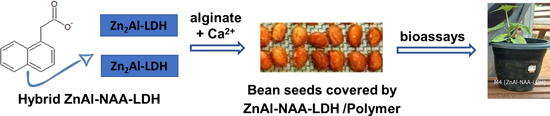
- with indefinitely coherent fragments [28][29]. The volume and average pore diameter values are characteristic of a mesoporous material. Scanning electron microscopy (SEM) images of NAA and ZnAl-NAA-LDH, presented in Figure 4, show the presence of particles with a smooth surface, probably resulting from



Microwave-induced electric discharges on metal particles for the synthesis of inorganic nanomaterials under solvent-free conditions
Beilstein J. Nanotechnol. 2020, 11, 1019–1025, doi:10.3762/bjnano.11.86
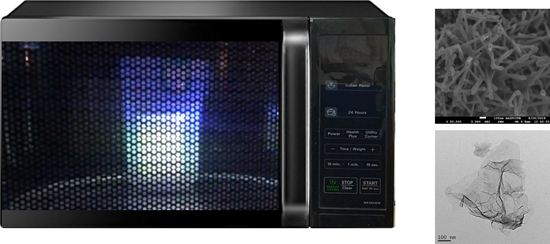
- of Cu2O after acid treatment, while the majority of Cu remains in the metallic form (Figure 1a). Scanning electron microscopy (SEM) images of copper powder before and after acid treatment are shown in Figure 1b and Figure 1c, respectively. The SEM image clearly shows the sharp edges on acid-treated





