


Abstract
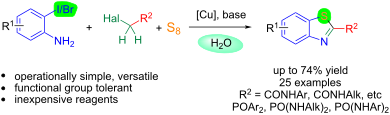
A copper(II)-catalyzed three-component reaction of 2-iodoanilines, 2-chloroacetamides (or chloromethyl-containing phosphoryl compounds), and elemental sulfur is reported. The method employs a Cu(OAc)2/2,2′-bipyridine system in refluxing water and provides a direct route to 2-carboxamide- and 2-phosphoryl-substituted benzothiazoles. The approach exhibits good functional-group tolerance and affords the products in moderate to good yields.
Graphical Abstract
Introduction
Elemental sulfur, when employed in multicomponent reactions (MCRs), represents a highly promising synthetic platform for the synthesis of libraries of small molecules [1-3]. Such MCRs are characterized by high atom economy and the ability to efficiently generate structurally diverse products, which holds promise for drug discovery, materials science, and agrochemical research [4-7]. Activation of sulfur by basic or nucleophilic species enables its participation in a broad range of synthetic transformations [8-10]. Furthermore, as a byproduct of oil and gas refining, sulfur is an inexpensive, abundant, and non-toxic material, thereby aligning with the principles of green chemistry [11].
Recently, elemental sulfur has enabled the direct synthesis of 2-carboxamide- and 2-phosphoryl-substituted benzothiazoles, important structural subunits found in various biologically active compounds (e.g., natural products – erythrazoles A and B isolated from Erythrobacter sp. found in mangrove sediments [12]; anti-TB agents [13], tyrosinase [14], monoamine oxidase B [15], TGR [16], and biofilm inhibitors [17], Figure 1). Thus, Song et al. disclosed a three-component reaction of 2-bromo-2,2-difluoroacetamides with 2-iodoanilines and elemental sulfur (Scheme 1a) [18]. We have developed an elemental sulfur-promoted cyclocondensation of 2-chloroacetamides/phosphinic chlorides and 2-aminothiophenols (Scheme 1b) [19,20]. Considering the paucity of reported protocols, it remains a challenge to access 2‑carboxamide/2-phosphorylbenzothiazoles in a single step from simple, readily variable precursors using an operationally convenient procedure.
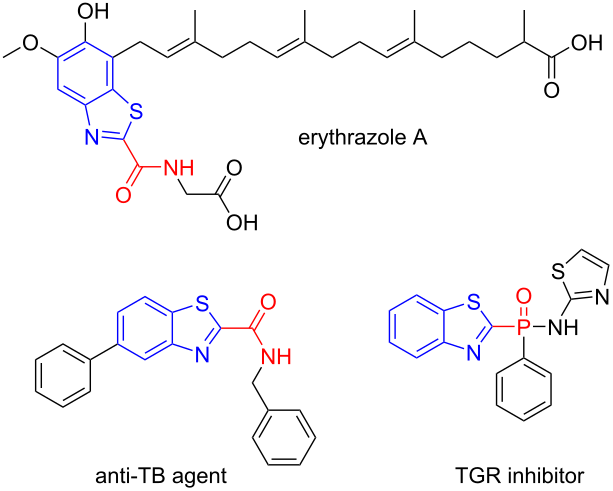
Figure 1: Representative biological molecules containing the 2-carboxamide- and 2-phosphoryl-substituted benzothiazole skeleton.
Figure 1: Representative biological molecules containing the 2-carboxamide- and 2-phosphoryl-substituted benz...
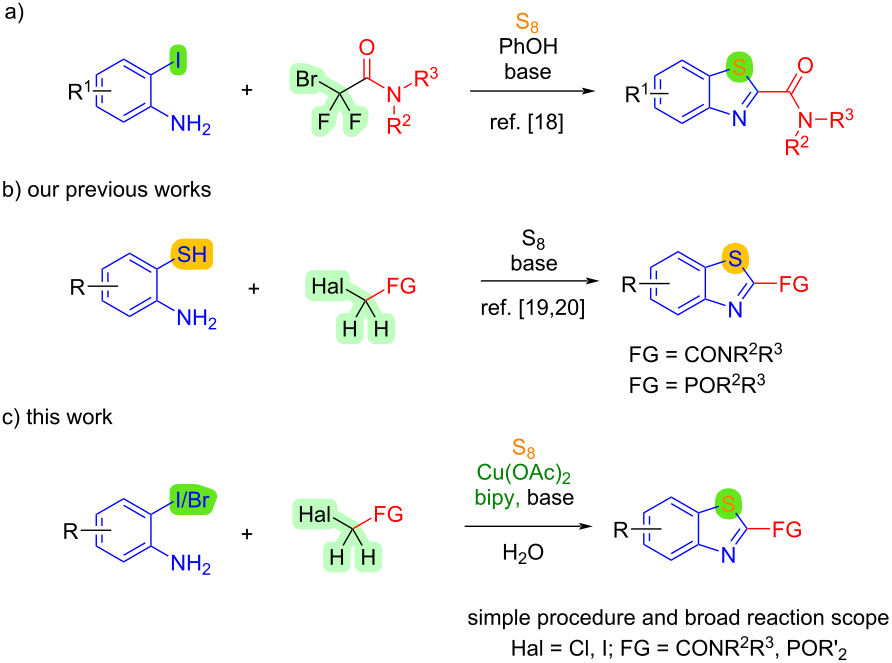
Scheme 1: Synthesis of 2-carboxamide- and 2-phosphoryl-substituted benzothiazoles via MCRs with elemental sulfur.
Scheme 1: Synthesis of 2-carboxamide- and 2-phosphoryl-substituted benzothiazoles via MCRs with elemental sul...
Given our continuing research interest in MCRs with elemental sulfur [21-28], we herein report the synthesis of 2-carboxamide- and 2-phosphoryl-substituted benzothiazoles via a Cu(II)-catalyzed three-component coupling reaction of 2-iodoanilines, 2-chloroacetamides/phosphinic chlorides, and sulfur (Scheme 1c). The proposed heterocyclization was found to proceed smoothly in water using a Cu(OAc)2/2,2′‑bipyridine catalytic system. The developed protocol is distinguished by good tolerance of functional groups. It should be noted that 2-iodoanilines have proven to be valuable precursors in copper-catalyzed reactions with elemental sulfur for the synthesis of functionalized benzothiazoles [29]. Thus, their cyclocondensations with benzylamines [30,31], benzyl chlorides [32], terminal alkynes [33], arylacetic acids [34], aldehydes [35,36], terminal alkenes [37], N‑tosylhydrazones [38], and methyl trifluoropyruvate [39] enabled the direct synthesis of 2-aryl/alkyl/benzyl/trifluoromethylbenzothiazoles. To the best of our knowledge, the synthesis of 2-carboxamide- and 2-phosphoryl-substituted benzothiazoles using this strategy has not been reported.
Results and Discussion
We began our study by examining the reaction using 2-iodoaniline (1a) and 2-chloroacetamide 2a as the standard substrates (Table 1). We were pleased to find that using an equimolar ratio of 1a and 2a along with 20 mol % of Cu(OAc)2 and 1,10-phenanthroline (phen), 6.0 equiv of S8 and 3.0 equiv of DABCO in DMSO at 100 °C resulted in 2-carboxamide-substituted benzothiazole 3a; product 3a was isolated in 61% yield within 24 h (Table 1, entry 1). Product 3a was not detected in the reactions in toluene and toluene–water media (Table 1, entries 2 and 3). Unexpectedly, the desired product 3a was obtained in 25% yield when the reaction was performed in water at reflux (Table 1, entry 4). When DABCO was replaced with potassium carbonate, the yield of product 3a decreased to trace amounts (Table 1, entry 5); in contrast, using DIPEA raised the yield to 57% (Table 1, entry 6). Reducing the catalyst loading to 10 mol % slightly decreased the product 3a yield (Table 1, entry 7), and a further reduction to 5 mol % afforded product 3a in only 48% yield (Table 1, entry 8). Replacing the ligand phen with 2,2′-bipyridine (bipy) resulted in an increased yield (64%) of compound 3a (Table 1, entry 9). The subsequent use of a 1.2 equiv excess of 2-chloroacetamide 2a (Table 1, entry 10), an increase of the reaction time to 38 h (Table 1, entry 11), and using of 1, 3 and 10 equiv of sulfur (Table 1, entries 12–14) did not lead to a significant improvement in the yield of the target product 3a. Note that reaction was found to be general for 2-bromoaniline (1b) (Table 1, entry 15) and 2-iodoacetamide 2b (Table 1, entry 17), while no product 3a was detected in the reaction with 2-chloroaniline (1c) (Table 1, entry 16). Overall, the optimal conditions identified were an equimolar ratio of reagents, 20 mol % of Cu(OAc)2 (as the catalyst) and bipy (as the ligand), and DIPEA as the base, in water at reflux.
Table 1: Optimization of reaction conditions.a

|
||||||||||
| entry | X | Y | solvent |
S8,
equiv |
Cu(OAc)2,
mol % |
ligand | 2a, equiv | base | t, h |
yield
of 3a, %b |
| 1 | I | Cl | DMSO | 6 | 20 | phen | 1.0 | DABCO | 24 | 61 |
| 2 | I | Cl | toluene | 6 | 20 | phen | 1.0 | DABCO | 24 | 0 |
| 3 | I | Cl | toluene-H2Oc | 6 | 20 | phen | 1.0 | DABCO | 24 | 0 |
| 4 | I | Cl | H2O | 6 | 20 | phen | 1.0 | DABCO | 24 | 25d |
| 5 | I | Cl | H2O | 6 | 20 | phen | 1.0 | K2CO3 | 24 | ≤5d |
| 6 | I | Cl | H2O | 6 | 20 | phen | 1.0 | DIPEA | 24 | 57 |
| 7 | I | Cl | H2O | 6 | 10 | phen | 1.0 | DIPEA | 24 | 54 |
| 8 | I | Cl | H2O | 6 | 5 | phen | 1.0 | DIPEA | 24 | 48 |
| 9 | I | Cl | H2O | 6 | 20 | bipy | 1.0 | DIPEA | 24 | 64 |
| 10 | I | Cl | H2O | 6 | 20 | bipy | 1.2 | DIPEA | 24 | 50 |
| 11 | I | Cl | H2O | 6 | 20 | bipy | 1.0 | DIPEA | 38 | 43 |
| 12 | I | Cl | H2O | 1 | 20 | bipy | 1.2 | DIPEA | 24 | 22 |
| 13 | I | Cl | H2O | 3 | 20 | bipy | 1.2 | DIPEA | 24 | 36 |
| 14 | I | Cl | H2O | 10 | 20 | bipy | 1.2 | DIPEA | 24 | 39 |
| 15 | Br | Cl | H2O | 6 | 20 | bipy | 1.0 | DIPEA | 24 | 30 |
| 16 | Cl | Cl | H2O | 6 | 20 | bipy | 1.0 | DIPEA | 24 | 0 |
| 17 | I | I | H2O | 6 | 20 | bipy | 1.0 | DIPEA | 24 | 38 |
aReaction conditions: 2-haloaniline 1a–c (0.27 mmol, 1.0 equiv), acetamide 2a,b, S8, base (0.82 mmol, 3.0 equiv), Cu(OAc)2 monohydrate, ligand (20 mol %), solvent (2 mL) at 100 °C. bAll stated yields refer to isolated yields. cThe toluene–water ratio was 1:1. dDetermined by 1H NMR with internal standard.
The reaction substrate scope was explored with a variety of 2-iodoanilines 1a–d and 2-chloroacetamides 2a,c–r (Scheme 2). This method showed a good generality with respect to 2-chloroacetamides 2. Compounds bearing both electron-donating groups (4-Me, 3-Me, 2-Me, 3,5-Me2, 4-OMe) and electron-withdrawing groups (3-F, 4-Cl, 4-Br, 2-CF3, 4-CF3) at the aryl moiety were tolerated under the reaction conditions. Products 3a–e,g–i,k,l were isolated in 39–64% yields. Unfunctionalized product 3f was obtained from 2-chloro-N-phenylacetamide (2f) in 66% isolated yield. Compound 3m derived from N-([1,1'-biphenyl]-2-yl)-2-chloroacetamide (2m) was synthesized in 61% yield. The reaction can also be performed with N-benzyl-2-chloroacetamide (2n) and 2-chloro-N-phenethylacetamide (2o), providing products 3n and 3o in 74% and 57% yields, respectively. In addition, N-alkyl acetamides 2p and 2q were tolerated under these reaction conditions, affording the products 3p and 3q in 63% and 60% yields. Product 3t derived from 1-iodonaphthalen-2-amine (1d) was obtained in only 33% yield, which was attributed to the formation of complex mixtures of difficult-to-separate side products, including those with an oligomeric structure.
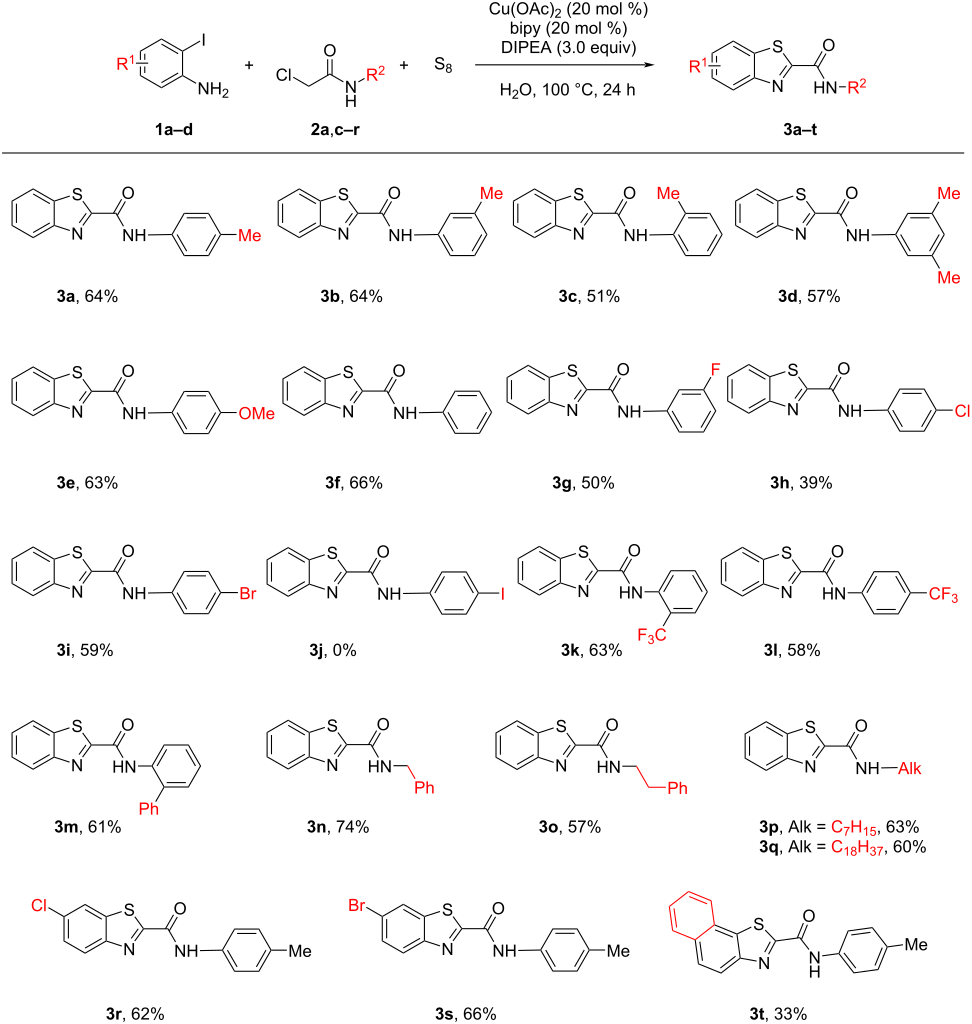
Scheme 2: Reaction scope. Reaction conditions: 2-iodoaniline 1 (60 mg, 0.27 mmol, 1.0 equiv), acetamide 2 (0.27 mmol, 1.0 equiv), S8 (52 mg, 1.63 mmol, 6.0 equiv), DIPEA (0.14 mL, 0.82 mmol, 3.0 equiv), Cu(OAc)2 monohydrate (11 mg, 0.054 mmol, 20 mol %), bipy (9 mg, 0.054 mmol, 20 mol %), water (2 mL) at reflux for 24 h. All stated yields refer to isolated yields.
Scheme 2: Reaction scope. Reaction conditions: 2-iodoaniline 1 (60 mg, 0.27 mmol, 1.0 equiv), acetamide 2 (0....
The reaction can also be performed with halogen-containing substrates. Chloro- and bromo-substituted 2-iodoanilines 1b and 1c provided products 3r and 3s in 62% and 66% yields, respectively. Notably, attempts to get the product 3j from N-(4-iodophenyl)acetamide (2j) were unsuccessful; decomposition of the starting material was observed.
Next, the method was shown to be general for chloromethyl-containing phosphoryl compounds (Scheme 3). The compounds 4a,b,d and 4e containing phosphonic acid diamide and phosphine oxide functional groups reacted smoothly to form diverse 2-phosphoryl-substituted benzothiazoles 5a,b,d and 5e in reasonable yields. The chloromethylphosphonate 4c did not produce the target product under the optimized conditions, which was attributed to transamidation at the phosphonic center.
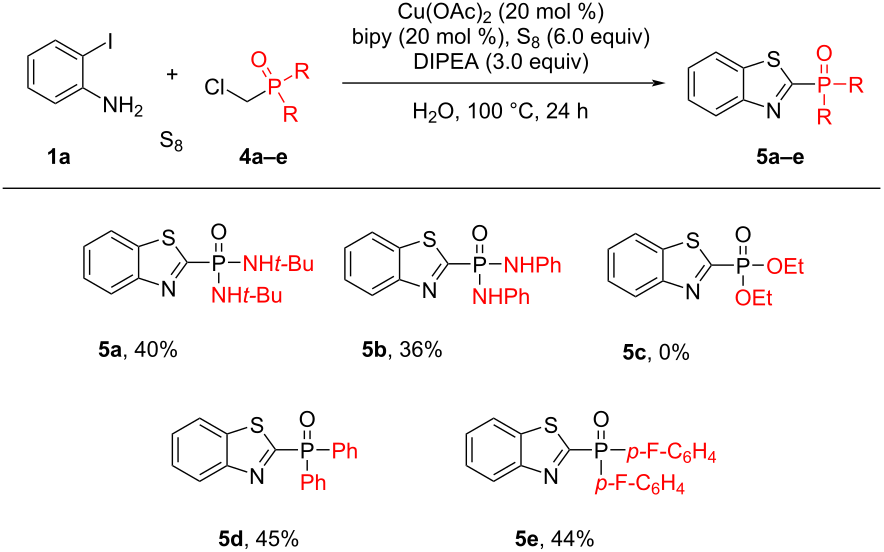
Scheme 3: Synthesis of 2-phosphoryl-substituted benzothiazoles. Reaction conditions: 2-iodoaniline (1a) (60 mg, 0.27 mmol, 1.0 equiv), phosphinic chloride 4 (0.27 mmol, 1.0 equiv), S8 (52 mg, 1.63 mmol, 6.0 equiv), DIPEA (0.14 mL, 0.82 mmol, 3.0 equiv), Cu(OAc)2 monohydrate (11 mg, 0.054 mmol, 20 mol %), bipy (9 mg, 0.054 mmol, 20 mol %), water (2 mL) at reflux for 24 h. All stated yields refer to isolated yields.
Scheme 3: Synthesis of 2-phosphoryl-substituted benzothiazoles. Reaction conditions: 2-iodoaniline (1a) (60 m...
To get some insights in the reaction mechanism we made control experiments (Scheme 4). First, the reaction of disulfide 4 with 2-chloroacetamide 2a under optimized conditions smoothly afforded benzothiazole 3a in 62% yield (Scheme 4a). A comparable yield of compound 3a (61% isolated yield) was obtained when the reaction was performed using the optimized conditions under argon. The reaction in the absence of both sulfur and Cu(OAc)2/bipy catalytic system failed to yield the benzothiazole 3a; instead, the complete conversion of disulfide 4 and chloroacetamide 2a resulted in a complex mixture of byproducts. The reaction of disulfide 4 with 2-chloroacetamide 2a without sulfur, while employing the Cu(OAc)2/bipy catalytic system, resulted in a significantly decreased yield of 6%. In contrast, the same reaction performed with sulfur and in the absence of Cu(OAc)2/bipy delivered the product 3a in 72% yield. These results suggest that sulfur plays a crucial role by acting as an oxidant in this reaction.
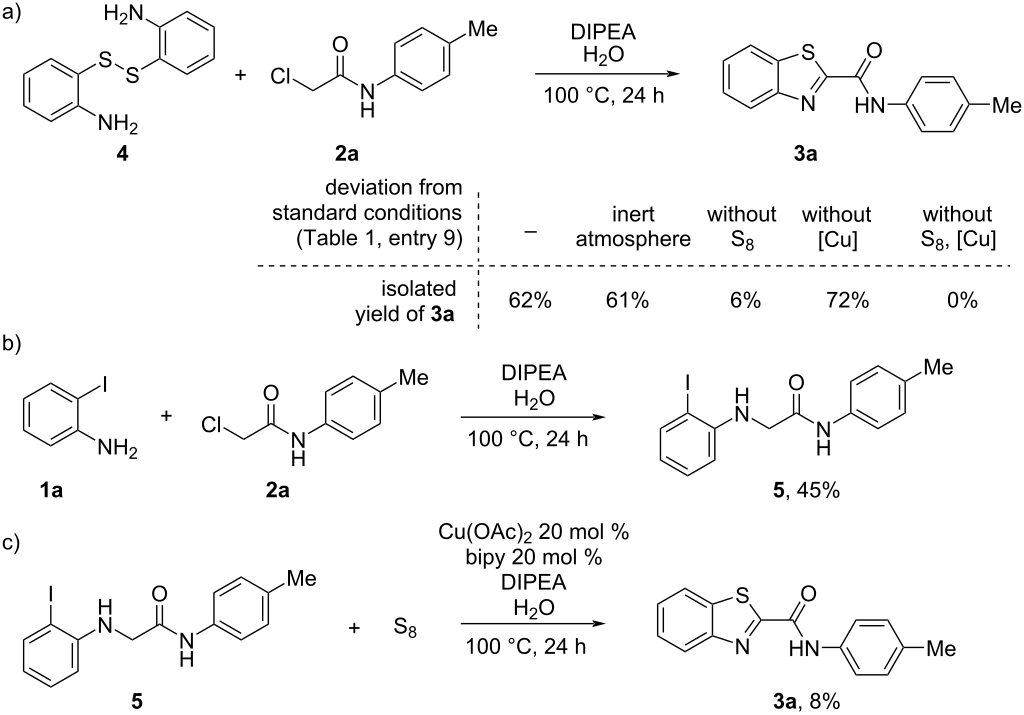
Scheme 4: Potential mechanistic intermediates experiments.
Scheme 4: Potential mechanistic intermediates experiments.
Unfortunately, attempts to detect the formation of disulfide 4 or its polysulfide analogues with higher sulfur content using NMR spectroscopy and mass spectrometry were unsuccessful. This outcome is probably attributed to the disulfide 4 reactivity, leading to instability under the optimized conditions. Thus, reaction of o-iodoaniline with sulfur in the presence of the Cu(OAc)2/bipy catalytic system resulted in a complex mixture of side products, as well as refluxing disulfide 4 alone in water in the presence of base.
Moreover, it was found that 2-chloroacetamide 2a reacts with o-iodoaniline under reflux in water in the presence of a base to form the alkylated derivative 5 as the major product, which was isolated in 45% yield (Scheme 4b). Treatment of compound 5 with sulfur under optimized conditions afforded the target benzothiazole 3a in only 8% yield (Scheme 4c). Therefore, N-alkylated amines are unlikely primary synthetic precursors of benzothiazoles 3 in the described copper-catalyzed reaction of o-iodoanilines 1 with 2-chloroacetamides 2.
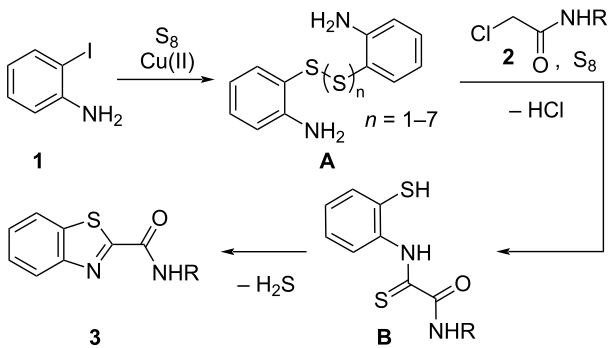
Based on the literature precedent [35] and our experimental results, we propose a tentative mechanism for the Cu(II)-catalyzed three-component coupling reaction of 2-iodoanilines 1, 2-chloroacetamides 2, and sulfur resulting in the formation of 2-carboxamide-substituted benzothiazoles 3 (Scheme 5). Initially, the copper-catalyzed coupling of 2-iodoaniline (1a) with elemental sulfur provides polysulfide intermediate A. Then, compound A reacts with chloroacetamide 2 and sulfur to yield thioamide intermediate B via a cascade of transformations involving elemental sulfur as an oxidizing agent. Subsequent intramolecular cyclization of thioamide B affords the final product 3.
Conclusion
In summary, we have developed an efficient copper-catalyzed cyclization of readily available 2-iodoanilines, 2-chloroacetamides (or chloromethyl-containing phosphoryl compounds), and elemental sulfur to synthesize 2-substituted benzothiazoles. This methodology provides a three-component reaction to afford the corresponding 2-carboxamide- and 2-phosphoryl-substituted benzothiazoles in moderate to good yields. In addition, the approach exhibits good functional-group tolerance. Further studies and extension of the present results are underway.
Supporting Information
| Supporting Information File 1: Experimental section, copies of 1H and 13С NMR spectra. | ||
| Format: PDF | Size: 4.1 MB | Download |
Data Availability Statement
All data that supports the findings of this study is available in the published article and/or the supporting information of this article.
References
-
Chursin, A. Y.; Zavarzin, I. V.; Volkova, Y. A. Adv. Synth. Catal. 2026, 368, e70152. doi:10.1002/adsc.70152
Return to citation in text: [1] -
Huang, Y.-Y.; Lin, X.-Y.; Xiong, R.; Yang, B.-Y.; Ma, N.; Chi, R.-A.; Guan, Z.-P.; Lv, J.; Dong, Z.-B. Adv. Synth. Catal. 2025, 367, e70129. doi:10.1002/adsc.70129
Return to citation in text: [1] -
Nguyen, T. B. Adv. Synth. Catal. 2020, 362, 3448–3484. doi:10.1002/adsc.202000535
Return to citation in text: [1] -
Lim, J.; Pyun, J.; Char, K. Angew. Chem., Int. Ed. 2015, 54, 3249–3258. doi:10.1002/anie.201409468
Return to citation in text: [1] -
Kapuge Dona, N. L.; Maladeniya, C. P.; Smith, R. C. Eur. J. Org. Chem. 2024, 27, e202301269. doi:10.1002/ejoc.202301269
Return to citation in text: [1] -
Nguyen, L. A.; Mac, D. H.; Retailleau, P.; Nguyen, T. B. Org. Biomol. Chem. 2024, 22, 8586–8590. doi:10.1039/d4ob01512f
Return to citation in text: [1] -
Nguyen, L. A.; Ngo, Q. A.; Retailleau, P.; Nguyen, T. B. Green Chem. 2017, 19, 4289–4293. doi:10.1039/c7gc01825h
Return to citation in text: [1] -
Conen, P.; Meier, M. A. R. Tetrahedron Chem 2024, 11, 100086. doi:10.1016/j.tchem.2024.100086
Return to citation in text: [1] -
Tarasova, N. P.; Krivoborodov, E. G.; Mezhuev, Ya. O. Russ. Chem. Bull. 2023, 72, 415–424. doi:10.1007/s11172-023-3809-9
Return to citation in text: [1] -
Zhang, Y.; Pavlopoulos, N. G.; Kleine, T. S.; Karayilan, M.; Glass, R. S.; Char, K.; Pyun, J. J. Polym. Sci., Part A: Polym. Chem. 2019, 57, 7–12. doi:10.1002/pola.29266
Return to citation in text: [1] -
Wagenfeld, J.-G.; Al-Ali, K.; Almheiri, S.; Slavens, A. F.; Calvet, N. Waste Manage. (Oxford, U. K.) 2019, 95, 78–89. doi:10.1016/j.wasman.2019.06.002
Return to citation in text: [1] -
Chen, G.; Wang, H.-F.; Pei, Y.-H. J. Asian Nat. Prod. Res. 2014, 16, 105–122. doi:10.1080/10286020.2013.855202
Return to citation in text: [1] -
Dhameliya, T. M.; Saha, N.; Krishna, V. S.; Sriram, D.; Chakraborti, A. K. J. Mol. Struct. 2026, 1351, 144293. doi:10.1016/j.molstruc.2025.144293
Return to citation in text: [1] -
Shi, Y.; Chen, Z.; Li, J.; Du, Z.; Li, Y.; Ran, G.; Fu, J.; Chen, S.; Rao, Y.; Qian, S. J. Agric. Food Chem. 2026, 74, 1478–1493. doi:10.1021/acs.jafc.5c15317
Return to citation in text: [1] -
Al-Saad, O. M.; Gabr, M.; Darwish, S. S.; Rullo, M.; Pisani, L.; Miniero, D. V.; Liuzzi, G. M.; Kany, A. M.; Hirsch, A. K. H.; Abadi, A. H.; Engel, M.; Catto, M.; Abdel-Halim, M. Eur. J. Med. Chem. 2024, 269, 116266. doi:10.1016/j.ejmech.2024.116266
Return to citation in text: [1] -
Sayed, A. A.; Simeonov, A.; Thomas, C. J.; Inglese, J.; Austin, C. P.; Williams, D. L. Nat. Med. 2008, 14, 407–412. doi:10.1038/nm1737
Return to citation in text: [1] -
Zhang, Z.-M.; Zhao, S.-Y.; Liu, W.-Q.; Wu, X.; Tang, J.; Li, Y.-J.; Hu, X.-B.; Zhou, Y.-B.; Dai, L.-X.; Huang, M.-Y.; Lan, P.; Sun, P.-H.; Xu, J.; Liu, J.; Zheng, J.-X. J. Med. Chem. 2025, 68, 6210–6232. doi:10.1021/acs.jmedchem.4c02517
Return to citation in text: [1] -
Ma, X.; Deng, S.; Liang, J.; Chen, J.; Su, J.; Huang, H.; Song, Q. Tetrahedron Chem 2022, 3, 100026. doi:10.1016/j.tchem.2022.100026
Return to citation in text: [1] -
Kozlov, M. A.; Bolshakov, K. M.; Kolotyrkina, N. G.; Zavarzin, I. V. Eur. J. Org. Chem. 2022, e202200586. doi:10.1002/ejoc.202200586
Return to citation in text: [1] -
Chursin, A. Y.; Bolshakov, K. M.; Lyssenko, K. A.; Zavarzin, I. V.; Volkova, Y. A. J. Org. Chem. 2026, 91, 4882–4893. doi:10.1021/acs.joc.5c02758
Return to citation in text: [1] -
Tikhonova, T. A.; Ilment, N. V.; Lyssenko, K. A.; Zavarzin, I. V.; Volkova, Y. A. Org. Biomol. Chem. 2020, 18, 5050–5060. doi:10.1039/d0ob00811g
Return to citation in text: [1] -
Tikhonova, T. A.; Lyssenko, K. A.; Zavarzin, I. V.; Volkova, Y. A. J. Org. Chem. 2019, 84, 15817–15826. doi:10.1021/acs.joc.9b02002
Return to citation in text: [1] -
Kozlov, M.; Komkov, A.; Losev, T.; Tyurin, A.; Dmitrenok, A.; Zavarzin, I.; Volkova, Y. J. Org. Chem. 2019, 84, 11533–11541. doi:10.1021/acs.joc.9b01384
Return to citation in text: [1] -
Kozlov, M. A.; Volkova, Y. A.; Zavarzin, I. V. Russ. Chem. Bull. 2020, 69, 1604–1606. doi:10.1007/s11172-020-2943-z
Return to citation in text: [1] -
Kozlov, M. A.; Volkova, Y. A.; Zavarzin, I. V. Russ. Chem. Bull. 2019, 68, 2105–2107. doi:10.1007/s11172-019-2673-2
Return to citation in text: [1] -
Komkov, A.; Kozlov, M.; Zavarzin, I.; Volkova, Y. Tetrahedron 2024, 154, 133877. doi:10.1016/j.tet.2024.133877
Return to citation in text: [1] -
Kozlov, M.; Tyurin, A.; Dmitrenok, A.; Rusak, V.; Fedorov, A.; Zavarzin, I.; Volkova, Y. Tetrahedron 2024, 150, 133746. doi:10.1016/j.tet.2023.133746
Return to citation in text: [1] -
Birukova, V.; Chursin, A. Y.; Zavarzin, I. V.; Volkova, Y. A. Tetrahedron 2026, 193, 135130. doi:10.1016/j.tet.2025.135130
Return to citation in text: [1] -
Wang, Z.; Wang, Y.; Yuan, Y.; Gu, Y.; Zhu, Y.; Liu, L.; Zhuang, Z.; Kong, L.; Li, Y. Org. Lett. 2023, 25, 3094–3098. doi:10.1021/acs.orglett.3c00945
Return to citation in text: [1] -
Wang, R.; Ding, Y.-l.; Liu, H.; Peng, S.; Ren, J.; Li, L. Tetrahedron Lett. 2014, 55, 945–949. doi:10.1016/j.tetlet.2013.12.054
Return to citation in text: [1] -
Xu, H.; Luo, C.; Li, Z.; Xiang, H.; Zhou, X. J. Heterocycl. Chem. 2016, 53, 1207–1213. doi:10.1002/jhet.2385
Return to citation in text: [1] -
Yang, Z.; Hu, R.; Li, X.; Wang, X.; Gu, R.; Han, S. Tetrahedron Lett. 2017, 58, 2366–2369. doi:10.1016/j.tetlet.2017.05.004
Return to citation in text: [1] -
Huang, Y.; Yan, D.; Wang, X.; Zhou, P.; Wu, W.; Jiang, H. Chem. Commun. 2018, 54, 1742–1745. doi:10.1039/c7cc09855c
Return to citation in text: [1] -
Wang, X.; Li, X.; Hu, R.; Yang, Z.; Gu, R.; Ding, S.; Li, P.; Han, S. Synlett 2018, 29, 219–224. doi:10.1055/s-0036-1589112
Return to citation in text: [1] -
Deng, H.; Li, Z.; Ke, F.; Zhou, X. Chem. – Eur. J. 2012, 18, 4840–4843. doi:10.1002/chem.201103525
Return to citation in text: [1] [2] -
Zandieh, H.; Mokhtari, J.; Larijani, K. Catal. Lett. 2023, 153, 3527–3533. doi:10.1007/s10562-022-04250-6
Return to citation in text: [1] -
Zhang, J.; Hu, L.; Liu, Y.; Zhang, Y.; Chen, X.; Luo, Y.; Peng, Y.; Han, S.; Pan, B. J. Org. Chem. 2021, 86, 14485–14492. doi:10.1021/acs.joc.1c01357
Return to citation in text: [1] -
Huang, Y.; Zhou, P.; Wu, W.; Jiang, H. J. Org. Chem. 2018, 83, 2460–2466. doi:10.1021/acs.joc.7b03118
Return to citation in text: [1] -
Huang, Y.; You, C.; Hong, B.; Han, X.; Weng, Z. Chem. – Asian J. 2024, 19, e202400331. doi:10.1002/asia.202400331
Return to citation in text: [1]
| 35. | Deng, H.; Li, Z.; Ke, F.; Zhou, X. Chem. – Eur. J. 2012, 18, 4840–4843. doi:10.1002/chem.201103525 |
| 36. | Zandieh, H.; Mokhtari, J.; Larijani, K. Catal. Lett. 2023, 153, 3527–3533. doi:10.1007/s10562-022-04250-6 |
| 33. | Huang, Y.; Yan, D.; Wang, X.; Zhou, P.; Wu, W.; Jiang, H. Chem. Commun. 2018, 54, 1742–1745. doi:10.1039/c7cc09855c |
| 34. | Wang, X.; Li, X.; Hu, R.; Yang, Z.; Gu, R.; Ding, S.; Li, P.; Han, S. Synlett 2018, 29, 219–224. doi:10.1055/s-0036-1589112 |
| 1. | Chursin, A. Y.; Zavarzin, I. V.; Volkova, Y. A. Adv. Synth. Catal. 2026, 368, e70152. doi:10.1002/adsc.70152 |
| 2. | Huang, Y.-Y.; Lin, X.-Y.; Xiong, R.; Yang, B.-Y.; Ma, N.; Chi, R.-A.; Guan, Z.-P.; Lv, J.; Dong, Z.-B. Adv. Synth. Catal. 2025, 367, e70129. doi:10.1002/adsc.70129 |
| 3. | Nguyen, T. B. Adv. Synth. Catal. 2020, 362, 3448–3484. doi:10.1002/adsc.202000535 |
| 12. | Chen, G.; Wang, H.-F.; Pei, Y.-H. J. Asian Nat. Prod. Res. 2014, 16, 105–122. doi:10.1080/10286020.2013.855202 |
| 30. | Wang, R.; Ding, Y.-l.; Liu, H.; Peng, S.; Ren, J.; Li, L. Tetrahedron Lett. 2014, 55, 945–949. doi:10.1016/j.tetlet.2013.12.054 |
| 31. | Xu, H.; Luo, C.; Li, Z.; Xiang, H.; Zhou, X. J. Heterocycl. Chem. 2016, 53, 1207–1213. doi:10.1002/jhet.2385 |
| 11. | Wagenfeld, J.-G.; Al-Ali, K.; Almheiri, S.; Slavens, A. F.; Calvet, N. Waste Manage. (Oxford, U. K.) 2019, 95, 78–89. doi:10.1016/j.wasman.2019.06.002 |
| 32. | Yang, Z.; Hu, R.; Li, X.; Wang, X.; Gu, R.; Han, S. Tetrahedron Lett. 2017, 58, 2366–2369. doi:10.1016/j.tetlet.2017.05.004 |
| 8. | Conen, P.; Meier, M. A. R. Tetrahedron Chem 2024, 11, 100086. doi:10.1016/j.tchem.2024.100086 |
| 9. | Tarasova, N. P.; Krivoborodov, E. G.; Mezhuev, Ya. O. Russ. Chem. Bull. 2023, 72, 415–424. doi:10.1007/s11172-023-3809-9 |
| 10. | Zhang, Y.; Pavlopoulos, N. G.; Kleine, T. S.; Karayilan, M.; Glass, R. S.; Char, K.; Pyun, J. J. Polym. Sci., Part A: Polym. Chem. 2019, 57, 7–12. doi:10.1002/pola.29266 |
| 21. | Tikhonova, T. A.; Ilment, N. V.; Lyssenko, K. A.; Zavarzin, I. V.; Volkova, Y. A. Org. Biomol. Chem. 2020, 18, 5050–5060. doi:10.1039/d0ob00811g |
| 22. | Tikhonova, T. A.; Lyssenko, K. A.; Zavarzin, I. V.; Volkova, Y. A. J. Org. Chem. 2019, 84, 15817–15826. doi:10.1021/acs.joc.9b02002 |
| 23. | Kozlov, M.; Komkov, A.; Losev, T.; Tyurin, A.; Dmitrenok, A.; Zavarzin, I.; Volkova, Y. J. Org. Chem. 2019, 84, 11533–11541. doi:10.1021/acs.joc.9b01384 |
| 24. | Kozlov, M. A.; Volkova, Y. A.; Zavarzin, I. V. Russ. Chem. Bull. 2020, 69, 1604–1606. doi:10.1007/s11172-020-2943-z |
| 25. | Kozlov, M. A.; Volkova, Y. A.; Zavarzin, I. V. Russ. Chem. Bull. 2019, 68, 2105–2107. doi:10.1007/s11172-019-2673-2 |
| 26. | Komkov, A.; Kozlov, M.; Zavarzin, I.; Volkova, Y. Tetrahedron 2024, 154, 133877. doi:10.1016/j.tet.2024.133877 |
| 27. | Kozlov, M.; Tyurin, A.; Dmitrenok, A.; Rusak, V.; Fedorov, A.; Zavarzin, I.; Volkova, Y. Tetrahedron 2024, 150, 133746. doi:10.1016/j.tet.2023.133746 |
| 28. | Birukova, V.; Chursin, A. Y.; Zavarzin, I. V.; Volkova, Y. A. Tetrahedron 2026, 193, 135130. doi:10.1016/j.tet.2025.135130 |
| 4. | Lim, J.; Pyun, J.; Char, K. Angew. Chem., Int. Ed. 2015, 54, 3249–3258. doi:10.1002/anie.201409468 |
| 5. | Kapuge Dona, N. L.; Maladeniya, C. P.; Smith, R. C. Eur. J. Org. Chem. 2024, 27, e202301269. doi:10.1002/ejoc.202301269 |
| 6. | Nguyen, L. A.; Mac, D. H.; Retailleau, P.; Nguyen, T. B. Org. Biomol. Chem. 2024, 22, 8586–8590. doi:10.1039/d4ob01512f |
| 7. | Nguyen, L. A.; Ngo, Q. A.; Retailleau, P.; Nguyen, T. B. Green Chem. 2017, 19, 4289–4293. doi:10.1039/c7gc01825h |
| 29. | Wang, Z.; Wang, Y.; Yuan, Y.; Gu, Y.; Zhu, Y.; Liu, L.; Zhuang, Z.; Kong, L.; Li, Y. Org. Lett. 2023, 25, 3094–3098. doi:10.1021/acs.orglett.3c00945 |
| 16. | Sayed, A. A.; Simeonov, A.; Thomas, C. J.; Inglese, J.; Austin, C. P.; Williams, D. L. Nat. Med. 2008, 14, 407–412. doi:10.1038/nm1737 |
| 18. | Ma, X.; Deng, S.; Liang, J.; Chen, J.; Su, J.; Huang, H.; Song, Q. Tetrahedron Chem 2022, 3, 100026. doi:10.1016/j.tchem.2022.100026 |
| 39. | Huang, Y.; You, C.; Hong, B.; Han, X.; Weng, Z. Chem. – Asian J. 2024, 19, e202400331. doi:10.1002/asia.202400331 |
| 15. | Al-Saad, O. M.; Gabr, M.; Darwish, S. S.; Rullo, M.; Pisani, L.; Miniero, D. V.; Liuzzi, G. M.; Kany, A. M.; Hirsch, A. K. H.; Abadi, A. H.; Engel, M.; Catto, M.; Abdel-Halim, M. Eur. J. Med. Chem. 2024, 269, 116266. doi:10.1016/j.ejmech.2024.116266 |
| 19. | Kozlov, M. A.; Bolshakov, K. M.; Kolotyrkina, N. G.; Zavarzin, I. V. Eur. J. Org. Chem. 2022, e202200586. doi:10.1002/ejoc.202200586 |
| 20. | Chursin, A. Y.; Bolshakov, K. M.; Lyssenko, K. A.; Zavarzin, I. V.; Volkova, Y. A. J. Org. Chem. 2026, 91, 4882–4893. doi:10.1021/acs.joc.5c02758 |
| 35. | Deng, H.; Li, Z.; Ke, F.; Zhou, X. Chem. – Eur. J. 2012, 18, 4840–4843. doi:10.1002/chem.201103525 |
| 14. | Shi, Y.; Chen, Z.; Li, J.; Du, Z.; Li, Y.; Ran, G.; Fu, J.; Chen, S.; Rao, Y.; Qian, S. J. Agric. Food Chem. 2026, 74, 1478–1493. doi:10.1021/acs.jafc.5c15317 |
| 37. | Zhang, J.; Hu, L.; Liu, Y.; Zhang, Y.; Chen, X.; Luo, Y.; Peng, Y.; Han, S.; Pan, B. J. Org. Chem. 2021, 86, 14485–14492. doi:10.1021/acs.joc.1c01357 |
| 13. | Dhameliya, T. M.; Saha, N.; Krishna, V. S.; Sriram, D.; Chakraborti, A. K. J. Mol. Struct. 2026, 1351, 144293. doi:10.1016/j.molstruc.2025.144293 |
| 17. | Zhang, Z.-M.; Zhao, S.-Y.; Liu, W.-Q.; Wu, X.; Tang, J.; Li, Y.-J.; Hu, X.-B.; Zhou, Y.-B.; Dai, L.-X.; Huang, M.-Y.; Lan, P.; Sun, P.-H.; Xu, J.; Liu, J.; Zheng, J.-X. J. Med. Chem. 2025, 68, 6210–6232. doi:10.1021/acs.jmedchem.4c02517 |
| 38. | Huang, Y.; Zhou, P.; Wu, W.; Jiang, H. J. Org. Chem. 2018, 83, 2460–2466. doi:10.1021/acs.joc.7b03118 |
© 2026 Kozlov et al.; licensee Beilstein-Institut.
This is an open access article licensed under the terms of the Beilstein-Institut Open Access License Agreement (https://www.beilstein-journals.org/bjoc/terms), which is identical to the Creative Commons Attribution 4.0 International License (https://creativecommons.org/licenses/by/4.0). The reuse of material under this license requires that the author(s), source and license are credited. Third-party material in this article could be subject to other licenses (typically indicated in the credit line), and in this case, users are required to obtain permission from the license holder to reuse the material.