


Abstract
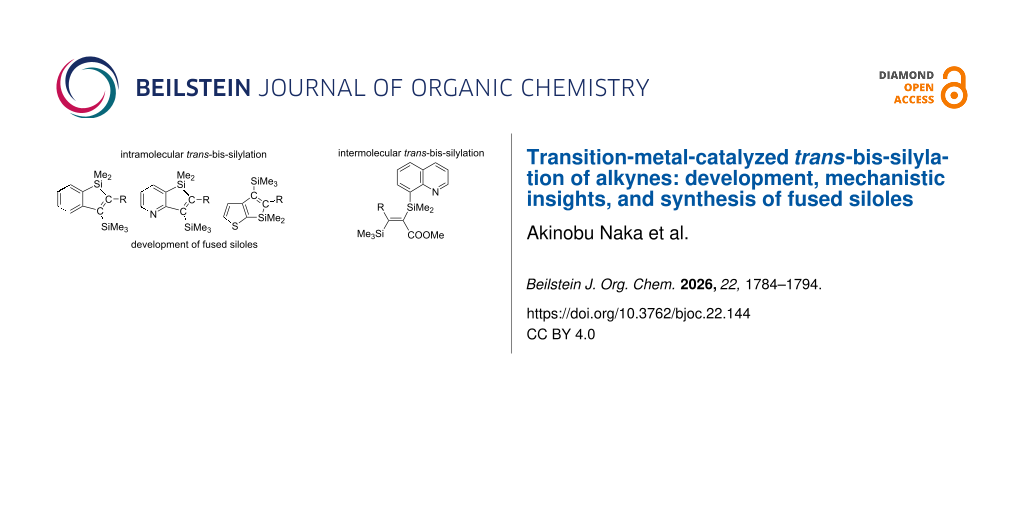
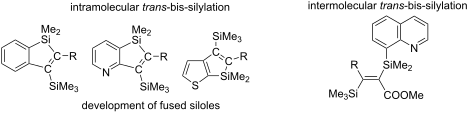
Transition-metal-catalyzed bis-silylation of alkynes is an atom-economical strategy for constructing two carbon–silicon bonds in a single transformation. Classical bis-silylation reactions generally proceed through cis addition of a Si–Si bond to an unsaturated substrate, whereas trans-bis-silylation is much less common and requires control of both Si–Si bond activation and the stereochemical course of C–Si bond formation. Intramolecular trans-bis-silylation has emerged as a particularly useful route to fused siloles. This review traces the development of transition-metal-catalyzed trans-bis-silylation from the rhodium(I)-catalyzed cyclization of (2-alkynylphenyl)disilanes to palladium- and rhodium-catalyzed syntheses of pyridine- and thiophene-fused siloles. Density functional theory studies show that a formal trans product does not necessarily imply a direct elementary anti-addition event; palladium and rhodium systems can reach the same net stereochemical outcome through distinct multistep organometallic pathways. Ruthenium-catalyzed intramolecular hydrosilylation is discussed as a mechanistically distinct but structurally related route to pyridine-fused siloles. The review also places these ring-forming reactions in the broader context of intermolecular trans-bis-silylation, including rhodium-catalyzed trans-disilylation of alkynones with unactivated disilanes and palladium-catalyzed reactions enabled by coordinating unsymmetrical disilanes. Recent reagent-design studies, particularly those employing quinoline-containing disilanes, demonstrate that coordination, substrate polarization, and cooperative catalysis can control regio- and stereoselectivity without the geometric constraint of ring closure. Current limitations – including narrow substrate and disilane scope, reliance on precious metals, elevated reaction temperatures, and limited functional evaluation – are critically assessed. Opportunities for catalyst and reagent design, predictive computational analysis, broader heteroarene scope, and integration with functional-materials studies are highlighted.
Graphical Abstract
Introduction
Organosilicon compounds occupy a distinctive position at the interface of synthetic chemistry and materials science. Incorporation of silicon can modify molecular geometry, orbital energies, lipophilicity, and chemical reactivity, while silicon-containing π-conjugated frameworks have found broad application in optoelectronic and functional materials. Among these frameworks, siloles (silacyclopenta-2,4-dienes) are particularly notable because σ*–π* interaction involving the silicon center and the conjugated diene contributes to a relatively low-lying LUMO. This electronic feature has stimulated extensive investigation of silole-containing molecules and polymers for light-emitting, photovoltaic, and semiconducting applications .
A wide range of synthetic strategies has been developed for silole construction, including reactions of dilithiobutadienes with halosilanes, transition-metal-catalyzed cyclizations, reductive cyclizations of diynes, C–H silylation, hydrosilylation, and transformations that exploit Si–Si bonds . Among these approaches, bis-silylation is attractive because two C–Si bonds can be formed by addition of a single Si–Si bond across an unsaturated unit. More broadly, transition-metal-catalyzed addition of element–element bonds to alkynes provides a versatile platform for the stereodefined synthesis of highly substituted alkenes . Most established alkyne bis-silylation reactions proceed with cis selectivity. In the conventional mechanistic picture, oxidative addition of a Si–Si bond to a low-valent metal is followed by alkyne coordination, migratory insertion, and reductive elimination; the geometric requirements of these elementary steps generally favor delivery of the two silyl groups to the same face of the alkyne-derived framework. trans-Bis-silylation therefore represents both a synthetic challenge and a mechanistic departure from the canonical pathway. A key advance was reported by Matsuda and Ichioka in 2012, who demonstrated that rhodium(I)-catalyzed intramolecular addition of a Si–Si bond across the alkyne of (2-alkynylphenyl)disilanes afforded 3-silyl-1-benzosiloles with a net trans relationship . This work established that the usual stereochemical preference of bis-silylation can be overridden when substrate preorganization, catalyst identity, and favorable ring formation act cooperatively. An important intermolecular precedent followed in 2018, when He and co-workers reported a rhodium(I)-catalyzed trans-disilylation of alkynones with unactivated disilanes . Subsequent studies extended the intramolecular concept to heteroaromatic fused siloles and to distinct catalytic manifolds. An earlier contribution by Matsuda, Kadowaki, and Murakami in 2007 demonstrated ruthenium-catalyzed double trans-hydrosilylation of 1,4-diarylbuta-1,3-diynes with dihydrosilanes to afford 2,5-diarylsiloles . Although distinct from intramolecular bis-silylation involving Si–Si bond cleavage, this work provided an important precedent for ruthenium-catalyzed trans-selective silole formation. Ruthenium-catalyzed intramolecular hydrosilylation of 3-dimethylsilyl-2-ethynylpyridines provided a related route to pyridine-fused siloles . Although this reaction does not involve bis-silylation, it offers a useful comparison between Si–H and Si–Si activation. Palladium-catalyzed intramolecular trans-bis-silylation subsequently afforded pyridine-fused siloles from 2-bromo-3-(pentamethyldisilanyl)pyridines under Sonogashira-type conditions . Rhodium catalysis then enabled trans-bis-silylation of preformed 2-ethynyl-3-(pentamethyldisilanyl)pyridines , and the strategy was further extended to thiophene-fused siloles . More recently, Zhao and co-workers achieved a palladium-catalyzed intermolecular trans-bis-silylation of terminal alkynes using a designed quinoline-containing disilane and subsequently established the regio- and stereodivergent bis-silylation of alkynoates through cooperative palladium/Lewis acid catalysis . Together, these studies show that net trans selectivity can be generated by several distinct combinations of substrate design, catalyst, and disilane reagent.
This review critically examines the development, scope, and mechanistic understanding of transition-metal-catalyzed trans-bis-silylation of alkynes, with particular emphasis on the synthesis of fused siloles. The discussion is organized around the interplay among substrate topology, metal catalyst, Si–Si versus Si–H activation, and computed reaction pathways. Particular attention is given to the distinction between the observed trans stereochemistry and the elementary steps by which that stereochemical outcome is generated. Current limitations in substrate scope, catalyst efficiency, disilane design, and functional evaluation are then considered to identify directions for further development. Recent reviews have surveyed either disilylation chemistry broadly or trans-selective addition of diverse element–element bonds to alkynes, including Si–Si, B–B, Si–B, P–B, Se–B, and B–Sn . In contrast, this review focuses specifically on the transition-metal-catalyzed trans-bis-silylation of alkynes, emphasizing its mechanistic diversity, the distinction between net trans selectivity and the underlying elementary steps, and its development as a ring-forming strategy for fused siloles. The historical development of the field and the related Ru-catalyzed pathway are summarized in Figure 1.
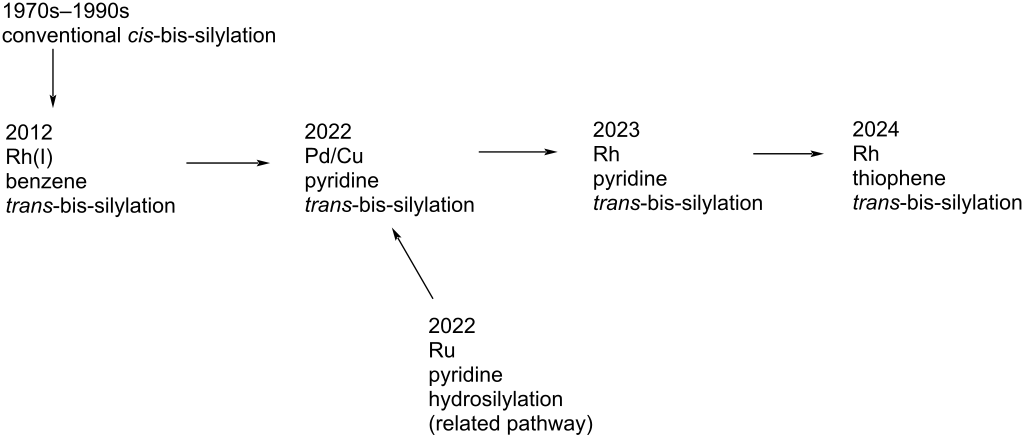
Figure 1: Historical development of intramolecular transition-metal-catalyzed trans-bis-silylation leading to fused siloles, with ruthenium-catalyzed intramolecular hydrosilylation shown as a related pathway.
Figure 1: Historical development of intramolecular transition-metal-catalyzed trans-bis-silylation leading to...
Review
Background: transition-metal-catalyzed silylation approaches to fused siloles
Conventional bis-silylation and the predominance of cis addition
Transition-metal-catalyzed bis-silylation has been investigated for several decades. Early palladium- and platinum-catalyzed studies established that disilanes can add across unsaturated carbon–carbon bonds, and subsequent works broadened both the range of disilane reagents and the available catalyst classes . Activated disilanes, strained cyclic disilanes, and well-defined palladium silyl complexes have all been employed in alkyne bis-silylation. A recent comprehensive review has summarized the rapid expansion of methods leading to cis/trans-1,2-disilylated and gem-disilylated alkenes . Despite this mechanistic and structural diversity, the classical reaction landscape remains dominated by cis products.
The predominance of cis addition is consistent with the canonical catalytic sequence. Oxidative addition of a Si–Si bond generates a bis(silyl)metal species, after which alkyne insertion into one M–Si bond and subsequent C–Si reductive elimination can preserve a syn-relationship between the two silicon substituents. Formation of a trans product therefore requires the system to deviate from this trajectory, for example through a different sequence of elementary steps, geometric reorganization of an intermediate, or stereochemical inversion before the formation of the second C–Si bond. Intramolecular substrates introduce an additional driving force because the formation of a favorable five-membered ring can compensate for otherwise disfavored geometric changes.
Ru-catalyzed intramolecular hydrosilylation as a related route
Before considering Si–Si-based cyclizations, a related Si–H-based reaction is informative because it provides access to the same class of heteroarene-fused products through a distinct bond-activation mode. 3-Dimethylsilyl-2-ethynylpyridine derivatives undergo intramolecular hydrosilylation in the presence of [Cp*Ru(MeCN)3]PF6 to furnish pyridine-fused siloles . Phenyl- and tert-butyl-substituted alkynes gave the corresponding cyclic products in 15% and 17% isolated yields, respectively, whereas an n-butyl-substituted substrate produced a complex mixture and the trimethylsilyl-substituted alkyne was recovered without cyclization.
The proposed Ru pathway involves substrate coordination, oxidative hydrometalation to a σ-vinyl intermediate, and reductive elimination to form the C–Si bond. This mechanism differs fundamentally from the bis-silylation because Si–Si bond cleavage is not involved. Nevertheless, the reaction establishes that appropriately positioned pyridylalkynylsilanes can undergo five-membered-ring closure to the silolo[3,2-b]pyridine framework. The modest yields and pronounced substituent dependence also illustrate a recurring limitation in fused-silole synthesis: productive intramolecular cyclization must compete with oligomerization, polymerization, and other unselective alkyne reactions.
The Ru study also examined the photophysical properties of the products. The phenyl-substituted derivative exhibited a longer-wavelength absorption than the tert-butyl analogue, consistent with enhanced π conjugation, and time-dependent density functional theory (TD-DFT) calculations were used to interpret the observed electronic transitions. These results are relevant to the broader context of trans-bis-silylation because they connect the ring-forming methodology with the electronic consequences of fused-silole construction. Representative Ru-catalyzed cyclizations are shown in Scheme 1.
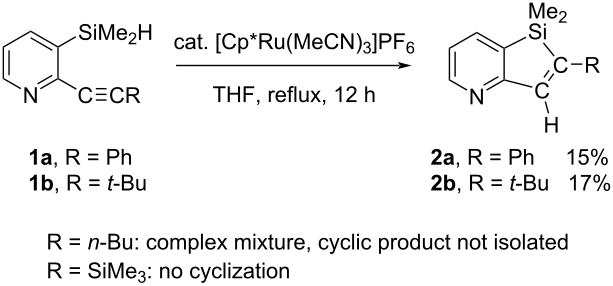
Scheme 1: Ruthenium-catalyzed intramolecular hydrosilylation of 3-dimethylsilyl-2-ethynylpyridine derivatives 1 leading to pyridine-fused siloles 2.
Scheme 1: Ruthenium-catalyzed intramolecular hydrosilylation of 3-dimethylsilyl-2-ethynylpyridine derivatives ...
Emergence of intramolecular trans-bis-silylation
Rhodium-catalyzed formation of benzosiloles
The 2012 study by Matsuda and Ichioka provided the key proof of concept for the intramolecular trans-bis-silylation . Rhodium(I)-catalyzed cyclization of (2-alkynylphenyl)disilanes furnished 3-silyl-1-benzosiloles through formal trans addition of the Si–Si bond across the alkyne. Importantly, the outcome was strongly catalyst-dependent: related palladium/isocyanide chemistry favored cis-bis-silylation and formation of a different ring system, whereas rhodium promoted formation of the five-membered benzosilole through trans addition.
This catalyst-dependent divergence established two principles that remain central to the field. First, trans-bis-silylation is not simply a stereochemical variant of conventional cis addition; a change in the stereochemical course can alter skeletal connectivity and ring size. Second, the substrate functions as a preorganized reaction platform in which Si–Si activation, alkyne insertion, and ring closure are coupled. These features make intramolecular systems particularly useful for probing how catalyst identity and substrate geometry govern the formal trans outcome. The catalyst-controlled divergence between the cis and trans pathways is illustrated in Scheme 2.
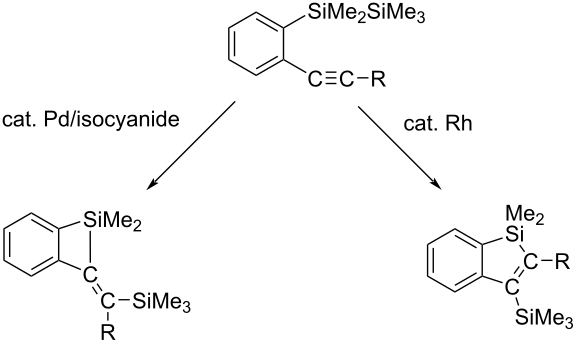
Scheme 2: Catalyst-controlled intramolecular bis-silylation of (2-alkynylphenyl)disilanes reported by Matsuda and Ichioka : cis-bis-silylation with a Pd/isocyanide system and trans-bis-silylation with a Rh(I) catalyst.
Scheme 2: Catalyst-controlled intramolecular bis-silylation of (2-alkynylphenyl)disilanes reported by Matsuda...
Palladium-catalyzed intramolecular trans-bis-silylation of pyridine substrates
A complementary route to pyridine-fused siloles was developed from 2-bromo-3-(pentamethyldisilanyl)pyridine and terminal alkynes under PdCl2(PPh3)2/CuI conditions . The transformation combines the formation of the C(sp2)–C(sp) bond characteristic of a Sonogashira coupling with the subsequent intramolecular trans-bis-silylation of the resulting alkynylpyridine framework. Ethynylbenzene derivatives afforded the corresponding pyridine-fused siloles, and the study constituted the first reported successful use of a palladium catalyst for a trans-bis-silylation of alkynes with disilanes.
The tandem nature of this process is synthetically significant because the alkynyldisilane intermediate can be generated in situ rather than isolated in advance. Mechanistically, however, the simultaneous presence of Pd and Cu introduces additional complexity relative to a single-metal cyclization. Any mechanistic description must account for the cross-coupling event, Si–Si bond activation, alkyne coordination and insertion, and closure of the five-membered silole ring.
Density functional theory (DFT) calculations were used to investigate possible pathways leading to the trans-bis-silylated product. The calculations suggested a sequential mechanism in which a cis-bis-silylation species is initially formed and subsequently converted into the thermodynamically more stable trans product. However, the proposed cis species has not been experimentally observed or isolated, and its conversion into the trans product has not been experimentally demonstrated. Thus, the cis-to-trans pathway should be regarded as a computationally proposed mechanism rather than an experimentally established isomerization. This distinction emphasizes that the stereochemistry of the isolated product does not necessarily reveal the stereochemical course of the initial Si–Si bond addition.
The palladium system also illustrates that the pyridine ring is not merely a passive fused aromatic component. Its nitrogen atom modifies substrate electronics and can influence coordination behavior, while the resulting pyridine-fused silole introduces an electron-deficient heteroaromatic unit into the conjugated framework. Thus, the reaction addresses both a mechanistic problem in organosilicon catalysis and a structural objective in heteroaromatic silole synthesis. The tandem Pd/Cu transformation and the simplified DFT-derived pathway are summarized in Scheme 3.
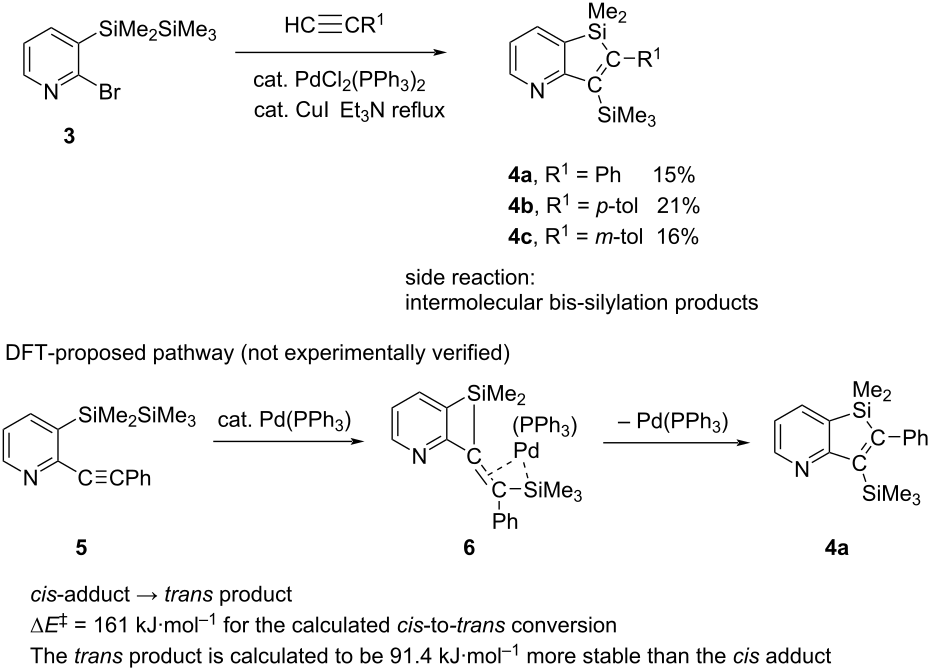
Scheme 3: Palladium-catalyzed synthesis of pyridine-fused siloles 4 through intramolecular trans-bis-silylation and a simplified representation of the DFT-derived pathway.
Scheme 3: Palladium-catalyzed synthesis of pyridine-fused siloles 4 through intramolecular trans-bis-silylati...
Rhodium-catalyzed trans-bis-silylation of heteroaromatic alkynes
Pyridine-fused siloles
To separate the cyclization step from the preceding cross-coupling chemistry and to evaluate a distinct transition-metal platform, preformed 2-ethynyl-3-(pentamethyldisilanyl)pyridines were subjected to rhodium catalysis . Heating at 110 °C in the presence of a rhodium complex afforded pyridine-fused siloles through intramolecular trans-bis-silylation. The results demonstrated that formation of the pyridine-fused framework is not specific to the Pd/Cu tandem system and that Rh-mediated Si–Si activation, previously established for the benzosilole formation, can be extended to a nitrogen-containing heteroaromatic substrate.
The study also addressed the mechanistic origin of the trans product. DFT calculations compared trans- and cis-bis-silylation routes using RhCl(CO) and RhCl(CO)2 catalyst models. In both models, the calculated activation barriers favored the trans pathway, consistent with the experimental outcome. The proposed route involves Si–Si bond cleavage, migration of a trimethylsilyl group to the alkyne-derived carbon framework, and subsequent structural reorganization before release of the fused silole product . Importantly, this mechanism differs from the sequential cis-to-trans pathway identified for the palladium system.
Comparison of the palladium and rhodium reactions is therefore particularly instructive. Both generate the same general pyridine-fused silole topology from pentamethyldisilanylpyridine precursors, but they do so in different catalytic contexts. The Pd/Cu system couples Sonogashira alkynylation with ring formation, whereas the Rh reaction begins from an isolated alkynyl substrate. The latter consequently provides a more direct platform for examining Si–Si activation and the elementary steps associated with intramolecular trans-bis-silylation.
Thiophene-fused siloles
The heteroaromatic scope was subsequently extended from pyridine to thiophene . 3-Ethynyl-2-(pentamethyldisilanyl)thiophene derivatives underwent rhodium-catalyzed cyclization at 110 °C to give thiophene-fused siloles through intramolecular trans-bis-silylation. This study represented the first transition-metal-catalyzed bis-silylation route to thiophene-fused siloles and demonstrated that the ring-forming concept is not confined to nitrogen-containing heteroarenes.
This extension is significant from both synthetic and materials perspectives. Thiophene-containing π systems are established components of electrochromic materials, field-effect transistors, light-emitting systems, and organic photovoltaics. Fusion of a silole unit to thiophene therefore combines two electronically distinctive building blocks within a single conjugated framework. More generally, the pyridine and thiophene examples show that intramolecular trans-bis-silylation can operate on heteroarenes with markedly different electronic characteristics.
The materials relevance of thiophene-fused siloles was established in earlier studies of dithienosilole-containing conjugated oligomers and polymers. Ohshita reviewed the synthesis and electronic properties of these materials, including their applications in organic light-emitting diodes, photovoltaic cells, and thin-film transistors . This prior work provides a materials-science context for the later development of rhodium-catalyzed routes to thiophene-fused siloles, although the synthetic methodologies are distinct.
DFT calculations were again employed to analyze formation of the thiophene-fused product. Using RhCl(nbd) (nbd = norbornadiene) as the active catalyst model, a multistep pathway containing several intermediates and transition states was identified, with the calculated rate-determining step occurring late in the sequence . Considered together with the pyridine study, these results support a general methodological point: formal trans-bis-silylation should be interpreted in terms of catalyst-dependent organometallic elementary steps rather than assumed to correspond to a single concerted anti-addition event. The demonstrated heteroaromatic scope nevertheless remains narrow, and extension to furans, pyrroles, benzothiophenes, azaarenes, and more highly substituted fused systems remains an important objective. Representative Rh-catalyzed pyridine- and thiophene-fused silole syntheses are compared in Scheme 4.
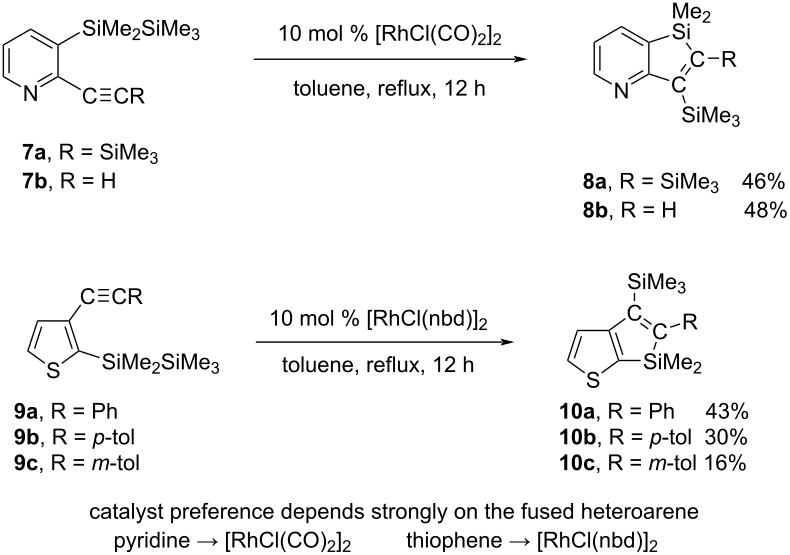
Scheme 4: Rhodium-catalyzed intramolecular trans-bis-silylation leading to pyridine- and thiophene-fused siloles 8 and 10. Mechanistic investigations employed RhCl(CO) and RhCl(CO)2 models for the pyridine system and a RhCl(nbd) model for the thiophene system. These computational models should be distinguished from the experimentally employed rhodium catalyst precursors.
Scheme 4: Rhodium-catalyzed intramolecular trans-bis-silylation leading to pyridine- and thiophene-fused silo...
The representative cyclizations also illustrate the present limitations in reaction efficiency. The Pd/Cu tandem synthesis of pyridine-fused siloles afforded isolated yields of 15–21% for three arylalkyne substrates under reflux in triethylamine for 12 h . In contrast, the Rh-catalyzed cyclizations of preformed pyridylalkynes gave 46–48% yields with 10 mol % [RhCl(CO)2]2 in refluxing toluene for 12 h , whereas the corresponding thiophene series furnished 16–43% yields using 10 mol % [RhCl(nbd)]2 under toluene reflux . Because these results involve different substrates and reaction sequences, the yields should not be interpreted as a direct comparison of intrinsic Pd and Rh catalyst efficiencies.
Mechanistic understanding of trans-bis-silylation
Why is trans addition unusual?
In a simplified cis-bis-silylation cycle, oxidative addition of a disilane to a low-valent metal generates a bis(silyl)metal species. Alkyne coordination and migratory insertion then place a silyl group and the metal on the developing alkene framework, after which reductive elimination forms the second C–Si bond. In the absence of additional reorganization, this sequence tends to preserve a cis relationship between the two silicon substituents. A formal trans outcome therefore requires the catalytic system to depart from this default stereochemical trajectory.
Intramolecular ring formation provides one means of overcoming this constraint. Tethering the alkyne and disilane increases effective molarity and creates a thermodynamic incentive for five-membered-ring formation. The catalyst can therefore access pathways involving insertion, rotation, metal migration, or other structural reorganization before formation of the final C–Si bond. Accordingly, the term “trans-bis-silylation” describes the overall stereochemical outcome without necessarily specifying an elementary anti-addition step.
Comparative analysis of Pd- and Rh-catalyzed reaction pathways
The DFT studies of the Pd- and Rh-catalyzed reactions provide insight into the possible origins of trans selectivity, although the proposed pathways differ among the catalytic systems . For the Pd-catalyzed pyridine system, a sequential pathway involving a computationally identified cis-bis-silylation species followed by conversion into the trans product was proposed. The calculated activation barrier for this conversion was 161 kJ·mol−1, and the trans product was calculated to be 91.4 kJ·mol−1 more stable than the cis species . Importantly, neither the cis species nor its conversion into the trans product has been experimentally demonstrated. For the Rh-catalyzed pyridine system, calculations using RhCl(CO) and RhCl(CO)2 models favored the trans-bis-silylation pathway over the competing cis pathway . In the Rh-catalyzed thiophene system, a different catalyst model, RhCl(nbd), was employed to investigate a multistep pathway leading to the trans product . Because these calculations involve different substrates, ligand environments, and computational models, their activation energies cannot be compared directly to establish the relative catalytic activities of Pd and Rh complexes. Rather, the results indicate that trans-bis-silylation can proceed through distinct mechanistic pathways depending on the substrate and catalytic system. For the RhCl(CO) model of the pyridine reaction, the reported activation energies were 169 and 189 kJ·mol−1 for the trans and cis pathways, respectively. With RhCl(CO)2, the corresponding values were 123 and 170 kJ·mol−1, although the rate-determining transition states differed between the two pathways . The RhCl(nbd) model used for the thiophene reaction gave a calculated free-energy barrier of 176 kJ·mol−1 at 383.15 K . These values describe different substrates, catalyst coordination environments, and computational treatments; in particular, the number and identity of coordinated ligands may affect steric congestion and the accessibility of competing transition states. Therefore, the numerical barriers should not be used to rank the experimental catalysts directly.
This mechanistic diversity has direct implications for catalyst design. Ligands and substrate substituents can influence Si–Si bond activation, alkyne insertion, intermediate geometry, and the barriers associated with subsequent bond formation or reorganization. Consequently, catalyst identity can alter ring size or stereochemical outcome even within closely related substrate classes. Mechanistic conclusions should therefore be established for each catalytic manifold rather than transferred uncritically from one metal system to another.
The Ru hydrosilylation reaction provides a useful mechanistic contrast . In that system, oxidative hydrometalation of the Si–H/alkyne unit followed by reductive elimination can generate the cyclic C–Si bond without Si–Si cleavage. Comparison with the Pd and Rh bis-silylation systems emphasizes that similar fused silole architectures can be reached through fundamentally different activation modes. A unified computational analysis employing consistent DFT calculations, solvation treatments, and ligand models across Ru, Pd, and Rh systems would be valuable for more quantitative comparison of these pathways.
Intermolecular trans-bis-silylation and stereodivergent reactions
The transition from intramolecular to intermolecular trans-bis-silylation reaction is a critical test of generality because regioselectivity and stereoselectivity must be controlled without the geometric assistance of a tether. A notable early intermolecular example was reported by He and co-workers in 2018: the rhodium(I)-catalyzed disilylation of alkynones with unactivated disilanes furnished trans-disilylated products with high stereoselectivity . The reaction demonstrated that trans selectivity can be achieved intermolecularly when an electronically biased alkyne and an appropriate rhodium catalyst are combined. Mechanistic studies also revealed facile Si–Si activation and crossover of the disilane components under the reaction conditions, highlighting the dynamic behavior of the Si–Si bond before product formation. A mechanistically distinct but related approach was reported by Yamagishi, Shimokawa, and Yorimitsu, who developed a Cu-catalyzed twofold silylmetalation of diarylacetylenes using silylpotassium species generated in situ from a disilane and t-BuOK . Because this transformation proceeds through a sequential silylmetalation rather than a direct addition of an intact Si–Si bond, it lies outside the strict definition of bis-silylation adopted here, but it provides a useful complementary strategy for vicinal disilylation of alkynes.
A conceptually different solution emerged from reagent design. Zhao and co-workers employed strongly coordinating unsymmetrical disilanes 8-(2-substituted-1,1,2,2-tetramethyldisilanyl)quinoline (TMDQ) to achieve the palladium-catalyzed intermolecular trans-bis-silylation of terminal alkynes . Experimental and computational studies indicated that the observed trans product is generated through a sequence involving initial cis-bis-silylation followed by Z/E isomerization, rather than by a simple direct anti-addition event. This result closely parallels a central theme of the intramolecular chemistry: the net stereochemistry of the isolated product does not necessarily identify the stereochemistry of the initial Si–Si-addition step.
The development of TMDQ was itself enabled by earlier advances in unsymmetrical disilane design. Song and co-workers showed that an amide-functionalized unsymmetrical disilane could undergo a highly regio- and stereoselective palladium-catalyzed bis-silylation of terminal alkynes , while Zhao and co-workers later demonstrated a Ni(0)-catalyzed cis-bis-silylation of internal alkynes using strongly coordinating TMDQ reagents . These studies established that a coordinating substituent attached to the disilane can profoundly affect Si–Si activation, catalyst association, regioselectivity, and downstream differentiation of the two silyl groups. Building on this concept, a subsequent palladium/Lewis acid catalytic system enabled regio- and stereodivergent bis-silylation of alkynoates with TMDQ . Modulation of the catalytic environment provided access to distinct 1,2-bis(silyl)alkene products, including a trans isomer, demonstrating that regioselectivity and cis/trans stereoselectivity are interdependent variables that can be controlled through cooperative catalyst and reagent design. More recently, Chen and co-workers reported the Pd-catalyzed trans-silaboration of terminal alkynes using a quinoline-directed Si–B reagent . In a related development in reagent design, Liu and co-workers demonstrated a regioselective bis-silylation of terminal alkenes with unsymmetrical disilanes . Although these reactions involve Si–B addition or alkene substrates rather than trans-bis-silylation of alkynes, respectively, they further illustrate the utility of coordinating reagent design for selectivity control.
For fused-silole synthesis, these intermolecular advances are important for two reasons. First, they demonstrate that trans selectivity is not intrinsically dependent on ring closure. Second, they identify complementary strategies – substrate polarization, coordinating disilane design, and cooperative catalysis – that may ultimately reduce the dependence of intramolecular methods on highly preorganized substrates. Conversely, insights into intermediate reorganization and ring-closure energetics may inform the design of intermolecular trans-bis-silylation systems. Representative intermolecular reactions based on these reagent-design concepts are shown in Scheme 5.
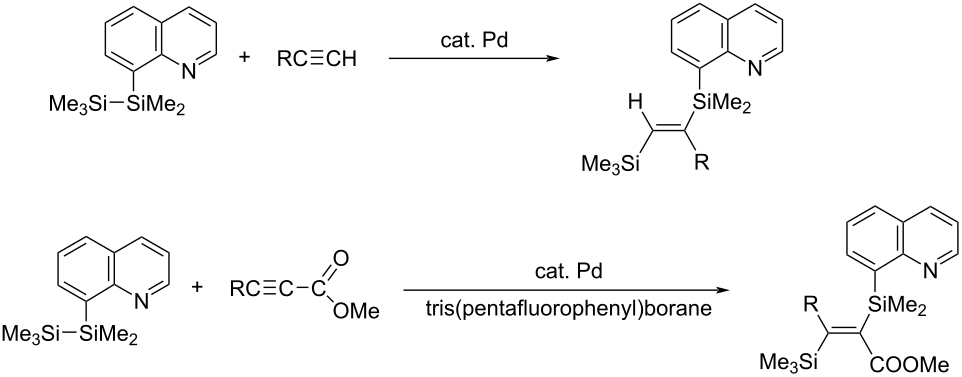
Scheme 5: Representative palladium-catalyzed intermolecular trans-bis-silylation of terminal alkynes and regio- and stereodivergent bis-silylation of alkynoates using designed disilane reagents.
Scheme 5: Representative palladium-catalyzed intermolecular trans-bis-silylation of terminal alkynes and regi...
Scope, limitations, and opportunities
Substrate scope and reaction efficiency
Intramolecular trans-bis-silylation has so far been demonstrated mainly for ortho-related alkynyl and disilanyl groups on benzene, pyridine, and thiophene rings. The limited heteroarene scope and pronounced substituent dependence remain important constraints: in the related Ru-catalyzed hydrosilylation, phenyl- and tert-butyl-substituted alkynes cyclized, whereas the n-butyl substrate gave no isolable cyclic product and the trimethylsilyl-substituted substrate did not cyclize . Systematic comparisons of alkyne substituents under a common catalyst system, followed by tests with furan, pyrrole, and benzothiophene substrates, would establish which steric and electronic factors control ring closure.
Catalyst and disilane design
Current intramolecular methods rely largely on Pd or Rh catalysts, often at elevated temperatures and substantial catalyst loadings. In the reported heteroaromatic examples, the preferred Rh precatalyst differs between pyridine and thiophene substrates . Direct comparisons of ligand sets, catalyst loadings, and temperatures within each substrate series would therefore be more informative than extrapolating from different catalytic systems. Pentamethyldisilanyl groups also dominate the reported fused-silole syntheses. Coordinating disilanes, including amide-functionalized reagents and quinoline-based TMDQ, have demonstrated control of Si–Si activation and selectivity in intermolecular chemistry ; testing analogous designs in intramolecular cyclizations is a specific opportunity, rather than an established solution. Functionalization of the residual silyl substituent could further diversify the resulting siloles.
Functional evaluation and outlook
The materials potential of these fused siloles remains less developed than their synthesis. The Ru-derived pyridine-fused siloles showed substituent-dependent absorption and fluorescence , while related fused oligosiloles prepared by a distinct synthetic route displayed changes in optical and electrochemical properties with increasing fusion . A useful next step would be to measure absorption, emission, and redox properties for matched pyridine- and thiophene-fused silole series and correlate these data with substitution and molecular structure. Combined with consistently modeled reaction pathways and experimentally measured selectivities, such comparisons would identify both the practical limits of trans-bis-silylation and the functional value of its products. The representative catalytic routes are summarized in Table 1. Systematic absorption, emission, and electrochemical comparisons of the Pd- and Rh-derived fused siloles have not yet been reported in the studies discussed here .
| catalyst | key substrate | activation mode | net outcome | product class | ref. |
|---|---|---|---|---|---|
| Rh(I) | (2-alkynylphenyl)disilane | Si–Si | intramolecular trans-bis-silylation | 3-silyl-1-benzosilole | |
| [Cp*Ru(MeCN)3]PF6 | 3-dimethylsilyl-2-ethynylpyridine | Si–H | intramolecular hydrosilylation | pyridine-fused silole | |
| PdCl2(PPh3)2/CuI |
2-bromo-3-(pentamethyldisilanyl)-
pyridine + terminal alkyne |
C–C coupling + Si–Si |
tandem coupling/trans-bis-
silylation |
pyridine-fused silole | |
| [RhCl(CO)2]2 |
2-ethynyl-3-(pentamethyldisilanyl)-
pyridine |
Si–Si | intramolecular trans-bis-silylation | pyridine-fused silole | |
| [RhCl(nbd)]2 |
3-ethynyl-2-(pentamethyldisilanyl)-
thiophene |
Si–Si | intramolecular trans-bis-silylation | thiophene-fused silole | |
| Rh(I) | alkynone + unactivated disilane | Si–Si | intermolecular trans-disilylation | trans-1,2-disilylalkene | |
| Pd | terminal alkyne + TMDQ | Si–Si | intermolecular trans-bis-silylation | trans-1,2-bis(silyl)alkene | |
| Pd/B(C6F5)3 | alkynoate + TMDQ | Si–Si | regio-/stereodivergent bis-silylation | 1,2-bis(silyl)alkenes | |
Conclusion
Transition-metal-catalyzed trans-bis-silylation of alkynes constitutes a still-limited but conceptually important area of organosilicon chemistry. In 2012 a rhodium-catalyzed synthesis of 3-silyl-1-benzosiloles established that a Si–Si bond can be incorporated across an alkyne with a net trans relationship under intramolecular conditions. Subsequent palladium and rhodium studies extended this reactivity to pyridine-fused siloles, and rhodium catalysis further enabled the synthesis of thiophene-fused siloles. Mechanistic and computational studies have shown that these formal trans products can arise through catalyst-dependent multistep organometallic pathways and therefore should not be interpreted automatically as the products of a simple concerted anti addition.
The ruthenium-catalyzed intramolecular hydrosilylation of pyridine substrates provides a useful mechanistic and synthetic comparison, illustrating how Si–H and Si–Si activation can converge on related fused-silole architectures through distinct pathways. At the same time, the intermolecular trans-bis-silylation with designed disilanes demonstrates that trans selectivity can be achieved without the geometric constraint imposed by ring closure and substantially broadens the conceptual scope of the field.
The principal challenge is now one of generality. Expansion of substrate and disilane scope, improved catalyst efficiency, mechanistically guided ligand and reagent design, and closer integration with structure–property studies will be required for trans-bis-silylation to develop from a mechanistically distinctive transformation into a broadly useful synthetic strategy. Progress along these directions should enable access to a wider range of structurally and electronically differentiated organosilicon molecules and clarify the role of trans-bis-silylation in both synthetic and materials chemistry.
Data Availability Statement
Data sharing is not applicable as no new data was generated or analyzed in this study.
References
-
Yamaguchi, S.; Tamao, K. Polysiloles and Related Silole - Containing Polymers. In The Chemistry of Organic Silicon Compounds; Rappoport, Z.; Apeloig, Y., Eds.; PATAI'S Chemistry of Functional Groups, Vol. 3; John Wiley & Sons: Chichester, UK, 2001; pp 641–694. doi:10.1002/0470857269.ch11
Return to citation in text: [1] -
Liu, J.; Lam, J. W. Y.; Tang, B. Z. J. Inorg. Organomet. Polym. Mater. 2009, 19, 249–285. doi:10.1007/s10904-009-9282-8
Return to citation in text: [1] -
Chen, J.; Cao, Y. Macromol. Rapid Commun. 2007, 28, 1714–1742. doi:10.1002/marc.200700326
Return to citation in text: [1] -
Lu, G.; Usta, H.; Risko, C.; Wang, L.; Facchetti, A.; Ratner, M. A.; Marks, T. J. J. Am. Chem. Soc. 2008, 130, 7670–7685. doi:10.1021/ja800424m
Return to citation in text: [1] -
Dang, T. T.; Nguyen, H. M. T.; Nguyen, H.; Dung, T. N.; Nguyen, M. T.; Dehaen, W. Molecules 2020, 25, 548. doi:10.3390/molecules25030548
Return to citation in text: [1] -
Braye, E. H.; Hübel, W.; Caplier, I. J. Am. Chem. Soc. 1961, 83, 4406–4413. doi:10.1021/ja01482a026
Return to citation in text: [1] -
Dubac, J.; Laporterie, A.; Manuel, G. Chem. Rev. 1990, 90, 215–263. doi:10.1021/cr00099a008
Return to citation in text: [1] -
Okinoshima, H.; Yamamoto, K.; Kumada, M. J. Am. Chem. Soc. 1972, 94, 9263–9264. doi:10.1021/ja00781a066
Return to citation in text: [1] -
Tamao, K.; Yamaguchi, S.; Shiro, M. J. Am. Chem. Soc. 1994, 116, 11715–11722. doi:10.1021/ja00105a012
Return to citation in text: [1] -
Bähr, S.; Ogasawara, H.; Yamaguchi, S.; Oestreich, M. Organometallics 2017, 36, 4013–4019. doi:10.1021/acs.organomet.7b00619
Return to citation in text: [1] -
Tobisu, M.; Onoe, M.; Kita, Y.; Chatani, N. J. Am. Chem. Soc. 2009, 131, 7506–7507. doi:10.1021/ja9022978
Return to citation in text: [1] -
Ureshino, T.; Yoshida, T.; Kuninobu, Y.; Takai, K. J. Am. Chem. Soc. 2010, 132, 14324–14326. doi:10.1021/ja107698p
Return to citation in text: [1] -
Ansell, M. B.; Navarro, O.; Spencer, J. Coord. Chem. Rev. 2017, 336, 54–77. doi:10.1016/j.ccr.2017.01.003
Return to citation in text: [1] [2] -
Matsuda, T.; Ichioka, Y. Org. Biomol. Chem. 2012, 10, 3175–3177. doi:10.1039/c2ob25242b
Return to citation in text: [1] [2] [3] [4] -
He, T.; Liu, L.-C.; Guo, L.; Li, B.; Zhang, Q.-W.; He, W. Angew. Chem., Int. Ed. 2018, 57, 10868–10872. doi:10.1002/anie.201804223
Return to citation in text: [1] [2] [3] -
Matsuda, T.; Kadowaki, S.; Murakami, M. Chem. Commun. 2007, 43, 2627–2629. doi:10.1039/b703397d
Return to citation in text: [1] -
Naka, A.; Shimomura, N.; Kobayashi, H. J. Organomet. Chem. 2022, 959, 122201. doi:10.1016/j.jorganchem.2021.122201
Return to citation in text: [1] [2] [3] [4] [5] [6] -
Naka, A.; Shimomura, N.; Kobayashi, H. ACS Omega 2022, 7, 30369–30375. doi:10.1021/acsomega.2c03637
Return to citation in text: [1] [2] [3] [4] [5] [6] [7] -
Naka, A.; Kobayashi, H. Molecules 2023, 28, 3284. doi:10.3390/molecules28083284
Return to citation in text: [1] [2] [3] [4] [5] [6] [7] [8] [9] [10] -
Naka, A.; Inoue, M.; Kawabe, H.; Kobayashi, H. AppliedChem 2024, 4, 29–41. doi:10.3390/appliedchem4010003
Return to citation in text: [1] [2] [3] [4] [5] [6] [7] [8] [9] [10] -
Zhao, S.; Zhang, Y.; Wu, R.; Yin, K.; Hong, X.; Zhao, D. Nat. Synth. 2023, 2, 937–948. doi:10.1038/s44160-023-00325-3
Return to citation in text: [1] [2] [3] [4] -
Zhao, S.; Ding, L.; Sun, Y.; Wang, M.; Zhao, D. Angew. Chem., Int. Ed. 2023, 62, e202309169. doi:10.1002/anie.202309169
Return to citation in text: [1] [2] [3] [4] -
Zhao, S.; Sun, Y.; Li, S.; Zhao, D. ChemCatChem 2024, 16, e202400913. doi:10.1002/cctc.202400913
Return to citation in text: [1] [2] -
Geng, S.; Pu, Y.; Wang, S.; Ji, Y.; Feng, Z. Chem. Commun. 2024, 60, 3484–3506. doi:10.1039/d4cc00288a
Return to citation in text: [1] -
Sakurai, H.; Kamiyama, Y.; Nakadaira, Y. J. Am. Chem. Soc. 1975, 97, 931–932. doi:10.1021/ja00837a061
Return to citation in text: [1] -
Tamao, K.; Hayashi, T.; Kumada, M. J. Organomet. Chem. 1976, 114, C19–C22. doi:10.1016/s0022-328x(00)87240-x
Return to citation in text: [1] -
Watanabe, H.; Kobayashi, M.; Higuchi, K.; Nagai, Y. J. Organomet. Chem. 1980, 186, 51–62. doi:10.1016/s0022-328x(00)93817-8
Return to citation in text: [1] -
Ozawa, F.; Sugawara, M.; Hayashi, T. Organometallics 1994, 13, 3237–3243. doi:10.1021/om00020a042
Return to citation in text: [1] -
Ansell, M. B.; Roberts, D. E.; Cloke, F. G. N.; Navarro, O.; Spencer, J. Angew. Chem., Int. Ed. 2015, 54, 5578–5582. doi:10.1002/anie.201501764
Return to citation in text: [1] -
Ohshita, J. Macromol. Chem. Phys. 2009, 210, 1360–1370. doi:10.1002/macp.200900180
Return to citation in text: [1] -
Yamagishi, H.; Shimokawa, J.; Yorimitsu, H. Synlett 2019, 30, 1551–1554. doi:10.1055/s-0037-1611869
Return to citation in text: [1] -
Xiao, P.; Cao, Y.; Gui, Y.; Gao, L.; Song, Z. Angew. Chem., Int. Ed. 2018, 57, 4769–4773. doi:10.1002/anie.201800513
Return to citation in text: [1] [2] -
Zhang, Y.; Wang, X.-C.; Ju, C.-W.; Zhao, D. Nat. Commun. 2021, 12, 68. doi:10.1038/s41467-020-20392-w
Return to citation in text: [1] [2] -
Chen, S.; Yin, K.; Zhu, L.; Cui, C.; Zhao, D. Angew. Chem., Int. Ed. 2025, 64, e202517688. doi:10.1002/anie.202517688
Return to citation in text: [1] -
Liu, M.; Xu, Y.; Huang, G.; Zhao, D. Sci. China: Chem. 2026, 69, 2967–2973. doi:10.1007/s11426-025-3053-4
Return to citation in text: [1] -
Morita, M.; Shintani, R. Chem. Lett. 2024, 53, upae068. doi:10.1093/chemle/upae068
Return to citation in text: [1]
© 2026 Naka and Kobayashi; licensee Beilstein-Institut.
This is an open access article licensed under the terms of the Beilstein-Institut Open Access License Agreement (https://www.beilstein-journals.org/bjoc/terms), which is identical to the Creative Commons Attribution 4.0 International License (https://creativecommons.org/licenses/by/4.0). The reuse of material under this license requires that the author(s), source and license are credited. Third-party material in this article could be subject to other licenses (typically indicated in the credit line), and in this case, users are required to obtain permission from the license holder to reuse the material.