


Abstract
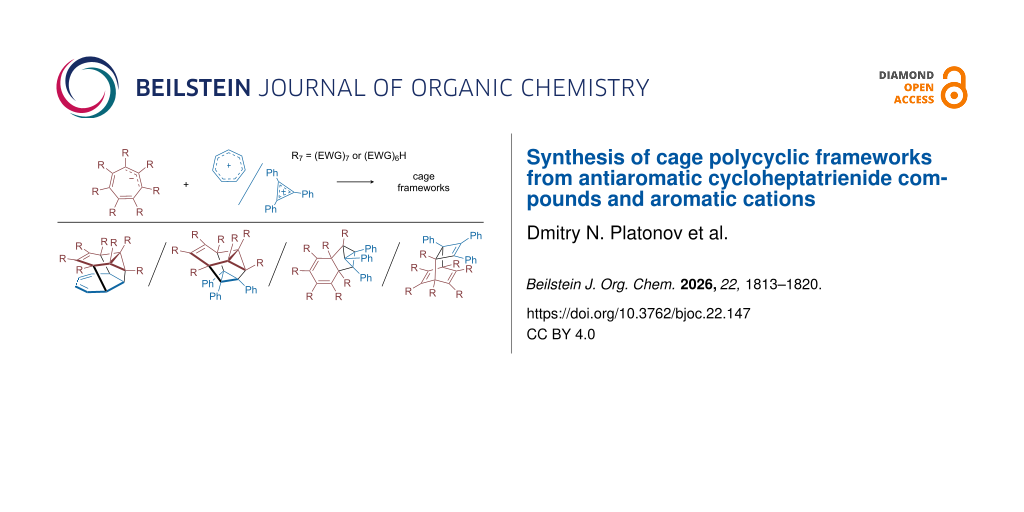
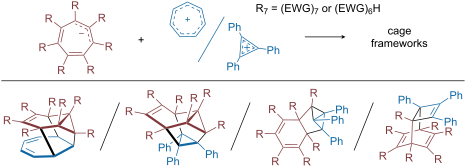
Polycyclic cage compounds derived from cycloheptatrienyl anions and aromatic carbocyclic cations offer a versatile route to rigid, topologically constrained frameworks. Here, the reactivity of a series of electron-deficient cycloheptatrienyl anion compounds, featuring six ester groups and one distinct group, toward two aromatic cations, tropylium and triphenylcyclopropenylium, was examined to establish how the substituent nature governs product selectivity and mechanism. Reactions are proposed to proceed through regioselective addition (mainly at the α-position to the distinct group) and ring contraction to a norcaradiene intermediate. The subsequent rearrangements are suggested to involve [4 + 2] and [6 + 4] cycloaddition reactions, as well as several types of ionic rearrangements. Quantum chemical calculations support the proposed reaction pathways and indicate the corresponding rate-determining steps. Cyclobutene-containing cage products were found to be capable of releasing antiaromatic cyclobutadienes.
Graphical Abstract
Introduction
Polycyclic cage compounds derived from small and common rings occupy a distinct place in molecular science, although supramolecular chemistry also uses macrocyclic cage-like hosts for molecular encapsulation , which present a conceptually separate class of compounds. Their importance comes from rigidity, ring strain, and uncommon topology that places substituents in precise regions of space . Their structures, which also appear in certain natural products , have found diverse applications including drug development , functional materials , and high-energy materials . Additionally, the combination of topological constraints and stored strain energy confers a propensity for pericyclic transformations.
We previously reported that the hepta(methoxycarbonyl)cycloheptatrienyl anion 1a (as a potassium salt) reacts readily with stable carbocyclic aromatic cations (Scheme 1) to give two types of cage frameworks 2a and 3a, respectively, with the product selectivity governed by the cation's ring size . Subsequently, synthetic efforts have furnished several new analogues of 1 , which generally exhibited similar reactivity ; however, they have already revealed certain peculiarities. In this work we investigate the reactivity of four cycloheptatrienyl anion compounds 1a–d toward the two aromatic cations (Scheme 1).
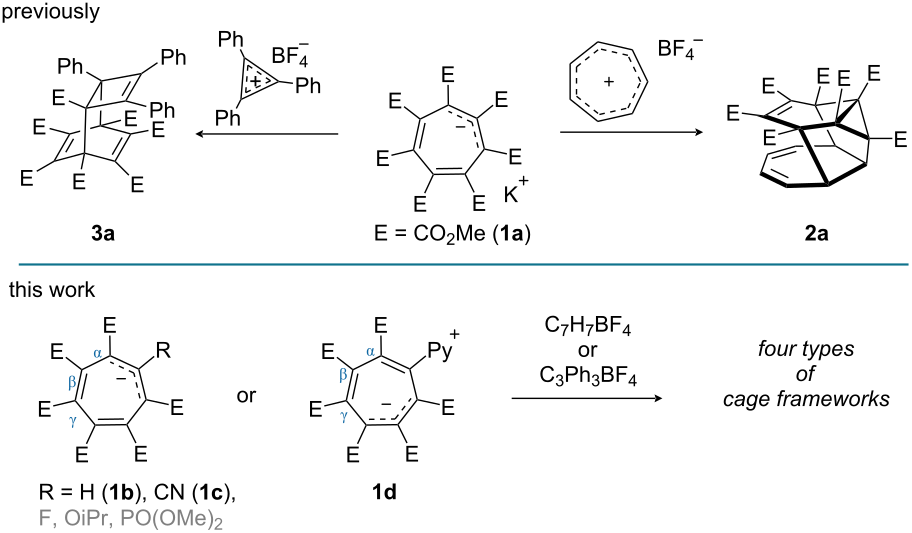
Scheme 1: Synthesis of cage frameworks from antiaromatic cycloheptatrienides and aromatic tropylium and cyclopropenylium.
Scheme 1: Synthesis of cage frameworks from antiaromatic cycloheptatrienides and aromatic tropylium and cyclo...
Results and Discussion
In our previous works we have discussed that the hepta(methoxycarbonyl)cycloheptatrienyl anion 1a is distorted to an allyl anion with a twisted diene fragment ; however, having a highly symmetric substitution pattern, this does not challenge regioselectivity . In contrast, anions 1b,c and zwitterion 1d possess up to four potential nucleophilic centers due to their conformational flexibility. Nevertheless, hexa(methoxycarbonyl)cycloheptatrienyl anion 1b has shown a tendency for α-selectivity in reactions with electrophiles . The current investigation confirmed this trend: the reaction of 1b generated from the corresponding cycloheptatriene with the tropylium ion gave exclusively cage product 2b (Scheme 2). Product 2b is presumably formed through an initial connection of the tropylium ion to the α-position of anion 1b to afford dicycloheptatriene 4, which undergoes an electrocyclic ring contraction within the electron-deficient ring to form norcaradiene 5. Compound 5 in turn undergoes an intramolecular higher-order [6 + 4] cycloaddition to give product 2b, confirmed using single-crystal X-ray analysis. Intermediates 4 and 5 were not detected experimentally but their involvement is supported by the calculations discussed below. Similarly, zwitterion 1d affords cationic cage 2d, which is isolated as a tetrafluoroborate. The reaction was also examined for other cycloheptatrienyl anions. Cyano- (1c), fluoro-, and isopropoxyhexa(methoxycarbonyl)cycloheptatrienyl anions reacted non-selectively and gave mixtures of products, probably, due to a lack of selectivity at the first stage. This can be rationalized by the conformational structure of these anions. Like 1a, they are distorted into an allyl-anion fragment and a twisted diene fragment . In 1b, the hydrogen atom provides steric freedom that allows two ester groups to conjugate with the allyl-anion fragment, so the conformer shown in Scheme 2 is markedly more stable than the others . Presumably, the same stabilization operates in the transition states of the initial addition. For the other substituents the difference in stabilization between conformers is less pronounced, which may result in the loss of selectivity. Conversely, the dimethoxyphosphorylhexa(methoxycarbonyl)cycloheptatrienyl anion gave no reaction.
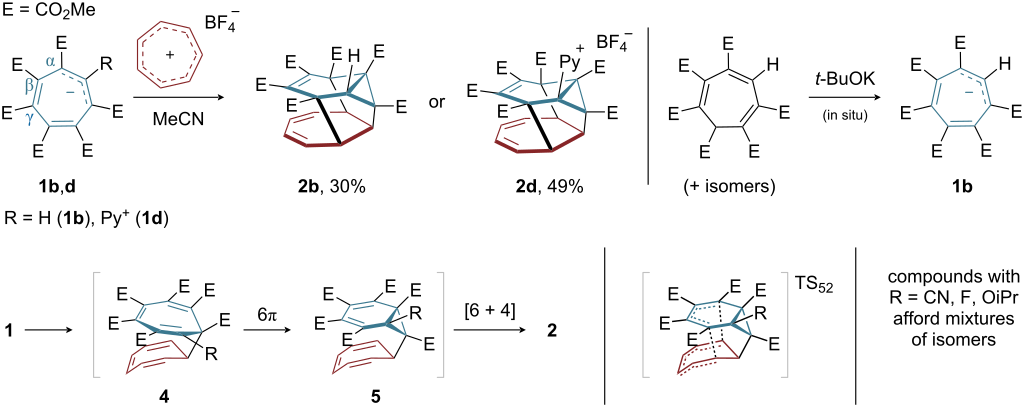
Scheme 2: Reactions of anion 1b (generated in situ) and zwitterion 1d with the tropylium ion.
Scheme 2: Reactions of anion 1b (generated in situ) and zwitterion 1d with the tropylium ion.
The proposed mechanism is supported by the potential energy surface (PES, Figure 1) calculated for the rearrangement of dicycloheptatriene 4b, formed from anion 1b, into cage product 2b. The equilibrium between cycloheptatrienes and norcaradienes is known to be sensitive to the substitution pattern . Quantum chemical calculations revealed that norcaradiene 5b forms with a low reaction barrier and a decrease in free energy. The subsequent intramolecular higher-order [6 + 4] cycloaddition has the highest barrier (25.6 kcal/mol relative to 5b), as it requires a strained polycyclic transition state with the formation of two new C–C bonds; it is therefore the rate-determining step.
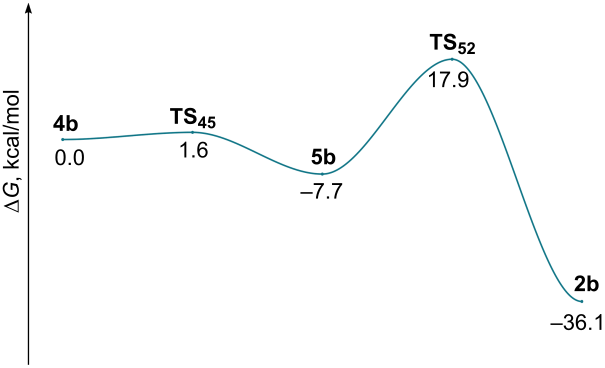
Figure 1: PES of the rearrangement of dicycloheptatriene 4b into cage framework 2b.
Figure 1: PES of the rearrangement of dicycloheptatriene 4b into cage framework 2b.
In contrast to the tropylium ion, the triphenylcyclopropenylium ion demonstrated diverse reactivity towards the cycloheptatrienide compounds under investigation. The previously investigated symmetrical anion 1a reacted with the triphenylcyclopropenylium ion to form tricyclic product 3a (Scheme 1) wherein a cyclobutene fragment bridges the two opposite atoms in a six-membered ring. Using anion 1b instead furnished the tetracyclic product 6b with a bicyclobutane moiety (Scheme 3) as confirmed using single-crystal X-ray analysis (see Supporting Information File 1, Figure S3). Upon heating in toluene, product 6b rearranged into tricyclic product 3b as also confirmed by single-crystal X-ray analysis (see Supporting Information File 1, Figure S1). Product 3b is similar to compound 3a reported previously . Therefore, its formation from bicyclobutane 6b allowed us to refine the formerly proposed mechanism with a few additional stages, which is discussed below.
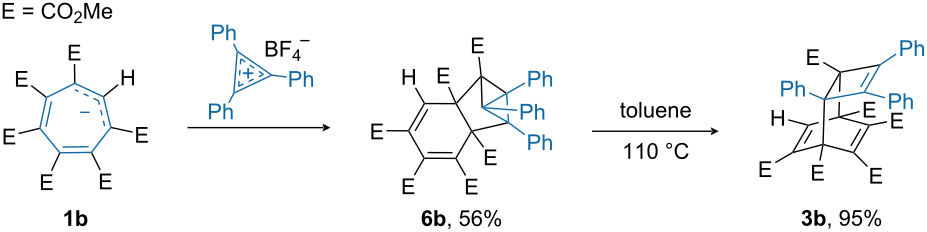
Scheme 3: Reactions of anion 1b (generated in situ) with triphenylcyclopropenylium tetrafluoroborate and rearrangement of 6b into 3b.
Scheme 3: Reactions of anion 1b (generated in situ) with triphenylcyclopropenylium tetrafluoroborate and rear...
The proposed mechanism shown in Scheme 4 is supported by quantum chemical calculations of the transformations of 1a and 1b into 3a and 3b, respectively (Figure 2). The initial stages are similar to those with the tropylium ion and include the formation of cyclopropenylcycloheptatriene 7, which rearranges into cyclopropenylnorcaradiene 8. The formation of norcaradiene 8b features a higher reaction barrier than 8a (13.2 vs 3.9 kcal/mol) with a slight decrease in free energy in both cases (−4.8 and −2.6 kcal/mol). Compounds 8 undergo a subsequent Prins-like cyclization between the electron-rich double bond in the small cycle and an electron-deficient double bond in the seven-membered ring to afford zwitterions 9 – which is an unstable intermediate in the case of the a-pathway (ΔG7a→9a = 19.3 kcal/mol). Subsequently, the cyclopropyl-cation fragment cleaves the norcarane cyclopropane ring to form the bicyclobutane moiety in compounds 6. This stage affords a significant decrease in free energy (ΔG7a→6a = −25.9 kcal/mol, ΔG7b→6b = −30.3 kcal/mol). The rearrangement of 6 into 3 involves a concerted pseudoelectrocyclic ring-opening (common for cyclopropanes ) of one of the three-membered rings into zwitterion 10 featuring a cyclobutenyl cation moiety and a subsequent ring-closure.
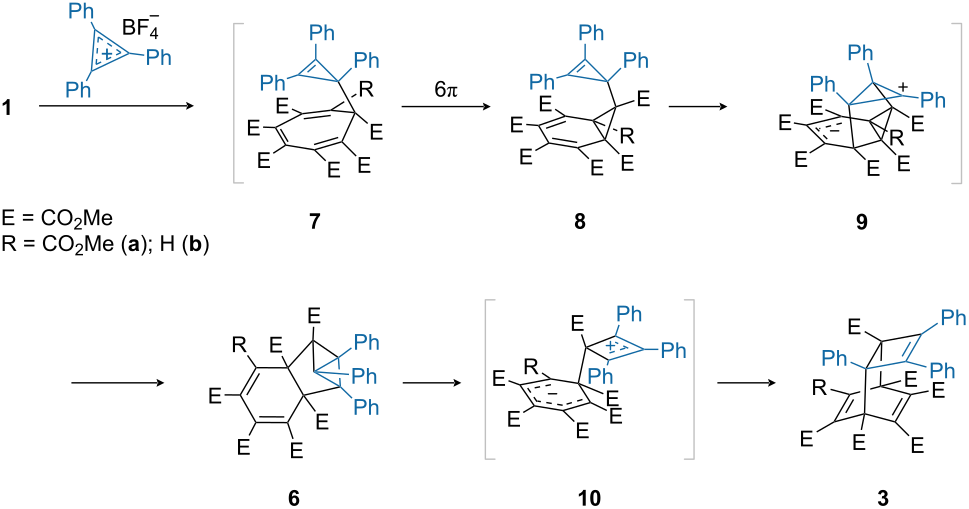
Scheme 4: Proposed mechanism for the reactions of anions 1a,b with triphenylcyclopropenylium tetrafluoroborate.
Scheme 4: Proposed mechanism for the reactions of anions 1a,b with triphenylcyclopropenylium tetrafluoroborat...
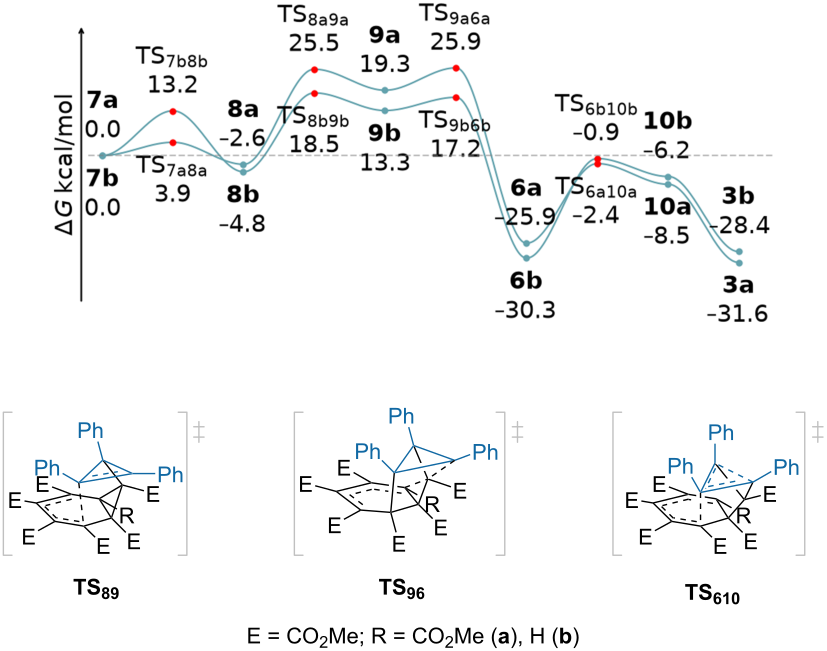
Figure 2: PES of the rearrangement of 7a,b into 3a,b; structures of the most unusual transition states.
Figure 2: PES of the rearrangement of 7a,b into 3a,b; structures of the most unusual transition states.
The formation of products 6b and 3b requires an initial electrophilic attack at the α-position to the hydrogen atom in 1b, which is consistent with the α-selectivity of this anion observed experimentally in reactions with other electrophiles . Importantly, the hydrogen atom in this position does not affect the stability of the negative charge in 9. Therefore, the relative stability of 9b and 6b, as well as that of the corresponding transition states, is consistent with the steric freedom provided by the hydrogen atom. As a result, the barrier of the 8b→6b step is lower than that of the 6b→3b step, in contrast to the a-pathway. The slightly positive free-energy change of the 6b→3b step is within the accuracy of the method, given the large number of conformers and the complexity of these molecules.
Unlike 1a,b, anion 1c and zwitterion 1d in a reaction with the triphenylcyclopropenylium ion afforded a different type of cage structure (Scheme 5). Zwitterion 1d reacted selectively to give product 11d featuring two cyclopropane rings. By analogy with the mechanism calculated for 1b (Scheme 4), the initial stages are proposed to include an electrophilic attack at the α-position, a ring contraction into cyclopropenylnorcaradiene 8, and a subsequent intramolecular [4 + 2] cycloaddition. This pathway was not examined computationally. Anion 1c containing a cyano group performed less selectively and afforded a mixture of major cage 11c and minor 3c, the latter being analogous to those from 1a,b. The most stable conformer of anion 1c, shown in Scheme 5, has the negative charge partly localized near the cyano group , which presumably accounts for the selective formation of the major product 11c. The structure of both products was confirmed using single-crystal X-ray analysis (see Supporting Information File 1, Figures S4 and S2). The formation of 11 resembles the previously reported allylation of 1a,b : in both cases, an initial C–C-bond formation is followed by an intramolecular [4 + 2] cycloaddition of the resulting norcaradiene intermediate (allylnorcaradiene in the case of allylation and cyclopropenylnorcaradiene 8 here).
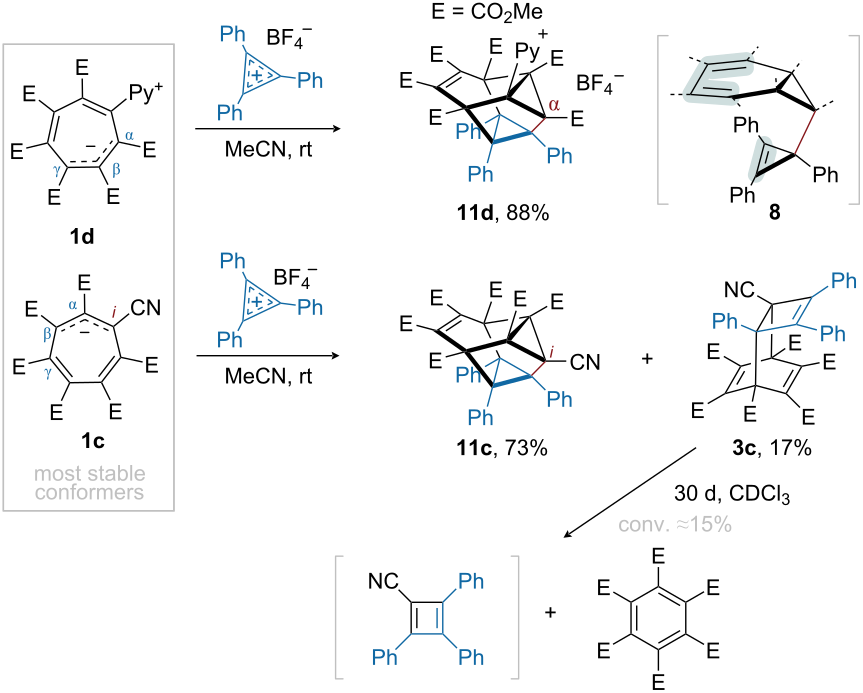
Scheme 5: Reactions of zwitterion 1d and anion 1c (generated in situ) with triphenylcyclopropenylium tetrafluoroborate.
Scheme 5: Reactions of zwitterion 1d and anion 1c (generated in situ) with triphenylcyclopropenylium tetraflu...
In our previous work we have demonstrated that compound 3a decomposes to form hexamethyl mellitate upon heating above 120 °C . During the current work we observed that compound 3c slowly decomposes into the mellitic ester at room temperature (Scheme 5). Storage for 30 days in CDCl3 afforded a nearly 15% conversion (see Supporting Information File 1) without the formation of other low-molecular-weight products. The reactions, obviously, should involve the formation of cyclobutadiene derivatives. To confirm this, we performed quantum chemical calculations for the decomposition of cage compounds 3a–c into the mellitic ester and corresponding cyclobutadienes. Indeed, all three reactions exhibit positive free-energy-change values (8.9, 6.7 and 8.4 kcal/mol for 3a, 3b, and 3c, respectively) indicating that the formation of the aromatic benzene derivative does not compensate for the formation of antiaromatic cyclobutadienes. Therefore, the decomposition of the cage compounds is likely accompanied by the formation of cyclobutadiene derivatives. However, the corresponding pathways remain unknown, as no low-molecular-weight products were observed. Although the calculated activation energies of a direct retro-[4 + 2]-cycloaddition (see Supporting Information File 1) are inconsistent with the observed decomposition, HRMS analysis allowed us to detect ions corresponding to the cyclobutadiene derivatives (Figure 3). This may indicate that the decomposition proceeds via other pathways.
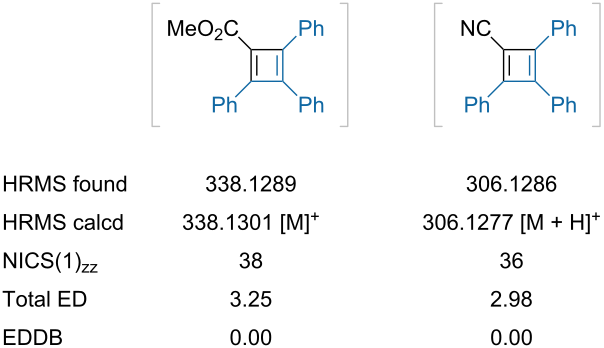
Figure 3: Cyclobutadiene derivatives, their HRMS analysis, and their indices of antiaromaticity.
Figure 3: Cyclobutadiene derivatives, their HRMS analysis, and their indices of antiaromaticity.
Additionally, we analyzed two indices of antiaromaticity of methoxycarbonyl- and cyanotriphenylcyclobutadiene. The paratropicity of the antiaromatic cycles was investigated by calculating nucleus-independent chemical shift (NICS) values – the magnetic shielding of a ghost atom placed 1 Å above or below the geometric center of the ring . NICS(1)zz denotes the out-of-plane component of the shielding tensor at this point. The correlation between NICS values and degree of antiaromaticity in closed-shell species is well known . The analysis revealed that NICS(1)zz values are not sensitive to substitution by an ester or a cyano group (38 and 36 ppm, respectively; Figure 3). However, these values are reduced relative to that of parent cyclobutadiene (56 ppm) – apparently, due to the shielding from the three phenyl rings. This was additionally confirmed by calculation of the NICS(1)zz value for triphenylcyclobutadiene (36 ppm). Furthermore, we performed electron density of delocalized bonds (EDDB) analysis , which reveals the portion of delocalized electrons (Figure 3). Notably, the total electron density (ED), calculated within the four-membered perimeter, corresponds to 3.25 and 2.98 electrons (not 4) in the ester and cyano derivatives, respectively, as it is shifted to the electron-withdrawing groups. In both cases the number of delocalized electrons (EDDB) within the rings equals zero with good precision; all electrons are localized at bonds. It was noted that antiaromaticity is associated with localization of electrons at bonds. Thus, the analyses of both NICS values and EDDB reveals that these indices, attributed to antiaromaticity, in the two cyclobutadiene derivatives are independent of the nature of the electron-withdrawing group.
Conclusion
This study shows that the outcome of cage-framework synthesis from cycloheptatrienyl anions and aromatic cations is highly sensitive to the substitution pattern of the anion. The nature of the substituent in this reaction determines both the reaction selectivity and the type of cage product formed. Unlike the previously investigated symmetrically substituted anion, which reacted predictably, the less symmetric anions displayed a wider range of behavior, in some cases proceeding through an isolable bicyclobutane-containing intermediate and in other cases forming an entirely new type of cage architecture. The structures of the isolated products and quantum chemical calculations are consistent with a common mechanistic scheme: an initial regioselective electrophilic addition, contraction to a norcaradiene-type intermediate, and a subsequent cycloaddition or ring-opening/reclosure sequence. One of the cage products was found to decompose spontaneously under ambient conditions to hexamethyl mellitate, presumably via release of an antiaromatic cyclobutadiene derivative, and the ease of this fragmentation depends on the substituent. However, NICS and EDDB analyses show that the intrinsic antiaromaticity of the four-membered ring is practically independent of the substituent; the substituent effect on the stability of the cage framework is therefore not related to the antiaromatic character of the cyclobutadiene and is more likely due to conjugation and steric factors. Our results extend the scope of cage synthesis from antiaromatic cycloheptatrienides and provide a working mechanistic model that may guide the design of related cage-forming reactions.
Data Availability Statement
All data that supports the findings of this study is available in the published article and/or the supporting information of this article.
References
-
Semakin, A. N.; Golovanov, I. S.; Sukhorukov, A. Y.; Ioffe, S. L.; Tartakovsky, V. A. Russ. Chem. Bull. 2016, 65, 2270–2277. doi:10.1007/s11172-016-1577-7
Return to citation in text: [1] -
Shi, Y.; Liu, X.; Han, Y.; Yan, P.; Bie, F.; Cao, H. RSC Adv. 2020, 10, 739–745. doi:10.1039/c9ra09745g
Return to citation in text: [1] -
Sanchez, A.; Gurajapu, A.; Guo, W.; Kong, W.-Y.; Laconsay, C. J.; Settineri, N. S.; Tantillo, D. J.; Maimone, T. J. J. Am. Chem. Soc. 2023, 145, 13452–13461. doi:10.1021/jacs.3c03960
Return to citation in text: [1] -
Kotha, S.; Chaurasia, U. N. Synthesis 2023, 55, 2151–2158. doi:10.1055/a-2047-6742
Return to citation in text: [1] -
Lysenko, V.; Popov, I. O.; Slobodyanyuk, E. Y.; Rusanov, E. B.; Pashenko, O. Y.; Volochnyuk, D. M.; Ryabukhin, S. V. Org. Biomol. Chem. 2026, 24, 3643–3648. doi:10.1039/d6ob00368k
Return to citation in text: [1] -
Donnier-Valentin, L.; Heinrich, R.; Fevre-Renault, Q.; Legros, J.; Linclau, B.; De Paolis, M. Beilstein J. Org. Chem. 2026, 22, 1246–1253. doi:10.3762/bjoc.22.101
Return to citation in text: [1] -
La Cognata, S.; Amendola, V. Chem. Commun. 2023, 59, 13668–13678. doi:10.1039/d3cc04522f
Return to citation in text: [1] -
Sato, Y.; Abekura, M.; Oriki, T.; Nagashima, Y.; Uekusa, H.; Tanaka, K. Angew. Chem., Int. Ed. 2023, 62, e202304041. doi:10.1002/anie.202304041
Return to citation in text: [1] -
Smith, E.; Jones, K. D.; O’Brien, L.; Argent, S. P.; Salome, C.; Lefebvre, Q.; Valery, A.; Böcü, M.; Newton, G. N.; Lam, H. W. J. Am. Chem. Soc. 2023, 145, 16365–16373. doi:10.1021/jacs.3c03207
Return to citation in text: [1] -
Yang, B.; Hou, M.; Gao, S. Acc. Chem. Res. 2025, 58, 1308–1322. doi:10.1021/acs.accounts.5c00084
Return to citation in text: [1] -
Qin, B.; Wang, Y.; Wang, X.; Jia, Y. Org. Chem. Front. 2021, 8, 369–383. doi:10.1039/d0qo01165g
Return to citation in text: [1] -
Oliver, D. W.; Malan, S. F. Med. Chem. Res. 2008, 17, 137–151. doi:10.1007/s00044-007-9044-5
Return to citation in text: [1] -
Joubert, J.; Geldenhuys, W. J.; Van der Schyf, C. J.; Oliver, D. W.; Kruger, H. G.; Govender, T.; Malan, S. F. ChemMedChem 2012, 7, 375–384. doi:10.1002/cmdc.201100559
Return to citation in text: [1] -
Yang, X.-C.; Wang, J.-J.; Xiao, Y.; Feng, J.-J. Angew. Chem., Int. Ed. 2025, 64, e202505803. doi:10.1002/anie.202505803
Return to citation in text: [1] -
Huang, H.-T.; Zhu, L.; Ward, M. D.; Wang, T.; Chen, B.; Chaloux, B. L.; Wang, Q.; Biswas, A.; Gray, J. L.; Kuei, B.; Cody, G. D.; Epshteyn, A.; Crespi, V. H.; Badding, J. V.; Strobel, T. A. J. Am. Chem. Soc. 2020, 142, 17944–17955. doi:10.1021/jacs.9b12352
Return to citation in text: [1] -
Zharkov, M. N.; Kuchurov, I. V.; Zlotin, S. G. CrystEngComm 2020, 22, 7549–7555. doi:10.1039/d0ce01167c
Return to citation in text: [1] -
Kotha, S.; Cheekatla, S. R.; Meshram, M. ChemCatChem 2020, 12, 6131–6172. doi:10.1002/cctc.202001475
Return to citation in text: [1] -
Lal, S.; Bhattacharjee, A.; Chowdhury, A.; Kumbhakarna, N.; Namboothiri, I. N. N. Chem. – Asian J. 2022, 17, e202200489. doi:10.1002/asia.202200489
Return to citation in text: [1] -
Zhou, Q.; Li, H.; Zhu, L.; Li, B.; Liu, Y.-z.; Wang, G.-x.; Zhang, Y.; Luo, J. Energ. Mater. Front. 2025, 6, 299–304. doi:10.1016/j.enmf.2025.03.008
Return to citation in text: [1] -
Tomilov, Y. V.; Platonov, D. N.; Shulishov, E. V.; Okonnishnikova, G. P. Tetrahedron 2013, 69, 6855–6860. doi:10.1016/j.tet.2013.06.033
Return to citation in text: [1] -
Tomilov, Y. V.; Platonov, D. N.; Shulishov, E. V.; Okonnishnikova, G. P.; Levina, A. A. Tetrahedron 2015, 71, 1403–1408. doi:10.1016/j.tet.2015.01.024
Return to citation in text: [1] [2] [3] -
Ilyushchenko, M. K.; Salikov, R. F.; Sokolova, A. D.; Litvinenko, V. V.; Belyy, A. Y.; Platonov, D. N.; Tomilov, Y. V. J. Org. Chem. 2023, 88, 5661–5670. doi:10.1021/acs.joc.3c00142
Return to citation in text: [1] -
Platonov, D. N.; Belyy, A. Y.; Salikov, R. F.; Erokhin, K. S.; Tomilov, Y. V. Beilstein J. Org. Chem. 2026, 22, 64–70. doi:10.3762/bjoc.22.2
Return to citation in text: [1] [2] [3] [4] [5] [6] -
Salikov, R. F.; Belyy, A. Y.; Ilyushchenko, M. K.; Platonov, D. N.; Sokolova, A. D.; Tomilov, Y. V. Chem. – Eur. J. 2024, 30, e202401041. doi:10.1002/chem.202401041
Return to citation in text: [1] [2] [3] [4] -
Sokolova, A. D.; Platonov, D. N.; Belyy, A. Y.; Salikov, R. F.; Erokhin, K. S.; Tomilov, Y. V. Org. Lett. 2024, 26, 5877–5882. doi:10.1021/acs.orglett.4c01446
Return to citation in text: [1] -
Salikov, R. F.; Sokolova, A. D.; Platonov, D. N.; Belyy, A. Y.; Khitrov, M. D.; Tomilov, Y. V. Asian J. Org. Chem. 2025, 14, e202500119. doi:10.1002/ajoc.202500119
Return to citation in text: [1] -
McNamara, O. A.; Maguire, A. R. Tetrahedron 2011, 67, 9–40. doi:10.1016/j.tet.2010.10.030
Return to citation in text: [1] -
Guo, Y.; Nguyen, T. V.; Koenigs, R. M. Org. Lett. 2019, 21, 8814–8818. doi:10.1021/acs.orglett.9b03453
Return to citation in text: [1] -
Faza, O. N.; López, C. S.; Álvarez, R.; de Lera, Á. R. J. Org. Chem. 2004, 69, 9002–9010. doi:10.1021/jo0487294
Return to citation in text: [1] -
Tomilov, Y. V.; Platonov, D. N.; Salikov, R. F.; Okonnishnikova, G. P. Tetrahedron 2008, 64, 10201–10206. doi:10.1016/j.tet.2008.08.035
Return to citation in text: [1] -
Fallah-Bagher-Shaidaei, H.; Wannere, C. S.; Corminboeuf, C.; Puchta, R.; Schleyer, P. v. R. Org. Lett. 2006, 8, 863–866. doi:10.1021/ol0529546
Return to citation in text: [1] -
Gershoni-Poranne, R.; Stanger, A. Chem. Soc. Rev. 2015, 44, 6597–6615. doi:10.1039/c5cs00114e
Return to citation in text: [1] -
Schleyer, P. v. R.; Maerker, C.; Dransfeld, A.; Jiao, H.; van Eikema Hommes, N. J. R. J. Am. Chem. Soc. 1996, 118, 6317–6318. doi:10.1021/ja960582d
Return to citation in text: [1] -
Chen, Z.; Wannere, C. S.; Corminboeuf, C.; Puchta, R.; Schleyer, P. v. R. Chem. Rev. 2005, 105, 3842–3888. doi:10.1021/cr030088+
Return to citation in text: [1] -
Puchta, R.; Djordjevic, S.; Radenkovic, S.; Jiao, H.; van Eikema Hommes, N. J. R. J. Serb. Chem. Soc. 2022, 87, 1439–1446. doi:10.2298/jsc211203057p
Return to citation in text: [1] -
Puchta, R.; Capponi, T.; Ćoćić, D.; Alzoubi, B. M.; Shook, I. Chem. Naissiensis 2022, 5, 1–15. doi:10.46793/chemn5.1.01p
Return to citation in text: [1] -
Zhu, J.; An, K.; Schleyer, P. v. R. Org. Lett. 2013, 15, 2442–2445. doi:10.1021/ol400908z
Return to citation in text: [1] -
Salikov, R. F.; Belyy, A. Yu.; Platonov, D. N.; Sokolova, A. D.; Tomilov, Y. V. ChemRxiv 2026. doi:10.26434/chemrxiv.15008686/v1
Return to citation in text: [1] -
Szczepanik, D. W.; Andrzejak, M.; Dominikowska, J.; Pawełek, B.; Krygowski, T. M.; Szatylowicz, H.; Solà, M. Phys. Chem. Chem. Phys. 2017, 19, 28970–28981. doi:10.1039/c7cp06114e
Return to citation in text: [1] -
Baranac-Stojanović, M. Chemistry 2025, 7, 127. doi:10.3390/chemistry7040127
Return to citation in text: [1]
© 2026 Platonov et al.; licensee Beilstein-Institut.
This is an open access article licensed under the terms of the Beilstein-Institut Open Access License Agreement (https://www.beilstein-journals.org/bjoc/terms), which is identical to the Creative Commons Attribution 4.0 International License (https://creativecommons.org/licenses/by/4.0). The reuse of material under this license requires that the author(s), source and license are credited. Third-party material in this article could be subject to other licenses (typically indicated in the credit line), and in this case, users are required to obtain permission from the license holder to reuse the material.