Search results
Search for "ether" in Full Text gives 1416 result(s) in Beilstein Journal of Organic Chemistry. Showing first 200.
Construction of CF2 moieties in FDA-approved drugs (2016–2025): industrial routes, mechanisms, and scale-up considerations
Beilstein J. Org. Chem. 2026, 22, 1122–1150, doi:10.3762/bjoc.22.91
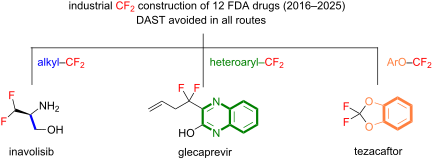
- production. 1.3.2 Difamilast (2021): As shown in Figure 13, the synthesis of the key intermediate of difamilast (6) mainly involves the assembly of three functional groups: the difluoromethyl group, the isopropyl ether, and the carboxylic acid group. Route a (reported in 2017) [68] uses a DMF solution of






Controlled supramolecular assemblies of luminescent tridentate cyclometalated alkynylgold(III) amphiphiles in aqueous media
Beilstein J. Org. Chem. 2026, 22, 1097–1106, doi:10.3762/bjoc.22.88
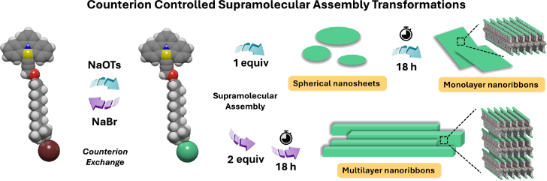
- (92 mg, 0.13 mmol) and 20% trimethylamine in ethanol (1 mL) in dichloromethane (2 mL) was heated at 50 °C for 24 h in a Schlenk tube. The resulting mixture was cooled to room temperature and precipitated with dichloromethane and diethyl ether. The precipitate was filtered off and was washed with


Synthesis and acaricidal activity against Varroa destructor of α- and γ-costic acid dimers
Beilstein J. Org. Chem. 2026, 22, 1088–1096, doi:10.3762/bjoc.22.87
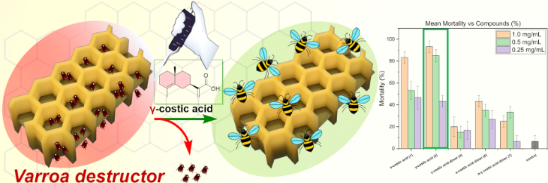
- acid (0.1 equiv) were dissolved in anhydrous toluene (2.0 mL/mmol), the reaction mixture was heated at 100 °C and stirred for 4 hours. The solvent was then removed under reduced pressure. The crude residue was purified by column chromatography (eluent: petroleum ether/EtOAc 8:2) to afford the γ-costic
- room temperature and stirred overnight. The white precipitate was removed by filtration and rinsed with CH2Cl2. The solvent was then removed under reduced pressure. The crude residue was purified by column chromatography (eluent: petroleum ether/EtOAc 8:2) to afford α-costic acid diester 6 (79%). 1H
- suspension and the reaction mixture was allowed to warm to room temperature overnight. The white precipitate was removed by filtration and rinsed with CH2Cl2. The solvent was then removed under reduced pressure. The crude was purified by column chromatography (eluent: petroleum ether/AcOEt 8:2) to afford the


Synthesis of functionalized, 13-alkyl-substituted coralyne derivatives and investigation of their interactions with duplex and abasic site-containing DNA
Beilstein J. Org. Chem. 2026, 22, 1057–1066, doi:10.3762/bjoc.22.84
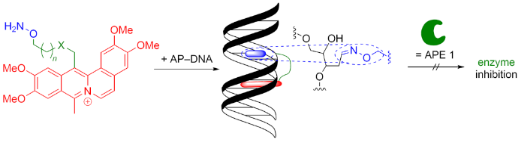
- to give the aminooxy-functionalized coralyne derivative 2g in quantitative yield (Scheme 4). To examine exemplarily whether the latter product can be subsequently employed for oxime ether formation, it was also generated in the presence of benzaldehyde, which furnished the corresponding oxime
- ligand concentration (log[M]) . Nonlinear regression analysis (solid line): IC50 = 0.78 µM. Sketch of the proposed combination of covalent oxime ether formation and DNA intercalation with a coralyne–alkoxyamine conjugate. Synthesis of alkylated papaverine derivatives 3b–f. Synthesis of 13-alkylated


Z-Selective semihydrogenation of alkynes via Ni/Lewis acid synergistic catalyzed system using DMF as hydrogen source and solvent
Beilstein J. Org. Chem. 2026, 22, 1004–1012, doi:10.3762/bjoc.22.79
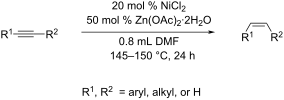
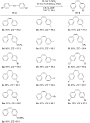
- complete consumption of the starting material, heating was discontinued. After cooling to room temperature, the volatiles were removed under reduced pressure. The resulting crude residue was purified by flash column chromatography on silica gel (eluent: petroleum ether) to afford pure (Z)-stilbene (2a) as



Diastereodivergent electrophilic trapping of α-boryl lithium derivatives
Beilstein J. Org. Chem. 2026, 22, 882–887, doi:10.3762/bjoc.22.68
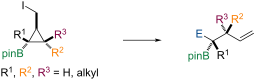
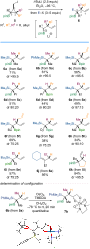
- derivative 1 to afford product 4 as single diastereomers. Specifically, iodide 2 was subjected to tert-butyllithium (t-BuLi) in diethyl ether at −95 °C, efficiently generating cyclopropylmethyllithium 3 via lithium–iodine exchange. Subsequent selective C–C bond cleavage of 3, proceeding exclusively through




The trans-influence in gold chemistry from a catalytic perspective
Beilstein J. Org. Chem. 2026, 22, 838–856, doi:10.3762/bjoc.22.66
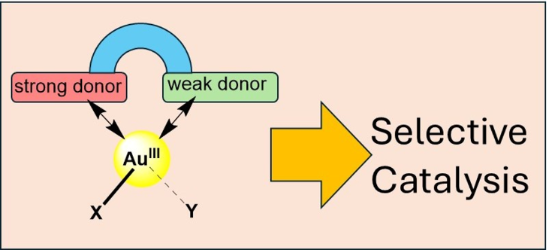
- H–H bond cleavage had been reported earlier by Rocchigiani et al. for the highly electrophilic ether adduct [(C^N–CH)Au(C6F5)OEt2]+ which shows “frustrated Lewis pair” (FLP)-like reactivity (Scheme 7) [32]. The electrophilic character of CO ligated to gold explains why gold is more active than


Total synthesis of the capsular polysaccharide repeating unit towards the development of a glycoconjugate vaccine against Klebsiella pneumoniae ST512
Beilstein J. Org. Chem. 2026, 22, 821–827, doi:10.3762/bjoc.22.64
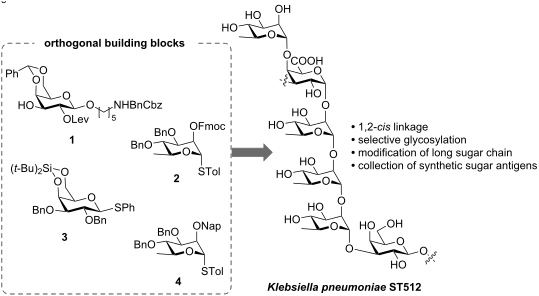
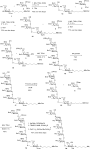
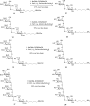
- Nap group to yield 9 (87% yield). Protection of the remaining C3-hydroxy group with a benzyl (Bn) ether furnished building block 4. To obtain building block 2, the Nap group was replaced with a fluorenylmethyloxycarbonyl protecting group (Fmoc) via a two-step sequence: DDQ-mediated deprotection (69


Knoevenagel condensation of 4,5- and 1,8-diazafluorenes
Beilstein J. Org. Chem. 2026, 22, 803–812, doi:10.3762/bjoc.22.62
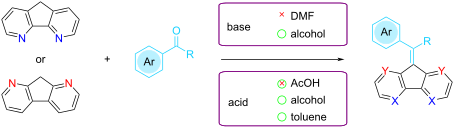
- diethyl ether to the residue after evaporation followed by filtration of the resulting precipitate, which was then washed with diethyl ether, and dried in air. General method (B1) for the condensation in basic conditions In a manner analogous to [34]. A solution of diazafluorene (30.0 mg, 0.18 mmol) in




Design, synthesis, and biological evaluation of FXR/ASK1 dual-target modulators
Beilstein J. Org. Chem. 2026, 22, 771–781, doi:10.3762/bjoc.22.59
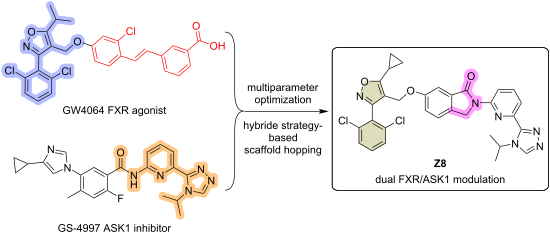
- dioxaborolane 7 or boronic acid 9 and IXa–c. Next, Z16–18 and Z23–25 were obtained by Williamson ether synthesis from the intermediates 8, 10 and isoxazole intermediates 2. Finally, hydrolysis in the presence of LiOH and reduction in the presence of lithium aluminum hydride provided target compounds Z19–22 and
- Z26–29. The synthesis of target compound Z30 is illustrated in Scheme 8. Treatment of intermediate 2 with N-Boc-4-hydroxypiperidine (11) in the presence of sodium hydride produced ether 12, followed by removal of the Boc-protecting group, provided intermediate 13. Coupling of intermediate 13 with IXa


Anti-invasive and cytotoxic evaluation of a (+)-pinoresinol-based semisynthetic library against glioblastoma
Beilstein J. Org. Chem. 2026, 22, 691–704, doi:10.3762/bjoc.22.54
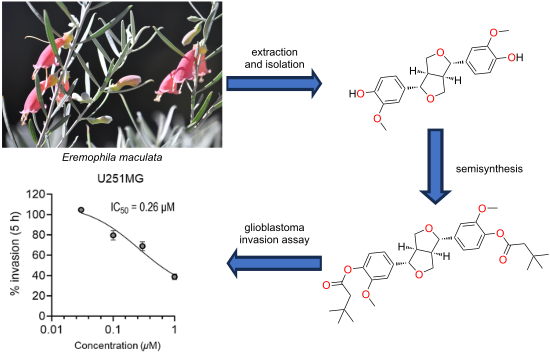
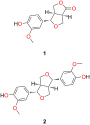
- (+)-pinoresinol derivatives 3–7 Methylation of (+)-pinoresinol (2) (+)-Pinoresinol (2, 15.8 mg, 0.044 mmol) was dissolved in MeOH/CH2Cl2 1:1 (250 μL) before (trimethylsilyl)diazomethane (2.0 M in diethyl ether, 150 μL) was added dropwise. The reaction mixture was stirred for 20 min at room temperature and then



Synthesis of depressin, cryptomeridiol and 4-epi-cryptomeridiol enabled by a terpenoid chiral pool-producing platform
Beilstein J. Org. Chem. 2026, 22, 683–690, doi:10.3762/bjoc.22.53
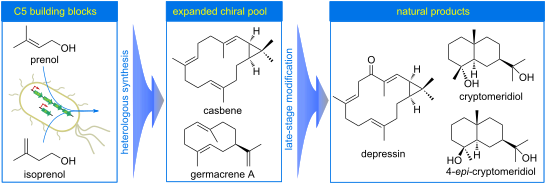
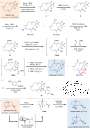
- allylic position C13 being oxidized, a second allylic oxidation would possibly occur at the desired C5 position. However, when compound 8, as well as its acetyl ester (Ac) and tert-butyldimethylsilyl ether (TBS) derivatives, were subjected to several metal-mediated allylic oxidation conditions, either no
- ketone in a later step for the synthesis of 1. The 5-hydroxy group in 11 was then protected as a TBS ether to give 12 in 96% yield. However, direct deoxygenation of the 13-ketone of 12 was not fruitful in our hands [58][59][60]. We then converted enone 12 to the allylic alcohols 13a/b as two
- -butylammonium fluoride (TBAF) for TBS ether removal, followed by DMP for hydroxy group oxidation, delivering the desired product 1 in 29% overall yield in three steps from 14a/b, together with a double bond-isomerized product 15 in 39% overall yield after HPLC purification. The configuration of C12–C13 double


Photoorganocatalytic trifluoromethylation of (het)arenes in green conditions
Beilstein J. Org. Chem. 2026, 22, 662–671, doi:10.3762/bjoc.22.50
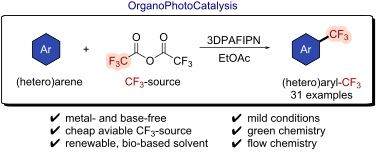
- afforded no more than 6% yield (Table 1, entry 6). Interestingly, MTBE, in contrast to the cyclic ether THF, gave a satisfactory yield of 27% (Table 1, entry 7). BuOAc provided a comparable yield of 28% (Table 1, entry 7), likely due to its higher viscosity (0.685 cP at 25 °C) compared with EtOAc (0.423 cP




Kinetic resolution of racemic planar-chiral vinylcymantrenes by molybdenum-catalyzed asymmetric metathesis dimerization
Beilstein J. Org. Chem. 2026, 22, 568–574, doi:10.3762/bjoc.22.42
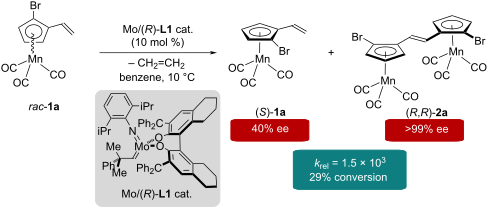
- configuration of (–)-2b Levorotatory AMD/KR product (–)-2b, which was obtained as in entry 8, Table 1 using Mo/(R)-L1 precatalyst, was recrystallized by slow diffusion of pentane into the concentrated diethyl ether solution. Crystals of (–)-2b were grown as light-yellow blocks. The X-ray crystallography


Melifoliox B, a novel phloroglucin derivative isolated from Melicope barbigera (Rutaceae) and synthesis of new oxidation products from melifoliones A and B
Beilstein J. Org. Chem. 2026, 22, 535–546, doi:10.3762/bjoc.22.39
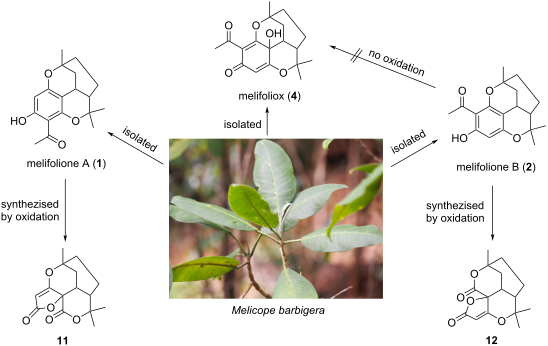
- chromene 5, which is a strong phenol. It is therefore easily separable as a nearly pure compound from the complex reaction mixture by extraction of the ether solution with NaOH. According to the literature, 5 should be converted into melifolione B (2) under acidic conditions [6]. Numerous attempts were
- could be identified as iodized phenyl ether of melifolione A (10), based on its HRESIMS and 1H NMR spectrum. The quinols 3 or 4 could not be detected. Phenols with additional electronegative substituents (e.g., nitro or acetyl) and at least one ortho-positioned hydrogen atom initially react with
- of an alkaline solution of ferricyanide to a hydrogen peroxide containing solution of the melifoliones (1:2 ratio ca. 10:1) in acetonitrile, the color turns deep purple and later orange. After consumption of educts (TLC), extraction with ether yielded small amounts of a new substance as glistening



Modern synthetic pathways towards eribulin and its subunits
Beilstein J. Org. Chem. 2026, 22, 495–526, doi:10.3762/bjoc.22.37
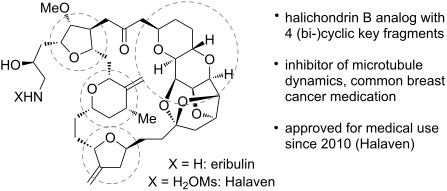
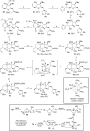
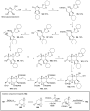
- protected with TESCl, then regioselective oxidation of the primary TES ether and addition of vinyl grignard led to 87. Another oxidation afforded α,β-unsaturated carbonyl 88 and acidic treatment with BnOH triggered the oxa-Michael reaction and transketalization towards tetracyclic 90. Following Kishi
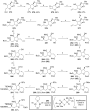
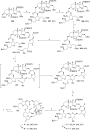
- in 71% yield. A detailed mechanism for this transformation is shown in Scheme 24 below [98]. Here, the Rh(II)-induced elimination of N2 generates carbene 218, which is attacked by the adjacent allyl ether moiety to form unstable zwitterion 219. Sigmatropic rearrangement and acidic workup yielded 213








Synthesis and uranyl(VI) extraction performance of a calix[4]pyrrole–tetrahydroxamic acid receptor
Beilstein J. Org. Chem. 2026, 22, 486–494, doi:10.3762/bjoc.22.36
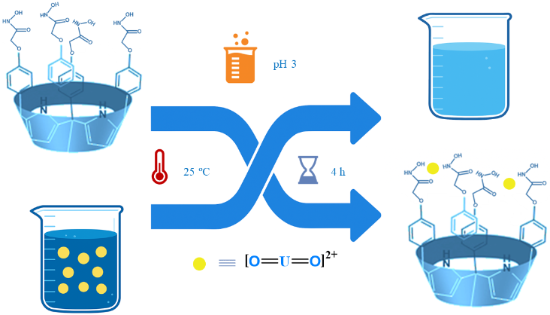
- corresponding hydroxamic acid, with no detectable acid-derived by-products. Solubility tests revealed that PCP HA is soluble exclusively in highly polar aprotic solvents (DMSO, DMF) and remains completely insoluble in other common organic solvents (chloroform, ether, etc.) and water. The absence of ligand


A facile and practical method for the synthesis of trans-(±)-taxifolin and its derivatives via Darzens reaction
Beilstein J. Org. Chem. 2026, 22, 443–450, doi:10.3762/bjoc.22.31
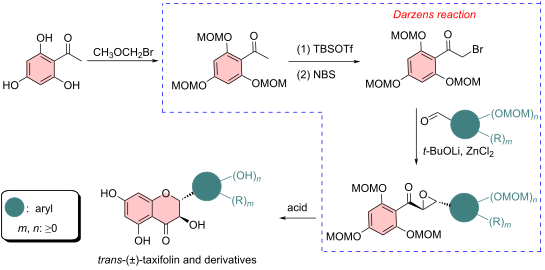
- expanded synthesis of taxifolin derivatives with oxidant-sensitive substituents. Results and Discussion 2,4,6-Trihydroxyacetophenone was used as starting material, and its hydroxy groups were protected as methoxymethyl (MOM) ether by treatment with MOMBr (6.0 equiv) in the presence of NaH (4.0 equiv) to
- cleaved (Supporting Information File 1, Table S1, entry 6). To overcome these challenges, we decided to convert 1 to its corresponding silyl enol ether by treatment with TBSOTf in the presence of Et3N, and the formed silyl enol ether was in turn treated with NBS in a neutral THF/H2O mixture (PBS buffer
- trihydroxyacetophenone were reacted with bromomethyl methyl ether (6.0 equiv) using NaH (4.0 equiv) as base in THF to give OH-protected acetophenone 1 with 78% yield. Compound 1 was then converted to the silyl enol ether via reaction with TBSOTf (1.2 equiv) in the presence of Et3N (3.0 equiv) in CH2Cl2 and no further


Synthesis and stereochemical analysis of dynamic planar chiral oxa[7]orthocyclophene
Beilstein J. Org. Chem. 2026, 22, 436–442, doi:10.3762/bjoc.22.30

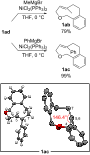
- -substituted oxacyclophene 1ad We planned to construct the nine-membered cyclic ether skeleton of 1ad in the final step by an intramolecular Williamson etherification of haloalcohol 2 (Scheme 1). The iodine-substituted Z-alkene moiety of 2 was planned to be introduced through a trans-selective hydroiodination




Synthesis and anti-cancer activity of naphthalimide–organylselanyl conjugates
Beilstein J. Org. Chem. 2026, 22, 416–435, doi:10.3762/bjoc.22.29
- with water (20 mL) and brine (20 mL). The organic layer was dried with anhydrous MgSO4, filtered and the solvent was evaporated under vacuum. Petroleum ether was added to the residue and triturated. The solid was filtered, affording white amine 11 (500 mg, 48%). mp: 95–97 °C; 1H NMR (400 MHz, CDCl3) δ
- magnesium sulfate (MgSO₄) and concentrated under low pressure. Column chromatography was performed to purify the crude product using a solvent ratio of petroleum ether to ethyl acetate (85:15), which yielded a yellow solid. Yield: (295 mg, 54%). mp: 156–157 °C; 1H NMR (400 MHz, CDCl3) δ 8.62 (d, J = 7.3 Hz
- water was added to the reaction mixture, and the mixture was extracted with ethyl acetate. The organic layers were washed with water and brine, then dried on anhydrous MgSO4 and concentrated under reduced pressure. The crude yellow liquid was purified by column chromatography (petroleum ether/ethyl




Cone p-aminocalix[4]arenes enriched with ‘clickable’ alkyne or azide functionalities
Beilstein J. Org. Chem. 2026, 22, 399–415, doi:10.3762/bjoc.22.28
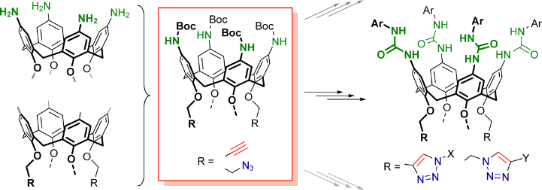
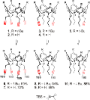
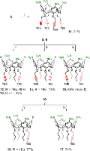
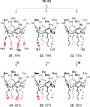
- and reaction time did not significantly improve the yield. Also an attempt to obtain calixarene 11 by nitration of the silylated p-H-calix[4]arene tetrapropargyl ether 7 failed, as no complete conversion of the starting calixarene could be achieved likely due to a slower nitration of unsubstituted
- , the room-temperature nitration of the silylated p-tert-butylcalix[4]arene ether 8 using 2.5 equiv of HNO3 per calixarene aromatic unit resulted in di- or trinitrated macrocycles 12 and 14 as the major products, when ≈0.2 and ≈1 M nitric acid concentrations were used. Similarly, the wide-rim
- -temperature preparation of the tetrapropargyl ether 24 from its silylated precursor 21. Surprisingly, attempts to apply these conditions to a complete removal of TBS groups in the less sterically hindered propargyl ethers 22 and 23 failed, and large amounts of the starting materials (as well as the partially






Recent advances in the cleavage of non-activated amides
Beilstein J. Org. Chem. 2026, 22, 352–369, doi:10.3762/bjoc.22.23
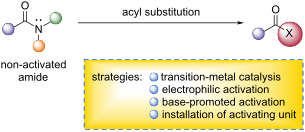
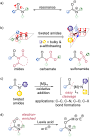
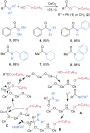
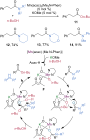
- generates the imidate-like intermediate Q. Subsequent nucleophilic attack of BuOH on the methyl group of Q leads to transition state R, accompanied by the departure of butyl methyl ether. Further attack of BuOH on the O-protonated amide, followed by an intramolecular proton transfer, furnishes transition




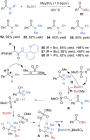
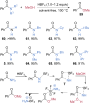
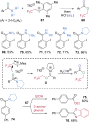
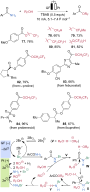

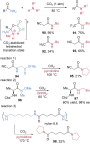
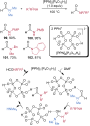


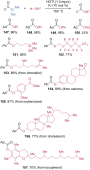

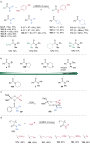


Synthesis of tricyclic fused pyrrolidine nitroxides from 2-alkynylpyrrolidine-1-oxyls
Beilstein J. Org. Chem. 2026, 22, 344–351, doi:10.3762/bjoc.22.22

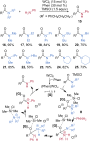
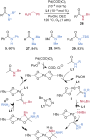
- corresponding alkynylmagnesium bromides to nitrone 1 [20]. Radicals 2d and 2e were prepared in analogy to the known procedure using trimethylsilylacetylene and benzyl propargyl ether as the terminal alkynes (Scheme 1). Nitrone 1 was treated with a 10-fold excess of alkynylmagnesium bromide prepared in situ via
- metalation of trimethylsilylacetylene or benzyl propargyl ether with ethylmagnesium bromide. After quenching, removal of the MOP protecting group, and oxidation by atmospheric oxygen the nitroxides 2d and 2e were isolated in 64% and 66% yields, respectively. Terminal alkynes can be converted into
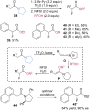
- dioxide in tetrahydrofuran gave vinyl ether 8, which was isolated with 50% yield (Scheme 4). The structure of the product 8 was confirmed by X-ray crystallographic analysis (Figure 3, CCDC 2512653). Formation of 8 apparently occurs via cyclization of alkynal 7. The formation of vinyl ethers has been




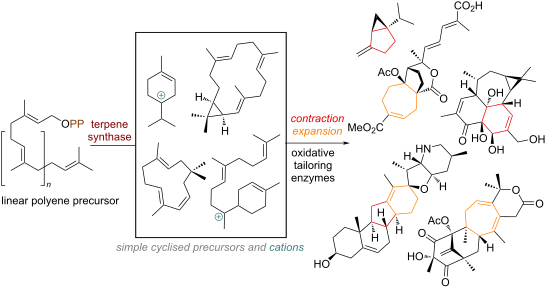
Ring contraction and ring expansion reactions in terpenoid biosynthesis and their application to total synthesis
Beilstein J. Org. Chem. 2026, 22, 289–343, doi:10.3762/bjoc.22.21






Arene activation via π-bond localization: concepts and opportunities
Beilstein J. Org. Chem. 2026, 22, 257–273, doi:10.3762/bjoc.22.19
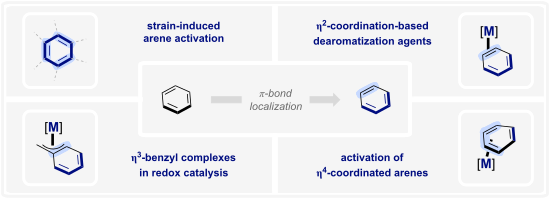
- electrophilic addition. Comparable effects are observed for furans and pyridines, where η2-coordination accentuates their vinyl ether and imine character, respectively. As an illustrative example, treatment of the phenol complex 5 with methyl vinyl ketone and pyridine affords 4-alkylated 4H-phenol complex 6 as