Search results
Search for "cycloisomerization" in Full Text gives 66 result(s) in Beilstein Journal of Organic Chemistry.
Combination of gold catalysis and Selectfluor for the synthesis of fluorinated nitrogen heterocycles
Beilstein J. Org. Chem. 2011, 7, 1379–1386, doi:10.3762/bjoc.7.162

- the elucidation of the mechanism and Selectfluor was suggested to play the double role of promoting the oxidation of gold(I) to a gold(III) active species and also the electrophilic fluorination of the enamine intermediates. Keywords: cycloisomerization reactions; fluorinated pyrrolidines; gold




Asymmetric Au-catalyzed cycloisomerization of 1,6-enynes: An entry to bicyclo[4.1.0]heptene
Beilstein J. Org. Chem. 2011, 7, 1021–1029, doi:10.3762/bjoc.7.116
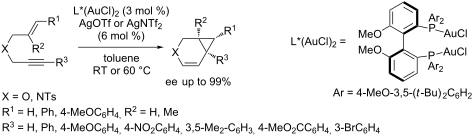
- gold-catalyzed cycloisomerization reaction of heteroatom tethered 1,6-enynes is described. The cycloisomerization reactions were conducted in the presence of the chiral cationic Au(I) catalyst consisting of (R)-4-MeO-3,5-(t-Bu)2-MeOBIPHEP-(AuCl)2 complex and silver salts (AgOTf or AgNTf2) in toluene
- , was reported in moderate to good yields and in enantiomeric excesses up to 99%. Keywords: asymmetric catalysis; bicycloheptene; cycloisomerization reactions; enynes; gold; Introduction Metal-catalyzed cycloisomerization reactions of 1,n-enynes have emerged as efficient processes that contribute to
- cycloisomerization reaction of allyl propynyl ethers leading to oxabicyclo[4.1.0]heptenes [14] (Scheme 1, reaction 1). The group of Murai observed a similar reactivity in the presence of PtCl2, although in a lower yield [15]. These seminal contributions were then followed by several comprehensive studies involving


Recent advances in the gold-catalyzed additions to C–C multiple bonds
Beilstein J. Org. Chem. 2011, 7, 897–936, doi:10.3762/bjoc.7.103
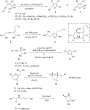
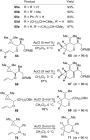
- the gold-catalyzed cycloisomerization of α-hydroxyallenes 16 to 2,5-dihydrofurans 17 (Scheme 3) [25]. The best system was found to be AuBr3 in [BMIM][PF6]. The cycloisomerization of various alkyl- or arylsubstituted α-hydroxyallenes gave corresponding 2,5-dihydrofuran with complete axis-to-center
- tetrahydropyran 24 were produced by an efficient gold(I) chloride catalyzed cycloisomerization of 2-alkynyl-1,5-diol 22 [28]. A plausible mechanism for the gold-catalyzed transformation of dioxabicyclo[4.2.1]ketal 25 to tetrahydropyran 31 is outlined in Scheme 5. The gold catalyst activates one of the oxygen
- gold-catalyzed cyclization of alk-4-yn-1-ones 79 depending on the substitution pattern in the substrate and the reaction solvent. Thus, alkynones with one substituent at C-3 undergo a 5-exo-dig cycloisomerization to yield substituted furans 81, whilst substrates bearing two substituents at C-3 undergo








Gold(I)-catalyzed formation of furans by a Claisen-type rearrangement of ynenyl allyl ethers
Beilstein J. Org. Chem. 2011, 7, 878–885, doi:10.3762/bjoc.7.100

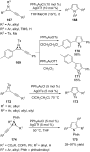
- of a new procedure for the synthesis of polysubstituted furans by a gold-catalyzed cycloisomerization of ynenyl allyl ethers [45][46][47][48]. In the course of our work on the development of new gold-catalyzed transformations [49][50][51], we recently found that a series of ynenyl allyl tosylamides 1
- , whatever substrate was used [67]. Substrates 6b and 6e, which were used as a mixture of Z/E isomers, each afforded a single product, i.e., the furans 7b and 7e, respectively (entries 2 and 5). The cycloisomerization of compounds 6f, 6g, 6o, 6q and 6s, which possess an exocyclic allyl moiety, furnished the


Gold-catalyzed propargylic substitutions: Scope and synthetic developments
Beilstein J. Org. Chem. 2011, 7, 866–877, doi:10.3762/bjoc.7.99

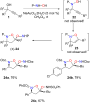
- an one-pot, sequential, reaction with first a gold(III)-catalyzed propargylic substitution followed by a gold(I)-catalyzed cycloisomerization, the bicyclic compound 37 was obtained in 71% yield [24][80][81][82]. Very recently, a remarkable one-pot reaction using an original gold(III) catalyst has




When gold can do what iodine cannot do: A critical comparison
Beilstein J. Org. Chem. 2011, 7, 847–859, doi:10.3762/bjoc.7.97
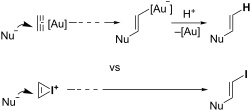
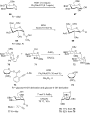
- the same core unit. In 2006, a substantial variation to the traditional synthesis of furanones was developed by Kirsch and co-workers from readily accessible 2-hydroxy-2-alkynylcarbonyl compounds by a gold-catalyzed cycloisomerization approach [69]. The gold-catalyzed cyclization of 1, containing a
- carbocyclizations have been mainly restricted to the intramolecular arylation of alkynes (i.e., arene nucleophiles) [85][86][87][88] whilst simple olefins have been rarely used in this way. Analogous cyclization modes Several processes involving the cycloisomerization of 1,5-enynes have been realized in an
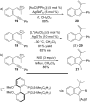
- of an asymmetric halocyclization towards indenes remains an ongoing task [93][94][95][96]. Notably, 1,5-enynes that do not contain an aryl system react in quite a similar manner when disubstituted at C1. For example, Michelet and co-workers reported the diastereoselective cycloisomerization of 1,5






High chemoselectivity in the phenol synthesis
Beilstein J. Org. Chem. 2011, 7, 794–801, doi:10.3762/bjoc.7.90
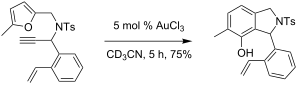
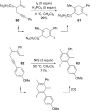
- much less widespread [2][3][15]. The gold-catalyzed ene–yne cycloisomerization reactions are, mechanistically, very complex reactions [16][17][18], and the furan–yne cycloisomerization is no exception. For the latter reaction arene oxides D [19] and oxepines C [20] could be detected as intermediates


Synthetic applications of gold-catalyzed ring expansions
Beilstein J. Org. Chem. 2011, 7, 767–780, doi:10.3762/bjoc.7.87
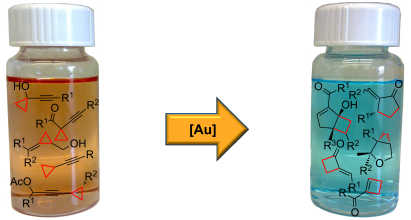
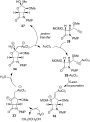
- intermolecular nucleophilic attack to give intermediate 47, which upon cycloisomerization affords the aromatic product (Scheme 14, path b). Toste and co-workers reported an intramolecular acetylenic Schmidt reaction using azides as internal nucleophiles to give substituted pyrroles (Scheme 15) [42]. Gold
- cyclopropenes Highly strained cyclopropenes can undergo a wide variety of transformations in the presence of Lewis acids. Shi and co-workers reported in 2008 a gold-catalyzed cycloisomerization of aryl vinyl cyclopropenes to produce, selectively, 2-vinyl-1H-indene derivatives in high yields (Scheme 18). Upon
- , intermediates characterize these competitive processes, i.e., 1,2-migration via metal "carbenoid" 81 formation and [3,3]-sigmatropic rearrangement via allenyl acetate 82 as an intermediate (Scheme 24) [5][56][57]. In 2008, Toste and co-workers reported a gold(I)-catalyzed cycloisomerization of cis-pivaloyloxy


A racemic formal total synthesis of clavukerin A using gold(I)-catalyzed cycloisomerization of 3-methoxy-1,6-enynes as the key strategy
Beilstein J. Org. Chem. 2011, 7, 740–743, doi:10.3762/bjoc.7.84
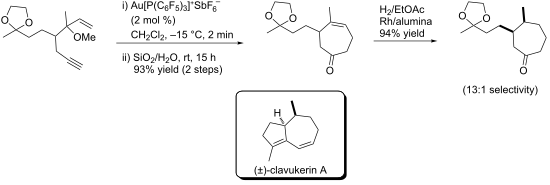
- -catalyzed cycloisomerization of a 3-methoxy-1,6-enyne 5 as the key strategy followed by Rh-catalyzed stereoselective hydrogenation of the cycloheptenone 4. Keywords: clavukerin A; cycloisomerization; gold catalyst; hydrogenation; stereoselectivity; Findings Clavukerin A is a member of marine trinorguaiane
- followed by several other racemic and enantioselective syntheses [2][3][4][5][6][7][8][9][10][11][12][13][14]. Herein, we report a short formal total synthesis of racemic clavukerin A employing the gold(I)-catalyzed cycloisomerization of a 3-methoxy-1,6-enyne as the key strategy, which was recently
- cyclization (path B). The cycloheptenone 4 could then be synthesized from the enyne substrate 5 by gold(I)-catalyzed cycloisomerization. The synthesis of enyne substrate 5 commenced with the alkylation of methyl acetoacetate with the known bromide 6 [24] to provide compound 7 in 55% yield (Scheme 2


When cyclopropenes meet gold catalysts
Beilstein J. Org. Chem. 2011, 7, 717–734, doi:10.3762/bjoc.7.82
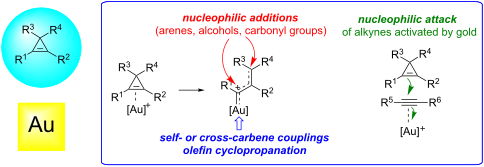
- electron-deficient groups (Scheme 25) [24]. Besides these examples of intermolecular cyclopropanations, examples of intramolecular cyclopropanation of olefins by gold carbenes generated from cyclopropenes have been investigated in our group. Intramolecular cyclopropanation: cycloisomerization of
- , AuCl, [(Ph3P)AuNTf2], [(Ph3P)AuSbF6] or [(Ph3P)AuOTf]} were found to catalyze smoothly the cycloisomerization and yield the desired oxabicyclic compound 60 in high yields and with excellent diastereoselectivity (dr > 96:4) [25]. The observed stereochemical outcome has been tentatively rationalized by
- highlighted by the behaviour of geranyl ether 62d and neryl ether 62e, which furnished the epimeric cycloisomerization products 63d and 63e, respectively. The stereoselectivity was lower for methallyl ether 62f which afforded compound 63f as an 87:13 mixture of diastereomers (Scheme 27) [25]. The influence of




Gold-catalyzed heterocyclizations in alkynyl- and allenyl-β-lactams
Beilstein J. Org. Chem. 2011, 7, 622–630, doi:10.3762/bjoc.7.73
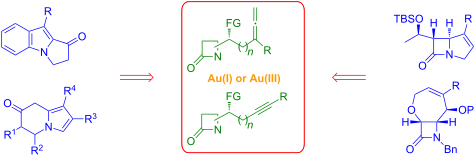
- good yields for 2-azetidinones with n-butyl, THPOCH2, phenyl, and 2-naphthyl substituents. It should be mentioned that the cyclization of allenyl-β-lactams 1 is an application of the gold-catalyzed cycloisomerization of α-aminoallenes which was discovered earlier [32][33]. Although the mechanism of the
- was catalyzed by gold salts (AuCl3), allene cycloisomerization adducts 7 were obtained as the sole isomers (Scheme 3). The cyclization of allenyl-β-lactams 5 is an application of the previously reported gold-catalyzed cycloisomerization of α-hydroxyallenes [42][43][44]. Similarly to the transition
- -(2-alkynylphenyl)-β-lactams 18 has been accomplished (Scheme 10). Platinum was the metal of choice, gold salts being less effective [51]. This cycloisomerization can be viewed as a net intramolecular insertion of one end of the alkyne into the lactam amide bond with concurrent migration of the



A gold-catalyzed alkyne-diol cycloisomerization for the synthesis of oxygenated 5,5-spiroketals
Beilstein J. Org. Chem. 2011, 7, 570–577, doi:10.3762/bjoc.7.66
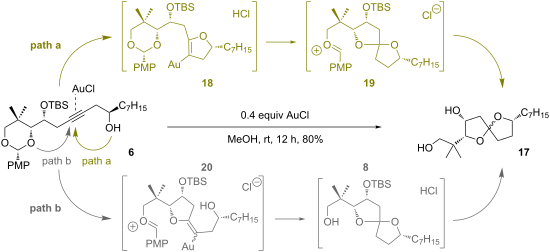
- cephalosporolides. Gold(I) chloride in methanol induced the cycloisomerization of a protected alkyne triol with concomitant deprotection to give a strategically hydroxylated 5,5-spiroketal, despite the potential for regiochemical complications and elimination to furan. Other late transition metal Lewis acids were
- less effective. The use of methanol as solvent helped suppress the formation of the undesired furan by-product. This study provides yet another example of the advantages of gold catalysis in the activation of alkyne π-systems. Keywords: alkynes; cyclocondensation; cycloisomerization; gold-catalyzed
- 5,5-spiroketals, including cyclocondensation of ketone diols [6][7], the cycloisomerization of alkyne diols (Scheme 1) [8][9][10][11][12][13][14][15][16], oxidative spirocyclization of tetrahydrofuryl propanols [17][18][19][20], and others. Cyclocondensation of ketone diols is perhaps the most


Gold catalysis for organic synthesis
Beilstein J. Org. Chem. 2011, 7, 553–554, doi:10.3762/bjoc.7.63
- , cycloaddition and cycloisomerization reactions, to applications in enantioselective catalysis, oxidative coupling and the total synthesis of natural products, and transformations of alkynes, allenes, alkenes and even C–H bonds. A true treasure chest of reactivity! I am grateful to all of the authors that have
Rh(I)-catalyzed intramolecular [2 + 2 + 1] cycloaddition of allenenes: Construction of bicyclo[4.3.0]nonenones with an angular methyl group and tricyclo[6.4.0.01,5]dodecenone
Beilstein J. Org. Chem. 2011, 7, 404–409, doi:10.3762/bjoc.7.52
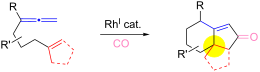
- , entries 3–5). Therefore, the formation of 12 must be rationalized by the Rh(I)-catalyzed cycloisomerization. The oxidative addition of the Rh(I)-catalyst to an alkene group and the distal double bond of the allenyl moiety would form a rhodabicyclo[4.3.0]nonene intermediate, which would collapse to the


Synthesis of fluorinated δ-lactams via cycloisomerization of gem-difluoropropargyl amides
Beilstein J. Org. Chem. 2010, 6, No. 48, doi:10.3762/bjoc.6.48
- ; cycloisomerization; difluoropropargyl; enyne; ring-closing metathesis; Introduction It has been estimated that as many as 25% of all synthetic pharmaceutical drugs contain an amide bond [1]. Commonly, β- and γ-lactams are present in many natural products and pharmaceuticals, and the introduction of a gem
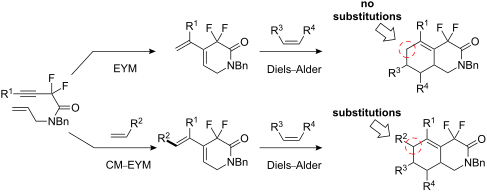
- (Scheme 3). In summary, gem-difluoro-1,7-enyne carbonyl derivatives are useful reaction partners in enyne metathesis cycloisomerization and CM–EYM tandem reactions catalyzed by ruthenium carbene complexes. The resulting diene products can be elaborated further using a Diels–Alder reaction. Comparison of
- fluorinated δ-lactams via cycloisomerization of gem-difluoropropargyl amides Acknowledgements We are grateful to the National Science Foundation for financial support (CHE-0809683) and to Professor Santos Fustero, Universidad de Valencia, Spain, for scientific cooperation and advice.


Recent progress on the total synthesis of acetogenins from Annonaceae
Beilstein J. Org. Chem. 2008, 4, No. 48, doi:10.3762/bjoc.4.48