


Search results
Search for "umpolung" in Full Text gives 59 result(s) in Beilstein Journal of Organic Chemistry.
The chemistry of amine radical cations produced by visible light photoredox catalysis
Beilstein J. Org. Chem. 2013, 9, 1977–2001, doi:10.3762/bjoc.9.234
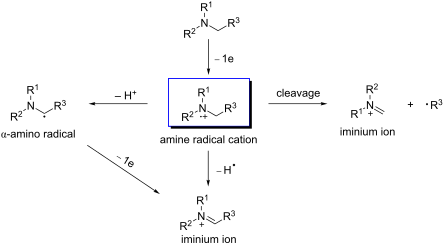
- conducted under degassing conditions. This is in contrast to the chemistries involving iminium ions, which are often performed with exposure to air or oxygen. The reactivity umpolung at the carbon α to the nitrogen atom has expanded the repertoire of amine radical cations’ modes of reactivity. Compared to




Carbolithiation of N-alkenyl ureas and N-alkenyl carbamates
Beilstein J. Org. Chem. 2013, 9, 628–632, doi:10.3762/bjoc.9.70

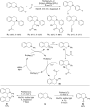
- primary, secondary and tertiary organolithium reagents. N-tert-butoxycarbonyl vinylcarbamates may be carbolithiated, protonated and deprotected in a one-pot synthesis of amines employing this unusual umpolung nucleophilic β-alkylation. With β-substituted vinylureas, the carbolithiation is
- structure of carbamate E-10. Carbolithiation of ureas 1. Diastereospecific carbolithiation of ureas 3. Diastereospecific carbolithiation of ureas 5. Synthesis of N-alkenyl carbamates 9–11. Umpolung carbolithiation of carbamates 9 and 10. Organolithium addition to ureas 1. Organolithium additions to ureas 3


NHC-catalysed highly selective aerobic oxidation of nonactivated aldehydes
Beilstein J. Org. Chem. 2013, 9, 602–607, doi:10.3762/bjoc.9.65
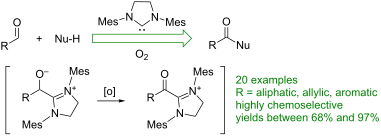
- led to a higher total conversion. We suppose that this is caused by the oxidation of the NHC, i.e., the consumption of the umpolung catalyst [23]. With this result in hand we focused on the aerobic autoxidation using only D as a precatalyst. An interesting conversion of aromatic aldehydes to acids


N-Heterocyclic carbene-catalyzed direct cross-aza-benzoin reaction: Efficient synthesis of α-amino-β-keto esters
Beilstein J. Org. Chem. 2012, 8, 1499–1504, doi:10.3762/bjoc.8.169
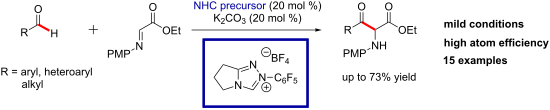
- -amino-β-keto esters; cross-aza-benzoin; α-imino ester; N-heterocyclic carbenes; organocatalysis; umpolung reactions; Introduction α-Amino-β-keto ester derivatives are one of the fundamental structural subunits in natural products such as miuraenamides [1], and important building blocks for the
- of PhI=O is needed as the oxidant (Figure 1, (e)) [23]. Therefore, mild, efficient and environmentally friendly strategies for the synthesis of these esters are still needed. We envisioned that highly atom-efficient synthesis of α-amino-β-keto esters could be achieved by a novel umpolung approach
- including C–C bond construction, that is, formal addition of acyl anion equivalents generated from aldehydes 1 with NHCs, to α-imino esters 2 (Figure 1, (f)). Although a large number of NHC-catalyzed umpolung reactions, such as the benzoin reaction and Stetter reaction, have been developed [24][25][26][27


Organocatalytic asymmetric addition of malonates to unsaturated 1,4-diketones
Beilstein J. Org. Chem. 2012, 8, 1452–1457, doi:10.3762/bjoc.8.165
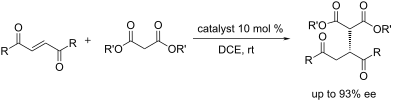
- enantiomer. From the synthetic point of view, the conjugate addition of the nucleophile is, at the same time, a formal umpolung reaction with respect to the other carbonyl group (Figure 1). Results and Discussion Catalyst screening As a part of our ongoing studies in organocatalysis [16][17][18][19] we


Approaches to α-amino acids via rearrangement to electron-deficient nitrogen: Beckmann and Hofmann rearrangements of appropriate carboxyl-protected substrates
Beilstein J. Org. Chem. 2012, 8, 1393–1399, doi:10.3762/bjoc.8.161

- transformation of 1 to 5 indicates that 1 functions as a glycine enolate equivalent with the benzoylamino group in 5 being introduced in umpolung fashion (reaction involves the migration to an electrophilic nitrogen center). Hofmann rearrangement approach Our strategy was based on the known ethyl
- amino group is being introduced in umpolung fashion in the strategy described above. Generally, the amino group is introduced nucleophilically, e.g., in the Gabriel method. The trioxaadamantylmethylamine carbamates 10 also represent α-amino acids with both carboxyl and amino group protection. The methyl


N-Heterocyclic carbene/Brønsted acid cooperative catalysis as a powerful tool in organic synthesis
Beilstein J. Org. Chem. 2012, 8, 398–402, doi:10.3762/bjoc.8.43
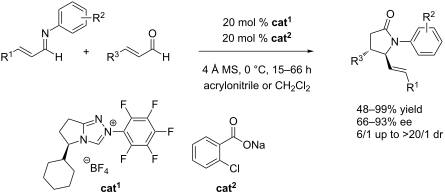
- encouraged many chemists to search intensively for new NHC ligands, and this has led to the establishment of a very fruitful research area in organic chemistry [4][5][6][7][8][9][10]. A particularly interesting application comprises the use of “umpolung” reactions [11] (inversion of polarity) catalyzed by N
- -heterocyclic carbenes, such as the benzoin condensation and the Stetter reaction. In these reactions, the NHC effects an “umpolung” of the normal carbonyl reactivity, and the electrophilic aldehyde carbon atom thus becomes nucleophilic and can attack a variety of electrophiles. The story of “umpolung
- ” reactions of aldehydes started as long ago as 1832, and the preparation of sterically hindered triazolium salts in 1996 provided a solid basis for highly stereoselective “umpolung” reactions utilizing NHCs [12]. In addition, conjugate “umpolung” relates to a process in which α,β-unsaturated aldehydes 3 are


Lithium phosphonate umpolung catalysts: Do fluoro substituents increase the catalytic activity?
Beilstein J. Org. Chem. 2011, 7, 1189–1197, doi:10.3762/bjoc.7.138
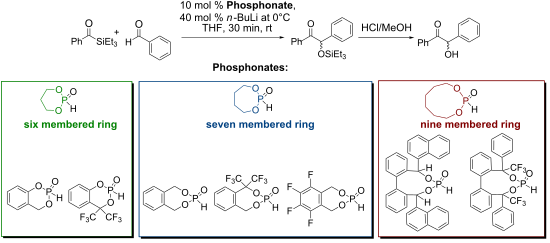
- ; lithium phosphonates; umpolung; Introduction Since the discovery of the cyanide catalyzed benzoin reaction by Liebig and Wöhler in 1832 [1], acyloin-type reactions evolved as powerful tools for couplings of acylanion equivalents with carbon electrophiles. In addition to cyanide [2][3][4][5] and




Shelf-stable electrophilic trifluoromethylating reagents: A brief historical perspective
Beilstein J. Org. Chem. 2010, 6, No. 65, doi:10.3762/bjoc.6.65
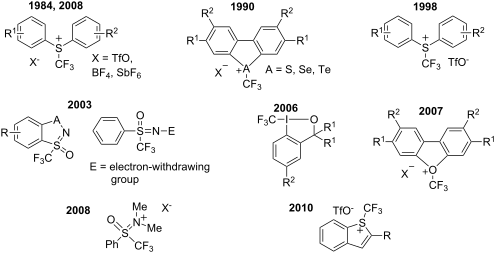
- stability compared to the intermediates with Rf groups with more than one carbon atom. In 2006 Togni and co-workers reported a new family of hypervalent iodine compounds in which the CF3 group is bonded directly to the iodine atom. The overall synthetic protocol depends on a formal umpolung of the CF3 group


Other Beilstein-Institut Open Science Activities



