Search results
Search for "dipole moment" in Full Text gives 114 result(s) in Beilstein Journal of Organic Chemistry.
Fluorinated cyclohexanes: Synthesis of amine building blocks of the all-cis 2,3,5,6-tetrafluorocyclohexylamine motif
Beilstein J. Org. Chem. 2017, 13, 728–733, doi:10.3762/bjoc.13.72
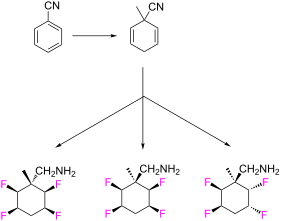
- (Figure 1) [1][2][3]. The cyclohexane ring has four C–F bonds on one face, two of which are aligned 1,3-diaxial. Due to the particularly polar nature of the C–F bond, the alignment of those two bonds results in a large molecular dipole moment [4][5][6]. For the parent cyclohexane ring 1 the magnitude of



Spectral and DFT studies of anion bound organic receptors: Time dependent studies and logic gate applications
Beilstein J. Org. Chem. 2017, 13, 222–238, doi:10.3762/bjoc.13.25
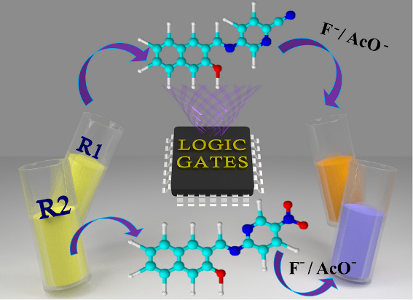
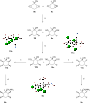
- 571 nm fully supports the anion-binding process. A substantial increase in the dipole moment of the fluoride complex indicates an efficient charge separation allowing the formation of the hydrogen bond between OH and F−. While the corresponding acetate complex exhibited a two-fold increase in the
- dipole moment implying the bifurcated nature of the hydrogen bond involving one OH proton with two electronegative oxygen atoms of the acetate ion. Binding mechanism Based on the 1H NMR titration studies the following binding mechanism is proposed. The receptors R1 and R2 undergo an anion-induced


New approaches to organocatalysis based on C–H and C–X bonding for electrophilic substrate activation
Beilstein J. Org. Chem. 2016, 12, 2834–2848, doi:10.3762/bjoc.12.283
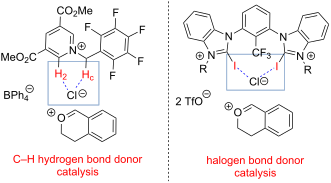
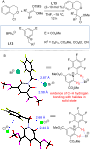
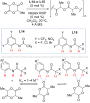
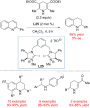
- substantial dipole moment (≈4.5 D) almost aligned with the C5–H bond and the relatively high acidity of this position (pKa(DMSO) = 27–28, for the 1H-tautomer). These heterocycles, which are easily available from 1,3-cycloaddition of alkynes and azides, can both form strong C–H bonds with hydrogen bond








Organofluorine chemistry: Difluoromethylene motifs spaced 1,3 to each other imparts facial polarity to a cyclohexane ring
Beilstein J. Org. Chem. 2016, 12, 2823–2827, doi:10.3762/bjoc.12.281
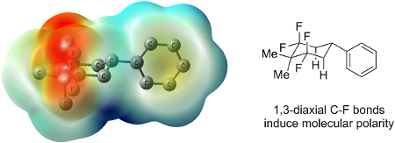
- incorporation of fluorine atoms is a powerful strategy for modulating the properties of organic compounds [1][2][3]. For instance, the replacement of hydrogen by fluorine is commonly practised in medicinal [4][5] and agrochemical [6][7] research programmes. The dipole moment associated with the C–F bond has
- bonds (Figure 4). A molecular dipole moment for compound 4c was calculated at 3.1 D and can be compared for example to 1,2,4,5-tetrafluorocyclohexane (2, 5.2 D) [18]. Conclusion In this study we have prepared a novel polar aliphatic structure 4c based on the 1,1,3,3-tetrafluorocyclohexyl motif. The


Benzothiadiazole oligoene fatty acids: fluorescent dyes with large Stokes shifts
Beilstein J. Org. Chem. 2016, 12, 2739–2747, doi:10.3762/bjoc.12.270
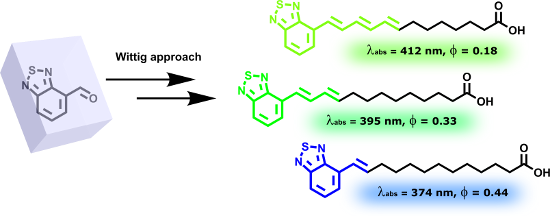
- transition. Thus, the low overlap between both wavefunctions results in a small transition dipole moment and subsequently a quite weak absorption. The situation is even aggravated by the specific small angle (≈64°) between the oligoene and the longitudinal axis of the BTD moiety, which diminishes the dipole
- moment of the electronic shift additionally. However, the large displacement of electron density from one part of the π-system to another enforces a geometrical equilibration of the nuclei which triggers the emission event to take place from a considerably relaxed excited state. As a consequence, the


Synthesis and fluorosolvatochromism of 3-arylnaphtho[1,2-b]quinolizinium derivatives
Beilstein J. Org. Chem. 2016, 12, 854–862, doi:10.3762/bjoc.12.84
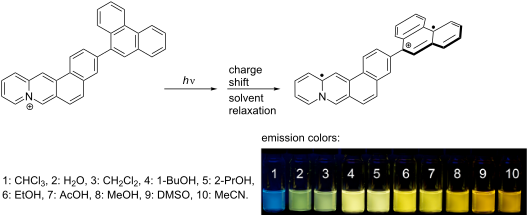
- , the Taft parameter π*, the dipole moment, μ, the acidity, SA, the basicity, SB, the dipolarity and polarizability SPP, the polarizability, SP, or the dipolarity SDP (cf. Supporting Information File 1). In all cases, the plots of the solvent parameters versus the emission energy do not disclose an
- effect on the emission properties of 6e. Namely, the emission maxima shift to lower energy with increasing polarity of the aprotic solvents (Figure 5). This qualitative relationship denotes a larger dipole moment of the molecule in the excited state than in the ground state, as usually observed in donor


Is conformation a fundamental descriptor in QSAR? A case for halogenated anesthetics
Beilstein J. Org. Chem. 2016, 12, 760–768, doi:10.3762/bjoc.12.76
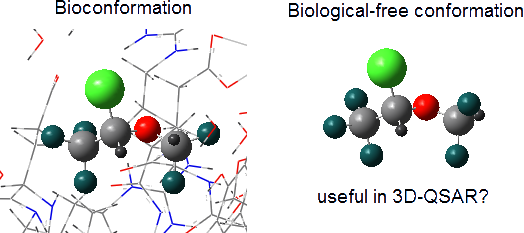
- bonds along with a bond path: loss of atomic charge (q), decreased first dipole moment (M1), decreased atomic volume (V) and increased atomic energy (E). Since these criteria do not vary significantly among the conformers (either when H approaches to Cl and F or not), we can confirm that hydrogen


Selectively fluorinated cyclohexane building blocks: Derivatives of carbonylated all-cis-3-phenyl-1,2,4,5-tetrafluorocyclohexane
Beilstein J. Org. Chem. 2015, 11, 2671–2676, doi:10.3762/bjoc.11.287
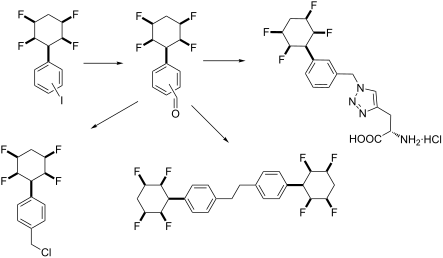
- therefore there are three C–F bonds orientated triaxial, on one face of the ring. This gives rise to a large dipole moment (6.2 D) and a molecule which is among the most polar aliphatics known in organic chemistry. The all-cis-tetrafluorocyclohexanes 2 and 3 are also facially polarised because in the chair


Quarternization of 3-azido-1-propyne oligomers obtained by copper(I)-catalyzed azide–alkyne cycloaddition polymerization
Beilstein J. Org. Chem. 2015, 11, 1037–1042, doi:10.3762/bjoc.11.116

- dipole moment and aromaticity, 1,2,3-triazole itself may be a functional group. Polymers composed of dense 1,2,3-triazole moieties on the backbone are thus promising as functional materials. Recently, we have investigated the CuAAC polymerization of 3-azido-1-propyne (AP) using 3-bromo-1-propyne as a


Automated solid-phase synthesis of oligosaccharides containing sialic acids
Beilstein J. Org. Chem. 2015, 11, 617–621, doi:10.3762/bjoc.11.69
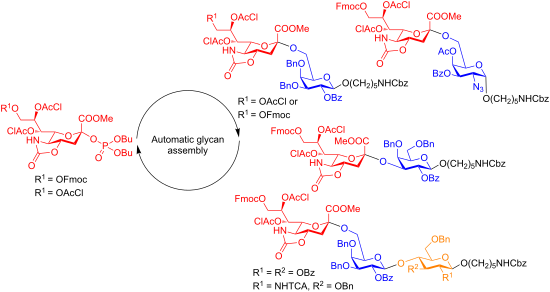
- ][13][14][15], where the trans-fused cyclic protecting group in the glycosylation transition state likely stabilizes the positive charge on the intermediate acetonitrile adduct and decreases the generation of a positive charge at the anomeric center by their strong dipole moment [2][16][17]. Based on


Novel biphenyl-substituted 1,2,4-oxadiazole ferroelectric liquid crystals: synthesis and characterization
Beilstein J. Org. Chem. 2015, 11, 233–241, doi:10.3762/bjoc.11.26
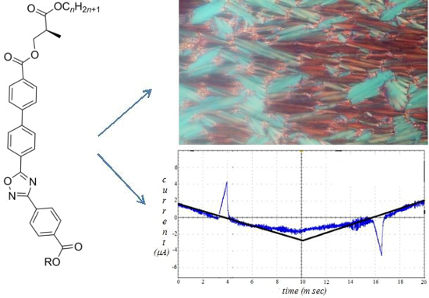
- dipole moment [23][24] and polarisability, which results for greater optical anisotropy and birefringence of the material. It is well established that the chiral center in a molecule renders it to exhibit ferroelectric (FE) behavior due to its configuration for transverse dipole moment (μt). Meyer et al



Supercritical carbon dioxide: a solvent like no other
Beilstein J. Org. Chem. 2014, 10, 1878–1895, doi:10.3762/bjoc.10.196
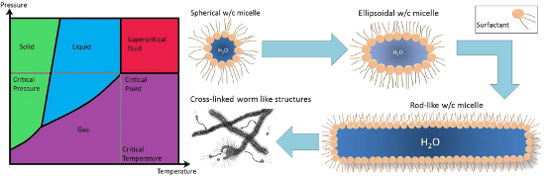
- properties ordinarily required for an effective solvent, with a lower viscosity, dielectric constant [26][27] and surface tension in comparison to other common reference solvents. Also, as CO2 is a linear molecule with no net dipole moment there is significant difficulty dissolving polar and ionic species
- moments within a molecule cancel each other out, the molecule will not be polar. Any molecule with an inversion centre, a horizontal mirror plane (σh), or multiple Cn axes will not have dipole moments and therefore will not be polar, (C1, Cs, C∞h, D∞h Cn and Cnv do not have a dipole moment). CO2 has a
- di-CF1 having the minimum level of fluorination, Table 1, compounds 2–5), and a HC control analogue (di-C5SS, Table 1, compound 6) containing no fluorine. The study also looked at the effects of replacing a terminal fluorine atom with hydrogen (n-CF3 to n-CF2H), hereby introducing a dipole moment at


Automated solid-phase peptide synthesis to obtain therapeutic peptides
Beilstein J. Org. Chem. 2014, 10, 1197–1212, doi:10.3762/bjoc.10.118
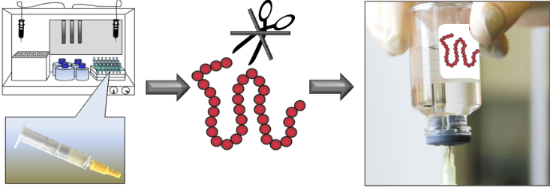
- evolved [71]. In 1992, Yu and coworkers reported for the first time that microwave irradiation in combination with SPPS leads to enhanced reaction rates and hence, to a higher quality of the crude peptides [72]. Microwave energy is capable of activating any molecule containing a dipole moment, which is


Isocyanide-based multicomponent reactions towards cyclic constrained peptidomimetics
Beilstein J. Org. Chem. 2014, 10, 544–598, doi:10.3762/bjoc.10.50

- [80][81][82]. The relative planarity of 1,2,3-triazoles, the strong dipole moment (~5 D) and the ability to both donate and accept hydrogen bonds indicate the physicochemical similarities with amide bonds (Scheme 25), however, they are inert towards oxidation, hydrolysis and enzymatic degradation [88


Diastereoselectivity in the Staudinger reaction of pentafluorosulfanylaldimines and ketimines
Beilstein J. Org. Chem. 2013, 9, 2675–2680, doi:10.3762/bjoc.9.303

- number of different ylides [16]. The reactions of α-pentafluorosulfanyl carbonyl compounds are governed by a combination of the substantial dipole moment and unique steric effects of the octahedral SF5 group. Aliphatic SF5-containing derivatives of biologically active compounds are not well-known. One


Conformational analysis and intramolecular interactions in monosubstituted phenylboranes and phenylboronic acids
Beilstein J. Org. Chem. 2013, 9, 1127–1134, doi:10.3762/bjoc.9.125
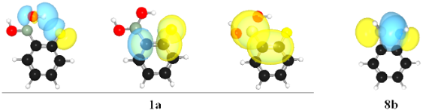
- ), which lie in the range of 0.002 atomic units (au) to 0.04 au, and 0.024 au to 0.139 au to electrostatic hydrogen bonds, respectively. Moreover, the H atom associated with the hydrogen bond should have a loss of atomic charge [q(H)], an increased atomic energy [E(H)], a decreased atomic first dipole
- moment [M1(H)] and a decreased atomic volume [V(H)] in comparison to those of a H atom not involved in hydrogen bonding [23]. Spectroscopic (Raman, infrared and NMR) and theoretical studies on 2-fluorophenylboronic acid have already been performed previously for assignment purposes, because of the lack


The β-cyclodextrin/benzene complex and its hydrogen bonds – a theoretical study using molecular dynamics, quantum mechanics and COSMO-RS
Beilstein J. Org. Chem. 2013, 9, 118–134, doi:10.3762/bjoc.9.15
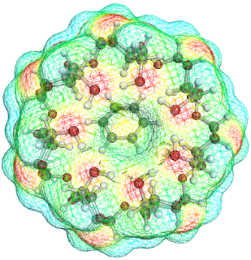
- , 290, 280, and 273 K for 500 ps each, and their release of the guest was analysed from these trajectories. Results and Discussion AM1 Calculations The four conformers of empty β-CD The BCDO23rO6l structure turned out to be the lowest energy conformer, also having the lowest dipole moment of only 0.5618
- Debye (dipole-moment components x = 0.0; y = 0.0; −z = 0.5618) pointing from the O6 rim towards the O23 rim of the cone. This structure is so symmetric that all its Mulliken partial atomic charges on all types of oxygen atoms were identical, e.g., equal to each average number (Table 1). Second, with
- about 6 kcal mol−1 above, was conformer BCDO23rO6r. This oval structure has the highest dipole moment of 2.5639 D (x = +0.0268; y = +0.0236; z = −2.5637) and its O6 atomic charges display a range from −0.340 to −0.349 (average −0.344), but all O2 atoms still have the same charge of 0.325, and O3 and O4



A new family of four-ring bent-core nematic liquid crystals with highly polar transverse and end groups
Beilstein J. Org. Chem. 2013, 9, 26–35, doi:10.3762/bjoc.9.4
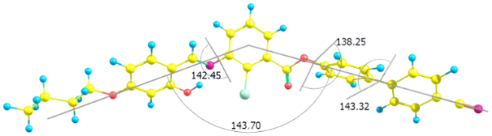
- -core mesogens; cyanobiphenyl; dipole moment; liquid crystals; nematic phase; polarity; Introduction Following the discovery of chiral and polar properties of mesomorphic bent-core compounds [1][2][3][4][5][6] the area of design, synthesis and properties of banana or bent-shaped liquid crystals (LC
- azobenzene or salicylideneimine or phenylbenzoate unit in one of the arms of the bent molecule by a polar cyanobiphenyl moiety lends stiffness to the molecule with a strong dipole moment in the lateral direction. The realization of such a molecular architecture leads to a reduction in rotational disorder as
- arm ends with a highly polar cyano group. The end cyano group in one of the arms of 1a–1c contributes to the large dipole moment. In highly polar calamitic cyanobiphenyl compounds [42][43] as well as in bent-core compounds possessing an end cyano moiety [44][45][46][47][48] the antiparallel short


Theoretical study on β-cyclodextrin inclusion complexes with propiconazole and protonated propiconazole
Beilstein J. Org. Chem. 2012, 8, 2191–2201, doi:10.3762/bjoc.8.247
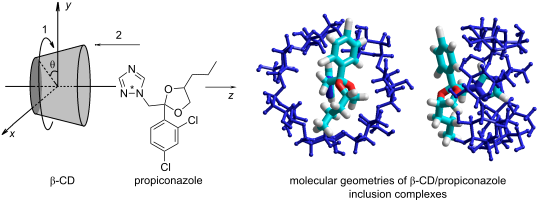
- bonds were evidenced and, since there are no steric constraints to explain the difference between the A and B orientations in terms of stability, other forces must be considered. It is already known that cyclodextrin molecules have a rather high electric dipole moment; the correlation between this
- parameter and the complex stability by means of quantum-mechanical calculations has been previously reported [19][20]. The PP molecule has a permanent electric dipole, and the dipole–dipole interaction can make the difference between the A and B configurations. The decrease of the global dipole moment
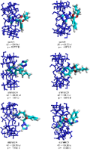
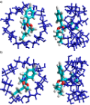
- important to note that both in vacuo and in aqua, the guest molecules are deeply inserted in the β-CD cavity, according to the B configurations (Figure 10), and no hydrogen bonds can be evidenced. The decrease of the global dipole moment by the increase of binding energy, suggests again that dipole–dipole






Control over molecular motion using the cis–trans photoisomerization of the azo group
Beilstein J. Org. Chem. 2012, 8, 1071–1090, doi:10.3762/bjoc.8.119
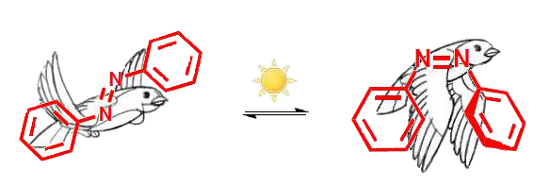
- remarkable change in their physical properties, such as molecular geometry, dipole moment or absorption spectrum [12][13][14][15][16]. The isomerization process involves a decrease in the distance between the two carbon atoms in position 4 of the aromatic rings of azobenzene, from 9.0 Å in the trans form to
- 5.5 Å in the cis form (Figure 1) [17]. The trans-azobenzene is almost flat and has no dipole moment, whereas the cis isomer presents an angular geometry and a dipole moment of 3.0 D. One of the rings rotates to avoid steric repulsions due to facing of one of the π clouds of one aromatic ring to the


Liquid-crystalline heterodimesogens and ABA-heterotrimesogens comprising a bent 3,5-diphenyl-1,2,4-oxadiazole central unit
Beilstein J. Org. Chem. 2012, 8, 472–485, doi:10.3762/bjoc.8.54
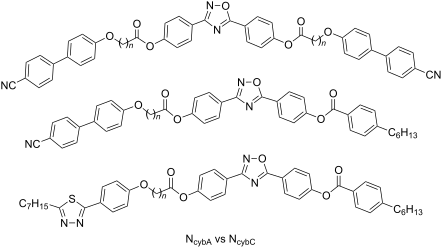
- distinct from that of compounds CB-Ox/n. Firstly, they have alkyl tails at both ends, and secondly, they incorporate a 1,3,4-thiadiazole unit, which is not strictly linear (bending angle 162°) [80] and within which the direction of the major dipole moment is perpendicular to the molecular long axis [80][81





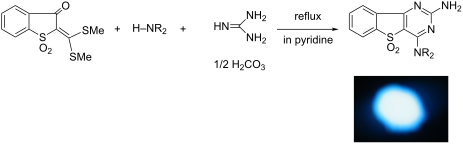
Synthesis, solid-state fluorescence properties, and computational analysis of novel 2-aminobenzo[4,5]thieno[3,2-d]pyrimidine 5,5-dioxides
Beilstein J. Org. Chem. 2012, 8, 266–274, doi:10.3762/bjoc.8.28
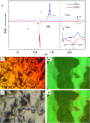
- with the transition dipole moment directed along the long molecular axis. The electron density difference between HOMO and LUMO is shown in Figure 2; this reflects the balanced electron redistribution between the pyrimidine and phenyl moieties. Solid-state fluorescence Tris(8-hydroxyquinolinato




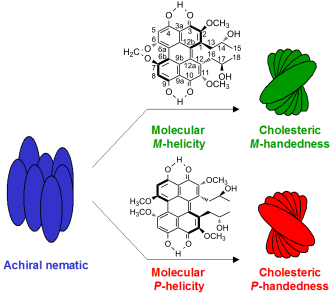
The interplay of configuration and conformation in helical perylenequinones: Insights from chirality induction in liquid crystals and calculations
Beilstein J. Org. Chem. 2012, 8, 155–163, doi:10.3762/bjoc.8.16
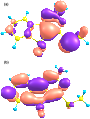
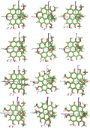
- of gauche− states was found. A possible reason for the lack of agreement between theory and experiment is the fact that calculations were performed in vacuum, whereas experiments were carried out in acetone. According to our calculations, the conformers of phleichrome (2) would have higher dipole
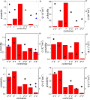
- moment than those of cercosporin (1), therefore 2 should be more sensitive to solvent polarity (acetone has a dielectric constant of about 20 at room temperature). HTP predictions by the SC method Within the SC approach, the HTP of a chiral dopant in a nematic solvent is proportional to the so-called


Imidazole as a parent π-conjugated backbone in charge-transfer chromophores
Beilstein J. Org. Chem. 2012, 8, 25–49, doi:10.3762/bjoc.8.4
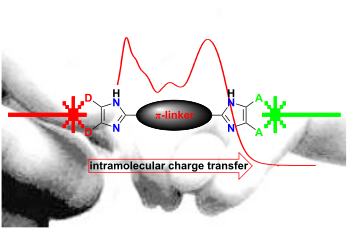
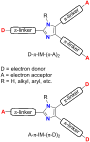
- −30 esu) showed a substantially higher dipole moment and first-order hyperpolarizability than chromophore 27a (Figure 9; μ = 10.9 D; β = 50.91 × 10⁻³⁰ esu) due to a higher efficiency of D-A conjugation. Benzimidazole-derived chromophores In contrast to imidazoles, benzimidazoles possess fused benzene




Valence isomerization of cyclohepta-1,3,5-triene and its heteroelement analogues
Beilstein J. Org. Chem. 2011, 7, 1713–1721, doi:10.3762/bjoc.7.201
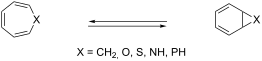
- equilibrium shifts further toward benzene oxide (more positive ΔG), suggesting that benzene oxide has the larger dipole moment. Methyl substitution at the 2- and 7-positions reverses the stability order, rendering the oxepine as the energetically favoured isomer due to the destabilizing eclipsing of the two