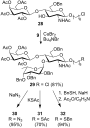
Search results
Search for "hemiacetal" in Full Text gives 93 result(s) in Beilstein Journal of Organic Chemistry.
Recent advances in transition metal-catalyzed Csp2-monofluoro-, difluoro-, perfluoromethylation and trifluoromethylthiolation
Beilstein J. Org. Chem. 2013, 9, 2476–2536, doi:10.3762/bjoc.9.287
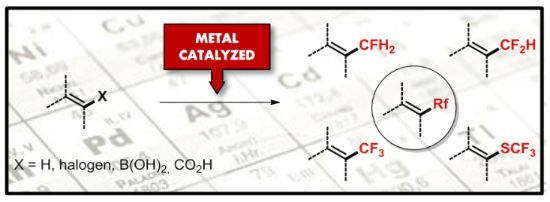
- convenient sources of trifluoromethyl anion [75]. H. Amii et al. reported on the use of an O-silylated hemiaminal as a cross-coupling partner for aromatic trifluoromethylation with a copper iodide/1,10-phenanthroline catalytic system [76]. Compound B was prepared from commercially available hemiacetal of


A reductive coupling strategy towards ripostatin A
Beilstein J. Org. Chem. 2013, 9, 1533–1550, doi:10.3762/bjoc.9.175
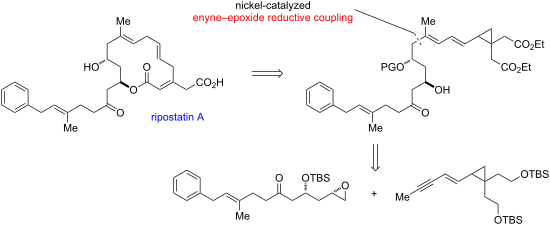
- well tolerated for the reaction using γ-hydroxy-α,β-enones. Although the presence of chirality at the δ-position allows for diastereoselective intramolecular oxy-Michael addition of hemiacetal-derived alkoxides into α,β-unsaturated esters, the extension of this reaction to ketones was not successful


Re2O7-catalyzed reaction of hemiacetals and aldehydes with O-, S-, and C-nucleophiles
Beilstein J. Org. Chem. 2013, 9, 1526–1532, doi:10.3762/bjoc.9.174
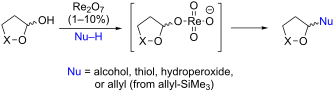
- a Brønsted acid. Keywords: allylation; hemiacetal; O,O-acetal; O,S-thioacetal; peroxyacetal; Re2O7; S,S-acetal; Introduction The synthetically important conversions of hemiacetals to acetals, thioacetals, or homoallyl ethers are typically achieved through activation of the substrate with a strong
- oxybisacetals (Table 3). As will be described later, these apparent byproducts proved to be competent substrates for acetal formation. We next attempted to maximize the yield of acetal based upon alcohol (Table 4). Good yields were obtained at a 1:1 ratio of alcohol to hemiacetal and yields did not vary
- significantly with the rate of addition of hemiacetal. This latter observation was initially surprising given the rapidity of hemiacetal dimerization (vide supra). However, we soon realized that the bisacetal ether 11 (Table 4, entry 4) was a remarkably effective substrate. In fact, the reaction of phenethyl


Copper-catalyzed aerobic aliphatic C–H oxygenation with hydroperoxides
Beilstein J. Org. Chem. 2013, 9, 1217–1225, doi:10.3762/bjoc.9.138

- presence of Et3N (2 equiv) in DMF, the reaction proceeded at room temperature for 17 h to afford C–H oxygenation products, cyclic hemiacetal 2a and 1,4-diol 3a in 49% and 8% yields, respectively (Table 1, entry 1). It was found that addition of nitrogen ligands such as 2,2’-bipyridine and 1,10
- molecular O2 to give peroxy radical III. Probably further reaction of III with Cu(I) species gives Cu(II)-peroxide IV, which undergoes fragmentation to give aldehyde V [16][17][18], which in turn cyclizes to afford hemiacetal 2a. Protonation of Cu(II)-peroxide IV followed by the reduction of the resulting


Appel-reagent-mediated transformation of glycosyl hemiacetal derivatives into thioglycosides and glycosyl thiols
Beilstein J. Org. Chem. 2013, 9, 974–982, doi:10.3762/bjoc.9.112
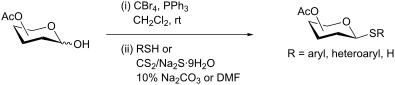
- Tamashree Ghosh Abhishek Santra Anup Kumar Misra Bose Institute, Division of Molecular Medicine, P-1/12, C.I.T. Scheme VII-M, Kolkata-700054, India, Fax: 91-33-2355 3886 10.3762/bjoc.9.112 Abstract A series of glycosyl hemiacetal derivatives have been transformed into thioglycosides and glycosyl
- carbonotrithioate. The reaction conditions are reasonably simple and yields were very good. Keywords: Appel reagent; carbon tetrabromide; glycosyl hemiacetal; glycosyl thiol; thioglycoside; triphenylphosphine; Introduction Thioglycosides (1-thiosugar) are widely used glycosyl donors in glycosylation reactions [1
- , fluoride, bromide, hemiacetal, etc.) and hence the thio functionality is often used as a temporary anomeric protecting group. Thioglycosides can act as a glycosyl donor as well as glycosyl acceptor depending on the reaction conditions (orthogonal glycosylations) [11][12]. Due to their stability towards


A new intermediate in the Prins reaction
Beilstein J. Org. Chem. 2013, 9, 476–485, doi:10.3762/bjoc.9.51
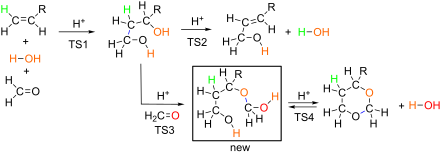
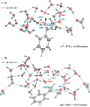
- . From the 1,3-diol, a bimolecular elimination (TS2) leads to the allylic alcohol as the first channel. In the second channel, the 1,3-diol was converted via TS3 into an unprecedented hemiacetal intermediate, HO–CH2–O–CH(R)–CH2–CH2–OH. This intermediate undergoes ring closure (TS4), affording the 1,3
- . Dynamical calculations of a classical trajectory using the atom-centered density matrix propagation molecular dynamics model on the four TSs were carried out, and results of IRC calculations were confirmed by them. Keywords: DFT calculations; hemiacetal intermediate; hydrogen bond; Prins reaction
- allylic alcohol, 2-buten-1-ol, here called ene-ol(Me). The other is TS3(Me) leading to an intermediate, not included in Scheme 5. This species, 3-(hydroxymethoxy)-1-butanol, called here ether(Me), has an ether moiety and is a hemiacetal. Generally, these are formed by the formal addition of an alcohol to





Synthesis of a derivative of α-D-Glcp(1->2)-D-Galf suitable for further glycosylation and of α-D-Glcp(1->2)-D-Gal, a disaccharide fragment obtained from varianose
Beilstein J. Org. Chem. 2012, 8, 2142–2148, doi:10.3762/bjoc.8.241

- lactone, due to the differential reactivity of the HO groups [21][22]. These derivatives can be used as acceptors, with the anomeric center virtually masked as a carbonyl group, which may be later selectively reduced to the hemiacetal with diisoamylborane (DSB). By this strategy the synthesis of many


Organocatalytic cascade aza-Michael/hemiacetal reaction between disubstituted hydrazines and α,β-unsaturated aldehydes: Highly diastereo- and enantioselective synthesis of pyrazolidine derivatives
Beilstein J. Org. Chem. 2012, 8, 1710–1720, doi:10.3762/bjoc.8.195
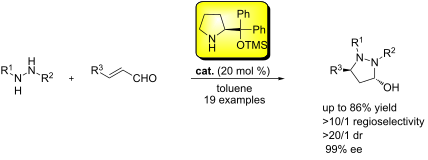
- /hemiacetal sequence with chiral or achiral secondary amines as organocatalysts. Thus, a series of achiral pyrazolidine derivatives were obtained with good yields (up to 90%) and high diastereoselectivities (>20:1) with pyrrolidine as an organocatalyst, and enantioenriched pyrazolidines are also achieved with
- stereoselective cascade reaction for the synthesis of the pyrazolidine compounds through organocatalysis. In this paper, we present a convenient access to racemic and enantioenriched 5-hydroxypyrazolidines through a domino aza-Michael/hemiacetal organocatalytic sequence of disubstituted hydrazines to α,β
- aldehydes containing only linear alkyl chains, whereas our work provides better results when unsaturated aldehydes bearing an aromatic moiety are employed. Results and Discussion First, the cascade aza-Michael/hemiacetal reactions between disubstituted hydrazines 2a–c and 4-nitrocinnamaldehyde (3a) were


The Amadori rearrangement as glycoconjugation method: Synthesis of non-natural C-glycosyl type glycoconjugates
Beilstein J. Org. Chem. 2012, 8, 1619–1629, doi:10.3762/bjoc.8.185

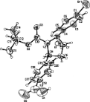
- products featuring a secondary amine at position C-1, compounds 24 and 25, were further reacted with triphosgene [25]. In this reaction, the anomeric hydroxy group and the amine at position C-1 formed a cyclic carbamate, thereby stabilising the hemiacetal at the anomeric position. Compounds 24 (a and b


Stereoselective synthesis of trans-fused iridoid lactones and their identification in the parasitoid wasp Alloxysta victrix, Part II: Iridomyrmecins
Beilstein J. Org. Chem. 2012, 8, 1256–1264, doi:10.3762/bjoc.8.141
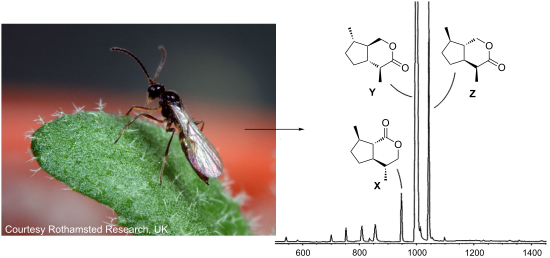
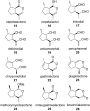
- that, the cis-fused nepetalactone 15 and diastereomers thereof are typical components of many species of the plant genus Nepeta [22][23]. Along with the corresponding hemiacetal 16, which shows (1R)-configuration, 15 is also a most important sex pheromone of aphids [24] (Figure 8). Nevertheless



Synthesis of 4” manipulated Lewis X trisaccharide analogues
Beilstein J. Org. Chem. 2012, 8, 1134–1143, doi:10.3762/bjoc.8.126
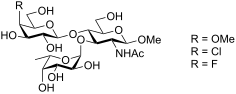
- , trichloroethyl galactoside 16 was converted to the trichloroacetimidate donor 9 in two steps: the anomeric trichloroethyl group was removed (Zn/AcOH), and then the resulting hemiacetal was treated with trichloroacetonitrile in the presence of DBU giving the desired α-trichloroacetimidate in good yield. A


Synthesis of a library of tricyclic azepinoisoindolinones
Beilstein J. Org. Chem. 2012, 8, 1091–1097, doi:10.3762/bjoc.8.120
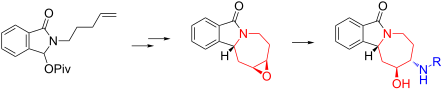
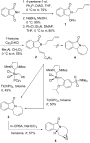
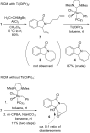
- . When the RCM reaction of 7 was conducted on larger scale in the absence of Ti(OiPr)4, and the crude intermediate was subjected to m-CPBA oxidation, epoxy alcohol 6 was isolated in 11% overall yield. LC–MS as well as NMR analyses suggested a 5:1 ratio of epimers at the hemiacetal carbon. Hydroxylation






Branching out at C-2 of septanosides. Synthesis of 2-deoxy-2-C-alkyl/aryl septanosides from a bromo-oxepine
Beilstein J. Org. Chem. 2012, 8, 522–527, doi:10.3762/bjoc.8.59

- been explored in many instances, for example, (i) hemiacetal or acetal formation from a linear precursor containing aldehyde and an appropriately positioned hydroxyl group [4][5][6][7][8]; (ii) Knoevenagel-type condensation of sugar aldehyde with active methylene compounds [9][10]; (iii) ring-closing


Metathesis access to monocyclic iminocyclitol-based therapeutic agents
Beilstein J. Org. Chem. 2011, 7, 699–716, doi:10.3762/bjoc.7.81

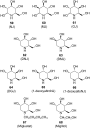
- in both the α- and β-forms, each of which is responsible for inhibition of α- or β-glucosidase, respectively. Similar to its other congeners, mannonojirimycin (60; MJ or nojirimycin B) and galactonojirimycin (61; GJ or galactostatin), nojirimycin is unstable because hemiacetal structures can be





The arene–alkene photocycloaddition
Beilstein J. Org. Chem. 2011, 7, 525–542, doi:10.3762/bjoc.7.61
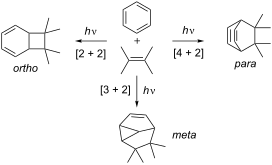
- afforded the hemiacetal after spontaneous cyclization. Subsequent oxidation and deprotection afforded the desired compound. In the same paper, the total synthesis of the naturally occurring epimer of Penifulvin B (Penifulvin C) was described, which was achieved by replacing the trans-olefin by the cis


Addition of lithiated enol ethers to nitrones and subsequent Lewis acid induced cyclizations to enantiopure 3,6-dihydro-2H-pyrans – an approach to carbohydrate mimetics
Beilstein J. Org. Chem. 2010, 6, No. 75, doi:10.3762/bjoc.6.75
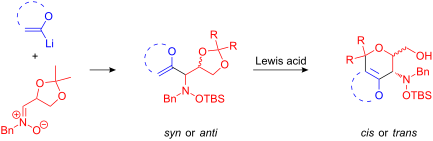
- -methylmorpholinoxide-system afforded α-hydroxyketone 9 via in situ hydrolysis of an initially formed hemiacetal. Bromination with NBS in MeCN/H2O led to α-bromoketone 10 and its desilylated derivative 11 as single diastereomers. We presume that the NBS attacks the enol ether moiety, as is also the case with the
- conditions were applied to the diastereomeric dihydropyran trans-5a, different behaviour was noted (Scheme 6). A smooth hydrolysis of the enol ether moiety leading to ketone 12 was neither feasible with methanolic HCl nor with aqueous HCl. After dihydroxylation, a partial hydrolysis of the hemiacetal


Benzyne arylation of oxathiane glycosyl donors
Beilstein J. Org. Chem. 2010, 6, No. 19, doi:10.3762/bjoc.6.19
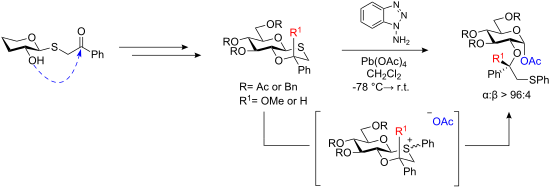
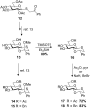
- -hemiacetal 22 was isolated in 70% yield following purification by flash silica chromatography [30]. Cleavage of the acyclic O-2 ketal on glycosyl acetate 21, followed by acetyl transfer from O-1 to O-2 could account for this transformation [31]. Arylation/acetate glycosylation using oxathiane ether donor 17



Convergent syntheses of LeX analogues
Beilstein J. Org. Chem. 2010, 6, No. 17, doi:10.3762/bjoc.6.17
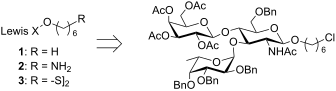
- situ by adding water to the reaction mixture. The resulting triacetate was chloroacetylated at O-3 and the resulting fully protected thioglycoside 23 was converted to the corresponding hemiacetal that was, in turn, treated with trichloroacetonitrile and DBU to give the α-trichloroacetimidate galactosyl