


Search results
Search for "hydration" in Full Text gives 142 result(s) in Beilstein Journal of Organic Chemistry.
An overview of recent advances in duplex DNA recognition by small molecules
Beilstein J. Org. Chem. 2018, 14, 1051–1086, doi:10.3762/bjoc.14.93
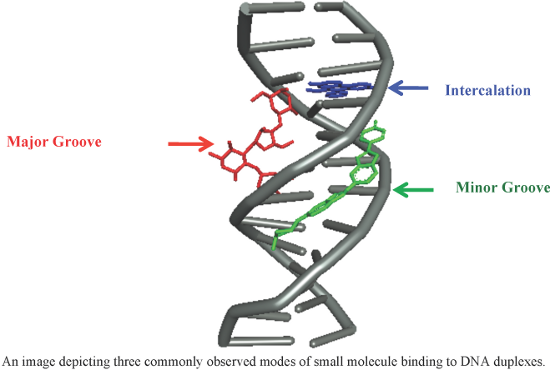
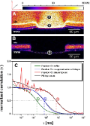
- small molecules comprise various heterocyclic and/or aromatic hydrocarbon rings with limited rotational freedom and torsion, allowing these drugs to fit into major/minor grooves of DNA by displacing water molecules from the spine of hydration as shown in the Figure 2 [25][26][27]. These molecules bind




Mechanochemistry of nucleosides, nucleotides and related materials
Beilstein J. Org. Chem. 2018, 14, 955–970, doi:10.3762/bjoc.14.81
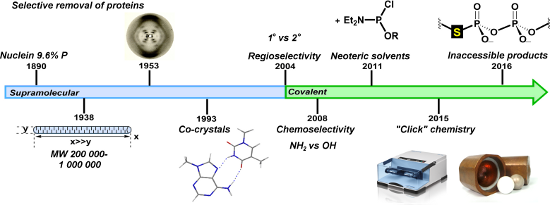
- DNA and RNA isolation The lack of free-volume within double-stranded DNA at low hydration levels leads to limited ice formation even under cooling in liquid air [57]. In contrast, cold denaturation of globular proteins at such temperatures is almost ubiquitous [58]. Furthermore, large conformational


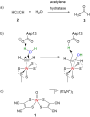
Is the tungsten(IV) complex (NEt4)2[WO(mnt)2] a functional analogue of acetylene hydratase?
Beilstein J. Org. Chem. 2017, 13, 2332–2339, doi:10.3762/bjoc.13.230
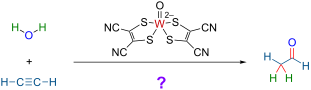
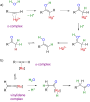
- absence of a satisfactory mechanistic proposal for the hydration reaction, we considered the possibility of a metal–vinylidene type activation mode, as it is well established for ruthenium-based alkyne hydration catalysts with anti-Markovnikov regioselectivity. To validate the hypothesis, the
- regioselectivity of tungsten-catalyzed alkyne hydration of a terminal, higher alkyne had to be determined. However, complex 1 was not a competent catalyst for the hydration of 1-octyne under the conditions tested. Furthermore, we could not observe the earlier reported hydration activity of complex 1 towards
- acetylene. A critical assessment of, and a possible explanation for the earlier reported results are offered. The title question is answered with "no". Keywords: acetylene hydratase; alkynes; catalytic hydration; enzyme models; tungsten complexes; Introduction In 1985, the enzyme acetylene hydratase



Solid-state studies and antioxidant properties of the γ-cyclodextrin·fisetin inclusion compound
Beilstein J. Org. Chem. 2017, 13, 2138–2145, doi:10.3762/bjoc.13.212
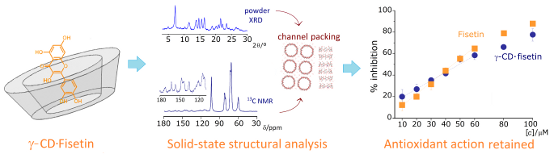
- conducted on the freeze-dried samples. The elemental analysis data are in agreement with the values calculated for a 1:1 stoichiometry, i.e., the empirical formula C48H80O40·C15H10O6·20H2O. Note also the remarkable increase in the hydration status, from 7 water molecules per host molecule in γ-CD to 20
- and C4 carbons, multiplicity is associated with differences in the conformation about the α(1→4) linkages, while carbons positioned closer to the rims, such as is the case for C6, are more sensitive to ambient changes arising from hydration water molecules and the hydrogen-bonding network [33][34
- . 280 °C, after which the charred residue undergoes a slow thermal oxidation from 330 °C until its complete combustion at 520 °C [38]. The thermal decomposition trace of the physical mixture is quite similar to that of γ-CD, having approximately the same number of hydration water molecules. Remarkably


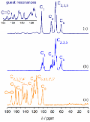


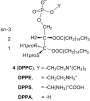
Remarkable functions of sn-3 hydroxy and phosphocholine groups in 1,2-diacyl-sn-glycerolipids to induce clockwise (+)-helicity around the 1,2-diacyl moiety: Evidence from conformation analysis by 1H NMR spectroscopy
Beilstein J. Org. Chem. 2017, 13, 1999–2009, doi:10.3762/bjoc.13.196
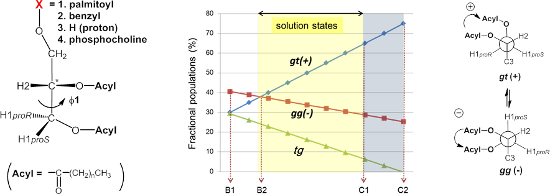
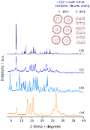
- hydration occurring around the carbonyl groups in the 1,2-diacyl moiety triggers the dynamics of the molecular alignments in liposomes. Probably, an analogous phenomenon related to the solvation around sn-3 OH was observed. Thus, solvation is thought to play a key role in the dynamic conformation change




Accessing simply-substituted 4-hydroxytetrahydroisoquinolines via Pomeranz–Fritsch–Bobbitt reaction with non-activated and moderately-activated systems
Beilstein J. Org. Chem. 2017, 13, 1871–1878, doi:10.3762/bjoc.13.182
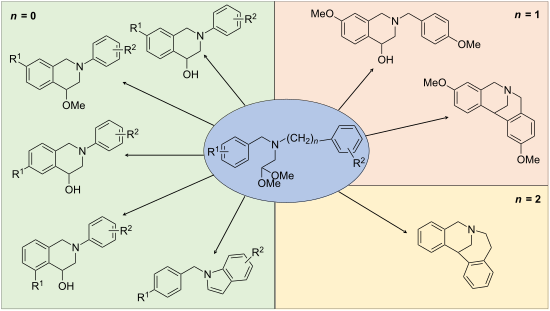
- rearrangement product 13 would then lead to the isolated compound 11 upon hydration, either during the reaction or the work-up. However, the precise mechanism for the formation of 11 has yet to be explored and efforts to unravel it lay outside the scope of this work. The addition of 6 M HCl led to the


Opportunities and challenges for the sustainable production of structurally complex diterpenoids in recombinant microbial systems
Beilstein J. Org. Chem. 2017, 13, 845–854, doi:10.3762/bjoc.13.85
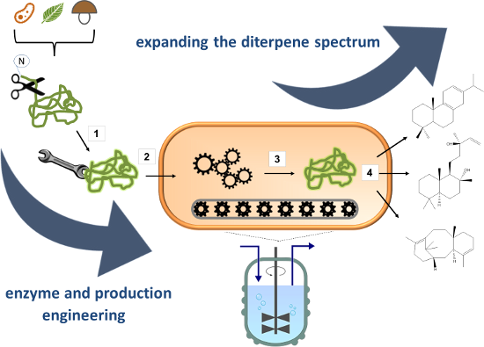
- deprotonation with occasional hydration at the C8 position of the carbocation intermediate which yields hydroxylated diphosphate products [62]. MvCPS1, however, catalyzes a C9–C8 hydride shift preceding hydration resulting in the labdane-type diterpene precursor for the antidiabetic marrubiin [63]. Double


Formose reaction accelerated in aerosol-OT reverse micelles
Beilstein J. Org. Chem. 2016, 12, 2663–2667, doi:10.3762/bjoc.12.262
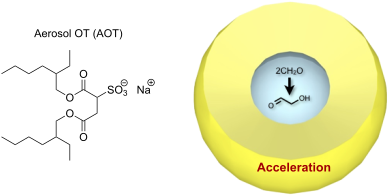
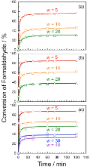
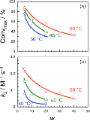
- a layer of water molecules with restricted mobility, because of hydration of the hydrophilic group of the surfactant (i.e., the surfactant head) [22][23]. It is likely that the thickness of the layer of restricted water is approximately several nm [24][25]. The water molecules in the interfacial
- layer are more polar than those in the bulk water phase because of polarization caused by hydration of the surfactant head. Since Rw of AOT reverse micelles is practically proportional to w (Figure S1 in Supporting Information File 1), the fraction of water molecules in the interfacial layer increases


A self-assembled cyclodextrin nanocarrier for photoreactive squaraine
Beilstein J. Org. Chem. 2016, 12, 2535–2542, doi:10.3762/bjoc.12.248
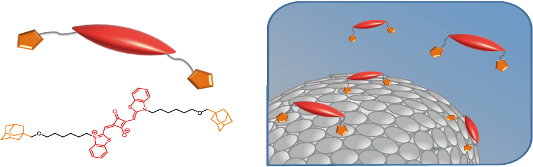
- solution in a round bottom flask. Hydration and extrusion with a Liposofast extruder and membranes with 100 nm pore size yield bilayer vesicles of an approximate size of 100 nm. CDVs were decorated with AdSq by simple addition of the AdSq to the aqueous dispersion of the CDVs. Interestingly, the




A new paradigm for designing ring construction strategies for green organic synthesis: implications for the discovery of multicomponent reactions to build molecules containing a single ring
Beilstein J. Org. Chem. 2016, 12, 2420–2442, doi:10.3762/bjoc.12.236
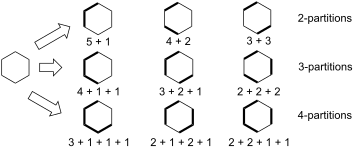
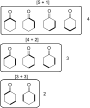
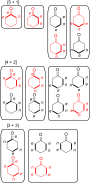
- , catalytic hydration of cyclohexene, or catalytic air oxidation of cyclohexane. However, as an intellectual exercise and proof of principle, we may be able to use the results described for integer partitioning to devise creative syntheses for cyclohexanone which involve actual ring construction via 2






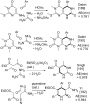


Diastereoselective synthesis of 3,4-dihydro-2H-pyran-4-carboxamides through an unusual regiospecific quasi-hydrolysis of a cyano group
Beilstein J. Org. Chem. 2016, 12, 2093–2098, doi:10.3762/bjoc.12.198
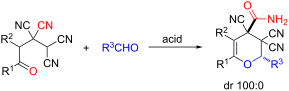
- presence thereof, but all acids promote only the iminolactone decyclization process without traces of lactone derivative 4 (Table 2). It is also important to note that during the reaction pathway (Scheme 3) a carbonyl-assisted carbonitrile hydration effect (CACHE) was occured. The carbonyl group, through


Solvent-free synthesis of novel para-menthane-3,8-diol ester derivatives from citronellal using a polymer-supported scandium triflate catalyst
Beilstein J. Org. Chem. 2016, 12, 2046–2054, doi:10.3762/bjoc.12.193
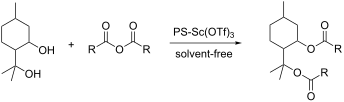
- further hydrogenated over a metal-supported catalyst to yield the cis and trans isomers of menthol 2 (Scheme 1) [4]. Alternatively the acid-catalysed hydration of citronellal (1) results in the synthesis of the cis and trans isomers of para-menthane-3,8-diol (3, Scheme 2). This chemical derivative is well


From steroids to aqueous supramolecular chemistry: an autobiographical career review
Beilstein J. Org. Chem. 2016, 12, 684–701, doi:10.3762/bjoc.12.69





Interactions of cyclodextrins and their derivatives with toxic organophosphorus compounds
Beilstein J. Org. Chem. 2016, 12, 204–228, doi:10.3762/bjoc.12.23
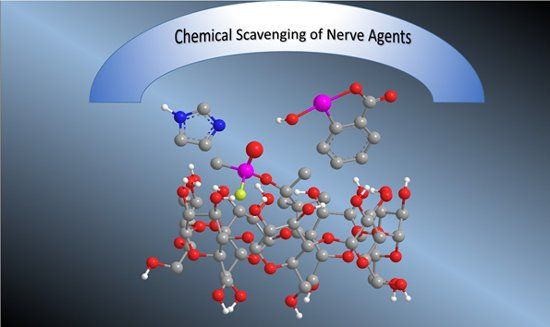
- guest might weaken the hydration water binding, as revealed in DSC experiments by the lower endothermic fusion peak, specific to a dehydration process. X-ray powder diffraction analysis finally confirmed the complex formation. All these studies proved that organophosphorus pesticides are able to






Thermal and oxidative stability of Atlantic salmon oil (Salmo salar L.) and complexation with β-cyclodextrin
Beilstein J. Org. Chem. 2016, 12, 179–191, doi:10.3762/bjoc.12.20
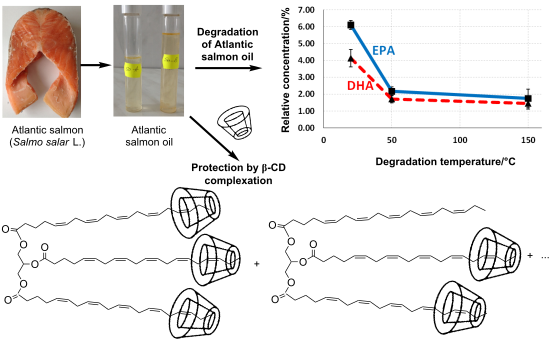
- from complexes. According to the TG analysis, the water content is 4.1–6.4% lower than for the β-CD. This observation supports the formation of the inclusion compound by partial replacement of the hydration water from the CD cavity by the guest compounds (FA glycerides). Studies on the evaluation of
- support the conclusion of formation of the β-CD/FA glyceride inclusion complex by means of water behavior. Hydration water is easier released from the β-CD/ASO complexes obtained at a 3:1 molar ratio. Both DSC and KFT analyses demonstrate this finding with a lower peak temperature and lower “strongly



Scope and limitations of the dual-gold-catalysed hydrophenoxylation of alkynes
Beilstein J. Org. Chem. 2016, 12, 172–178, doi:10.3762/bjoc.12.19
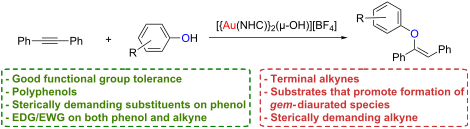
- as 10% of acetophenone, the corresponding hydration product. Furthermore, the formation of a new gold species, which was characterised as the previously reported σ,π-digold–acetylide species could also be observed. This diaurated species can be formed by reaction of [{Au(IPr)}2(µ-OH)][BF4] with




Polydisperse methyl β-cyclodextrin–epichlorohydrin polymers: variable contact time 13C CP-MAS solid-state NMR characterization
Beilstein J. Org. Chem. 2015, 11, 2785–2794, doi:10.3762/bjoc.11.299
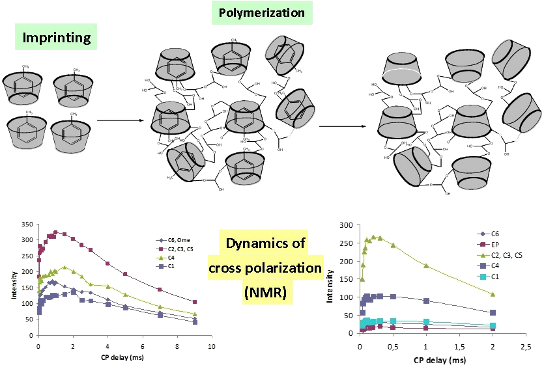
- atoms in the molecular frame and whether regions of morphological heterogeneity exist or not. At this stage, it is important to stress two points: i) T1ρ describes the relaxation time of the 1H nuclei, and thus it is sensitive to hydrogen parameters only, including, as an example, the hydration state




Aggregation behaviour of amphiphilic cyclodextrins: the nucleation stage by atomistic molecular dynamics simulations
Beilstein J. Org. Chem. 2015, 11, 2459–2473, doi:10.3762/bjoc.11.267
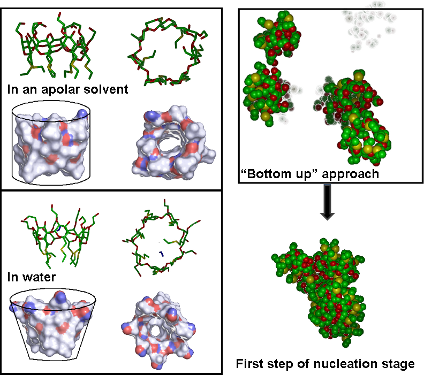
- secondary rim so as to maximize the P-chain hydration. It should also be noted that there is a small cluster of five water molecules trapped into the cavity, and quite isolated from the bulk water, with a pattern rather similar to what found in the native β-CD [46]. Interestingly, also in this case there is
- groups significantly cluster so as to minimize the contact with the environment, whereas the hydrophilic P groups show a marked opening to enhance their hydration. The ellipsoidal distortion of the macrocycle caused by the above mentioned interactions should also be noted. As a result, in water the
- for the tight clustering of the H groups to minimize the hydrated surface and for the wide opening of the P groups to maximize their hydration. In conclusion, even though one could denote this arrangement as a 2 + 1 + 1 aggregate, it is best described as a 3 + 1 aggregate. There is a further


Biocatalysis for the application of CO2 as a chemical feedstock
Beilstein J. Org. Chem. 2015, 11, 2370–2387, doi:10.3762/bjoc.11.259
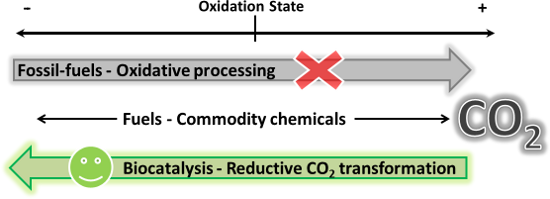
- minimised [25][27]. By balancing thermodynamic feasibililty and a low requirement in NADH and ATP or equivalents, Milo and coworkers [25] were able to computationally predict the most efficient synthetic CO2 fixation pathways, using all known natural enzymes. Aqueous solubility and hydration of CO2 A
- . [117] were able to prove that this FDH utilises CO2, rather than HCO3−, as the active species, through experiments carried out at low temperatures where CO2 hydration is slow. The enzyme from Clostridium carboxidivorans was recombinantly expressed in E. coli and shown to display higher CO2 reducing






Evidencing an inner-sphere mechanism for NHC-Au(I)-catalyzed carbene-transfer reactions from ethyl diazoacetate
Beilstein J. Org. Chem. 2015, 11, 2254–2260, doi:10.3762/bjoc.11.245
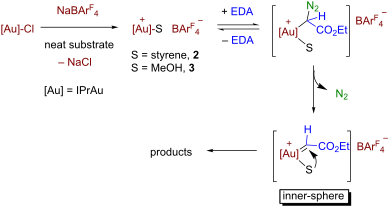
- functionalization; olefin cyclopropanation; Introduction The discovery of the catalytic capabilities of soluble gold(I) species toward the hydration of alkynes by Teles and co-workers [1] is considered as the rising of the golden era for the use of this metal in homogeneous catalysis [2][3]. A number of


Influence of bulky yet flexible N-heterocyclic carbene ligands in gold catalysis
Beilstein J. Org. Chem. 2015, 11, 1809–1814, doi:10.3762/bjoc.11.196
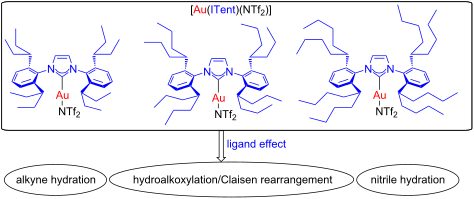
- selected: alkyne hydration, nitrile hydration, and the synthesis of homoallylic ketones. To place these results into context, [Au(IPr)(NTf2)] (10) [46] was also tested under the same conditions. Alkyne hydration Alkyne hydration is an attractive transformation to generate ketones from alkynes with high
- (10–1000 ppm) [51][52][53][56] have been achieved and the transformation has been successfully performed in aqueous media [54][57]. Due to its relevance and importance, the hydration of phenylacetylene was selected as a model transformation to explore the different activity of complexes 7–9. The
- obtained in all cases (Table 1, entries 5–8). However, the best conversion was observed when complex 10 bearing the IPr ligand was used (Table 1, entry 5). Complexes 7–9 afforded lower conversions, with [Au(IHept)(NTf2)] (8) being the most efficient amongst them (Table 1, entries 6–9). Nitrile hydration


Fates of imine intermediates in radical cyclizations of N-sulfonylindoles and ene-sulfonamides
Beilstein J. Org. Chem. 2015, 11, 1649–1655, doi:10.3762/bjoc.11.181
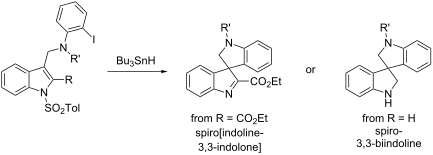
- Hanmo Zhang E. Ben Hay Stephen J. Geib Dennis P. Curran Department of Chemistry, University of Pittsburgh, Pittsburgh, PA 15260, USA 10.3762/bjoc.11.181 Abstract Two new fates of imine intermediates formed on radical cyclizations of ene-sulfonamides have been identified, reduction and hydration
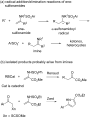
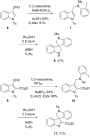
- -dihydropyrroles also presumably form spiro-imines as primary products. However, the lactam carbonyl group facilitates the ring-opening of these cyclic imines by a new pathway of hydration and retro-Claisen-type reaction, providing rearranged 2-(2'-formamidoethyl)oxindoles. Keywords: ene-sulfonamide; imine
- substrates were chosen to provide imines with spirocyclic indoline and indolone substituents. We discovered that these imines are rather reactive, being either reduced or undergoing an unusual hydration and retro-Claisen-type reaction of an amide. Here we report the results of these experiments, which add to





Azobenzene-based inhibitors of human carbonic anhydrase II
Beilstein J. Org. Chem. 2015, 11, 1129–1135, doi:10.3762/bjoc.11.127
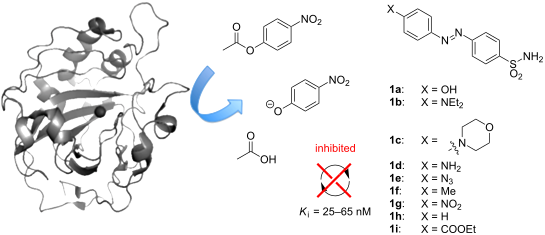
- ). Azobenzenes 1a and 1d have been synthesized and tested previously (with a CO2 hydration assay), and the Ki values determined in the previous work are one order of magnitude higher than in our findings (Ki (1a) = 665 nM or 29.7; Ki (1d) = 106 nM or 30.7) towards hCAII [6]. Interestingly, in our studies the
- hCAII. a) hCAII (pdb: 2vva [7]) catalyzes the hydration of carbon dioxide to bicarbonate and a proton (left) as well as the hydrolysis of pNPA to acetate and a colored phenolate (λmax = 400 nm). b) Aryl sulfonamide-containing pharmacophores of hCAII. c) Aryl sulfonamide merged to azobenzenes. Crystal


Terminal lipophilization of a unique DNA dodecamer by various nucleolipid headgroups: Their incorporation into artificial lipid bilayers and hydrodynamic properties
Beilstein J. Org. Chem. 2015, 11, 913–929, doi:10.3762/bjoc.11.103
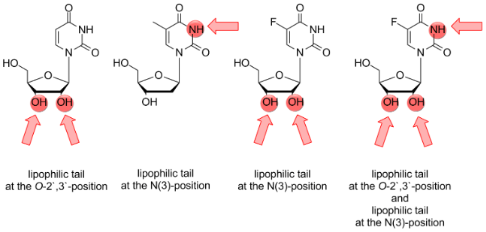
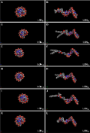
- 12-mer DNA sequence using the Avogadro or the RasMol software. Half of the diameter corresponds to the half axis, b. Because nucleic acids bind water molecules and are, therefore, covered by a hydration shell, 2.8 Å is added to the radius b which is the diameter of a water molecule. The mean value of
- experimental and the calculated diffusion coefficients (Table 5, last column) is 1.45 ± 0.09 on average. Our data are comparable with those reported by Fernandes et al. in 2002 [23], which was also determined for DNA 12mers (1.22 and 1.45 × 10⁻⁶ cm2 s−1). Hydration of the lipo-oligonucleotides In an aqueous
- environment, water molecules form a hydration shell around the nucleic acid. Consequently, the surface of the nucleic acid chain is smoothed, and the partial volume of the hydrated molecule (Vhyd) is increased by the volume of the water shell. By determining the Vhyd of the LONs, one can calculate the degree






The Shono-type electroorganic oxidation of unfunctionalised amides. Carbon–carbon bond formation via electrogenerated N-acyliminium ions
Beilstein J. Org. Chem. 2014, 10, 3056–3072, doi:10.3762/bjoc.10.323
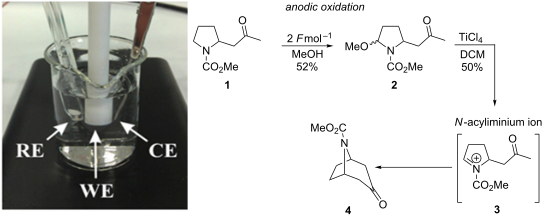
- ]. The proposed formation of a bicyclic intermediate 18 resulting from a cycloaddition reaction would enhance the diastereoselectivity of the hydration step compared to an acyclic intermediate that would be formed in the step-wise mechanism to 18. The authors’ suggest the step-wise mechanism does play a
- role in reducing the diastereoselectivity of the reaction when the alkene is aryl- or alkyl-substituted. The hydration step can occur via pathway a or b to afford 17 (dr ca. 3:2). The N-acyliminium ions formed during an anodic oxidation of a silyl auxiliary can be coupled to a radical pathway using a





