Search results
Search for "hydrogen-atom-transfer" in Full Text gives 87 result(s) in Beilstein Journal of Organic Chemistry.
Reagent-controlled regiodivergent intermolecular cyclization of 2-aminobenzothiazoles with β-ketoesters and β-ketoamides
Beilstein J. Org. Chem. 2017, 13, 2739–2750, doi:10.3762/bjoc.13.270
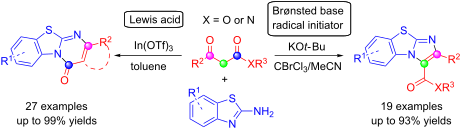
- -butoxide anion to CBrCl3, forming the tert-butoxy radical [94]. This radical attacks the α-hydrogen of 2a via hydrogen atom transfer (HAT), to form intermediate A with a radical at the α-carbon. A then undergoes α-bromination to form the intermediate 6 [95]. Attack at the α-carbon of 6 by 2


The reductive decyanation reaction: an overview and recent developments
Beilstein J. Org. Chem. 2017, 13, 267–284, doi:10.3762/bjoc.13.30
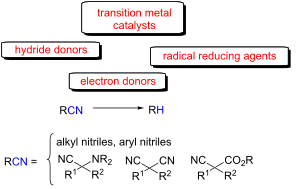
- nitrile carbon to form the nitrogen centered radical 77. β-Fragmentation leads to NHC-boryl nitrile 74 and a carbon centered radical. A hydrogen atom transfer reaction between the electrophilic α-cyano radical and the nucleophile NHC-borane achieves the chain propagation (Scheme 24). The isolation of the


Solvent-free, visible-light photocatalytic alcohol oxidations applying an organic photocatalyst
Beilstein J. Org. Chem. 2016, 12, 2358–2363, doi:10.3762/bjoc.12.229
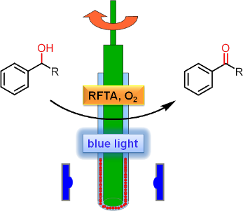
- solvent like hydrogen-atom transfer or the formation of byproducts could be excluded. For liquid substrates, some examples for photocatalytic, solvent-free conversions are reported, such as the oxidation of benzyl alcohol to benzaldehyde [4] and the oxidation of benzenes to phenols [5]. Another field of




Conjugate addition–enantioselective protonation reactions
Beilstein J. Org. Chem. 2016, 12, 1203–1228, doi:10.3762/bjoc.12.116
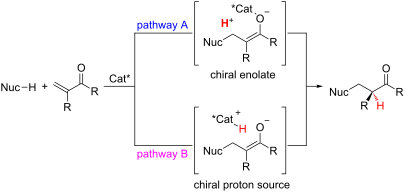
- enantioselective hydrogen atom transfer is an approach that provides products analogous to those accessed via conjugate addition–enantioselective protonation sequences. Due to the similar challenges when delivering both protons and hydrogen atoms enantioselectively, examples of conjugate addition–enantioselective
- hydrogen atom transfer are also included in this review. Review α,β-Unsaturated esters Lewis acids α,β-Unsaturated esters have been the most extensively studied class of electrophiles for conjugate addition–enantioselective protonation sequences. Esters are useful functional group handles for additional
- yield, with the best enantioselectivities being observed for α-arylacrylates (94:6 to 96:4 er). For the synthesis of enantioenriched α-amino esters 7a, β-amino esters 7b and 2-hydroxymethyl esters 7c, the Sibi group has utilized a conjugate addition–enantioselective hydrogen atom transfer reaction


Pyridine-promoted dediazoniation of aryldiazonium tetrafluoroborates: Application to the synthesis of SF5-substituted phenylboronic esters and iodobenzenes
Beilstein J. Org. Chem. 2015, 11, 1494–1502, doi:10.3762/bjoc.11.162
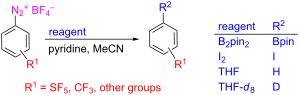
- configuration) and 6i in 16:31:28:25 GC–MS ratio. The presence of these products can be explained only by the formation of the substituted SF5-phenyl radical which undergoes borylation to 2i, hydrogen atom transfer followed by borylation to 2i’, intramolecular cyclization to 5i or hydrogen abstraction to 6i
- -trimethylpyridine) gave similar yields. Unlike borylations, the iodination reactions were not sensitive to ortho substitutions. In the case of 3i, compound 10i was the sole product; no product of hydrogen atom transfer or cyclization was observed, demonstrating that the reaction with I2 is much faster than with


Antioxidant potential of curcumin-related compounds studied by chemiluminescence kinetics, chain-breaking efficiencies, scavenging activity (ORAC) and DFT calculations
Beilstein J. Org. Chem. 2015, 11, 1398–1411, doi:10.3762/bjoc.11.151
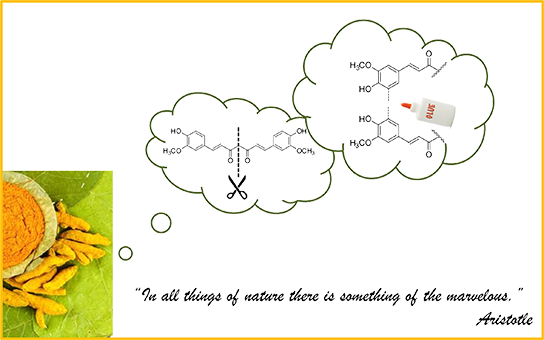
- up does not exert any influence on the antioxidant efficiency and reactivity of the two dimers. The presence of the keto–enol moiety is not of significance for the hydrogen-atom-transfer (HAT) reactions and the classical chain-breaking antioxidant activity. The presence of two longer unsaturated keto




Metal-free aerobic oxidations mediated by N-hydroxyphthalimide. A concise review
Beilstein J. Org. Chem. 2013, 9, 1296–1310, doi:10.3762/bjoc.9.146
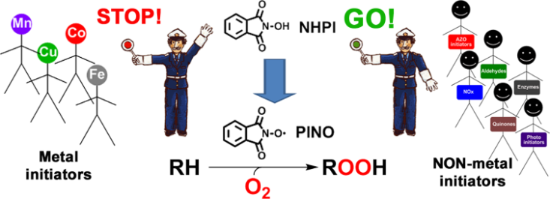
- laccase-ABTS follows an electron transfer (ET) mechanism, NHPI, VLA, HBT, and NHAmediators promote a hydrogen atom transfer (HAT) route through the formation of the corresponding N-oxyl radicals as NHDs-Medox species (Scheme 11). The same research group also emphasized the specialization of mediators
- -electron-transfer interaction of antraquinone (AQ) with NHPI in zeolite HY, followed by hydrogen-atom transfer, successfully led to the formation of the PINO radical, which in turn was responsible for the propagation of the radical chain in the selective oxidation of ethylbenzene to the corresponding


Mitomycins syntheses: a recent update
Beilstein J. Org. Chem. 2009, 5, No. 33, doi:10.3762/bjoc.5.33
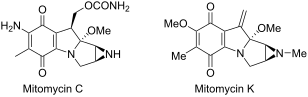
- ) [114]. 5.4. Parson. Radical cyclization The development of novel cascade (or domino) radical reactions is an active area of current research, and one approach to the mitomycin ring system focused on the application of 1-6-hydrogen atom transfer to create a pyrrolidinone radical, which could then


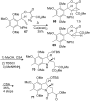


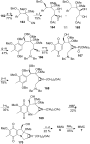


Radical cascades using enantioenriched 7-azabenzonorbornenes and their applications in synthesis
Beilstein J. Org. Chem. 2008, 4, No. 38, doi:10.3762/bjoc.4.38
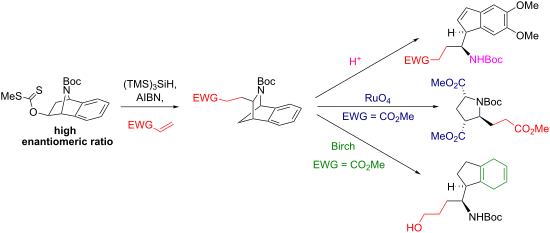
- electrophile trapping with the sulfone corresponds approximately to the rate of hydrogen atom transfer from (TMS)3SiH. Attempted reaction with methyl vinyl ketone, N,N-dimethylacrylamide and methyl propiolate gave rearranged-reduced azacycle 8 in modest yields, as well as small quantities of hydrosilylated


Part 2. Mechanistic aspects of the reduction of S-alkyl- thionocarbonates in the presence of triethylborane and air
Beilstein J. Org. Chem. 2007, 3, No. 46, doi:10.1186/1860-5397-3-46
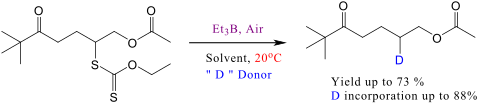
- deuterium transfer is observed from either compounds 3, 4, or 5 when xanthate 1a was subjected to reduction (Method A) in the presence of one equivalent of O-ethyl-S-ethyl dithiocarbonate, using benzene as solvent to suppress any hydrogen atom transfer from the solvent. Along the same lines, we prepared


Part 1. Reduction of S-alkyl- thionocarbonates and related compounds in the presence of trialkylboranes/air
Beilstein J. Org. Chem. 2007, 3, No. 45, doi:10.1186/1860-5397-3-45
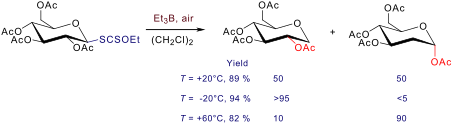
- following observations: – the attack of a carbon radical on the sulfur atom of a thiocarbonyl function is known to be a fast process; – the hydrogen atom transfer in the system Et3B/air is a relatively slow process as demonstrated above. In the case of S-alkylxanthates a, the production of radical R
- transfer is slow, the radical may easily react with a or e [equation (2)], thus establishing a degenerate process that does not consume the starting material a, preserves the radical character and allows slow hydrogen atom transfer to occur. For O-alkylxanthates, the situation is different. The reaction of
- Et• with f gives rise to h and R• [equation (3)]. If the hydrogen atom transfer is slow, the latter reacts with f to afford the rearranged S-alkyl S-methyldithiocarbonate j. As R• radical cannot react with the carbonyl function of j, the starting material is progressively consumed by the unwanted


Do α-acyloxy and α-alkoxycarbonyloxy radicals fragment to form acyl and alkoxycarbonyl radicals?
Beilstein J. Org. Chem. 2006, 2, No. 10, doi:10.1186/1860-5397-2-10
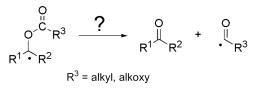
- atom transfer (Figure 2). The resulting radical 5 rebounds back to the enol ether in a 1,5-cyclization to provide 6. In the crucial self-terminating step, radical 6 is suggested to fragment to product 2 and radical X•. Related steps are involved in the formation of ketone 3 (not shown), except that the
- . Representative reagents, reactions conditions and product yields for this very general transformation are shown in Figure 1. The suggested mechanism for formation of 2 involves addition of an oxygen-centered radical (XO•) to 1 to generate vinyl radical 4, followed by rapid radical translocation by 1,5-hydrogen