Search results
Search for "UV irradiation" in Full Text gives 138 result(s) in Beilstein Journal of Organic Chemistry.
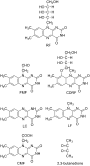
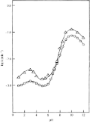
Photo, thermal and chemical degradation of riboflavin
Beilstein J. Org. Chem. 2014, 10, 1999–2012, doi:10.3762/bjoc.10.208
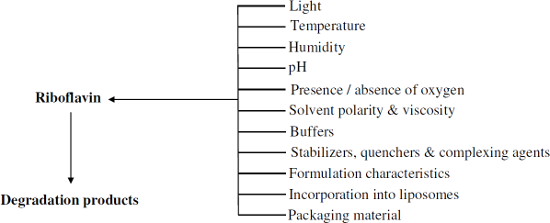
- reaction was higher on UV irradiation as compared to that of the visible irradiation. Similarly, the magnitude of the formation of the photoproducts was higher in solutions exposed to UV light as compared to the visible light. The difference in rates might be due to the higher intensity of the UV radiation




Improving the reactivity of phenylacetylene macrocycles toward topochemical polymerization by side chains modification
Beilstein J. Org. Chem. 2014, 10, 1613–1619, doi:10.3762/bjoc.10.167
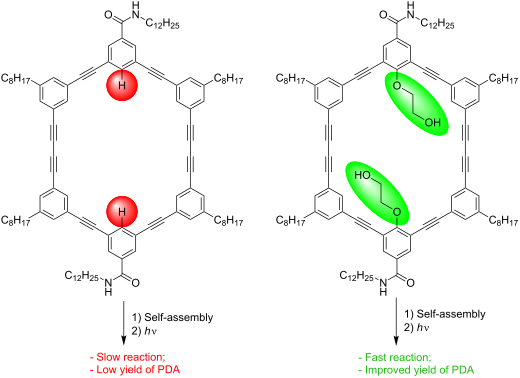
- are also present in the Raman spectrum of PAM2 due to partial photo-induced polymerization during spectrum acquisition. This demonstrates the high reactivity of PAM2 under UV irradiation. Further research on the resulting nanoarchitectures is currently underway to establish if covalent nanotubes have
- to PAM3. Scanning electron microscopy (SEM) images of PAM2 xerogel in cyclohexane (10 mg/mL). Scales are a) 1 μm and b) 0.5 μm. UV–vis spectrum of PAM2 before (black) and after (red) polymerization (PDA). Background-corrected Raman spectra of PAM2 (red) and the blue material obtained after UV
- irradiation (black). Synthetic pathway to PAM2 and PAM3. Supporting Information Supporting Information File 456: Experimental part. Acknowledgements This work was supported by NSERC through a Discovery Grant. We thank Rodica Plesu (U. Laval) and Jean-François Rioux (U. Laval) for their help in polymer


Orthogonal dual thiol–chloroacetyl and thiol–ene couplings for the sequential one-pot assembly of heteroglycoclusters
Beilstein J. Org. Chem. 2014, 10, 1557–1563, doi:10.3762/bjoc.10.160
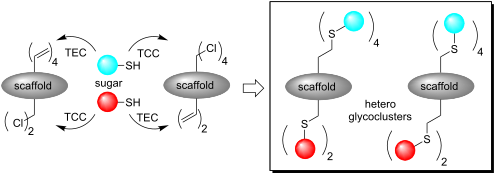
- of DMF and H2O under UV irradiation (λ = 365 nm) in the presence of 2,2-dimethoxy-2-phenylacetophenone (DPAP) as a radical initiator (Scheme 1, route A). In previous studies [26], we observed that the TEC reaction requires the utilization of 3 equivalents of sugar per reaction site to be complete


Multichromophoric sugar for fluorescence photoswitching
Beilstein J. Org. Chem. 2014, 10, 1471–1481, doi:10.3762/bjoc.10.151
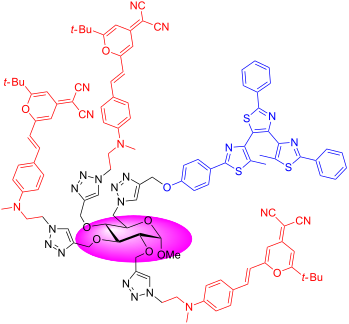
- multichromophoric glucopyranoside 2 bearing three dicyanomethylenepyran (DCM) fluorophores and one diarylethene (DAE) photochrome has been prepared by Cu(I)-catalyzed alkyne–azide cycloaddition reaction. The fluorescence of 2 was switched off upon UV irradiation, in proportion with the open to closed form (OF to CF
- -dicyanomethylene-2-tert-butyl-6-(p-dialkylaminostyryl)-4H-pyran) [3] with a photochromic diarylethene (DAE) which showed a photoreversible two-way FRET controlled by the state of the photochromic moiety, and 49% quenching of the fluorescence upon UV irradiation [4]. Bifunctional molecules built on two distinct
- illumination is composed of 91% of 9-CF and 9% of 9-OF (Figure 3c, dashed line). The target compound 2 can be considered as the assembly of the fluorescent model derivative 6 and the photochromic model compound 9. Indeed, before any UV irradiation, the absorption spectrum of 2 in its open form (2-OF




Cyclization–endoperoxidation cascade reactions of dienes mediated by a pyrylium photoredox catalyst
Beilstein J. Org. Chem. 2014, 10, 1272–1281, doi:10.3762/bjoc.10.128
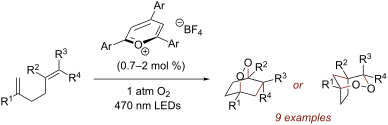
- were inspired by the work of Miyashi, who, during the course of the investigation of the cation radical Cope rearrangement, discovered an intriguing endoperoxide-forming reaction (Scheme 1, reaction 1). Upon exposure of 1,5 and 1,6-dienes to catalytic quantities of 9,10-dicyanoanthracene (DCA) under UV
- irradiation in the presence of oxygen, bicyclic endoperoxides were obtained [12]. Formation of the 1,2-dioxanes was presumed to occur via single electron oxidation of the diene by the excited state DCA followed by either 6-endo or 7-endo cyclization modes to generate a fleeting distonic cation radical species


Atherton–Todd reaction: mechanism, scope and applications
Beilstein J. Org. Chem. 2014, 10, 1166–1196, doi:10.3762/bjoc.10.117

- mechanism proceeding by radical processes. Indeed, the use of UV irradiation or radical initiators in the absence of trialkylamine was found to be unsuccessful to produce phosphoramidates. Recently, Krutikov et al. [9] have reported that hexahydroazepine (a secondary amine with a pKa of 11.1 (Scheme 3-iii




Solid-phase-supported synthesis of morpholinoglycine oligonucleotide mimics
Beilstein J. Org. Chem. 2014, 10, 1151–1158, doi:10.3762/bjoc.10.115
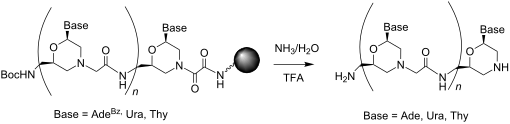
- plates (Merck, Germany) in the proper solvent systems (see below) and visualized by UV irradiation, ninhydrin (amine groups) or cystein/aqueous sulfuric acid (nucleoside and trityl groups). Preparative silica gel column chromatography, RPC, and cation exchange chromatography were performed using silica



Domino reactions of 2H-azirines with acylketenes from furan-2,3-diones: Competition between the formation of ortho-fused and bridged heterocyclic systems
Beilstein J. Org. Chem. 2014, 10, 784–793, doi:10.3762/bjoc.10.74

- -system (4.56, 4.68 ppm). Attempts to initiate the reaction by UV-irradiation (at 20 or 50 °C) or catalysis by compounds of transition metals (Cu(acac)2, Fe(acac)3, Pd(bzac)2, Rh2(AcO)4, Cu(OTf)2, Pd/C) at 20 or 40 °C failed. Benzene was found to be a solvent of choice, and a 1:1 molar ratio of reagents


Direct and indirect single electron transfer (SET)-photochemical approaches for the preparation of novel phthalimide and naphthalimide-based lariat-type crown ethers
Beilstein J. Org. Chem. 2014, 10, 514–527, doi:10.3762/bjoc.10.47
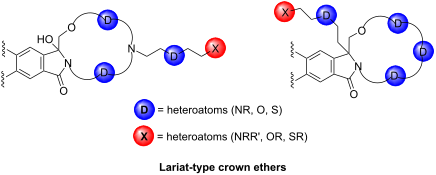
- which nitrogen-linked side chains containing polyethoxy-tethered phthalimides and naphthalimides, possessing terminal α-trialkylsilyl groups, are synthesized utilizing concise routes and UV-irradiation to form macrocyclic ring systems. In contrast, the indirect route developed for the synthesis of
- naphthalimides, possessing terminal α-trialkylsilyl groups, are synthesized utilizing concise routes and UV-irradiation to form the macrocyclic ring systems (Scheme 6). In contrast, the indirect route developed for the synthesis of lariat-type crown ethers employs sequences in which the SET-promoted
- branched chain-tethered phthalimides In order to explore the feasibility of using the direct approach for the preparation of lariat-type crown ethers, branched, bis(α-silyl ether)-terminated chains containing phthalimides 32 and 33 were prepared and subjected to UV-irradiation in MeOH solution containing


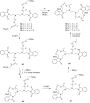


Synthesis of nucleotide–amino acid conjugates designed for photo-CIDNP experiments by a phosphotriester approach
Beilstein J. Org. Chem. 2013, 9, 2898–2909, doi:10.3762/bjoc.9.326
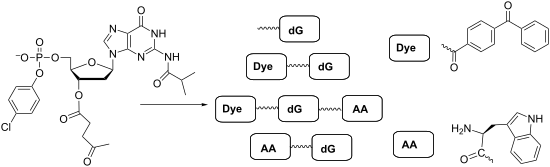
- solvent systems (see below) and spots were visualized by UV irradiation, ninhydrin (for amine groups) or cysteine/aqueous sulfuric acid (for nucleosides and tryptophan) solution. Evaporations were performed under reduced pressure at 40 °C. The preparative silica gel column chromatography was performed


Damage of polyesters by the atmospheric free radical oxidant NO3•: a product study involving model systems
Beilstein J. Org. Chem. 2013, 9, 1907–1916, doi:10.3762/bjoc.9.225

- are widely used in the building, automotive and aircraft industries to protect the underlying material from degradation, are commonly high-performing polyesters, which are exposed to significant environmental stress, in particular high temperatures, humidity and UV irradiation. These materials are in


Organotellurium-mediated living radical polymerization under photoirradiation by a low-intensity light-emitting diode
Beilstein J. Org. Chem. 2013, 9, 1607–1612, doi:10.3762/bjoc.9.183
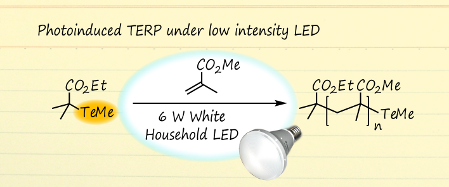
- conditions [8][9][10][11]. In addition, photochemical activation is beneficial for increasing the fidelity of the polymer-end structure [12]. However, the experimental setup required for the reaction provides problems, as distinctive light sources such as γ-rays or high-intensity UV irradiation are required


Diastereoselective radical addition to γ-alkyl-α-methylene-γ-butyrolactams and the synthesis of a chiral pyroglutamic acid derivative
Beilstein J. Org. Chem. 2013, 9, 1432–1436, doi:10.3762/bjoc.9.161
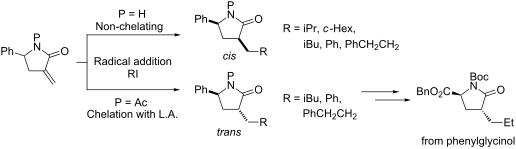
- ][7][8] and no reports on radical addition. We have already investigated diastereoselective alkyl radical additions to α-methylene-γ-phenyl- γ-lactam and reported that the N-unsubstituted lactam yields cis-α,γ-disubstituted lactams using (Me3Si)3SiH under UV irradiation, whereas the reactions of N
- temperature under UV irradiation. The reactions of 1a and 1b yielded strong cis-diastereoselectivities, but the reactions of 1c and 1d were less diastereoselective. Next, isopropyl radical additions to N-pivaloyl substrates 3a–3d in the presence of a Lewis acid were investigated (Table 2). The reactions of 3a


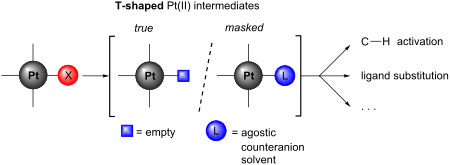
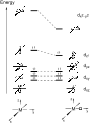
True and masked three-coordinate T-shaped platinum(II) intermediates
Beilstein J. Org. Chem. 2013, 9, 1352–1382, doi:10.3762/bjoc.9.153





Homolytic substitution at phosphorus for C–P bond formation in organic synthesis
Beilstein J. Org. Chem. 2013, 9, 1269–1277, doi:10.3762/bjoc.9.143

- phenylacetylene under UV irradiation or upon heating in the presence of AIBN (Scheme 6) [27]. The reaction consists of the addition of a diorganophosphanyl radical to phenylacetylene and the homolytic substitution of tetraorganodiphosphine with the resulting vinyl radical to afford the adduct and to regenerate
- fluorescence (Scheme 8). The initially formed diphosphanylethylene derivatives are not very stable in air, and therefore sulfidation or oxidation was performed to accurately assess the efficiency of the diphosphination reactions. Ogawa independently reported similar diphosphination under UV irradiation (Table


Design and synthesis of tag-free photoprobes for the identification of the molecular target for CCG-1423, a novel inhibitor of the Rho/MKL1/SRF signaling pathway
Beilstein J. Org. Chem. 2013, 9, 966–973, doi:10.3762/bjoc.9.111
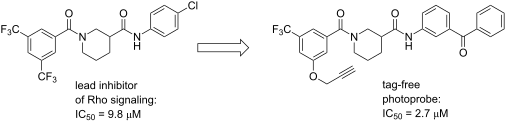
- 29 (Figure 4), i.e., an analogue of 2 with slightly greater potency (IC50 = 6.4 µM) that was identified in later SAR studies [23]. UV irradiation was applied for 30 min at room temperature by using the long-wavelength setting of a hand-held illuminator (366 nm, UVL-56 lamp, UltraViolet Products, San




High-spin intermediates of the photolysis of 2,4,6-triazido-3-chloro-5-fluoropyridine
Beilstein J. Org. Chem. 2013, 9, 733–742, doi:10.3762/bjoc.9.83
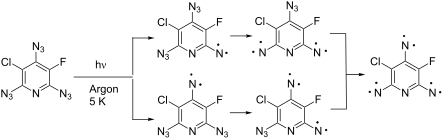
- -spin intermediates formed during the photolysis of asymmetric triazide 11, providing the first information about selective photochemical decomposition of three nonequivalent azido groups in monocyclic aromatic compounds. Results and Discussion Brief UV irradiation (2 min, λ = 260–320 nm) of triazide 11
- when an additional line-broadening parameter Γ(E) was used in the spin-Hamiltonian calculations [24]. The necessity of the use of this parameter in calculations is due to the presence in matrices of numerous conformational isomers of the starting azides. Upon UV irradiation, these conformers decompose
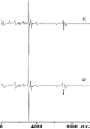
- UV irradiation of triazide 11. Microwave frequency ν0 = 9.605832 GHz. UB3LYP/6-311G*+BLYP/EPRII calculated orientations of the tensors DSS and DSO in nitrenes 15–18. The tensors DSS and DTot have the same orientations. Mulliken spin populations on the nitrene units and parameters DTSS in cm−1 of




Towards a biocompatible artificial lung: Covalent functionalization of poly(4-methylpent-1-ene) (TPX) with cRGD pentapeptide
Beilstein J. Org. Chem. 2013, 9, 270–277, doi:10.3762/bjoc.9.33
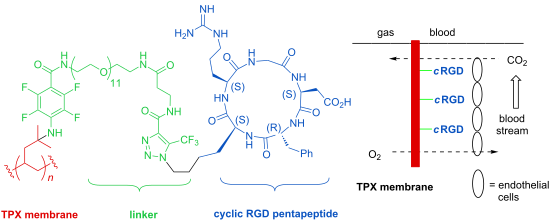
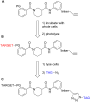
- 2 with a methanolic solution of nitrene precursor 3, and then drying followed by UV irradiation (Hg lamp, 254 nm) initially did not lead to surface modification. The presence of F and N on the TPX membrane was not detectable by XPS analysis. The photoinduced reaction of azide 3 with cyclohexane
- membrane 2 (see below; bars are given in cm) was treated with a solution of azide 3 as described above and UV-irradiation gave covalently functionalized polymer 4. For practicability reasons, flat TPX membranes instead of hollow fibers were used. Physicochemical analysis of modified TPX foils Analysis of


A bisazobenzene crosslinker that isomerizes with visible light
Beilstein J. Org. Chem. 2012, 8, 2184–2190, doi:10.3762/bjoc.8.246
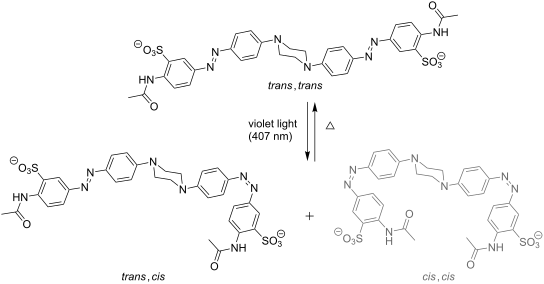
- -modified biomolecules require longer azobenzene derivatives that undergo large end-to-end distance changes upon photoisomerization. In addition, isomerization that occurs with visible rather than UV irradiation is preferred for biological applications. Results: We report the synthesis and characterization


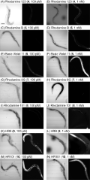
Hydrophobic analogues of rhodamine B and rhodamine 101: potent fluorescent probes of mitochondria in living C. elegans
Beilstein J. Org. Chem. 2012, 8, 2156–2165, doi:10.3762/bjoc.8.243
- Science). TLC plates were visualized by UV irradiation (254 nm) or stained with a solution of phosphomolybdic acid and sulfuric acid in ethanol (1:1:20). Flash column chromatography employed ICN SiliTech Silica Gel (32–63 μm). Melting points were measured with a Thomas Hoover capillary melting point




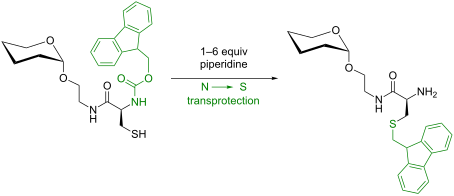
S-Fluorenylmethyl protection of the cysteine side chain upon Nα-Fmoc deprotection
Beilstein J. Org. Chem. 2012, 8, 2149–2155, doi:10.3762/bjoc.8.242
- , Merck). Detection was effected by UV irradiation and subsequent charring with 10% sulfuric acid in EtOH followed by heat treatment. Flash chromatography was performed on silica gel 60 (230–400 mesh, particle size 0.040–0.063 mm, Merck). Preparative MPLC was performed on a Büchi apparatus by using a


Flow photochemistry: Old light through new windows
Beilstein J. Org. Chem. 2012, 8, 2025–2052, doi:10.3762/bjoc.8.229
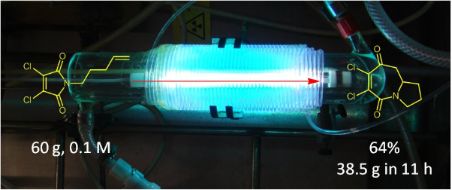
- total reaction solution “sees” intense UV irradiation from the UV source. This leads to very efficient, uniform irradiation of the whole reaction solution over time. • The UV exposure time can be precisely controlled by the flow-rate and reactor volume. This can address both the under- and over


Photochemistry with laser radiation in condensed phase using miniaturized photoreactors
Beilstein J. Org. Chem. 2012, 8, 1213–1218, doi:10.3762/bjoc.8.135
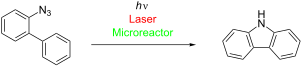
- was shown that a largely better selectivity can be achieved, compared to the one obtained in a standard UV irradiation setup (Figure 2). Experiments were performed in batch as well as flow-injection configuration. The continuous process used allowed us to vary the residence time in the reactor by



Synthesis of new pyrrole–pyridine-based ligands using an in situ Suzuki coupling method
Beilstein J. Org. Chem. 2012, 8, 1037–1047, doi:10.3762/bjoc.8.116
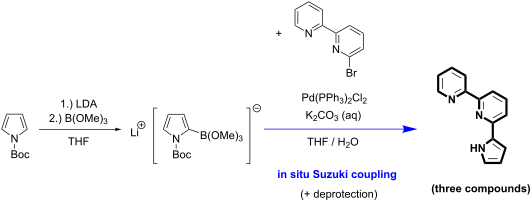
- were tried) we noticed smearing of the blue fluorescent product under UV irradiation. Even deactivated aluminium oxide provides enough acidity to split the Boc-moiety, which probably causes the generated amine to partly remain on the column. In the case of 6, using an excess of 19 lead to better yields


Recent advances towards azobenzene-based light-driven real-time information-transmitting materials
Beilstein J. Org. Chem. 2012, 8, 1003–1017, doi:10.3762/bjoc.8.113
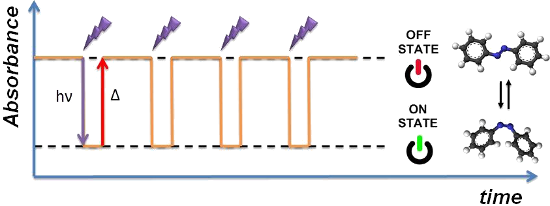
- , associated with the n→π* transition. Upon UV-irradiation, the trans-to-cis photoisomerisation occurs, producing a decrease in the intensity of the 355 nm band and an increase in the 450 nm signal until the photostationary state is reached, that is, the inverse process of that shown in Figure 4 [44]. The
- information-transmitting photochromic switches. Figure 25 shows the information-transmission capability of azo-dye 26 with time. The repeatability of the different optical oscillators was tested by submitting them to consecutive UV-irradiation–dark cycles. The optical photochromic switches reported show no
- -trans isomerisation processes of azobenzenes. Effect of the presence of the electron-withdrawing cyano and nitro groups on the thermal relaxation time in ethanol at 298 K, τ, for the type-I azoderivatives 5 and 6. Transient absorption generated by UV irradiation (λ = 355 nm) for azo-dyes 8 (right) and 9