Search results
Search for "epimerization" in Full Text gives 148 result(s) in Beilstein Journal of Organic Chemistry.
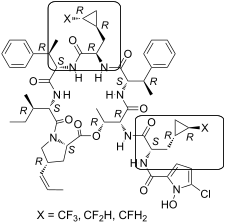
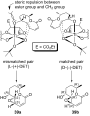
(2R,1'S,2'R)- and (2S,1'S,2'R)-3-[2-Mono(di,tri)fluoromethylcyclopropyl]alanines and their incorporation into hormaomycin analogues
Beilstein J. Org. Chem. 2014, 10, 2844–2857, doi:10.3762/bjoc.10.302
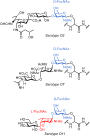
- equivalent with aldehydes the situation is more complicated. The reaction of (S)-10 with acetaldehyde under strongly basic conditions led to the (R)-threonine complex 29 (inverse configuration relative to that of the proline moiety of (S)-10 due to epimerization on C-2), but when a weaker base such as
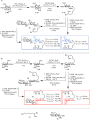
- Figure 4 and Supporting Information File 1) [28]. However, the product ratio changed in time from 95:5 after 30 s through 70:18 after 10 min to 5:95 after 24 h at ambient temperature. This epimerization comes along with a possible rearrangement in the Ni complex. The newly formed hydroxide group of the
- conditions at low temperature and to quench the reaction after a short time to avoid epimerization of 28. This modified protocol indeed gave the (R)-allo-threonine (4) in relatively poor yield [7.5% for the Ni complex, 91% (7% overall) for the amino acid], but with high enantiomeric purity in two steps




Total synthesis of the proposed structure of astakolactin
Beilstein J. Org. Chem. 2014, 10, 2421–2427, doi:10.3762/bjoc.10.252
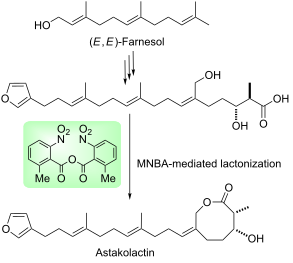
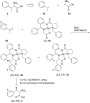
- yield was improved from 60 to 71% by decreasing the substrate concentration from 2.0 to 1.0 mM (Table 1, entry 4). During the MNBA-mediated lactonization, no epimerization occurred at the α position of lactone carbonyl group. Thus, the total synthesis of the proposed structure of 1 was achieved. We next




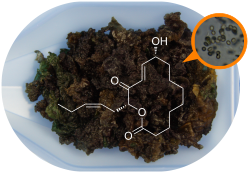
Sacrolide A, a new antimicrobial and cytotoxic oxylipin macrolide from the edible cyanobacterium Aphanothece sacrum
Beilstein J. Org. Chem. 2014, 10, 1808–1816, doi:10.3762/bjoc.10.190
- because of epimerization [12]. To circumvent this problem, we initially attempted to protect the ketone group prior to chemical conversion (Scheme 1). Compound 1 was acetylated (Supporting Information File 1) and subjected to protection as 1,3-dithiane [13] or 1,4-dinitrophenylhydrazone [14]; however


Multicomponent reactions in nucleoside chemistry
Beilstein J. Org. Chem. 2014, 10, 1706–1732, doi:10.3762/bjoc.10.179
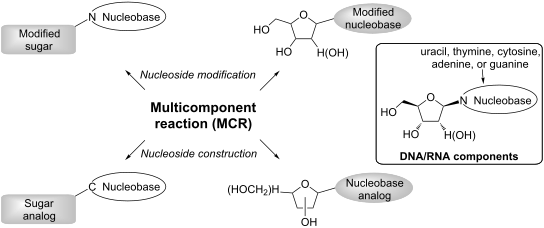
- system), the catalytic effect of L-proline resulted in an increase in the reaction yield. Moreover, epimerization on the C-1 carbon atom of the starting aldehyde 88 was also suppressed. The latter effect was attributed to the preferential activation of methyl 3-aminocrotonate by L-proline via the


Automated solid-phase peptide synthesis to obtain therapeutic peptides
Beilstein J. Org. Chem. 2014, 10, 1197–1212, doi:10.3762/bjoc.10.118
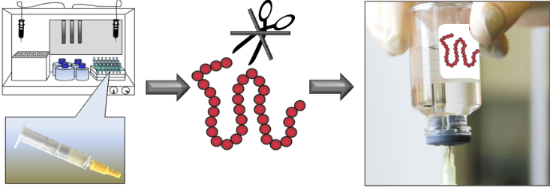
- potent Oxyma-based uronium salt. Dependent on the bulkiness of the amino acids to be coupled and the chemical conditions such as its solubility and its stability, the decision of the proper coupling reagent, offering enhanced reactivity by simultaneous reduction of epimerization, is of high relevance


Addition of H-phosphonates to quinine-derived carbonyl compounds. An unexpected C9 phosphonate–phosphate rearrangement and tandem intramolecular piperidine elimination
Beilstein J. Org. Chem. 2014, 10, 883–889, doi:10.3762/bjoc.10.85
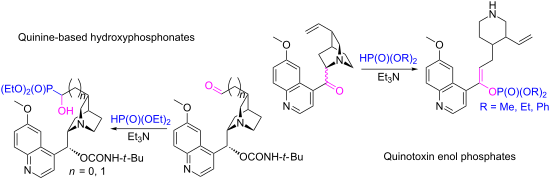
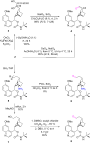
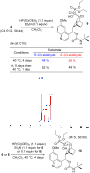
- solvent, instead of benzene, the reaction time was shortened to 7 hours while maintaining the same yield [35]. Epimerization, that occurred at the neighboring C8 atom, resulted in formation of two diastereomeric products: quininone 11 and quinidinone 12 in a 50:50 ratio. The mixture of ketones 11 and 12




Structure elucidation of female-specific volatiles released by the parasitoid wasp Trichogramma turkestanica (Hymenoptera: Trichogrammatidae)
Beilstein J. Org. Chem. 2014, 10, 767–773, doi:10.3762/bjoc.10.72
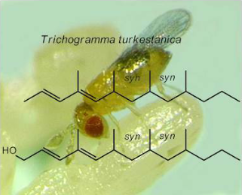
- position 2 underwent ca. 6% epimerization to yield 7 as a mixture of 4 stereoisomers. The synthesis of 2,6,8,12-tetramethyltrideca-2,4-diene (8) was completed by Wittig reaction using (3-methylbut-2-en-1-yl)triphenylphosphonium bromide [15]. As expected, the obtained mixture of all possible stereoisomers
- , followed by oxidation, yielded the aldehyde 10, which was chain elongated by Wittig reaction with [(2E)-1-methylbut-2-en-1-yl]triphenylphosphonium bromide [17] to afford the protected dienol 11 as a mixture of 4 racemates. This was due to partial epimerization at position 2 of the aldehyde 10 and the less



Isocyanide-based multicomponent reactions towards cyclic constrained peptidomimetics
Beilstein J. Org. Chem. 2014, 10, 544–598, doi:10.3762/bjoc.10.50



Total synthesis and cytotoxicity of the marine natural product malevamide D and a photoreactive analog
Beilstein J. Org. Chem. 2014, 10, 316–322, doi:10.3762/bjoc.10.29
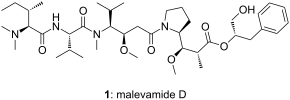
- was still active, because it had been shown in several SAR studies that limited variation of the amine or alcohol component at the C-terminal amide or ester moieties of the dolastatin family members can be tolerated without much loss of cytotoxicity. This includes epimerization of the thiazole




Recent applications of the divinylcyclopropane–cycloheptadiene rearrangement in organic synthesis
Beilstein J. Org. Chem. 2014, 10, 163–193, doi:10.3762/bjoc.10.14
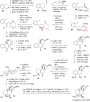
- isomerization to the desired cis-isomer 9 at elevated temperature (≈200 °C [1][2], lowered for more conjugated systems). The isomerization pathways have been suggested to proceed either via the formation of intermediate diradical-species (pathway A, Scheme 3) [16][20][26][27] or through one-center epimerization




Studies toward bivalent κ opioids derived from salvinorin A: heteromethylation of the furan ring reduces affinity
Beilstein J. Org. Chem. 2013, 9, 2916–2924, doi:10.3762/bjoc.9.328
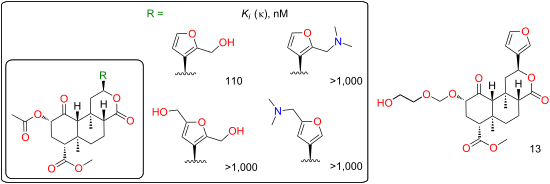
- affinity for opioid receptors [1]. In particular, most modifications of the furan ring tested to date dramatically reduce affinity for κ-OR [1], although small substituents at C-16 have little effect (Figure 1). Unexpectedly, epimerization at C-12, inverting the configuration of the furan ring, reduces
- chromatography, blocking the column. This was therefore extracted from the crude product with hot water. Our results conflict with a previous report that heating 1 in acetic acid led to deacetylation and epimerization [29]. In our hands, 1 was freely soluble in glacial acetic acid and was recovered unchanged


Garner’s aldehyde as a versatile intermediate in the synthesis of enantiopure natural products
Beilstein J. Org. Chem. 2013, 9, 2641–2659, doi:10.3762/bjoc.9.300
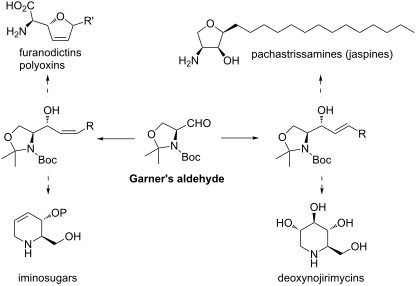
- deleterious epimerization of the existing stereocenter in Garner’s aldehyde. Keywords: asymmetric synthesis; Garner’s aldehyde; natural product synthesis; L-serine; Introduction “The universe is a dissymmetrical whole. I am inclined to think that life, as manifested to us, must be a function of the
- -toluenesulfonic acid and 2,2-dimethoxypropane (DMP) in refluxing benzene (Scheme 1) [24][25]. Reduction of the methyl ester 4 to aldehyde 1 was performed with DIBAL-H (175 mol %) at −78 °C. Garner later reported that they had detected some epimerization of the chiral center (5–7% loss of ee down to 93–95% ee) [26
- (Hünig’s base, DIPEA) inhibits the epimerization (Scheme 3) [28]. With DIPEA as the base they could isolate the aldehyde (S)-1 with an enantiopurity of 96–98% ee. The drawback of this route is an additional reaction step, the “overreduction” of the ester 4 to alcohol 6 and the necessary re-oxidation to




Stereodivergent synthesis of jaspine B and its isomers using a carbohydrate-derived alkoxyallene as C3-building block
Beilstein J. Org. Chem. 2013, 9, 2564–2569, doi:10.3762/bjoc.9.291
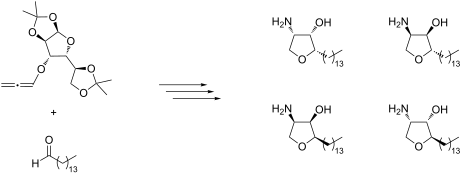
- indicates that a (partial) epimerization at C-4 occurs under the reaction conditions employed. The diastereoselective reduction of the carbonyl group with L-selectride afforded the α-azidotetrahydrofuranones 9 and 10 in 66% yield over three steps. Subsequent hydrogenolysis of 9 and 10 afforded a mixture of


Bidirectional cross metathesis and ring-closing metathesis/ring opening of a C2-symmetric building block: a strategy for the synthesis of decanolide natural products
Beilstein J. Org. Chem. 2013, 9, 2544–2555, doi:10.3762/bjoc.9.289
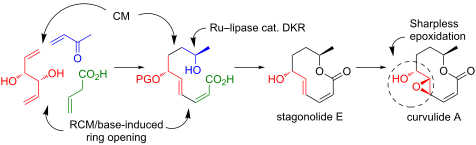
- quantitative recovery of unreacted starting material, the 6-MOM-protected precursor 29 underwent cyclization to the protected decanolide 38 [31] in 67% yield. Deprotection of 38 was accomplished with TFA in dichloromethane at ambient temperature without noticeable epimerization or elimination of water


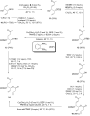




Biosynthesis of rare hexoses using microorganisms and related enzymes
Beilstein J. Org. Chem. 2013, 9, 2434–2445, doi:10.3762/bjoc.9.281
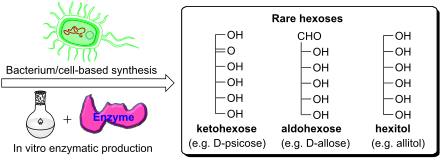
- rare sugar [25]. More interestingly, D-psicose has also been used to prepare several D-psicose containing disaccharides, aiming to learn the function of the rare sugar containing oligosaccharides and glycosides [27]. D-Psicose can be prepared through the epimerization of D-fructose at C-3 catalyzed by
- respectively. As these two enzymes showed high preference towards D-psicose, they were both renamed as DPEase as well. The activity of these two enzymes is strictly metal-dependent and requires Mn2+ as the optimum cofactor. Under optimal conditions, the epimerization yields were 32% and 28%, respectively [35
- galactitol catalyzed by Pseudomonas sp. ST 24 and the production yield was as high as 70%. The possible transformation route from galactitol to D-sorbose in this strain was deduced as follows (Scheme 4): the substrate galactitol is dehydrogenated at C-2 to afford D-tagatose followed by C-3 epimerization [43


Sequential Diels–Alder/[3,3]-sigmatropic rearrangement reactions of β-nitrostyrene with 3-methyl-1,3-pentadiene
Beilstein J. Org. Chem. 2013, 9, 2137–2146, doi:10.3762/bjoc.9.251

- . Epimerization occurred at C-6 (the C-atom attached to the nitronate O-atom). An intermediate cyclic zwitterion would seem to be present and is consistent with observed relative rates of isomerization. The rate (and success) of the thermal [3,3]-sigmatropic rearrangement of O-allyl nitronic esters appears to


Non-cross-linked polystyrene-supported 2-imidazolidinone chiral auxiliary: synthesis and application in asymmetric alkylation reactions
Beilstein J. Org. Chem. 2013, 9, 2113–2119, doi:10.3762/bjoc.9.248
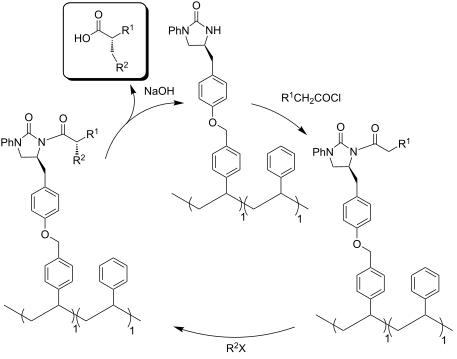
- ]. Additionally, in the solid phase asymmetric alkylation reactions, in which Evans' 2-oxazolidinone chiral auxiliaries were used, the yield and stereoselectivity were too dependent on the base, reaction time, and supported resins. As an example, the base-catalyzed epimerization of the chiral center was
- responsible for epimerization was removed before adding the alkylated reagents [17], to obtain the high stereoselectivity control, the NCPS-supported 2-imidazolidinone chiral auxiliary 3 was simply prepared and asymmetric alkylations of it proceeded smoothly to produce the products in excellent
- acids 8a, 8b, and 8c in excellent ee values (Table 4, entries 1–3). To our surprise, although the asymmetric methylation proceeded very well with excellent diastereocontrol (>99 de), epimerization occurred under NaOH cleavage condition. Consequently, chiral acid 8d was obtained in only 89% ee (Table 4


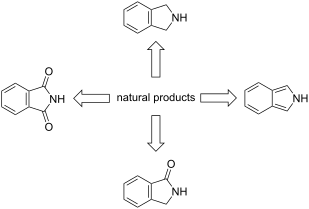
The chemistry of isoindole natural products
Beilstein J. Org. Chem. 2013, 9, 2048–2078, doi:10.3762/bjoc.9.243
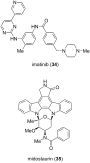
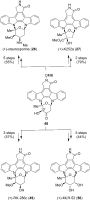
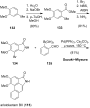
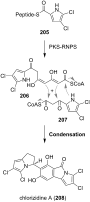
- for this system. The stereochemical outcome could be attributed to the sterically less demanding transition state 82b. The epimerization of 83 to 85 proceeded via an intermediate lactone and extended the route by seven steps. After having secured the cis-epimer 85, the diene moiety was introduced in
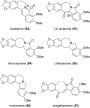
- sequence. The asymmetric intramolecular Diels–Alder reaction was then catalyzed by Kristensens’ catalyst (201) to give 202. A base-promoted epimerization of the aldehyde and a Horner–Wadsworth–Emmons reaction furnished 203, the most advanced intermediate reported so far. Just recently, the group of












The chemistry of amine radical cations produced by visible light photoredox catalysis
Beilstein J. Org. Chem. 2013, 9, 1977–2001, doi:10.3762/bjoc.9.234
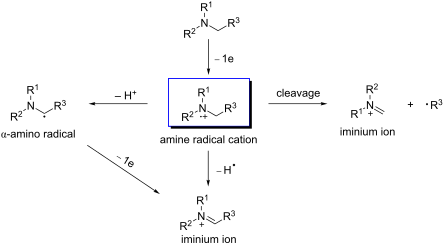
- reaction. The diastereoselectivities were greatly improved by prolonging the reaction time, which would allow for epimerization leading to the thermodynamically more stable products. The starting materials, 1,2-diamines 70, were readily prepared from natural amino acids in enantiomerically pure form. Xiao




An approach towards azafuranomycin analogs by gold-catalyzed cycloisomerization of allenes: synthesis of (αS,2R)-(2,5-dihydro-1H-pyrrol-2-yl)glycine
Beilstein J. Org. Chem. 2013, 9, 1936–1942, doi:10.3762/bjoc.9.229
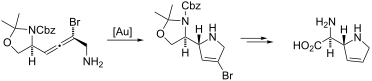
- ; then hydrazine monohydrate) [38][39][62]. Unfortunately, fluoride-mediated desilylation of allene 6c caused complete epimerization of the allenic chirality axis. Therefore, the silylallene was not used in further studies. The results of the gold-catalyzed cycloisomerization of the allenes 7 and 8 to
- epimerization of the allene, so that dihydrofuran 9b was isolated as a 4:1-mixture of diastereomers. As expected, the cycloisomerization of allenes 8 bearing an unprotected amino group is much slower [38][39] and requires rather forcing conditions. For a complete conversion of α-aminoallene 8a, 10 mol % of AuCl
- compound 2’-epi-11b in 4% yield, indicating a minimal epimerization of bromoallene 8b during the gold-catalyzed cyclization. The synthesis of azafuranomycin analogs was continued with the twofold Cbz-protected heterocycle 11a which was obtained with 79% yield by treatment of 10a with CbzCl and DMAP [63


A practical synthesis of long-chain iso-fatty acids (iso-C12–C19) and related natural products
Beilstein J. Org. Chem. 2013, 9, 1807–1812, doi:10.3762/bjoc.9.210
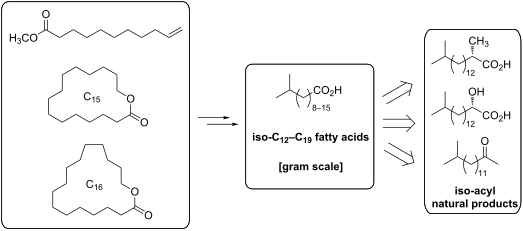
- 2-hydroxy compound 31 as a single diastereoisomer (as determined by 1H NMR) in 71% yield. Esterification with MeOMgCl [69] (which has been shown not to cause epimerization at the α-position [67]) and saponification [70] afforded (S)-2-hydroxy-15-methylpalmitic acid (32). The ketone 33 was isolated


The preparation of several 1,2,3,4,5-functionalized cyclopentane derivatives
Beilstein J. Org. Chem. 2013, 9, 1705–1712, doi:10.3762/bjoc.9.195
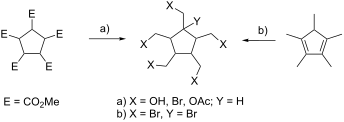
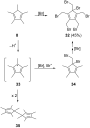
- studies, or whether epimerization took place during the attempted conversion of the pentaalcohol to the pentabromide 17. The complete, structure-confirming spectroscopic and analytical data of 19 can be found in Supporting Information File 1. In closing this section on the preparation of bromine



Preparation of optically active bicyclodihydrosiloles by a radical cascade reaction
Beilstein J. Org. Chem. 2013, 9, 1326–1332, doi:10.3762/bjoc.9.149
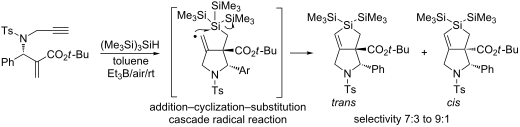
- enhanced the yield of 2a to 58% (Table 1, entry 3). The enantiomeric excess of trans-2a was estimated to be 95% by HPLC analysis, which was the same ee level of precursor 1a. Thus, no epimerization at the C3 chiral center occurred during the reaction. The stereoselectivity was improved to 8:2. The
- analyses using ChiralPak ID and IC (Table 2, entries 1, 2, and 4), the enantiomeric excesses of most of products 2 were high, and their original values were maintained (Table 2, entries 3, 5, 6, 8, and 9). Interestingly, significant epimerization occurred during the reaction of 1h; the enantiomeric excess


Exploration of an epoxidation–ring-opening strategy for the synthesis of lyconadin A and discovery of an unexpected Payne rearrangement
Beilstein J. Org. Chem. 2013, 9, 1179–1184, doi:10.3762/bjoc.9.132
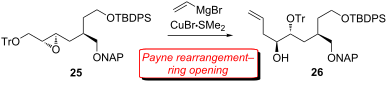
- triggered by exposure of trimesylate 2 or a related electrophile to ammonia. A sequential alkylation process would serve as a viable alternative in the event of problems with this approach. In turn, cis-fused trimesylate 2 could be derived from trans-fused tricyclic ketone 3 by epimerization and standard


De novo synthesis of D- and L-fucosamine containing disaccharides
Beilstein J. Org. Chem. 2013, 9, 332–341, doi:10.3762/bjoc.9.38
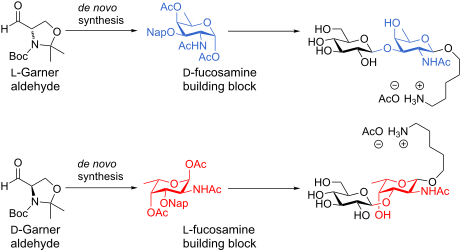
- undergo α-epimerization, oxidation had to proceed under mild conditions in order to avoid the formation of the undesired D-talosamine building block D-9 (Scheme 4). Several oxidation methods were tested (Table 2). All the reactions were performed sequentially without column-chromatographic purification of
- - and L-fucosamine building blocks. (A) Synthesis of aldehydes 6a and 6b. (B) Alkyne reduction by hydrosilylation–protodesilylation sequence (see Table 1). Synthesis of D-fucosamine building blocks 8a and 8b. Epimerization of aldehyde 6a. Synthesis of L-fucosamine building block L-8a from D-Garner