


Search results
Search for "catalytic hydrogenation" in Full Text gives 137 result(s) in Beilstein Journal of Organic Chemistry.
Asymmetric reactions in continuous flow
Beilstein J. Org. Chem. 2009, 5, No. 19, doi:10.3762/bjoc.5.19
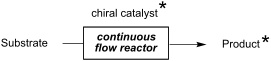
- in the near future. Enantioselective addition of trimethylsilyl cyanide to benzaldehyde. Asymmetric catalytic hydrogenation in a falling-film microreactor. Aldol reaction catalyzed by 5-(pyrrolidine-2-yl)tetrazole. Enantioselective addition of diethylzinc to aryl aldehydes. Glyoxylate-ene reaction in


(−)-Complanine, an inflammatory substance of marine fireworm: a synthetic study
Beilstein J. Org. Chem. 2009, 5, No. 12, doi:10.3762/bjoc.5.12
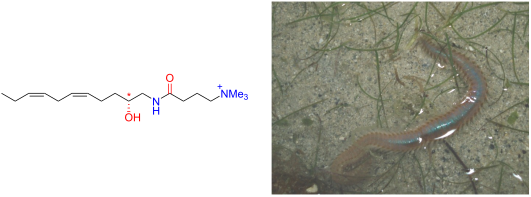
- ) of both enantiomers are under consideration at the present time. In conclusion, (−)-complanine was successfully synthesized from (R)-malic acid by acetylene coupling and catalytic hydrogenation as key steps. The absolute configuration of the natural product was determined to be R. Experimental


Recent progress on the total synthesis of acetogenins from Annonaceae
Beilstein J. Org. Chem. 2008, 4, No. 48, doi:10.3762/bjoc.4.48
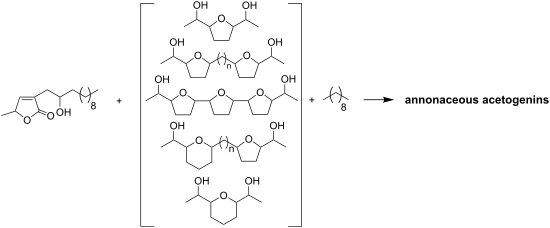
- Sharpless AD and AE reactions (Scheme 35). Elongation of the carbon skeleton of 256 was achieved by a ring-opening reaction using 257 to afford alkyne 258. Then Wittig reaction of the corresponding Wittig reagent prepared from 258 with aldehyde 259 followed by catalytic hydrogenation and deprotection
- further elaborated to afford the epoxide 53. Next, the lithiated derivative of THF alkyne 22, which was prepared from the D-glucono-δ-lactone-derived α-hydroxyl ester 54 through Sharpless AD reaction as a key step, was treated with epoxide 53 in the presence of BF3·Et2O to afford alkynol 56. Catalytic
- hydrogenation of 56 and subsequent construction of the butenolide segment finished the total synthesis of annonacin (48), whose Rf value and spectroscopic data were identical to those reported for the natural product. In 2001, the full details of this total synthesis were reported [31]. Total synthesis of


Diastereoselective and enantioselective reduction of tetralin- 1,4-dione
Beilstein J. Org. Chem. 2008, 4, No. 37, doi:10.3762/bjoc.4.37
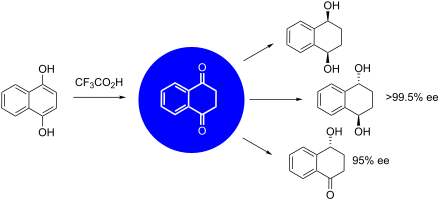
- being the largely dominant species in solution [4]. Tetralin-1,4-dione (2) has also been obtained by catalytic hydrogenation of 1,4-naphthoquinone (3) using Wilkinson’s catalyst (70% yield) [5], by oxidation of 1-tetralone (4) with t-BuOOH and a dirhodium caprolactamate catalyst (27% yield at 29


New acylides: synthesis of 3-O-[γ-(4-oxo-2-aryl- thiazolidin- 3-yl)butyryl]erythromycin A derivatives
Beilstein J. Org. Chem. 2008, 4, No. 14, doi:10.3762/bjoc.4.14
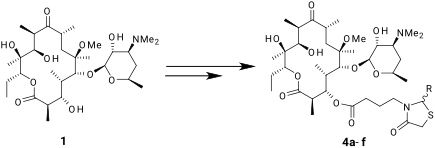
- upon treatment with methanol for several hours gave the desired 3-O-acyl derivative 2 in 72% yield after silica gel column chromatography. Compound 2 was subjected to catalytic hydrogenation using 10% Pd/C in methanol. The reaction was complete within 1 h as monitored by tlc. After usual work up the


Analogues of amphibian alkaloids: total synthesis of (5R,8S,8aS)-(−)-8-methyl- 5-pentyloctahydroindolizine (8-epi-indolizidine 209B) and [(1S,4R,9aS)-(−)-4-pentyloctahydro- 2H-quinolizin- 1-yl]methanol
Beilstein J. Org. Chem. 2008, 4, No. 5, doi:10.1186/1860-5397-4-5
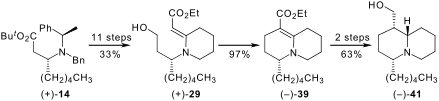
- (−)-39 in 70% yield. In order to introduce the remaining stereogenic centres of the target system, the alkene bond of the bicyclic vinylogous urethane 39 needs to be reduced stereoselectively. Based on our previous success with the indolizidine analogue 19, we opted for catalytic hydrogenation, which is
- through bicyclic enaminone intermediates in which the alkene bond is located between the bridgehead position and the adjacent site, we have a convenient and dependable method for introducing the correct relative stereochemistry at these two sites by means of catalytic hydrogenation. However, the


Knorr- Rabe partial reduction of pyrroles: Application to the synthesis of indolizidine alkaloids
Beilstein J. Org. Chem. 2008, 4, No. 3, doi:10.1186/1860-5397-4-3

- -alkylindolizidines and the stereoselectivity obtained is opposite to that of catalytic hydrogenation. Conclusion An efficient stereoselective synthesis of indolizidine alkaloids has been developed from α-ketopyrrole intermediates using a modified version of Knorr and Rabe's pyrrole reduction. Background The Birch
- to the facile and rapid reaction of the α-ketopyrrole 8 we explored the potential tandem α-ketopyrrole reduction/catalytic hydrogenation as an alternative to catalytic hydrogenation. The catalytic hydrogenation of 5-substituted tetrahydroindolizidines proceeds with high diastereoselectivity [14][15
- as a 9:1 mixture of diastereomers. The volatility of the compound meant that for practical purposes it was isolated as the hydrochloride salt by adding concentrated HCl to the organic extract before evaporation. Catalytic hydrogenation of the hydrochloride salt of the pyrroline gave a corresponding


A convenient allylsilane- N-acyliminium route toward indolizidine and quinolizidine alkaloids
Beilstein J. Org. Chem. 2007, 3, No. 32, doi:10.1186/1860-5397-3-32
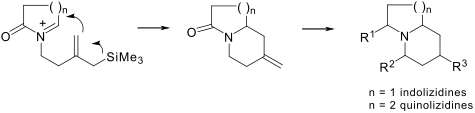
- with one equivalent of stannic chloride resulted in the formation of 10 via the acyliminium ion intermediate 11. Subsequent oxidation of alcohol 10 with pyridinium dichromate, then catalytic hydrogenation (H2 over Pd/C) of ketone 12 induced hydrogenolysis of the CBz group, reduction of the double bond
- by reduction with LiAlH4 of indolizidinones 26. Access to (-)-dendroprimine by catalytic hydrogenation of indolizidinones 26. Synthesis of (±)-myrtine and (±)-epimyrtine. Enantioselective synthesis of (+)-myrtine and (-)-epimyrtine. Synthesis of (±)-lasubines I and II and (±)-2-epilasubine II


Diastereoselective synthesis of some novel benzopyranopyridine derivatives
Beilstein J. Org. Chem. 2006, 2, No. 25, doi:10.1186/1860-5397-2-25
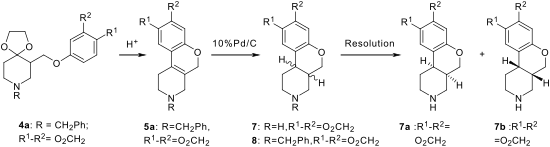
- derivative was also obtained from the N-benzylated-1,2,3,4-tetrahydro[1,3]-dioxolo-[6,7]-5H-[1]benzopyrano [3,4-c]pyridine via catalytic hydrogenation. The resolution of the enantiomers was carried out using D-(-)-mandelic acid as chiral reagent. The absolute configuration of the S,S-mandelate salt


The vicinal difluoro motif: The synthesis and conformation of erythro- and threo- diastereoisomers of 1,2-difluorodiphenylethanes, 2,3-difluorosuccinic acids and their derivatives
Beilstein J. Org. Chem. 2006, 2, No. 19, doi:10.1186/1860-5397-2-19
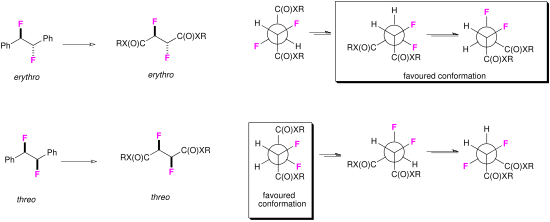
- -difluorosuccinic acids 19. The preparation of stereoisomers of 2,3-difluorosuccinic acids, has involved conversions of tartaric acids (esters) [6][7], as described above in Scheme 1. Other approaches have involved the direct fluorination of fumaric acid [16] and the catalytic hydrogenation of 2,3-difluoromaleic




Multiple hydride reduction pathways in isoflavonoids
Beilstein J. Org. Chem. 2006, 2, No. 16, doi:10.1186/1860-5397-2-16
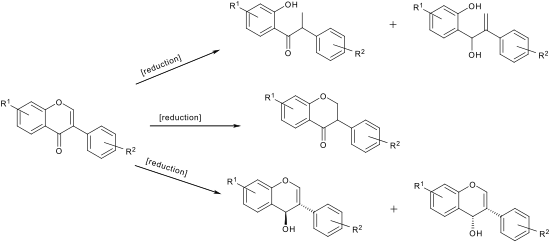
- isoflavans 9, which however are obtained by catalytic hydrogenation [10][16][20]). Incidentally, it is appropriate to point out that flavones do not undergo similar reductive metabolism in mammals as described above for isoflavones. We will nevertheless present at a later date certain findings on the hydride
- study clears this issue by 2D NMR work on a natural 2-isoflavene, [54] establishing that the H-2 and H-4 protons appear at δ 6.87 and 3.61, respectively, much as expected by correlation data shift calculations. Isoflavans (9) have not been prepared by hydride reductions, but by catalytic hydrogenation


Hydrogenation of aromatic ketones, aldehydes, and epoxides with hydrogen and Pd(0)EnCat™ 30NP
Beilstein J. Org. Chem. 2006, 2, No. 15, doi:10.1186/1860-5397-2-15
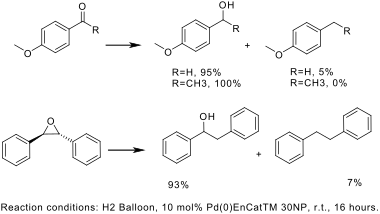
- effectively be reduced using Pd(0)EnCat™ 30NP under conventional catalytic hydrogenation conditions of H2 (atmospheric pressure) with good selectivity and conversions [20]. Results and discussion The results obtained using different conditions for the carbonyl reduction of 4-methoxybenzaldehyde and 4




