


Search results
Search for "click" in Full Text gives 263 result(s) in Beilstein Journal of Organic Chemistry. Showing first 200.
Superstructures with cyclodextrins: Chemistry and applications IV
Beilstein J. Org. Chem. 2017, 13, 2157–2159, doi:10.3762/bjoc.13.215
- magnetic resonance imaging (MRI) [22]. Well-defined fluorescent polyrotaxanes with alternating, threaded cucurbit[6]uril and CD rings were assembled by Fraser Stoddart’s group via an alkyne–azide click reaction exploiting supramolecular catalysis [23][24]. The concurrent radical copolymerization of 1,3
Intramolecular glycosylation
Beilstein J. Org. Chem. 2017, 13, 2028–2048, doi:10.3762/bjoc.13.201
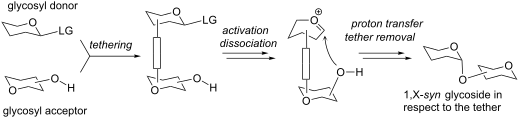
- attempt to simplify the synthesis of the non-symmetrical tethers, a highly trendy triazole-forming click chemistry was combined with rigid spacers by the Schmidt group. α,α’-Dibromo ortho- and meta-xylene-derived rigid spacers were used in this application, and this approach allowed to investigate the
- size of the macrocycle formed during the glycosylation (Scheme 12) [80][81]. Thioglycoside donor 45 containing a 2-O-propargyl group and acceptor 46 with an azide-containing protecting group were connected using a click reaction to afford the tethered intermediate 47. Upon treatment with NIS/TfOH


Mechanochemical synthesis of small organic molecules
Beilstein J. Org. Chem. 2017, 13, 1907–1931, doi:10.3762/bjoc.13.186
- synthesize the triazole rings with additional 1 equiv of K2CO3 which resulted in >85% of product (Scheme 37b). Mack and co-workers reported another mechanochemical variation of “click” reaction [153][154] where they could isolate 33–90% of triazole derivatives using copper reaction vial in ball mill for 16 h
- particles [146]. Mechanochemical synthesis of 1,2-di-substituted benzimidazoles [149]. Mechanochemical click reaction using an alumina-supported Cu-catalyst [152]. Mechanochemical click reaction using copper vial [155]. Mechanochemical indole synthesis [157]. Mechanochemical synthesis of chromene [158


Influence of the milling parameters on the nucleophilic substitution reaction of activated β-cyclodextrins
Beilstein J. Org. Chem. 2017, 13, 1893–1899, doi:10.3762/bjoc.13.184
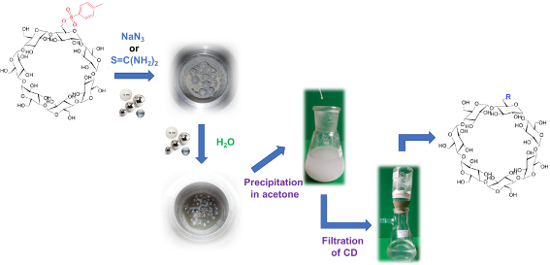
- derivative and is used in analytical chemistry as chiral stationary phase [6]. CDs functionalized with triazole substituents can be similarly prepared through click reactions involving the azido group as a dipolarophile [7], and utilized as suitable starting material to access hydroxy functionality after


Mechanochemical synthesis of thioureas, ureas and guanidines
Beilstein J. Org. Chem. 2017, 13, 1828–1849, doi:10.3762/bjoc.13.178
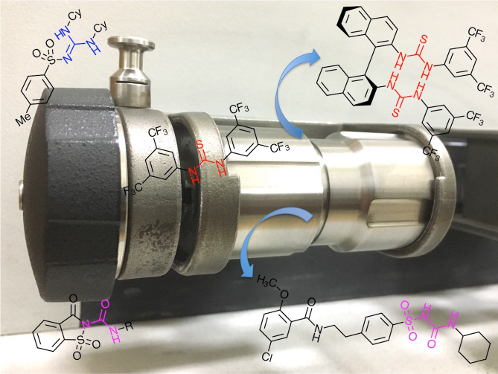
- enabled the quantitative synthesis of (thio)ureas and guanidines without using bulk solvents and the generation of byproducts, but it has also been established as a means to develop "click-type" chemistry for these classes of compounds and the concept of small molecule desymmetrization. Moreover
- '-disubstituted thioureas in quantitative yields. In contrast to mortar-and-pestle synthesis, automated ball milling at 30 Hz using a single 12 mm stainless steel ball afforded the desired products quantitatively in 10 minutes, demonstrating its efficiency for a rapid and general synthesis of thioureas via click
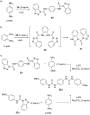
- -withdrawing aryl isothiocyanates with anilines used for the synthesis of N,N'-disubstituted thioureas, thorough mixing in an agate mortar typically leads to the formation of the products in a couple of minutes. As an extension of the mechanochemical click-coupling of amines with isothiocyanates, the thiourea




The chemistry and biology of mycolactones
Beilstein J. Org. Chem. 2017, 13, 1596–1660, doi:10.3762/bjoc.13.159









Biomimetic molecular design tools that learn, evolve, and adapt
Beilstein J. Org. Chem. 2017, 13, 1288–1302, doi:10.3762/bjoc.13.125
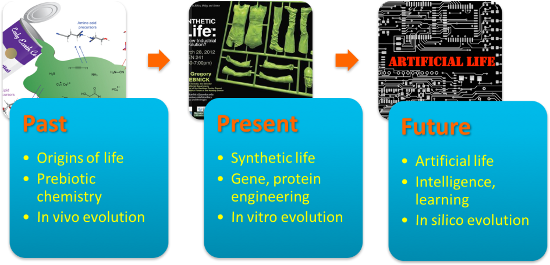
- characterization facility at CSIRO Manufacturing in Melbourne Australia. This can generate and test hundreds of polymers, nanomaterials, catalysts, or metal organic frameworks in a day. Clearly, certain types of chemistries (benzodiazepines, click reactions, etc.) are amenable to large chemical library synthesis




Strategies toward protecting group-free glycosylation through selective activation of the anomeric center
Beilstein J. Org. Chem. 2017, 13, 1239–1279, doi:10.3762/bjoc.13.123

- ). Encouragingly, disaccharides LacNAc and lactose derivatives are compatible (Table 6, entries 5 and 6) [84]. Fairbanks and colleagues have also devised a two-step one-pot method to obtain glycosyl click products [85]. The authors utilized 2-azido-1,3-dimethylimidazolium hexafluorophosphate (ADMI) [86], which
- , L-ascorbic acid and applying mild heat, the desired 1,2-trans click triazole could be obtained in good to excellent yield [85]. This reaction was shown to be very robust as not only di- and oligosaccharides can be formed (one example is shown in Scheme 28B), but also cancer-associated MUC1




An eco-compatible strategy for the diversity-oriented synthesis of macrocycles exploiting carbohydrate-derived building blocks
Beilstein J. Org. Chem. 2017, 13, 1106–1118, doi:10.3762/bjoc.13.110
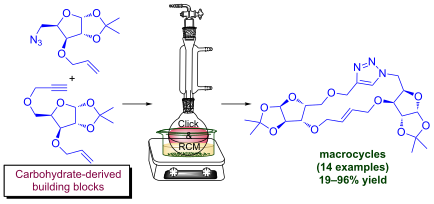
- potential of the new eco-compatible approach for the macrocyclic library generation. Keywords: carbohydrate; click chemistry; diversity-oriented synthesis; macrocycles; ring-closing metathesis; Introduction Macrocycles offer very complex molecular architectures with a diverse range of ring sizes decorated
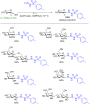
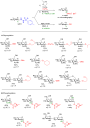
- blocks were coupled via 1,3-dipolar cycloaddition (click reaction) iteratively through the development of a greener base-free Cu(I)-catalyzed azide–alkyne cycloaddition reaction. The cycloadducts were then converted to macrocycles by Ru-catalyzed cyclization reaction using greener and non-hazards
- ratio of integration of the terminal alkyne proton in the propargyl building block and the characteristic triazole–alkene proton in the cyclo-adducts. The click reaction proceeds under various conditions with a plenty of sources of Cu(I) [19]. We have selected copper iodide (CuI) as Cu(I) source for the


Glyco-gold nanoparticles: synthesis and applications
Beilstein J. Org. Chem. 2017, 13, 1008–1021, doi:10.3762/bjoc.13.100
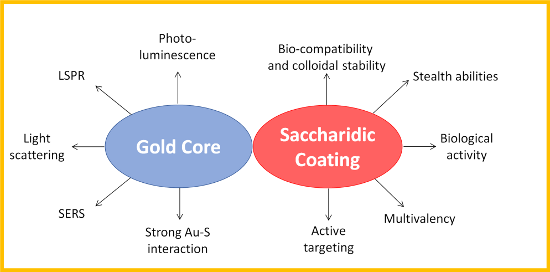
- employed for this purpose (i.e., click reaction, amidation, conjugation via carbonyldiimidazol and perfluorophenyl azide (PFPA) photo-coupling) have to be compatible with water, the common medium for AuNP preparation [25][26][27][28][29]. One example of the three-step approach was described by Tian and co


Automating multistep flow synthesis: approach and challenges in integrating chemistry, machines and logic
Beilstein J. Org. Chem. 2017, 13, 960–987, doi:10.3762/bjoc.13.97
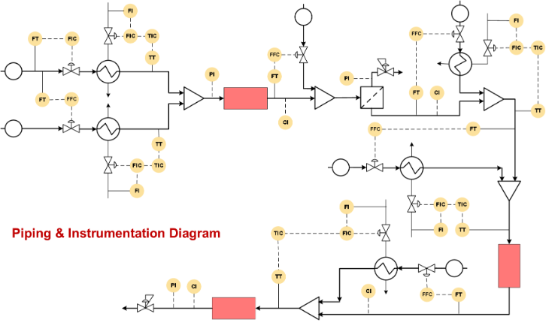
- the multistep synthesis of rufinamide, an antiepileptic agent [14] (Scheme 3). The process involves three steps namely azide synthesis, amide synthesis and click reaction or azide–alkyne cycloaddition. For the azide synthesis, the aryl bromide (1 equiv) and sodium azide (1.3 equiv) are reacted in a




Interactions between shape-persistent macromolecules as probed by AFM
Beilstein J. Org. Chem. 2017, 13, 938–951, doi:10.3762/bjoc.13.95
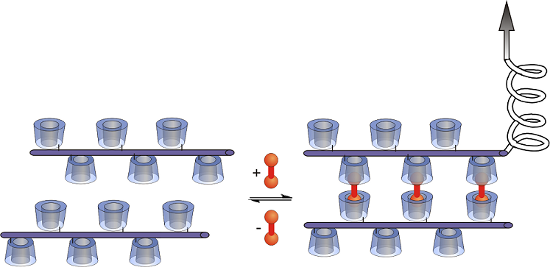
- end groups were prepared starting from diacetylene-modified cyclodextrin monomers by a combined Glaser coupling/click chemistry approach. Structural perfection of the neutral CD polymers and inclusion complex formation with ditopic and monotopic guest molecules were proven by MALDI–TOF and UV–vis
- connection of one CD moiety at each phenylene unit. Based on the stiffness of the polymer chain self-passivation of CD polymer modified surfaces is reduced to a minimum. Furthermore, the ethynyl end groups are easily functionalized by click chemistry. Isothermal titration calorimetry (ITC), fluorescence
- than one polymer molecule might be involved. Conclusion In conclusion, regular water-soluble shape-persistent CD polymers based on poly(phenylene butadiynylene) were prepared by a straightforward Glaser coupling/click chemistry approach, which can be attached to planar silicon surfaces as well as AFM


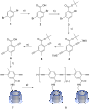


Synthesis of D-manno-heptulose via a cascade aldol/hemiketalization reaction
Beilstein J. Org. Chem. 2017, 13, 795–799, doi:10.3762/bjoc.13.79

- evaluation of carbohydrate–lectin interactions by conjugation with fluorescent quantum dots via click chemistry [13][14]. Besides, differentially protected D-manno-heptulose building blocks could serve as valuable precursors for the synthesis of C-glycosides [15][16]. The known synthesis of D-manno-heptulose


Isoxazole derivatives as new nitric oxide elicitors in plants
Beilstein J. Org. Chem. 2017, 13, 659–664, doi:10.3762/bjoc.13.65
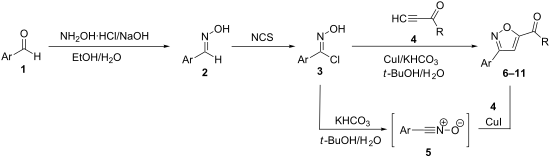
- -deficient alkene led to the intermediate bromoisoxazoline from which, by loss of HBr, a 3,5-disubstituted isoxazole derivative is formed as major regioisomer [34]. Based on the copper(I)-catalyzed click reactions of organic azides with terminal acetylenes [35], different copper(I)-catalyzed synthetic


Fast and efficient synthesis of microporous polymer nanomembranes via light-induced click reaction
Beilstein J. Org. Chem. 2017, 13, 558–563, doi:10.3762/bjoc.13.54
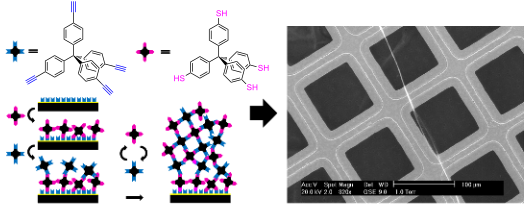
- induced thiol–yne click reaction. Using this reaction, we could greatly enhance the CMP nanomembrane synthesis and further broaden the variability of the LbL approach. Keywords: click chemistry; conjugated microporous polymers (CMPs); microporous materials; nanomembranes; thin films; thiol–yne coupling
- catalyst-free thiol–yne coupling (TYC) reaction. TYC has gained large attention as a representative of the click chemistry concept [17]. In the TYC reaction, usually a photoinitiator creates thiyl radicals [18][19][20], which react with nearby alkyne moieties to form covalent sulfur–carbon bonds and vinyl
- . The growth rate of roughly 1 nm per reaction cycle is in the same order as the previously described LbL synthesis of CMP nanomembranes using CuAAC click chemistry [16]. Synthesis of freestanding CMP nanomembranes In order to produce freestanding CMP nanomembranes, we coated the CMP thin films on


Investigation of the action of poly(ADP-ribose)-synthesising enzymes on NAD+ analogues
Beilstein J. Org. Chem. 2017, 13, 495–501, doi:10.3762/bjoc.13.49
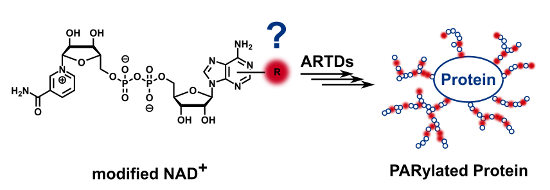
- -synthesising enzymes ARTD1, ARTD2, ARTD5 and ARTD6. By varying the site and size of the NAD+ modification, suitable probes were identified for each enzyme. This report provides guidelines for choosing analogues for studying poly(ADP-ribose)-synthesising enzymes. Keywords: ARTD; click chemistry; NAD+; poly(ADP
- introducing small, terminal alkyne functionalities at common sites of the adenine base. Upon successful incorporation into PAR, these alkynes serve as handles for copper(I) catalysed azide–alkyne click reaction (CuAAC) [22] with fluorescent dyes. Terminal alkynes are the smallest possible reporter group that
- ARTD2 catalysed PAR production [24]. After the times indicated, copper-catalysed click conjugations to a fluorophore-containing azide were performed and the reactions were analysed by SDS PAGE. Then, fluorescent signals were detected and compared to the Coomassie Blue stained gels (Figure 2). Each


Solid-phase enrichment and analysis of electrophilic natural products
Beilstein J. Org. Chem. 2017, 13, 405–409, doi:10.3762/bjoc.13.43
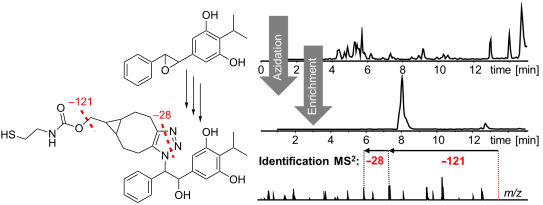
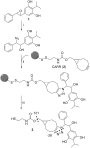
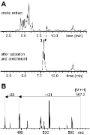
- entomopathogenic Photorhabdus bacteria. Keywords: azides; click chemistry; enrichment; electrophilic natural products; epoxides; glidobactin; Photorhabdus; stilbenes; Introduction Microorganisms are a major source for novel natural products and the subsequent development of new drugs for all kinds of


A postsynthetically 2’-“clickable” uridine with arabino configuration and its application for fluorescent labeling and imaging of DNA
Beilstein J. Org. Chem. 2017, 13, 127–137, doi:10.3762/bjoc.13.16
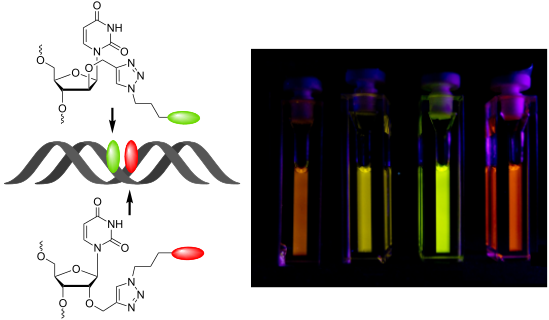
- cells. Keywords: dyes; fluorescence; nucleic acid; oligonucleotide; Introduction The “click”-type reactions [1], in particular the 1,3-dipolar cycloaddition between alkynes and azides (CuAAC) is a broadly applied strategy for postsynthetic oligonucleotide modification since both reactive groups are
- from the resin and deprotected with conc. NH4OH at 45 °C for 16 h. Click reaction with modified oligonucleotides. To the lyophilized alkyne-modified DNA sample were added water (100 µL), sodium ascorbate (25 µL of 0.4 M in water), tris[(1-benzyl-1H-1,2,3-triazol-4-yl)methyl]amine (34 µL of 0.1 M in


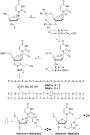
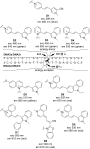


Iodination of carbohydrate-derived 1,2-oxazines to enantiopure 5-iodo-3,6-dihydro-2H-1,2-oxazines and subsequent palladium-catalyzed cross-coupling reactions
Beilstein J. Org. Chem. 2016, 12, 2898–2905, doi:10.3762/bjoc.12.289
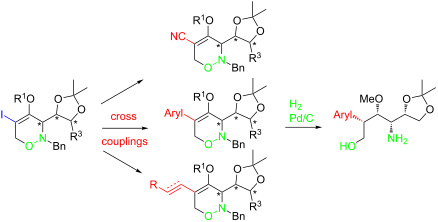
- . This was exemplarily demonstrated by the hydrogenation of syn-21 and anti-24 and by a click reaction of a 5-alkynyl-substituted precursor. Keywords: amino alcohol; click reaction; cross-coupling reactions; hydrogenation; iodination; 1,2-oxazines; Introduction Over the last decade, we have intensively
- -oxazines bearing the newly installed alkynyl group at C-5 are ideal candidates for efficient subsequent transformations. A very popular and widely applied reaction of terminal alkynes is the copper-catalyzed azide–alkyne cycloaddition, also termed as click reaction, efficiently leading to 1,4-disubstituted
- . Cross-coupling reaction of 1,2-oxazine anti-4d leading to 5-cyano-substituted 1,2-oxazine anti-25. Desilylation of 1,2-oxazine syn-5 and subsequent click reaction with benzyl azide leading to 5-(1,2,3-triazolyl)-substituted 1,2-oxazine syn-26. Hydrogenation of 1,2-oxazine syn-21 leading to γ-amino


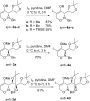


Versatile synthesis of end-reactive polyrotaxanes applicable to fabrication of supramolecular biomaterials
Beilstein J. Org. Chem. 2016, 12, 2883–2892, doi:10.3762/bjoc.12.287

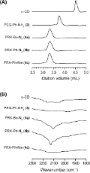
- (benzylazide: PRX-Bn-N3, phenylazide: PRX-Ph-N3,) were synthesized for functionalization via click reactions. The PRX-Bn-N3 and PRX-Ph-N3 reacted quickly and efficiently with p-(tert-butyl)phenylacetylene via copper-catalyzed click reactions. Additionally, the terminal azide groups of the PRX-Bn-N3 could be
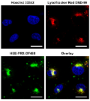
- modified with dibenzylcyclooctyne (DBCO)-conjugated fluorescent molecules via a copper-free click reaction; this fluorescently labeled PRX was utilized for intracellular fluorescence imaging. The method of synthesizing end-reactive PRXs described herein is simple and versatile for the design of diverse
- functional PRXs and can be applied to the fabrication of PRX-based supramolecular biomaterials. Keywords: azide group; biomaterials; click chemistry; cyclodextrin; polyrotaxane; Introduction Polyrotaxanes (PRXs) are a class of interlocked polymers that consist of an inclusion complex of cyclodextrins (CDs




Chemical probes for competitive profiling of the quorum sensing signal synthase PqsD of Pseudomonas aeruginosa
Beilstein J. Org. Chem. 2016, 12, 2784–2792, doi:10.3762/bjoc.12.277
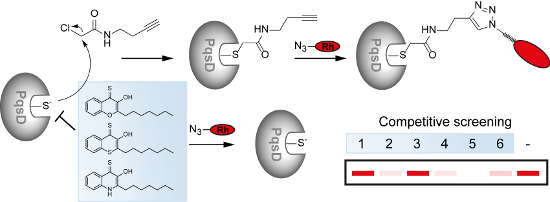
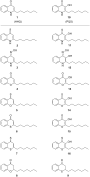
- protein reactive groups, which have been reported to exhibit selectivity for active site cysteines [19] (Supporting Information File 1, Figure S1). Each probe was equipped with a terminal alkyne handle for in-gel analysis by fluorescence tagging via click chemistry with a corresponding rhodamine azide
- Escherichia coli BL21 followed by affinity purification by an ÄKTA chromatography system equipped with a StrepTrap HP column. The individual probes were incubated with purified PqsD for 30 min and a rhodamine fluorescent reporter tag was appended by click chemistry. The remaining non-covalently bound probe
- followed by click chemistry with the fluorophore. A decreasing labelling intensity at increasing NEM concentrations indicates that NEM also blocks the active site cysteine Cys112 at concentrations above 5 µM and thereby prevents covalent attachment of the probe to PqsD (Figure 3D). We were thus interested



A versatile route to polythiophenes with functional pendant groups using alkyne chemistry
Beilstein J. Org. Chem. 2016, 12, 2682–2688, doi:10.3762/bjoc.12.265
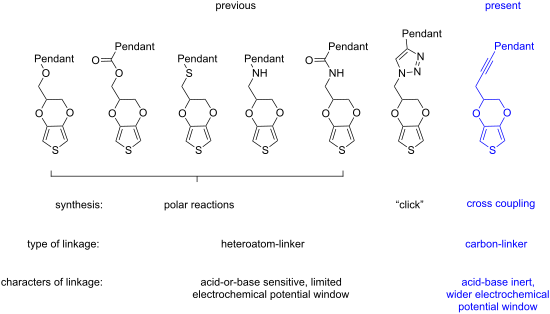
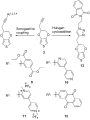
- alkyne chemistry. Its usefulness is demonstrated by a series of functionalized polythiophene derivatives that were obtained by pre- and post-electropolymerization transformations, provided by the synthetic ease of the Sonogashira coupling and click chemistry. Keywords: electropolymerization; functional
- of such functionalization using a Sonogashira cross-coupling [26] and an azide–alkyne Huisgen cycloaddition [27]. One of the advantages of the cross-coupling and click chemistry is that it allows for reaction conditions tolerant for nearly all of the above mentioned functional groups. Additionally
- , these functionalizations require only readily available starting materials. A related concept, i.e., attachment of a terminal alkyne moiety to the polymerizable thiophene derivative ProDOT, an EDOT analogue, and its utilization for “click“ chemistry has been reported [28]. However, this involved an


Synthesis of three-dimensional porous hyper-crosslinked polymers via thiol–yne reaction
Beilstein J. Org. Chem. 2016, 12, 2570–2576, doi:10.3762/bjoc.12.252
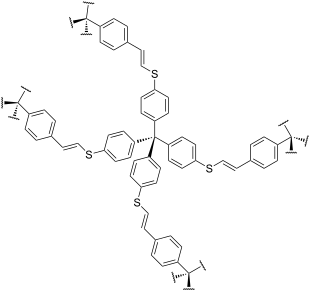
- ], gas separation [7] and catalysis [8][9][10]. For the synthesis of organic networks, many different reaction types such as condensation reactions [11][12], coupling reactions [3] and click reactions [5][13] have been reported. Herein we present the synthesis of porous, three-dimensional
- tetraphenylmethane-based networks by another click reaction, the thiol–yne reaction [14][15][16][17][18][19]. This reaction type has been known for several decades and relived a renaissance in the past decade, especially in material sciences [20][21][22][23][24][25][26][27][28][29][30][31][32], due to its mild, and



Synthesis, dynamic NMR characterization and XRD studies of novel N,N’-substituted piperazines for bioorthogonal labeling
Beilstein J. Org. Chem. 2016, 12, 2478–2489, doi:10.3762/bjoc.12.242
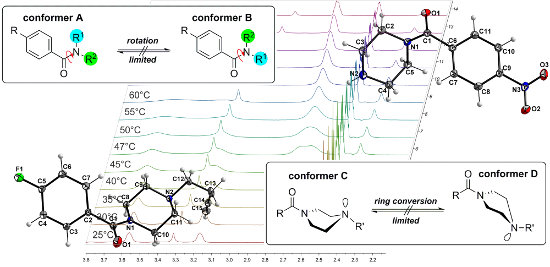
- applicability of these compounds as possible 18F-building blocks, two biomolecules were modified and chosen for conjugation either using the Huisgen-click reaction or the traceless Staudinger ligation. Keywords: building blocks; coalescence; dynamic NMR; labeling; Staudinger ligation; Introduction The
- to demonstrate the Cu-catalyzed azide–alkyne click reaction (Huisgen 1,3-dipolar cycloaddition) and the traceless Staudinger ligation, a proof of concept study was performed for the site-selective labeling of a pharmacologically active peptide and a small organic compound. These compounds provide the
- . First, piperazine (2) was reacted with functionalized benzoyl chlorides 1a,b to yield the mono-acylated amides 3a,b according to literature procedures [14]. Next, the necessary functional groups for the later click reactions to connect the resulting building blocks to biomolecules were introduced. Thus




A direct method for the N-tetraalkylation of azamacrocycles
Beilstein J. Org. Chem. 2016, 12, 2457–2461, doi:10.3762/bjoc.12.239
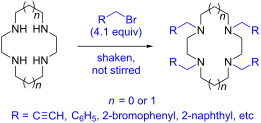
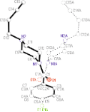
- . Utilisation of the N-tetrapropargyl products 3 and 8 to generate ‘click’-triazolylcyclam/cyclen derivatives for fluorescence sensing and other applications is underway and will be reported in due course. Ball-and-stick depiction of the crystal structure obtained for [(3)H2](ClO4)2, generated with X-Seed [51





