Search results
Search for "dynamics" in Full Text gives 247 result(s) in Beilstein Journal of Organic Chemistry. Showing first 200.
Inclusion complexes of β-cyclodextrin with tricyclic drugs: an X-ray diffraction, NMR and molecular dynamics study
Beilstein J. Org. Chem. 2017, 13, 714–719, doi:10.3762/bjoc.13.70
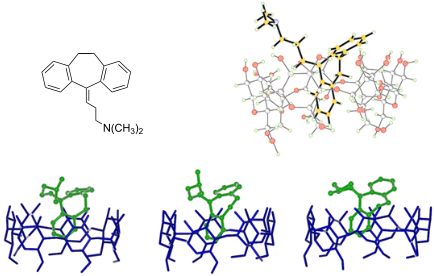
- /β-CD and 2/β-CD complexes, with the aromatic ring system entering the cavity from the large rim of the cyclodextrin and the alkylammonium chain protruding out of the cavity and facing the secondary OH rim. These features matched those found in the molecular dynamics (MD) simulations in solution and
- . Keywords: amitriptyline; β-cyclodextrin; crystal structure; cyclobenzaprine; molecular dynamics simulations; NOE; Introduction The present paper reports on a multidisciplinary approach [1][2] based on single crystal X-ray diffraction, solution NMR spectroscopy and molecular dynamics (MD) simulations with
- : 2K points acquired in the F2 domain, 512 increments and subsequent zero-filling to 1K to process data. Molecular dynamics simulations The simulations employed InsightII/Discover [15] with the CVFF force field [16]. The structure of molecules 1 and 2 were first subjected to an MD run in vacuo and




How and why kinetics, thermodynamics, and chemistry induce the logic of biological evolution
Beilstein J. Org. Chem. 2017, 13, 665–674, doi:10.3762/bjoc.13.66
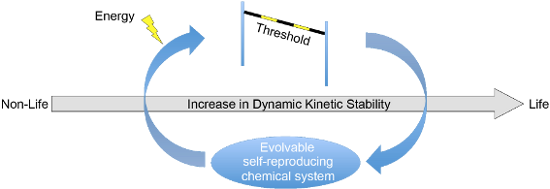
- (Figure 1B). These structures therefore result from dissipative self-assembly for which fascinating examples have been provided in the recent literature [19][20][21]. In biology, one of the most typical examples of this kind of assembly processes can be found in the dynamics of the cytoskeleton. However
- above which Raleigh–Bénard instability is observed (Figure 5). The result of convection is, of course, an increase of energy dissipation by the resulting non-linear process, though its emergence depends on the action of gravity and the laws of fluid dynamics. Regarding the origin of life, we suggested



Contribution of microreactor technology and flow chemistry to the development of green and sustainable synthesis
Beilstein J. Org. Chem. 2017, 13, 520–542, doi:10.3762/bjoc.13.51
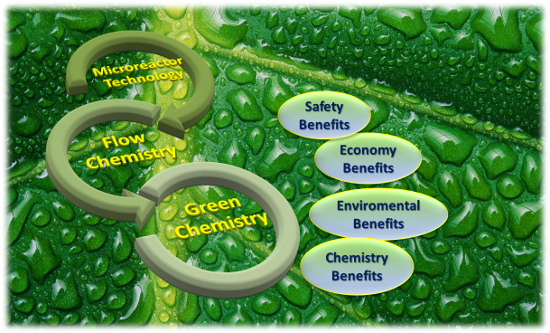
- the basis of computational fluids dynamics (CFD). The simulation results showed that serpentine 3D-structured channels (Figure 2), possessing five turns after each mixing point in a total length of 1 mm, was able to deliver the highest mixing efficiency. The inner volume for the reactor was of 25 μL






Dynamics and interactions of ibuprofen in cyclodextrin nanosponges by solid-state NMR spectroscopy
Beilstein J. Org. Chem. 2017, 13, 182–194, doi:10.3762/bjoc.13.21
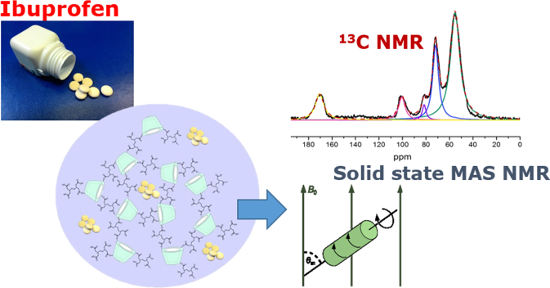
- . As detailed in the Discussion, this technique is quite rarely used. The results of the 1H Fast MAS NMR experiments provided further structural details of the state of the drug molecule loaded in the CDNS materials. Theoretical Aspects The CP-MAS experiment and CP dynamics Cross-polarization (CP) is a
- nuclei and B1 is the so-called spin-lock field generated by the spectrometer acquisition hardware. The efficiency of the CP process strongly depends on the structural and dynamic properties of the system, in particular molecular conformational changes, rotational dynamics and internuclear distances in
- detected via 1H NMR and discussed in the previous section is likely to involve two IbuH units in the formation of dimers. Dynamics of cross polarization We applied variable contact time (VCT) 1H-13C CP-MAS NMR techniques to study the CP kinetics of both the CDNS polymers. As an example, the array of 13C CP


Benzothiadiazole oligoene fatty acids: fluorescent dyes with large Stokes shifts
Beilstein J. Org. Chem. 2016, 12, 2739–2747, doi:10.3762/bjoc.12.270
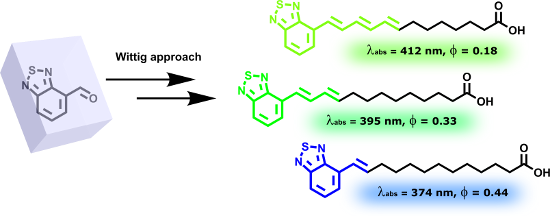
- sufficient to understand membrane dynamics and function. Often membrane domains are formed in which certain lipids, glycolipids or proteins are enriched [2][3][4]. Such domains – also called lipid rafts – do not only differ in their chemical composition, but also show different physical properties (e.g
- -dipyrromethene) [11][12], BOIMPY- (bis(borondifluoride)-8-imidazodipyrromethene) [13] and pyrene-labeled fatty acids [14]. Of course, all these alterations might also affect the membrane structure and its dynamics. While the NBD-fluorophore suffers from unsuitable polarity, a pyrene motif disrupts the unpolar


Computational methods in drug discovery
Beilstein J. Org. Chem. 2016, 12, 2694–2718, doi:10.3762/bjoc.12.267
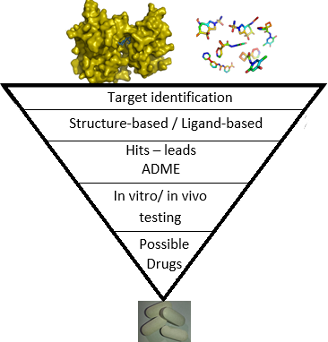
- , agonists, inhibitors, etc. of a target) design. Molecular dynamics (MD) simulations are frequently used in SBDD to give insights into not only how ligands bind with target proteins but also the pathways of interaction and to account for target flexibility. This is especially important when drug targets are
- AMBER [120] (Assisted Model Building and Energy Refinement) which have been built mainly for molecular dynamics simulations. The molecular docking program DOCK [121] uses force-field based scoring functions derived from molecular dynamics force-field AMBER. Empirical scoring functions Empirical scoring
- , these fragments can be joined to obtain a possible new drug molecule. In the SILCS (site identification by ligand competitive saturation) method, molecular dynamics simulations are used to identify fragments that bind to a target [161][162]. SILCS uses explicit molecular dynamics simulations where the



Interactions between cyclodextrins and cellular components: Towards greener medical applications?
Beilstein J. Org. Chem. 2016, 12, 2644–2662, doi:10.3762/bjoc.12.261
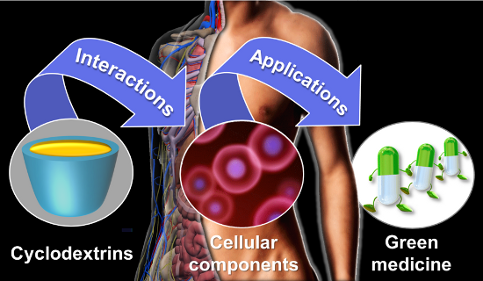
- cells. Unfortunately, only few papers have studied the dynamics of this process on cells. For instance, the kinetics of cholesterol efflux have been examined in different cell lines such as fibroblasts [117], human erythrocytes [122], rat cerebellar neurons [123], differentiated human neurons and


Experimental and theoretical investigations into the stability of cyclic aminals
Beilstein J. Org. Chem. 2016, 12, 2280–2292, doi:10.3762/bjoc.12.221
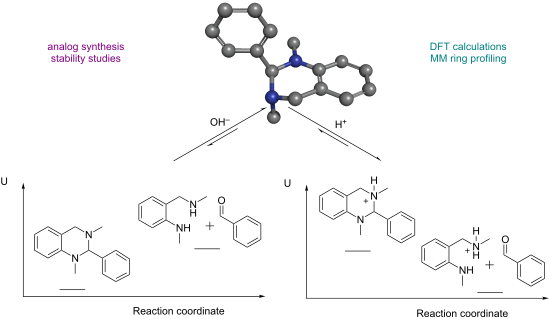
- Doctoral Program “Receptor Dynamics”.





Experimental and theoretical insights in the alkene–arene intramolecular π-stacking interaction
Beilstein J. Org. Chem. 2016, 12, 1616–1623, doi:10.3762/bjoc.12.158
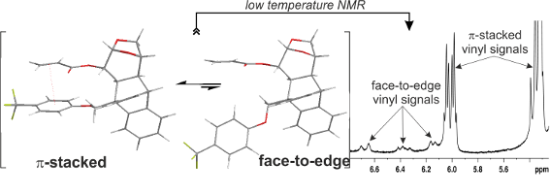
- conformational dynamics, we further carried out a detailed computational study at the M06-2X level of theory [22] for the three acrylates 6a–c. This meta-GGA functional, developed by Truhlar [23] has been shown to be one of the approaches of choice to model noncovalent interactions [9]. After a complete
- -stacking interactions. To the best of our knowledge this is the first report that provides experimental and computational evidences to understand the effect of such intramolecular interactions in the conformational dynamics of the system. This equilibrium, that involves a fast s-cis/s-trans exchange and a




Synthesis and fluorosolvatochromism of 3-arylnaphtho[1,2-b]quinolizinium derivatives
Beilstein J. Org. Chem. 2016, 12, 854–862, doi:10.3762/bjoc.12.84
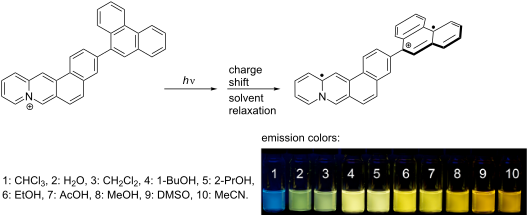
- -methylquinolinium have a strong emphasis on the dynamics and the charge separation in the excited state. Therefore, the work presented here may initiate investigations along these lines to further understand and fully explore the useful solvatochromic properties of this class of compounds. Conclusion In summary, we


Antibiotics from predatory bacteria
Beilstein J. Org. Chem. 2016, 12, 594–607, doi:10.3762/bjoc.12.58
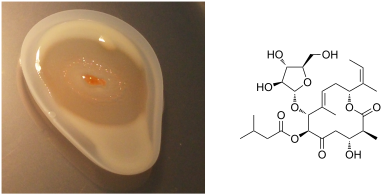
- is among the ecological forces, which drive the diversity and dynamics of microbial consortia [1][2][3]. While protozoa and nematodes are widely known as bacterivores [4][5], the existence of predatory prokaryotes is often neglected despite the abundance of the latter and their early occurrence in




Dynamic behavior of rearranging carbocations – implications for terpene biosynthesis
Beilstein J. Org. Chem. 2016, 12, 377–390, doi:10.3762/bjoc.12.41
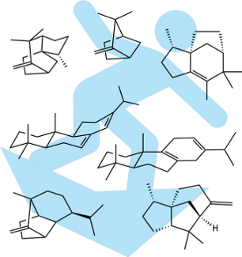
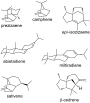
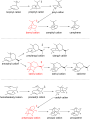
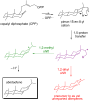
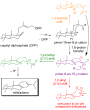
- transformations. Cautions for analyzing both experimental and theoretical data on carbocation rearrangements are included throughout. Keywords: carbocation; density functional theory; dynamics; mechanism; terpene; Review Introduction to terpene forming carbocation rearrangements Terpene natural products display
- [31][32][33][34]. To acquire evidence for non-statistical dynamic effects, molecular dynamics (MD) simulations are run for a statistically relevant number of trajectories (typically on the order of hundreds or thousands, depending on the system and the starting point for trajectories) [35][36]. The
- most common modern technique for computing dynamics trajectories for organic reactions is the method of direct dynamics. With direct dynamics, instead of solving for a PES analytically, each point along a trajectory is calculated numerically “as needed” or “on-the-fly”. A quantum chemical program



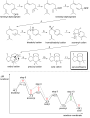
Art, auto-mechanics, and supramolecular chemistry. A merging of hobbies and career
Beilstein J. Org. Chem. 2016, 12, 362–376, doi:10.3762/bjoc.12.40
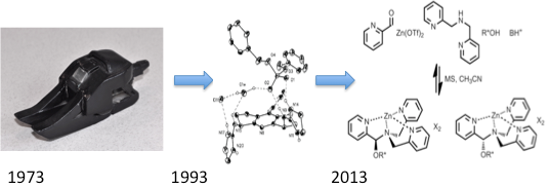
- medical school, research was one of my pursuits from freshman year throughout my undergraduate career. The project entailed the use of variable-temperature NMR to measure the dynamics of ligand migration in trimetallic osmium clusters [22][23]. Dr. Rosenberg was an inspirational figure, and his pursuit





Aggregation behavior of amphiphilic cyclodextrins in a nonpolar solvent: evidence of large-scale structures by atomistic molecular dynamics simulations and solution studies
Beilstein J. Org. Chem. 2016, 12, 73–80, doi:10.3762/bjoc.12.8
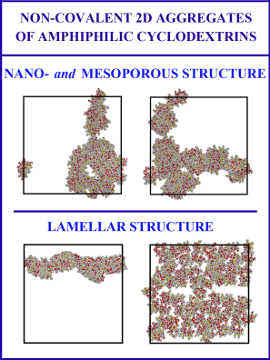
- have been usually investigated and characterized in water for their potential use as nanocarriers for drug delivery, but they can also aggregate in apolar solvents, as shown in the present paper through atomistic molecular dynamics simulations and dynamic light scattering measurements. The simulations
- nanoaggregates even in apolar solvents. Keywords: aggregation; amphiphilic cyclodextrins; molecular dynamics; nanoparticles; self-assembly; simulations; Introduction Amphiphilic cyclodextrins (aCD) are a class of molecules highly investigated for their self-assembly properties and inherent potential
- shown in Scheme 1b (n = 1), dissolved in an apolar solvent and an atomistic Molecular Dynamics study of a model compound (n = 0 in Scheme 1) carried out in vacuo. In particular, the latter approach aims to model the bottom-up aggregation of the model aCD molecules, an approach that was started in [11



Determination of formation constants and structural characterization of cyclodextrin inclusion complexes with two phenolic isomers: carvacrol and thymol
Beilstein J. Org. Chem. 2016, 12, 29–42, doi:10.3762/bjoc.12.5
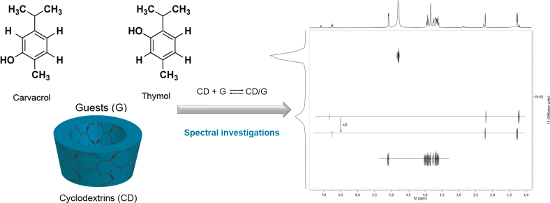
- the 2D DOSY spectra was processed by means of the Bruker Dynamics Center software (version 2.1.9). The diffusion constants were calculated by exponential fitting of the data belonging to individual columns of the 2D matrix. The software gave the mean value of the diffusion coefficient. The Kf values




Polydisperse methyl β-cyclodextrin–epichlorohydrin polymers: variable contact time 13C CP-MAS solid-state NMR characterization
Beilstein J. Org. Chem. 2015, 11, 2785–2794, doi:10.3762/bjoc.11.299
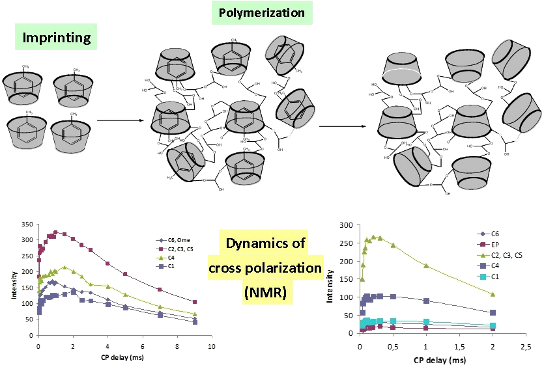
- recognition sites for the template molecule. As a matter of fact, high-resolution solid-state NMR is a powerful tool to characterize the structure of polymers [23][24] and to study their dynamics [25][26]. Crini has reported previously a solid-state NMR spectroscopy study [27][28] of β-cyclodextrin polymers
- different amounts of imprinting agent, as in the present case. We herein propose an approach based on solid-state 13C NMR techniques such as variable contact time cross-polarization magic angle spinning with dipolar decoupling (VCP-MAS) to describe these new materials. The dynamics of cross-polarization can
- of the two experimental spectra reveals that no chemical shift variations are observed. Consequently, no relevant structural modification occurs on the β-CD moiety during the polymerization process. Dynamics of cross polarization – theoretical description Important features of the dynamic behavior of




Physical properties and biological activities of hesperetin and naringenin in complex with methylated β-cyclodextrin
Beilstein J. Org. Chem. 2015, 11, 2763–2773, doi:10.3762/bjoc.11.297
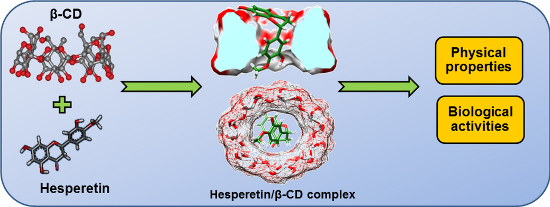
- hesperetin with cyclodextrins (β-CD and DM-β-CD) were theoretically investigated by molecular dynamics simulation. The free energy values obtained suggested a more stable inclusion complex with DM-β-CD. The vdW force is the main guest–host interaction when hesperetin binds with CDs. The phase solubility
- physical properties and biological activities of hesperetin and naringenin through complexation with cyclodextrins. Computational tools (molecular dynamics simulation) were adopted to first predict the stability of flavanones/CDs inclusion complexes. Consequently, the experimental phase solubility and
- values showed the same trend with values from molecular dynamics simulation that complexing with DM-β-CD was more effective than with β-CD, and the values obtained were in good agreement with the previous report [42]. These results suggested that both flavanones bind to and interact with DM-β-CD stronger


Smart molecules for imaging, sensing and health (SMITH)
Beilstein J. Org. Chem. 2015, 11, 2540–2548, doi:10.3762/bjoc.11.274
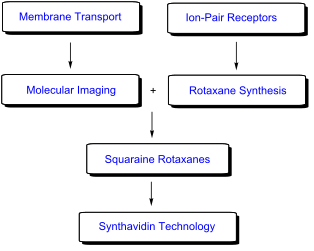
- was vital for efficient rotaxane formation. The interlocked molecule retained its salt binding ability and association of the ions modulated the rotaxane structural dynamics [33][34]. Squaraine rotaxanes The interests in molecular imaging and rotaxane structures merged in 2005 with the discovery and


Aggregation behaviour of amphiphilic cyclodextrins: the nucleation stage by atomistic molecular dynamics simulations
Beilstein J. Org. Chem. 2015, 11, 2459–2473, doi:10.3762/bjoc.11.267
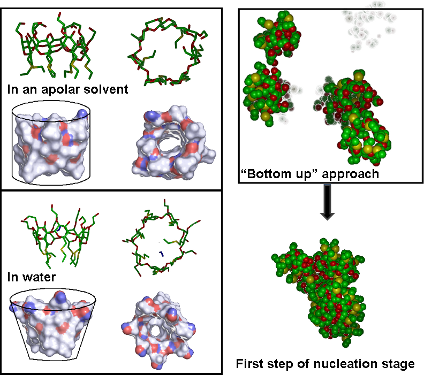
- report a theoretical study of the aggregation of a few amphiphilic cyclodextrins carrying hydrophobic thioalkyl groups and hydrophilic ethylene glycol moieties at opposite rims, focusing on the initial nucleation stage in an apolar solvent and in water. The study is based on atomistic molecular dynamics
- correlating their structures with the pharmaceutical properties. Keywords: aggregation; amphiphilic cyclodextrins; micelles; molecular dynamics simulations; nanoparticles; self-assembly; Introduction Inclusion complexes with supramolecular structures formed by native or modified cyclodextrins (CDs) are
- supramolecular aggregates was seldom, if ever, considered, apart from the above-mentioned reference [35]. To improve our understanding of the factors driving the formation of aCD molecular assemblies, we describe in this paper an atomistic molecular dynamics investigation of a model compound of a non-ionic aCD


Co-solvation effect on the binding mode of the α-mangostin/β-cyclodextrin inclusion complex
Beilstein J. Org. Chem. 2015, 11, 2306–2317, doi:10.3762/bjoc.11.251
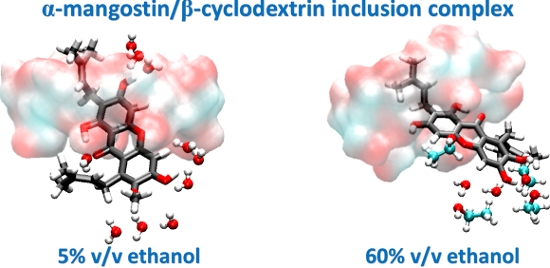
- anion affinity and selectivity of a neutral anion receptor, bis(cyclopeptide) [17]. Molecular dynamics (MD) simulations can give important insights into the energetics of structural interactions. The hydrated structure of β-CD in aqueous solution [18] and those showing host–guest interactions between
- given in Table 1. Details of molecular dynamics simulations In the present study, all MD simulations were performed using the SANDER module of the Amber10 software package in accordance with the recently reported MD simulations of flavonoid/β-CD inclusion complexes in water [34][35]. The particle-mesh
- then heated to 300 K within the 500 steps of relaxation time using the Canonical Ensemble (NVT) algorithm at constant volume up to 1 g/mL of water density. Finally, the MD simulations were performed at 1 atm and 300 K for 20 ns. The structural dynamics over simulation time were monitored by root mean



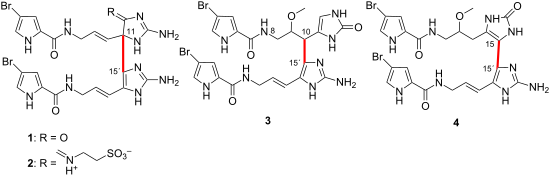
The marine sponge Agelas citrina as a source of the new pyrrole–imidazole alkaloids citrinamines A–D and N-methylagelongine
Beilstein J. Org. Chem. 2015, 11, 2029–2037, doi:10.3762/bjoc.11.220
- Museum, University of Amsterdam (The Netherlands). Sponge identification was kindly conducted by W. H. de Weerdt and Dr. R. W. M. van Soest, Institute for Biodiversity and Ecosystem Dynamics, Zoölogical Museum, University of Amsterdam, The Netherlands (new address of RWMvS: Netherlands Centre for


Asymmetric 1,4-bis(ethynyl)bicyclo[2.2.2]octane rotators via monocarbinol functionalization. Ready access to polyrotors
Beilstein J. Org. Chem. 2015, 11, 1881–1885, doi:10.3762/bjoc.11.202
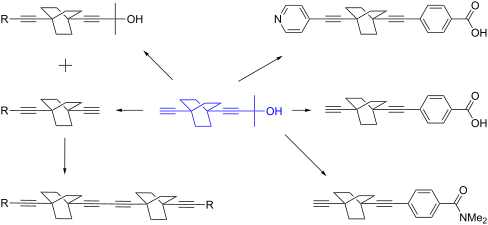
- )bicyclo[2.2.2]octane rotators. The good yields allow the large amounts required for self-assembly and subsequent investigations of the dynamics of the rotors in the solid state to be readily prepare. The chemistry, physical chemistry and materials chemistry and physics of asymmetric rotors and their




A comprehensive study of olefin metathesis catalyzed by Ru-based catalysts
Beilstein J. Org. Chem. 2015, 11, 1767–1780, doi:10.3762/bjoc.11.192
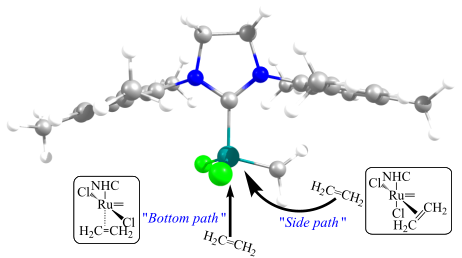
- bond of C2H4 is nearly perpendicular to the Ru–methylidene bond, whereas in the bigger substrate the tether forces the coordinated C=C bond to be almost aligned with the Ru–alkylidene bond. However, the molecular dynamics simulations (vide infra) clearly indicate that in the trans geometries the C2H4




Donor–acceptor type co-crystals of arylthio-substituted tetrathiafulvalenes and fullerenes
Beilstein J. Org. Chem. 2015, 11, 1043–1051, doi:10.3762/bjoc.11.117
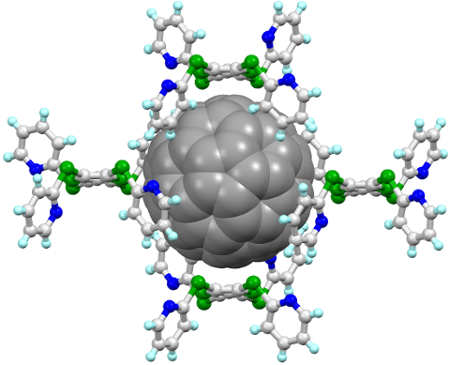
- thought to be the cooperative consequence of the molecular geometry of Ar-S-TTF, the shape and size of the fullerene molecule, the solvent adduct, and the crystallization dynamics. The donor–acceptor interaction mode and the packing motif of the fullerenes largely depend on the composition of the co


Peptide–polymer ligands for a tandem WW-domain, an adaptive multivalent protein–protein interaction: lessons on the thermodynamic fitness of flexible ligands
Beilstein J. Org. Chem. 2015, 11, 837–847, doi:10.3762/bjoc.11.93
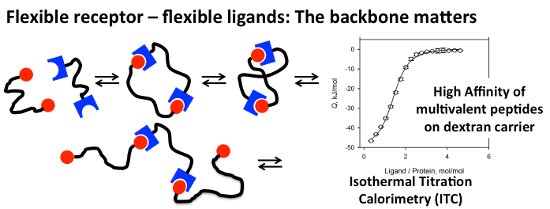
- precipitation. Experimental results were compared with parameters obtained from molecular dynamics simulations in order to understand the observed differences between the three carrier materials. In summary, the more rigid and condensed peptide–polymer conjugates based on the dextran scaffold seem to be
- understanding of structure–activity relationships of polymeric ligands. For this purpose, the thermodynamics and the stoichiometry of protein binding events were determined experimentally for all multivalent ligands. Finally, atomistic molecular dynamics simulations were conducted in order to rationalize the
- bivalent binding mode for the complex of Dex-2 and tandem-WW-FBP21, which is supported also by the solubility of the non-crosslinked peptide-polymer–protein complex. Molecular dynamics simulations of multivalent ligands In order to better understand our experimental observations regarding binding