


Search results
Search for "epoxides" in Full Text gives 169 result(s) in Beilstein Journal of Organic Chemistry.
Carbasugar analogues of galactofuranosides: α-O-linked derivatives
Beilstein J. Org. Chem. 2010, 6, 1127–1131, doi:10.3762/bjoc.6.129

- electron-withdrawing group, the C3 benzyl ether. Ogawa has extensively used epoxide-opening reactions as a coupling method to access N- and O-linked pseudodisaccharides based on carbapyranoses [10]. The epoxides were opened by amines in uncatalysed reactions, or by alcohols under Lewis acidic, but more
- , which must rearrange to give the diequatorial product. As the skew-boat is a higher energy conformation, this situation is disfavoured from a stereoelectronic point of view. Carbapyranose 1,2-epoxides with the β-manno configuration 2 (Figure 1) were opened efficiently with attack at C1 (sterically and
- major factor in explaining the generally low reactivity of carbohydrates (at non-anomeric positions) in SN2 reactions. Carbapyranose 1,2-epoxides with α-gluco 3 and α-galacto configurations did not give such good results. With amine nucleophiles, attack was often unregioselective [15]: attack at C1


Kinetics and mechanism of vanadium catalysed asymmetric cyanohydrin synthesis in propylene carbonate
Beilstein J. Org. Chem. 2010, 6, 1043–1055, doi:10.3762/bjoc.6.119
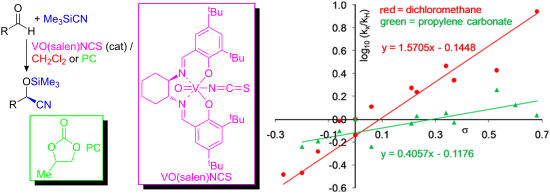
- prepared by a 100% atom economical reaction between epoxides and CO2 (Scheme 2) [65]. The green credentials of propylene carbonate are enhanced by the commercialization of a low temperature synthesis of propylene oxide from propene and hydrogen peroxide [66][67][68][69][70], by the development of a greener
- synthesis of hydrogen peroxide [71], and by the combination of these processes into a one-pot synthesis of propylene oxide from propene, hydrogen and oxygen [72][73]. In addition, it has been shown that in the presence of an appropriate catalyst, the reaction between epoxides and carbon dioxide can be






α,β-Aziridinylphosphonates by lithium amide-induced phosphonyl migration from nitrogen to carbon in terminal aziridines
Beilstein J. Org. Chem. 2010, 6, 978–983, doi:10.3762/bjoc.6.110

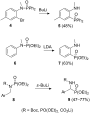
- ) and suggests that 5 equiv of the base may not always be needed to effect efficient rearrangement. Asymmetric access to an aziridinylphosphonate was also explored to demonstrate further the utility of the above methodology. As terminal epoxides are readily available as single enantiomers [37], terminal




Diastereoselective functionalisation of benzo-annulated bicyclic sultams: Application for the synthesis of cis-2,4-diarylpyrrolidines
Beilstein J. Org. Chem. 2009, 5, No. 69, doi:10.3762/bjoc.5.69
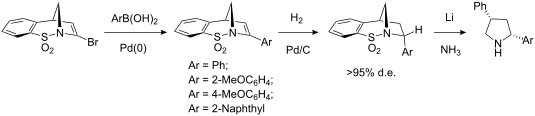
- [16][17]. Unfortunately, however, under a variety of conditions it proved impossible to elaborate these species. For example, reductive ring-opening using triethylsilane, conditions previously reported for N-sulfonylamino-α,β-epoxides [18][19], led only to recovery of starting material and not the


Three step synthesis of single diastereoisomers of the vicinal trifluoro motif
Beilstein J. Org. Chem. 2009, 5, No. 61, doi:10.3762/bjoc.5.61
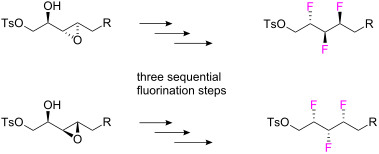
- manner. Conversion of the free hydroxyl group to fluorine would generate α-fluoro-epoxides B. Epoxide ring opening with an HF source could then provide difluoroalcohols C. Insertion of the third fluorine would reasonably be achieved by fluorination of the free hydroxyl group of C to generate D. Such a
- reactions following Sharpless’ methodology [16]. The anti-epoxy alcohols were easily generated, however it proved more difficult to prepare the syn-epoxides cleanly. Treatment with titanium isopropoxide (Ti(OiPr)4) and D-diisopropyl tartrate (D-DIPT) favoured formation of the anti-α,β-epoxy alcohols. In the
- and relative stereochemistry of the crystalline threo-isomer (2R,3S,4S)-7a was confirmed by X-ray structure analysis as shown in Figure 2. With a strategy to access both stereoisomeric series of the allylic alcohol epoxides A in place, the fluorination reactions were then explored. The fluorination of


The development and evaluation of a continuous flow process for the lipase- mediated oxidation of alkenes
Beilstein J. Org. Chem. 2009, 5, No. 27, doi:10.3762/bjoc.5.27
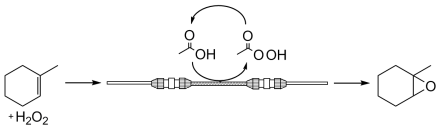
- ; hydrogen peroxide; lipase; micro reactor; Novozym® 435; peracids; Introduction In addition to their synthetic value as intermediates in the preparation of diols, alcohols, hydroxyesters and alkenes, epoxides are a key raw material in many industrial processes, finding application in adhesives, polymers
- , coatings and paints [1][2], with some epoxides even exhibiting biological activity [3][4]. As such, over the years, convenient and efficient techniques have been sought for their preparation. Within the research laboratory, epoxidation of alkenes is achieved using organic peroxides and metal catalysts [5
- ] or peracids [6] such as m-chloroperbenzoic acid (m-CPBA) [7][8]. The hazardous nature of these techniques and the potential to hydrolyse the epoxide [9] however precludes their use on a large scale. Many of the epoxides produced industrially are synthesised using the chlorohydrin method, or via in




Recent progress on the total synthesis of acetogenins from Annonaceae
Beilstein J. Org. Chem. 2008, 4, No. 48, doi:10.3762/bjoc.4.48
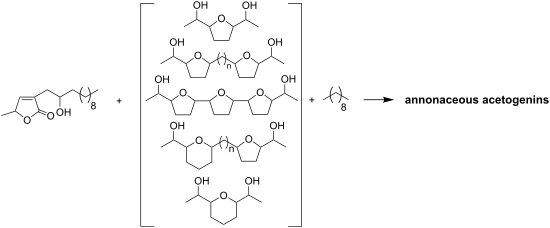
- , ketones, epoxides, tetrahydrofurans (THF) and tetrahydropyrans (THP), may be present, as well as double and triple bonds. Thus several types of ACGs have been characterised, based on the nature of the functional groups which are present. These including mono-THF, adjacent bis-THF, nonadjacent bis-THF, tri
- two different procedures afforded isomeric epoxides 17 and 18, respectively. Coupling between the lithium salt of 13 and 17 (or 18) followed by hydrogenation, oxidation and deprotection afforded (8′S)- or (8′R)-8a. Comparison of the mp, [α]D, IR and NMR data of both synthetic materials with those
- 21 and oxidative cleavage of the resulting diol, the resultant aldehyde was treated with chiral allenylboronic ester to afford 22. The terminal epoxides 24 and 26 were prepared from the same intermediate 23. Coupling of 22 with 24 (or 26) in the same manner followed by hydrogenation and removal of


Mechanistic aspects of the isomerization of Z-vinylic tellurides double bonds in the synthesis of potassium Z-vinyltrifluoroborate salts
Beilstein J. Org. Chem. 2008, 4, No. 9, doi:10.1186/1860-5397-4-9
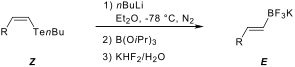
- organometallic species obtained in this way can also react with carbonyl compounds, α,β-unsaturated systems, or epoxides [9][10][11] with complete retention of the double-bond stereochemistry. Taking advantage of the regio- and stereocontrol of the preparation of Z-vinylic tellurides [12], and of the unique


Part 3. Triethylborane- air: a suitable initiator for intermolecular radical additions of S-2-oxoalkyl- thionocarbonates (S-xanthates) to olefins
Beilstein J. Org. Chem. 2007, 3, No. 47, doi:10.1186/1860-5397-3-47

- additions of various S-alkylxanthates to vinyl epoxides and related derivatives using an excess of triethylborane (2 equiv vs xanthate) at room temperature. The mechanism is different from that reported in this note as the radical chain is maintained by the ring opening of the oxirane that produces an



The enantiospecific synthesis of (+)-monomorine I using a 5-endo- trig cyclisation strategy
Beilstein J. Org. Chem. 2007, 3, No. 39, doi:10.1186/1860-5397-3-39
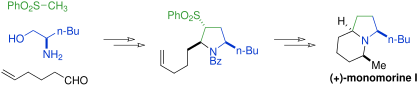
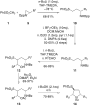
- mode of cyclisation. [1][2][3][4][5][6] The methodology allows the conversion of epoxides (X = O) or aziridines (X = N-PG) (2) into the desired trisubstituted tetrahydrofurans or pyrrolidines (5) via a series of sulfone-mediated transformations (Scheme 1). Ring-opening 2 with the sulfone-stabilised




An asymmetric synthesis of all stereoisomers of piclavines A1-4 using an iterative asymmetric dihydroxylation
Beilstein J. Org. Chem. 2007, 3, No. 37, doi:10.1186/1860-5397-3-37
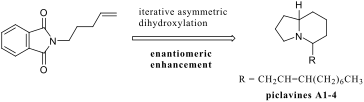
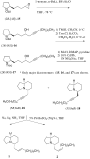
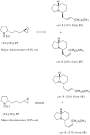
- stereoisomers of the epoxides 15[9] derived from 11 according to our reported procedure as synthetic intermediates. Regioselective cleavage of the epoxide (2R-[4S])-15 rings with lithium acetylide generated from 1-nonyne with n-butyl lithium in combination with BF3-Et2O[10] gave the secondary alcohols (2R-[4S



Allylsilanes in the synthesis of three to seven membered rings: the silylcuprate strategy
Beilstein J. Org. Chem. 2007, 3, No. 16, doi:10.1186/1860-5397-3-16
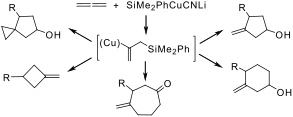
- -vinylcuprate species toward electrophiles increases their synthetic potential (Scheme 1). [7][8] A large number of electrophiles (alkyl and allyl halides, epoxides, ketones, α,β-unsaturated oxo compounds and acid chlorides, unsaturated nitriles and imines) have been successfully used in this reaction, leading
- the synthesis of spiro[2][5]octanes, an structural moiety of interest in the synthesis of natural products. Alcohols as 40 containing an allylsilane unit, which can be readily obtained by reaction of epoxides with the silylcuprate 2, are excellent synthons for cyclobutane ring-formation. Formation of
- . Intramolecular cyclization of TMS-epoxyallylsilanes. Spiro-cyclopropanation from oxoallylsilanes. Cyclobutane formation from hydroxy-functionalized allysilanes. Cyclobutene formation from vinyltin cuprates and epoxides. Silylcupration of 1,2-propadiene and reaction with α,β-unsaturated nitriles. Cycloheptane




Photosonochemical catalytic ring opening of α-epoxyketones
Beilstein J. Org. Chem. 2007, 3, No. 2, doi:10.1186/1860-5397-3-2
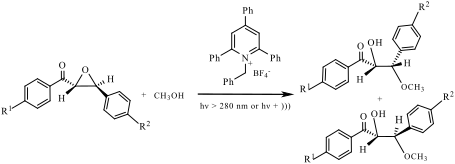
- the corresponding γ-lactone. [19] In our recent study, we have used 1-benzyl-2,4,6-triphenylpyridinium tetrafluoroborate (NBTPT) as photocatalyst in a highly diastereoselective ring opening of α-epoxyketones in acetone solution with the formation of 1.3-dioxolanes. [20] Ring opening of epoxides and α
- only in thermal but also in photochemical transformations. Single electron transfer (SET) induced ring opening reactions of epoxides and α-epoxyketones have demonstrated C-C and C-O bond cleavages through photo-induced electron transfer by various electron donors such as triethylamine (TEA), [21
- ] tribenzylamine (TBA) [20] and 1,3-dimethyl-2-phenylbenzimidazoline (DMPBI) [22][23][24] or thermally induced single electron transfer by electron donating compounds such as samarium diiodide, [25] tributyltin hydride [26] and bis(cyclopentadienyl)titanium(III) chloride. [27] Ring opening reactions of epoxides




The vicinal difluoro motif: The synthesis and conformation of erythro- and threo- diastereoisomers of 1,2-difluorodiphenylethanes, 2,3-difluorosuccinic acids and their derivatives
Beilstein J. Org. Chem. 2006, 2, No. 19, doi:10.1186/1860-5397-2-19
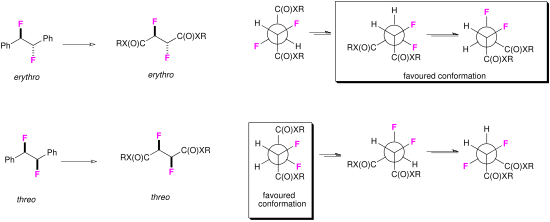
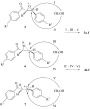
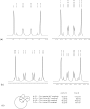
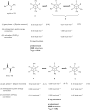
- manner, using either cis- or trans- epoxides 3 obtained directly from either the Z- or the E- alkenes. (Scheme 2). Ring opening of the epoxides 3 with HF-amine reagents generate the corresponding threo- and erythro- fluorohydrins 4 in largely a stereoselective manner. The resulting fluorohydrins 4 can




Hydrogenation of aromatic ketones, aldehydes, and epoxides with hydrogen and Pd(0)EnCat™ 30NP
Beilstein J. Org. Chem. 2006, 2, No. 15, doi:10.1186/1860-5397-2-15
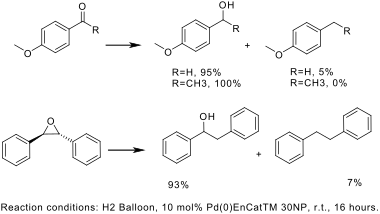
- well as aromatic epoxides are selectively reduced to the corresponding alcohols under mild conditions using conventional hydrogen in the presence of Pd(0)EnCat™ 30NP catalyst. The reactions were performed at room temperature during 16 hours with high to excellent conversions of the corresponding
- University described the selective reduction of electron deficient and neutral aryl ketones to benzylic alcohols using Pd(0)EnCat™ 30NP as catalyst and a mixture of HCOOH/Et3N as the source of hydrogen [16]. Under these conditions they also achieved the chemoselective hydrogenolysis of aryl epoxides [17
- ]. For these kind of substrates, catalysts based on Ni, Pd, and Pt have been used, and further efforts are directed toward improving the chemoselectivity and regioselectivity of this ring-opening reaction. [18][19] We now demonstrate that aryl aldehydes and ketones as well as aryl epoxides can also

The oxanorbornene approach to 3-hydroxy, 3,4-dihydroxy and 3,4,5-trihydroxy derivatives of 2-aminocyclohexanecarboxylic acid
Beilstein J. Org. Chem. 2006, 2, No. 9, doi:10.1186/1860-5397-2-9

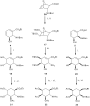
- carbamates we then sort to exploit the alkene units to provide a convenient source of poly-hydroxylated cyclohexane β-aminoacids. Consequently, treatment of endo derived hydroxy diene with mCPBA in DCM afforded a separable 9:1 mixture of epoxides 10 and 11 favouring addition syn to the carbamate, Scheme 3
- , palladium mediated reactions of vinyl epoxides are known to proceed with allylic cleavage.[24] Subsequent addition of hydrogen to the intermediate π-allyl palladium complex would provide the desired 4-hydroxy-ACHC derivative. In agreement with this analysis, reaction of the epoxides with hydrogen in the
- afforded the trans β-amino acid derivative 22 as established by NMR experiments. Having prepared the 4,5-cis diol, we turned our attention to the synthesis of the corresponding trans diols. These could be prepared by simple hydrolytic cleavage of epoxides 10–13. In line with this plan, treatment of 12 with




Synthesis of phosphorothioates using thiophosphate salts
Beilstein J. Org. Chem. 2006, 2, No. 4, doi:10.1186/1860-5397-2-4

- of ammonium acetate/sulfur/acidic alumina under solvent-free conditions using microwave irradiation. [49] This reagent can be used as an efficient reagent for the conversion of epoxides to thiiranes. This ambident nucleophile has two potentially attacking atoms (S or O) and can attack with either of


Synthesis and glycosidase inhibitory activity of new hexa- substituted C8-glycomimetics
Beilstein J. Org. Chem. 2005, 1, No. 12, doi:10.1186/1860-5397-1-12

- particular case, due to the hindered conformation of such epoxides as demonstrated by X-ray cristallographic analysis. Conclusion The biological activity of the synthesized glycomimetics has been evaluated towards 24 commercially available glycosidases. The weak observed activities can probably be related to
- epoxidation [35] of the cyclooctenes 1 and 2 (Scheme 2). Thus, treatment of 1 and 2 with meta-chloroperbenzoic acid in the presence of sodium hydrogen carbonate afforded the epoxides 7 and 8 in 91–96% yield. As precedently, because of the C2-axis of symmetry displayed by the L-ido or D-manno-cyclooctenes 1




Reagent controlled addition of chiral sulfur ylides to chiral aldehydes
Beilstein J. Org. Chem. 2005, 1, No. 4, doi:10.1186/1860-5397-1-4
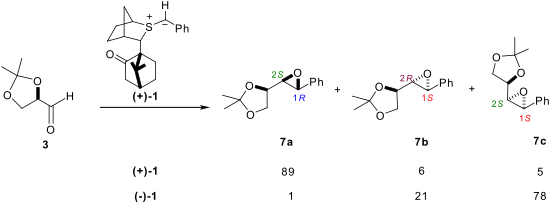
- (dimethylamino)-phosphoranylidene]-phosphoric triamide ethylimine,) [4][5] (sulfur ylide 4) was initially investigated to establish the degree of substrate control. This furnished a mixture of 3 epoxides 7a, 7b, and 7c in a 37:14:49 ratio (Table 1, entry 1). The cis and trans isomers are easily distinguished by
- k9 and k11) was very similar and that the ratio of epoxides obtained was therefore governed by the rates of betaine formation (k1 and k3) which again is determined by the degree of Felkin-Anh/Cornforth control by the substrate (Scheme 5). These experiments showed that in the absence of reagent





