Search results
Search for "CO" in Full Text gives 1872 result(s) in Beilstein Journal of Organic Chemistry. Showing first 200.
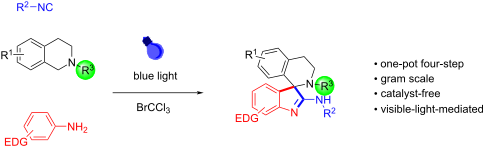
Synthesis of spiroindolenines through a one-pot multistep process mediated by visible light
Beilstein J. Org. Chem. 2024, 20, 2722–2731, doi:10.3762/bjoc.20.230
- optimized reaction conditions, we observed good conversion of the starting material, but the desired compound was isolated in very poor yield, as the α-aminoamide 4a resulted the main product (Table 1, entry 1). We were surprised about that, as, even if water is present as co-solvent in the reaction mixture





5th International Symposium on Synthesis and Catalysis (ISySyCat2023)
Beilstein J. Org. Chem. 2024, 20, 2704–2707, doi:10.3762/bjoc.20.227
- intramolecular aminocarbonylation using Mo(CO)6. Both catalytic approaches successfully produced the desired DBDAPs. As previously mentioned, organic synthesis is a crucial tool for preparing complex molecules of high value to industry. Frackenpohl et al. [13] designed and synthesized a new library of 2,3

Applications of microscopy and small angle scattering techniques for the characterisation of supramolecular gels
Beilstein J. Org. Chem. 2024, 20, 2608–2634, doi:10.3762/bjoc.20.220

- use of fluorescence probes should be used in tandem with CLSM. For example, Raeburn et al. showed that the addition of molecular rotors and fluorescent dyes affects the bulk network of self-assembled materials using rheology. The co-packing was observed to alter rheological properties of the materials
- arising, for example, from differences in the rate of fibre growth and entanglements. The change in rheological properties when comparing the material and its co-assembly with the probe shows that addition of such probes may lead to measurements which do not truly represent the system of interest [19
- ]. The work by Alakpa et al. highlights how important it is to consider how one assesses the impact of co-assembly on a molecular system [20]. AFM suggested that the addition of the surfactant-like Fmoc-serine (Fmoc-S) to the fibrous Fmoc-diphenylalanine (Fmoc-FF) did not impact the structure of the Fmoc


Efficient modification of peroxydisulfate oxidation reactions of nitrogen-containing heterocycles 6-methyluracil and pyridine
Beilstein J. Org. Chem. 2024, 20, 2599–2607, doi:10.3762/bjoc.20.219
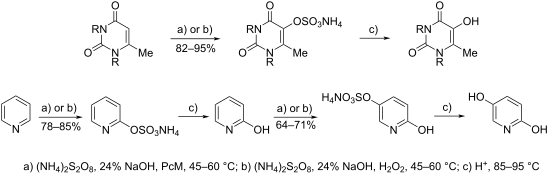
- in two different ways: with metallophthalocyanine catalysts present and by including hydrogen peroxide as a co-oxidant (Scheme 1). Metal–phthalocyanine complexes (PcM) are recognized as catalysts for gentle, particular oxidation reactions under aerobic [14] and H2O2-based conditions [15][16][17][18
- − ion, which is formed by the non-radical decomposition of the peroxydisulfate ion in a strongly alkaline medium [34]: The Elbs and Boyland–Sims reactions were also effectively modified by the use of H2O2 as a co-oxidant (binary oxidation mixture APS/H2O2). Adding 2.0–2.3 equiv of H2O2 (Table 3) [35
- LLC, Russia), chloroform (reagent grade, JSC Khimreaktivsnab, Russia) and ethyl alcohol (reagent grade, LLC TD Khimmed, Russia) were used in this work. The phthalocyanine catalysts (Co, FeII, FeIII, Mn, Ni, and Zn phthalocyanines) were synthesized according to the known procedure [44] from


Anion-dependent ion-pairing assemblies of triazatriangulenium cation that interferes with stacking structures
Beilstein J. Org. Chem. 2024, 20, 2567–2576, doi:10.3762/bjoc.20.215
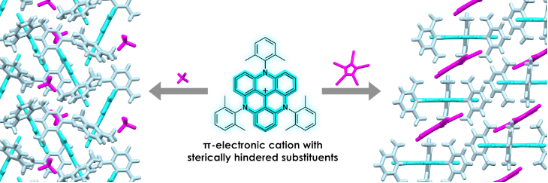
- are the interactions between charged (ionic) π-systems, with interesting electronic properties like electric conductivities. Experimental General procedures Starting materials were purchased from FUJIFILM Wako Pure Chemical Corp., Nacalai Tesque Inc., and Sigma-Aldrich Co. and were used without



A review of recent advances in electrochemical and photoelectrochemical late-stage functionalization classified by anodic oxidation, cathodic reduction, and paired electrolysis
Beilstein J. Org. Chem. 2024, 20, 2500–2566, doi:10.3762/bjoc.20.214
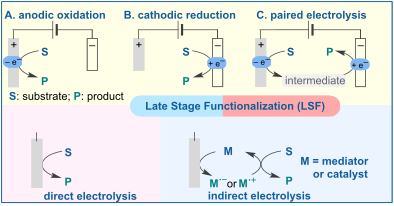
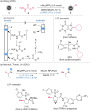
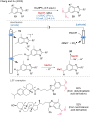
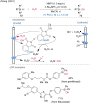
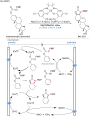
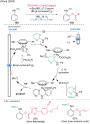
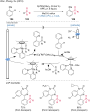
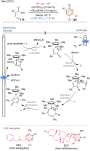
- benzylic position (Scheme 31). 1.3.2 Co-assisted anodic oxidation. In 2021, Xu and colleagues developed an electrocatalytic approach for the intramolecular oxidative allylic amination and C–H alkylation using cobalt–salen complexes as catalysts [43]. In this reaction, the cobalt catalyst [Co(II)] is first
- oxidized to [Co(III)]+ at the anode, while MeOH undergoes cathodic reduction to form MeO− and H2. The MeO− then deprotonates the carbamate, and the resulting conjugated base is oxidized by the cobalt–salen complex [Co(III)]+, generating an amide radical. This amide radical initiates radical cyclization to
- form a cyclic alkyl radical. The alkyl radical is further oxidized by [Co(III)] to produce the target amination product and a [Co(II)–H] species via direct hydrogen transfer or β-hydride elimination. Deprotonation of [Co(II)–H] by MeO− regenerates the [Co(I)] complex, which is subsequently oxidized


























Hypervalent iodine-mediated cyclization of bishomoallylamides to prolinols
Beilstein J. Org. Chem. 2024, 20, 2455–2460, doi:10.3762/bjoc.20.209
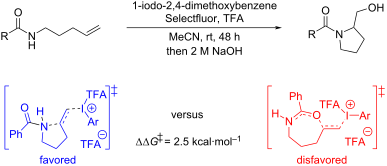
- yield (Scheme 1B). Notably, we are unaware of any reported method to achieve this specific transformation in the literature. Although, Tellitu and co-workers have reported a related preparation of indoline derivatives mediated by bis(trifluoroacetoxy)iodobenzene (PIFA) [17]. Results and Discussion In


Homogeneous continuous flow nitration of O-methylisouronium sulfate and its optimization by kinetic modeling
Beilstein J. Org. Chem. 2024, 20, 2408–2420, doi:10.3762/bjoc.20.205
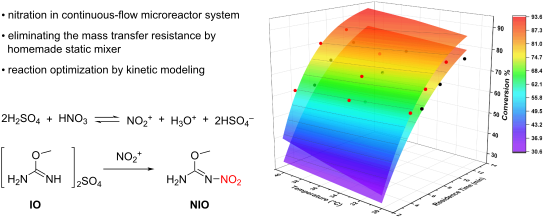
- serve as guidance for industrial production. Experimental Materials and methods Chemicals O-Methylisouronium sulfate (IO, 95%) was purchased from Shanghai Yien Chemical Technology Co., Ltd; fuming nitric acid (HNO3, 98.0%) was purchased from Sinopharm Chemical Reagent Co., Ltd.; sulfuric acid (H2SO4
- , 98.0%) was purchased from Sinopharm Chemical Reagent Co., Ltd.; pure water from AR, Hangzhou Wahaha Group Co., Ltd.; all reagents were used without further purification. Sulfuric acid solutions of different mass fractions were prepared with pure water and 98% concentrated sulfuric acid in an ice bath
- = 112 mL. Continuous flow microreactor system The continuous flow microreactor system is shown in Figure 1. Solutions A and B were stored in two glass vials (500 mL) with lids and were preheated by two high-pressure PTFE pumps (pump A, pump B, JJRZ-10004F, Hangzhou JingJin Technology Co., Ltd.) and


![[Graphic 1]](/bjoc/content/inline/1860-5397-20-205-i17.svg?max-width=637&scale=1.18182)


Evaluating the halogen bonding strength of a iodoloisoxazolium(III) salt
Beilstein J. Org. Chem. 2024, 20, 2401–2407, doi:10.3762/bjoc.20.204
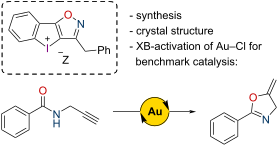
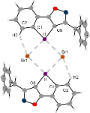
- ) Å, 84% of Σr, and C1–I1···Br1 = 176.08(9)°]. The bond distances indicate that the hydrogen bond is noticeably weaker than the two XBs and thus constitutes merely an assisting interaction. The XB interactions in this crystal structure were compared to the ones in the literature-known co-crystal of




Efficient one-step synthesis of diarylacetic acids by electrochemical direct carboxylation of diarylmethanol compounds in DMSO
Beilstein J. Org. Chem. 2024, 20, 2392–2400, doi:10.3762/bjoc.20.203
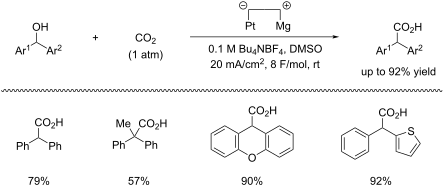
- constant-current electrolysis in DMF using an undivided cell equipped with a Pt cathode and a Mg anode in the presence of carbon dioxide. On the other hand, carboxylation scarcely took place in DMF when other benzyl alcohols were used as substrates. Lundberg and co-workers recently reported similar results


Asymmetric organocatalytic synthesis of chiral homoallylic amines
Beilstein J. Org. Chem. 2024, 20, 2349–2377, doi:10.3762/bjoc.20.201
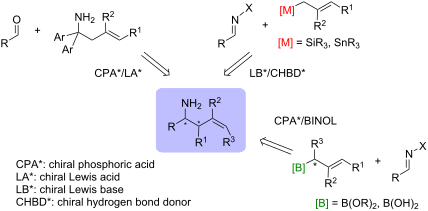
- essential to provide a comprehensive overview of this significant topic. Review Asymmetric allylation with boron-based reagents The research on the metal-free, asymmetric organocatalytic allylation of acylimines was pioneered in 2007 by Schaus and co-workers [24]. In their elegant approach, high
- Maraviroc, an HIV-1 drug of the CCR5-receptor antagonists class that was approved by the FDA in 2007. In 2013, a significant work was published by Hoveyda and co-workers [6], who demonstrated that small organic molecules like hindered aminophenol 11 can serve as highly efficient and versatile catalysts in
- for the resolution of chiral amines [28]. However, it was not until 2004 that they were recognised as efficient chiral Brønsted acid organocatalysts for asymmetric Mannich reactions [29]. Malkov and co-workers revealed [30] that (R)-TRIP can act as a very efficient catalyst for the kinetic resolution




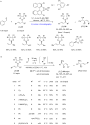


Improved deconvolution of natural products’ protein targets using diagnostic ions from chemical proteomics linkers
Beilstein J. Org. Chem. 2024, 20, 2323–2341, doi:10.3762/bjoc.20.199
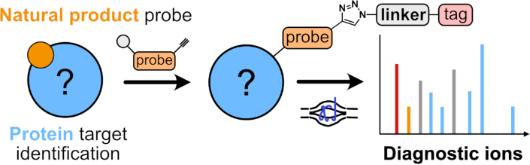
- (AS-MS), co-fractionation mass spectrometry (CF-MS), or mass spectrometry integrated with equilibrium dialysis for the discovery of allostery systematically (MIDAS) [38][39][40][41][42][43][44]. The chemical proteomics approach and related activity-based protein profiling has been reviewed


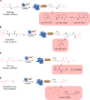
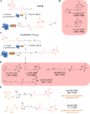


Catalysing (organo-)catalysis: Trends in the application of machine learning to enantioselective organocatalysis
Beilstein J. Org. Chem. 2024, 20, 2280–2304, doi:10.3762/bjoc.20.196
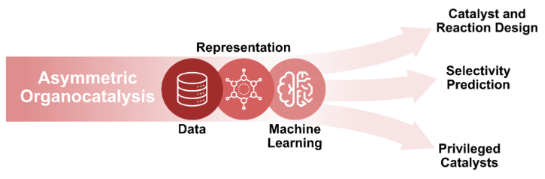
- Drawing inspiration from linear free energy relationships, MLR models, pioneered by Norrby and co-workers [83] and later further developed by Sigman and co-workers [69][82], are commonly used for the prediction of enantioselectivity. In such models, the substrates, catalysts, and other relevant reaction
- structure, it is important to include information from relevant conformers. To avoid losing important information from discarding conformers, Paton and co-workers [85] introduced wSterimol, which takes into account structures from the entire conformer ensemble via Boltzmann-weighting. The authors used their
- acrylates [95] and found a similar performance compared to NCI probe descriptors. Despite the success of this approach, it is important to remember that descriptors do not have to be parameters of one molecule and that intermolecular terms can be used to derive mechanistic hypotheses. Toste and co-workers


Deuterated reagents in multicomponent reactions to afford deuterium-labeled products
Beilstein J. Org. Chem. 2024, 20, 2270–2279, doi:10.3762/bjoc.20.195
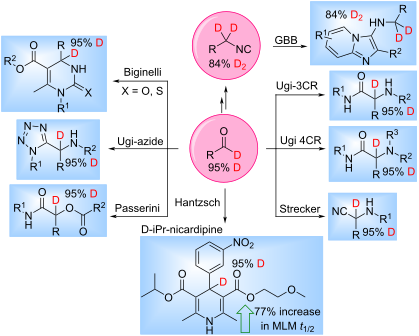
- method to prepare [D1]-formamides (D–C=O) is through a Leuckart–Wallach reaction with an amine and [D1]-methyl/ethyl formate or [D1]-dimethylformamide [19][20]. Stockmann and co-workers produced [D2]-formamides (N–D, D–C=O) via acid-catalyzed nitrile hydrolysis with HCl and D2O [21]. Thus, using the


gem-Difluorination of carbon–carbon triple bonds using Brønsted acid/Bu4NBF4 or electrogenerated acid
Beilstein J. Org. Chem. 2024, 20, 2261–2269, doi:10.3762/bjoc.20.194
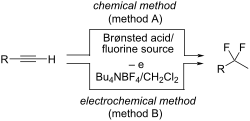
- the use of HF or its complexes as a reagent. These reactions seem to proceed via the formation of the vinyl fluoride as the intermediate [25][26][27][28]. In the first example, Olah and co-workers reported the reaction of terminal alkynes with HF/pyridine (Olah reagent) (Figure 1, reaction 1) [29][30
- ][31][32], although the original work was developed by Linn and Plueddeman using HF [33][34][35]. As another example, Renoux and co-workers developed the utility of SbF5/HF (Figure 1, reaction 2) [36]. In 2014, the HF/N,N’-dimethylpropyleneurea (DMPU) complex in the presence of an Au catalyst was found
- HF is still inevitable [40][41]. Quite recently, Crimmin and co-workers reported gem-difluorination by shuttling between fluoroalkanes and alkynes, in which catalytic HF played a key role [42]. In the course of our study on the fluorination reaction, we have envisioned that the combination of a



Cell-free protein synthesis with technical additives – expanding the parameter space of in vitro gene expression
Beilstein J. Org. Chem. 2024, 20, 2242–2253, doi:10.3762/bjoc.20.192
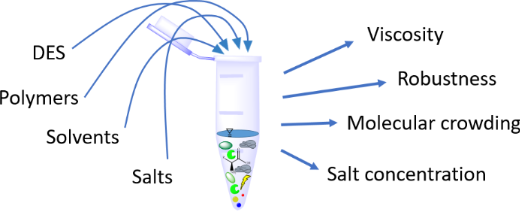
- . This is in agreement with results on the co-optimization of PEG with phosphoenolpyruvate, which indicate an optimal concentration of 4% PEG (7.5 kDa) and a decrease in the activity of the CFPS system at concentrations above 5% [47]. PEG-8000 has been shown to have opposite effects on transcription and



Metal-free double azide addition to strained alkynes of an octadehydrodibenzo[12]annulene derivative with electron-withdrawing substituents
Beilstein J. Org. Chem. 2024, 20, 2234–2241, doi:10.3762/bjoc.20.191
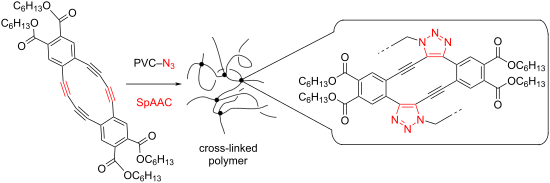
- is straightforward and has broad applicability, extending to other azidated molecules and polymers. Experimental Materials All reagents are purchased from TCI, Aldrich, and Kanto Chemical Co. Inc., and used as received. 4,5-Diiodophthalic acid was prepared according to a literature method [20]. A




Selective hydrolysis of α-oxo ketene N,S-acetals in water: switchable aqueous synthesis of β-keto thioesters and β-keto amides
Beilstein J. Org. Chem. 2024, 20, 2225–2233, doi:10.3762/bjoc.20.190

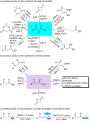
- both β-keto thioesters and β-keto amides [40][41]. Li and co-authors achieved the synthesis of β-keto thioesters by CF3SO3H-promoted hydrolysis of α-oxo ketene N,S-acetals with an amino leaving group (Scheme 1a, path 8) [40]. Subsequently, using NaOH-promoted hydrolysis of α-oxo ketene N,S-acetals, we



Heterocycle-guided synthesis of m-hetarylanilines via three-component benzannulation
Beilstein J. Org. Chem. 2024, 20, 2208–2216, doi:10.3762/bjoc.20.188
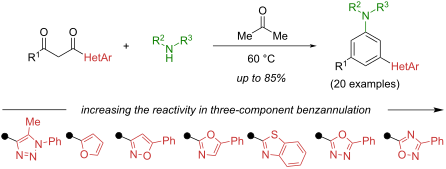
- diketone 1b, bearing the less electron-withdrawing 1,3,4-oxadiazole moiety (σm/σp 0.335/0.443), with alkylamines proceeded well (73–74% yields), but required the addition of CHCl3 as co-solvent due to the low solubility of the starting 1,3-diketone 1b. On the other hand, the reaction of 1,3-diketone 1b


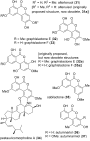
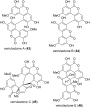
Natural resorcylic lactones derived from alternariol
Beilstein J. Org. Chem. 2024, 20, 2171–2207, doi:10.3762/bjoc.20.187






Novel truxene-based dipyrromethanes (DPMs): synthesis, spectroscopic characterization and photophysical properties
Beilstein J. Org. Chem. 2024, 20, 2163–2170, doi:10.3762/bjoc.20.186
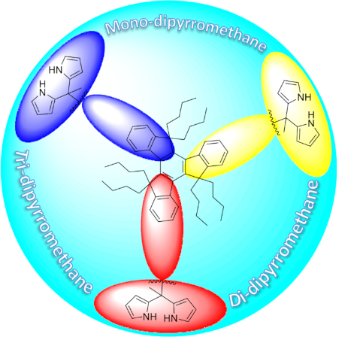
- for diverse applications in future studies. Keywords: condensation; co-timerization; dipyrromethane; Friedel–Crafts acylation; heterocycles; pyrrole; truxene; Introduction The scaffold of truxene (10,15‐dihydro‐5H‐diindeno[1,2‐a;1′,2′‐c]fluorene) and its congeners comprises three fluorene subunits
- – sharing a common benzene ring at the centre [1]. The notable structural signatures of truxene are its rigid, planar and C3-symmetric skeleton, wherein three peripheral phenylene ring systems are all meta-positioned with respect to the congested central benzene ring, so that all four benzene rings are co
- functional materials for diverse uses [1][5][6][7]. Notably, to synthesize this vital heptacyclic star‐shaped π‐conjugated polyarene framework, only a single acid-mediated co-trimerization step is required from an inexpensive and commercially available starting material, namely 1-indanone [8]. It is to be


Factors influencing the performance of organocatalysts immobilised on solid supports: A review
Beilstein J. Org. Chem. 2024, 20, 2129–2142, doi:10.3762/bjoc.20.183
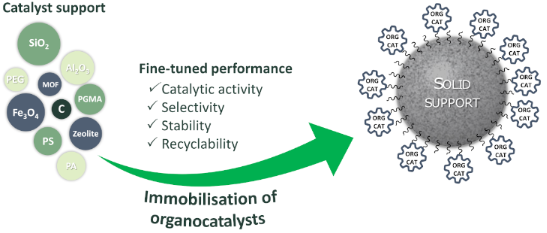
- controllability of surface, geometry, and pore size makes silica-based materials sustainable and functionalisable supports for organocatalytic reactions [44]. The particle morphology of mesoporous silica can be tuned to various shapes, including spheres, tubes, and rods of various dimensions [45], by using a co
- lead to a decrease in selectivity. Connon and co-workers have attached a cinchona thiourea organocatalyst to magnetic nanoparticles 13 for the Michael addition of dimethyl malonate (10) to trans-β-nitrostyrene (11) (Scheme 3) [31]. To explore the potential impact of nanoparticles on catalyst efficiency
- conditions (Scheme 4). Thiel and co-workers examined N-benzylthiazolium salts 17 anchored covalently to mesoporous materials in a benzoin condensation reaction (Scheme 5) [65]. Initially good yields were observed, even after a short reaction time, but a drop in yield was seen after reusing the catalysts for


Efficacy of radical reactions of isocyanides with heteroatom radicals in organic synthesis
Beilstein J. Org. Chem. 2024, 20, 2114–2128, doi:10.3762/bjoc.20.182
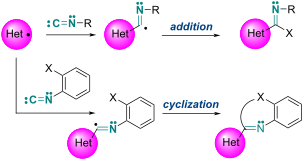
- reaction, pressurization in an autoclave or other pressurization device is required to increase the CO concentration. Isocyanides, on the other hand, have an isoelectronic structure with carbon monoxide and are expected to be not only a promising C1 resource but also an important synthetic reagent for


From perfluoroalkyl aryl sulfoxides to ortho thioethers
Beilstein J. Org. Chem. 2024, 20, 2108–2113, doi:10.3762/bjoc.20.181
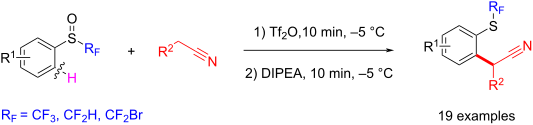
- strategy to improve or modulate their physicochemical and biological properties [41][42][43][44][45], only few publications have reported a [3,3]-rearrangement with fluorinated molecules (Scheme 1c). In 2020, Wang and co-workers have developed a one-pot [3,3]-sigmatropic rearrangement/Haller–Bauer reaction
- of aryl sulfoxides with difluoroenoxysilanes as nucleophile under mild reaction conditions [46]. This provided access to organosulfur compounds ortho-functionalized by CF2H. At the same time Peng and co-workers described the dearomatization of aryl sulfoxides using the same difluoroenol silyl ether
- (Scheme 1d). It is important to mention that during the preparation of this paper, a similar study appeared. Peng and co-workers demonstrated the efficient use of acetonitrile as nucleophile with various aryl difluoroalkyl sulfoxides but only one example of an SCF3 compound was reported [49]. Results and



Computational toolbox for the analysis of protein–glycan interactions
Beilstein J. Org. Chem. 2024, 20, 2084–2107, doi:10.3762/bjoc.20.180
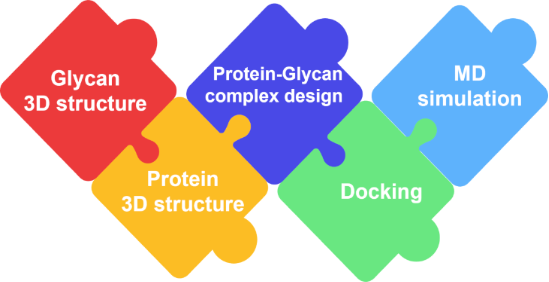
- search space, can be done by comparing the target protein to related proteins or those co-crystallised with ligands [103] and manually superimposing the new ligand to the reference structure. Some payment software like Glide [116][117], GOLD [118] and Molecular Operating Environment (MOE) dock [119] can