


Search results
Search for "redox reactions" in Full Text gives 77 result(s) in Beilstein Journal of Nanotechnology.
Engineered titania nanomaterials in advanced clinical applications
Beilstein J. Nanotechnol. 2022, 13, 201–218, doi:10.3762/bjnano.13.15
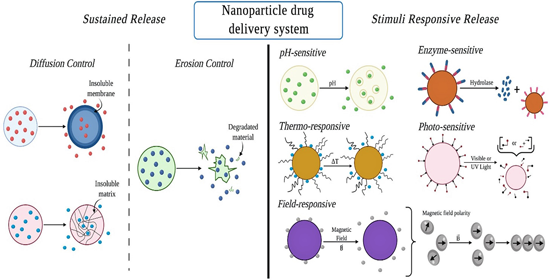
- hindrance inside the tubular structure. This stage of drug release is known as sustained release. The controlled release of drugs is triggered by various external or internal stimuli. Changes in pH value, redox reactions, and enzyme activity are internal stimuli, while light, magnetic fields, and ultrasound


Progress and innovation of nanostructured sulfur cathodes and metal-free anodes for room-temperature Na–S batteries
Beilstein J. Nanotechnol. 2021, 12, 995–1020, doi:10.3762/bjnano.12.75
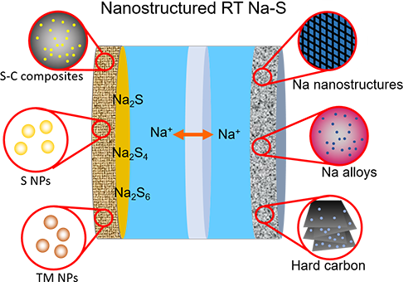
- -efficiency RT Na–S batteries (vide infra). The electrochemical mechanism of RT Na–S batteries is based on the release of sodium cations from the anode leading to the transfer of two electrons that reduce sulfur on the cathode side (Figure 1A) [4]. The redox reactions of the battery are as follows (the
- polysulfides is not only electrostatic but also involves surface redox reactions. The polysulfides are oxidized to thiosulfate by MnO2 while Mn(IV) is reduced to Mn(III) and Mn(II). Afterwards, the formed thiosulfate interacts with long-chain polysulfides and converts them into short-chain polysulfides. The




Molecular assemblies on surfaces: towards physical and electronic decoupling of organic molecules
Beilstein J. Nanotechnol. 2021, 12, 950–956, doi:10.3762/bjnano.12.71

- molecular design, the built-in functionality of the active part of the molecule can be preserved upon adsorption on a surface. An example of the preservation of catalytic properties is demonstrated for the redox behavior of manganese porphyrins at the solid–liquid interface. Redox reactions at the axial
The role of deep eutectic solvents and carrageenan in synthesizing biocompatible anisotropic metal nanoparticles
Beilstein J. Nanotechnol. 2021, 12, 924–938, doi:10.3762/bjnano.12.69
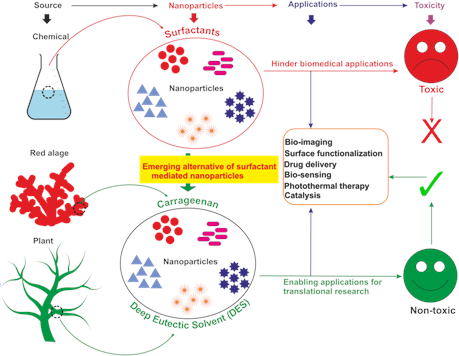
- of the nanoparticle core (Auδ + Oδ and Auδ + Sδ), which cannot be neglected following its subsequent leaching [55]. It is also well known that gold cations play a key role in oxidizing substrates in aerobic redox reactions catalyzed by gold nanoparticles [56]. Redox reactions are intrinsic in


Solution combustion synthesis of a nanometer-scale Co3O4 anode material for Li-ion batteries
Beilstein J. Nanotechnol. 2021, 12, 424–431, doi:10.3762/bjnano.12.34
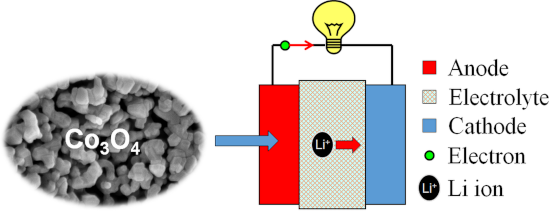
- ][44][45][46][47][48][49][50]. The SCS process is based on strongly exothermic redox reactions in which oxidants, such as metal nitrates, carbonates, or sulfates, react with reducing organic agents, frequently called fuels, such as starch, urea, glycine, or glucose [42][43][45][46][47][48][49][50


TiOx/Pt3Ti(111) surface-directed formation of electronically responsive supramolecular assemblies of tungsten oxide clusters
Beilstein J. Nanotechnol. 2021, 12, 203–212, doi:10.3762/bjnano.12.16
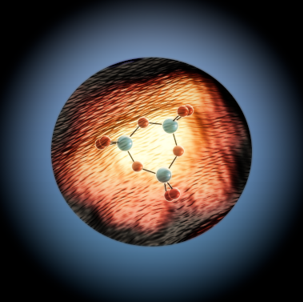
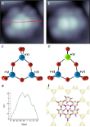
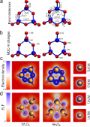
- applied potential [3], have shown great potential for next-generation information technologies. This change of the electrical resistance often faces local redox reactions inside the oxide layer [4]. From the chemical point of view, the active switching layer can be downsized to individual molecular units



Antimicrobial metal-based nanoparticles: a review on their synthesis, types and antimicrobial action
Beilstein J. Nanotechnol. 2020, 11, 1450–1469, doi:10.3762/bjnano.11.129

- production and clearance of ROS in cells are balanced by those enzymatic systems. Nevertheless, when these reactive species are in excess, a set of redox reactions can lead to cell death by the alteration of different essential structures (such as cell membrane, DNA, proteins, and electron transport chain


Role of redox-active axial ligands of metal porphyrins adsorbed at solid–liquid interfaces in a liquid-STM setup
Beilstein J. Nanotechnol. 2020, 11, 1264–1271, doi:10.3762/bjnano.11.110
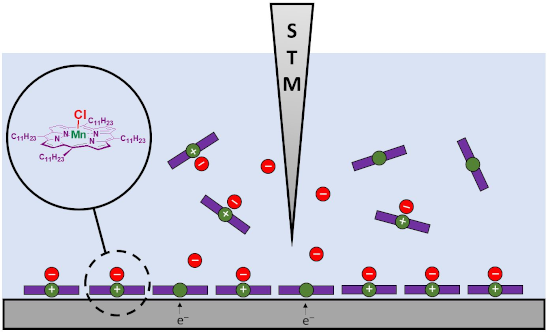
- ascribed to the occurrence of redox reactions in which chloride is oxidized to chlorine and the Mn(III) center of the porphyrin moiety is reduced to Mn(II). The resulting Mn(II) porphyrin products were identified by UV–vis analysis of the liquid phase. For solutions of Mn(III) porphyrins with non-redox
- active acetate instead of chloride axial ligands, the currents remained absent. Keywords: manganese; porphyrins; redox reactions; scanning tunneling microscopy; solid–liquid interface; Introduction Manganese(III) porphyrins are well-known catalysts for the epoxidation of alkenes [1][2][3][4]. The
- sample surface. Such reactions would result in so-called Faradaic currents between the tip and the sample. In the case of MnTUPCl, the following redox reactions at the tip or sample surface can be envisaged: We base these proposed reactions on the fact that the manganese center can be reduced from (III


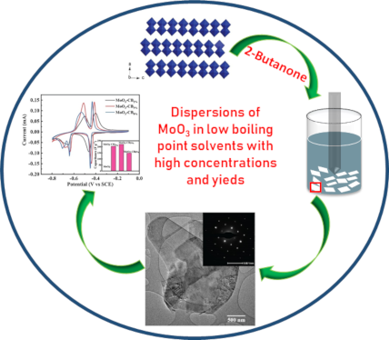
Exfoliation in a low boiling point solvent and electrochemical applications of MoO3
Beilstein J. Nanotechnol. 2020, 11, 662–670, doi:10.3762/bjnano.11.52
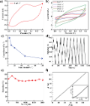
- potential window from 0 to 0.6 V. The humps indicating a pseudocapacitance may be attributed to redox reactions in MoO3 as discussed for the three-electrode measurements. CV measurements have been carried out at different scan rates (Figure 4b). A maximum specific capacitance of 68.4 F·g−1 at a scan rate of

High-performance asymmetric supercapacitor made of NiMoO4 nanorods@Co3O4 on a cellulose-based carbon aerogel
Beilstein J. Nanotechnol. 2020, 11, 240–251, doi:10.3762/bjnano.11.18
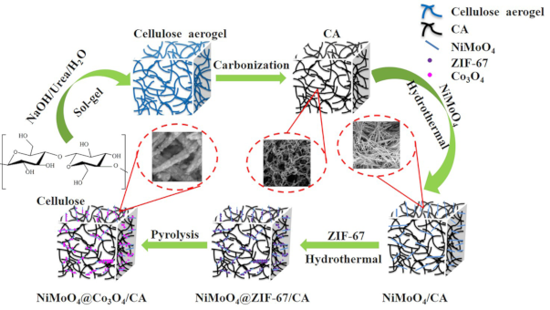
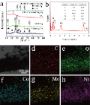
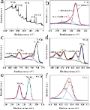
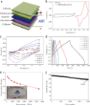
- can provide a much higher specific capacitance as a result of rapid reversible redox reactions [9][10]. Recently, advanced electrode materials based on transition metal molybdates such as NiMoO4 [11], CoMoO4 [12], MnMoO4 [13] and FeMoO4 [14] with suitable oxidation states and unique electrochemical
- and electrolyte and facilitating the transport of electrons during the redox reactions [33]. Such a hierarchical structure can effectively enlarge the specific surface area of Faradaic reactions and shorten the diffusion pathways for the fast ion transfer, thus increasing the performance of the
- , which can be attributed to the redox reaction between M2+ and M3+ (M represents Ni and Co elements) and Co3+ and Co4+, as described by the following equations [43]: Therefore, the coexistence of Ni and Co provides multiple redox reactions for the electrochemical process. The peak currents of the CV




Formation of metal/semiconductor Cu–Si composite nanostructures
Beilstein J. Nanotechnol. 2019, 10, 2497–2504, doi:10.3762/bjnano.10.240
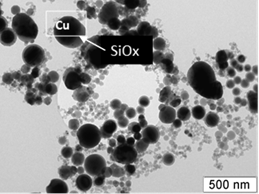
- improvement of the thermal stability of the core and, under the condition of a hermetic coating, reliably protects its surface from redox reactions [3]. Janus-like metal/semiconductor nanoparticles are promising as effective radio-absorbing media and are the basis for creating the elemental basis for


Label-free highly sensitive probe detection with novel hierarchical SERS substrates fabricated by nanoindentation and chemical reaction methods
Beilstein J. Nanotechnol. 2019, 10, 2483–2496, doi:10.3762/bjnano.10.239
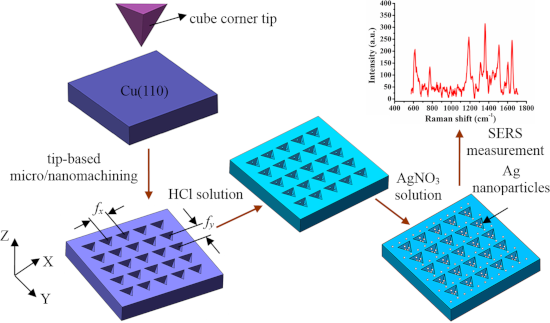
- substrate, and Ag is formed on the Cu substrate due to redox reactions. Oxygen is generated when the Ag nanoparticles are formed. Table 2 and Table 3 show the distribution of the contents of each element of the internal cavities and pile-ups of cavities with fx = 2 μm and fy = 2 μm. The mass ratio of silver


Design and facile synthesis of defect-rich C-MoS2/rGO nanosheets for enhanced lithium–sulfur battery performance
Beilstein J. Nanotechnol. 2019, 10, 2251–2260, doi:10.3762/bjnano.10.217
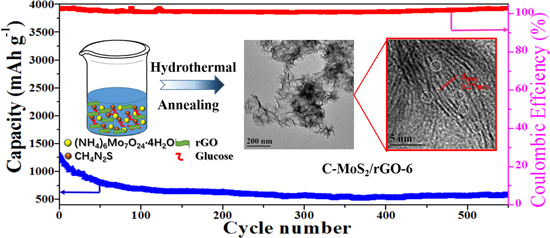
- redox reactions but also chemically adsorb polysulfides. In addition, rGO and carbon layer can also enhance the conductivity of C-MoS2/rGO. Therefore, the C-MoS2/rGO, as an efficient sulfur host, could exhibit excellent electrochemical performance. Experimental Preparation of defect-rich C-MoS2/rGO


Ultrathin Ni1−xCoxS2 nanoflakes as high energy density electrode materials for asymmetric supercapacitors
Beilstein J. Nanotechnol. 2019, 10, 2207–2216, doi:10.3762/bjnano.10.213
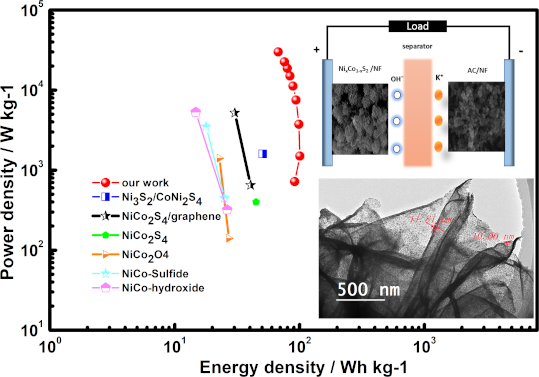
- from both nickel and cobalt ions in the bimetallic sulfides can provide relatively affluent redox reactions, resulting in higher specific capacitance and electrical conductivity [6][7]. Moreover, layered ultrathin nanoflakes in the synthesised nanomaterials, derived from metal oxides/dichalcogenides
- from −0.1 to 0.65 V (vs Hg/HgO), which can be attributed to reversible faradaic redox reactions of Co2+/Co3+/Co4+ and Ni2+/Ni3+ associated with the following reaction equations (Equation 6–8) [14][31]: With increased sweep rates, the anodic peaks move in the positive direction and the cathodic peaks
- energy density of 67.5 Wh·kg−1), and excellent cycling stability and capacity retention. These results can be credited to synergic effects rich and fast redox reactions, high conductivity, as well as highly porous and robust ultrathin nanoflakes structures. (a) X-ray diffraction patterns of Ni1−xCoxS2


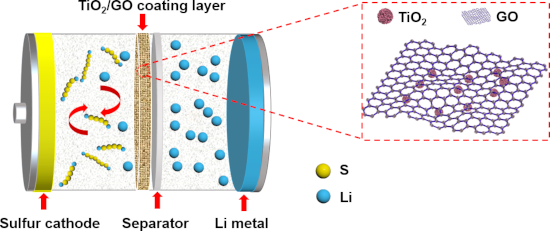
TiO2/GO-coated functional separator to suppress polysulfide migration in lithium–sulfur batteries
Beilstein J. Nanotechnol. 2019, 10, 1726–1736, doi:10.3762/bjnano.10.168
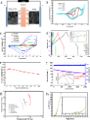
- reduction and oxidation peaks, corresponding to the redox reactions of typical Li/S batteries. These observations are consistent with the CV curves. In addition, the plateaus in the discharge–charge profiles are almost overlapped even after the 100th cycle, indicating a stable electrochemical performance of


Tuning the performance of vanadium redox flow batteries by modifying the structural defects of the carbon felt electrode
Beilstein J. Nanotechnol. 2019, 10, 1698–1706, doi:10.3762/bjnano.10.165
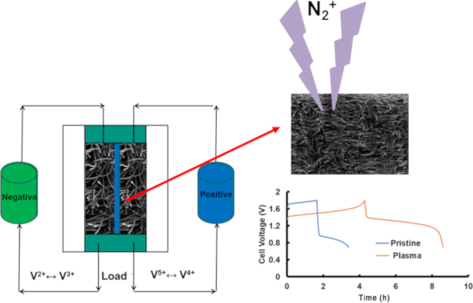
- oxygen functional groups on the N2-plasma-treated sample was very low, the felt showed enhanced electrochemical performance for both V3+/V2+ as well as V5+/V4+ redox reactions. The result is highly significant as the pristine electrode with the same amount of oxygen functional groups showed significantly
- were carried out. In contrast to the pristine sample, a prominent V3+/V2+ redox peak is observed for the N2-plasma-treated sample. The CV of the pristine sample is mainly characterized by a hydrogen evolution peak. The CV curves for both negative and positive redox reactions are shown in Figure 5


Kelvin probe force microscopy work function characterization of transition metal oxide crystals under ongoing reduction and oxidation
Beilstein J. Nanotechnol. 2019, 10, 1596–1607, doi:10.3762/bjnano.10.155
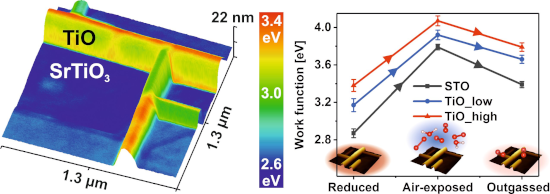
- the oxygen activity and redox reactions on surfaces, the next experiment was aimed to study the work function dependence upon controlled reoxidation of reduced oxides. Transition metal oxide nanostructures find manifold applications, especially in various (photo)catalytic processes, e.g., water


Porous N- and S-doped carbon–carbon composite electrodes by soft-templating for redox flow batteries
Beilstein J. Nanotechnol. 2019, 10, 1131–1139, doi:10.3762/bjnano.10.113
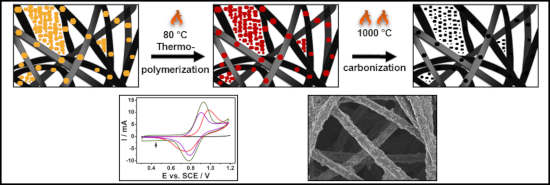
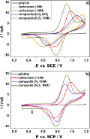
- works described heteroatom doping that should provide more active centres for the vanadium redox reactions, and hence lead to a higher electrochemical activity [14][15][16][17]. But still details of the mechanism are lacking and contradictory suggestions can be found in the literature, as to which



Concurrent nanoscale surface etching and SnO2 loading of carbon fibers for vanadium ion redox enhancement
Beilstein J. Nanotechnol. 2019, 10, 985–992, doi:10.3762/bjnano.10.99
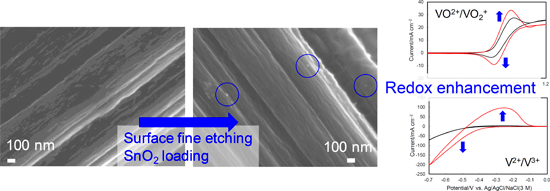
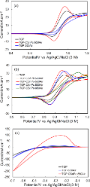
- redox reactions of electrolyte ions are required to produce efficient and low-cost redox flow batteries (RFBs). Carbon-fiber electrodes are widely used in various types of RFBs and surface oxidation is commonly performed to enhance the redox reactions, although it is not necessarily efficient. Quite
- photoelectron spectroscopy (XPS). The activity for the vanadium ion redox reactions was evaluated by cyclic voltammetry (CV) to demonstrate the enhancement of both the positive and negative electrode reactions. A full cell test of the vanadium redox flow battery (VRFB) showed a significant decrease of the
- overpotential and a stable cycling performance. A facile and efficient technique based on the nanoscale processing of the carbon fiber surface was presented to substantially enhance the activity for the redox reactions in redox flow batteries. Keywords: carbon fiber; electrode reactions; metal-oxide



Synthesis of MnO2–CuO–Fe2O3/CNTs catalysts: low-temperature SCR activity and formation mechanism
Beilstein J. Nanotechnol. 2019, 10, 848–855, doi:10.3762/bjnano.10.85
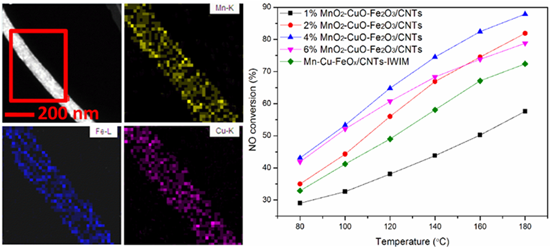
- °C. The mechanisms of above preparation method are redox reactions between MnO4− (from KMnO4) and Cl− (from FeCl3 and CeCl3), or Mn7+ and O2− (from KMnO4) as well as MnO4− (from the KMnO4) and Cl− (from CeCl3). The generation of Cl− anions in the preparation process can result in corrosion of the





An efficient electrode material for high performance solid-state hybrid supercapacitors based on a Cu/CuO/porous carbon nanofiber/TiO2 hybrid composite
Beilstein J. Nanotechnol. 2019, 10, 781–793, doi:10.3762/bjnano.10.78
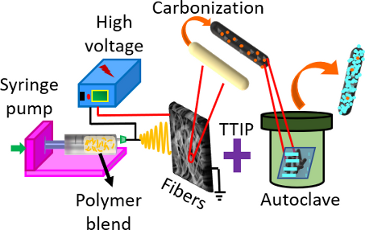
- weak and broad characteristic peaks, which result from the redox reactions, indicating the pseudo-capacitive behavior of TiO2. Notably, the composite material shows a combined electric double-layer capacitance and pseudo-capacitive behavior with a higher integrated area compared to all the other
- values than all other electrode materials, which was due to the addition of TiO2 nanoparticles. TiO2 nanoparticles show pseudo-capacitive behavior due to faradaic charge transfer that takes place in redox reactions. Therefore, the supercapacitor performance of the Cu/CuO/PCNF/TiO2 composite electrode


Trapping polysulfide on two-dimensional molybdenum disulfide for Li–S batteries through phase selection with optimized binding
Beilstein J. Nanotechnol. 2019, 10, 774–780, doi:10.3762/bjnano.10.77
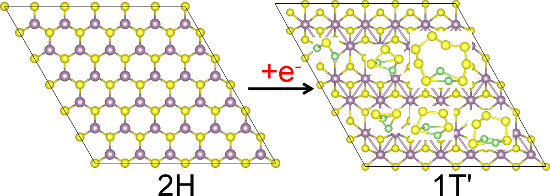
- polysulfides (LPSs) (Li2Sx, x = 4–8) in the organic electrolyte solvent will migrate and react with the lithium anode, which results in capacity fading and low coulombic efficiency [7][8]. The major issue is the complex diffusion of LPSs, which in combination with the subsequent redox reactions is known as the


A Ni(OH)2 nanopetals network for high-performance supercapacitors synthesized by immersing Ni nanofoam in water
Beilstein J. Nanotechnol. 2019, 10, 281–293, doi:10.3762/bjnano.10.27
- derivatives, such as active carbon, porous carbon, graphene, carbon nanotubes with good electrical conductivity and high specific surface area, are most commonly employed as electrode materials [5][6][7]. The other category are pseudocapacitors governed by reversible faradic redox reactions at the interface
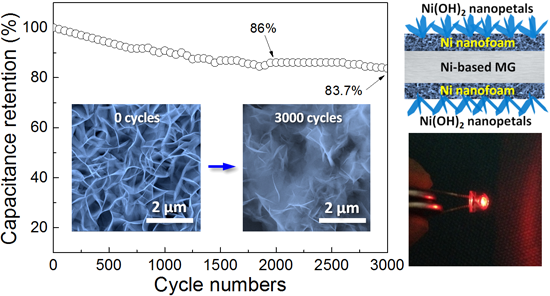
- (OH)2/Ni-NF/MG electrodes further elucidate the pseudo-capacitance characteristics, as shown in Figure 5b. Every GCD curve has an obvious charge–discharge plateau and the voltage position is in agreement with the CV curves, demonstrating that the faradic redox reactions mainly contribute to the




Electrospun one-dimensional nanostructures: a new horizon for gas sensing materials
Beilstein J. Nanotechnol. 2018, 9, 2128–2170, doi:10.3762/bjnano.9.202
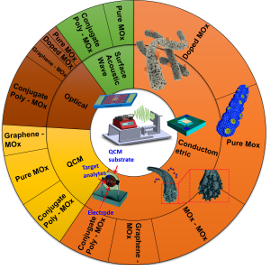
- changes upon exposure to the target gas. The adsorption of gas molecules on the sensing layer leads to redox reactions by serving as an electron donor or acceptor which depends on the reductive or oxidative nature of the target gas compared to molecular oxygen. As the charge carrier concentration changes






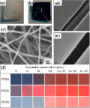
Synthesis of a MnO2/Fe3O4/diatomite nanocomposite as an efficient heterogeneous Fenton-like catalyst for methylene blue degradation
Beilstein J. Nanotechnol. 2018, 9, 1940–1950, doi:10.3762/bjnano.9.185
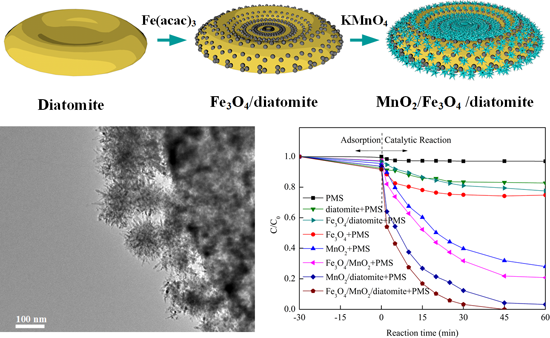
- accelerates the redox reactions of Fe(III)/Fe(II) and Mn(IV)/Mn(III), resulting in an accelerated •SO4− generation rate. The standard redox potential of Mn(IV)/Mn(III) is 0.15 V [40], while that of Fe(III)/Fe(II) is 0.77 V [10]. Therefore, the transfer of electrons from ≡Mn(III) to ≡Fe(III) is





