Search results
Search for "Ga" in Full Text gives 158 result(s) in Beilstein Journal of Nanotechnology.
Atomic defect classification of the H–Si(100) surface through multi-mode scanning probe microscopy
Beilstein J. Nanotechnol. 2020, 11, 1346–1360, doi:10.3762/bjnano.11.119
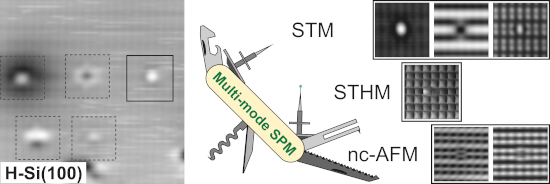
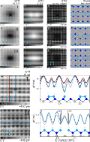
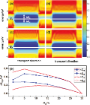
- speculated a variety of origins for this defect, including a negatively charged As dopant [58], Si-vacancy hydrogen complexes [9], and B dopants [59][60]. Crystal vacancies have previously been identified in other materials using scanning probe microscopy including Ga vacancies in GaAs [61], As vacancies in



3D superconducting hollow nanowires with tailored diameters grown by focused He+ beam direct writing
Beilstein J. Nanotechnol. 2020, 11, 1198–1206, doi:10.3762/bjnano.11.104
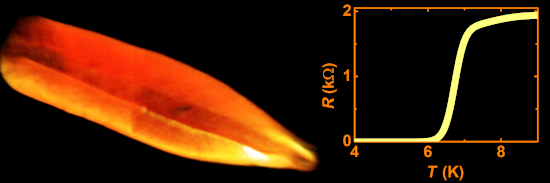
- is based on Ga+ ions. Functional 3D nanomaterials have been grown by Ga+ FIBID in the last decade [21][22][23][24][25][26]. In particular, Ga+ FIBID in combination with W(CO)6 as precursor material yielded 3D superconducting W-based wires with a critical temperature (Tc) below 5 K and a critical
- magnetic field (µ0Hc2(0)) up to 9.5 T [14][15][16]. Alternatively, in combination with Nb(NMe2)3(N-t-Bu), Ga+ FIBID yielded NbC wires with a broadened Tc range from 4 to 11 K [18]. One significant limitation is that 3D elements below 100 nm in diameter cannot be obtained with Ga+ FIBID, mainly due to the
- relatively large Ga+ beam diameter (approx. 5 nm) and a high proximity effect generated by Ga+ ion scattering. Regarding a higher spatial resolution, the helium ion microscope (HIM) [27], based on a gas field-ionization source, has emerged as a tool for direct writing of complex 3D nano-objects taking



Electrochemical nanostructuring of (111) oriented GaAs crystals: from porous structures to nanowires
Beilstein J. Nanotechnol. 2020, 11, 966–975, doi:10.3762/bjnano.11.81
- at 1.32 eV is usually attributed to Si impurities at the Ga sites forming different complexes, such as (SiGaVGa) [28][29] or (SiGaGaAs) [30]. Since Si impurities exhibit an amphoteric behavior in GaAs, they give rise to an acceptor SiAs state in addition to the SiGa shallow donor state. The second PL





Effect of substitutional defects on resonant tunneling diodes based on armchair graphene and boron nitride nanoribbons lateral heterojunctions
Beilstein J. Nanotechnol. 2020, 11, 688–694, doi:10.3762/bjnano.11.56
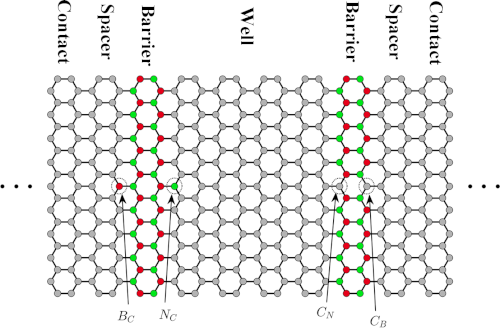
- the semi-infinite contacts. The self-energy matrices are calculated through a highly convergent recursive method [39]. Then the transmission as a function of the energy is obtained via [39]: in which Ga(E) = (Gr(E))† is the advanced Green's function and Γj (j = 1, 2), represent the level broadening



Multilayer capsules made of weak polyelectrolytes: a review on the preparation, functionalization and applications in drug delivery
Beilstein J. Nanotechnol. 2020, 11, 508–532, doi:10.3762/bjnano.11.41
- formation of PAA/PAH capsules via EDC crosslinking (Figure 3c) [26]. Similarly, the post crosslinking of PEI/PAA microcapsules via glutaraldehyde (GA) chemistry also resulted in better stability over a wide pH range [53]. These capsules successfully encapsulated dextran (2000 KDa) molecules without any
- as high as 910 MPa. By making use of the reaction between amine and aldehyde via GA chemistry, a single polymer PAH capsule can be fabricated [57]. The deposition of one PAH layer was followed by suspending the particles in GA solution to induce free aldehyde groups for deposition of the next PAH
- most commonly used method is the movement of cargo from lower to higher concentration via a concentration gradient based diffusion process such as in case of Dox loading in GA cross-linked (chitosan-alginate)5 microcapsules [76]. At low feeding concentrations (e.g., 750 µg/mL), the drug loading was



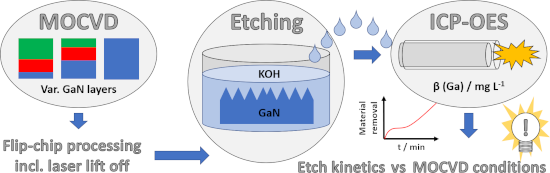
Influence of the epitaxial composition on N-face GaN KOH etch kinetics determined by ICP-OES
Beilstein J. Nanotechnol. 2020, 11, 41–50, doi:10.3762/bjnano.11.4
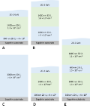
- ]. Nucleation layers have the second but very important effect of controlling crystal orientation, which is commonly Ga-polar (0001) [7]. Other than nucleation layers, there are several more strategies for defect reduction. These all require the insertion of additional layers or layer transitions into the
- and a 2D GaN layer with a combined thickness of 2000 nm. A, C and E contained a rudimentary MQW to allow for photoluminescence microscopy (PLM) analysis of dislocation density. Wafer processing After growth with Ga-polarity, the Ga-face of epilayers were bonded to silicon carriers with a non-ohmic
- gas stream and 12 L min−1 cooling gas stream. The Ga concentration obtained was averaged from three separate subsequent measurements of the identical dilution. The maximum integration time was set to 15 s. Both low and high standard solutions were prepared with identical concentrations of pure KOH and


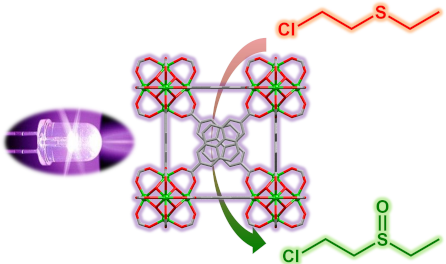
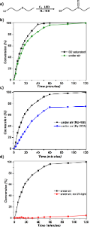
Air oxidation of sulfur mustard gas simulants using a pyrene-based metal–organic framework photocatalyst
Beilstein J. Nanotechnol. 2019, 10, 2422–2427, doi:10.3762/bjnano.10.232
- Award (for GA), and Northwestern University.




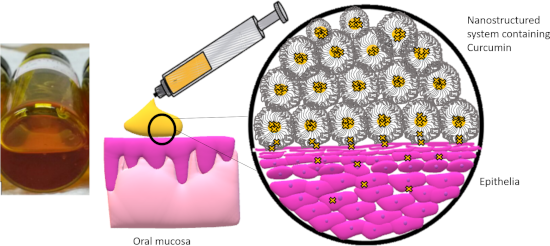
Design of a nanostructured mucoadhesive system containing curcumin for buccal application: from physicochemical to biological aspects
Beilstein J. Nanotechnol. 2019, 10, 2304–2328, doi:10.3762/bjnano.10.222


First principles modeling of pure black phosphorus devices under pressure
Beilstein J. Nanotechnol. 2019, 10, 1943–1951, doi:10.3762/bjnano.10.190
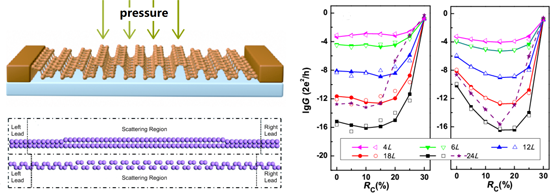
- -related conductance of pure monolayer zigzag and armchair BP devices. The transmission coefficient of a two-probe system can be calculated by, where GR and GA are the retarded and advanced non-equilibrium Green’s functions of the system, respectively, and ΓL and ΓR are the line-width functions describing

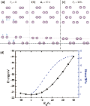



Synthesis of nickel/gallium nanoalloys using a dual-source approach in 1-alkyl-3-methylimidazole ionic liquids
Beilstein J. Nanotechnol. 2019, 10, 1754–1767, doi:10.3762/bjnano.10.171
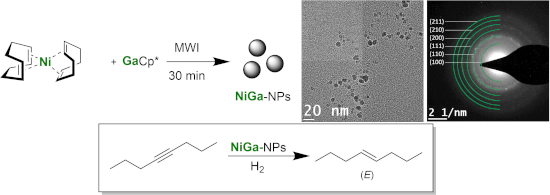
- = 1,5-cyclooctadiene) and GaCp* (Cp* = pentamethylcyclopentadienyl) in the ionic liquid [BMIm][NTf2] selectively yields small intermetallic Ni/Ga nanocrystals of 5 ± 1 nm as derived from transmission electron microscopy (TEM) and high-angle annular dark-field scanning transmission electron microscopy
- experimentally [30][31] and reasoned by theory [32]. The phase diagram of Ni/Ga shows nine different Ni/Ga phases (Supporting Information File 1, Figure S1) [33][34][35][36]. In a comparison of the CO2 hydrogenation abilities of NiGa (β), Ni3Ga (α) and Ni5Ga3 (δ) high selectivities towards the formation of
- methanol were found for Ni5Ga3 and NiGa [37]. At 165 °C Ni5Ga3 (δ) yielded 100% selectivity towards methanol [38]. Above 220 °C Ni5Ga3 is even more active than a conventional Cu/ZnO/Al2O3 catalyst with less CO formation in the reverse water-gas shift reaction (rWGS). In Ni5Ga3 the Ga-rich step sites




Precise local control of liquid crystal pretilt on polymer layers by focused ion beam nanopatterning
Beilstein J. Nanotechnol. 2019, 10, 1691–1697, doi:10.3762/bjnano.10.164
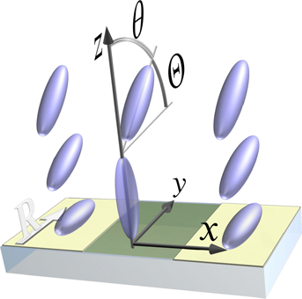
- anchoring conditions from planar to vertical upon certain surface areas is performed using a FEI Scios dual-beam electron microscope operating with a FIB of Ga+ ions of a current of 0.1 nA accelerated by a voltage of 30 kV. The FIB patterning is controlled by digital templates, which prescribe the beam path
- within a raster consisting of up to 4096 × 3536 pixel2 as well as the time spent by the beam on each pixel (the so-called dwell time). According to our previous comparative study [31], a relatively small dose of Ga+ ions is sufficient for the required polymer transformation and we adopt here the same


Giant magnetoresistance ratio in a current-perpendicular-to-plane spin valve based on an inverse Heusler alloy Ti2NiAl
Beilstein J. Nanotechnol. 2019, 10, 1658–1665, doi:10.3762/bjnano.10.161
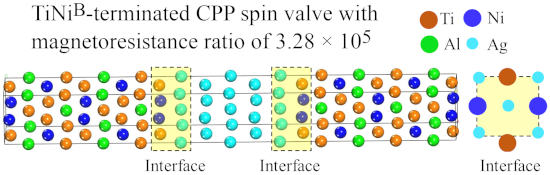
- transmission coefficient Tσ(E) can be calculated employing Tσ(E) = Tr[ГLGRГRGA], where ГL and ГR are the coupling matrix of the left and right electrode, respectively; GR and GA are the retarded and advanced Green’s function of the central region, respectively; and σ is the spin direction, spin up or spin down


Kelvin probe force microscopy of the nanoscale electrical surface potential barrier of metal/semiconductor interfaces in ambient atmosphere
Beilstein J. Nanotechnol. 2019, 10, 1401–1411, doi:10.3762/bjnano.10.138
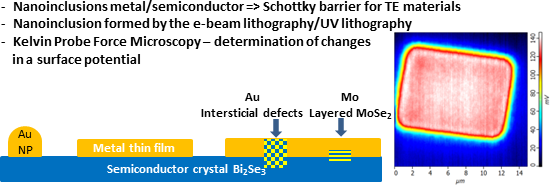
- Republic (GA CR), projects No. 16-07711S and No. 19-11814S is greatly appreciated. The work was supported from European Regional Development Fund-Project "Modernization and upgrade of the CEMNAT (No. CZ.02.1.01/0.0/0.0/16_013/0001829)".


Fabrication of phase masks from amorphous carbon thin films for electron-beam shaping
Beilstein J. Nanotechnol. 2019, 10, 1290–1302, doi:10.3762/bjnano.10.128
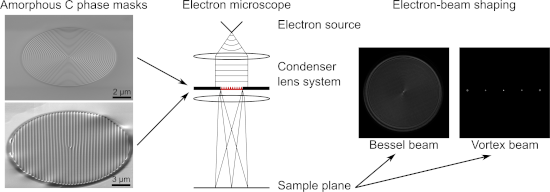
- formation of holes in the film, which let us expect an offset thickness in the range of only a few nanometers. The fast generation of holes may be associated with the implantation depth of the impinging Ga ions (Figure 4d). When the film becomes thin enough for Ga ions to penetrate through, there is a
- penetration depth of the Ga ions in the material of the thin film. The thickness amplitude is smaller than expected, because even though the FIB is only scanned azimuthally along the minima, sputtering also takes place near the maxima of the sinusoidal structure and decreases the total thickness of the thin
- film with each repetition. Finer FIB probes at smaller FIB currents could improve this at the cost of increasing milling duration and possible artifacts due to stage drift. Furthermore, implanted Ga induces a dark contrast and alters the effective MIP compared to pristine aC. Since the FIB was only



Electroluminescence and current–voltage measurements of single-(In,Ga)N/GaN-nanowire light-emitting diodes in a nanowire ensemble
Beilstein J. Nanotechnol. 2019, 10, 1177–1187, doi:10.3762/bjnano.10.117
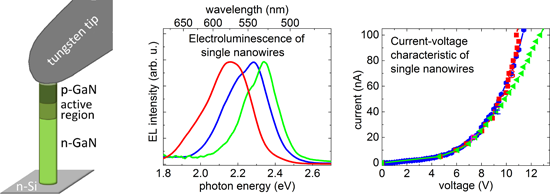
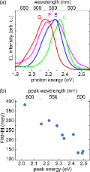
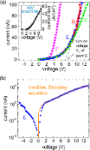
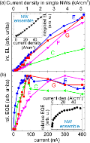
- ) behavior of single, freestanding (In,Ga)N/GaN nanowire (NW) light-emitting diodes (LEDs) in an unprocessed, self-assembled ensemble grown by molecular beam epitaxy. The data were acquired in a scanning electron microscope equipped with a micromanipulator and a luminescence detection system. Single NW
- respective electroluminescence (EL) signal [6]. Yet another approach was implemented by Bavencove et al. and Musolino and co-workers [4][7]. They did not contact single (In,Ga)N/GaN NWs with a probe tip, but detected diffraction-limited EL spots in the working ensemble device using a confocal microscope
- epitaxy (MBE) on an n-doped Si(111) substrate. They consist of an intrinsic multiple quantum-well structure grown on a Si-doped n-GaN base of about 600 nm length. The active region is composed of four (In,Ga)N insertions with an In content of (20 ± 10)% and a thickness of 3 ± 1 nm. The insertions are


A highly efficient porous rod-like Ce-doped ZnO photocatalyst for the degradation of dye contaminants in water
Beilstein J. Nanotechnol. 2019, 10, 1157–1165, doi:10.3762/bjnano.10.115
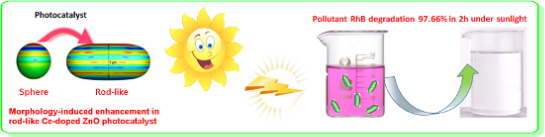
- ]. In recent years, metal organic frameworks (MOFs) have been intensively investigated and widely utilized in various fields, such as electrocatalysis [14], heterogeneous catalysis [15] and photocatalysis [16]. Yang et al. [17] reported that Ga-MOF displayed moderate to high catalytic activity of


CuInSe2 quantum dots grown by molecular beam epitaxy on amorphous SiO2 surfaces
Beilstein J. Nanotechnol. 2019, 10, 1103–1111, doi:10.3762/bjnano.10.110
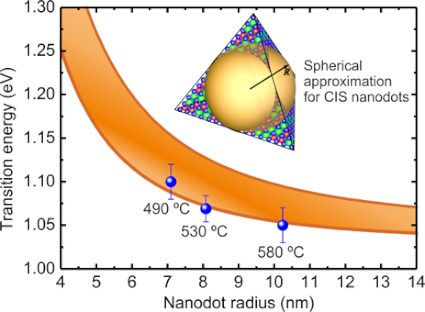
- , 20663 Casablanca, Morocco 10.3762/bjnano.10.110 Abstract The currently most efficient polycrystalline solar cells are based on the Cu(In,Ga)Se2 compound as a light absorption layer. However, in view of new concepts of nanostructured solar cells, CuInSe2 nanostructures are of high interest. In this work
- with the average size of the nanodots. Keywords: copper indium gallium selenide (CuInSe2); quantum dots; Introduction The chalcopyrite compound Cu(In,Ga)Se2 (CIGS) is used as the light absorber layer in thin film solar cells that typically consist of a glass substrate, a Mo back contact, the CIGS
- layer prior to the protective Pt bi-layer deposition assisted by electron and ion beams. The final polishing of the lamella was done using 1 keV in energy to reduce the lateral damage and the Ga implantation effects in the lamellae. EDS was performed in the same STEM microscope in order to check the [Cu


Electronic properties of several two dimensional halides from ab initio calculations
Beilstein J. Nanotechnol. 2019, 10, 823–832, doi:10.3762/bjnano.10.82
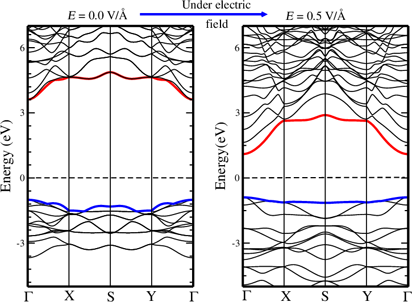
- detailed electronic properties were not studied. In the present work, using density functional theory, we investigate the structural, vibrational and electronic properties of several 2D halide compounds such as the bromides (XOBr and X′FBr with X = Ac, Bi; X′ = Ba, Ca), the fluorides (XOF with X = Cr, Ga
- theory (DFPT) [40]. Results and Discussion In this section we discuss the structural and electronic properties of the compounds investigated in this paper. We will focus on XOBr and X′FBr (where X = Ac, Bi and X′ = Ba, Ca) for the bromides, on XOF (where X = Cr, Ga, In, La) for the fluorides, on XOCl and
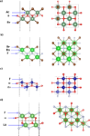
- (where X = Cr, Ga, In, La) monolayers, as presented in Figure 4. For instance, we can see from the PDOS of AcOCl that the valence bands come from the Ac, O, and Cl atoms while the bottom of the conduction bands correspond mainly to states derived from the Ac atoms. The DOSs and PDOSs of the fluoride
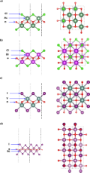


Renewable energy conversion using nano- and microstructured materials
Beilstein J. Nanotechnol. 2019, 10, 771–773, doi:10.3762/bjnano.10.76

- cells [1] or via microabsorbers as shown for Cu(In,Ga)Se2 [4] in this thematic issue. At the same time, material reduction demands for optical concepts that support efficient collection of the incident solar radiation. In this regard, nanotexturing is of interest, where optical resonances and light
Contact splitting in dry adhesion and friction: reducing the influence of roughness
Beilstein J. Nanotechnol. 2019, 10, 1–8, doi:10.3762/bjnano.10.1
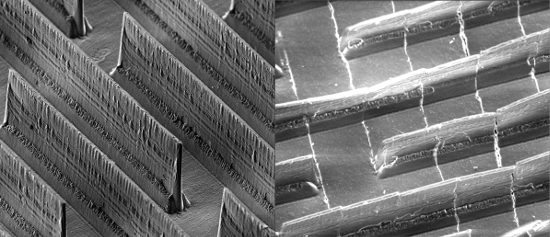
- Jae-Kang Kim Michael Varenberg George W. Woodruff School of Mechanical Engineering, Georgia Institute of Technology, Atlanta, GA 30332, USA 10.3762/bjnano.10.1 Abstract Splitting a large contact area into finer, sub-contact areas is thought to result in higher adaptability to rough surfaces


Femtosecond laser-assisted fabrication of chalcopyrite micro-concentrator photovoltaics
Beilstein J. Nanotechnol. 2018, 9, 3025–3038, doi:10.3762/bjnano.9.281
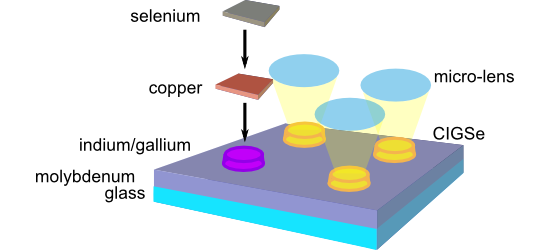
- enhance the efficiency of planar-cell technologies while saving absorber material. Here, two laser-based bottom-up processes for the fabrication of regular arrays of CuInSe2 and Cu(In,Ga)Se2 microabsorber islands are presented, namely one approach based on nucleation and one based on laser-induced forward
- for low-cost solar power. In the present review, we provide an overview about research carried out on micro-concentrator solar cells – a new cell concept that has been emerging in recent years – using Cu(In,Ga)Se2 (CIGSe) as absorber material. The review focuses on two different laser-based
- fabrication methods for microabsorbers. In thin-film photovoltaics, Cu(In,Ga)Se2 (CIGSe) solar cells with an efficiency record of 22.9% for planar cells [2] and 19.2% for sub-modules [3] are among the leading technologies. Figure 1 shows the structure of a planar CIGSe solar cell representing the current


Size limits of magnetic-domain engineering in continuous in-plane exchange-bias prototype films
Beilstein J. Nanotechnol. 2018, 9, 2968–2979, doi:10.3762/bjnano.9.276
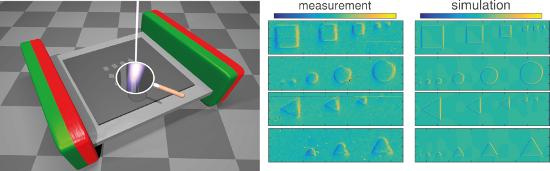
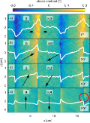
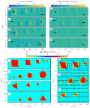
- patterning by Ga ions in a FIB (suffering from destruction of the thin films due to high sputter yields) [32][33], available patterning methods do not achieve the necessary resolution. Currently, the smallest engineered domains in films with in-plane anisotropy are 300 nm wide stripes produced by thermally




![[Graphic 63]](/bjnano/content/inline/2190-4286-9-276-i63.svg?max-width=637&scale=1.18182) .
. ![[Graphic 64]](/bjnano/content/inline/2190-4286-9-276-i64.svg?max-width=637&scale=1.18182) is the angle between the domain wall (DW) normal vector
is the angle between the domain wall (DW) normal vector ![[Graphic 65]](/bjnano/content/inline/2190-4286-9-276-i65.svg?max-width=637&scale=1.18182) and the local unidirectio...
and the local unidirectio...
Charged particle single nanometre manufacturing
Beilstein J. Nanotechnol. 2018, 9, 2855–2882, doi:10.3762/bjnano.9.266
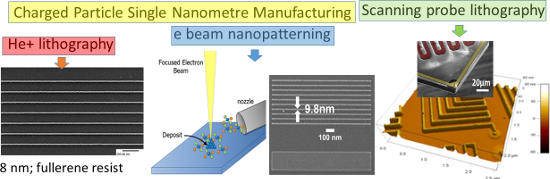
- electrons from the resist–substrate interface result in overlap of two features written in close proximity [20]. Ions are over a thousand times heavier than electrons and are consequently not backscattered to the same degree. Mention should also be made of another problem of Ga+ lithography which causes a
- suppressed the adoption of the original Ga+ SIBL technology for silicon microelectronics and other applications. There has, however, been a paradigm shift in ion beam microscopy and lithography with the development in 2006 of the atomic level ion source (ALIS) [23]. This can be used to provide a focused beam
- ten times smaller than for the Ga+ LMIS which has an ultimate source size of 3 nm [26]. The ALIS source consequently has an extremely high brightness estimated to be approximately 5 × 10⁹ A·cm−2·sr−1 at an ion energy of ca. 30 keV. The ALIS source has been incorporated into the ORION scanning ion


Variation of the photoluminescence spectrum of InAs/GaAs heterostructures grown by ion-beam deposition
Beilstein J. Nanotechnol. 2018, 9, 2794–2801, doi:10.3762/bjnano.9.261
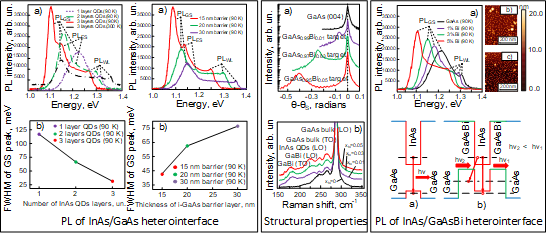
- Bi = 148 pm and In = 142 pm atoms are very close. Therefore, in the InAs QD growth process on the GaAs1−xBix surface, In adatom surface diffusion can be realized both through substituting Ga or Bi vacancies. Increase of QD heights in the InAs/GaAs0.95Bi0.05 heterosystem is an indirect demonstration


High-temperature magnetism and microstructure of a semiconducting ferromagnetic (GaSb)1−x(MnSb)x alloy
Beilstein J. Nanotechnol. 2018, 9, 2457–2465, doi:10.3762/bjnano.9.230
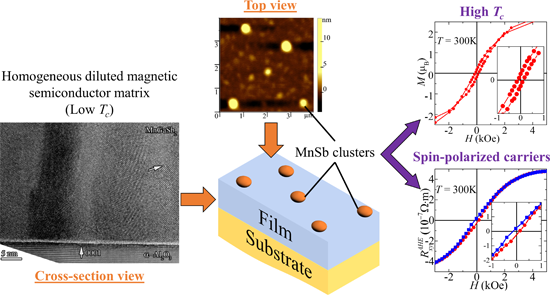
- doped by Mn [1][2][3]. Among these systems, the most well-known and extensively studied is Ga1−xMnxAs. Here Mn atoms substitute Ga atoms and establish a ferromagnetic state realized through carrier-induced indirect exchange between Mn atoms by a Zener–RKKY mechanism accompanied by the spin polarization
- injectors and a micromanipulator (Omniprobe, US). A 2 μm Pt layer was deposited on the surface of the sample prior to the cross-section preparation by FIB milling. Sections of approximately 8 × 5 μm2 area and 2 μm thickness were cut by 30 kV Ga+ ions, removed from the sample and then attached to the
- Omniprobe semiring (Omniprobe, US). Final thinning was performed with 5 kV Ga+ ions followed by cleaning by 2 keV Ga+ ions for electron transparency. All specimens were studied in a scanning/transmission electron microscope Titan 80-300 (FEI, US) equipped with a spherical aberration (Cs) corrector (electron