Search results
Search for "chemical reactions" in Full Text gives 153 result(s) in Beilstein Journal of Nanotechnology.
Antimicrobial metal-based nanoparticles: a review on their synthesis, types and antimicrobial action
Beilstein J. Nanotechnol. 2020, 11, 1450–1469, doi:10.3762/bjnano.11.129
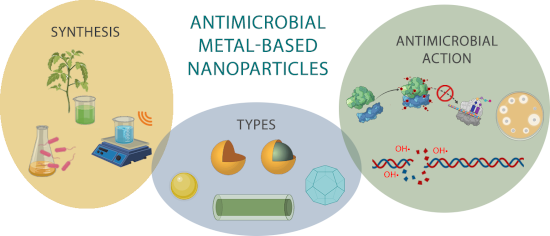
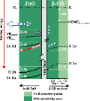
- through chemical reactions and these NPs have a strong bactericidal effect against Gram-negative and Gram-positive bacteria [108]. Composites containing Cu NPs and ZnO were developed by deposition of needle-like and spherical Cu NPs on a ZnO surface. These composites were exposed to visible light


Thermophoretic tweezers for single nanoparticle manipulation
Beilstein J. Nanotechnol. 2020, 11, 1126–1133, doi:10.3762/bjnano.11.97
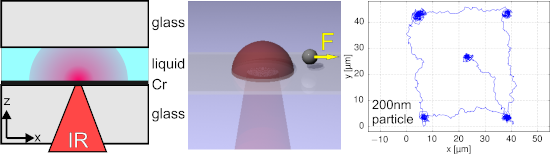
- enables the manipulation of trapped objects, which could be, for example, used to enormously increase the reaction rate of single-molecule chemical reactions. Given the usability for research on the nanometer-scale and relative ease of implementation on existing optical tweezers systems, we anticipate


Gas-sensing features of nanostructured tellurium thin films
Beilstein J. Nanotechnol. 2020, 11, 1010–1018, doi:10.3762/bjnano.11.85
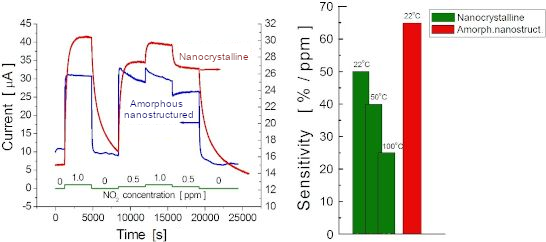
- grow Te nanoflakes. In order to synthesize Te nanowires, Liang and collaborators [13] performed chemical reactions of Na2TeO3, in aqueous solution, via hydrothermal treatment, whereas Ma and colleagues [14] used a solvothermal approach on glass substrates. To synthesize Te nanotubes, techniques such as


Simulations of the 2D self-assembly of tripod-shaped building blocks
Beilstein J. Nanotechnol. 2020, 11, 884–890, doi:10.3762/bjnano.11.73
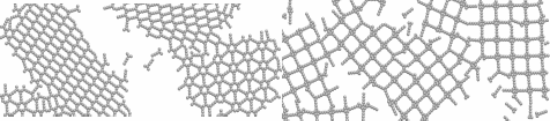
- a confinement template to initiate chemical reactions. It can be thought of as an extension of heterogenous catalysis where the initial precursors, the intermediate state, and the final supramolecular network all remain in an adsorbed state. Complex self-assembled structures are essential for many
- these chemical reactions are impossible to be performed in bulk. This is mainly because the substrate reduces the number of rotational and translational degrees of freedom of the admolecules. As a consequence, intermolecular contacts occur that stabilize the interactions between the particles. To


Multilayer capsules made of weak polyelectrolytes: a review on the preparation, functionalization and applications in drug delivery
Beilstein J. Nanotechnol. 2020, 11, 508–532, doi:10.3762/bjnano.11.41
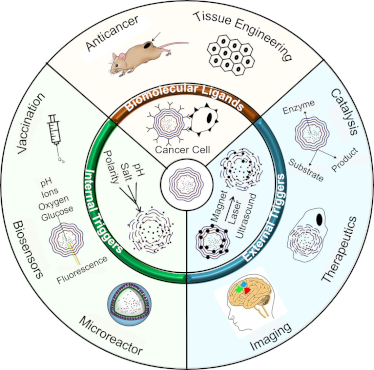
- conditions, number of polycation layers, cross-linker concentration and the nature of the dyes could significantly influence the encapsulation of anionic dyes or molecules [54]. Another method uses direct covalent chemical reactions as the driving force between comprising polymers yielding simultaneous



The different ways to chitosan/hyaluronic acid nanoparticles: templated vs direct complexation. Influence of particle preparation on morphology, cell uptake and silencing efficiency
Beilstein J. Nanotechnol. 2019, 10, 2594–2608, doi:10.3762/bjnano.10.250
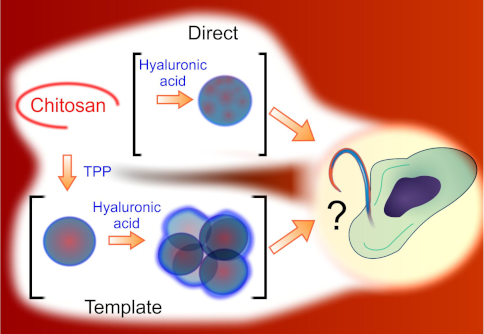
- anions, which effectively act as cross-linkers. Electrostatic complexation allows for very mild preparative processes, carried out in water under mild and almost physiological conditions and without the use of chemical reactions. Additionally, electrostatic interactions may not only be used to hold

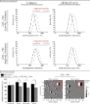


Evaluation of click chemistry microarrays for immunosensing of alpha-fetoprotein (AFP)
Beilstein J. Nanotechnol. 2019, 10, 2505–2515, doi:10.3762/bjnano.10.241
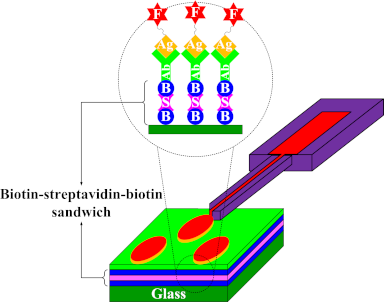
- successful implementation and a thorough comparison of their properties. Characterization of the surfaces by XPS and AFM All steps of the immobilization reactions were monitored by X-ray photoelectron spectroscopy (XPS) to validate the expected chemical reactions taking place (Figure 2). The



Ion mobility and material transport on KBr in air as a function of the relative humidity
Beilstein J. Nanotechnol. 2019, 10, 2084–2093, doi:10.3762/bjnano.10.203
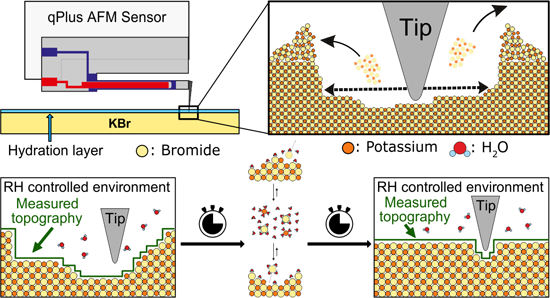
- chemical reactions or material exchange and movement. The adsorbed water layer that is present under ambient conditions plays an important role especially for highly soluble materials. Surface atoms can easily diffuse into the thin water layer and, when surface conditions are favorable, they can re-attach


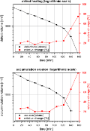
Growth of lithium hydride thin films from solutions: Towards solution atomic layer deposition of lithiated films
Beilstein J. Nanotechnol. 2019, 10, 1443–1451, doi:10.3762/bjnano.10.142
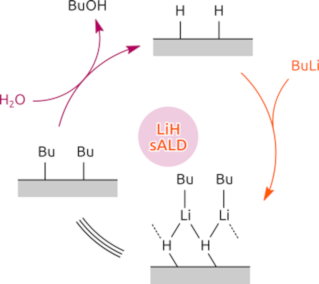
- deposition (ALD) avoids these issues and is able to deposit conformal films on 3D substrates. However, ALD is limited in the range of chemical reactions, due to the required volatility of the precursors. Moreover, relatively high temperatures are necessary (above 100 °C), which can be detrimental to


Multicomponent bionanocomposites based on clay nanoarchitectures for electrochemical devices
Beilstein J. Nanotechnol. 2019, 10, 1303–1315, doi:10.3762/bjnano.10.129
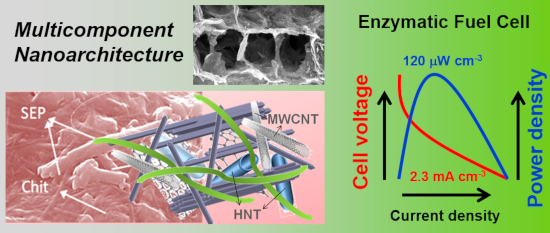
- functional materials. On the other hand, tubular nanoclays, such as halloysite nanotubes (HNTs), are interesting containers for the controlled chemical reactions at nanoscale interfaces and the delivery of active compounds thanks to their unique nature [12], which could be advantageous when integrated as



Synthesis of MnO2–CuO–Fe2O3/CNTs catalysts: low-temperature SCR activity and formation mechanism
Beilstein J. Nanotechnol. 2019, 10, 848–855, doi:10.3762/bjnano.10.85
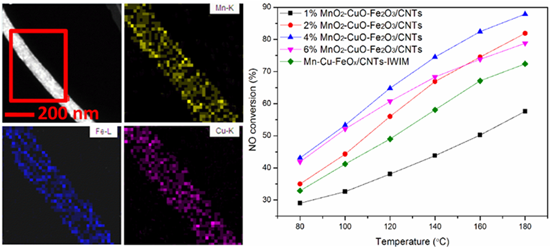
- shows three catalysts with excellent performance in the low-temperature NO reduction with NH3, but the chemical reactions during preparation are different. The 6% Ce2O3–CeO2–CuO–MnO2/CNTs and 4% MnO2–Fe2O3–CeO2–Ce2O3/CNT catalysts present outstanding denitration efficiency values over the test




Ceria/polymer nanocontainers for high-performance encapsulation of fluorophores
Beilstein J. Nanotechnol. 2019, 10, 522–530, doi:10.3762/bjnano.10.53
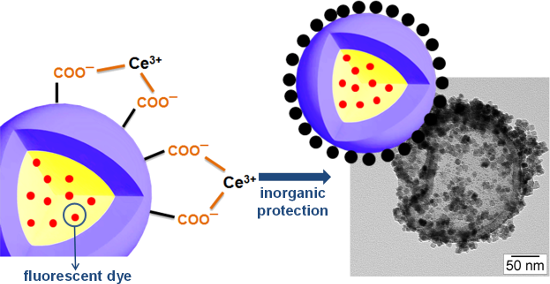
- unwanted chemical reactions [13]. Molecular oxygen is a well-known quencher of fluorescence. Consequently, the shell properties of the nanocontainers are often customized to protect the fluorophore encapsulated into a liquid core. Higher lying singlet states of a fluorophore are relatively short living and


Geometrical optimisation of core–shell nanowire arrays for enhanced absorption in thin crystalline silicon heterojunction solar cells
Beilstein J. Nanotechnol. 2019, 10, 322–331, doi:10.3762/bjnano.10.31
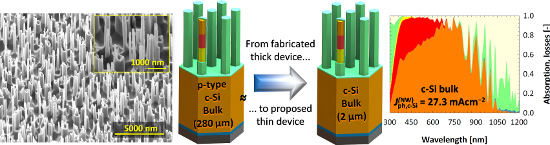
- fluorine radicals (F*) and oxygen radicals O*, which feed two competing chemical reactions: F* and Si react to form SF4+ ions, while from the reaction of O* and Si a silicon oxyfluorine (SiOxFy) layer is formed. This layer acts as mask against F* etching, but is physically broken by sputtered ions


Nitrous oxide as an effective AFM tip functionalization: a comparative study
Beilstein J. Nanotechnol. 2019, 10, 315–321, doi:10.3762/bjnano.10.30
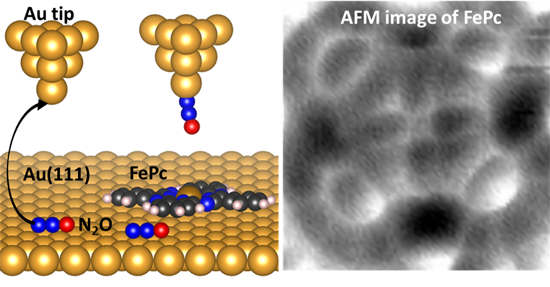
- states of chemical reactions [15][16][17][18][19] or discriminate the spin state of single molecules [20]. In most of these cases, the functionalized tip is routinely obtained by picking up a single CO molecule from the substrate. Applying an analogous approach, atomically sharp metal apexes can be also


Electrostatic force microscopy for the accurate characterization of interphases in nanocomposites
Beilstein J. Nanotechnol. 2018, 9, 2999–3012, doi:10.3762/bjnano.9.279
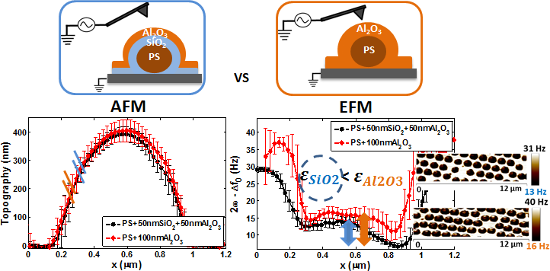
- [54]. Shells Alumina thin layers: atomic layer deposition (ALD). The ALD method was used to grow Al2O3 layers on the nanoparticles [55][56]. ALD is a thin film deposition technique where the film thickness is precisely controlled at the atomic level [57]. The deposition is based on sequential chemical
- reactions between gas precursors and the material surface. After each cycle of one precursor, an inert gas is introduced to remove the remaining precursor and the resulting by-products. The deposition conditions were the same as in [28]. The final theoretical configuration of the samples was similar to that




Colloidal chemistry with patchy silica nanoparticles
Beilstein J. Nanotechnol. 2018, 9, 2989–2998, doi:10.3762/bjnano.9.278
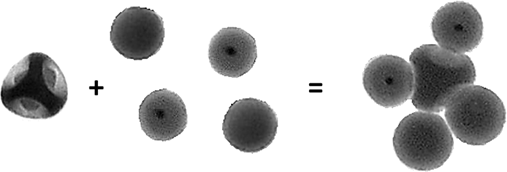
- nanoparticles and the chemical composition of the spherical satellites, we demonstrate that a vast collection of CMs are accessible through assemblies that are analogous to chemical reactions (Figure 1). Results and Discussion Synthesis and surface modification of the precursors The first type of precursors


Ternary nanocomposites of reduced graphene oxide, polyaniline and hexaniobate: hierarchical architecture and high polaron formation
Beilstein J. Nanotechnol. 2018, 9, 2936–2946, doi:10.3762/bjnano.9.272
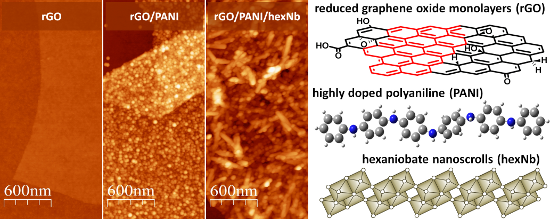
- K4Nb6O17) and protons (acidic form H2K2Nb6O17) [28][29]. Due to their high acidic surfaces, protonic niobates and titanoniobates have been reported as promising solid acid catalysts for various chemical reactions [30][31]. Moreover, hexaniobate can be exfoliated by treatment with a number of species such


Block copolymers for designing nanostructured porous coatings
Beilstein J. Nanotechnol. 2018, 9, 2332–2344, doi:10.3762/bjnano.9.218
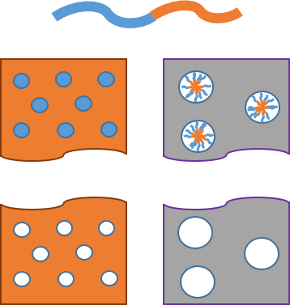
- peculiar characteristic can be coupled with sol–gel processes to produce well-ordered oxidic architectures [95][96]. The sol–gel process involves various chemical reactions such as hydrolysis, condensation, and consequently, polymerization involving the monomers (for inorganic systems, either metal


Spin-coated planar Sb2S3 hybrid solar cells approaching 5% efficiency
Beilstein J. Nanotechnol. 2018, 9, 2114–2124, doi:10.3762/bjnano.9.200
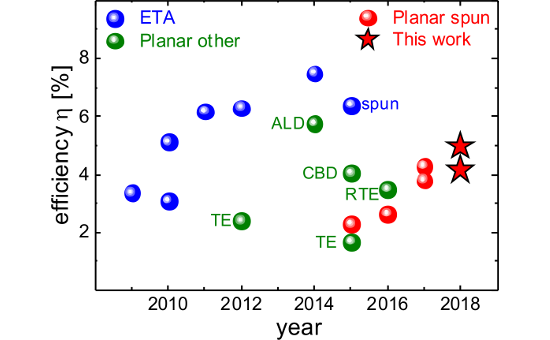
- requires the precise control of processing conditions and eventually limits the process’ reproducibility [29][32]. During chemical reactions in the water bath, various antimony oxides, hydroxides and sulfates form [6][42][43][44] which could be detrimental to device performance. With respect to oxide


Localized photodeposition of catalysts using nanophotonic resonances in silicon photocathodes
Beilstein J. Nanotechnol. 2018, 9, 2097–2105, doi:10.3762/bjnano.9.198
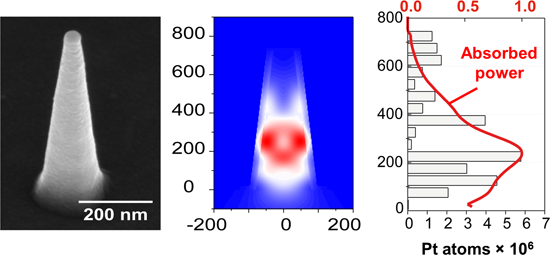
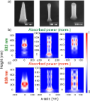
- spots”. These areas can be used for localized extraction of the photogenerated charges, which in turn could drive chemical reactions for synthesis of catalytic materials. In this work, we use these nanophotonic hot spots in vertical silicon nanowires to locally deposit platinum nanoparticles in a photo
- microscopy image analysis showed a reasonable correlation between the simulated hot spots and the actual experimental localization and quantity of platinum atoms. This nanophotonic approach of driving chemical reactions at the nanoscale using the optical properties of the photo-electrode, can be very
- separation participate in chemical reactions in the electrolyte to make fuels. One example is water splitting for H2 generation [5][6]. Carefully designed photo-electrodes are necessary for low cost and high efficiency, which are both needed to make solar fuels competitive with fossil fuels as an energy


Cryochemical synthesis of ultrasmall, highly crystalline, nanostructured metal oxides and salts
Beilstein J. Nanotechnol. 2018, 9, 1755–1763, doi:10.3762/bjnano.9.166
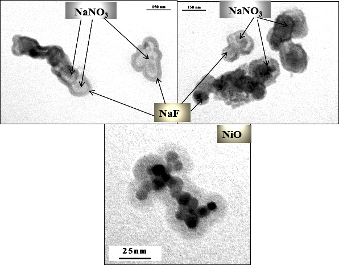
- industry and have applications in medical and biological research. Sergeev et al. have shown that the particle size is an active variable that together with other thermodynamic variables determines the state and reactivity of the system, whereby nanoparticles can promote chemical reactions which are not


Chemistry for electron-induced nanofabrication
Beilstein J. Nanotechnol. 2018, 9, 1317–1320, doi:10.3762/bjnano.9.124

- beams can be used to induce, on a very small area, chemical reactions of adsorbed precursor molecules that either lead to etching of the underlying surface or deposition of material. The latter additive variant of FEBIP is focused electron beam induced deposition (FEBID), a powerful direct-write
Heterostuctures of 4-(chloromethyl)phenyltrichlorosilane and 5,10,15,20-tetra(4-pyridyl)-21H,23H-porphine prepared on Si(111) using particle lithography: Nanoscale characterization of the main steps of nanopatterning
Beilstein J. Nanotechnol. 2018, 9, 1211–1219, doi:10.3762/bjnano.9.112
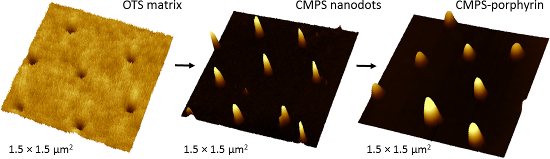
- porphyrins and organosilanes. With ex situ steps of particle lithography, the successive addition of molecules through chemical reactions in solution can be evaluated by measuring changes in the heights and morphology of nanostructures. Using high-resolution atomic force microscopy (AFM), surface changes can
- CMPS nanodots with growth observed in both the vertical and lateral directions. Particle lithography provides a practical tool for evaluating surface growth and changes for multistep chemical reactions on surfaces. Experimental Materials and reagents The porphyrin selected, 5,10,15,20-tetra(4-pyridyl


Understanding the performance and mechanism of Mg-containing oxides as support catalysts in the thermal dry reforming of methane
Beilstein J. Nanotechnol. 2018, 9, 1162–1183, doi:10.3762/bjnano.9.108
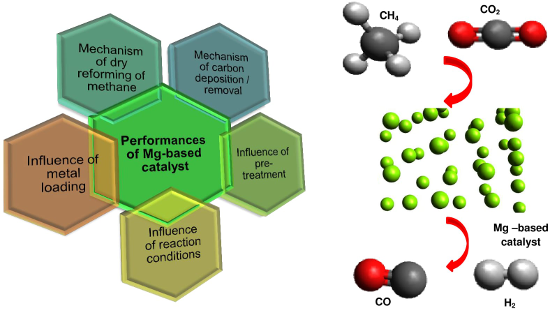
- analysis of a reaction is important for the theoretical study on the behavior of the process and the possible reaction conditions. A thermodynamic study could provide a basis for experimental investigation of the DRM reaction because the chemical reactions are conducted under equilibrium conditions [13][56
- especially on developing elementary and microkinetic analyses for the understanding of reactions that occur in DRM [79][80][81][82]. Microkinetic analysis is an investigation based on elementary chemical reactions on the catalytic surface and their relationship with each other and with the surface during a
- -containing oxide catalysts The use of Mg or MgO, as either a promoter or a support in catalyst components, has attracted considerable interest [50][51][52][78]. Catalyst supports and promoters perform different roles in chemical reactions. Catalyst supports are normally applied to increase the catalyst







Cyclodextrin inhibits zinc corrosion by destabilizing point defect formation in the oxide layer
Beilstein J. Nanotechnol. 2018, 9, 936–944, doi:10.3762/bjnano.9.86
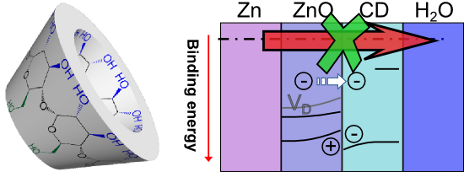
- ). On the other hand, ex situ Raman spectra (Supporting Information File 1, Figure S5) recorded after exposure do show the presence of β-CD on the surface, by the presence of several of the characteristic vibrational modes in the spectrum. The dissolution product Zn2+ is a reactant in follow-up chemical
- reactions, forming precipitates such as hydrated zinc oxide [15]. ZnO is naturally an n-type semiconductor with a band gap of 3.4 eV [20]. Oxides formed in an aerated corrosion process are typically defect-rich oxides [21], especially in the presence of Cl− [15]. Consequently, the products remain initially