


Search results
Search for "nanowire" in Full Text gives 182 result(s) in Beilstein Journal of Nanotechnology.
Superconductor–insulator transition in capacitively coupled superconducting nanowires
Beilstein J. Nanotechnol. 2020, 11, 1402–1408, doi:10.3762/bjnano.11.124
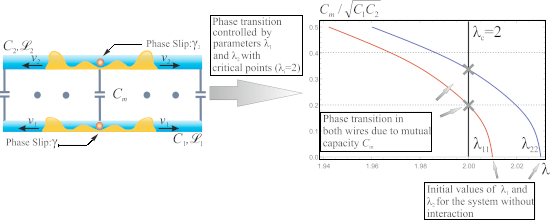
- voltage in the form of pulses. By applying a bias current the symmetry between positive and negative voltage pulses is broken and, as a result, a superconducting nanowire acquires a non-vanishing electrical resistance down to the lowest temperatures [5][6]. This effect was directly observed in a number of
- those of another one, thereby shifting the QPT in each of the wires in a way to increase the parameter range for the insulating phase. Qualitatively the same effect is expected to occur in a single superconducting nanowire that has the form of a meander frequently used in experiments. Results and
- properties can be investigated in exactly the same manner as was done in [5] in the case of a single nanowire. Generalization of the technique [5] to the case of two capacitively coupled superconducting nanowires is straightforward. For a linear resistance of the ith wire Ri(T) and for λii > 2 (or for any


Analysis of catalyst surface wetting: the early stage of epitaxial germanium nanowire growth
Beilstein J. Nanotechnol. 2020, 11, 1371–1380, doi:10.3762/bjnano.11.121
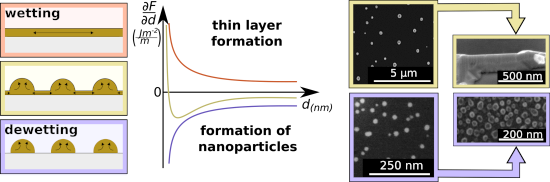
- grow germanium nanowires on different substrates is described. Keywords: dewetting; germanium; interfacial energy; Laplace pressure; nanostructure; nanowire; Ostwald ripening; wetting layer; Introduction Wetting phenomena as well as the formation and movement of droplets are essential for numerous
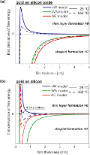
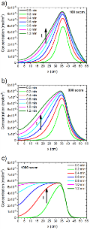
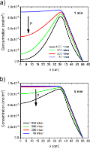
- can be found in the Experimental section. The resulting free energy leads to different nanodroplets, which changed their catalytic behaviour during nanowire growth. Results and Discussion Theoretical results Gold on silicon oxide Figure 1 shows the first derivative of the free energy with respect to
- germanium was deposited onto Au/Si substrates, germanium nanowires were grown. The in-plane nanowires started to grow at places where the gold droplets had formed previously. The inset shows gold at the top of the germanium nanowire, where continuous homoepitaxial growth was catalysed. A sample with a


3D superconducting hollow nanowires with tailored diameters grown by focused He+ beam direct writing
Beilstein J. Nanotechnol. 2020, 11, 1198–1206, doi:10.3762/bjnano.11.104
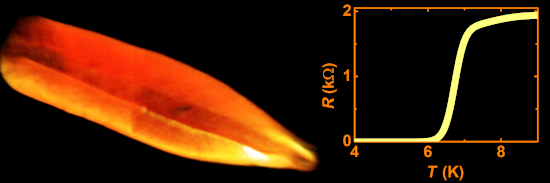
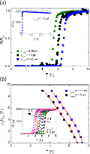
- is present along the whole nanowire length. Moreover, these nanowires become superconducting at 6.8 K and show high values of critical magnetic field and critical current density. Consequently, these 3D nano-objects could be implemented as components in the next generation of electronics, such as
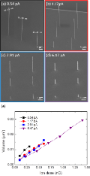
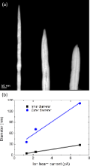
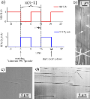
- ion beam current from 1.3 to 7 pA. STEM images of these hollow NWs are shown in Figure 3a. The observed non-uniform shape of the cavity in the central nanowire could be explained by several reasons, such as He+ FIB instability or irregular substrate surface. We find a linear dependence of the inner



Revealing the local crystallinity of single silicon core–shell nanowires using tip-enhanced Raman spectroscopy
Beilstein J. Nanotechnol. 2020, 11, 1147–1156, doi:10.3762/bjnano.11.99
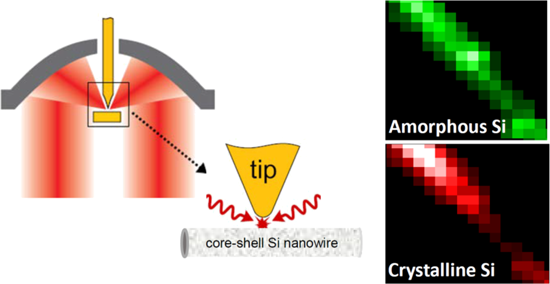
- electronic functionality of such nanometer-scale building blocks. A rational and well-established synthesis strategy for the creation of complex silicon nanostructures is metal-catalyzed vapor–liquid–solid (VLS) nanowire growth [13]. VLS nanowire growth belongs to the gas-phase synthesis procedures, similar
- to chemical vapor deposition (CVD), and enables direct nanowire growth in a bottom-up manner. The nanowire composition, in particular the doping concentration, can be controlled by an adequate adjustment of the synthesis gas mixture, e.g., by setting the SiH4/B2H6 ratio during the synthesis of boron
- the optical and electronic behavior of nanowire building blocks. Hence, there is an inherent need for non-destructive characterization techniques that are able to elucidate the local crystallinity. Raman spectroscopy is such a type of non-destructive characterization techniques and has become a


Electrochemical nanostructuring of (111) oriented GaAs crystals: from porous structures to nanowires
Beilstein J. Nanotechnol. 2020, 11, 966–975, doi:10.3762/bjnano.11.81
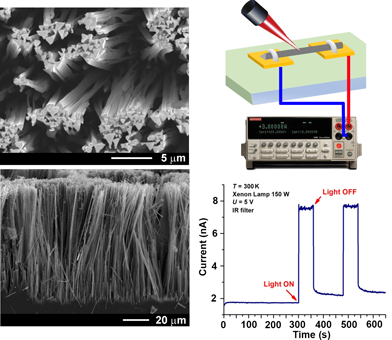
- present work also exhibit a diameter distribution with a certain width. However, we believe that the distribution could be narrowed by further optimization of the technological processes. Note that the diameter of a particular nanowire is determined by the width of the space charge region (SCR) set up
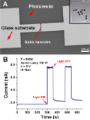
- metal deposition. Note that the nanowire was visible in the optical microscope due to its length of 70 µm, despite the small diameter. The distance between the contacts is 20 µm. A photograph of five contacted nanowires on a glass substrate after Cr/Au deposition and lift-off is presented in the inset
- of the Figure 7A. The photocurrent build-up and relaxation for a photodetector produced on a nanowire with a diameter of 400 nm is presented in Figure 7B for an IR illumination density of 800 mW·cm−2. One can see that the current increases by a factor of four in magnitude under illumination with IR





Transition from freestanding SnO2 nanowires to laterally aligned nanowires with a simulation-based experimental design
Beilstein J. Nanotechnol. 2020, 11, 843–853, doi:10.3762/bjnano.11.69

- experiments in order to switch freestanding nanowire growth to a laterally aligned growth mode. By means of finite element simulations, we determined that a higher volumetric flow and a reduced process pressure will result in a preferred laterally aligned nanowire growth. Furthermore, increasing the
- Sn gas was achieved by a carbothermal reduction of SnO2 powder. However, we observed no elongation of the nanowire length with an increase of the process time. Nevertheless, an alternating gas exchange between an inert gas (Ar) and an oxygen-containing process atmosphere yielded an elongation of the
- laterally aligned nanowires, indicating that the nanowire growth takes place in a transient period of the gas exchange. Keywords: finite element method simulation; laterally aligned nanowires; planar growth; tin oxide; vapor–liquid–solid nanowire growth; Introduction Since the first reports in 1964 by





Electromigration-induced directional steps towards the formation of single atomic Ag contacts
Beilstein J. Nanotechnol. 2020, 11, 680–687, doi:10.3762/bjnano.11.55
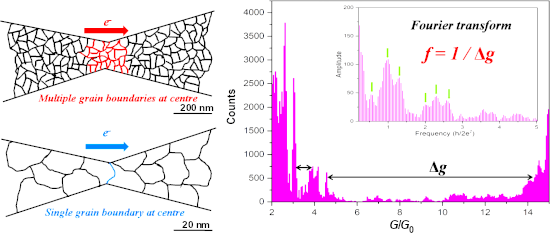
- corresponds to characteristic decrements of conductance. It can be interpreted by the semi-classical Sharvin formula. This formula is an approximation for contacts approaching the ballistic regime. Within this model, the nanowire conductance for a circular cross-sectional area, A, is given by [21]: with the


High-performance asymmetric supercapacitor made of NiMoO4 nanorods@Co3O4 on a cellulose-based carbon aerogel
Beilstein J. Nanotechnol. 2020, 11, 240–251, doi:10.3762/bjnano.11.18
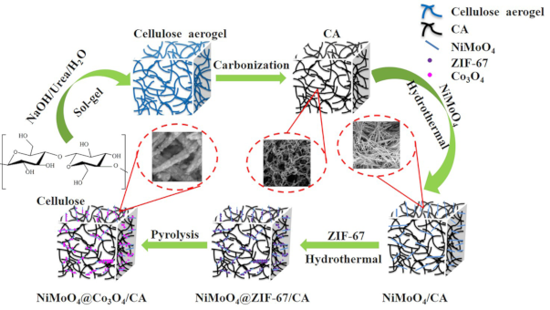
- construction of an integrated hierarchical porous nanoarchitecture by combining two metal oxides is a brilliant way to greatly enhance the overall electrochemical performance owing to synergistic effects [20]. For example, Li et al. synthesized 3D hybrid Co3O4/NiMoO4 nanowire/nanosheet arrays on a carbon cloth
- , which exhibited a capacitance of 3.6 F/cm2 at 3 mA/cm2, a capacitance retention of 82% and an increase of the current density from 3 to 15 mA/cm2 [21]. Cai et al. reported a facile two-step hydrothermal method to synthesize unique 3D Co3O4/NiMoO4 core/shell nanowire arrays on Ni foam, and the resulting




Molecular architectonics of DNA for functional nanoarchitectures
Beilstein J. Nanotechnol. 2020, 11, 124–140, doi:10.3762/bjnano.11.11

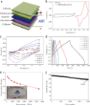
- template for nanowire synthesis. The miniaturization of devices is of central importance in electronics and has galvanized significant research in materials science. The need for the miniaturization of devices at the nanoscale interface has led to the exploration of new material systems and building blocks


Abrupt elastic-to-plastic transition in pentagonal nanowires under bending
Beilstein J. Nanotechnol. 2019, 10, 2468–2476, doi:10.3762/bjnano.10.237
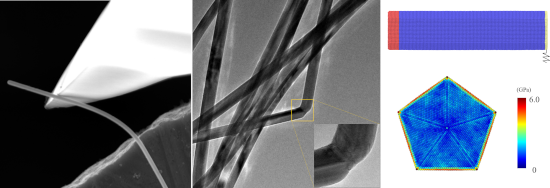
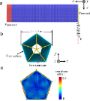
- are described by the widely used embedded atom method (EAM), and a potential for Ag is utilized here [36]. Due to the limitation of computational resources, the size of the nanowire in simulation is much smaller than that in the experiments. Figure 2a shows the atomic configuration of the penta
- showed that coating can increase the bending strength of the NWs. Schematic and SEM image of a pentagonal silver nanowire (Ag NW). SEM image adapted with permission from [28], copyright 2013 Elsevier. (a) Atomic simulation model of the Ag NW, (b) the internal twin structures (atoms in perfect lattice and



Deterministic placement of ultra-bright near-infrared color centers in arrays of silicon carbide micropillars
Beilstein J. Nanotechnol. 2019, 10, 2383–2395, doi:10.3762/bjnano.10.229
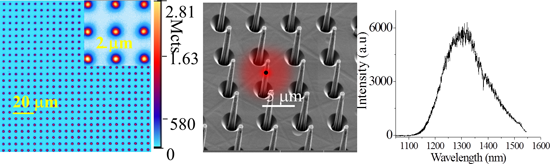
- nanowire detector with 80% quantum efficiency, and the DWF is 5%. The ZFS is 1.2–1.4 GHz in the ground state and 0.75–0.95 GHz in excited states. Both VSi and VSiVC have been proved to be useful for a high-fidelity spin–photon interface [6][27]. PL spectroscopy and EPR measurements combined with ab initio


Nitrogen-vacancy centers in diamond for nanoscale magnetic resonance imaging applications
Beilstein J. Nanotechnol. 2019, 10, 2128–2151, doi:10.3762/bjnano.10.207
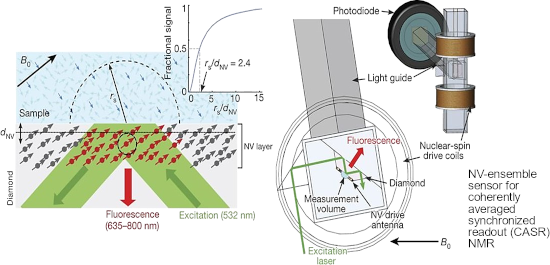
- allowed for in vivo imaging on the single-biomolecular scale at room temperature [12]. Other approaches not based on NV centers are evolving at the same pace as methods based on NV centers. For example, a new method for high-resolution nano-MRI coupling high spin sensitivity of nanowire-based MR detection


Prestress-loading effect on the current–voltage characteristics of a piezoelectric p–n junction together with the corresponding mechanical tuning laws
Beilstein J. Nanotechnol. 2019, 10, 1833–1843, doi:10.3762/bjnano.10.178
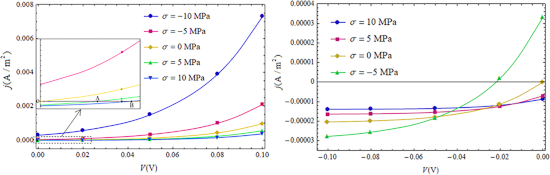
- ] studied the static extensional behavior of a piezoelectric semiconductor nanofiber. Liang et al. [20] analyzed the fundamental characteristics of a cantilevered ZnO nanowire exposed to a transient end force. Recently, Fan et al. [21] and Zhang et al. [22] revisited the bending behavior of a cantilevered
- ZnO nanowire based on the linear phenomenological theory of piezoelectric semiconductors. In their studies, the electric leakage of a bent ZnO nanowire is connected to the semiconductor properties and concluded that a lower doping concentration is more suitable for a bent ZnO nanowire to harvest




Kelvin probe force microscopy work function characterization of transition metal oxide crystals under ongoing reduction and oxidation
Beilstein J. Nanotechnol. 2019, 10, 1596–1607, doi:10.3762/bjnano.10.155
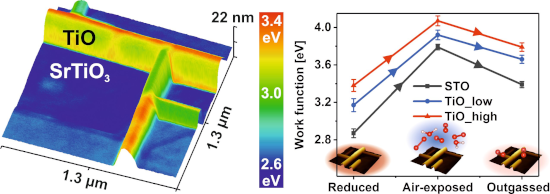
- nanowire array embedded in an insulator matrix, and to properly disentangle the electronic properties of both structures a technique with nanoscale resolution is needed. Indeed with the use of the LC-AFM technique, the conductivity of the developed nanostructures at the nanoscale can be characterized
- , providing the possibility of obtaining current maps as well as I–V characteristics at a given spot. Figure 2a and Figure 2b show the topography and current maps of the TiO nanowire network on SrTiO3(100). TiO has a higher conductivity than the surrounding SrTiO3 (STO) surface (the no current areas at
- nanowire edges are due to technical artefacts, such as wear of the coating of the conductive probe). To better illustrate the differences, I–V characteristics of TiO and STO were collected and are presented in Figure 2c. Given the ohmic behavior at the TiO nanowire, the conductance of the whole system (tip


Selective gas detection using Mn3O4/WO3 composites as a sensing layer
Beilstein J. Nanotechnol. 2019, 10, 1423–1433, doi:10.3762/bjnano.10.140
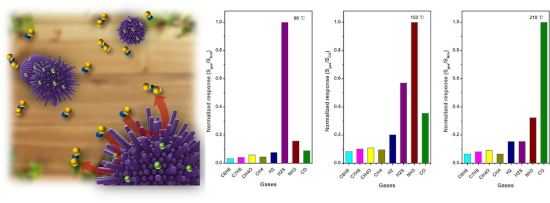
- gas sensing performance. Actually, the precursors before calcination are nanowire-like (Supporting Information File 1, Figure S1), but they present nanoparticles or nanorods after calcination treatment. The process could be explained by the re-crystallization of WO3 when annealing in air atmosphere


Gas sensing properties of individual SnO2 nanowires and SnO2 sol–gel nanocomposites
Beilstein J. Nanotechnol. 2019, 10, 1380–1390, doi:10.3762/bjnano.10.136
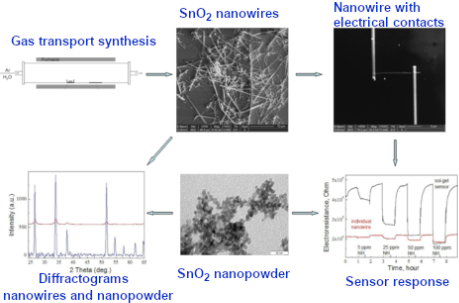
- sensor response due to the unlikelihood of sample recrystallization. The results from the ammonia detection experiments showed that the ratio of the sensor response to the surface area exhibits similar values for both the individual nanowire and nanopowders-based sensor materials. Keywords: gas sensors
- mainstream process in sensor development, because researchers have reached the limits of this method. For this reason, the interest in the development of nanowire devices (i.e., quasi-1-dimensional objects) has increased. Their surface-to-volume ratio can be as high as that of nanopowders obtained from
- nanowire synthesis was developed and reported in detail in the classic work of R. Wagner and W. Ellis [1]. Recently, with the use of this method, SnO2, In2O3, WO3, ZnO and other metal oxide nanowires were obtained [1][2][3][4][5]. Liquid phase synthesis methods have also been widely implemented [6][7][8][9




Janus-micromotor-based on–off luminescence sensor for active TNT detection
Beilstein J. Nanotechnol. 2019, 10, 1324–1331, doi:10.3762/bjnano.10.131
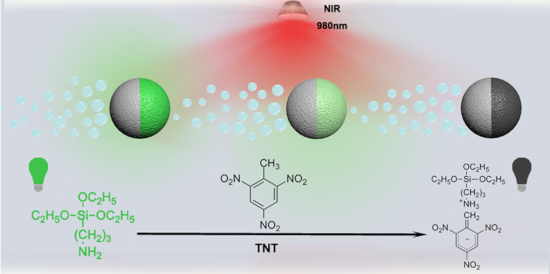
- ][17][18][19][20]. Based on the concept of nanoarchitectonics [21][22], various kinds of micro/nanomotors have been fabricated, such as Janus capsule micromotors [23], tubular micromotors [24], helical nanomotors [25], nanowire motors [26], and nanorod motors [27]. Unlike inert particles that move by


Electroluminescence and current–voltage measurements of single-(In,Ga)N/GaN-nanowire light-emitting diodes in a nanowire ensemble
Beilstein J. Nanotechnol. 2019, 10, 1177–1187, doi:10.3762/bjnano.10.117
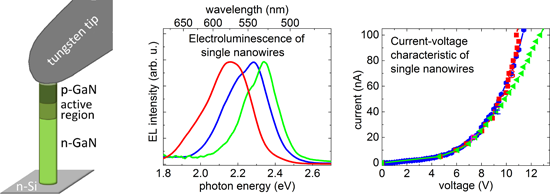
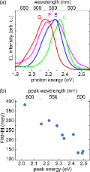
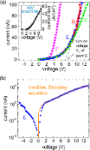
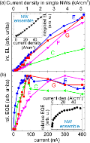
- ) behavior of single, freestanding (In,Ga)N/GaN nanowire (NW) light-emitting diodes (LEDs) in an unprocessed, self-assembled ensemble grown by molecular beam epitaxy. The data were acquired in a scanning electron microscope equipped with a micromanipulator and a luminescence detection system. Single NW
- employed here a very powerful analysis tool. Keywords: electroluminescence; external quantum efficiency (EQE); nanowire LED; single nanowire; current–voltage; Introduction Group-III nitride nanowire (NW) ensembles have been employed for a wide range of applications, especially optoelectronic devices [1
- . However, with this approach they could not measure the currents in the investigated NWs. Here, we present simultaneous measurements of the I–V behavior as well as the EL of single, freestanding nanowire LEDs in a self-assembled NW ensemble. To this end, as-grown NWs are contacted without any further


Renewable energy conversion using nano- and microstructured materials
Beilstein J. Nanotechnol. 2019, 10, 771–773, doi:10.3762/bjnano.10.76

- benefits arising from core–shell nanowire arrays for Si heterojunction solar cells. Contacts with a high surface-to-volume ratio can clearly be seen. Particularly in photovoltaics, they may be prone to increased recombination losses. For other applications, such as water splitting, porous materials may
Gold nanoparticles embedded in a polymer as a 3D-printable dichroic nanocomposite material
Beilstein J. Nanotechnol. 2019, 10, 442–447, doi:10.3762/bjnano.10.43
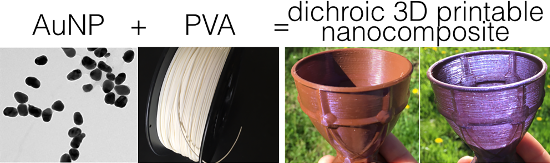
- dependent study shows the formation of small gold nuclei that in time cluster together forming nanowire-like structures concomitant to the first color change. The second change of color, from ink-black to purple, is accompanied by an enhancement of the scattering, giving the purple solution a brown



Sub-wavelength waveguide properties of 1D and surface-functionalized SnO2 nanostructures of various morphologies
Beilstein J. Nanotechnol. 2019, 10, 379–388, doi:10.3762/bjnano.10.37
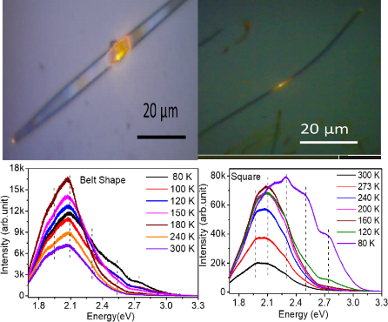
- measurements and a band diagram is proposed. Keywords: functionalization; nanowires; photoluminescence; SnO2; sub-wavelength waveguide; Introduction The development and understanding of one-dimensional (1D) nanowire (NW) sub-wavelength waveguides is a crucial step towards on-chip routing of optical signals
- measurements. The NWs were excited at 325 nm to observe the waveguide nature. Optical images were captured for the nanowire waveguides using the same optical microscope attached to the micro-Raman set up. We used a 50× objective for capturing images with numerical aperture (NA) of 0.45. The images were saved


Geometrical optimisation of core–shell nanowire arrays for enhanced absorption in thin crystalline silicon heterojunction solar cells
Beilstein J. Nanotechnol. 2019, 10, 322–331, doi:10.3762/bjnano.10.31
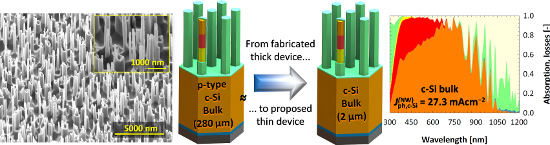
- characteristic radial junction configuration can lead to higher device performance, by increasing light absorption and, at the same time, improving the collection efficiency of photo-generated charge carriers. This work investigates the performance of ultra-thin solar cells characterised by nanowire arrays on a
- crystalline silicon bulk. Results: Proof-of-concept devices on a p-type mono-crystalline silicon wafer were manufactured and compared to flat references, showing improved absorption of light, while the final 11.8% (best-device) efficiency was hindered by sub-optimal passivation of the nanowire array. A
- dependence of absorption on the nanowire cross section, a weaker effect of the nanowire height and good resilience for angles of incidence of light up to 60°. Conclusion: The presence of a nanowire array increases the optical performance of ultra-thin crystalline silicon solar cells in a wide range of


Electromagnetic analysis of the lasing thresholds of hybrid plasmon modes of a silver tube nanolaser with active core and active shell
Beilstein J. Nanotechnol. 2019, 10, 294–304, doi:10.3762/bjnano.10.28
- cyclic photonic molecules [22][23], active circular disks with passive annular Bragg reflectors [24], and partially active circular and elliptic cavities [25][26]. More recently the LEP was applied to the modes of a single plasmonic nanowire [5] and a single plasmonic nanostrip [8] placed into an active
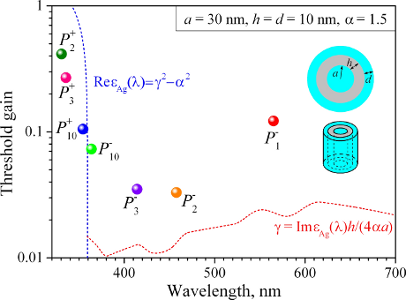
- highest red-shift, followed by the higher-order modes of the same type, and etc. If the tube gets thicker, each of the emission wavelengths of these modes moves closer to the value of 359 nm (from the red side) that is the accumulation point for the modes of the solid circular silver nanowire placed in


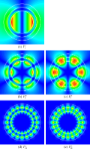
![[Graphic 29]](/bjnano/content/inline/2190-4286-10-28-i46.svg?max-width=637&scale=1.18182) λ = 565.03...
λ = 565.03...

![[Graphic 36]](/bjnano/content/inline/2190-4286-10-28-i53.svg?max-width=637&scale=1.18182) ...
...


Charged particle single nanometre manufacturing
Beilstein J. Nanotechnol. 2018, 9, 2855–2882, doi:10.3762/bjnano.9.266
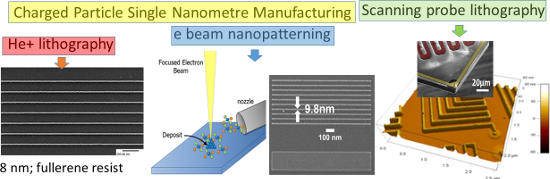
- technique and to determine the ultimate process resolution. In one of their early papers, Toth and Lobo [94] suggested that the etching was driven by SEs generated at the surface of the deposit or the substrate. Based on this, they demonstrated the fabrication of 4–7 nm wide gaps in a carbonaceous nanowire
- by an unconventional method. Using a stationary beam, pits were first etched at the desired location by EBIE with H2O in an environmental scanning electron microscope (ESEM). The field of view containing the nanowire was then scanned repeatedly in the presence of the precursor until a gap was created
- due to the increased SE yield from the nanowire sidewalls. The enhanced contrast of the nanowire edges seen in the SE image lends support to their theory. The advantage of working in an ESEM was the possibility of charge counteraction, allowing the use of insulating substrates like SiO2 that are


Improved catalytic combustion of methane using CuO nanobelts with predominantly (001) surfaces
Beilstein J. Nanotechnol. 2018, 9, 2526–2532, doi:10.3762/bjnano.9.235
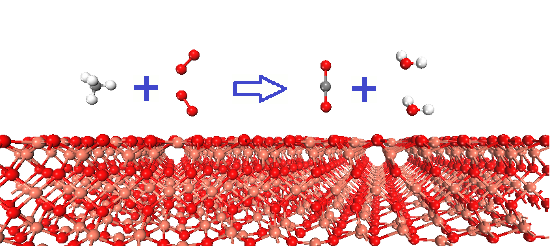
- in an early study [21][23], CuO NWs or NBs having predominantly (001) surfaces can be obtained when Cu(OH)2 is employed as a nanowire precursor for decomposition. The mechanism of shape-reserved transformation from Cu(OH)2 to CuO has been previously discussed in the literature [24][25][26]. Prior to





