Search results
Search for "roughness" in Full Text gives 481 result(s) in Beilstein Journal of Nanotechnology. Showing first 200.
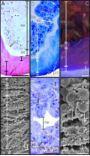
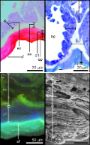
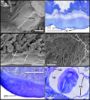
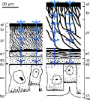
Comparative analysis of the ultrastructure and adhesive secretion pathways of different smooth attachment pads of the stick insect Medauroidea extradentata (Phasmatodea)
Beilstein J. Nanotechnol. 2024, 15, 612–630, doi:10.3762/bjnano.15.52
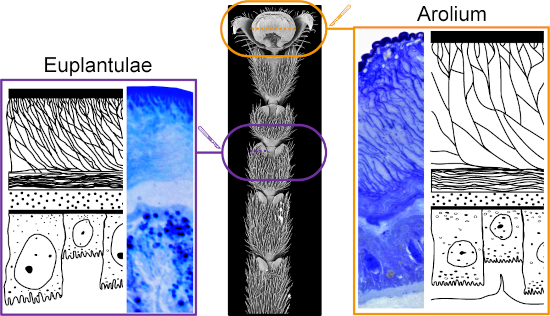
- roughness and thereby increase the contact area [14][16][17][18][19]. It can aid in the enhancement of viscous and capillary forces further increasing the attachment strength [9][14][20][21][22][23][24]. The adhesive secretion can be essential for the self-cleaning mechanism by binding smaller contamination


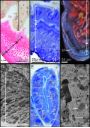

Insect attachment on waxy plant surfaces: the effect of pad contamination by different waxes
Beilstein J. Nanotechnol. 2024, 15, 385–395, doi:10.3762/bjnano.15.35
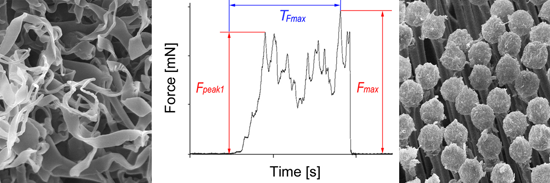
- (number per unit area) influence insect attachment [11][12]. As an explanation for reduced insect adhesion on waxy plant surfaces, several contributing mechanisms have been previously suggested, such as (1) specific micro/nanoroughness created by wax projections (roughness hypothesis), (2) contamination
- particles forming a separation layer between insect pads and the plant surface and serving as a kind of lubricant (separation layer hypothesis) [7][13]. To date, several experimental studies have been performed to test the first three hypotheses. As for the roughness hypothesis, it was revealed in
- centrifugal and pulling tests with some insect species bearing hairy attachment pads and mostly artificial substrates having different surface roughness. Insects showed several times higher attachment forces on both smooth and rather coarse microrough surfaces (>3 μm asperity size) compared to force values on




Investigating ripple pattern formation and damage profiles in Si and Ge induced by 100 keV Ar+ ion beam: a comparative study
Beilstein J. Nanotechnol. 2024, 15, 367–375, doi:10.3762/bjnano.15.33
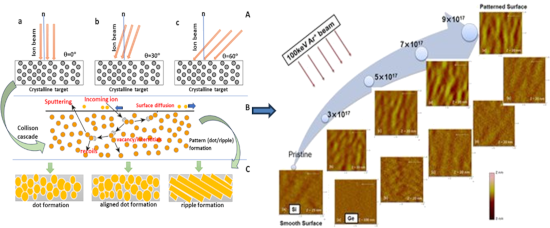
- samples were studied via AFM for the surface topography and change in root-mean-square (RMS) surface roughness. Figure 1 shows AFM images of pristine and 100 keV Ar+ ion-irradiated Si samples. Pristine samples show a smooth surface with a surface roughness of ≈0.5 nm as observed in Figure 1A (a). Figure
- 1A (b–e) shows the surface topography of the irradiated samples at respective ion fluences of (b) 3 × 10¹⁷, (c) 5 × 10¹⁷, (d) 7 × 10¹⁷, and (e) 9 × 10¹⁷ ions/cm2. The surface roughness (Rq) is found to be increased with ion fluence from ≈1.0 nm to 1.6 nm due to ion-induced sputtering at a 60
- nm) for an ion fluence of 9 × 10¹⁷ ions/cm2. Figure 2A shows AFM images of pristine and 100 keV Ar+ ion-irradiated Ge samples. The pristine sample shows a smooth surface with roughness of ≈0.5 nm as observed in Figure 2A (a). Figure 2A (b–e) shows AFM images of irradiated samples at respective ion


Controllable physicochemical properties of WOx thin films grown under glancing angle
Beilstein J. Nanotechnol. 2024, 15, 350–359, doi:10.3762/bjnano.15.31
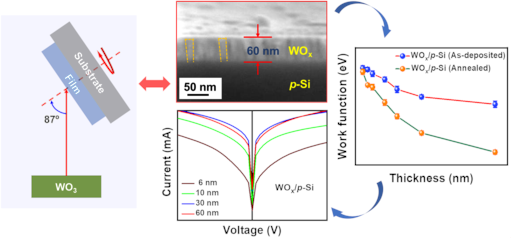
- WOx films having thicknesses of 6, 10, 30, and 60 nm on p-Si substrates. It is observed that the films are granular in nature. RMS roughness (blue-green circles) and average grain size (red-blue circles) increase as the film thickness increases from 6 to 60 nm (Figure 1i). Figure 1e–h shows the AFM
- images of vacuum-annealed (at 673 K for 1 h) WOx films prepared by the same set of deposition conditions. Similar to the as-deposited ones, all annealed WOx films possess prominent granular structures and an increasing trend in grain size and RMS roughness with film thickness (Figure 1j). However, the
- -deposited and (e–h) vacuum-annealed WOx films grown at a fixed glancing angle of 87°. (i, j) Variations in RMS roughness and grain size with WOx films thickness before and after annealing, respectively. (a) Transmittance plots of the as-deposited NS-WOx films and (b) bandgap variation with film thickness


Quantitative wear evaluation of tips based on sharp structures
Beilstein J. Nanotechnol. 2024, 15, 230–241, doi:10.3762/bjnano.15.22
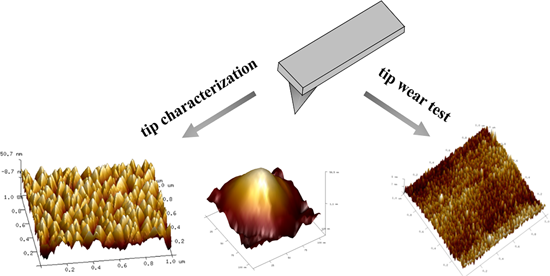
- structures is proposed. This research explored the wear of AFM tips during tapping mode and examined the effects of scanning parameters on estimated tip diameter and surface roughness. The experiment results show that the non-destructive method for measuring tip morphology is highly repeatable. Additionally
- indicator of tip wear, but also used the surface roughness (Ra) to represent the degree of image deterioration to evaluate the degree of probe wear. It was concluded that a high free amplitude and a set point of 0.5 increase probe wear, while a set point of 0.6 reduces tip wear; the scanning speed does not
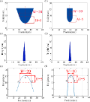
- procedure comprised three steps, as shown in Figure 10. Each test started with a new AFM tip. First, the TipCheck sample was used to measure the initial tip topography. Then, the wear resistance of the tip was tested by recording the average roughness of each image and conducting regular checks. The 3D




Multiscale modelling of biomolecular corona formation on metallic surfaces
Beilstein J. Nanotechnol. 2024, 15, 215–229, doi:10.3762/bjnano.15.21
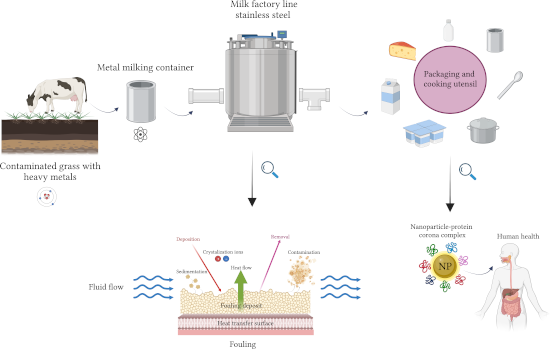
- orientation of each individual protein, a primary coarse-graining step was performed. In this part, we use the UA model to predict the protein–NP binding energies. This model takes into account various factors, such as the material’s chemical composition, size, shape, surface roughness, charge




CdSe/ZnS quantum dots as a booster in the active layer of distributed ternary organic photovoltaics
Beilstein J. Nanotechnol. 2024, 15, 144–156, doi:10.3762/bjnano.15.14
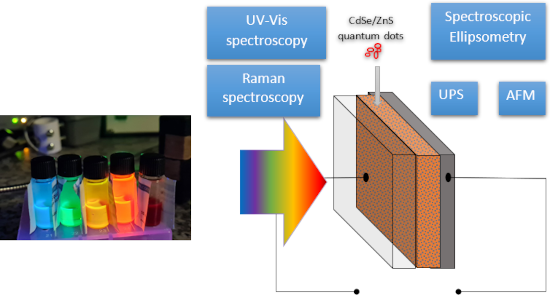
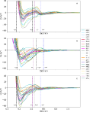
- observed in our study. Atomic force microscopy Surface examinations of the sample mixtures were performed. Figure 7 illustrates the surface morphology in a two-dimensional format. Three-dimensional images of the surface are in Supporting Information File 1, Figure S1. The roughness profile parameters for
- profile. The addition of quantum dots to the layer increases its roughness parameters. The surface also shows greater morphological differentiation in the form of numerous peaks present throughout the surface. The third component in the BHJ for the systems studied so far supported a reduction in roughness
- , which favored the charging process of the metallic electrode. These were used to facilitate the transport of charge carriers between the electrode and the layer, which can become problematic because of limitations in the conductivity of organic materials. The changes in roughness presented from the AFM




Influence of conductive carbon and MnCo2O4 on morphological and electrical properties of hydrogels for electrochemical energy conversion
Beilstein J. Nanotechnol. 2024, 15, 57–70, doi:10.3762/bjnano.15.6
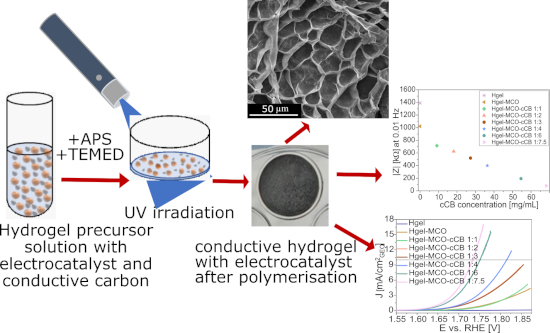
- cCB in the hydrogel-MCO structure. For the studied materials, CPE can be linked to a surface distribution of properties, related to the material roughness and the porosity of the films. In general, α values correlate with the observed behaviour of the corresponding Q parameters (Table 1). Therefore


Measurements of dichroic bow-tie antenna arrays with integrated cold-electron bolometers using YBCO oscillators
Beilstein J. Nanotechnol. 2024, 15, 26–36, doi:10.3762/bjnano.15.3
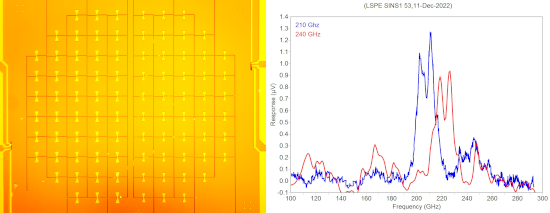
- process. In the future, it is planned to carry out a set of works to improve the barrier properties of aluminum oxide. The quality of the barrier largely depends on the roughness of aluminum. It can be critically large during electron beam deposition, which in turn affects the thickness of the barrier and
- the leakage resistance. We now test various ways to reduce the aluminum roughness. Also, the roughness strongly depends on the deposition rate. The oxidation process affects the barrier properties as well; perhaps with dynamic oxidation [26] (with constant pumping) one can try to achieve better


TEM sample preparation of lithographically patterned permalloy nanostructures on silicon nitride membranes
Beilstein J. Nanotechnol. 2024, 15, 1–12, doi:10.3762/bjnano.15.1
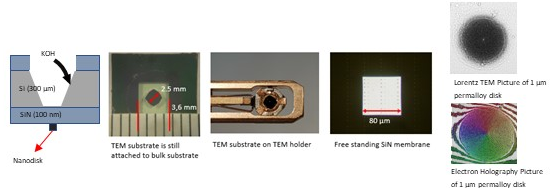
- . Fences and edge roughness from the imperfect lift-off process were reported to influence the magnetic properties of nanostructures [22]. The third method, stencil lithography, makes use of a shadow mask, which was fabricated by milling submicrometer apertures on a conventional TEM grid using a focused


Spatial variations of conductivity of self-assembled monolayers of dodecanethiol on Au/mica and Au/Si substrates
Beilstein J. Nanotechnol. 2023, 14, 1169–1177, doi:10.3762/bjnano.14.97
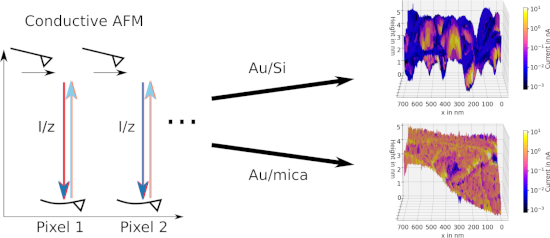
- rougher and a flatter gold substrate on the lateral variation of the conductivity. We find that the roughness of the substrate crucially defines this variation. We conclude that it is paramount to adequately choose a gold substrate for investigations on molecular layer conductivity. Keywords: Au/mica; Au
- substrates consisting of thin Au layers of different surface roughness. We compare granular Au films deposited on Si wafers with epitaxial (flat) Au films on mica. Experimental Before the experimental results are presented, this section focuses on the preparation of the samples under study and the setup used
- two DDT/Au/mica samples were investigated, yielding consistent results. In Figure 3a, the topography is similar to that obtained for the bare Au/mica surface, that is, relatively large flat areas, only small height differences throughout the image, and small roughness of the surface. By means of


Industrial perspectives for personalized microneedles
Beilstein J. Nanotechnol. 2023, 14, 857–864, doi:10.3762/bjnano.14.70
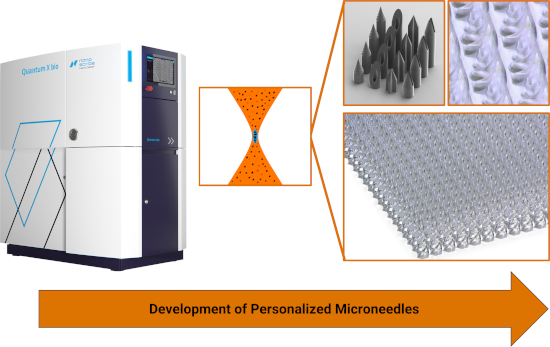
- artifact from slicing the computer-aided design (CAD) into layers [47][48]. The staircase effect leads to increased surface roughness of the order of micrometers, and high surface roughness on the microneedles will require substantially more pressure to penetrate the skin. These slicing artifacts


Biomimetics on the micro- and nanoscale – The 25th anniversary of the lotus effect
Beilstein J. Nanotechnol. 2023, 14, 850–856, doi:10.3762/bjnano.14.69

- material through a few steps. In the first step, a molten polypropylene layer is laminated onto a carrier film and run over rollers to cool down. Then the combined laminate is forced through a gap between a hot sandblasted roller and a cold smooth one. The surface roughness and temperature difference
- also reflected in the adhesive forces the animals are able to produce on surfaces of varying roughness. These observations make specific predictions about the behavioural ecology of this species in the wild. They also remind us to keep looking at the archetypes and closely related species for further


Cross-sectional Kelvin probe force microscopy on III–V epitaxial multilayer stacks: challenges and perspectives
Beilstein J. Nanotechnol. 2023, 14, 725–737, doi:10.3762/bjnano.14.59
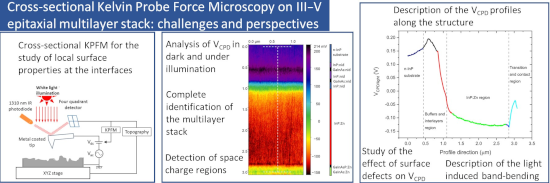
- , that is, the surface of the 2D wafer (e.g., around 3.09 μm in Figure 2). In order to achieve a successful KPFM analysis, a low surface roughness is essential to obtain high-quality images since surface inhomogeneities can cause a topographical image imprint on the surface potential image. With
- sufficiently low surface roughness, the topographic influence on the measurement is minor, and the observed contrast of the VCPD map is dominated by the surface potential such that topographic artefacts can be neglected. A first look at the VCPD image and the extrapolated profile (Figure 2c) allows for a


Investigations on the optical forces from three mainstream optical resonances in all-dielectric nanostructure arrays
Beilstein J. Nanotechnol. 2023, 14, 674–682, doi:10.3762/bjnano.14.53
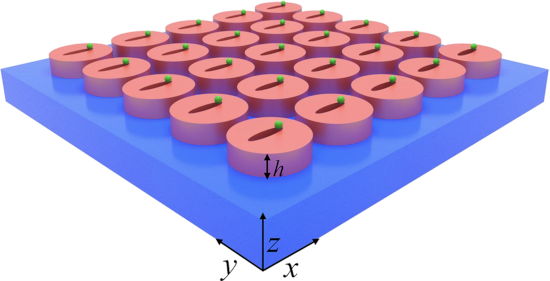
- , such as surface roughness, a BIC will turn into a quasi-BIC mode with both the Q-factor and resonant bandwidth becoming limited. Many applications of quasi-BICs have been reported, including ultrasensitive sensing [13], ultra-narrow bandwidth filters [14], and enhanced nonlinear effects [15]. The BICs


Thermal transport in kinked nanowires through simulation
Beilstein J. Nanotechnol. 2023, 14, 586–602, doi:10.3762/bjnano.14.49
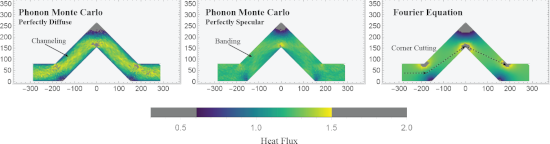
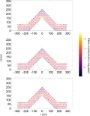
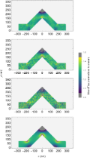
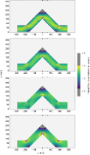
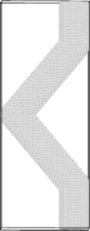
- systems with high surface roughness. Note the probability of specular reflection is constant here and not a function of the phonon wavelength or incidence angle, so specularities between 0% and 100% should be taken with this in mind. More sophisticated methods for calculating the probability of




SERS performance of GaN/Ag substrates fabricated by Ag coating of GaN platforms
Beilstein J. Nanotechnol. 2023, 14, 552–564, doi:10.3762/bjnano.14.46
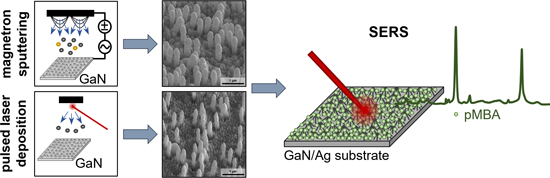
- absorption level for samples in a given series, it can be seen that an increase in the amount of deposited metal causes a decrease in light absorption, which is related to a decrease in surface roughness and the filling of the nanoporous GaN structure with silver. SERS performance of fabricated of GaN/Ag


Observation of multiple bulk bound states in the continuum modes in a photonic crystal cavity
Beilstein J. Nanotechnol. 2023, 14, 544–551, doi:10.3762/bjnano.14.45
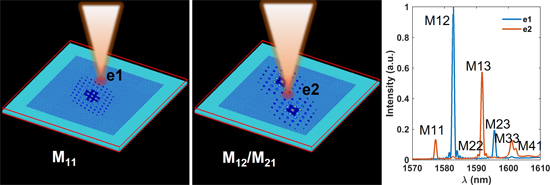
- influenced by both the radiative part Qr and a nonradiative part Qnr via 1/Q = 1/Qr + 1/Qnr provided that the material is lossless. Qnr incorporates defects such as structural disorder, surface roughness, and fabrication errors. The simulation of the unit cell was performed by COMSOL Multiphysics with
- nonradiative part of the Q factor mentioned above. Qnr is caused by structural imperfections and disorders, including roughness on the surface, tilted sidewalls, and incomplete etching of the AlGaAs layer, as shown in Figure 3a. Theoretically, resonances of high-order modes have lower Q factors and longer


Conjugated photothermal materials and structure design for solar steam generation
Beilstein J. Nanotechnol. 2023, 14, 454–466, doi:10.3762/bjnano.14.36
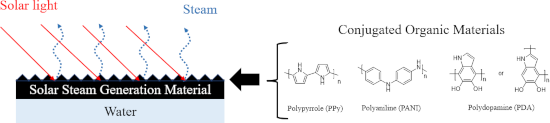
- depends on the number of layers, which was caused by the surface structure of the multilayer PPy nanosheets. The high roughness and sharp local curvature of the multilayer PPy nanosheets were retained and incident light was effectively redistributed. In other words, transmitted light is confined in the


Structural, optical, and bioimaging characterization of carbon quantum dots solvothermally synthesized from o-phenylenediamine
Beilstein J. Nanotechnol. 2023, 14, 165–174, doi:10.3762/bjnano.14.17
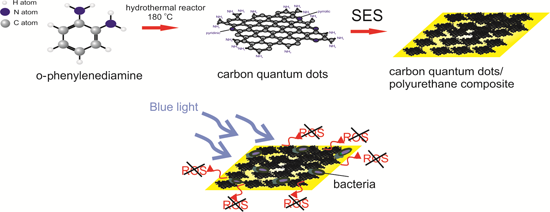
- nm (Figure S1c,d in Supporting Information File 1). Figure 1 shows the surface morphology of neat PU and a CQDs/PU sample. The RMS roughness values of these samples are 4.45 and 14.04 nm, respectively. FTIR, UV–vis, and PL spectra of CQDs and CQDs/PU To study the chemical and optical properties of


Characterisation of a micrometer-scale active plasmonic element by means of complementary computational and experimental methods
Beilstein J. Nanotechnol. 2023, 14, 110–122, doi:10.3762/bjnano.14.12
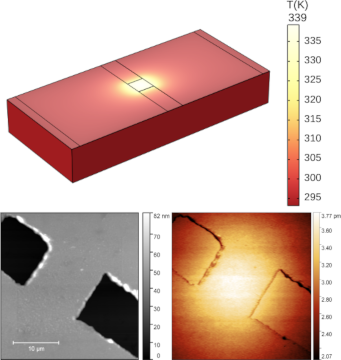
- SPR curve is slightly broader than the simulated one. This is due to experimental broadening (in particular, the divergence of the laser beam), surface roughness, and further temperature-induced degradation effects that are not taken into account in the simplified simulation setup employed. In order




Antimicrobial and mechanical properties of functionalized textile by nanoarchitectured photoinduced Ag@polymer coating
Beilstein J. Nanotechnol. 2023, 14, 95–109, doi:10.3762/bjnano.14.11
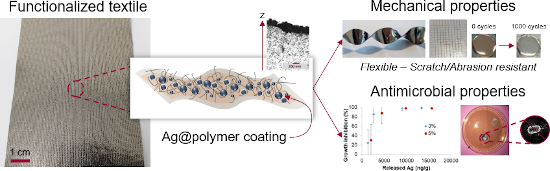
- surface roughness, as can be seen in the SEM images (Figure 7c). Consequently, the diffuse reflectivity drops in favor of the specular reflectance. The particles are no longer simply juxtaposed but form a continuous silver layer, especially after 1000 friction cycles. The characteristic silver plasmon



Electrical and optical enhancement of ITO/Mo bilayer thin films via laser annealing
Beilstein J. Nanotechnol. 2022, 13, 1589–1595, doi:10.3762/bjnano.13.133
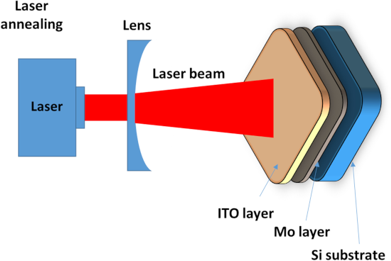
- AFM analysis shows that grain size and RMS roughness increased from 16.02 to 36.19 nm and 0.4 to 2.6 nm, respectively, when the laser energy was increased to 120 mJ. The as-deposited sample has an optical transmittance of nearly 80% in the 300–800 nm range. The laser annealing yielded a higher
- roughness. In this work, we investigate the effect of laser annealing treatment on ITO/Mo (IM) bilayer thin films as transparent conducting material for solar cell applications. The structural, optical, and electrical properties of the IM structure were examined as functions of the laser energy
- roughness of the bilayer structure were studied utilizing an atomic force microscope (AFM, Bruker Dimension Edge) and the Gwyddion software. The optical transmission was measured using an UV–vis spectrophotometer (UV-3600i Plus, SHIMADZU) in the range of λ = 300–800 nm. Finally, the electrical properties


Induced electric conductivity in organic polymers
Beilstein J. Nanotechnol. 2022, 13, 1551–1557, doi:10.3762/bjnano.13.128
- strip and the whole sandwich itself. (b) Atomic force microscope scan of a PDP film 0.1 wt % on Si substrate. The plot at the bottom illustrates the roughness of the surface along the indicated line. (c) Side view of a Pb–PDP–Pb structure on glass with solitary defect (lead shortcut) obtained by



Bending and punching characteristics of aluminum sheets using the quasi-continuum method
Beilstein J. Nanotechnol. 2022, 13, 1303–1315, doi:10.3762/bjnano.13.108
- strength at a specific structural orientation [51]. Besides, Tran et al. studied the friction and scratch characteristics of pure aluminum by the QC method. The bump width to the bump pitch (W/P) value, scratch depth, surface roughness, and indenter radius were set as variables in order to explore the