Search results
Search for "thin films" in Full Text gives 477 result(s) in Beilstein Journal of Nanotechnology. Showing first 200.
AFM-IR investigation of thin PECVD SiOx films on a polypropylene substrate in the surface-sensitive mode
Beilstein J. Nanotechnol. 2024, 15, 603–611, doi:10.3762/bjnano.15.51
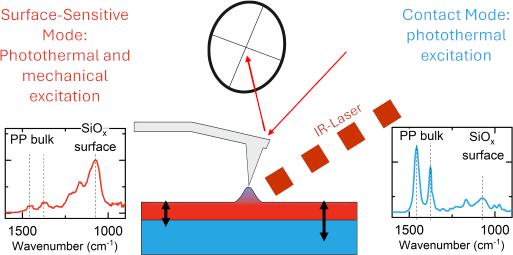
- the different measurement methods (i.e., contact mode and surface-sensitive mode) with respect to the chemical surface sensitivity. The use of the surface-sensitive mode in AFM-IR shows an enormous improvement for the analysis of thin films on the IR-active substrate. As a result, in this mode, the
- signal of the substrate material could be significantly reduced. Even layers that are so thin that they could hardly be measured in the contact mode can be analyzed with the surface-sensitive mode. Keywords: AFM-IR; polypropylene; surface-sensitive mode; silicon oxide; thin films; XPS; Introduction
- –sample force generated by the thermal expansion of the total excited volume is detected. This makes it very challenging to characterize thin films with a small thermal expansion coefficient (e.g., inorganic oxides) deposited on bulk materials with a large thermal expansion coefficient (e.g., polymers


On the mechanism of piezoresistance in nanocrystalline graphite
Beilstein J. Nanotechnol. 2024, 15, 376–384, doi:10.3762/bjnano.15.34
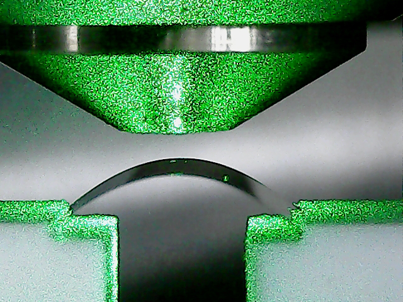
- density of defects in the form of grain boundaries. It holds an advantage over graphene in easily achieving wafer-scale growth with controlled thickness. In this study, we explore the piezoresistivity in thin films of nanocrystalline graphite. Simultaneous measurements of sheet resistance and externally


Controllable physicochemical properties of WOx thin films grown under glancing angle
Beilstein J. Nanotechnol. 2024, 15, 350–359, doi:10.3762/bjnano.15.31
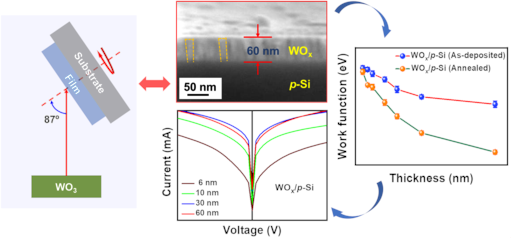
- , Alagappa University, Karaikudi 630 003, India Department of Physics, Indian Institute of Technology Kharagpur, Kharagpur 721 302, India 10.3762/bjnano.15.31 Abstract In this work, various physicochemical properties are investigated in nanostructured WOx thin films prepared by radio-frequency magnetron
- identified to regulate the rectification ratio values at the WOx/p-Si heterostructures and increase in series resistance within the bulk of the films. The present study provides valuable insights to correlate optical, electrical, and structural properties of WOx thin films, which will be beneficial for
- . In this regard, radio frequency (rf) sputter deposition is one of the preferred choices as an industry-compatible method to grow WOx thin films [2][19][20][21]. Apart from thin films, nanostructured metal oxides generally possess superior electrochemical properties compared to their bulk counterparts


Determining by Raman spectroscopy the average thickness and N-layer-specific surface coverages of MoS2 thin films with domains much smaller than the laser spot size
Beilstein J. Nanotechnol. 2024, 15, 279–296, doi:10.3762/bjnano.15.26
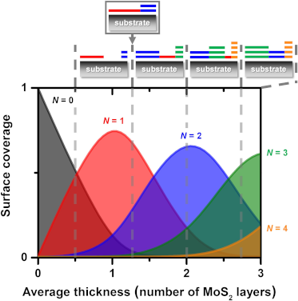
- Raman spectroscopy is a widely used technique to characterize nanomaterials because of its convenience, non-destructiveness, and sensitivity to materials change. The primary purpose of this work is to determine via Raman spectroscopy the average thickness of MoS2 thin films synthesized by direct liquid
- growth of wafer-scale MoS2 thin films on SiO2/Si substrates by direct liquid injection pulsed-pressure chemical vapor deposition (DLI-PP-CVD) using low-toxicity precursors [27]. Such MoS2 thin films showed good stoichiometry (Mo/S = 1.94–1.95) and the potential for high photoluminescence quantum yield
- develop and validate an approach for determining the average thickness of such sub-laser spot size inhomogeneous MoS2 thin films using Raman spectroscopy. First, we reassess here as a ground work the information that can be derived from the Raman spectra of MoS2 flakes for the evaluation of their


Ultrasensitive and ultrastretchable metal crack strain sensor based on helical polydimethylsiloxane
Beilstein J. Nanotechnol. 2024, 15, 270–278, doi:10.3762/bjnano.15.25
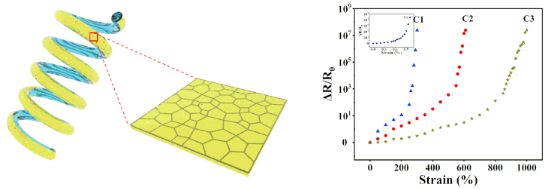
- was exerted on the surface of the Au film at a rate of 10% strain per second, resulting in the initiation and propagation of cracks. Following the release of the pre-stretch, the Au thin films were affixed to silver wires using silver paste at both ends. Ultimately, the surface of the helix was coated


Design, fabrication, and characterization of kinetic-inductive force sensors for scanning probe applications
Beilstein J. Nanotechnol. 2024, 15, 242–255, doi:10.3762/bjnano.15.23
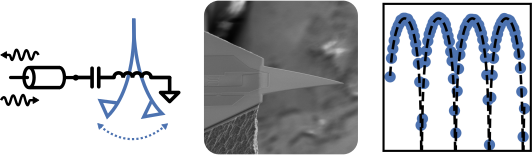
- larger than the geometric (electromagnetic) inductance in thin films and nanowires made of amorphous superconductors [16]. It is, therefore, useful in applications that require compact microwave resonators with low loss [17], including microwave filters [18] and resonant radiation detectors [19]. Large



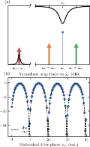
Ion beam processing of DNA origami nanostructures
Beilstein J. Nanotechnol. 2024, 15, 207–214, doi:10.3762/bjnano.15.20
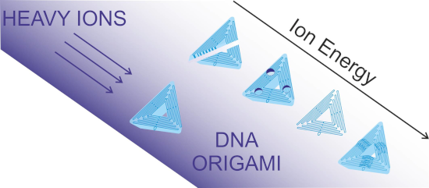
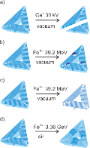
- the direction of the primary ion’s initial momentum. Hillock structures are usually formed upon such interaction with single-crystal materials [19], while craters and particle tracks form on polymeric thin films such as PMMA [20][21]. The dimensions of such features can be influenced by the interplay


CdSe/ZnS quantum dots as a booster in the active layer of distributed ternary organic photovoltaics
Beilstein J. Nanotechnol. 2024, 15, 144–156, doi:10.3762/bjnano.15.14
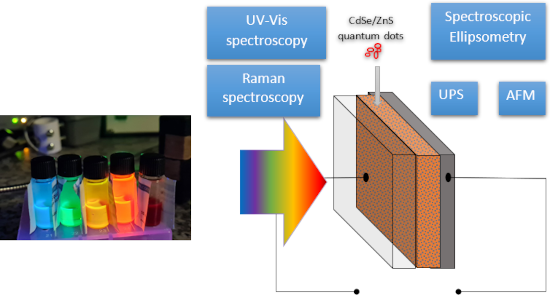
- relations of refractive indices and extinction coefficient were investigated. The morphologies of the thin films were studied with atomic force microscopy. The chemical boundaries of the ternary layers were determined by Raman spectroscopy. Based on UPS studies, the energy diagram of the potential devices
- –COOH groups, they can be easily labeled for chemical and biological applications. Low-molecular-weight organic molecules coat highly luminescent semiconductor nanocrystals. Materials and Methods Thin films, the intended active layers, were fabricated using the spin-coating method. The layers were a
- coefficient and shifts the maximum toward short wavelengths for the refractive index. Refractive indices and extinction coefficient parameters for investigated quantum dots thin films are summarized in Table 2. In ternary systems, a shift of the extinction coefficient maximum toward lower energies can be


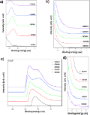


In situ optical sub-wavelength thickness control of porous anodic aluminum oxide
Beilstein J. Nanotechnol. 2024, 15, 126–133, doi:10.3762/bjnano.15.12
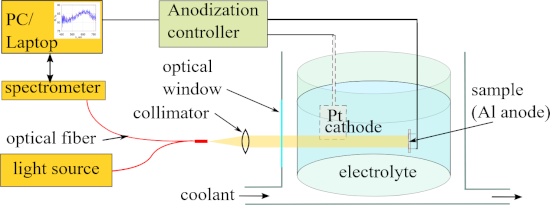
- microscopy and is particularly valuable for the small-scale production of PAAO-based functional optical coatings. Keywords: electrochemistry; ellipsometry; porous anodic alumina; spectroscopy; thin films; Introduction Porous anodic aluminum oxide (PAAO) is a versatile self-organized material with


Measurements of dichroic bow-tie antenna arrays with integrated cold-electron bolometers using YBCO oscillators
Beilstein J. Nanotechnol. 2024, 15, 26–36, doi:10.3762/bjnano.15.3
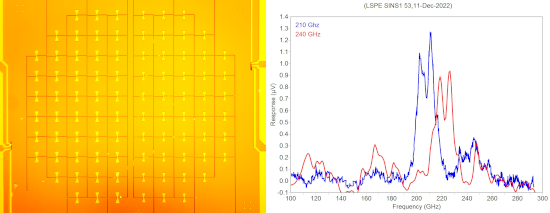
- based on high-temperature YBCO Josephson junctions [27][28][29]. Long junctions based on YBCO thin films were fabricated by the preliminary topology mask method [30][31]. Specifically, YBCO film was deposited on a 24° [001]-tilt Zr1−xYxO2 bicrystal substrate by magnetron sputtering with preliminary


Density functional theory study of Au-fcc/Ge and Au-hcp/Ge interfaces
Beilstein J. Nanotechnol. 2023, 14, 1093–1105, doi:10.3762/bjnano.14.90
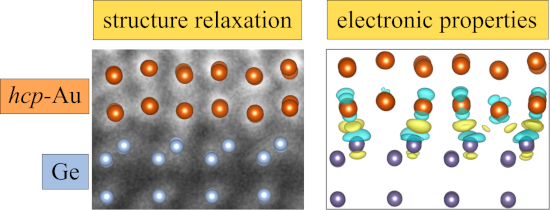
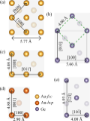
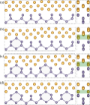
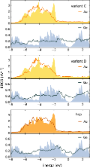
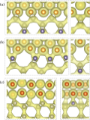
- interlayer distance compared to variant T2. The Ge–Au bond lengths obtained for the T1 structure, 2.50 Å, are in good agreement with the experimental values for amorphous GeAu alloys, 2.66 Å, [33] and thin films of Au covering a Ge(111) surface, 2.5 Å, [34]. In variant T2 the Au–Ge distance between Au atoms





Properties of tin oxide films grown by atomic layer deposition from tin tetraiodide and ozone
Beilstein J. Nanotechnol. 2023, 14, 1085–1092, doi:10.3762/bjnano.14.89
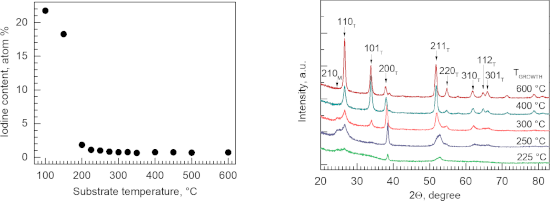
- Kristjan Kalam Peeter Ritslaid Tanel Kaambre Aile Tamm Kaupo Kukli Institute of Physics, University of Tartu, W. Ostwaldi 1, 50411 Tartu, Estonia 10.3762/bjnano.14.89 Abstract Polycrystalline SnO2 thin films were grown by atomic layer deposition (ALD) on SiO2/Si(100) substrates from SnI4 and O3
- from a film deposited at 300 °C is presented in Figure 9. The refractive index values in the range of 2.04–2.06 can be regarded as appreciably high for SnO2 thin films. Refractive index values of approx. 2.0 were measured by ellipsometry for SnO2 films grown by ALD from bis(1-dimethylamino-2-methyl-2
- outmost surface of the film. Conclusion SnO2 thin films were deposited from SnI4 and O3 via ALD in the temperature range of 100–600 °C. The resulting films formed in the crystalline tetragonal phase of SnO2 when the deposition temperature was over 225 °C, and the proportion of crystallised material in the


Dual-heterodyne Kelvin probe force microscopy
Beilstein J. Nanotechnol. 2023, 14, 1068–1084, doi:10.3762/bjnano.14.88
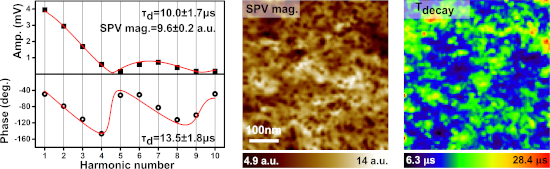
- latter configuration is used in the case of organic BHJ thin films (processed on transparent substrates, i.e., glass coated with indium thin oxide). The light intensity is adjusted using the laser power control and optical density filters. In the following, for each measurement, the optical power Popt
- again confirm the (positive) SPV polarity. To conclude this part of the work, it is important to check whether the data obtained for this PTB7:PC71BM sample are consistent with the results of our previous investigations on BHJ thin films based on the same donor–acceptor tandem. Considering only the SPV




Spatial mapping of photovoltage and light-induced displacement of on-chip coupled piezo/photodiodes by Kelvin probe force microscopy under modulated illumination
Beilstein J. Nanotechnol. 2023, 14, 1059–1067, doi:10.3762/bjnano.14.87
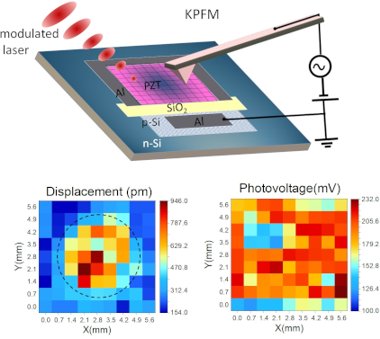
- effect of gravity on the displacement is taken into account. The voltage excitation signal is introduced to the LNO terminals as shown in the inset of Figure 2. The material properties of PZT and LNO thin films were derived from the literature and are summarized in Table 1. The strain-charge form is


N-Heterocyclic carbene-based gold etchants
Beilstein J. Nanotechnol. 2023, 14, 865–871, doi:10.3762/bjnano.14.71
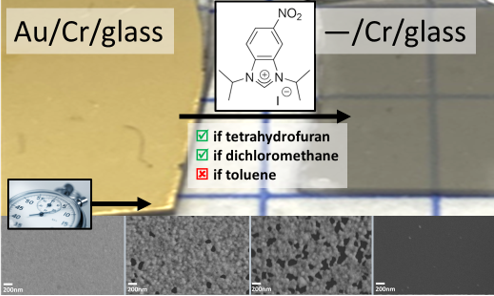
- but also the potential for deliberate etching, with the outcome determined by choice of chemically synthesized organic species and solvent. Keywords: gold etchant; microfabrication; N-heterocyclic carbenes; self-assembled monolayer (SAM); thin films; Introduction Self-assembled monolayers (SAMs) are
- reported the use of a benzimidazolium gold complex in dichloromethane (DCM) that readily functionalizes gold nanoparticles (AuNPs) in aqueous solution [15][19]. In our work using solution-based approaches to form NHC monolayers on gold thin films, we observed a loss of gold from our substrates. It is
- after only 30 min, that was at a substantially higher concentration of 2 in THF. In terms of generalizability, though, we are able to clearly show that etching of gold occurs from both thin films and nanoparticles, and in a single organic phase and a mixed organic and aqueous phase. Conclusion The



The microstrain-accompanied structural phase transition from h-MoO3 to α-MoO3 investigated by in situ X-ray diffraction
Beilstein J. Nanotechnol. 2023, 14, 692–700, doi:10.3762/bjnano.14.55
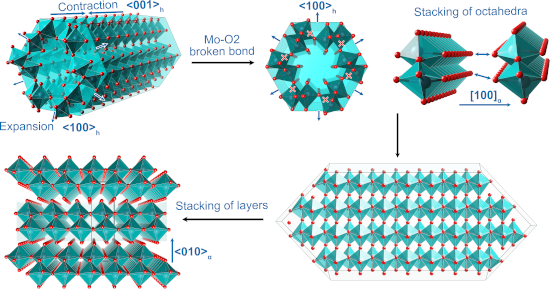
- some question regarding the h-MoO3 phase: (1) The location of the intercalated molecules inside the h-MoO3 structure is unknown. (2) The reason of the mismatch in h-MoO3 thin films and the failure of microdevices is not understood. (3) The structural phase transition at the atomic scale from h-MoO3 to
- transition from h-MoO3 to α-MoO3 Anisotropic thermal expansion and first-order phase transition The coefficient of thermal expansion (CTE) is an important mechanical parameter for the application of MoO3 thin films, as it can increase the mismatch between thin films and the substrate, causing microdevices to


Nanoarchitectonics to entrap living cells in silica-based systems: encapsulations with yolk–shell and sepiolite nanomaterials
Beilstein J. Nanotechnol. 2023, 14, 522–534, doi:10.3762/bjnano.14.43
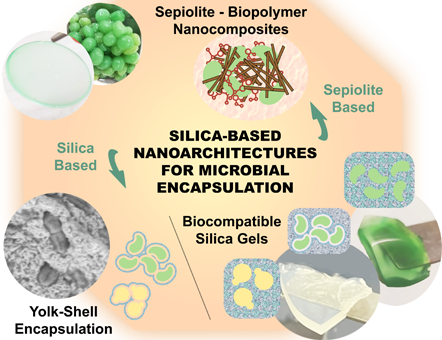
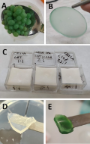
- to be tested as immobilization matrices of microalgae. Sepiolite–alginate beads, sepiolite–chitosan/alginate thin films, and sepiolite–chitosan foams were produced (Figure 1). Sepiolite and biopolymer concentration, synthesis temperature, and microorganism concentration were modified to study their
- precursor could be cast and gelled as thin films or hollow tubular monoliths with thin walls, improving the interaction between the encapsulated cells and a liquid medium in which the material could be placed. In addition to the optimisation of the sol–gel synthesis, the conditions for yolk–shell


The origin of black and white coloration of the Asian tiger mosquito Aedes albopictus (Diptera: Culicidae)
Beilstein J. Nanotechnol. 2023, 14, 496–508, doi:10.3762/bjnano.14.41
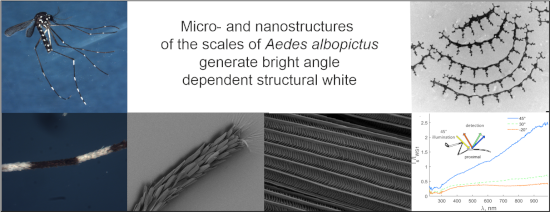
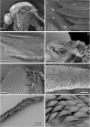
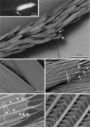
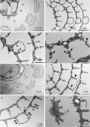
- (and also the black) appearance and demonstrates the importance of multiple reflections for the appearance of the white scales (Figure 6c). Thin film interference In the microscopic areas on the scales with relatively constant cuticle thickness, the effect of interference in thin films can be observed



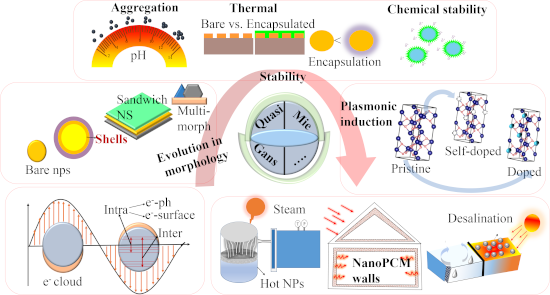
Plasmonic nanotechnology for photothermal applications – an evaluation
Beilstein J. Nanotechnol. 2023, 14, 380–419, doi:10.3762/bjnano.14.33




Formation of nanoflowers: Au and Ni silicide cores surrounded by SiOx branches
Beilstein J. Nanotechnol. 2023, 14, 133–140, doi:10.3762/bjnano.14.14
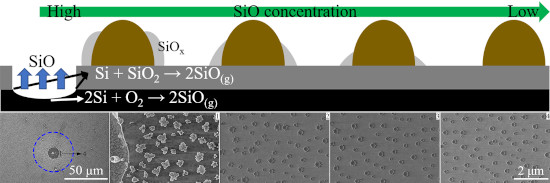
- also been obtained by depositing Au thin films on Si substrates with a thick silicon dioxide (SiO2) layer and subsequent rapid heating in reducing atmosphere. Here, the Si vapor source is silicon monoxide (SiO) gas produced by the decomposition of the SiO2 layer or the active oxidation of the Si
- ][24][25]. Apart from Au, both Ni and Ag can also catalyze the growth of NWs based on the VLS mechanism [26][27][28], and Si NWs have been grown using alloyed AuAg nanoparticles [29]. Au–SiOx nanoflowers have been fabricated by combining the dewetting of Au thin films and the growth of NWs based on the
- . It has been reported after the annealing of Au thin films deposited on SiO2/Si substrates with different thicknesses of the SiO2 layer [3][4][36]. The active oxidation of Si also occurs once the Si substrate is exposed [2][3][37], which can be proved by the calculated oxygen partial pressure


Combining physical vapor deposition structuration with dealloying for the creation of a highly efficient SERS platform
Beilstein J. Nanotechnol. 2023, 14, 83–94, doi:10.3762/bjnano.14.10
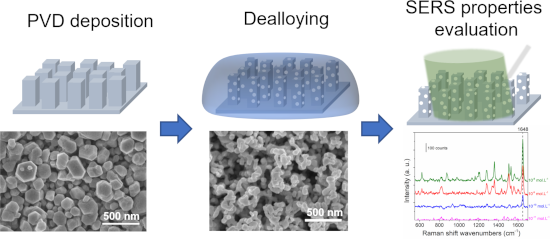
- Nanostructured noble metal thin films are highly studied for their interesting plasmonic properties. The latter can be effectively used for the detection of small and highly diluted molecules by the surface-enhanced Raman scattering (SERS) effect. Regardless of impressive detection limits achieved, synthesis
- suspension [15]. However, NPs suspensions are hard to handle, suffer from poor stability, and can hardly be reused [6]. In this perspective, major interest has been devoted to developing solid SERS platforms made of nanostructured thin films [15][16]. Among them, nanoporous materials show superior properties
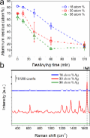
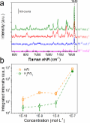
- . This approach allows for the synthesis of structured alloy thin films constituted of dispersed alloy columns. The dealloying of these films was implemented in three different media (i.e., hydrochloric acid (HCl), sodium hydroxide (NaOH), and phosphoric acid (H3PO4)) to highlight their impact on the




Upper critical magnetic field in NbRe and NbReN micrometric strips
Beilstein J. Nanotechnol. 2023, 14, 45–51, doi:10.3762/bjnano.14.5
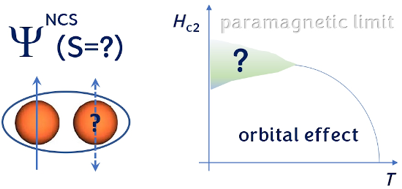
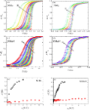
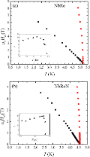
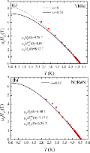
- rotation and relaxation studies [13] and large values of the upper critical magnetic fields [11][14], which are above the Pauli paramagnetic limit [15][16]. In the case of thin films, the structure of NbRe is polycrystalline with grains of small dimensions, typically of the order of 2–3 nm [7][8][17

The influence of structure and local structural defects on the magnetic properties of cobalt nanofilms
Beilstein J. Nanotechnol. 2023, 14, 23–33, doi:10.3762/bjnano.14.3
- performance improvement can be solved with the help of spintronics devices, which are currently presented in a fairly wide variety of valuable effects: spin valves and valves in thin films and heterostructures [19][20], sensors based on the anomalous Hall effect [21], spin injection and magnetism detection
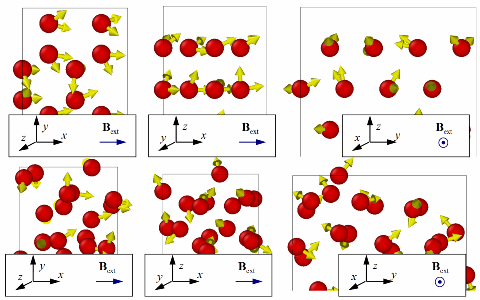
- defects and their influence on the magnetic properties of thin films. Therefore, in our studies, a small volume in the cobalt nanofilm is cut out and the simulation results were compared to that of the corresponding volume with an ideal structure. In addition, the periodic boundary conditions used in


Electrical and optical enhancement of ITO/Mo bilayer thin films via laser annealing
Beilstein J. Nanotechnol. 2022, 13, 1589–1595, doi:10.3762/bjnano.13.133
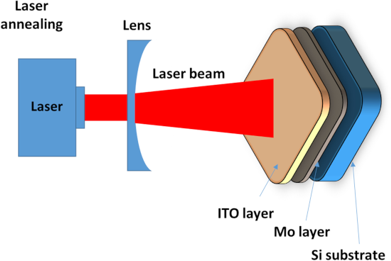
- Microelectronic and Nanotechnology Shamsuddin Research Centre (MiNT-SRC), Universiti Tun Hussein Onn Malaysia, 86400 Parit Raja, Batu Pahat, Johor, Malaysia 10.3762/bjnano.13.133 Abstract ITO/Mo bilayer thin films were sputtered on n-type silicon and glass substrates and annealed with a Nd:YAG pulsed laser. The
- structural results show that both the as-deposited and the annealed ITO/Mo thin films have a polycrystalline structure, and that the annealing treatment enhanced the crystallinity of samples. Moreover, the XRD patterns exhibited a cubic structure preferentially oriented along the (222) and (400) planes. The
- significantly improve the electrical properties without affecting the optical transmission [9]. Several metals have been used for such thin layers, including silver [10], aluminium [11], copper [12], and gold [13]. Molybdenum thin films are another choice for the application in solar cells because of good


Induced electric conductivity in organic polymers
Beilstein J. Nanotechnol. 2022, 13, 1551–1557, doi:10.3762/bjnano.13.128
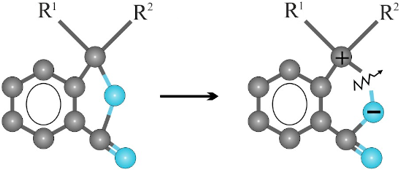
- ; thin films; Introduction Most polymers can be classified as organic dielectrics. However, there exists a specific class of polymers, typically characterized by the existence of conjugated π-bonds, which enable delocalization of electrons leading to electric conductivity in the ground state of the