Search results
Search for "topography" in Full Text gives 451 result(s) in Beilstein Journal of Nanotechnology. Showing first 200.
Spatial variations of conductivity of self-assembled monolayers of dodecanethiol on Au/mica and Au/Si substrates
Beilstein J. Nanotechnol. 2023, 14, 1169–1177, doi:10.3762/bjnano.14.97
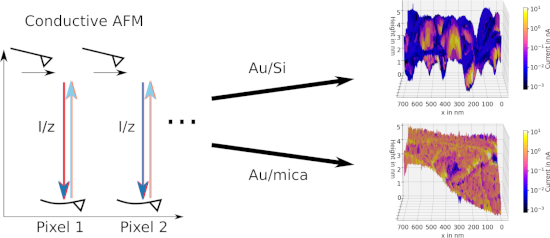
- applied method uses conductive atomic force microscopy (CAFM). In this technique, a conductive probe is used in an AFM, which allows for imaging the surface topography (and other characteristics such as adhesion and stiffness) with lateral resolution while simultaneously being able to measure current
- study, since it measures topography and current simultaneously and reduces wear effects on the tips. Results and Discussion We divided the results obtained with the methods described above into two main sections. These are studies on (i) the bare substrates and on (ii) the DDT SAMs on these substrates
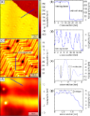
- Figure 2b show the topography and the current map, respectively, for a Au/mica substrate. The 300 × 300 nm2 topography map shows that the Au/mica substrate has large flat areas on which the height does not change significantly. The overall change in height throughout the image is approximately 4 nm, and


Hierarchically patterned polyurethane microgrooves featuring nanopillars or nanoholes for neurite elongation and alignment
Beilstein J. Nanotechnol. 2023, 14, 1157–1168, doi:10.3762/bjnano.14.96
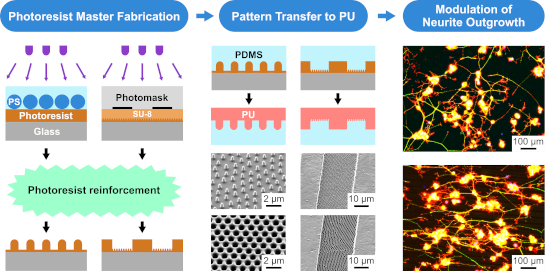
- patterned nano-/microstructured PU films enhance both PC12 neurite elongation and alignment, showing the potential use of our proposed method for the micro-/nanopatterning of polymers for nerve tissue engineering. Keywords: hierarchical; nanopatterning; neurite alignment; neurite outgrowth; topography


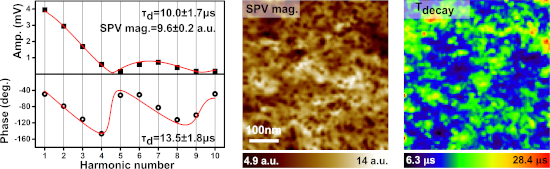
Dual-heterodyne Kelvin probe force microscopy
Beilstein J. Nanotechnol. 2023, 14, 1068–1084, doi:10.3762/bjnano.14.88




Spatial mapping of photovoltage and light-induced displacement of on-chip coupled piezo/photodiodes by Kelvin probe force microscopy under modulated illumination
Beilstein J. Nanotechnol. 2023, 14, 1059–1067, doi:10.3762/bjnano.14.87
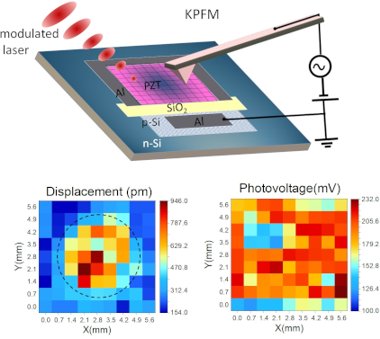
- with atomic vertical resolution. In several studies, AFM has been used to determine photo-induced height/topography variation in organic–inorganic lead halide perovskites [15], nanosheets [16], and photosensitive polymers [17]. Kelvin probe force microscopy (KPFM), an electrostatic variant of AFM, can
- the dark and CPDlight is the CPD under illumination in that same location [24][25][26][27]. In some studies, KPFM has been employed for simultaneous study of structural and optoelectronic properties of materials and functional devices [28][29][30]. For example, the topography and SPV of illuminated
- mechanical resonance frequency (f0) executed by the lock-in amplifier 1 and the generated topography signal is controlled by the Z feedback. A sinusoidal AC bias (VAC) with drive of 1 V and frequency (fAC) of 5 kHz is applied to the tip through lock-in 2, generating a signal with a frequency of f0 ± fAC near


Exploring internal structures and properties of terpolymer fibers via real-space characterizations
Beilstein J. Nanotechnol. 2023, 14, 1004–1017, doi:10.3762/bjnano.14.83
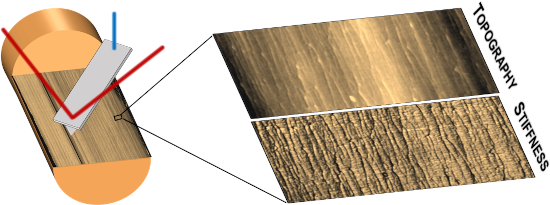
- nano- and microscale topography, stiffness, and transverse elastic modulus (ET) maps of internal structural features and local mechanical responses in real space. (See the Experimental section for additional details.) As Technora® has often been compared to Kevlar® K29 fibers, we focus further on
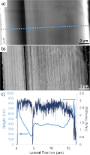
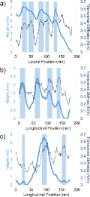
- ®, both the topography and stiffness maps (Figure 2) revealed a consistent microstructure across the fiber diameter at this length scale. Complementing topography and stiffness maps, lateral line profiles (e.g., dashed line, Figure 2a) quantified both topography and stiffness variations across the
- diameter. Topography and stiffness (Figure 2c) were remarkably uniform across the diameter as well. Only two notable features deviate from our consistent topography and stiffness measurements: (i) slopes from the outer edges inward and (ii) a sudden jump at a lateral position of ca. 5 μm. It should be






Cross-sectional Kelvin probe force microscopy on III–V epitaxial multilayer stacks: challenges and perspectives
Beilstein J. Nanotechnol. 2023, 14, 725–737, doi:10.3762/bjnano.14.59
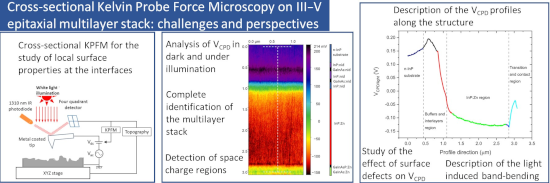
- , immediately after the chemical cleaning step. The topography and the associated VCPD image are reported in Figure 2a and Figure 2b, respectively. Note that the origin (0;0) is identified as a point in the InP substrate. Moving along the positive direction of the y axis, one will reach the end of the sample
- 0.61 and 0.91 μm, respectively. The low resolution of the interlayers can be attributed either to their narrowness or to the experimental conditions since the two GaInAs:nid layers are well resolved in the topography image. Certainly, the width of these layers is narrower than the radius of the tip
- illumination on the sample cross section, we have performed KPFM measurements under white-light illumination. The topography and the associated VCPD image are reported in Figure 4a and Figure 4b, respectively. The VCPD/light image of Figure 4b shows a significant contrast enhancement due to the interaction


Molecular nanoarchitectonics: unification of nanotechnology and molecular/materials science
Beilstein J. Nanotechnol. 2023, 14, 434–453, doi:10.3762/bjnano.14.35
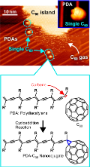
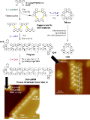
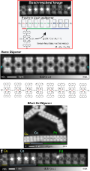
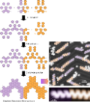
- oligomeric chains were significantly elongated. High-resolution scanning tunneling microscope (STM) topography shows alternating bright twin spots, which correspond to phenylene and tetrafluorophenylene, respectively. A high-resolution atomic force microscope (AFM) image of an entirely elongated fine





High–low Kelvin probe force spectroscopy for measuring the interface state density
Beilstein J. Nanotechnol. 2023, 14, 175–189, doi:10.3762/bjnano.14.18
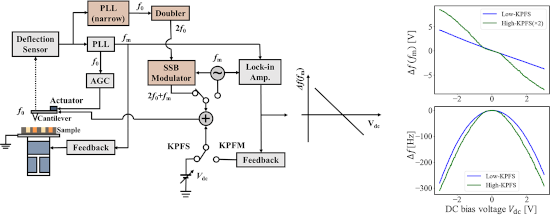
- the measurement. (a) Surface topography and (b) CPD image of the pn-patterned Si surface. The CPD image was obtained by KPFM using an AC bias voltage with a low modulation frequency of fm = 100 Hz. The scan size was 7 μm × 2.1 μm. (c) Line profile corresponding to the white line in panel (a); (d) line



Characterisation of a micrometer-scale active plasmonic element by means of complementary computational and experimental methods
Beilstein J. Nanotechnol. 2023, 14, 110–122, doi:10.3762/bjnano.14.12
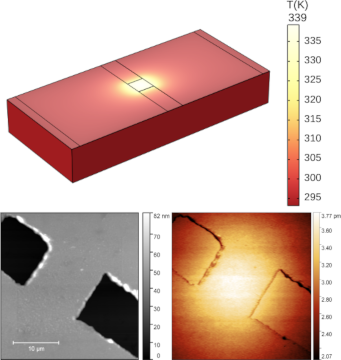
- of the topography from a surface scan performed while the element is modulated at a known frequency. This is the basis for SJEM measurements. Here, SJEM measurements have been performed using an Oxford instruments Cypher-S AFM and a signal recovery 7270 DSP lock-in amplifier. Figure 3 illustrates the
- setup used to perform such measurements. An Adama NM-RC probe (spring constant: 290.3 N/m, nominal resonance frequency: 814 kHz) has been used in contact mode to scan the topography of an electrically modulated sample with a loading force of 1.9 μN. This particular probe is intended for use in
- for each curve. Left: Topography of the active element. AFM scan of 30 × 30 μm2 area of a 10 μm wide constriction in a 48 nm thin silver film. Right: Expansion of active element due to applied voltage V(t), as defined above, for a current density of 44 mA/μm2. Both scans are 512 × 512 pixels yielding




Gap-directed chemical lift-off lithographic nanoarchitectonics for arbitrary sub-micrometer patterning
Beilstein J. Nanotechnol. 2023, 14, 34–44, doi:10.3762/bjnano.14.4
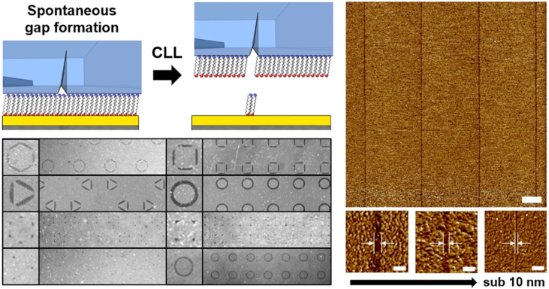
- ) Schematic illustration of the post lift-off wet etching process. (B) Bright field optical microscope and atomic force microscope topography images (inset) of Au structures fabricated by gap-directed CLL using collapse-free (left) and self-collapsing (middle and right) stamps rendering triangular pillars


Utilizing the surface potential of a solid electrolyte region as the potential reference in Kelvin probe force microscopy
Beilstein J. Nanotechnol. 2022, 13, 1558–1563, doi:10.3762/bjnano.13.129
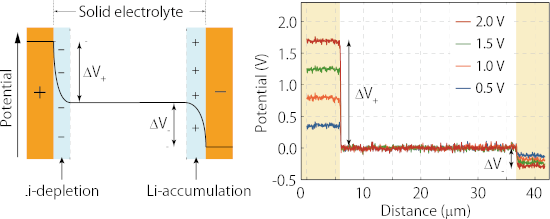
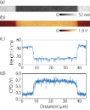
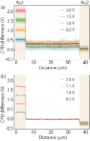
- negative direction, a cathodic current due to the reduction of Ti ions started to flow at around 2.8 V (vs Li/Li+). KPFM measurements were performed in the region across the solid electrolyte (Figure 1a). Figure 3a and Figure 3b display the topography and CPD images, respectively, obtained when 0 V was
- applied between the Au electrodes. The cross sections of the topography and CPD taken from the images in Figure 3a and Figure 3b are shown in Figure 3c and Figure 3d, respectively. The CPD values measured under this condition reflect the work-function difference across the surface [3]. The CPD values in
- an open circle. (a, b) Topography and CPD images, respectively, obtained across the solid electrolyte region (indicated in Figure 1a) when 0 V was applied between the Au electrodes. Image size is 45 μm × 3 μm. Scan rate is 0.1 Hz. (c, d) Cross sections of topography and CPD taken from the images in




Induced electric conductivity in organic polymers
Beilstein J. Nanotechnol. 2022, 13, 1551–1557, doi:10.3762/bjnano.13.128
- of the PDP polymer solutions. For example, Figure 2b shows the topography of the polymer film 0.1 wt % on Si substrate. The plot at the bottom demonstrates the variation of the structure along the line, depicted at the upper panel. The distance between the measuring lines is of the order of the



Frequency-dependent nanomechanical profiling for medical diagnosis
Beilstein J. Nanotechnol. 2022, 13, 1483–1489, doi:10.3762/bjnano.13.122
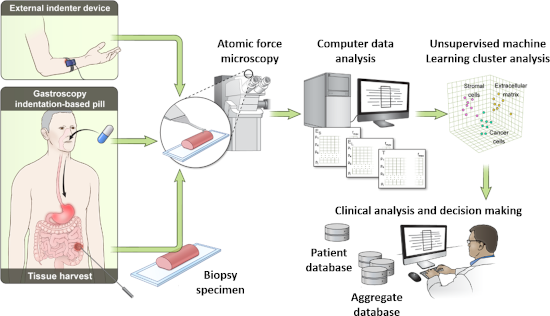
- property approximations, for example in the study of arterial degeneration [34][35]. Besides the above frequency-dependent representation, other important measurements can be recorded, such as general topography and morphology, cell or tissue adhesive properties, internal hydrostatic pressure, and surface
- – topography, f – frequency, and p – points within nanomechanical maps. Schematic of proposed enhanced endoscopy pill. The design is based on existing devices [30] that perform optical imaging, whose capabilities could be augmented to perform mechanical sensing, for example, through the incorporation of a


Growing up in a rough world: scaling of frictional adhesion and morphology of the Tokay gecko (Gekko gecko)
Beilstein J. Nanotechnol. 2022, 13, 1292–1302, doi:10.3762/bjnano.13.107
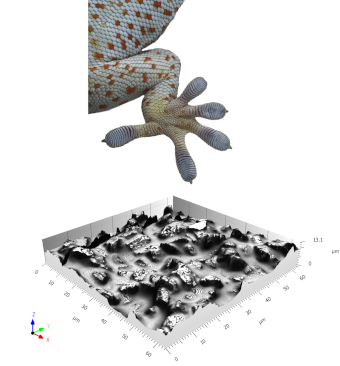
- this point in time, the ability to quantify the topography of surfaces of varying roughness [21], and to replicate them [32][33][34][35][36], rather than using vague categorizations, allows for the possibility to test fine-scale interactions of animal adhesion and traction with more accuracy [35][36
- , performance, and 3D surface topography, revealed key aspects of scaling that have significant impacts on our understanding of gecko adhesion. Setal diameter and density did not change with body size, whereas toepad area, and setal length, and therefore setal aspect ratio, increased with body size. Frictional
- . Surfaces Our experiments were carried out using a series of artificial surfaces that varied in surface topography and asperity size. In considering both the appropriate length-scale of animal adhesive structures and relevant manufactured artificial surfaces, we chose 7 different sandpapers that encompassed


Laser-processed antiadhesive bionic combs for handling nanofibers inspired by nanostructures on the legs of cribellate spiders
Beilstein J. Nanotechnol. 2022, 13, 1268–1283, doi:10.3762/bjnano.13.105
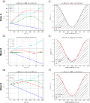
- ), which can be obtained from Taken together, if the topography function of the surface structure f(x) is given, the bending line, which only depends on the position of the contact point x0, is given to be A special case should be considered separately, namely S = 0, that is, if no longitudinal force is
- deflect the fiber in order to obtain the interaction energy, but not all to the bottom of the sinusoidal surface topography. Thus, a clear total energy minimum exists. Finally, in state C, bending requires less energy than can be gained by the van der Waals interaction. Thus, the fiber adapts completely
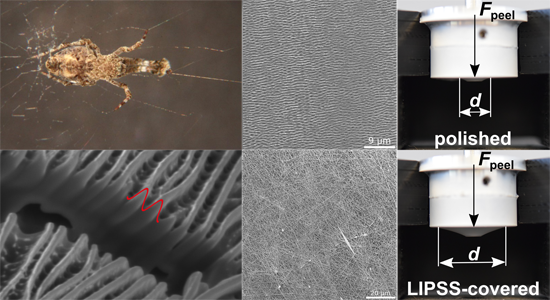
- scale bars of 0.8 mm length. Data is presented in Table S1 of Supporting Information File 1. Principle geometry of the interaction of a nanofiber with a periodic sinusoidal surface topography (a) and as single length unit when cut free (b). The periodic surface structure is drawn in black, the fiber is






Studies of probe tip materials by atomic force microscopy: a review
Beilstein J. Nanotechnol. 2022, 13, 1256–1267, doi:10.3762/bjnano.13.104
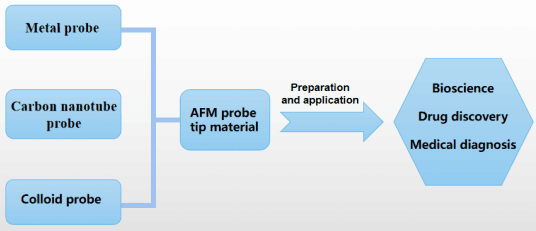
- conductive coatings and regenerated broken tips. The Pt/Ir cantilever was modified with small bundles of SWCNTs by a manual attachment process and fixed using a conductive Pt pad. AFM images of the current and topography of the nanomaterial samples and non-homogeneous polymers were collected using this type
Roll-to-roll fabrication of superhydrophobic pads covered with nanofur for the efficient clean-up of oil spills
Beilstein J. Nanotechnol. 2022, 13, 1228–1239, doi:10.3762/bjnano.13.102
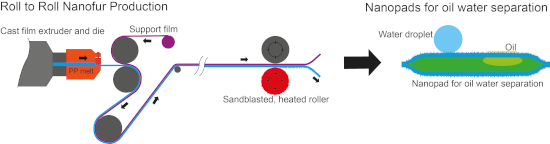
- of 53–75 µm. This procedure results in a surface topography of craters and edges with finer spikes on top. This sandblasted roller is mounted in a two-roller calender (Figure 2b) and heated (Figure 2c). Best quality nanofur in terms of high contact angles is obtained if the temperature is set
- case of later envisioned commercial applications, by two winding rollers that separate the two foils with a peeling motion (Figure 2d). The SEM (Zeiss Evo 10) picture in Figure 3a reveals the typical crater-like topography of nanofur with hair on the crater edges [16]. Typical contact angles of water




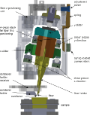
A cantilever-based, ultrahigh-vacuum, low-temperature scanning probe instrument for multidimensional scanning force microscopy
Beilstein J. Nanotechnol. 2022, 13, 1120–1140, doi:10.3762/bjnano.13.95
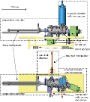
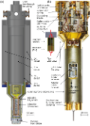
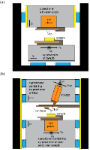

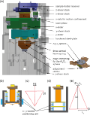




Interaction between honeybee mandibles and propolis
Beilstein J. Nanotechnol. 2022, 13, 958–974, doi:10.3762/bjnano.13.84
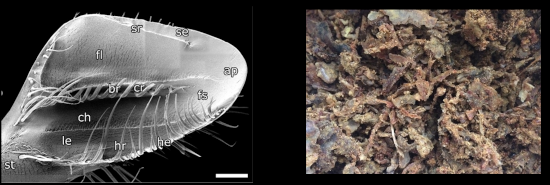
- experiment, a small amount of homogenised propolis powder was defrosted and kneaded into a homogeneous mass. Cone-shaped propolis samples with a spherical tip were subsequently formed by hand wearing ethanol-cleaned gloves (Figure 1C). The topography of the sample was analysed using a 3D optical profilometer
- to the hairy edge (Figure 4H). The scales on the outside of the mandible are more rounded and form rows of scales that are not clearly separated (12.62 ± 2.71 µm/12.72 ± 1.49 µm) (Figure 4I). Scale profile A 3D laser scanning microscope was used to study the topography of these structures on the
- of adhesion obtained from tests with a 60 s contact time performed on untreated and washed mandibles shows a significantly higher propolis adhesion on washed mandibles (P < 0.0001). Artificial bee mandible In order to test the effect of the surface structures and topography of the mandible as well as


Comparing the performance of single and multifrequency Kelvin probe force microscopy techniques in air and water
Beilstein J. Nanotechnol. 2022, 13, 922–943, doi:10.3762/bjnano.13.82
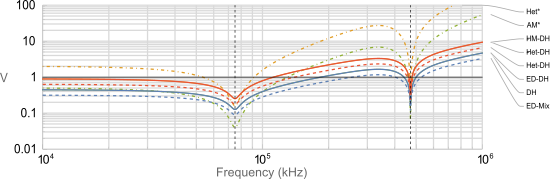
- of topography and surface properties of interfaces in a wide range of environments [1]. Kelvin probe force microscopy (KPFM) utilizes the application of a bias and a conductive probe to map the local electrical properties of an interface at the nanoscale [2], allowing for the determination of the
- excitation applied at ω1 as it traces the topography measured in the first pass at a specific lift height above the surface. Lift height can be set such that the electrostatic forces are isolated from stronger short range forces at the expense of spatial resolution [10][58]. By setting the lift height to
- match the mean tip–sample distance of the lever during the mechanical imaging pass, topography and potential can be correlated. (2) Sideband modes – here the electrical signal, ωe, is applied as a low frequency (ωe ≪ ω1) such that the electrical and mechanical drive, ωm, form mixing products ωm ± ωe
Bioselectivity of silk protein-based materials and their bio-inspired applications
Beilstein J. Nanotechnol. 2022, 13, 902–921, doi:10.3762/bjnano.13.81
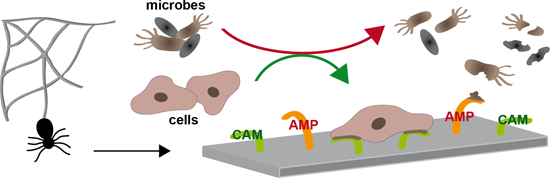
- distinguished according to their basic defense mechanism. These are (A) surface topography, which disturbs and inhibits the initial adhesion based on morphological features, (B) material modification, where intrinsic chemical and physical properties result in microbe-repellence, and (C) additives and coatings
- that inhibit initial attachment or directly kill microbes (see Figure 2) [50]. Natural surfaces provide many examples of anti-adhesive topography, including nanostructured pikes on Cicada wings [51], micro-structured and patterned riblets of the shark skin scales [52], hierarchically micro- and


Temperature and chemical effects on the interfacial energy between a Ga–In–Sn eutectic liquid alloy and nanoscopic asperities
Beilstein J. Nanotechnol. 2022, 13, 817–827, doi:10.3762/bjnano.13.72
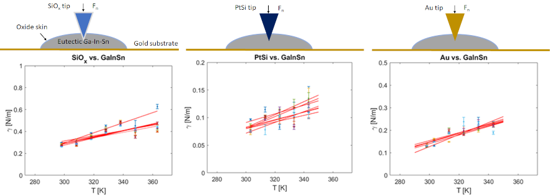
- could be tuned by texturing the substrate surface. The wetting of gallium-based liquid alloys is thus complex and depends on the stability of the oxide at the liquid–substrate interface, the reactivity with the substrate material, and the substrate topography. In this work, we applied atomic force
- manufactured by ThermoFischer Scientific, USA. We used a monochromated Al Kα source and a spot size of 400 µm. The results presented below consist of the average of ten consecutively recorded measurements. Results and Discussion Figure 2 shows contact AFM topography images recorded at room temperature on the
- surface of the eutectic Ga–In–Sn melt with three AFM tips of different chemistries, namely SiOx, PtSi, and Au. Figure 2 also indicates the surface roughness Rq value for each topography image. We recorded the presented topography images in contact mode by setting and controlling the normal force to Fn = 2



Optimizing PMMA solutions to suppress contamination in the transfer of CVD graphene for batch production
Beilstein J. Nanotechnol. 2022, 13, 796–806, doi:10.3762/bjnano.13.70
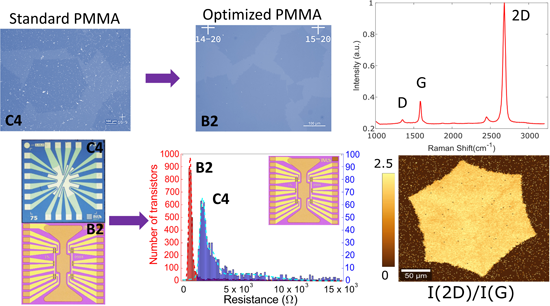
- ) above the surface, thus, reproducing its topography. Fabrication and characterization of graphene field-effect transistors Receded-gate graphene field-effect transistors were fabricated on an 8″ Si/SiO2 (200 nm thick) wafers. Two arrays of devices were fabricated with different process steps (Wafer 1




Direct measurement of surface photovoltage by AC bias Kelvin probe force microscopy
Beilstein J. Nanotechnol. 2022, 13, 712–720, doi:10.3762/bjnano.13.63
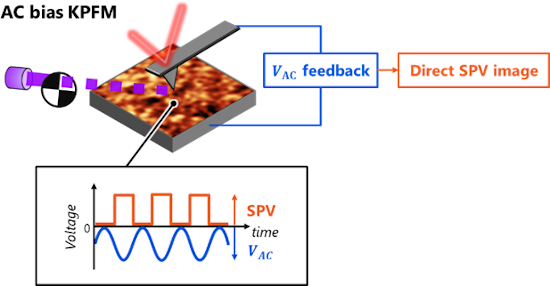
- -AFM was operated in the FM mode [32] with a constant oscillation amplitude A of 500 pm. The cantilever deflection was measured by an optical beam deflection (OBD) method [33]. AC-KPFM was carried out in the FM mode, in which the topography and SPV were measured simultaneously. An AC bias VAC with


Effects of substrate stiffness on the viscoelasticity and migration of prostate cancer cells examined by atomic force microscopy
Beilstein J. Nanotechnol. 2022, 13, 560–569, doi:10.3762/bjnano.13.47
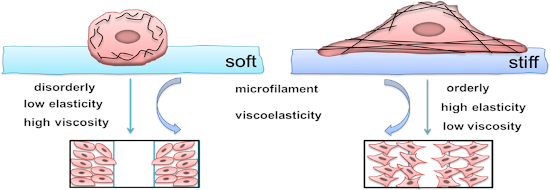
- , Figure S3c,d. Cell surface roughness is a quantitative measurement of the variability of cellular surface topography and serves as an indicator to assess the state of the cell (i.e., the greater the roughness, the greater the undulation of the cell surface topography [27]). It can be involved in many
- with 2 mL of PBS. Then, the cells were observed in QI working mode with Setpoint 1 nN, Z length of 2000 nm, and pixel time of 50 ms. The topography scanning at each pixel position (128 × 128) of the selected area (50 μm × 50 μm) was done to obtain high-resolution surface topography features of cells