Search results
Search for "cross section" in Full Text gives 525 result(s) in Beilstein Journal of Nanotechnology. Showing first 200.
Combining physical vapor deposition structuration with dealloying for the creation of a highly efficient SERS platform
Beilstein J. Nanotechnol. 2023, 14, 83–94, doi:10.3762/bjnano.14.10
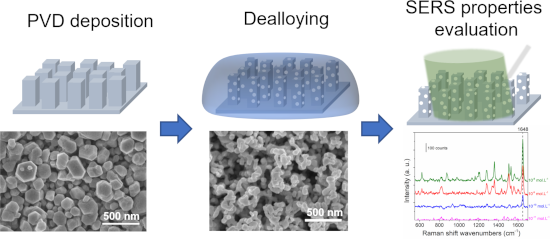
- cross-section SEM images in Figure 1d–f). The top view images (Figure 1a–c) reveal the presence of dispersed hexagonal columns. A possible explanation for the formation of the hexagonal structure is due to the Guinier–Preston (GP) zone of the silver–aluminum alloy system [31]. The GP zone induces the
- images of the nanolayers are available in Supporting Information File 1, Figure S1. The SEM micrographs of the dealloyed thin films are shown in Figure 2. After 10 min in HCl, pores appear on the top of the Ag–Al thin film (Figure 2a) whereas no changes are observed in the cross-section images (Figure 2e
- ). These small pores highlight the early dealloying stage and the propagating front at the grain boundaries [38]. After 30 min in HCl, bigger pores are formed (Figure 2b) and the cross-section image shows structures made of a porous and full layers (Figure 2f). After 60 min of dealloying, the initial




Observation of collective excitation of surface plasmon resonances in large Josephson junction arrays
Beilstein J. Nanotechnol. 2022, 13, 1578–1588, doi:10.3762/bjnano.13.132
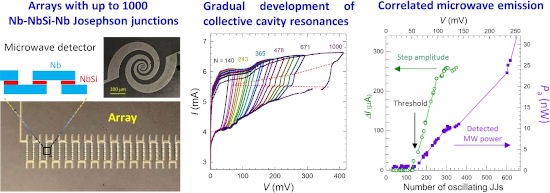
- . Each segment contains eight overlap-type JJs with the area 6 × 6 μm2. This can be seen from the close-up shown in the left panel of Figure 1a. The distance between nearby junction centers is 12 μm. A cross section of the junctions is sketched in the bottom-left panel of Figure 1c. The linear array
- array in (a) contains seven meandering sections with N = 1000 JJs in each. The linear array in (c) contains five straight lines with N = 332 JJs in each. The right panels represent corresponding closeups (top view). The bottom-left part in (c) shows a sketch of the junction cross section with Nb in




Dry under water: air retaining properties of large-scale elastomer foils covered with mushroom-shaped surface microstructures
Beilstein J. Nanotechnol. 2022, 13, 1370–1379, doi:10.3762/bjnano.13.113
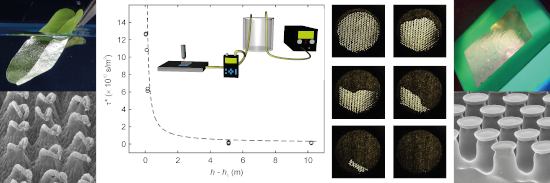
- submerging the sample in 5 mm water depth. A top view image as well as a cross section of the air–water interface is shown. The dark parts in the top view image represent the MSM, the bright parts show the air–water interface in between. Also in the cross section the air–water interface is represented by the
- bright areas of the image while the MSM in between appear darker. It could be seen that the shape of the air layer is almost completely flat. c) Results of the measurement of the same sample after 2 weeks under water. Still the air–water interface is spanned between the tips of the MSM. The cross section


Enhanced electronic transport properties of Te roll-like nanostructures
Beilstein J. Nanotechnol. 2022, 13, 1284–1291, doi:10.3762/bjnano.13.106
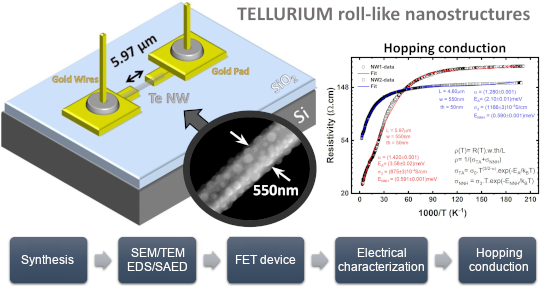
- a well-defined geometry with a uniform rectangular cross section along their entire length. This particular morphology makes them a strong candidate for providing a thorough understanding of dimensionally confined transport phenomena, as presented in SnO2 NBs. Moreover, strain-induced polarization




Laser-processed antiadhesive bionic combs for handling nanofibers inspired by nanostructures on the legs of cribellate spiders
Beilstein J. Nanotechnol. 2022, 13, 1268–1283, doi:10.3762/bjnano.13.105
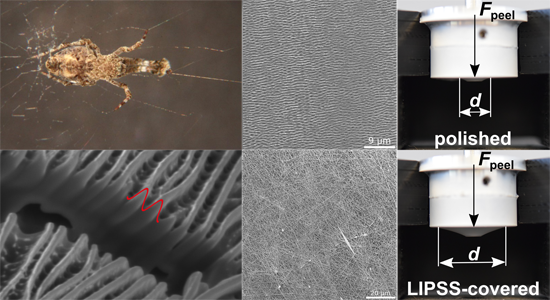
- center spider). Its fingerprint-like outmost surface structure has an approximately sinusoidal cross section with a periodicity of 200–300 nm and a height (amplitude) of approx. 200 nm. During the combing process, the nanofibers are pulled orthogonally over these nanoripples. It was shown that the
- identical with a laterally shifted sine function), that is, It has to be emphasized that, if the periodic modulation on the surface has a sinusoidal cross section but the fiber is not orthogonally oriented to these ridges, the cross section under an angle is still represented by a cosine function with same
- drawn in blue. Surface and fiber are mathematically modelled by two functions, f(x) and w(x), respectively. The cross section of the surface is sinusoidal with a period of 2λ and an amplitude of a. A fiber on top of the surface is deflected partially due to van der Waals interactions. The point of






A cantilever-based, ultrahigh-vacuum, low-temperature scanning probe instrument for multidimensional scanning force microscopy
Beilstein J. Nanotechnol. 2022, 13, 1120–1140, doi:10.3762/bjnano.13.95





Analytical and numerical design of a hybrid Fabry–Perot plano-concave microcavity for hexagonal boron nitride
Beilstein J. Nanotechnol. 2022, 13, 1030–1037, doi:10.3762/bjnano.13.90
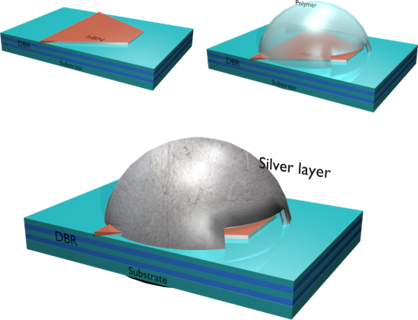
- microcavity is also an open-access cavity. Conceptual design shows cross-section of hybrid plano-concave microcavity with a 2D hBN layer inside on top of a distributed Bragg reflector (DBR). Fabrication steps of hybrid microcavity. (a) hBN layer positioned on top of DBR. (b) Concave polymer shape is
- fabricated by direct laser writing process. (c) A silver layer is added on top of polymer. Cross-section of hybrid plano-concave microcavity shows the geometrical parameters and the two Gaussian modes inside. Spotsizes W02 and W2 for different values of R2 and L2. Transverse cut of Figure 4 through length L2


Numerical study on all-optical modulation characteristics of quantum cascade lasers
Beilstein J. Nanotechnol. 2022, 13, 1011–1019, doi:10.3762/bjnano.13.88
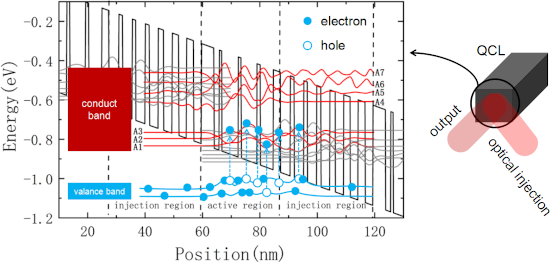
- equations (FRE) [18] as Equations 1–4 shows, where n0 is the cavity index, gc is the gain cross section, c is the speed of light. ΓP is the optical confinement factor per stage, α is the laser total loss. NP the total number of stages, 1/τk,i is the rate of electron scattered from subband k to subband i, 1


Theoretical investigations of oxygen vacancy effects in nickel-doped zirconia from ab initio XANES spectroscopy at the oxygen K-edge
Beilstein J. Nanotechnol. 2022, 13, 975–985, doi:10.3762/bjnano.13.85
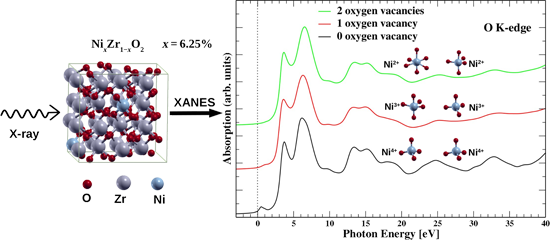
- are computed using the XSPECTRA code [34], which is a module in the Quantum-ESPRESSO computational package. In the code, the X-ray absorption cross section is modeled in terms of a transition operator coupling initial and final states, which are solutions of the KS equations. For the K-edge
- absorbing atom [34]. Within this pseudopotential approach, the final all-electron wave function is reconstructed from the pseudowave function by means of the projector augmented wave method [43]. The isotropic cross section has been found necessary to calculate XANES spectra, since our relaxed structural
- phase of Ni-doped zirconia is cubic. For a general symmetry, the isotropic electric dipole cross section is obtained by a linear combination of three cross sections calculated along three perpendicular directions of polarization, namely σ(0,0) = 1/3(σxx + σyy + σzz) [44]. In practice, the cross section


Design of a biomimetic, small-scale artificial leaf surface for the study of environmental interactions
Beilstein J. Nanotechnol. 2022, 13, 944–957, doi:10.3762/bjnano.13.83
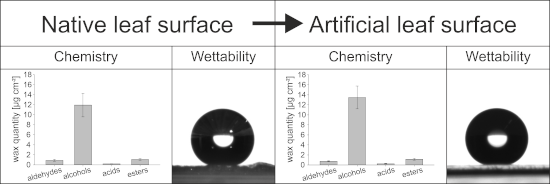
- were measured using the cross-section tool (n = 20). Analysis of the chemical composition of wax Fresh leaves were cut from intact plants and immediately processed. To extract the epicuticular waxes of the greenhouse plants, three leaves per leaf age were combined for one replicate and dipped for 20 s
- image, (b) height image. The white line indicates where the cross section in (c) was made. (c) Cross section. On the left side of each image: glass after the removal of the coating, on the right side: structure of the wax coating. Chemical composition of wheat wax. GH: greenhouse plants (n = 15); OD
Efficient liquid exfoliation of KP15 nanowires aided by Hansen's empirical theory
Beilstein J. Nanotechnol. 2022, 13, 788–795, doi:10.3762/bjnano.13.69
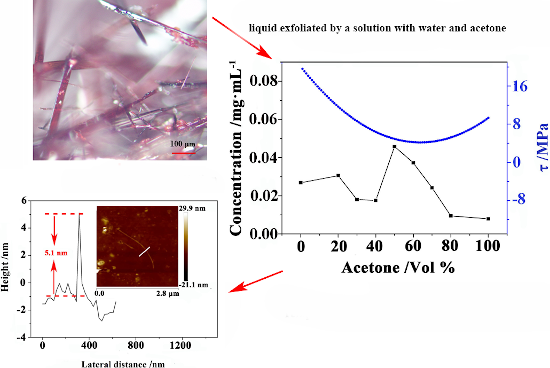
- after liquid exfoliation. (e) Width histograms of KP15 nanowires after liquid exfoliation. Sizes of exfoliated KP15 nanowires. (a) Cross section of the KP15 nanowire marked in the upper right corner inset image. (b) Cross section of the KP15 nanowire marked in the upper right corner inset image. (c
- ) Cross section of the KP15 nanowire marked in the upper right corner inset image. (d) Cross section of the KP15 nanowire marked in the upper right corner inset image. Hansen parameters for the solvents [21]. Supporting Information Supporting Information File 10: Strong temperature-dependent Raman


Experimental and theoretical study of field-dependent spin splitting at ferromagnetic insulator–superconductor interfaces
Beilstein J. Nanotechnol. 2022, 13, 682–688, doi:10.3762/bjnano.13.60
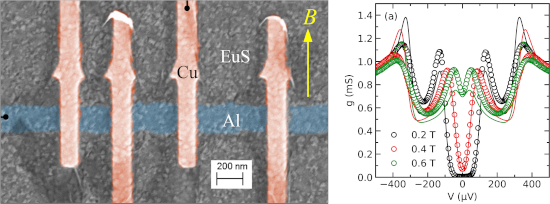
- = e2/h is the conductance quantum, and G = σNA/d is the conductance of the film (in the direction perpendicular to the interface of cross section A). D and σN are the diffusion constant and the normal-state conductivity of the film, respectively. Note, that due to the normalization condition for



Antibacterial activity of a berberine nanoformulation
Beilstein J. Nanotechnol. 2022, 13, 641–652, doi:10.3762/bjnano.13.56
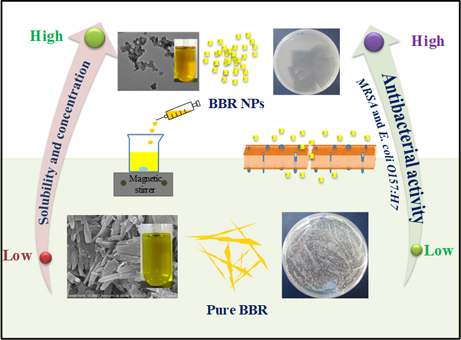
- explained by the formation of hydrogen bonds between the oxygen-containing groups (methoxy and furyl groups) of BBR and the –OH group of glycerol in water [38]. Morphology and size distribution of BBR NPs The SEM image (Figure 3a) shows that pure BBR forms tightly agglomerated rods with rectangular cross
- section and different sizes in the micrometer range. After the antisolvent precipitation process, the size of BBR NPs was expected to be at the nanoscale. TEM observation shows that the BBR NPs had a uniform rectangular shape with sizes lower than 100 nm (Figure 3b). It also reveals a good dispersion of



A new method for obtaining the magnetic shape anisotropy directly from electron tomography images
Beilstein J. Nanotechnol. 2022, 13, 590–598, doi:10.3762/bjnano.13.51
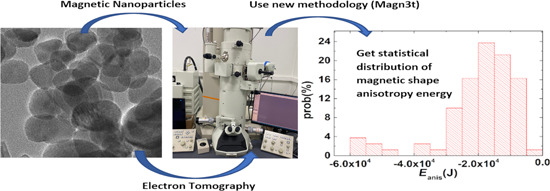
- circular transversal cross section. Using a calibration of 1.47 nm/px, it can be estimated that the MNPs have a cross section with an average diameter of roughly 30 nm whereas their length is, on average, slightly above 40 nm, which is compatible with the XRD measurements. Orientation data is given in


Revealing local structural properties of an atomically thin MoSe2 surface using optical microscopy
Beilstein J. Nanotechnol. 2022, 13, 572–581, doi:10.3762/bjnano.13.49
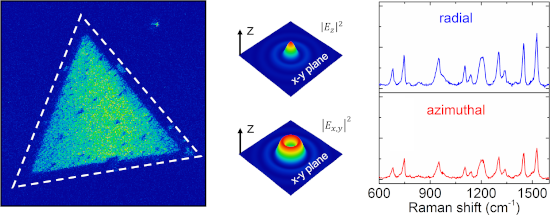
- CuPc as a Raman probe, because CuPc exhibits a large Raman scattering cross section and an extremely weak photoluminescence signal. A thin film of 5 nm of CuPc was deposited on the triangular MoSe2 flakes through thermal vapor deposition. Figure 1a shows a bright-field optical image of CuPc/MoSe2. From


Tunable superconducting neurons for networks based on radial basis functions
Beilstein J. Nanotechnol. 2022, 13, 444–454, doi:10.3762/bjnano.13.37
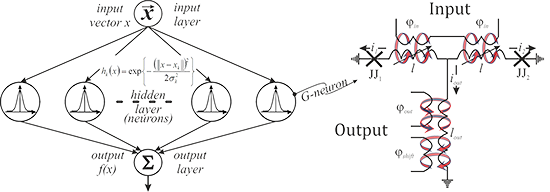
- resistivity ρN ≪ ρS, which ensures its lower kinetic inductance relative to the rest of the structure. This leads to a flow of the current mostly through this layer in the case of the open valve. Figure 6a shows the spatial distributions of the pairing amplitude F(x) in the cross section of this structure for


Effect of sample treatment on the elastic modulus of locust cuticle obtained by nanoindentation
Beilstein J. Nanotechnol. 2022, 13, 404–410, doi:10.3762/bjnano.13.33
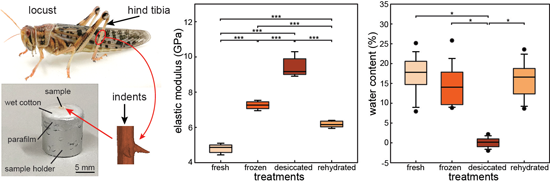
- , except for desiccation treatment, small pieces of wet cotton were used to surround the tibiae (Figure 1b). The wet cotton pieces were covered by a layer of parafilm (BEMIS Packaging Deutschland GmbH, Rheinbach, Germany) [11]. Prior to testing, the cross section of the specimens was polished with
- sandpaper with a grain diameter of 0.3 µm (ITW Test & Measurement GmbH, Esslingen, Germany). We performed the indentations normal to the cross section of the tibiae. This resulted in the measurement of the elastic moduli of the tibial cuticle in the longitudinal direction (along the axis of tibia) (Figure 1


Electrostatic pull-in application in flexible devices: A review
Beilstein J. Nanotechnol. 2022, 13, 390–403, doi:10.3762/bjnano.13.32
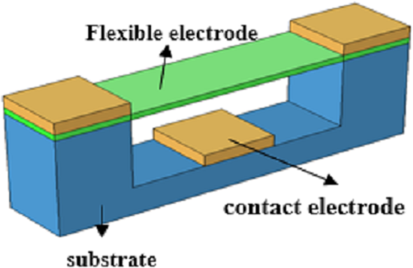
- cross section of 14 µm × 400 nm. The gap is 300 nm, and the pull-in voltage is 70 V. As the width is reduced to 200 nm and the gap is reduced to 100 nm, the pull-in voltage is reduced to 5 V. The switching current ratio is greater than 106, and the number of life cycles is greater than 105. Jasulaneca
- with a switching ratio of about 103. Qian et al. [37] produced a U-shaped NEM switch with two Si nanowires, which support a square capacitive plate to form a U-shaped removable electrode, as shown in Figure 5b. The length of the silicon nanowires is 5 µm, the cross section is 90 × 90 nm square, the


Micro- and nanotechnology in biomedical engineering for cartilage tissue regeneration in osteoarthritis
Beilstein J. Nanotechnol. 2022, 13, 363–389, doi:10.3762/bjnano.13.31


Selected properties of AlxZnyO thin films prepared by reactive pulsed magnetron sputtering using a two-element Zn/Al target
Beilstein J. Nanotechnol. 2022, 13, 344–354, doi:10.3762/bjnano.13.29
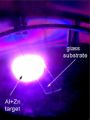
- morphology of the surface and cross section of the deposited thin films was investigated using a FEI Helios NanoLab 600i scanning electron microscope coupled with an energy-dispersive X-ray spectrometer (EDS) to determine the amount of Al and Zn in the deposited films (without taking the oxygen signal into


Investigation of a memory effect in a Au/(Ti–Cu)Ox-gradient thin film/TiAlV structure
Beilstein J. Nanotechnol. 2022, 13, 265–273, doi:10.3762/bjnano.13.21
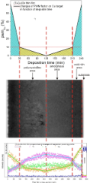
- testifying the predominantly amorphous nature of the deposited thin films. The microstructure of the (Ti–Cu)Ox films was further analyzed with the aid of a TECNAI G2 FEG Super-Twin (200 kV) transmission electron microscope equipped with EDS attachment. The local chemical composition of the cross section was



Relationship between corrosion and nanoscale friction on a metallic glass
Beilstein J. Nanotechnol. 2022, 13, 236–244, doi:10.3762/bjnano.13.18
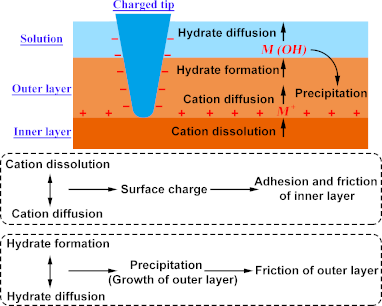
- for 72 h and after scanning the central area (1.0 × 0.125 μm2) 16 times at a normal load of 1.5 nN (imaging load: 1.0 nN); (b) cross section of the topography and friction image corresponding to the lines drawn in (a); (c) friction force of the scan field and surrounding area as a function of the


Low-energy electron interaction and focused electron beam-induced deposition of molybdenum hexacarbonyl (Mo(CO)6)
Beilstein J. Nanotechnol. 2022, 13, 182–191, doi:10.3762/bjnano.13.13
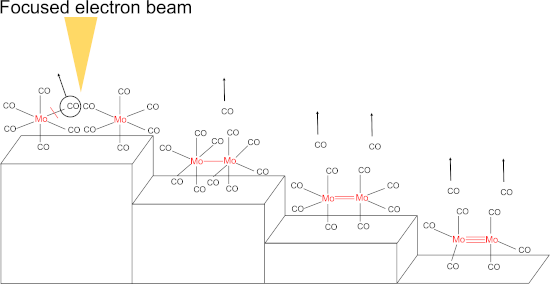
- about 10 eV and George et al. [21] determined the rate constant for the formation of [Mo(CO)5]− and found it to be 1.3 × 10⁻⁷ cm3·molecule−1·s−1. This is a very high rate constant, which is consistent with cross section measurements for single-ligand loss in DEA to Co(CO)3NO [25] and Pt(PF3)4 [26
- ], which were found to be 4.1 × 10⁻¹⁶ cm2 and 1.98 × 10⁻¹⁶ cm2, respectively, that is, only about a factor of 10 below the πλ2, s-wave attachment cross section given by the respective DeBroglie wavelength [26][27]. Using the approximation [28], where, ka is the rate constant, , the average velocity of the
- incident electron and is the respective average cross section. These translate to rate constants of ca. 2.43 × 10⁻⁸ and ca. 1.2 × 10⁻⁸ cm3·molecule−1·s–1, respectively, at 1.0 eV electron energy ( = 5.93 × 10⁵ m/s), approximately where the maxima for these processes are observed. Electron impact


Thermal oxidation process on Si(113)-(3 × 2) investigated using high-temperature scanning tunneling microscopy
Beilstein J. Nanotechnol. 2022, 13, 172–181, doi:10.3762/bjnano.13.12
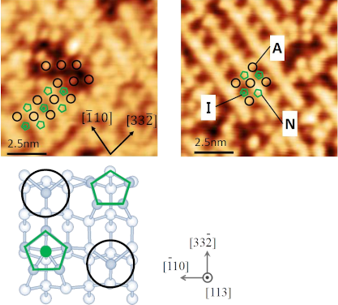
- -flow etching of the monolayer depth occurs just beside the remaining island, as shown by the solid arrow. The island remains at the step edge, as shown in the circle (d). A magnified image of the island in (d) is shown in Figure 4a. The line profile along the cross section A–B is shown in Figure 4b


Nanoscale friction and wear of a polymer coated with graphene
Beilstein J. Nanotechnol. 2022, 13, 63–73, doi:10.3762/bjnano.13.4
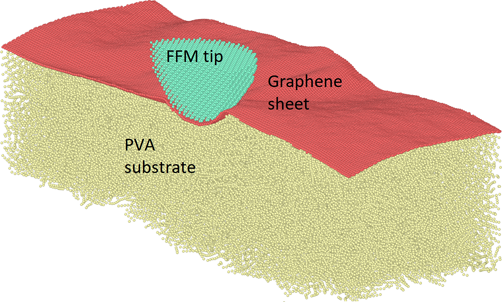
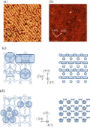
- graphene we investigate its effect on the surface. The deposited graphene sheet alters the structure and shape of the surface. This can be seen in Figure 4, where we show the density as a function of the position in a cross section of the substrate for the cases with and without the graphene layer. We
- (stiff membrane). Figure 8 shows the cross section of the density under the tip at the end of the indentation process. We can see regular lines of high density right below the graphene layer, which indicate a local reorganisation of the polymer chains. The graphene layer, especially the flat sheet, is