


Search results
Search for "nanocomposite" in Full Text gives 204 result(s) in Beilstein Journal of Nanotechnology. Showing first 200.
A novel dry-blending method to reduce the coefficient of thermal expansion of polymer templates for OTFT electrodes
Beilstein J. Nanotechnol. 2020, 11, 671–677, doi:10.3762/bjnano.11.53
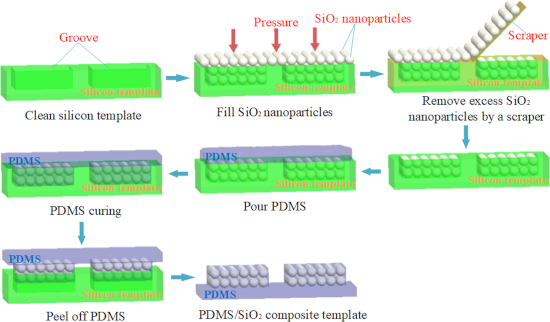
- with a size of 300 nm to be doped into polydimethylsiloxane (PDMS) to prepare a PDMS/MCM-41 nanocomposite. The CTE of the nanocomposite decreased from the initial 301 ppm/°C of PDMS to 241 ppm/°C, when the content of silica in PDMS was increased to 20 wt %. To further reduce the CTE of the polymer


Silver-decorated gel-shell nanobeads: physicochemical characterization and evaluation of antibacterial properties
Beilstein J. Nanotechnol. 2020, 11, 620–630, doi:10.3762/bjnano.11.49
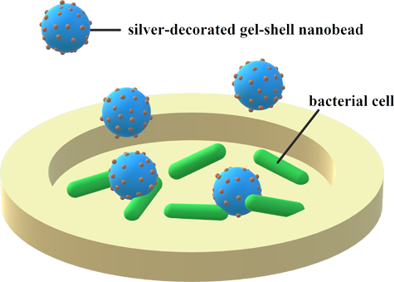
- of composite nanobeads with antibacterial properties. The particles consist of polystyrene cores that are surrounded by sulfonic gel shells with embedded silver nanoparticles. The nanocomposite beads are prepared by sulfonation of polystyrene particles followed by accumulation of silver ions in the
- have been partially reduced to thiol moieties. In consequence, the thiols interact with the silver nanoparticles anchoring them in the gel layer on the nanobeads. Moreover, it has been shown that the nanocomposite exhibits considerable antibacterial activity, comparable or superior to that of non
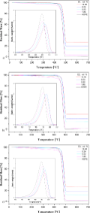
- nanocomposite using thermogravimetric analysis. The thermograms of PSS and PSSAg have been recorded up to 700 °C under oxygen/nitrogen atmosphere at a heating rate of 5 °C/min (Figure 7). For the PSS sample one can see several decomposition steps in the range of 400–650 °C, which is characteristic of sulfonated


High-performance asymmetric supercapacitor made of NiMoO4 nanorods@Co3O4 on a cellulose-based carbon aerogel
Beilstein J. Nanotechnol. 2020, 11, 240–251, doi:10.3762/bjnano.11.18
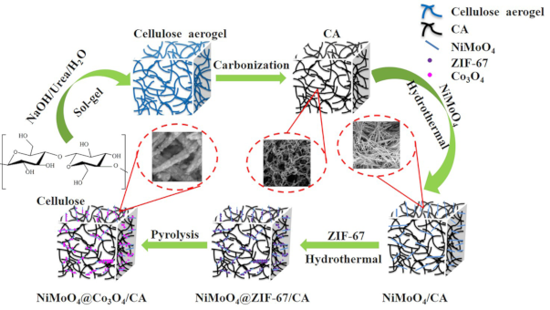
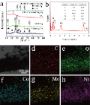
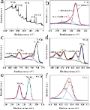
- , which agrees well with the XRD results. To investigate the chemical composition and the valence states of the NiMoO4@Co3O4/CA nanocomposite, X-ray photoelectron spectroscopy (XPS) was performed and the results are shown in Figure 4. According to Figure 4a, the elements Co, Ni, Mo, O and C can be clearly




Size effects of graphene nanoplatelets on the properties of high-density polyethylene nanocomposites: morphological, thermal, electrical, and mechanical characterization
Beilstein J. Nanotechnol. 2020, 11, 167–179, doi:10.3762/bjnano.11.14
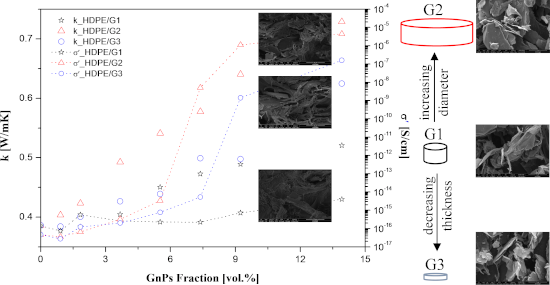
- scanning electron microscope (SEM) images. Our results show that the lateral size of GnPs was a more regulating factor for the above-mentioned nanocomposite properties compared to their thickness. For a given lateral size, thinner GnPs showed significantly higher electrical conductivity and a lower
- conductivity of the nanocomposites was approximately the same up to the percolation threshold for each type of nanocomposite. As the GnP loading reached the percolation threshold, there was an abrupt increase in electrical conductivity because a conductive network was formed. The percolation threshold varied
- in terms of the size of GnPs, as mentioned by Bakir and co-workers [12]. The percolation thresholds of G2 and G3 were 5.52 vol % and 7.38 vol %, respectively. However, the percolation threshold was not observed for the HDPE/G1 nanocomposite, which should appear at higher concentrations. Nevertheless


Gold and silver dichroic nanocomposite in the quest for 3D printing the Lycurgus cup
Beilstein J. Nanotechnol. 2020, 11, 16–23, doi:10.3762/bjnano.11.2
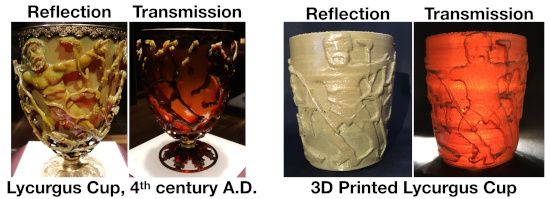
- nanoparticles present in the glass. In this research we show the synthesis of dichroic silver nanoparticles and their embedding in a 3D printable nanocomposite. The addition of gold nanoparticles to the silver nanoparticle composite, gave a 3D printable nanocomposite with the same dichroism effect of the
- Lycurgus cup. Keywords: 3D printing; dichroism; Lycurgus cup; nanocomposite; Introduction The Lycurgus cup is, without any doubt, one of the most fascinating glass artefacts in the history of humankind [1]. This 4th century Roman cup, classified as cage cup, is a wonderful masterpiece of glass working
- AuNP nanocomposite which presents a dichroic effect, showing a brownish colour in reflection and a violet colour in transmission [9]. Driven by the curiosity of reproducing the green/red dichroic effect of the Lycurgus cup using modern knowledge on nanoparticles and recent technology like 3D printing


Advanced hybrid nanomaterials
Beilstein J. Nanotechnol. 2019, 10, 2563–2567, doi:10.3762/bjnano.10.247

- .10.247 Keywords: colloidal chemistry; environmental remediation; hybrid nanomaterials; nanocomposite; nanofillers; nanomedicine; nanostructures; polymer fillers; pore templating; smart materials; The Maya blue pigment that was used in Mexico during the VIIIth century is often given as a prototypical
- specialized experimental and theoretical techniques. This thematic issue clearly shows that “advanced hybrid nanomaterials” is not just hype, it is a real and powerful toolbox towards advanced materials for highly diverse fields, such as polymer nanocomposite, health and environment. Smart Materials and
- fire retardancy and gas permeation in a low molecular weight epoxy resin [28]. Regarding specific applications, the dielectric properties were investigated by broadband dielectric spectroscopy (BDS) in “Nanocomposite–parylene C thin films with high dielectric constant and low losses for future organic
Integration of sharp silicon nitride tips into high-speed SU8 cantilevers in a batch fabrication process
Beilstein J. Nanotechnol. 2019, 10, 2357–2363, doi:10.3762/bjnano.10.226
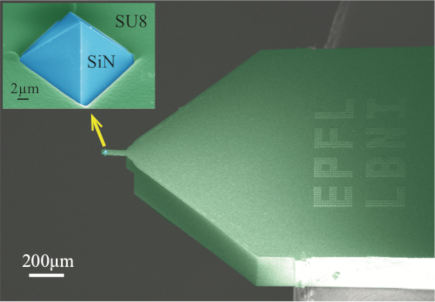
- -factor of the cantilever is aggravated by the fact that the chip body is also made of SU8 instead of a stiff conventional material. One technique to approach this challenge would be to make the cantilever chip body out of a SU8 nanocomposite with higher Young’s modulus instead of pure SU8. For instance


Targeted therapeutic effect against the breast cancer cell line MCF-7 with a CuFe2O4/silica/cisplatin nanocomposite formulation
Beilstein J. Nanotechnol. 2019, 10, 2217–2228, doi:10.3762/bjnano.10.214
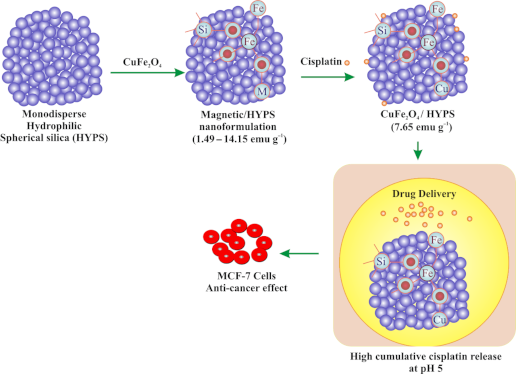
- layers in the mixed metal oxide spinel composite. CuFe2O4 composite formation with activated carbon was reported using the co-precipitation technique [12][13]. Herein, we have prepared a nanocomposite comprised of CuFe2O4 and monodispersed spherical hydrophilic silica (HYPS) particles (Scheme 1) for
- effectively reduce the viability of the human breast cancer cell line MCF7. Thus, cisplatin/CuFe2O4/HYPS nanoparticles can be considered an interesting option for drug delivery (Scheme 1). Conclusion An effective multifunctional CuFe2O4/HYPS nanocomposite system has been developed to deliver cisplatin
- ) of copper ferrite covering the HYPS. The composite showed paramagnetic behavior with a saturated magnetization value of 7.65 emu/g. The CuFe2O4/HYPS nanocomposite showed high cisplatin delivery and anticancer efficacy due to the coexistence of Pt and CuFe2O4 in HYPS. The cisplatin drug release


Porous silver-coated pNIPAM-co-AAc hydrogel nanocapsules
Beilstein J. Nanotechnol. 2019, 10, 1973–1982, doi:10.3762/bjnano.10.194
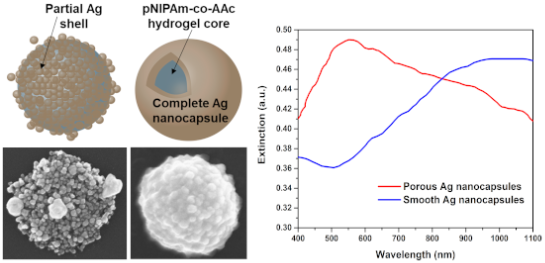
- polymers to create a nanocomposite system in which the outer polymer shell can be thermally activated by absorption of light or by a magnetic field [41][61]. By combining the optical properties of nanoshells and the thermo-responsive activity of hydrogel polymers, the present study seeks to develop a


Growth dynamics and light scattering of gold nanoparticles in situ synthesized at high concentration in thin polymer films
Beilstein J. Nanotechnol. 2019, 10, 1768–1777, doi:10.3762/bjnano.10.172
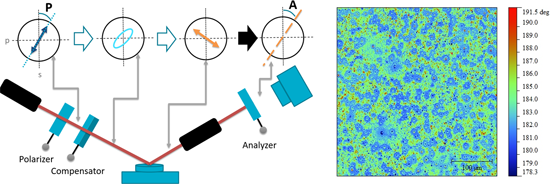
- regimes in the dynamics of the nanoparticle growth and in the optical response of the nanocomposite. Keywords: gold; imaging ellipsometry; metal nanoparticles; plasmonic nanocomposite; polymer films; Introduction Over the last 20 years, numerous studies were carried out to investigate the optical
- properties of plasmonic nanocomposite materials from experimental, theoretical as well as numerical points of view [1][2]. Metal nanoparticles (NPs) play a central role in the development of nanotechnology-based optical devices. Gold nanoparticles (AuNPs) are used in spectrally selective coatings to block
- simpler. In a single step, both the gold salt and the polymer are mixed to prepare the nanocomposite. The simplicity of the method is regarded as a great advantage for the production of nanocomposites for various applications in nano-optics. The principle of in situ methods is the use of one of the matrix


High-temperature resistive gas sensors based on ZnO/SiC nanocomposites
Beilstein J. Nanotechnol. 2019, 10, 1537–1547, doi:10.3762/bjnano.10.151
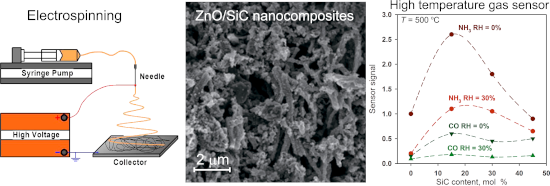
- an n–n heterojunction at the ZnO/SiC interface. Keywords: electrospinning; high temperature gas sensor; n–n heterojunction; ZnO/SiC nanocomposite; Introduction The risk of air pollution is growing due to the development of new technologies in the chemical, metallurgical and food industries, the use
- , ultrathin fibers of SiC and metal oxides as well as MO/SiC composites from polymer solutions [16][17][18][19]. The combination of unlimited length, highly porous microstructure, and high surface area come together to create ideal gas sensor materials. In this work, we prepared ZnO/SiC nanocomposite
- -type gas sensors based on ZnO/SiC composites and studying the sensor performance towards the main components of the exhaust gases CO and NH3 in air at a temperature range of 400–550 °C. Results and Discussion The nanocomposite synthesis scheme is shown in Figure 1 and described in detail in the



Kelvin probe force microscopy of the nanoscale electrical surface potential barrier of metal/semiconductor interfaces in ambient atmosphere
Beilstein J. Nanotechnol. 2019, 10, 1401–1411, doi:10.3762/bjnano.10.138
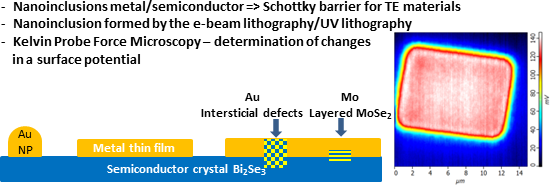
- the nanocomposite. An alternative way to study Schottky barriers at the nanoscale is to prepare a metallic layer on the Bi2Se3 surface and characterize such a nanocomposite. I–V spectroscopy is typically used for the determination of Schottky barriers [25][49][50]. The setup was tested on bulk Au and
- diffusion or the reaction of the Mo layer with the Bi2Se3 substrate. To enhance the diffusion/reaction rate, we used e-beam irradiation. An area of the 8 × 10 µm2 was locally irradiated by an electron beam for different periods of time (75 s; 180 s and 360 s). This resulted in a nanocomposite material


Highly ordered mesoporous silica film nanocomposites containing gold nanoparticles for the catalytic reduction of 4-nitrophenol
Beilstein J. Nanotechnol. 2019, 10, 1368–1379, doi:10.3762/bjnano.10.135
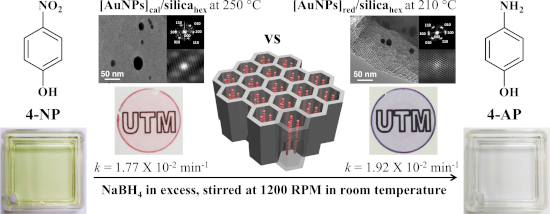
- Institute for Scientific and Industrial Research, Universiti Teknologi Malaysia, 81310 UTM Johor Bahru, Johor, Malaysia 10.3762/bjnano.10.135 Abstract We report that transparent mesostructured silica/gold nanocomposite materials with an interpore distance of 4.1 nm, as-synthesized from a templated sol–gel
- . Such catalytic activity is due to the presence of gold nanoparticles of smaller size in the silicate channels of the highly ordered mesoporous film nanocomposites. Keywords: catalyst; gold nanoparticle; mesoporous silica; nanocomposite; thermal hydrogen reduction; 4-nitrophenol reduction
- very interesting to utilize this nanocomposite for the growth of AuNPs in the silicate nanochannels. Recently, mesoporous silica nanomaterials were not only used as a support to control the size of the AuNPs [28], but also to enhance the thermal stability after heat treatment at high temperature [29


Multicomponent bionanocomposites based on clay nanoarchitectures for electrochemical devices
Beilstein J. Nanotechnol. 2019, 10, 1303–1315, doi:10.3762/bjnano.10.129
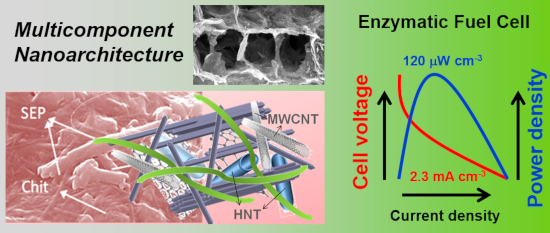
- ][26]. In fact, following this approach it was possible to prepare multifunctional and homogeneous nanocomposite materials such as self-supported sepiolite–nanocarbon hybrid buckypapers [25] and conducting bionanocomposites [26]. Therefore, the present study explores the potential of sepiolite for
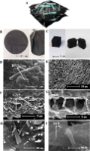
- (Figure S1, Supporting Information File 1), comparable to similar freeze-cast clay nanocomposite foams [43][44]. Halloysite nanotubes are visible on the surface of the cell walls with free access to the lumen (Figure 3I). The porosity of the foams was estimated from their relative density values (Table 1
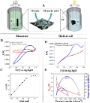
- nanocomposite interface. B) Effect of glucose on the Film-GOx sample in CV measurement in PBS, pH 7 and 0.1 mM of potassium ferricyanide at a scan rate of 5 mV·s−1. C) Sensor response as a function of the glucose concentration. The red line is a linear fit. ΔI = steady-state current at 0.45 V. D) LSV



Synthesis of novel C-doped g-C3N4 nanosheets coupled with CdIn2S4 for enhanced photocatalytic hydrogen evolution
Beilstein J. Nanotechnol. 2019, 10, 912–921, doi:10.3762/bjnano.10.92
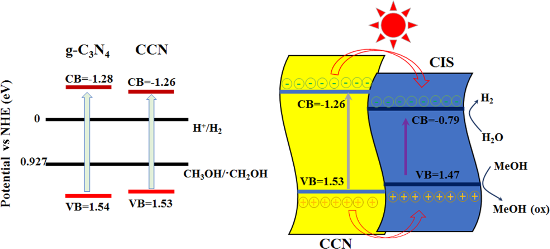
- effective strategy, the combination of C-doping with nanocomposite semiconductors, is presented in this work. C-doped g-C3N4 (CCN) was prepared by supramolecular self-assembly and subsequently a number of CdIn2S4/CCN composite photocatalysts were designed and fabricated though in situ decoration of CdIn2S4
- photogenerated holes and electrons. Yang et al. designed and constructed a 2D/2D nanocomposite photocatalyst through the in situ generation of ZnIn2S4 nanoleaf structures on the surface of g-C3N4 nanosheets by a facile one-step solvothermal method with surfactant, which exhibited distinct high-speed charge
- photoelectron peak for In 3d (Figure 5e) exhibits two peaks, corresponding to In 3d5/2 and In 3d3/2 [40]. Moreover, the S 2p peak splitting of 161.4 eV and 162.6 eV, a split energy with 1.2 eV, represents the S2− in the nanocomposite sample [28]. Consequently, from the XPS results, it can be concluded that the


Tungsten disulfide-based nanocomposites for photothermal therapy
Beilstein J. Nanotechnol. 2019, 10, 811–822, doi:10.3762/bjnano.10.81
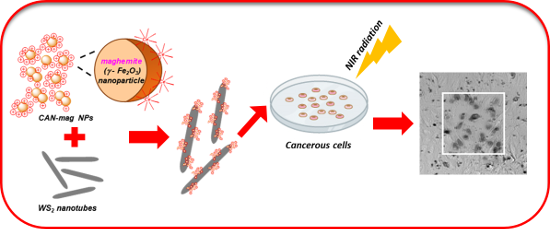
- . Functionalization of the nanotubes with CAN-mag nanoparticles resulted in a magnetic nanocomposite. When tested in vitro with two types of cancer cells, the functionalized nanotubes showed a better PTT activity compared to non-functionalized nanotubes, as well as reduced aggregation and the ability to add a second
- -step functionality. This ability is demonstrated here with two polymers grafted onto the nanocomposite surface, and other functionalities could be additional cancer therapy agents for achieving increased therapeutic activity. Keywords: cerium complex; magnetic nanoparticles; photothermal therapy
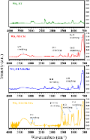
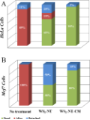
- ) nanocomposite. The composite is magnetic and forms a stable dispersion in water. It was characterized to verify the CAN-mag attachment to the nanotubes, and tested for PTT. Preliminary in-vitro PTT tests show that the WS2-CAN-mag nanocomposite successfully eliminated two types of cancerous cells: HeLa cells






Polydopamine-coated Au nanorods for targeted fluorescent cell imaging and photothermal therapy
Beilstein J. Nanotechnol. 2019, 10, 794–803, doi:10.3762/bjnano.10.79
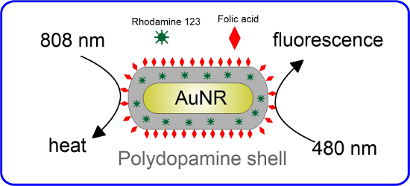
- efficient multimodal cancer treatments both in vitro and in vivo. An ideal nanorod coating for efficient nanocomposite formation should meet several important criteria. First, the resulting nanoparticles should be nontoxic and colloidally stable in blood serum. Second, the shell should have high loading
- nanocomposite AuNRs were fabricated by a seed-mediated method [41] with minor modifications concerning reaction protocol and some reagents, as described in [42][43]. According to statistical data derived from TEM images of 300 AuNRs (Figure 1A) the as-prepared particles have an average length of 44 ± 4 nm and
- were functionalized with folates and rhodamine 123. Folate receptors are commonly overexpressed in cancer cells, e.g., in HeLa cells, enabling an easy targeting with folic acid [44]. Rhodamine 123 was used as a fluorescent dye to control the nanocomposite interaction with cells using fluorescent


Outstanding chain-extension effect and high UV resistance of polybutylene succinate containing amino-acid-modified layered double hydroxides
Beilstein J. Nanotechnol. 2019, 10, 684–695, doi:10.3762/bjnano.10.68
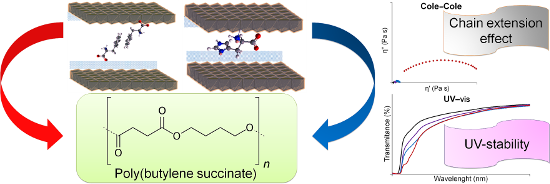
- Petrochemistry, Silesian University of Technology, 44100 Gliwice, Poland Dipartimento di Ingegneria Civile, Chimica, Ambientale e dei Materiali, Università di Bologna, Via Terracini 28, 40131 Bologna, Italy 10.3762/bjnano.10.68 Abstract Polybutylene succinate (PBS) nanocomposite materials were prepared using a
- LDH hybrid materials, and in particular, their application as a polymer chain extender and UV stabilizer for PBS, which can likely be extended to other biodegradable polymers. Keywords: amino acid; layered double hydroxide; phenylalanine; polybutylene succinate; Introduction Polymer nanocomposite
- endow the polymer composites with significantly improved properties as well as to envision a master-batch considering the observed state of dispersion. PBS–LDH nanocomposite films with thickness of about 90–100 µm were prepared by compression moulding between two Teflon sheets under 100 bar at 120 °C


Gold nanoparticles embedded in a polymer as a 3D-printable dichroic nanocomposite material
Beilstein J. Nanotechnol. 2019, 10, 442–447, doi:10.3762/bjnano.10.43
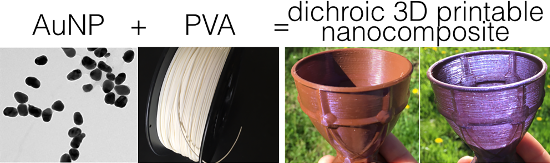
- way, 3D objects. Results: In this paper we show how to fabricate a 3D-printable nanocomposite composed of dichroic gold nanoparticles and a 3D-printable polymer. The minute amount of gold nanoparticles used for obtaining the dichroic effect does not influence the mechanical properties of the polymer
- nor its printability. Thus, the nanocomposite can be easily 3D-printed using a standard 3D printer and shows a purple color in transmission and a brownish color in reflection. Conclusion: This methodology can be used not only by artists, but also for studying the optical properties of nanoparticles or
- , for example, for the 3D fabrication of optical filters. Keywords: 3D printing; dichroism; gold nanoparticles; nanocomposite; Introduction As evidenced by paleolithic cave paintings [1], humans have always been fascinated by colors. Next to the traditional inorganic and organic colorants



Nanocomposite–parylene C thin films with high dielectric constant and low losses for future organic electronic devices
Beilstein J. Nanotechnol. 2019, 10, 428–441, doi:10.3762/bjnano.10.42
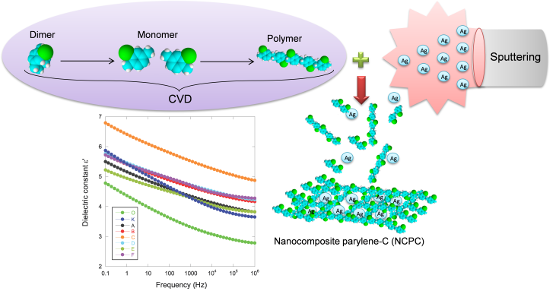
- Nazionale di Fisica Nucleare, Laboratori Nazionali di Legnaro, Viale dell’Università 2, 35020 Legnaro (PD), Italy 10.3762/bjnano.10.42 Abstract Nanocomposite–parylene C (NCPC) thin films were deposited with a new technique based on the combination of chemical vapor deposition (CVD) for parylene C
- with 3.8% Ag content. This study provides guidance for future NCPC materials for insulating gates in organic field-effect transistors (OFETs) and advanced electronic applications. Keywords: dielectric; nanocomposite polymer; organic field-effect transistor; parylene C; silver-containing nanoparticle
- applicability and a versatile role in the technology of OFETs and organic compounds [3]. However, parylene C, as the vast majority of polymers, exhibits a low dielectric constant (3.15 at 1 kHz [34]) thus limiting its performance in specific applications in OFETs and electronic devices. Using nanocomposite




New micro/mesoporous nanocomposite material from low-cost sources for the efficient removal of aromatic and pathogenic pollutants from water
Beilstein J. Nanotechnol. 2019, 10, 119–131, doi:10.3762/bjnano.10.11
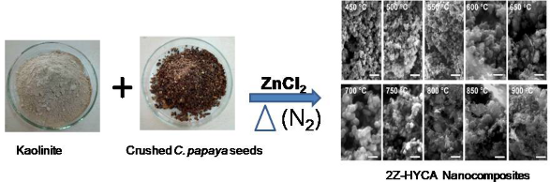
- Science), Theodor-Körner-Allee 16, 02763 Zittau, Germany Department of Earth and Environmental Science, University of Potsdam, 14476 Potsdam, Germany 10.3762/bjnano.10.11 Abstract A new micro/mesoporous hybrid clay nanocomposite prepared from kaolinite clay, Carica papaya seeds, and ZnCl2 via calcination
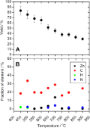
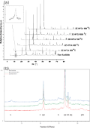
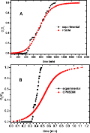
- in an inert atmosphere is presented. Regardless of the synthesis temperature, the specific surface area of the nanocomposite material is between ≈150 and 300 m2/g. The material contains both micro- and mesopores in roughly equal amounts. X-ray diffraction, infrared spectroscopy, and solid-state
- ; micro/mesoporous; nanocomposite; water remediation; Introduction Porous carbon-based materials and carbon/inorganic hybrid materials have extensively been used for the adsorption of pollutants, such as heavy metals or aromatic hydrocarbons, from water in developing countries [1][2][3][4]. The removal




Electrostatic force microscopy for the accurate characterization of interphases in nanocomposites
Beilstein J. Nanotechnol. 2018, 9, 2999–3012, doi:10.3762/bjnano.9.279
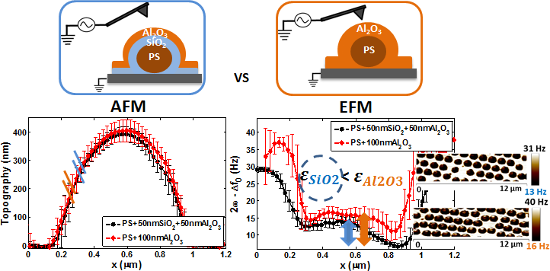
- of the interphase. Moreover, it has been reported that water can be absorbed at the interface [15][16][17]. Water molecules within the interphase increase its effective dielectric constant, and this can explain the unexpectedly higher nanocomposite permittivity. Therefore, the local characterization
- of the interphase is of utmost importance to explain most of the nanocomposite macroscopic behavior, particularly their electrical polarization properties. This local characterization requires high-resolution techniques that are sensitive to the dielectric properties of the material. These two
- the matrix that was attributed to the interphase. However, some experimental conditions during the comparison were not similar. Moreover, the highly probable presence of a matrix layer over the particles near the surface in the nanocomposite was ignored, although a matrix covering the nanoparticles




Co-intercalated layered double hydroxides as thermal and photo-oxidation stabilizers for polypropylene
Beilstein J. Nanotechnol. 2018, 9, 2980–2988, doi:10.3762/bjnano.9.277
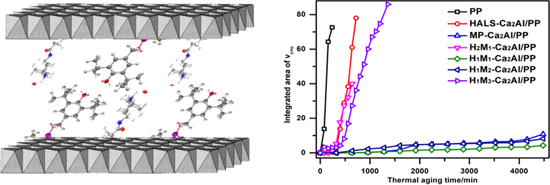
- , the PP chains were intercalated into the LDH gap structure to produce a polymer-intercalated nanocomposite [25]. Yet, none of the diffraction peaks of the co-intercalated HnMn′-Ca2Al hybrid LDHs is observed in the resulting HnMn′-Ca2Al/PP composites, suggesting a high dispersion of LDH nanoparticles


Ternary nanocomposites of reduced graphene oxide, polyaniline and hexaniobate: hierarchical architecture and high polaron formation
Beilstein J. Nanotechnol. 2018, 9, 2936–2946, doi:10.3762/bjnano.9.272
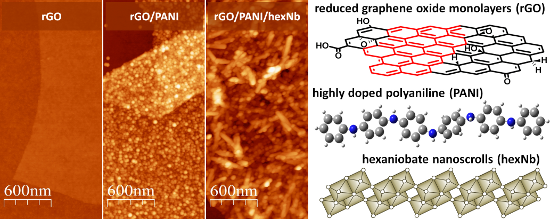
- nanocomposite composed of polyaniline (PANI), reduced graphene oxide (rGO) and hexaniobate (hexNb) nanoscrolls. Atomic force microscopy images show an interesting architecture of rGO flakes coated with PANI and decorated by hexNb. Such features are attributed to the high stability of the rGO flakes prepared at
- with rGO flakes and hexNb nanoscrolls, which promote conformational changes of the polymer backbone (secondary doping). Spectroscopic and electrochemistry data indicate a synergetic effect on the ternary nanocomposite, which is attributed to interactions between the components resulting from the
- morphological aspects. Therefore, the new nanocomposite presents promising properties for development of new materials in the film form on substrates for sensing or corrosion protection for example. Keywords: graphene oxide; hexaniobate; polyaniline; Raman spectroscopy; secondary doping; Introduction


Enhanced antineoplastic/therapeutic efficacy using 5-fluorouracil-loaded calcium phosphate nanoparticles
Beilstein J. Nanotechnol. 2018, 9, 2499–2515, doi:10.3762/bjnano.9.233
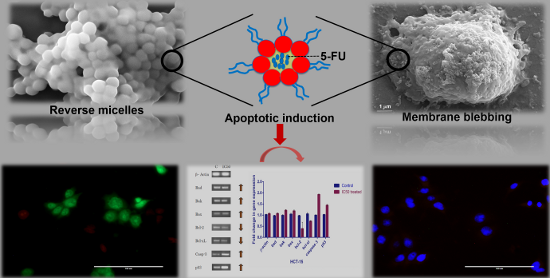
- with 5-FU and resulted in enhanced cellular uptake and efficacy [18]. Furthermore, a chitosan/gold nanocomposite was employed as a load carrier for 5-FU with an encapsulation efficiency of 96% [19]. Interestingly, monomeric self-assembled nucleoside nanoparticles (SNNPs) loaded with 5-FU were shown to





