


Search results
Search for "thin film" in Full Text gives 521 result(s) in Beilstein Journal of Nanotechnology. Showing first 200.
Near-infrared photoactive Ag-Zn-Ga-S-Se quantum dots for high-performance quantum dot-sensitized solar cells
Beilstein J. Nanotechnol. 2022, 13, 1337–1344, doi:10.3762/bjnano.13.110
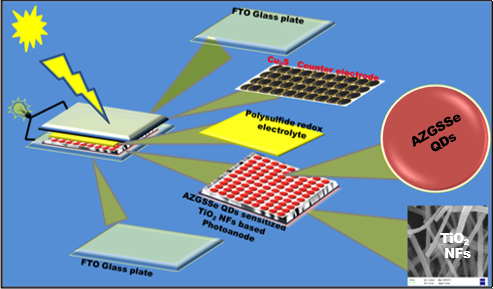
- [16]. Recently, Larsen et al. reported that, due to the appropriate bandgap (1.6–1.8 eV), AgGaSe2 is a wide-range light absorber in thin film solar cells [17]. Tianya Bai et al. [18] examined that ZnS-coated AgGaS2 nanocrystals (AgGaS2/ZnS core–shell nanocrystals) have a tunable bandgap and PL colors


Role of titanium and organic precursors in molecular layer deposition of “titanicone” hybrid materials
Beilstein J. Nanotechnol. 2022, 13, 1240–1255, doi:10.3762/bjnano.13.103
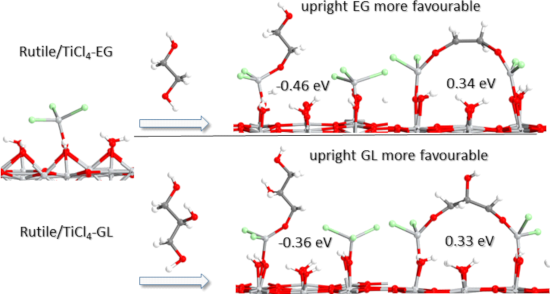
- growth could be achieved. Keywords: density functional theory (DFT) studies; double reactions; surface chemistry; titanicone; Introduction Molecular layer deposition (MLD), a thin film deposition technique, has attracted significant attention in recent years as a suitable approach for the deposition of


Roll-to-roll fabrication of superhydrophobic pads covered with nanofur for the efficient clean-up of oil spills
Beilstein J. Nanotechnol. 2022, 13, 1228–1239, doi:10.3762/bjnano.13.102
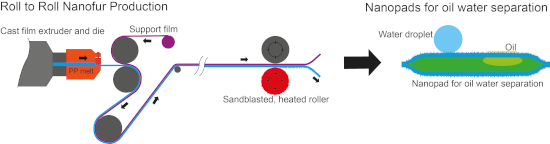
- /contaminated or by shredding and extruding a new support film. This sacrificial layer is essential to produce a thin film. It is necessary to find a material that sticks to the polymer the nanofur is to be made of, but can also easily be separated after the structuring step. For films thicker than 1 mm, the




Application of nanoarchitectonics in moist-electric generation
Beilstein J. Nanotechnol. 2022, 13, 1185–1200, doi:10.3762/bjnano.13.99
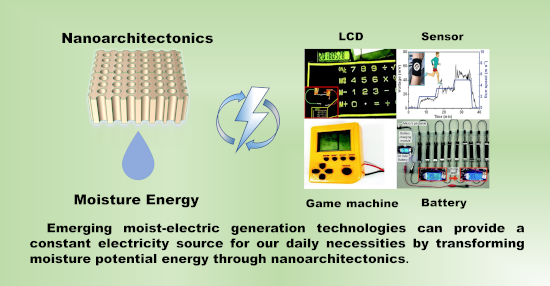
- , there are also some novel innovations in energy-harvesting structures, such as the construction of lateral gradients of nanomaterials, the construction of multilayer structures, and the direct use of ion distribution gradients in liquids. With a PVP thin film of 290 nm thickness as the dielectric layer


Effects of focused electron beam irradiation parameters on direct nanostructure formation on Ag surfaces
Beilstein J. Nanotechnol. 2022, 13, 1004–1010, doi:10.3762/bjnano.13.87
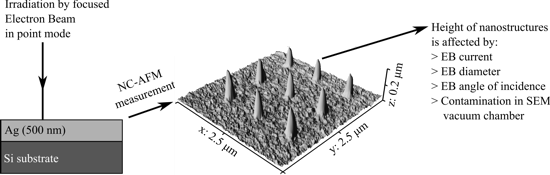
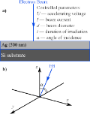
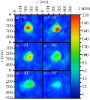
- to be removed from the vacuum chamber during the cleaning procedure since the N plasma cleaning procedure affected the Ag surface, most notably by forming a layer which produces thin film interference. The sample irradiation was repeated 15 min, 30 min, 1 h, and 2 h after the end of the cleaning
- , radiolysis by collisions with electrons seeming like the most obvious one. It should be noted that N plasma treatment in this case also affected the clean Ag surface, turning it into an interfering thin film. We believe that controlled etching with plasma has the potential to explore the structure of metal




Theoretical investigations of oxygen vacancy effects in nickel-doped zirconia from ab initio XANES spectroscopy at the oxygen K-edge
Beilstein J. Nanotechnol. 2022, 13, 975–985, doi:10.3762/bjnano.13.85
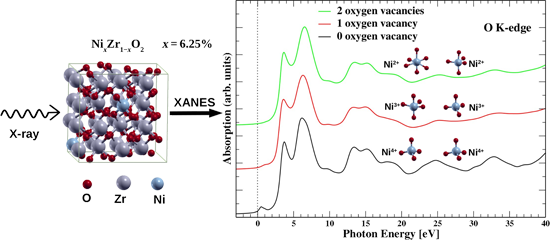
- structure. The fluorite structure is not stable under ambient conditions and, thus, zirconia is usually found in the monoclinic phase. The cubic distorted fluorite structure may however be stabilized by a doping or by deposition as a thin film (because the surface energy of the cubic structure is lower than


Bioselectivity of silk protein-based materials and their bio-inspired applications
Beilstein J. Nanotechnol. 2022, 13, 902–921, doi:10.3762/bjnano.13.81
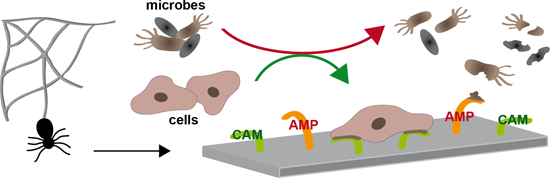
- obtained from fluorinated silica colloids, thin film deposition of silicone elastomers or nanoengineered superhydrophobic surfaces of Teflon®-coated aluminium [63][64][65]. Superhydrophobic surfaces have also been reported to be unfavorable for mammalian cell attachment and growth. This may be due to the



Ultrafast signatures of magnetic inhomogeneity in Pd1−xFex (x ≤ 0.08) epitaxial thin films
Beilstein J. Nanotechnol. 2022, 13, 836–844, doi:10.3762/bjnano.13.74
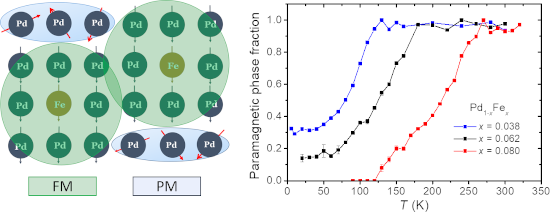
- ]. Superconducting spintronics is a branch of superconducting electronics, the key components of which are thin-film magnetic Josephson junctions (MJJs), which include layers of superconductors (S), ferromagnets (F) and insulators (I) [1][2][3][14][15]. The use of MJJs considerably reduces the energy consumption
- measurements at temperatures from 4.2 to 300 K, the films under study were mounted to the cold finger of the Janis ST-500 helium-flow cryostat. Permanent NdFeB magnets were fixed there, creating a magnetic field directed along the easy axis of the thin film in its plane with a magnitude of 470 Oe at room


Modeling a multiple-chain emeraldine gas sensor for NH3 and NO2 detection
Beilstein J. Nanotechnol. 2022, 13, 721–729, doi:10.3762/bjnano.13.64
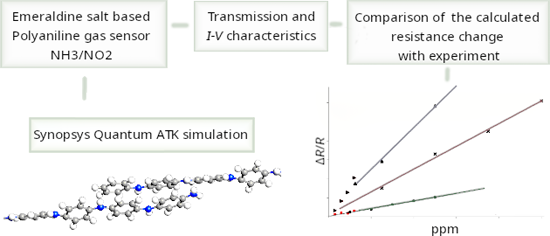
- nitrogen dioxide containing a flexible PANI thin film sensing area deposited on interleaved electrodes were produced by Posta et al. [13] and by Kroutil and co-workers [7]. In the experiments of Posta and Kroutil, the gas sensors for ammonia and nitrogen dioxide were exposed for 20 min to synthetic air


Experimental and theoretical study of field-dependent spin splitting at ferromagnetic insulator–superconductor interfaces
Beilstein J. Nanotechnol. 2022, 13, 682–688, doi:10.3762/bjnano.13.60
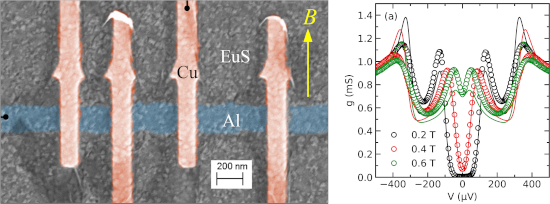
- treat the dirty limit appropriate for typical thin film structures. In [37], spin mixing in these systems was described in terms of an expansion for small phase shifts, where the linear order is equivalent to a Zeeman-type spin splitting, and the second order is equivalent to pair breaking by spin
- orbital depairing in the fits, with an orbital depairing parameter [44] for a thin film in an in-plane field. From known sample parameters we estimate Bc,orb ≈ 2 T and ε’ ≈ 70, which leaves us with Δ and δφ as free parameters. The fits give a good account of the observed spin splitting. The spin mixing



Revealing local structural properties of an atomically thin MoSe2 surface using optical microscopy
Beilstein J. Nanotechnol. 2022, 13, 572–581, doi:10.3762/bjnano.13.49
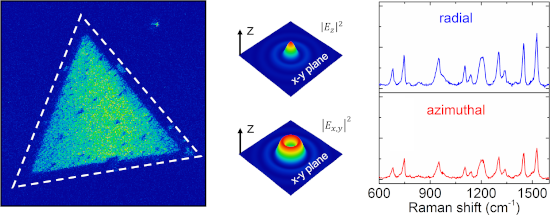
- CuPc as a Raman probe, because CuPc exhibits a large Raman scattering cross section and an extremely weak photoluminescence signal. A thin film of 5 nm of CuPc was deposited on the triangular MoSe2 flakes through thermal vapor deposition. Figure 1a shows a bright-field optical image of CuPc/MoSe2. From
- , which is parallel to the sample plane. To explain this phenomenon, we turn our discussions to the molecular orientation of CuPc on the MoSe2 flake. For a thin film thermally evaporated on a MoS2 flake surface, the CuPc molecule has been reported to adopt π-face-on orientation because the Cu metal center
- of face-on lying CuPc and the MoSe2 flake is the most efficient. With increasing film thickness, we assume that the CuPc molecular orientation varies, such as adopting a tilt angle with respect to the sample surface. The evolution of molecular orientation was observed in a FePc thin film that was


Influence of thickness and morphology of MoS2 on the performance of counter electrodes in dye-sensitized solar cells
Beilstein J. Nanotechnol. 2022, 13, 528–537, doi:10.3762/bjnano.13.44
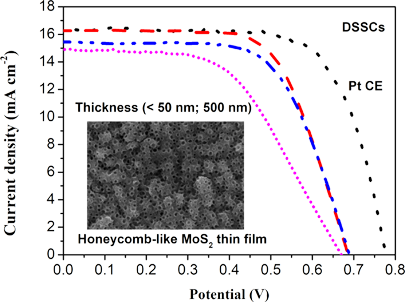
- City, 700000, Vietnam Vietnam National University Ho Chi Minh City, Linh Trung Ward, Thu Duc City, Ho Chi Minh City, 700000, Vietnam 10.3762/bjnano.13.44 Abstract Non-platinum electrodes for photoelectric devices are challenging and attractive to the scientific community. A thin film of molybdenum
- of the MoS2 thin films were controlled via the concentration of precursor solution. The obtained results showed that MoS2 thin films formed at a low precursor concentration had a layered morphology while a honeycomb-like MoS2 thin film was formed at a high precursor concentration. Both types of MoS2
- thin film were composed of 1T and 2H structures and exhibited excellent electrocatalytic activity for the I3–/I− redox couple. DSSCs assembled using these MoS2 CEs showed a maximal power conversion efficiency of 7.33%. The short-circuit value reached 16.3 mA·cm−2, which was higher than that of a


Selected properties of AlxZnyO thin films prepared by reactive pulsed magnetron sputtering using a two-element Zn/Al target
Beilstein J. Nanotechnol. 2022, 13, 344–354, doi:10.3762/bjnano.13.29
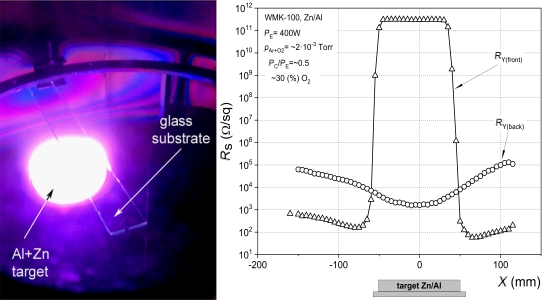
- : aluminium zinc oxide; magnetron sputtering; thin film; transparent conducting oxide; transparent electronics; Introduction Aluminium-doped zinc oxide (AZO) is a potential alternative to indium tin oxide (ITO) for transparent conducting oxide (TCO) electrodes in transparent electronic and photovoltaic
- , and the glass substrate itself. For comparison, the thin film spectra are presented together with the T characteristic of a bare glass substrate. As can be seen, all films, measured at different places of the substrate as a function of X, were well transparent, with an average transmission of about 70
- (Figure 11). The results presented in Figure 11 support the optical bandgap results presented in Figure 10. The higher the Al content, the wider the optical bandgap of the prepared thin film [1][24][25]. Discussion The analysis described in this paper showed a strong dependence of thickness as well as



Controllable two- and three-state magnetization switching in single-layer epitaxial Pd1−xFex films and an epitaxial Pd0.92Fe0.08/Ag/Pd0.96Fe0.04 heterostructure
Beilstein J. Nanotechnol. 2022, 13, 334–343, doi:10.3762/bjnano.13.28
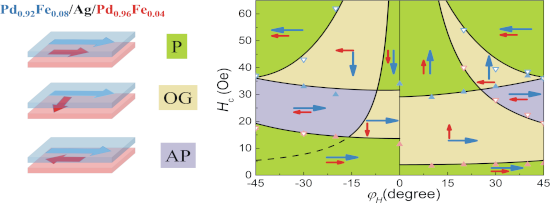
- epitaxial thin-film heterostructure Pd0.92Fe0.08(20 nm)/Ag(20 nm)/Pd0.96Fe0.04(20 nm) were grown in an ultrahigh-vacuum (UHV) apparatus (SPECS, Germany) by molecular beam deposition. Epi-polished MgO(100) single-crystal plates (Crystal GmbH, Germany) were used as substrates. The deposition routine and


Interfacial nanoarchitectonics for ZIF-8 membranes with enhanced gas separation
Beilstein J. Nanotechnol. 2022, 13, 313–324, doi:10.3762/bjnano.13.26
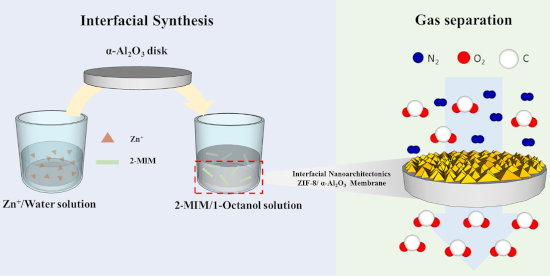
- -octanol solution was added dropwise to the zinc nitrate solution. The mixture was kept at 80 °C in an oil bath for 12 h to form a ZIF-8 free-standing thin film on the liquid–liquid interface. After the reaction, fragments of the ZIF-8 thin film were dispersed in methanol to remove solvents and unreacted
- synthesis method. Figure 1a shows that the XRD patterns of the as-synthesized free-standing ZIF-8 thin film was identical to that of a ZIF-8 crystal simulated with data from Crystallography Open Database (Mercury, version 3.6), indicating the success of the synthesis of ZIF-8 crystals by interfacial


Investigation of a memory effect in a Au/(Ti–Cu)Ox-gradient thin film/TiAlV structure
Beilstein J. Nanotechnol. 2022, 13, 265–273, doi:10.3762/bjnano.13.21
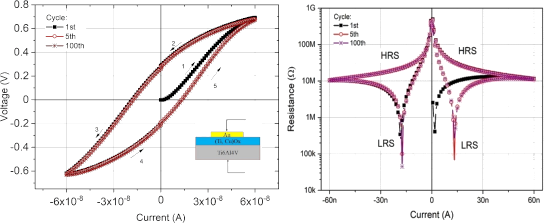
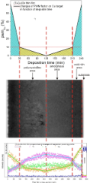
- analysis of resistive switching properties observed in a Au/(Ti–Cu)Ox/TiAlV structure with a gradient distribution of Cu and Ti along the (Ti–Cu)Ox thin film thickness. Thin films were prepared via multisource reactive magnetron co-sputtering. The programmed profile of the pulse width modulation
- coefficient during sputtering of the Cu target allowed us to obtain the designed gradient U-shape profile of the Cu concentration in the deposited thin film. Electrical measurements of the Au/(Ti–Cu)Ox/TiAlV structure showed the presence of nonpinched hysteresis loops in the voltage–current plane testifying a
- investigations allowed us to conclude about the possible mechanism for the observed resistive switching mechanism. Keywords: gradient thin film; magnetron sputtering; memory effect; resistive switching; Introduction In recent years, significant development has been observed in design, simulation, manufacturing



Thermal oxidation process on Si(113)-(3 × 2) investigated using high-temperature scanning tunneling microscopy
Beilstein J. Nanotechnol. 2022, 13, 172–181, doi:10.3762/bjnano.13.12
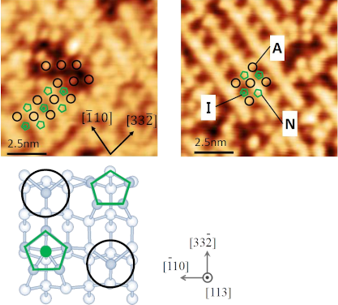
- towards a thin film regime. Conclusion We investigated three oxidation growth modes – oxidation, etching, and transition modes – in the third of which both oxidation and etching occur. Reaction dynamics in the oxidation of Si(113)-(3 × 2) was observed in real time using VT-STM. Nucleation of the oxide and




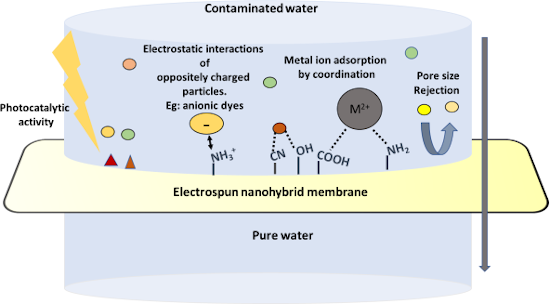
A comprehensive review on electrospun nanohybrid membranes for wastewater treatment
Beilstein J. Nanotechnol. 2022, 13, 137–159, doi:10.3762/bjnano.13.10





Tin dioxide nanomaterial-based photocatalysts for nitrogen oxide oxidation: a review
Beilstein J. Nanotechnol. 2022, 13, 96–113, doi:10.3762/bjnano.13.7
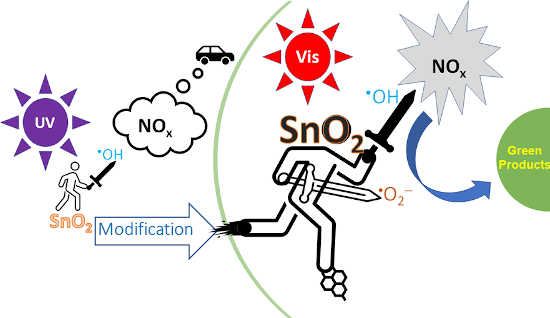
- a SnO2 thin film with a thickness of about 130 nm is 3.597 eV [42]. The reported bandgap of bulk SnO2 is 3.6 eV. Changing the morphology, particle size, or the formation of OVs or defects narrow the bandgap. In the study of Babu et al., a redshift of the absorption edge was observed when SnO2
- thin film materials that can replace powder materials, (5) adhering the catalyst materials on commercial films such as polypropylene, polytetrafluorethylene, or PM2.5 films for real-life applications, such as air filters and NOx gas treatment membranes; and (6) applying the materials in biological


Effect of lubricants on the rotational transmission between solid-state gears
Beilstein J. Nanotechnol. 2022, 13, 54–62, doi:10.3762/bjnano.13.3
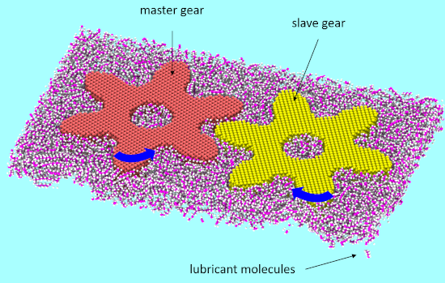
- are taken into account due to high pressure at intermediate sliding velocities. On the macroscopic scale, the hydrodynamics of the fluid can be analyzed by computational fluid dynamics (CFD) [6][7], which is based on solving the Navier–Stokes equation [8][9] or Reynold equation [10] for the thin-film


Sputtering onto liquids: a critical review
Beilstein J. Nanotechnol. 2022, 13, 10–53, doi:10.3762/bjnano.13.2

- designed to coat objects with thin film materials. Sputtering is the physical phenomenon describing the ejection of atoms from a surface bombarded by fast particles such as noble gas cations. These ions can be produced in a low-pressure plasma and accelerated towards a negatively biased surface, that is
- from the plasma to the film during growth through heating of the substrate and/or via bombardment by energetic particles or post-deposition annealing of the film can be envisaged. More information on thin film deposition (onto solid substrates) by sputtering-based processes can be found in books such






Design aspects of Bi2Sr2CaCu2O8+δ THz sources: optimization of thermal and radiative properties
Beilstein J. Nanotechnol. 2021, 12, 1392–1403, doi:10.3762/bjnano.12.103
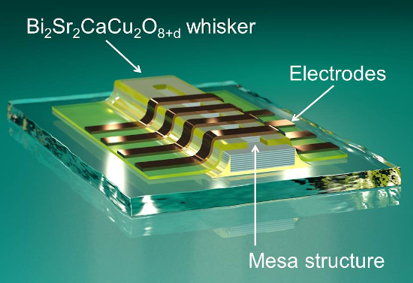
- of the other two materials, namely Bi-2212 and polycrystalline gold electrodes. At low T both have linear κ(T). For Bi-2212 we assume κab(T) = 0.1 T(K) W·K−1·m−1 [45] with an anisotropy κab/κc = 8 [46]. For a polycrystalline gold thin film we use κ(T) = 3 T(K) W·K−1·m−1 [32]. The heat is produced in


Plasmon-enhanced photoluminescence from TiO2 and TeO2 thin films doped by Eu3+ for optoelectronic applications
Beilstein J. Nanotechnol. 2021, 12, 1271–1278, doi:10.3762/bjnano.12.94
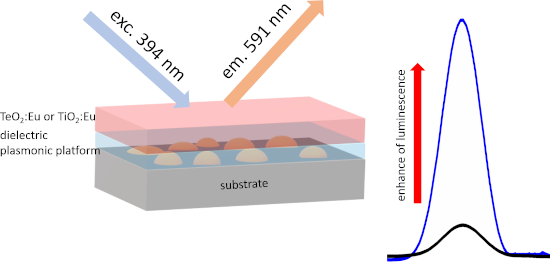
- thermal annealing of the gold thin film. Thermal dewetting of gold film results in spherical gold nanostructures with average dimensions of 50 nm. Both, luminescent TiO2:Eu and TeO2:Eu films were deposited by RF magnetron sputtering from mosaic targets. The morphology of the gold nanostructures was
- + was ca. 90%:10%. Additionally, on the basis of the survey spectrum the total percentage content of europium in the TiO2:Eu layer was calculated to be 5%. Figure 5 shows the UV–vis transmittance spectra for all prepared TiO2:Eu structures. It can be seen that the TiO2:Eu thin film deposited directly on
- TiO2 or TeO2 film are responsible for the emission of light. The intensity of the luminescence can be enhanced by the plasmon resonance from Au nanostructures. The gain is tunable by the thickness of a Al2O3 thin film deposited as a separator between metallic nanostructures and the luminescent layer


Enhancement of the piezoelectric coefficient in PVDF-TrFe/CoFe2O4 nanocomposites through DC magnetic poling
Beilstein J. Nanotechnol. 2021, 12, 1262–1270, doi:10.3762/bjnano.12.93
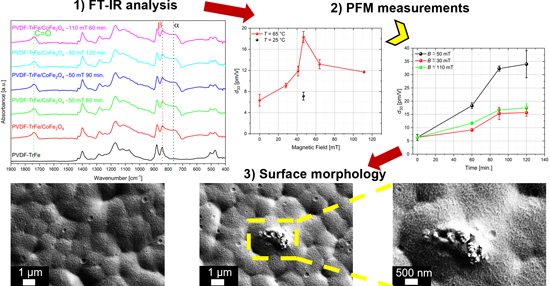
- for 30 min and then spin coated (30 s with a spin speed of 2000 rpm) onto polyethylene terephthalate/indium tin oxide (PET/ITO, Sigma-Aldrich, Rs = 60 Ω/sq). The obtained melt was cured in the oven at 120 °C for 2 h. After curing, the nanostructured thin film was placed over a heated mat reaching 65


Assessment of the optical and electrical properties of light-emitting diodes containing carbon-based nanostructures and plasmonic nanoparticles: a review
Beilstein J. Nanotechnol. 2021, 12, 1078–1092, doi:10.3762/bjnano.12.80
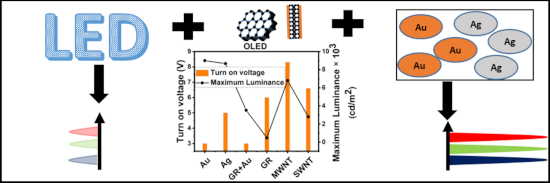
- from certain limitations, including high processing temperatures, cracking upon bending, and poor transparency in the blue and UV regions. In addition, ITO is expensive owing to the fact that it is deposited by high-vacuum thin-film deposition methods and the price of indium has escalated by almost 900
- absorbed (≈540 nm) by AuNP and the PL emission of the Alq3 thin film (≈530 nm) implies a suitable plasmonic coupling with the NPB HTL (Figure 6b). In Figure 6c, the SPR coupling radius for a 20 nm AuNP was estimated to be ≈10 nm. This implies that the excitonic recombination occurs very close to the NPB
- a uniform thin film. Some of the commonly used polymers and metal oxides for ETL are PBD, PBD-PMMA, BND, ZnO, SnO2, and TiO2 [69][70][71]. Improvements in the device performance have been reported, when using polymer–MWNT nanocomposite-based ETL. For example, Fournet et al. have investigated the





