


Search results
Search for "photocatalytic activity" in Full Text gives 139 result(s) in Beilstein Journal of Nanotechnology.
Role of RGO support and irradiation source on the photocatalytic activity of CdS–ZnO semiconductor nanostructures
Beilstein J. Nanotechnol. 2016, 7, 1684–1697, doi:10.3762/bjnano.7.161
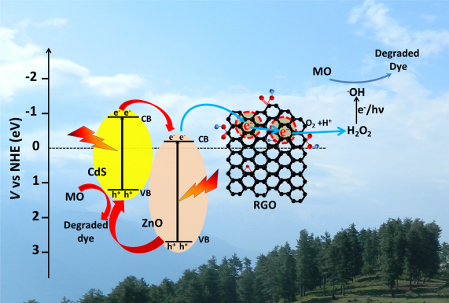
- , Rourkela, Odisha, India 10.3762/bjnano.7.161 Abstract Photocatalytic activity of semiconductor nanostructures is gaining much importance in recent years in both energy and environmental applications. However, several parameters play a crucial role in enhancing or suppressing the photocatalytic activity
- characterized using different spectroscopic and microscopic techniques. The photocatalytic activity was evaluated by studying the degradation of a model dye (methyl orange, MO) under visible light (only) irradiation and under natural sunlight. The results reveal that the RGO-supported CdS–ZnO photocatalyst
- performs considerably better than the unsupported CdS–ZnO nanostructures. In addition, both the catalysts perform significantly better under natural sunlight than under visible light (only) irradiation. In essence, this work paves way for tailoring the photocatalytic activity of semiconductor




High performance Ce-doped ZnO nanorods for sunlight-driven photocatalysis
Beilstein J. Nanotechnol. 2016, 7, 1338–1349, doi:10.3762/bjnano.7.125
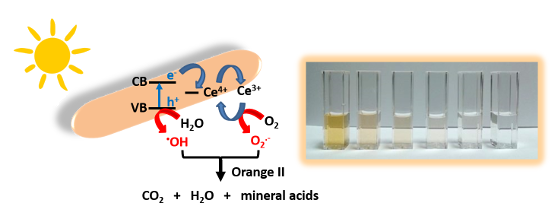
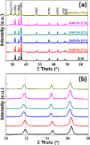
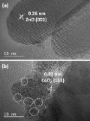
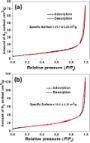
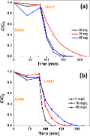
- by XRD, SEM, TEM, XPS, BET, DRS and Raman spectroscopy. 5% Ce-doped ZnO rods with an average length of 130 nm and a diameter of 23 nm exhibit the highest photocatalytic activity for the degradation of the Orange II dye under solar light irradiation. The high photocatalytic activity is ascribed to the
- no marked detrimental effect on the photocatalytic activity was observed. Finally, recyclability experiments demonstrate that ZnO:Ce rods are a stable solar-light photocatalyst. Keywords: Ce doping; photocatalysis; solvothermal synthesis; ZnO rods; Introduction Due to the increasing pollution of
- reported [34][35][36]. The synthesis of particles with well-defined properties is also of high importance to control the photocatalytic activity. Their optical, chemical and electronic properties are actually strongly dependent on shape, size, crystalline structure, defect concentration, and surface area







Fast diffusion of silver in TiO2 nanotube arrays
Beilstein J. Nanotechnol. 2016, 7, 1129–1140, doi:10.3762/bjnano.7.105
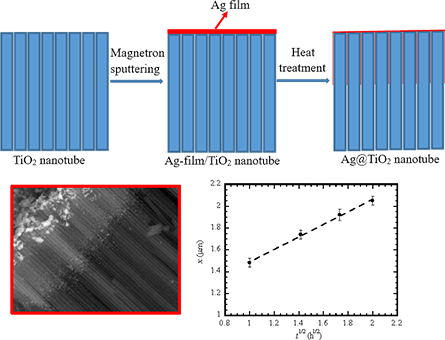
- migration of atoms (dopants), which determine the functionality of TiO2-based materials. Although recent success in improving the photocatalytic activity and energy storage of Li ions in TiO2-based materials has been reported [26][27][28][29], the understanding of the migration of atoms (dopants) in TiO2


Selective photocatalytic reduction of CO2 to methanol in CuO-loaded NaTaO3 nanocubes in isopropanol
Beilstein J. Nanotechnol. 2016, 7, 776–783, doi:10.3762/bjnano.7.69
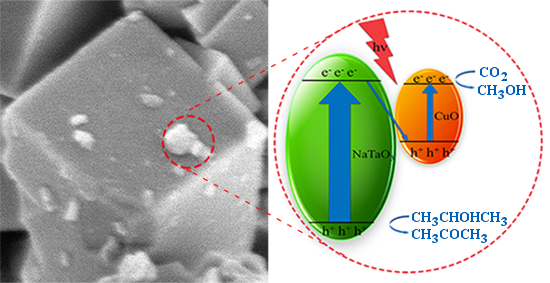
- . Photocatalytic reduction of CO2 The photocatalytic activity of CuO–NaTaO3 samples was evaluated by photocatalytic reduction of CO2 in isopropanol under UV light irradiation for 6 h. Methanol and acetone were generated as the reduction product of CO2 and the oxidation product of isopropanol, respectively. 2M
- photocatalytic activity. The high crystalline quality correlates to a low number of defects. The defects usually function as recombination centers where photogenerated electrons and holes recombine fast, resulting in poor photocatalytic activity [41]. Among these catalysts, 2M-NaTaO3 had the best morphology
- efficiently split water. In the 21st century, the study of Ta catalysts for the reduction of CO2 began. Kentaro Teramura et al. [15] prepared ATaO3 (A = Li, Na, K) compounds using a solid state reaction (SSR) method to reduce CO2 in the presence of H2. The only product was CO and the order of photocatalytic


Hierarchical coassembly of DNA–triptycene hybrid molecular building blocks and zinc protoporphyrin IX
Beilstein J. Nanotechnol. 2016, 7, 697–707, doi:10.3762/bjnano.7.62
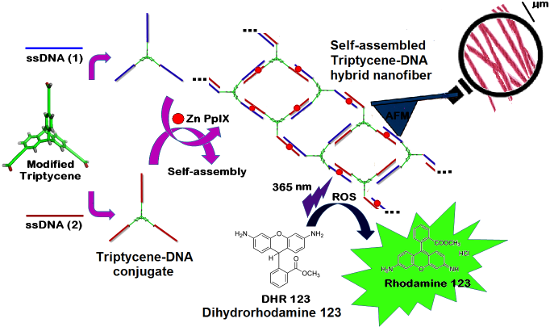
- . We also report excellent photocatalytic activity of these composite nanostructures wherein the oxidation of dihydrorhodamine 123 (DHR 123) into rhodamine 123 (R 123) under UV irradiation has been studied in aqueous environment. Furthermore, these composites exhibit higher catalytic activity with
- angle of 165°. The data acquisition time for each measurement was 1 h. All buffer solutions were filtered through syringe filters prior to use to remove dust particles. Photocatalytic activity of composite nanostructure The photocatalytic efficiency of composite DNA nanostructure was evaluated by
- ) after conjugation and assembly with DNA complementary strands. Interestingly, coassembly of DNA–TPA building block units and Zn PpIX generates DNA nanofibers showing enhanced photocatalytic activity. These features have been identified and confirmed by native PAGE, AFM, CD and spectroscopic analyses. It


Impact of ultrasonic dispersion on the photocatalytic activity of titania aggregates
Beilstein J. Nanotechnol. 2015, 6, 2423–2430, doi:10.3762/bjnano.6.250
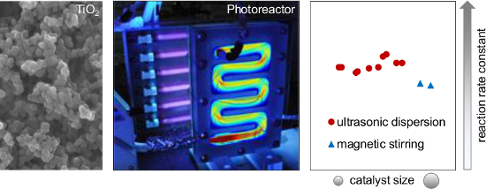
- effectiveness of photocatalytic materials increases with the specific surface area, thus nanoscale photocatalyst particles are preferred. However, such nanomaterials are frequently found in an aggregated state, which may reduce the photocatalytic activity due to internal obscuration and the extended diffusion
- path of the molecules to be treated. This paper investigates the effect of aggregate size on the photocatalytic activity of pyrogenic titania (Aeroxide® P25, Evonik), which is widely used in fundamental photocatalysis research. Well-defined and reproducible aggregate sizes were achieved by ultrasonic
- dispersion. The photocatalytic activity was examined by the color removal of methylene blue (MB) with a laboratory-scale setup based on a plug flow reactor (PFR) and planar UV illumination. The process parameters such as flow regime, optical path length and UV intensity are well-defined and can be varied


Effect of SiNx diffusion barrier thickness on the structural properties and photocatalytic activity of TiO2 films obtained by sol–gel dip coating and reactive magnetron sputtering
Beilstein J. Nanotechnol. 2015, 6, 2039–2045, doi:10.3762/bjnano.6.207
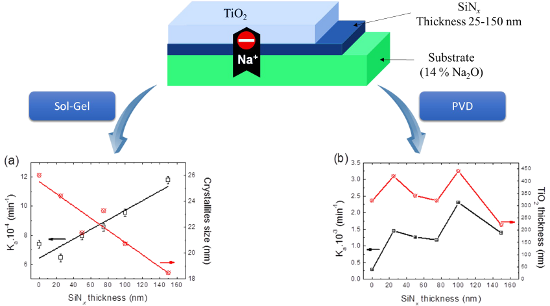
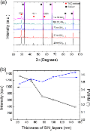
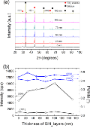
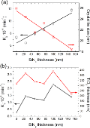
- required in order to obtain the photoactive anatase phase. However, Na+ ions have a detrimental effect on the photocatalytic efficiency of TiO2 [3][4][7]. The poisoning effect of the Na+ ions on the photocatalytic activity occurs in different ways and depends on their concentration, for example: (a) Na
- at grazing incidence (0.05°). Silicon powder was dispersed on the coating surface in order to calibrate the diffractograms. The photocatalytic activity of the films was evaluated by observing the photobleaching of Orange II (OII) dye with an initial concentration [OII] = 10 mg·L−1 over the course of
- the initial absorbance. The bleaching of the dye was thus quantitatively evaluated by recording the “real time” evolution of the maximum absorbance value of the OII, at 485.5 nm, at neutral pH 7.2, using a quartz circulating cell placed in a UV–vis spectrometer. The photocatalytic activity of the
Temperature-dependent breakdown of hydrogen peroxide-treated ZnO and TiO2 nanoparticle agglomerates
Beilstein J. Nanotechnol. 2015, 6, 1897–1903, doi:10.3762/bjnano.6.193
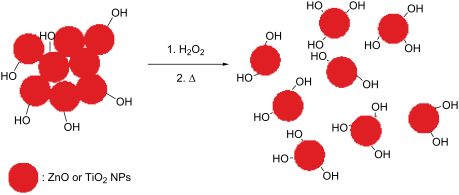
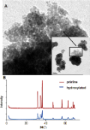
- photocatalytic activity of the NPs [23]. The objective of this study is to disintegrate MONP agglomerates using heat and H2O2 treatment without the use of any additional chemicals. ZnO and TiO2 NPs were chosen due to their widespread use in several industrial applications. The H2O2 treatment not only eliminates




High photocatalytic activity of V-doped SrTiO3 porous nanofibers produced from a combined electrospinning and thermal diffusion process
Beilstein J. Nanotechnol. 2015, 6, 1281–1286, doi:10.3762/bjnano.6.132
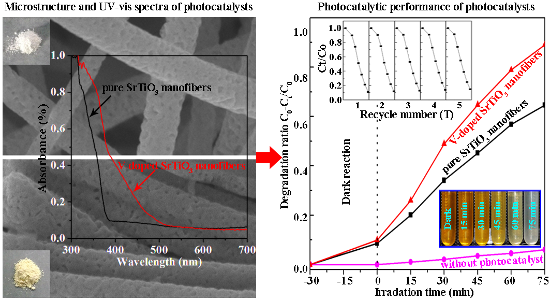
- photocatalytic activity with excellent endurance. Results and Discussion The morphology and microstructure are very important for the development of an excellent photocatalyst. In Figure 1a, the pure SrTiO3 nanofibers appear to be tens of micrometers in length, with a porous surface and uniform diameter
- synthesized. The photocatalytic activity of pure and V-doped SrTiO3 porous nanofibers were evaluated by the decomposition of methyl orange (MO) in aqueous solution under UV–vis light irradiation. In Figure 3a, the characteristic absorption peak of MO at approx. 464 nm is given which shows a progressive
- photocatalytic activity of V-doped SrTiO3 nanofibers compared to pure SrTiO3 nanofibers can be attributed to the V5+ ion doping. Stability and reusability are also very important for photocatalysts. As shown in the upper left inset in Figure 3b, the catalytic efficiency of V-doped SrTiO3 nanofibers is barely


Effects of swift heavy ion irradiation on structural, optical and photocatalytic properties of ZnO–CuO nanocomposites prepared by carbothermal evaporation method
Beilstein J. Nanotechnol. 2015, 6, 928–937, doi:10.3762/bjnano.6.96
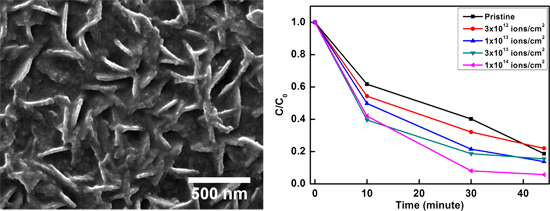
- absorption spectroscopy and Raman spectroscopy. XRD studies showed the presence of ZnO and CuO nanostructures in the nanocomposites. FESEM images revealed the presence of nanosheets and nanorods in the nanocomposites. The photocatalytic activity of ZnO–CuO nanocomposites was evaluated on the basis of
- enhanced photocatalytic activity of ZnO–CuO nanocomposites is proposed. We attribute the observed enhanced photocatalytic activity of ZnO–CuO nanocomposites to the combined effects of improved sun light utilization and suppression of the recombination of photogenerated charge carriers in ZnO–CuO
- carbothermal reduction-based vapor deposition method. We have demonstrated that swift heavy ion irradiation can be employed to significantly enhance the sun light driven photocatalytic activity of ZnO–CuO nanocomposites toward the degradation of methylene blue (MB) and methyl orange (MO) dyes in water. Results



Transformation of hydrogen titanate nanoribbons to TiO2 nanoribbons and the influence of the transformation strategies on the photocatalytic performance
Beilstein J. Nanotechnol. 2015, 6, 831–844, doi:10.3762/bjnano.6.86
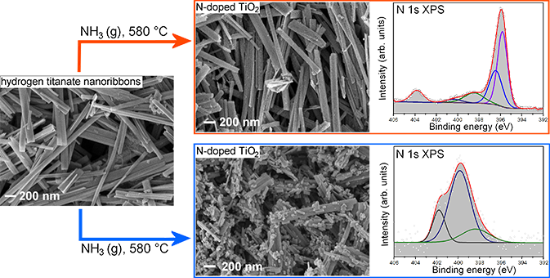
- TiO2 [22] in which the nitrogen atoms occupy substitutional and interstitial sites in the TiO2 and thus affect the photocatalytic activity of titania for reactions performed under visible-light irradiation [3][5][23][24]. On the other hand, transformation under wet-chemical or hydrothermal conditions
- PP of CH-W and MW-W. The specific surface area and the crystallinity are two of the key factors that strongly affect the photocatalytic activity of TiO2. Therefore, with the aim to improve the crystallinity of the TiO2 NRs the samples with the highest specific surface area (CH-W and MW-W) were




Tm-doped TiO2 and Tm2Ti2O7 pyrochlore nanoparticles: enhancing the photocatalytic activity of rutile with a pyrochlore phase
Beilstein J. Nanotechnol. 2015, 6, 605–616, doi:10.3762/bjnano.6.62
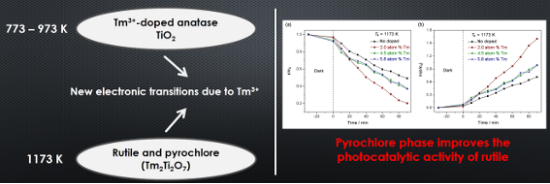
- obtained with a predominant rutile phase. The photodegradation of methylene blue showed that this pyrochlore phase enhanced the photocatalytic activity of the rutile phase. Keywords: nanoparticles; photocatalysis; pyrochlore; titanium dioxide; thulium; Introduction TiO2 is one of the most efficient
- semiconductors used as a photocatalyst for the degradation of organic compounds. This is due to its high chemical and biological stability, low cost, excellent electronic and optical properties, and the strong oxidation capacity of its photogenerated holes [1][2]. Photocatalytic activity depends on several
- studies in the literature in which pyrochlore-type compounds with high photocatalytic activity are used as a photocatalysts, such as Bi2Ti2O7 [9][10], Pb2Nb2O7 [11]; other pyrochlore compounds that have been evaluated are rare earths, such as Gd2BiSbO7 [12] or Ln2Ti2O7 (Ln = Nd, Gd, Er) [13]. In this


Novel ZnO:Ag nanocomposites induce significant oxidative stress in human fibroblast malignant melanoma (Ht144) cells
Beilstein J. Nanotechnol. 2015, 6, 570–582, doi:10.3762/bjnano.6.59
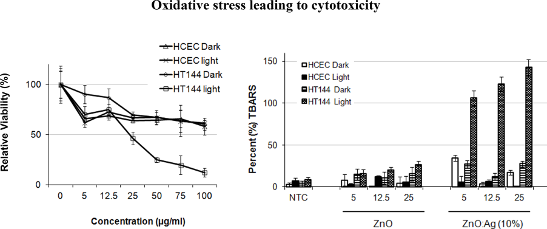
- exhibit an improved photocatalytic activity [26][27] and photostability [28] compared to the ZnO NPs. Nanoscale Ag2+ itself exhibits antimicrobial and anticancer activity [29], therefore it might be a very interesting and useful addition to the ZnO NPs as it not only enhances the photocatalytic activity
- , reduction in size of the NPs and increase in the photocatalytic activity [26][34]. It is, however, not well-understood how these NPs exactly work in the exposed cells. ZnO NPs were reported to cause toxicity by generating ROS [35], causing DNA damage, oxidative stress [36], an increase in caspase-3 activity




Palladium nanoparticles anchored to anatase TiO2 for enhanced surface plasmon resonance-stimulated, visible-light-driven photocatalytic activity
Beilstein J. Nanotechnol. 2015, 6, 428–437, doi:10.3762/bjnano.6.43
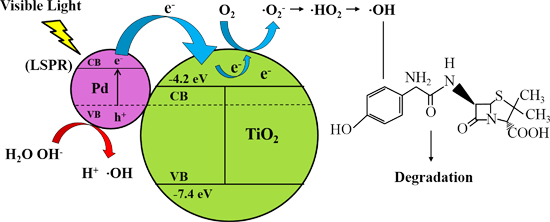
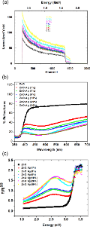
- with controlled Pd NPs size ranging between 17 and 29 nm onto the surface of TiO2. Thus, it gives the characteristic for Pd NPs to absorb light in the visible region obtained through localized surface plasmon resonance (LSPRs). Apparently, the photocatalytic activity of the prepared photocatalysts was
- Honda in 1972 [1]. To date, TiO2 is still the most favorable choice owing to its versatility and robust advantages that include photostability, non-toxicity, low cost, chemical and biological inertness, high photocatalytic activity and favorable optoelectronic properties [2][3][4][5]. TiO2 also
- -dimensional anatase TiO2/Ag, which exhibited an excellent photocatalytic activity with almost 100% degradation of 2,4-dichlorophenol within 2 h [26]. Likewise, Hou et al. reported a 9-fold improvement in the photocatalytic decomposition rate of methyl orange driven by a photocatalyst consisting of robust


Rapid degradation of zinc oxide nanoparticles by phosphate ions
Beilstein J. Nanotechnol. 2014, 5, 2007–2015, doi:10.3762/bjnano.5.209
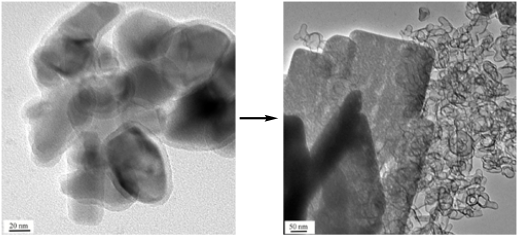
- recently [23]. Special attention to the effects of phosphate around neutral pH has been payed only very recently [24]. The photocatalytic activity of ZnO nanoparticles can be significantly reduced by coating with SiO2 [25]. This is important when ZnO-NP are applied as UV blockers. We therefore also
- phosphate buffers. Photocatalytic activity of ZnO-NP, e.g., in oxidation reactions, is an unwanted feature when they are to be applied as UV blockers. Among the suggested coatings, which should block this activity, silica is mostly used in commercial preparations [25]. In principle, coatings should also
- zinc phosphate, which does not lead to precipitation and equilibrium shifts. In the light of these results it seems essential to ensure a tight coating by a chemically resistant material before applying ZnO-NP for, e.g., medical or cosmetic purposes. Silica coating can suppress photocatalytic activity


Enhanced photocatalytic hydrogen evolution by combining water soluble graphene with cobalt salts
Beilstein J. Nanotechnol. 2014, 5, 1167–1174, doi:10.3762/bjnano.5.128
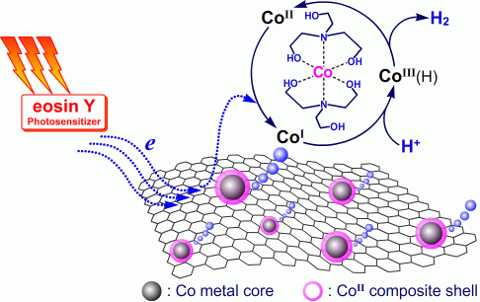
- carbon nanotubes, a small fraction of the electrons may get stored in graphene sheets, thus making graphene an electron reservoir to continuously provide electrons to the catalytic center [58][59][60]. The positive synergetic effect consequently enhances the photocatalytic activity for hydrogen evolution


Organic and inorganic–organic thin film structures by molecular layer deposition: A review
Beilstein J. Nanotechnol. 2014, 5, 1104–1136, doi:10.3762/bjnano.5.123




Characterization and photocatalytic study of tantalum oxide nanoparticles prepared by the hydrolysis of tantalum oxo-ethoxide Ta8(μ3-O)2(μ-O)8(μ-OEt)6(OEt)14
Beilstein J. Nanotechnol. 2014, 5, 1082–1090, doi:10.3762/bjnano.5.121
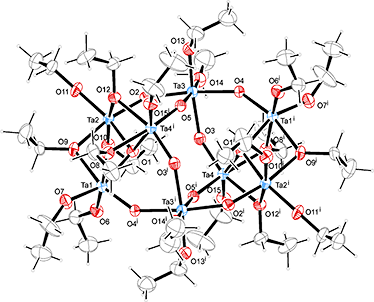
- characterized by various techniques such as TGA-DTA-DSC, UV–vis DRS, XRD, SEM, TEM, particle size analyzer (DLS) and the Brunauer–Emmett–Teller (BET) method. The band gap of the particles was calculated by using the Tauc plot. The photocatalytic activity of Ta2O5 nanoparticles was tested by the degradation of
- to its distinct properties such as large ion diffusion coefficient and high electrochromic reversibility, high dielectric constant, high refractive index, high chemical stability, large band gap [13][14][15] and photocatalytic activity for overall water decomposition and organic pollutant degradation
- (1) was isolated. When 1 was subjected to further hydrolysis it yielded nanoparticles of tantalum oxide after calcination at 750 °C for four hours. The photocatalytic activity of Ta2O5 nanoparticles was studied over the degradation of organic dye rhodamine B (RhB). Results and Discussion Tantalum


Functionalized nanostructures for enhanced photocatalytic performance under solar light
Beilstein J. Nanotechnol. 2014, 5, 994–1004, doi:10.3762/bjnano.5.113
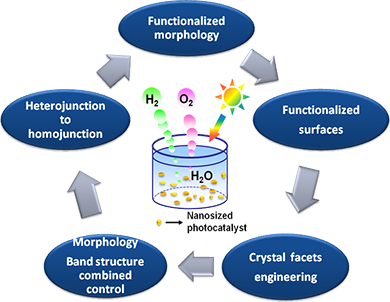
- with well-tailored band alignment provides a powerful means to the improvement of the photocatalytic activity. In the process of our study, we have also paid special attention on the nanoscale control of the material morphology and construction of functionalized nanostructures to promote charge
- work was carried out on Ni modified mesoporous TiO2 photocatalysts [15]. It was found that Ni ions were highly dispersed in the framework of mesoporous TiO2 resulting in enhanced hydrogen production in methanol aqueous solution compared to Ni-doped particulate TiO2. The photocatalytic activity was
- found to have a close relationship with the doping amount of Ni ions and the highest activity was obtained when the amount of Ni doping was 1%. Here, the enhanced photocatalytic activity was attributed to doped Ni2+ ions which served as shallow trapping sites, preferentially trapping photoexcited holes


Enhancement of photocatalytic H2 evolution of eosin Y-sensitized reduced graphene oxide through a simple photoreaction
Beilstein J. Nanotechnol. 2014, 5, 801–811, doi:10.3762/bjnano.5.92
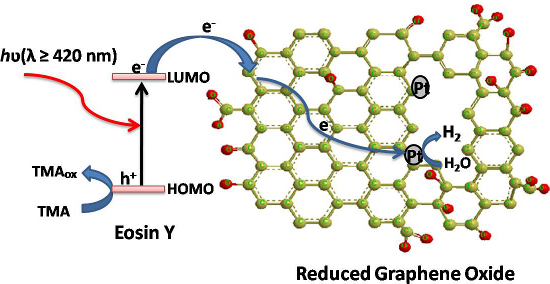
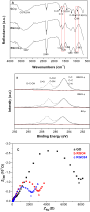
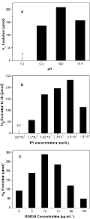
- hydroxy groups are gradually removed from GO, resulting in an increase of sp2 π-conjugated domains and defect carbons with holes for the formed RGO. The RGO conductivity increases due to the restoration of sp2 π-conjugated domains. The photocatalytic activity of EY-RGO/Pt for hydrogen evolution was
- (RGO) shows a higher activity as a semiconductor under UV irradiation [11][12]. Yeh et al. [12] reported that RGO sheets with in situ photoreduced platinum displayed a high activity for hydrogen evolution from an aqueous methanol solution. However, the RGO exhibits a very low photocatalytic activity
- characterized by a high activity for H2 evolution under visible light irradiation. Recently, to improve the photocatalytic activity for hydrogen evolution in the visible light region, EY has been employed to sensitize RGO, and the sensitized photocatalyst displays an increased photoactivity for hydrogen





Visible light photooxidative performance of a high-nuclearity molecular bismuth vanadium oxide cluster
Beilstein J. Nanotechnol. 2014, 5, 711–716, doi:10.3762/bjnano.5.83

- reported. Photocatalytic activity studies show faster reaction kinetics under anaerobic conditions, suggesting an oxygen-dependent quenching of the photoexcited cluster species. Further mechanistic analysis shows that the reaction proceeds via the intermediate formation of hydroxyl radicals which act as
- , olefins and others [1][2][3][14]. However, as POMs often only absorb light in the UV range, little is known about the visible-light photocatalytic activity of POMs [5][15]. One means of addressing this challenge is to tune the cluster structure and reactivity by incorporation of a reactive metal site into
- species H3[{Bi(dmso)3}4V13O40] × ca. 4 DMSO (= 1 × ca. 4 DMSO). 1 is formed spontaneously by reaction of Bi(NO3)3·5H2O and (n-Bu4N)3[H3V10O28] in dimethyl sulfoxide (DMSO) and it was shown that the cluster features both acidic and visible-light photocatalytic activity [29]. To date, to the best of our


Nanostructure sensitization of transition metal oxides for visible-light photocatalysis
Beilstein J. Nanotechnol. 2014, 5, 696–710, doi:10.3762/bjnano.5.82
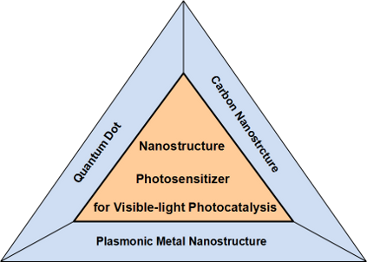
- up to nearly 80% and open circuit voltages up to the 1 V range [24]. Ho et al. revealed that the CdSe–TiO2 coupled system had a much higher photocatalytic activity than that of pure TiO2 and CdSe in the degradation of 4-chlorophenol under visible light irradiation [34]. Wang et al. reported facet ZnO
- water in TiO2 nanotubes with the addition of Au nanoparticles under 633 nm illumination, but a 4-fold reduction in the photocatalytic activity under UV radiation [66]. They ascribed the improvement of visible-light photocatalytic activity to the increase of the electron–hole pair generation rate by the
- used as an electron sink to improve the charge carrier separation and reduce the recombinations of electron–hole pairs. This way, the photocatalytic activity of the composite carbon nanotube/transition metal oxides is effectively improved (Figure 7a) [93]. Recently, it has been found that carbon


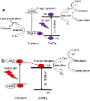


A visible-light-driven composite photocatalyst of TiO2 nanotube arrays and graphene quantum dots
Beilstein J. Nanotechnol. 2014, 5, 689–695, doi:10.3762/bjnano.5.81
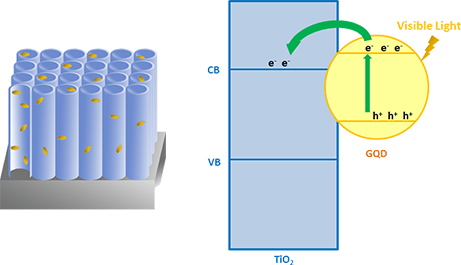
- fabricated by covalently bonding GQDs onto amine-modified TNAs. The GQDs/TNAs composite retains the highly ordered nanotube morphology and well crystallized anatase phase. The high visible-light photocatalytic activity could be attributed to photosensitization of TNAs by GQDs. This research shows the
- ). Thermogravimetric analysis was performed in air using a thermogravimetric analyzer (Perkin Elmer, TGA 6). The samples were heated from 50 °C to 800 °C at a rate of 10 °C·min−1. Photocatalytic activity measurements: The photocatalytic activities of catalysts were evaluated by measuring the photodegradation of


Effects of the preparation method on the structure and the visible-light photocatalytic activity of Ag2CrO4
Beilstein J. Nanotechnol. 2014, 5, 658–666, doi:10.3762/bjnano.5.77
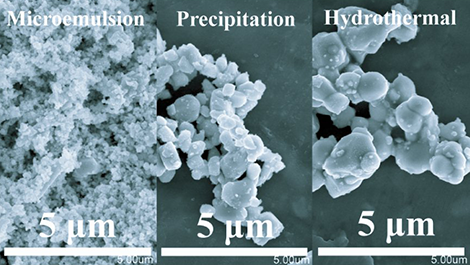
- 10.3762/bjnano.5.77 Abstract Silver chromate (Ag2CrO4) photocatalysts are prepared by microemulsion, precipitation, and hydrothermal methods, in order to investigate the effect of preparation methods on the structure and the visible-light photocatalytic activity. It is found that the photocatalytic
- activity of the prepared Ag2CrO4was highly dependent on the preparation methods. The sample prepared by microemulsion method exhibits the highest photocatalytic efficiency on the degradation of methylene blue (MB) under visible-light irradiation. The enhanced photocatalytic activity could be ascribed to
- ; photocatalytic activity; silver chromate; visible-light-driven; Introduction Semiconductor photocatalysis has been considered as a potential solution to the worldwide energy shortage and for counteracting environmental degradation [1][2][3][4][5]. Numerous efforts have been made to develop efficient and stable


Enhanced photocatalytic activity of Ag–ZnO hybrid plasmonic nanostructures prepared by a facile wet chemical method
Beilstein J. Nanotechnol. 2014, 5, 639–650, doi:10.3762/bjnano.5.75
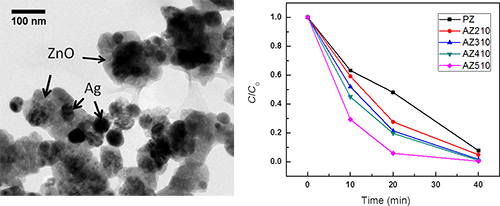
- the synthesis of Ag–ZnO hybrid plasmonic nanostructures with enhanced photocatalytic activity by a facile wet-chemical method. The structural, optical, plasmonic and photocatalytic properties of the Ag–ZnO hybrid nanostructures were studied by X-ray diffraction (XRD), field emission scanning electron
- microscopy (FESEM), transmission electron microscopy (TEM), photoluminescence (PL) and UV–visible absorption spectroscopy. The effects of citrate concentration and Ag nanoparticle loading on the photocatalytic activity of Ag–ZnO hybrid nanostructures towards sun-light driven degradation of methylene blue (MB
- physical and chemical stability, non-toxicity and low cost [11][12][13][14][15][16]. However, ZnO nanostructures suffer from drawbacks such as a high electron–hole recombination rate and the inefficient utilization of sun light, which limit their photocatalytic activity [17][18]. Several attempts have been





