Search results
Search for "aluminum" in Full Text gives 253 result(s) in Beilstein Journal of Nanotechnology. Showing first 200.
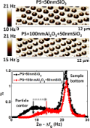
Electrostatic force microscopy for the accurate characterization of interphases in nanocomposites
Beilstein J. Nanotechnol. 2018, 9, 2999–3012, doi:10.3762/bjnano.9.279
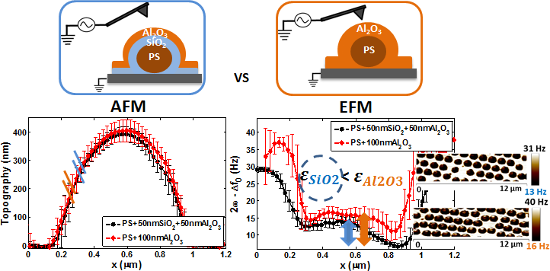
- nm) were deposited or grown over the whole sample surface. Aluminum oxide (Al2O3) shells were prepared using the atomic layer deposition (ALD) method, polyvinyl acetate (PVAc) shells by spin coating, and silicon dioxide (SiO2) shells by plasma sputtering deposition (PSD). The signature of each




Controlling surface morphology and sensitivity of granular and porous silver films for surface-enhanced Raman scattering, SERS
Beilstein J. Nanotechnol. 2018, 9, 2813–2831, doi:10.3762/bjnano.9.263
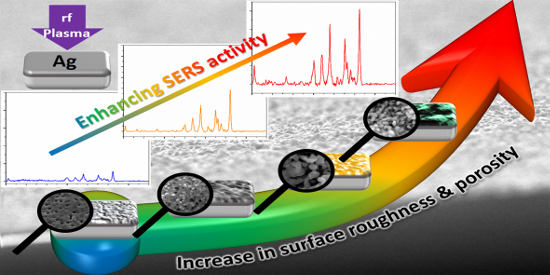
- ], anisotropically etched single-crystal silicon [47], plasma-treated plastic [48] and anodic aluminum oxide films [49][50][51][52]. Some methods aim at the fabrication of three -dimensional silver or gold structures, such as oblique-angle vapor deposition used for the fabrication of silver nanorod arrays [53][54



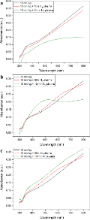



Near-infrared light harvesting of upconverting NaYF4:Yb3+/Er3+-based amorphous silicon solar cells investigated by an optical filter
Beilstein J. Nanotechnol. 2018, 9, 2788–2793, doi:10.3762/bjnano.9.260
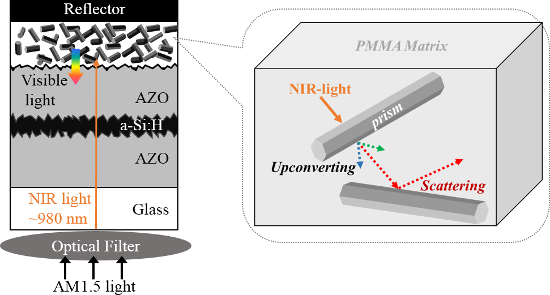
- prepared (Figure 3a). One a-Si:H layer of ca. 350 nm is sandwiched between two aluminum-doped zinc oxide (AZO) contacts. The thickness of the AZO contacts is approximately 1.5 μm. From Figure 3b, the photoelectric conversion efficiency of the a-Si:H solar cell is calculated to be 6.68% at the maximum power


Silencing the second harmonic generation from plasmonic nanodimers: A comprehensive discussion
Beilstein J. Nanotechnol. 2018, 9, 2674–2683, doi:10.3762/bjnano.9.250
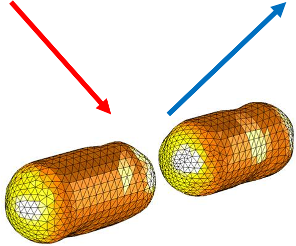
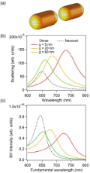
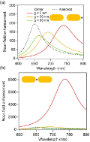
- straightforward and nonlinear plasmonic nanorulers need to be carefully calibrated [48]. Finally, it would be interesting to extend the present study to aluminum nanoantennas, since a significant bulk quadrupolar SHG is expected in this case [49]. (a) Example of one mesh used for the simulations. The nanorod


Enhancement of X-ray emission from nanocolloidal gold suspensions under double-pulse excitation
Beilstein J. Nanotechnol. 2018, 9, 2609–2617, doi:10.3762/bjnano.9.242
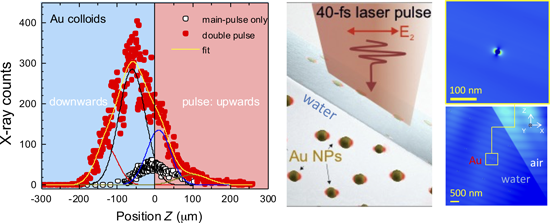
- of silver [21] or aluminum [22] could be also considered. However, experimental approaches have been limited to flat samples [23] so far. Gold, with the higher atomic number and a high stability even in aqueous environments, should be considered a main target for fs-laser-induced X-ray experiments


Effect of electrospinning process variables on the size of polymer fibers and bead-on-string structures established with a 23 factorial design
Beilstein J. Nanotechnol. 2018, 9, 2466–2478, doi:10.3762/bjnano.9.231
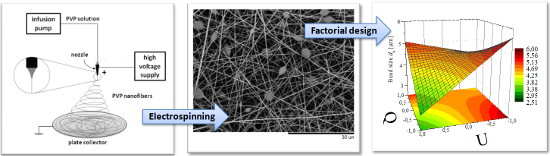
- mm (Figure 1). A round aluminum collector (thickness: 0.12 mm; diameter: 40 mm) was located about 15 cm below the metal nozzle. The high voltage was set within the limits of 7.5–15 kV and the flow rate of the solution in the range of 0.6–1.2 mL/h. The collection time of the fiber was adjusted to


Surface energy of nanoparticles – influence of particle size and structure
Beilstein J. Nanotechnol. 2018, 9, 2265–2276, doi:10.3762/bjnano.9.211
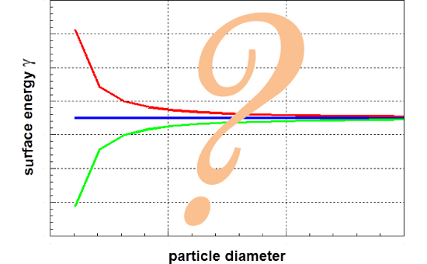
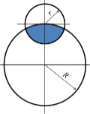
- applicability of the Pawlow-relationship over a wide range of particle sizes, as shown in Figure 1, is a strong indicator that the surface energy of gold particles is, down to a particle diameter, d of ≈2 nm, largely independent of the particle size. Other experimental results on aluminum [15] and lead [16
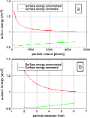
- interesting to note that after the correction, the dependence of the surface energy on the diameter is more or less in the range of the dataset as a whole. This result is somewhat similar to that obtained for gold as displayed in Figure 13. The results for aluminum particles displayed in Figure 17 obtained by
- original values and those corrected according to Holec et al. [53]. Except the systematic variation in the values for particles with sizes below ca. 2 nm, it is remarkable that there is only a relatively small influence of the particle diameter on the surface energy. Surface energy of aluminum particles as





The role of adatoms in chloride-activated colloidal silver nanoparticles for surface-enhanced Raman scattering enhancement
Beilstein J. Nanotechnol. 2018, 9, 2236–2247, doi:10.3762/bjnano.9.208
- total of 15 min and afterwards stored in the dark for 24 h. A slightly faster synthesis was observed when covering the beaker in aluminum foil, due to the local increase in light intensity. Also, we observed that a LED bulb with a “cool light” emission spectrum led to a faster synthesis compared to an
- , equipped with a Nd:YAG frequency-doubled laser emitting at 532 nm and a laser power of ≈60 mW on the sample. For each measurement, 10 μL of the sample was placed on a microscope slide that was covered with aluminum foil. The laser light was focused on the drop using a 5× objective (NA 0.12). The spectra



Localized photodeposition of catalysts using nanophotonic resonances in silicon photocathodes
Beilstein J. Nanotechnol. 2018, 9, 2097–2105, doi:10.3762/bjnano.9.198
- with a double-target sputter coater (Leica EM ACE600). The electrical connections of the sample with the potentiostat (BioLogic Science Instruments, SP-200) were made using conductive aluminum tape (Advance Tapes AT521) adhered to the back metal contact of the sample, which was not in contact with the


Biomimetic and biodegradable cellulose acetate scaffolds loaded with dexamethasone for bone implants
Beilstein J. Nanotechnol. 2018, 9, 1986–1994, doi:10.3762/bjnano.9.189
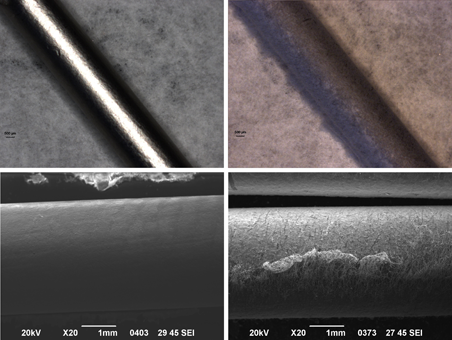
- is created [23]. Grounded aluminum foils, glass substrates and also coatings for orthopaedic pins were used as collectors to carry out the necessary studies. Drug-release kinetics and degradation study of scaffolds Degradation study was carried out in order to evaluate the mass loss of polymer and


Know your full potential: Quantitative Kelvin probe force microscopy on nanoscale electrical devices
Beilstein J. Nanotechnol. 2018, 9, 1809–1819, doi:10.3762/bjnano.9.172
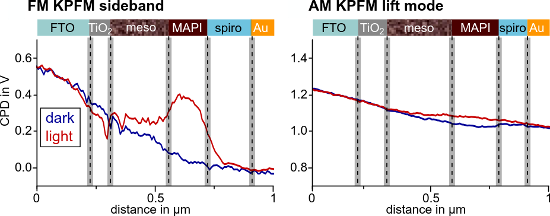
- measurements. To study the effect of stray fields, aluminum foil was placed under the substrate of the electrode array, where we could apply an external voltage of 200 V. To show that KPFM operates in a linear regime (Equation 19) we recorded bias spectroscopy sweeps prior to every measurement (Figure S1 and
- stray fields causing the offsets, we induced an artificial stray field by placing the substrate on a piece of aluminum foil and applying a voltage of 200 V with respect to the grounded electrode. We then repeated the experiments in the center and at the edge of the electrode structure. The measurement
- presence of the artificial stray field caused by the aluminum electrode underneath the substrate, the measured CPD further increased to up to 4.7 V (AM lift mode, Figure 8). Generally, the offsets in CPD were much higher in the AM-KPFM modes compared to the FM-KPFM modes, where the maximum deviation was


SO2 gas adsorption on carbon nanomaterials: a comparative study
Beilstein J. Nanotechnol. 2018, 9, 1782–1792, doi:10.3762/bjnano.9.169

- vapor deposition [56][57]. The bimetallic catalyst system for the VACNT growth was prepared by depositing a thin layer of aluminum (13–15 nm) over the substrate through thermal evaporation in a vacuum of 10−6 mbar, followed by the sputter deposition of 1.2 nm of an iron catalyst layer. The synthesis was


Uniform cobalt nanoparticles embedded in hexagonal mesoporous nanoplates as a magnetically separable, recyclable adsorbent
Beilstein J. Nanotechnol. 2018, 9, 1770–1781, doi:10.3762/bjnano.9.168
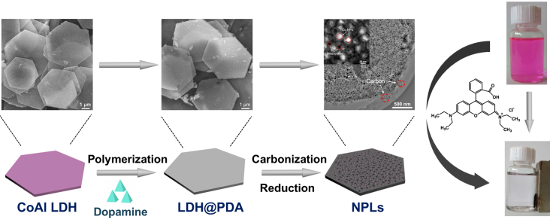
- in the carbon layer; and (iv) the obtained hexagonal magnetic mesoporous NPL displays a larger adsorption capacity towards removal of RhB from water than observed in other adsorbents [23][24][25][26][27][28][29][30]. Experimental Materials and chemicals Cobalt chloride hexahydrate, aluminum chloride


Light extraction efficiency enhancement of flip-chip blue light-emitting diodes by anodic aluminum oxide
Beilstein J. Nanotechnol. 2018, 9, 1602–1612, doi:10.3762/bjnano.9.152
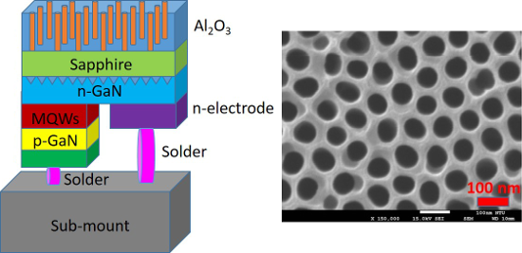
- aluminum oxide (AAO) structure with periodic nanopores on the surface of flip-chip blue light-emitting diodes (FC-BLEDs). The nanopores had diameters ranging from 73 to 85 nm and were separated by distances ranging from approximately 10 to 15 nm. The light extraction efficiency enhancement of the FC-BLEDs
- emitter into a surface plasmon mode produced by AAO. Keywords: anodic aluminum oxide; critical angle of total reflection; efficiency enhancement; flip-chip blue light-emitting diode; Introduction Light-emitting diodes (LEDs) are widely used in various fields, such as optical communication and automobile
- enhance the LEE of short-wavelength purple and ultraviolet LEDs by 1.4–2.5 times that of a traditional LED [14]. Ryu et al. adopted anodic aluminum oxide (AAO) to produce a photonic crystal structure at the n-GaN layer of LEDs, and transmission electron microscopy (TEM) images showed that screw


Closed polymer containers based on phenylboronic esters of resorcinarenes
Beilstein J. Nanotechnol. 2018, 9, 1594–1601, doi:10.3762/bjnano.9.151
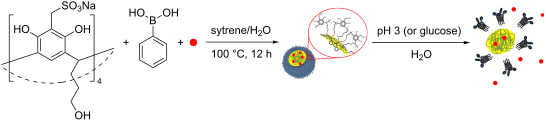
- Netzsch STA 449C Jupiter instrument in argon in the temperature range from 30 to 200 °С. The heating rate was 10 °C·min−1. The samples were placed in aluminum crucibles (non-sealed for the free removal of evolved products and a decrease of the influence of an excessive pressure). UV–vis spectra were


Correlative electrochemical strain and scanning electron microscopy for local characterization of the solid state electrolyte Li1.3Al0.3Ti1.7(PO4)3
Beilstein J. Nanotechnol. 2018, 9, 1564–1572, doi:10.3762/bjnano.9.148
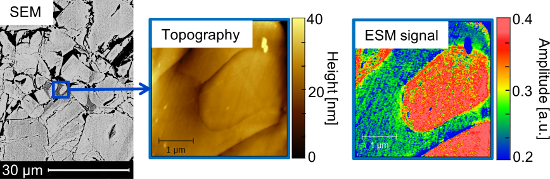
- , section JARA-Energy, 52425 Jülich, Germany 10.3762/bjnano.9.148 Abstract Correlative microscopy has been used to investigate the relationship between Li-ion conductivity and the microstructure of lithium aluminum titanium phosphate (Li1.3Al0.3Ti1.7(PO4)3, LATP) with high spatial resolution. A key to
- energy density [1][8][9][10]. Lithium aluminum titanium phosphate Li1.3Al0.3Ti1.7(PO4)3 (LATP), a ceramic with NASICON-type structure, is especially considered as a beneficial solid state electrolyte due to its superior lithium-ion conductivity in the range of 2 mS cm−1 in the “bulk” and 2 µS cm−1 at
- darker and contains the elements Al, P and O but only minor Ti content. Based on this observation, the primary phase is attributed to LATP while the secondary phase can be related to aluminum phosphate (AlPO4). As the stoichiometry of the EDX analysis matches that of LATP and aluminum phosphate


Preparation and morphology-dependent wettability of porous alumina membranes
Beilstein J. Nanotechnol. 2018, 9, 1423–1436, doi:10.3762/bjnano.9.135
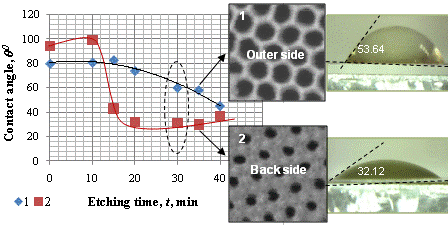
- aluminum layer beforehand is removed, as described previously. In the inset of Figure 2D, the split surface formation scheme is shown [34]. This explains why the pore diameter in the SEM surface photo does not coincide with the pore size obtained in the SEM cross-sectional view of the same sample. In
- dependencies occur. A dependence on the membrane thickness is also observed, a fact that is not explained by any of the previous models of prior works. Conclusion In this work, we have reported the preparation of porous alumina membranes (PAMs) by two-step anodization of aluminum foil in oxalic and sulfuric


Atomistic modeling of tribological properties of Pd and Al nanoparticles on a graphene surface
Beilstein J. Nanotechnol. 2018, 9, 1239–1246, doi:10.3762/bjnano.9.115
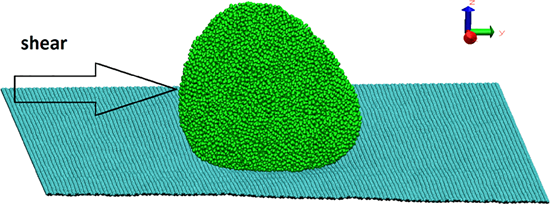
- insight into the fundamental origin of sliding friction. Results: Using molecular dynamics we investigate frictional properties of aluminum and palladium nanoparticles deposited on a graphene layer. We study the time evolution of the total momentum of the system, the total and potential energies, the
- peaks of radial distribution function are blurred indicating that the nanoparticles are amorphous or polycrystalline. Keywords: aluminum; friction force; graphene; nanoparticle; nanotribology; palladium; Introduction The study of surface or interface phenomena at the atomic level has attracted
- , morphology and orientation [10][11][13][14][17]. For atomistic modeling the material-dependent potential energy is needed. Here we use empirical potentials where the potential energy can be represented as a function of the atomic positions. For aluminum and palladium an empirical many-body potential is


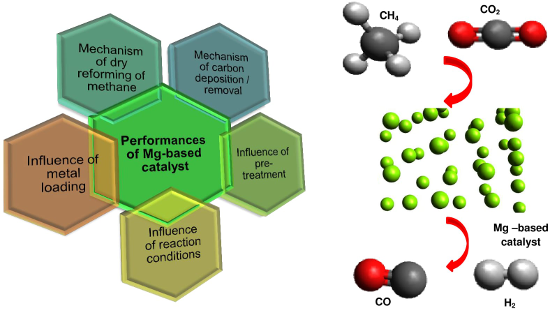
Understanding the performance and mechanism of Mg-containing oxides as support catalysts in the thermal dry reforming of methane
Beilstein J. Nanotechnol. 2018, 9, 1162–1183, doi:10.3762/bjnano.9.108






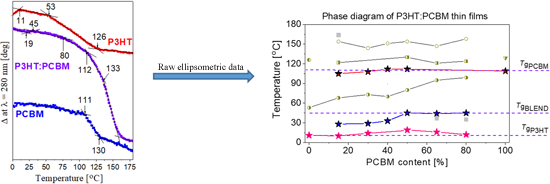
P3HT:PCBM blend films phase diagram on the base of variable-temperature spectroscopic ellipsometry
Beilstein J. Nanotechnol. 2018, 9, 1108–1115, doi:10.3762/bjnano.9.102
- temperatures using a DSC 2920 apparatus (TA Instruments, Newcastle, DE, USA), with aluminum sample pans. Thermal characteristics of the samples were obtained under nitrogen atmosphere (gas flow = 50 mL/min). The instrument was calibrated with high-purity indium and gallium standards. DSC measurements have been


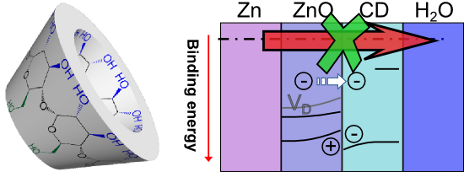
Cyclodextrin inhibits zinc corrosion by destabilizing point defect formation in the oxide layer
Beilstein J. Nanotechnol. 2018, 9, 936–944, doi:10.3762/bjnano.9.86
- , such as stainless steels or aluminum alloys [5]. Inhibitors may also actively participate in the electrode processes [1]. Corrosion inhibitors play an important role in mitigating corrosion, which causes huge economic losses [6]. The most potent corrosion inhibitors are based on carcinogenic Cr(VI


Synthesis and characterization of two new TiO2-containing benzothiazole-based imine composites for organic device applications
Beilstein J. Nanotechnol. 2018, 9, 721–739, doi:10.3762/bjnano.9.67
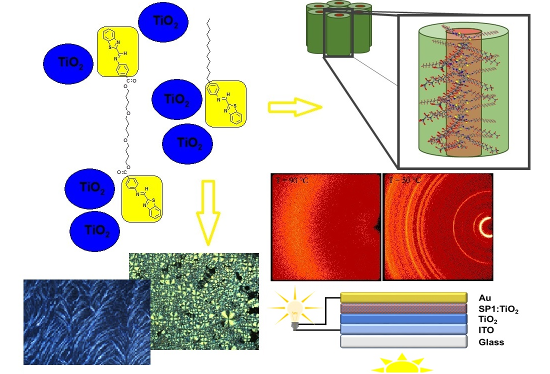
- , while for DSC studies, the mixture was scratched with a spatula and put into aluminum pans. Assembly and characterization of organic devices Samples for photocurrent measurements were prepared on ITO patterned glass substrates (Osilla S211) to form ITO/TiO2/SP1 (or SP1:P3HT, SP1:TiO2, SP1:PC71BM or P3HT
- heating stage. A Perkin Elmer DSC8000 calorimeter was used for calorimetric measurements. The temperature calibration procedure was done based on the onset of the melting point of water and indium. The sample was hermetically sealed in an aluminum pan of 30 μL. The temperature-dependent Fourier transform






Single-step process to improve the mechanical properties of carbon nanotube yarn
Beilstein J. Nanotechnol. 2018, 9, 545–554, doi:10.3762/bjnano.9.52
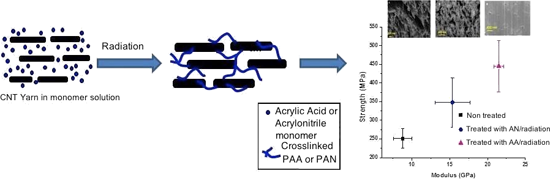
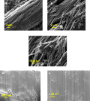
- that the yarn was kept straight during e-beam process. The fibers mounted on cardboard were protected with aluminum foil during the irradiation process. The CNT yarns were irradiated up to 108 kGy and washed with copious quantities of THF. The grafted CNT yarns were vacuum dried at room temperature
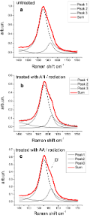
- intensity for the C–O peak (see Figure 1). As also illustrated in Table 1, some traces of contaminant elements (sulfur (S), iron (Fe) and aluminum (Al)) were observed in XPS spectra of all samples, which can be attributed to traces of the inhibitor metal salt, FeSO4 and other contaminants. The samples




Electron interaction with copper(II) carboxylate compounds
Beilstein J. Nanotechnol. 2018, 9, 384–398, doi:10.3762/bjnano.9.38
- -induced deformation, and electromigration resistance which is higher than for aluminum [24][25][26][27]. Copper nanostructures, especially nanowires, are applied in opto-electronic devices, solar cells, field-emission displays, catalysis, electronic skins, and sensor devices. Moreover, they can find


Photocatalytic and adsorption properties of TiO2-pillared montmorillonite obtained by hydrothermally activated intercalation of titanium polyhydroxo complexes
Beilstein J. Nanotechnol. 2018, 9, 364–378, doi:10.3762/bjnano.9.36
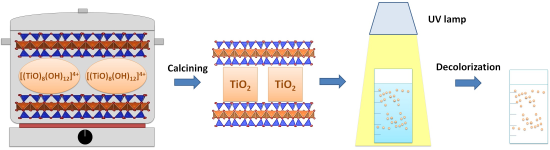
- mineral carriers such as natural clay minerals [2], particularly montmorillonite (MM) [3]. The structure of MM is characterized by a three-layer package (2:1): two layers of silicon–oxygen tetrahedron (T) turned towards each other by their vertices, covering a layer of aluminum hydroxyl octahedra (O) on